
PCPs and Inapproximability Introduction Why Approximation Algorithms Problems
PCPs and Inapproximability Introduction
Why Approximation Algorithms Ø Problems that we cannot find an optimal solution in a polynomial time q Eg: Set Cover, Bin Packing Ø Need to find a near-optimal solution: q Heuristic q Approximation algorithms: § This gives us a guarantee approximation ratio My T. Thai mythai@cise. ufl. edu 2
Combinatorial Optimization Ø The study of finding the “best” object from within some finite space of objects, eg: q Shortest path: Given a graph with edge costs and a pair of nodes, find the shortest path (least costs) between them q Traveling salesman: Given a complete graph with nonnegative edge costs, find a minimum cost cycle visiting every vertex exactly once q Maximum Network Lifetime: Given a wireless sensor networks and a set of targets, find a schedule of these sensors to maximize network lifetime My T. Thai mythai@cise. ufl. edu 3
In P or not in P? Informal Definitions: Ø The class P consists of those problems that are solvable in polynomial time, i. e. O(nk) for some constant k where n is the size of the input. Ø The class NP consists of those problems that are “verifiable” in polynomial time: q Given a certificate of a solution, then we can verify that the certificate is correct in polynomial time My T. Thai mythai@cise. ufl. edu 4
In P or not in P: Examples Ø In P: q Shortest path q Minimum Spanning Tree Ø Not in P (NP): q Vertex Cover q Traveling salesman q Minimum Connected Dominating Set My T. Thai mythai@cise. ufl. edu 5
Approximation Algorithms Ø An algorithm that returns near-optimal solutions in polynomial time Ø Approximation Ratio ρ(n): q Define: C* as a optimal solution and C is the solution produced by an approximation algorithm q max (C/C*, C*/C) <= ρ(n) q Maximization problem: 0 < C <= C*, thus C*/C shows that C* is larger than C by ρ(n) q Minimization problem: 0 < C* <= C, thus C/C* shows that C is larger than C* by ρ(n) My T. Thai mythai@cise. ufl. edu 6
Approximation Algorithms (cont) Ø PTAS (Polynomial Time Approximation Scheme): A (1 + ε)-approximation algorithm for a NP-hard optimization П where its running time is bounded by a polynomial in the size of instance I Ø FPTAS (Fully PTAS): The same as above + time is bounded by a polynomial in both the size of instance I and 1/ε My T. Thai mythai@cise. ufl. edu 7
Hardness of Approximation Ø Informally, how hard can we approximate? Ø Hardness results usually falls into the following 3 classes: q Constant ( > 1) q Ω(log n) q nε My T. Thai mythai@cise. ufl. edu 8
Proving Hardness of Approximation Ø Show if we have a ρ approximation to problem A, we could solve the NP-hard problem B exactly Ø The only inapproximability results that can be proved with such reductions are for problems that remain NP-hard even restricted to instances where the optimum is a small constant. Ø Want to use already proved hardness of approximation results to prove new results (objective of the course) My T. Thai mythai@cise. ufl. edu 9
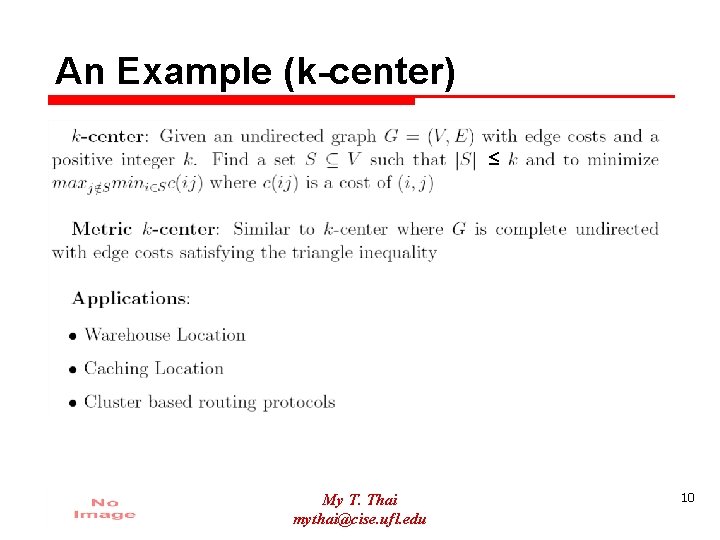
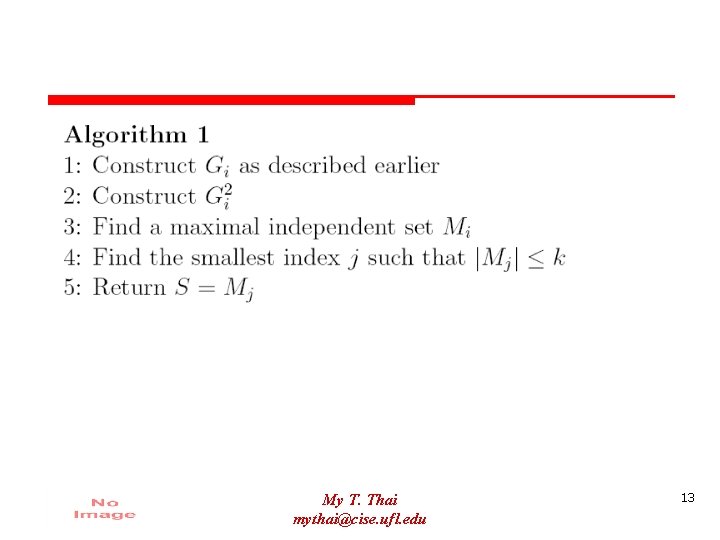
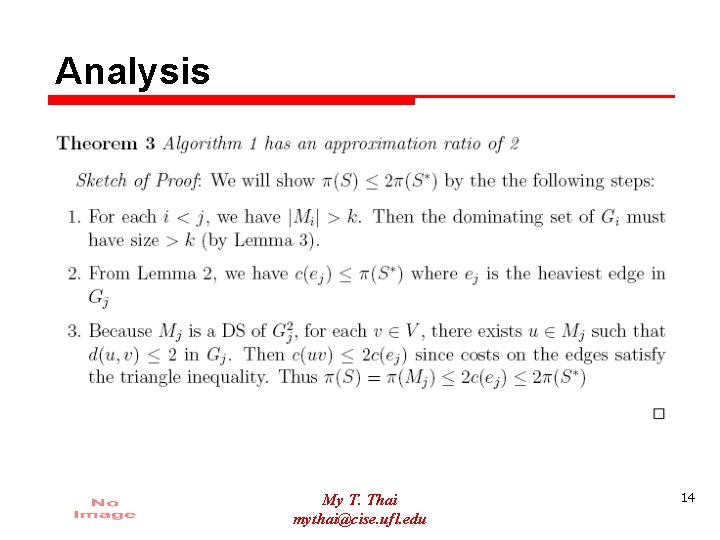
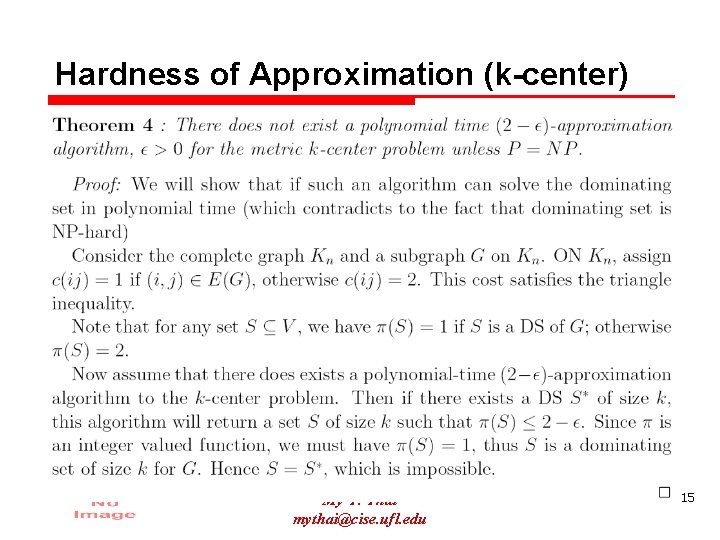
An Example (k-center) ≤ My T. Thai mythai@cise. ufl. edu 10
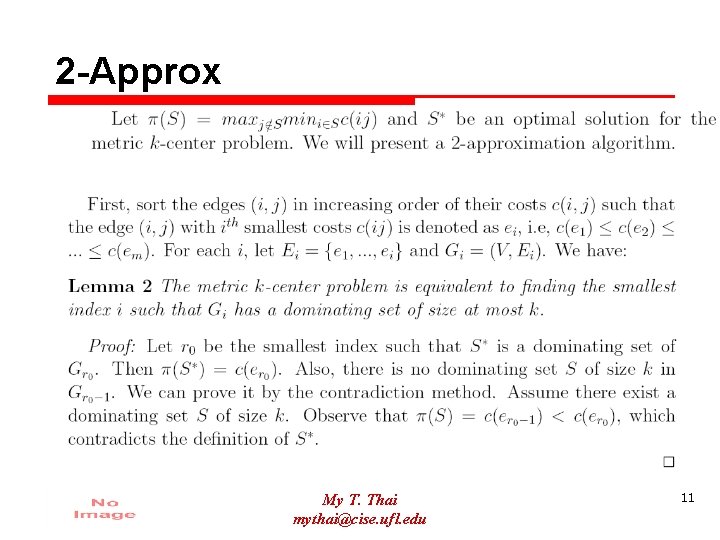
2 -Approx My T. Thai mythai@cise. ufl. edu 11
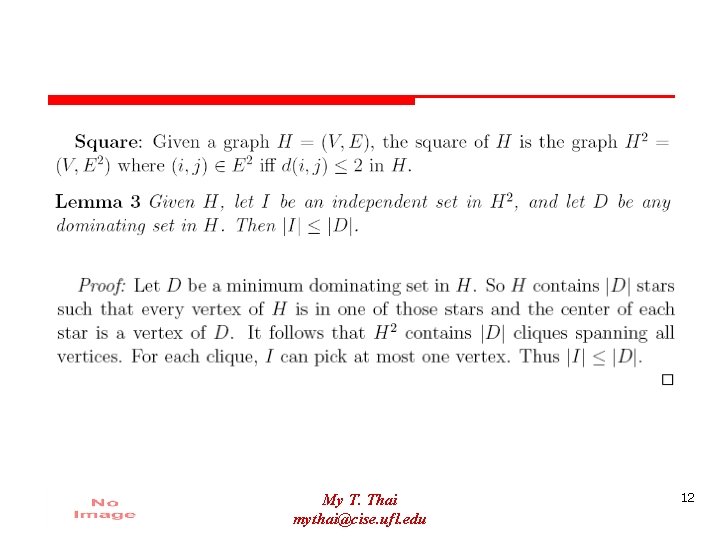
My T. Thai mythai@cise. ufl. edu 12
My T. Thai mythai@cise. ufl. edu 13
Analysis My T. Thai mythai@cise. ufl. edu 14
Hardness of Approximation (k-center) My T. Thai mythai@cise. ufl. edu 15
The PCP System My T. Thai mythai@cise. ufl. edu 16
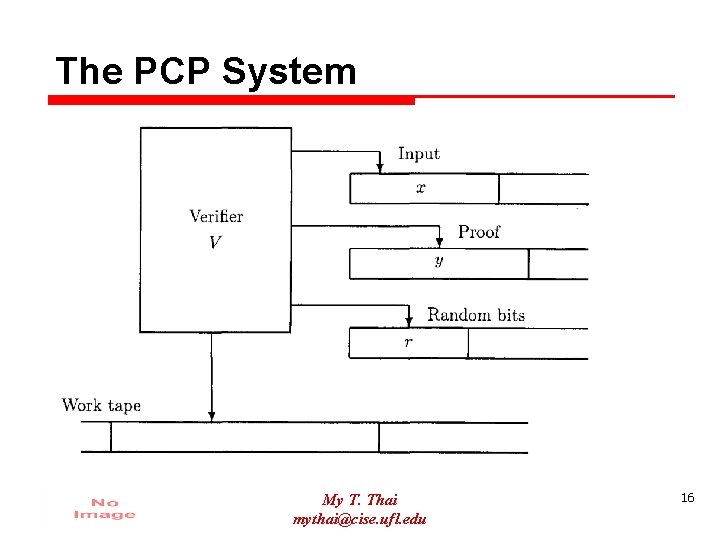
The PCP System Ø Use the familiar concept of a verifier and a proof Ø PCP system comes with two parameters: the number of random bits required by the verifier; the number of bits that the verifier is allowed to examine Ø The most useful setting of these parameters is O(log n) and O(1) respectively. This defines the class PCP(log n, 1) My T. Thai mythai@cise. ufl. edu 17
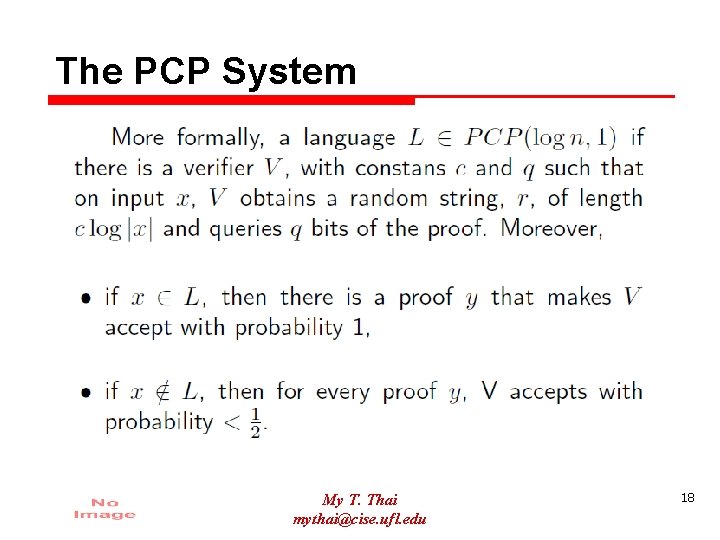
The PCP System My T. Thai mythai@cise. ufl. edu 18
![Connection to Inapproximability Ø Theorem: NP = PCP[log n, 1] Informally, the PCP theorem](http://slidetodoc.com/presentation_image_h2/4266ab7cfb863a6d5f04e9d3e6b7a961/image-19.jpg "Connection to Inapproximability Ø Theorem: NP = PCP[log n, 1] Informally, the PCP theorem")
Connection to Inapproximability Ø Theorem: NP = PCP[log n, 1] Informally, the PCP theorem states that every NP-statement has a probabilistically checkable proof, i. e. a proof which can be "spot-checked" by reading only a constant number of bits from the proof. These bits are selected by a randomized process using a very limited amount of randomness. The checking process always accepts a correct proof of a correct statement and rejects any cheating proof of an incorrect statement with high probability. If you verify k times, then the probability for a YES answer of a wrong proof is at most ½^k My T. Thai mythai@cise. ufl. edu 19
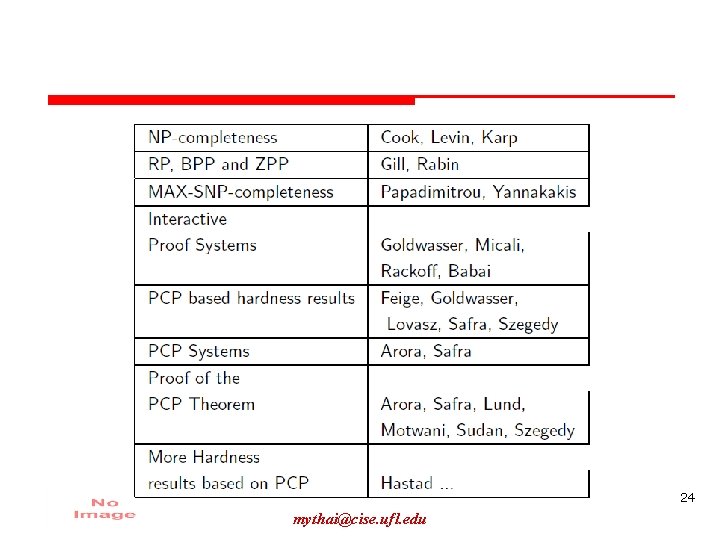
Brief History Ø Intractability of many combinatorial optimization problems was observed in the 60 s q R. L. Graham. Bounds for certain multiprocessing anomalies. Bell System Technology Journal, 45: 1563– 1581, 1966. Ø Introduce theory of NP-completeness (CLK) q S. A. Cook. The complexity of theorem proving procedures. In Proceedings of the 3 rd ACM Symposium on Theory of Computing, pages 151– 158, 1971 q L. A. Levin. Universal search problems. Problemi Peredachi Informatsii, 9: 265– 266, 1973 q R. M. Karp. Reducibility among combinatorial problems. In R. E. Miller and J. W. Thatcher, editors, Complexity of Computer Computations, pages 85– 103. Plenum Press, 1972 My T. Thai mythai@cise. ufl. edu 20
Brief History Ø In 1973, Johnson gave a foundation to the field of the design and analysis of approximation algorithms Ø Now, come to an exciting era (leading to PCPs and Inapproximability) Ø The story of the PCP Theorem begins at MIT in the early 1980 s My T. Thai mythai@cise. ufl. edu 21
Brief History Ø STOC 85: The Knowledge Complexity of Interactive Proof System by Goldwasser, Micali, and Rackoff q Introduced Interactive Proofs Ø In an interactive proof, a randomized poly-time verifier with private coin tosses interacts with an all-powerful prover; they send messages back and forth in poly many rounds. Correct statements should have proofs accepted with probability 1 (‘completeness’) and incorrect statements should be rejected, regardless of the proof, which probability at least ½ (‘soundness’) Ø (Independently with Babai et. al) My T. Thai mythai@cise. ufl. edu 22
Brief History Ø In 1991, Feige et al discovered that probabilistic proof systems could give a robust model for NP that could be used to prove an inapproximability for the Independent Set problem Ø A year later, Arora et al proved the PCP Theorem (NP = PCP[log n, 1]) and showed how to use the PCP Theorem to prove that Max 3 SAT does not have PTAS My T. Thai mythai@cise. ufl. edu 23
My T. Thai mythai@cise. ufl. edu 24
- Slides: 24