
PCD Objective 4 02 Infants Emotional and Social
PCD Objective 4. 02 Infant’s Emotional and Social Development The Developing Child-Chapter 8 3 days
“The Rescuing Hug” ¡ ¡ ¡ Close your eyes while teacher reads a story. After you HEAR the story you will then draw what you visualized during the reading. Under your picture you will need to write a 2 sentence summary about what you drew. l This activity encourages thinking and processing information; it is not for assessing drawing skills. l Paper and colored pencils will be provided http: //www. planetdeb. net/spirit/rescue. htm
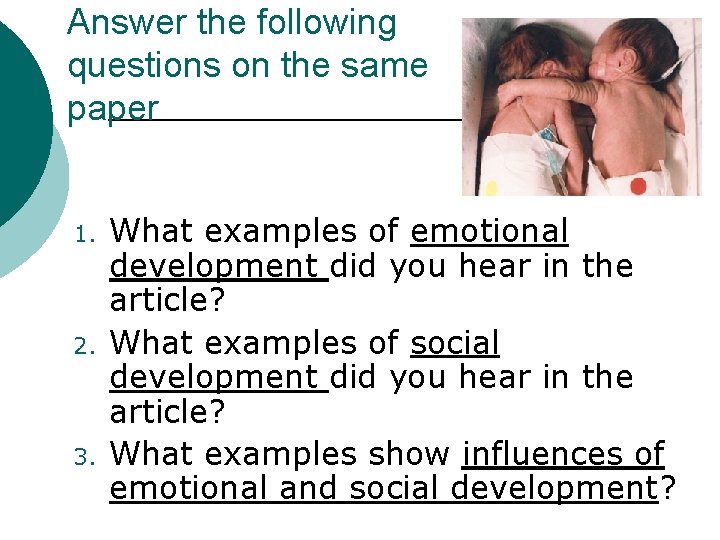
The Rescuing Hug ¡ Kyrie and Brielle Jackson were born on October 17, 1995, at the Massachusetts Memorial Hospital in Worcester. Each of the twins weighed all of two pounds at birth and each was in their respective incubators, but one was not expected to live. Though Kyrie was putting on a bit of weight in the days following her arrival, her sister, Brielle, was not doing as well. She cried a great deal, leaving her gasping and blue-faced.
¡ Brielle was having a particularly bad day. Newborn Intensive Care Unit nurse Gayle Kasparian tried everything to calm her. She held her. She had her dad hold her. She wrapped her in a blanket. She suctioned her nose. ¡ Nothing worked.
¡ Then she remembered hearing about a procedure done in Europe where twins were placed together in the same incubator; however, this was against Massachusetts Memorial Hospital's rules. Knowing that the one twin had little time to live, she put Brielle in the incubator with her sister Kyrie contrary to the hospital's rules.
¡ The healthier twin Brielle snuggled up next to Kyrie and put her arm over her sister in an endearing embrace. Almost immediately the smaller baby's heart rate stabilized and her temperature rose to normal. Her blood-oxygen saturation levels, which had been frighteningly low, soared. She began to breathe more easily. The frantic crying stopped and her normal pinkish color quickly returned.
¡ Over the next weeks, her health improved steadily in her new, less lonely quarters. The children survived their rocky beginning and in time went home with their parents. When last heard from, Brielle and Kyrie were healthy preschoolers.
¡ When the dramatic change in Brielle's life became apparent to the hospital staff and then in the community, Christo of the Worcester Telegram & Gazette Newspaper came to the hospital and took a photograph of the two together. This photograph immediately became famous and has appeared in Life Magazine and Reader's Digest.
¡ Another method used to stabilize preemies is "kangaroo care, " a term for prolonged skin-to-skin contact with parents and other caregivers. The technique, so named because of its resemblance to the way pouched animals care for their young, involves skin-to-skin contact between parent and baby.
¡ Often the child, wearing only a diaper and covered by a blanket, is placed against the parent's bare chest. The method is especially effective with premature babies, who are extremely fragile and have almost tissue-thin skin when born. Proponents say the method can have amazing effects: a steadier heart rate, better breathing, greater contentment and deeper sleep.
Answer the following questions on the same paper 1. 2. 3. What examples of emotional development did you hear in the article? What examples of social development did you hear in the article? What examples show influences of emotional and social development?
Emotional & Social Developments Interrelated (interconnected) ¡ Each is a separate type of dev. with clearly observable patterns and characteristics. ¡
¡ Both Emotional & Social Development follow PREDICTABLE PATTERNS Developmental milestones can be anticipated
¡ AFFECTION and HARMONY are key elements needed for both healthy emotional and social development.
¡ Both occur according to individual TIMING and vary from one individual to another
Building trust and forming attachments are essential for both emotional and social development. ¡ With TRUST AND HEALTHY ATTACHMENTS, people learn to handle their emotions and form healthy relationships. ¡
¡ As infants develop emotionally and socially, EACH develops his/her own INDIVIDUAL PERSONALITY.
¡ Personalities are the result of healthy emotional and social development
¡ Both influence a person’s RELATIONSHIPS AND BEHAVIORS.
¡ Both emotional and social development occur over the span of a lifetime---from NEWBORNS TO OLD AGE.
Self-concepts These feelings about self (emotional) are reflected in behavior toward others (social).
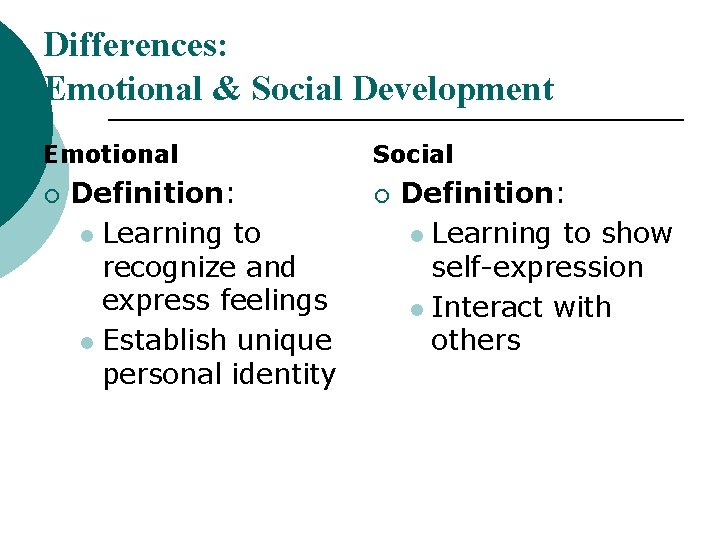
Differences: Emotional & Social Development Emotional ¡ Definition: l Learning to recognize and express feelings l Establish unique personal identity Social ¡ Definition: l Learning to show self-expression l Interact with others
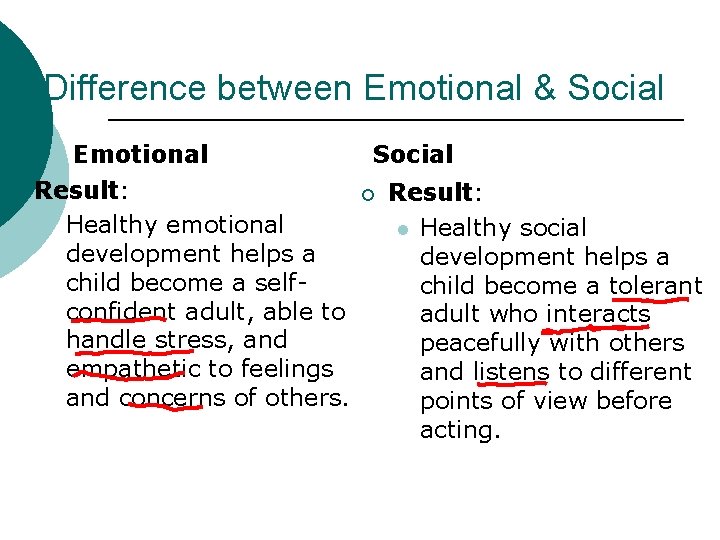
Difference between Emotional & Social Emotional ¡ Result: l Healthy emotional development helps a child become a selfconfident adult, able to handle stress, and empathetic to feelings and concerns of others. Social ¡ Result: l Healthy social development helps a child become a tolerant adult who interacts peacefully with others and listens to different points of view before acting.
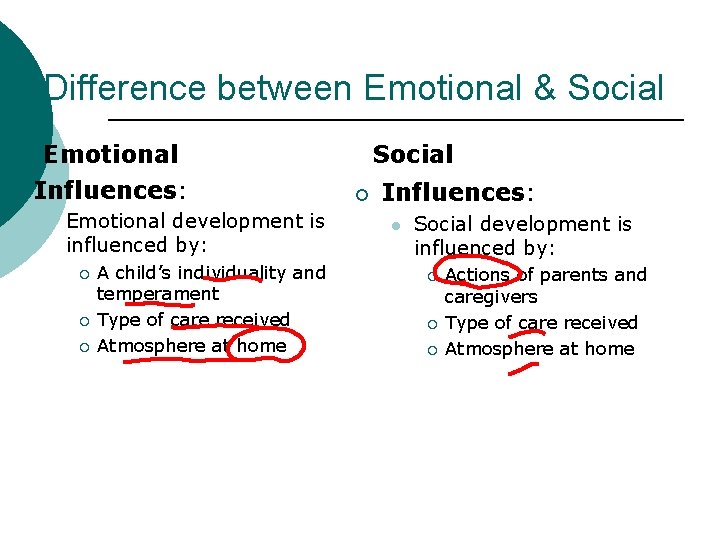
Difference between Emotional & Social Emotional ¡ Influences: l Emotional development is influenced by: ¡ ¡ ¡ A child’s individuality and temperament Type of care received Atmosphere at home Social ¡ Influences: l Social development is influenced by: ¡ ¡ ¡ Actions of parents and caregivers Type of care received Atmosphere at home
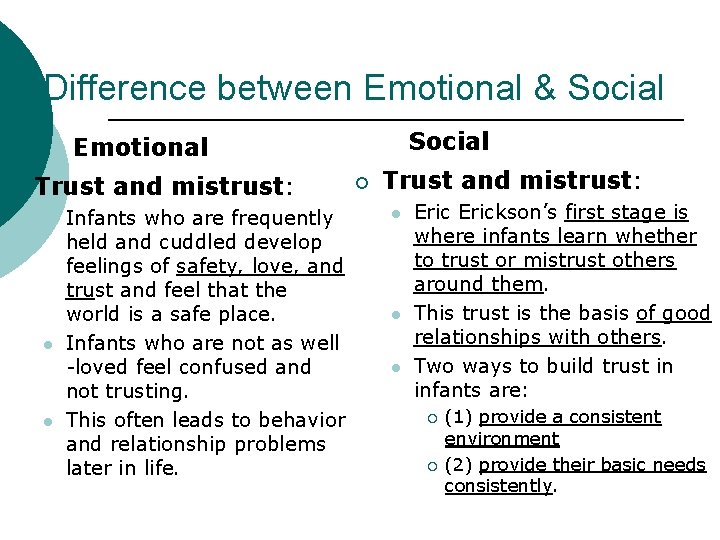
Difference between Emotional & Social Emotional ¡ Trust and mistrust: l l l Infants who are frequently held and cuddled develop feelings of safety, love, and trust and feel that the world is a safe place. Infants who are not as well -loved feel confused and not trusting. This often leads to behavior and relationship problems later in life. ¡ Trust and mistrust: l l l Erickson’s first stage is where infants learn whether to trust or mistrust others around them. This trust is the basis of good relationships with others. Two ways to build trust in infants are: ¡ ¡ (1) provide a consistent environment (2) provide their basic needs consistently.
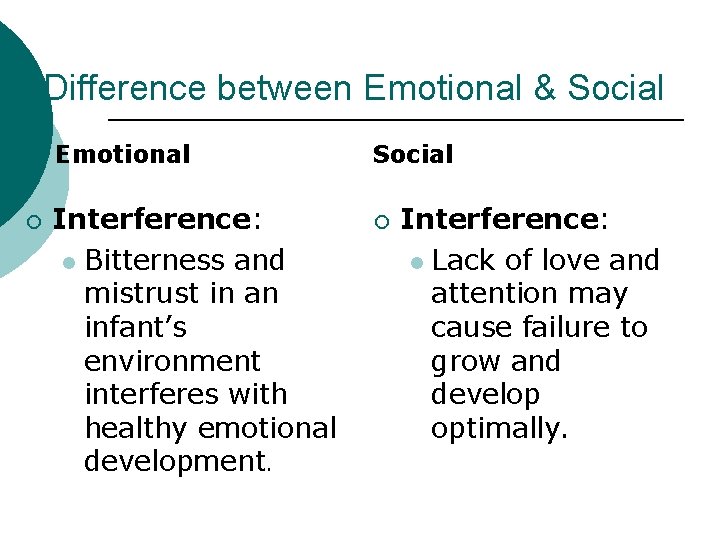
Difference between Emotional & Social Emotional ¡ Interference: l Bitterness and mistrust in an infant’s environment interferes with healthy emotional development. Social ¡ Interference: l Lack of love and attention may cause failure to grow and develop optimally.
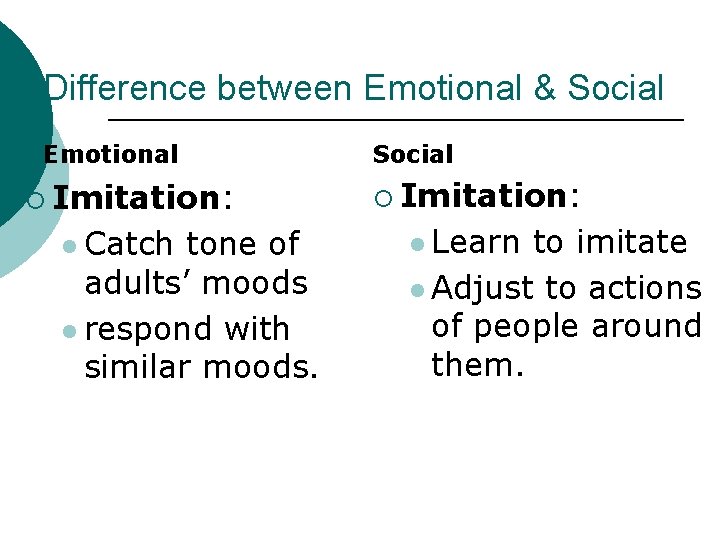
Difference between Emotional & Social Emotional ¡ Imitation: l Catch tone of adults’ moods l respond with similar moods. Social ¡ Imitation: l Learn to imitate l Adjust to actions of people around them.
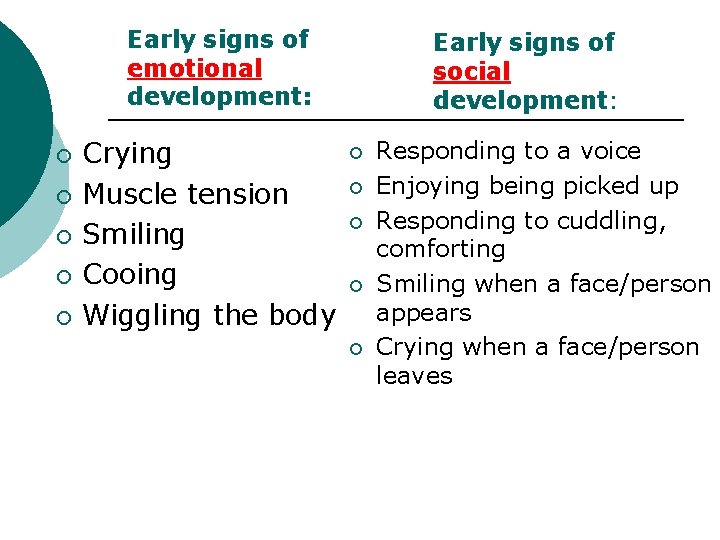
Early signs of emotional development: ¡ ¡ ¡ Crying Muscle tension Smiling Cooing Wiggling the body Early signs of social development: ¡ ¡ ¡ Responding to a voice Enjoying being picked up Responding to cuddling, comforting Smiling when a face/person appears Crying when a face/person leaves
Infant’s Emotional & Social Development Emotional ¡ At birth: l l Emotional development begins at birth and continues throughout life. Newborns are able to feel two basic emotions ¡ ¡ Contentment Distress Social ¡ At birth: l l Newborns are passive, not social, but within weeks they begin to interact with others around them. Social interaction continues throughout life.
Infant’s Emotional & Social Development Emotional ¡ First weeks: l l Infants’ emotions become more varied. They learn to associate emotions with causes ¡ ¡ Hunger Pain lack of attention etc. Social ¡ First weeks: l Newborns improve their social interactions as they listen to voices, begin to see faces, try to make eye contact, and smile at faces and voices.
Infant’s Emotional & Social Development Emotional ¡ Three months: l Show pleasure/delight with smiles and laughter ¡ show uncertainty with puzzled looks and questioning sounds Social ¡ Three months: l Make cooing sounds to catch attention, fuss until parents come, arch their backs and reach out to be held
Infant’s Emotional & Social Development Emotional ¡ Three to six months: l l Show excitement when caregivers appear and distress when they leave. Only when babies feel loved and secure can they extend their interests beyond themselves. Social ¡ Three to six months: l Begin to recognize and trust their caregivers; around six months, form an attachment, or strong bond, with parents/caregivers. ¡ This is their first real social relationship. Many infants also form attachments with special objects.
Infant’s Emotional & Social Development Emotional ¡ Six to ten months: l l Begin to show fear as they learn to recognize situations they perceive as threatening. At ten months, show more specific emotions ¡ ¡ Anger Sadness Happiness etc. Social ¡ Six to ten months: l l Many demonstrate fear of unfamiliar people, or stranger anxiety, and cry to express their fears. They often seek approval from parents by “showing off” what they’ve learned to do.
Infant’s Emotional & Social Development Emotional ¡ Eleven to twelve months: l l Infants’ fear of being apart from parents is at its peak. Many experience separation anxiety when parents leave. Social ¡ Eleven to twelve months: l l Infants who cry when parents leave them are not trying to be unreasonable. They are still unable to see anyone else’s point of view.
Infant’s Emotional & Social Development Emotional ¡ Search for independence: l As children learn new physical skills, such as walking, they are developing independence. Social ¡ Search for independence: l The loving care of parents helps children find their own sense of identity and independence.
Ways to promote healthy attachments Emotional ¡ ¡ ¡ Hug, kiss, cuddle, rock, and smile Use a comforting voice Keep up with attachment objects Set good examples of ways to express emotions Allow child to quiet self by sucking Social ¡ ¡ ¡ Encourage baby to use gestures Provide positive examples l “hello” l “thank you” l “bye-bye” Talk to infants in a pleasant voice Smile, show positive facial expressions Provide opportunities for other family members to interact with infant
Infant’s Emotional & Social Development Emotional Social ¡ Role of play: l Play helps children learn to express emotions. l Play helps children learn to interact with adults and other children.
1. Stages of both emotional and social development: are completely different for each child. B. are somewhat predictable in the timing in which they occur. C. follow steps that are unable to be predicted. D. involve milestones that are totally unpredictable. Answer=B A.
2. Both emotional and social development are related to Erickson’s first stage, trust and mistrust, because learning to trust: is the foundation of healthy emotional and social development later in life. B. is the last task that newborns achieve in social and emotional development. C. leads to healthy emotional development, but has little effect on social development. D. leads to healthy social development, but has little effect on emotional development Answer=A A.
Appendix 4. 02 G Student Handout Fix It ¡ Directions: l l Read the first scenario. Afterwards, write a “scene” in which Aunt Mary confronts her nephew about his son Jason and his lack of opportunities to develop emotionally. Read the second scenario. Write a “scene” about how the experiences support healthy social development in children.
Scenario One ¡ ¡ write a “scene” in which Aunt Mary confronts her nephew about his son Jason and his lack of opportunities to develop emotionally. Tom’s Aunt Mary volunteered to look after her nephews’ young son Jason one Saturday. Tom showed his aunt where all the bottles, diapers, and toys were located. Then he told Aunt Mary that she wouldn’t have any trouble because Jason watches television all day and hardly moves from his spot on the floor. Write a scene in which Aunt Mary talks with her nephew about his son’s lack of opportunities to develop emotionally.
Scenario Two ¡ ¡ Write a “scene” about how the experiences support healthy social development in children Mary is a caregiver at a local child care center. Sam and Sandra send their children to the center often to interact with other children through exercise and play. Laura and Susan play together with other children on the playground and work together at the tables on the inside. Write a scene to express how the experience at the child care center can help the children develop socially.
“Erickson’s Trust vs. Mistrust” ¡ Directions: Read in the textbook, The Developing Child, Chapter 8 page 256 -____ about Eric Erikson’s Theory of Personality Development--TRUST Vs. MISTRUST. l Use the graphic organizer (Appendix 4. 02 E) to record your findings. l
“Show & Tell—The EARLY SIGNS” ¡ Directions: ¡ Each student will have a different “early sign” of E + S Development. l Find a picture in a magazine that shows/demonstrates your “early sign. ” l Be ready to glue your picture to the poster labeled, “Early Signs” of Emotional and Social Development of Infants.
Emotional and Social Timeline Directions: 1. A timeline will be place on the wall 1. Labeled Month 1 -12 2. Materials: 1. The Developing Child, Textbook 2. A milestone of emotional or social dev. in infants 3. Scissors, crayons, colored pens 4. Paper doll 3. Look for your milestone in Ch. 8. 4. Write the following on your paper doll 1. Milestone info. 2. Age/month in which the milestone occurs 3. Color and/or decorate 5. After you have completed your doll, you will need to place your doll on the timeline in the appropriate time frame. 6. The whole class will view the timeline and discuss our findings.
“T chart--- Emotional and Social Development” • Directions: • Use Chapter 8 to complete the handout found 4. 02 F. • List the milestones of Emotional & Social development ¡ Left column l Write Emotional Dev. Milestones that occur in the first year in the left column. ¡ Right column l Write Social Dev. Milestones that occur in the first year. • Write how they are different in a summary paragraph at the bottom
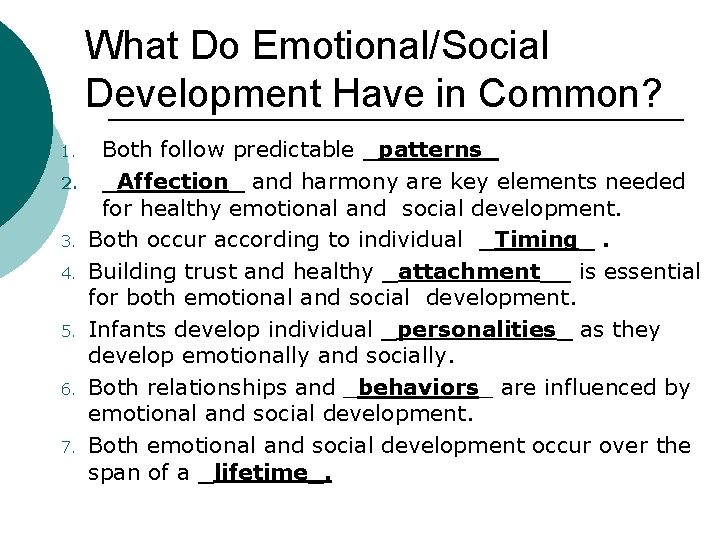
What Do Emotional/Social Development Have in Common? 1. 2. 3. 4. 5. 6. 7. Both follow predictable _patterns_ _Affection_ and harmony are key elements needed for healthy emotional and social development. Both occur according to individual _Timing_. Building trust and healthy _attachment__ is essential for both emotional and social development. Infants develop individual _personalities_ as they develop emotionally and socially. Both relationships and _behaviors_ are influenced by emotional and social development. Both emotional and social development occur over the span of a _lifetime_.
Multiple Choice Questions ¡Complete the multiple choice questions on the back of your Key Terms paper.
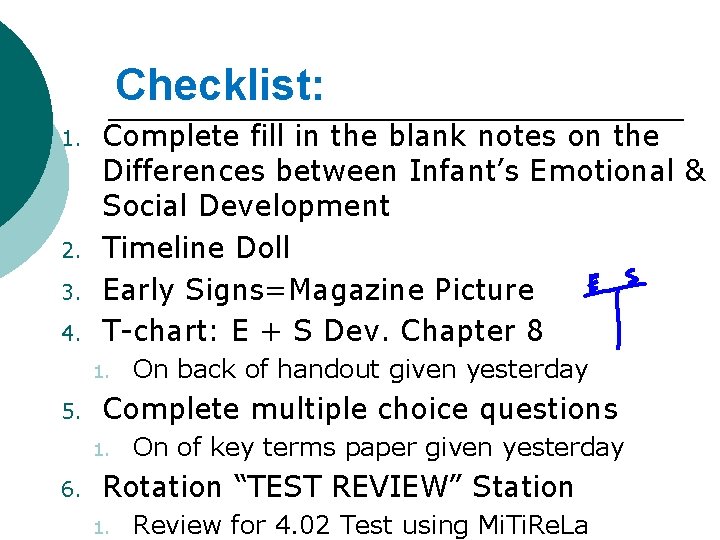
Checklist: 1. 2. 3. 4. Complete fill in the blank notes on the Differences between Infant’s Emotional & Social Development Timeline Doll Early Signs=Magazine Picture T-chart: E + S Dev. Chapter 8 1. 5. Complete multiple choice questions 1. 6. On back of handout given yesterday On of key terms paper given yesterday Rotation “TEST REVIEW” Station 1. Review for 4. 02 Test using Mi. Ti. Re. La
Key terms
emotional development ¡ The process of learning to recognize and express feelings and establish a unique personal identity
social development ¡ The process of learning to show self -expression and interact with others
predictable patterns ¡ Happening or turning out in the way that might have been expected
Affection ¡ Tender feelings toward someone or something
Harmony ¡ A situation in which there is friendly agreement or accord
Timing ¡ The ability to choose or the choice of the best moment to do or say something
Trust ¡ Reliance on good qualities, especially fairness, honor, and ability
healthy attachments ¡ A good bond between a child and a parent or other primary caregivers
individual personality ¡ A specific person, distinct from others in a group
Relationships ¡ A significant connection or similarity between two or more things, or the state of being related to something else
Behaviors ¡ The way a person acts
self-concepts ¡ The way a person looks at himself/herself
Mistrust ¡ Lack of confidence in a person or thing
Interference ¡ A hindrance that prevents a desired outcome
Imitation ¡ The act of mimicking somebody, or an impression of somebody
Independence ¡ Freedom from being controlled by another person
Emotions ¡ A strong feeling about someone or something
Personality ¡ The totality of someone’s attitudes, interests, behavioral patterns, emotional responses, social roles, and other traits that endure over long periods of time
Test Review ¡ Write this on your own paper so you will know what to STUDY!!! l Key terms l Chapter 8 l 4. 02 Mi. Ti. Re. La l E + S Dev. Similarities & Differences ¡ l Milestones ¡ l PP Notes with handout PP notes with handout Ways to promote healthy emotional & social development
- Slides: 69