
PC 4259 Chapter 5 Surface Processes in Materials
- Slides: 24
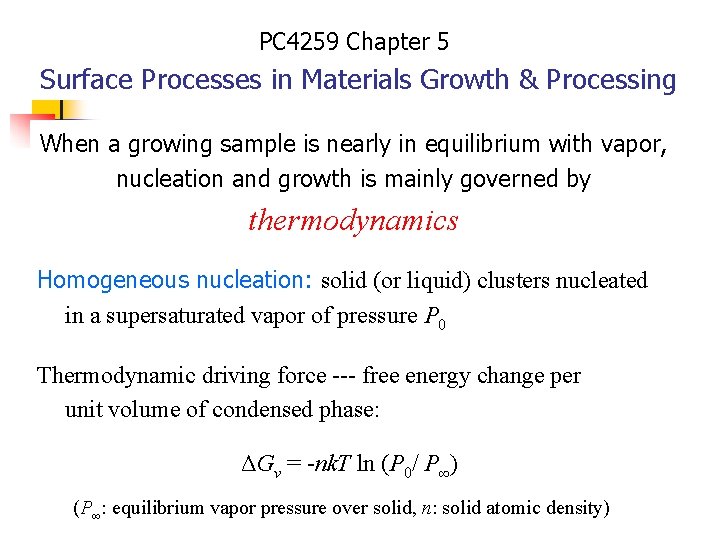
PC 4259 Chapter 5 Surface Processes in Materials Growth & Processing When a growing sample is nearly in equilibrium with vapor, nucleation and growth is mainly governed by thermodynamics Homogeneous nucleation: solid (or liquid) clusters nucleated in a supersaturated vapor of pressure P 0 Thermodynamic driving force --- free energy change per unit volume of condensed phase: ΔGv = -nk. T ln (P 0/ P∞) (P∞: equilibrium vapor pressure over solid, n: solid atomic density)
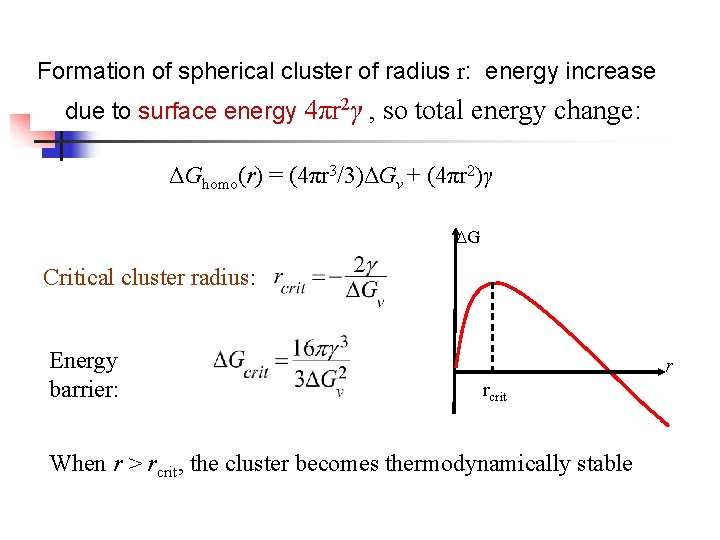
Formation of spherical cluster of radius r: energy increase due to surface energy 4πr 2γ , so total energy change: ΔGhomo(r) = (4πr 3/3)ΔGv + (4πr 2)γ G Critical cluster radius: Energy barrier: r rcrit When r > rcrit, the cluster becomes thermodynamically stable
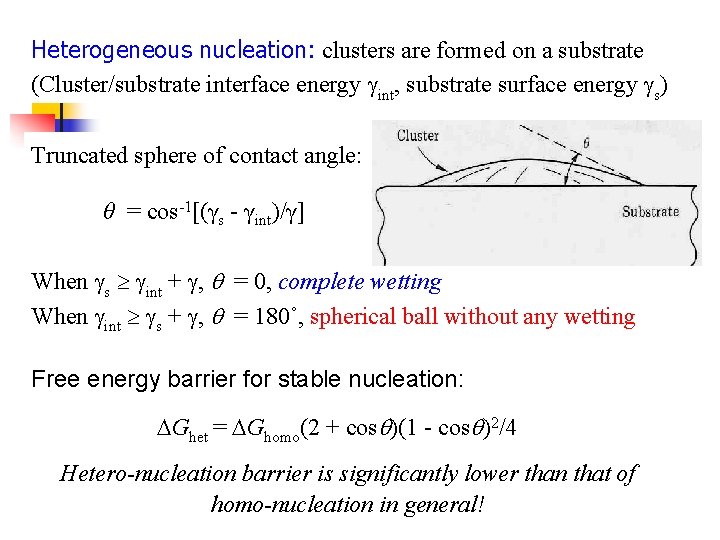
Heterogeneous nucleation: clusters are formed on a substrate (Cluster/substrate interface energy int, substrate surface energy s) Truncated sphere of contact angle: θ = cos-1[(γs - γint)/γ] When s int + , = 0, complete wetting When int s + , = 180˚, spherical ball without any wetting Free energy barrier for stable nucleation: Ghet = Ghomo(2 + cos )(1 - cos )2/4 Hetero-nucleation barrier is significantly lower than that of homo-nucleation in general!
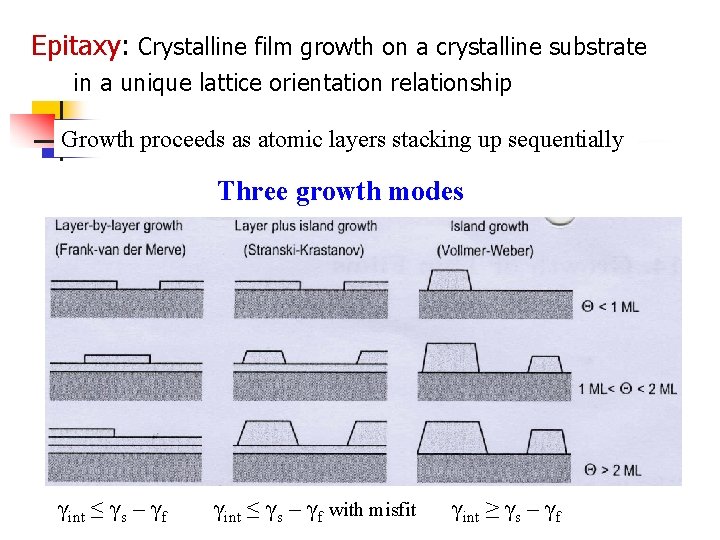
Epitaxy: Crystalline film growth on a crystalline substrate in a unique lattice orientation relationship Growth proceeds as atomic layers stacking up sequentially Three growth modes γint ≤ γs – γf with misfit γint ≥ γs – γf
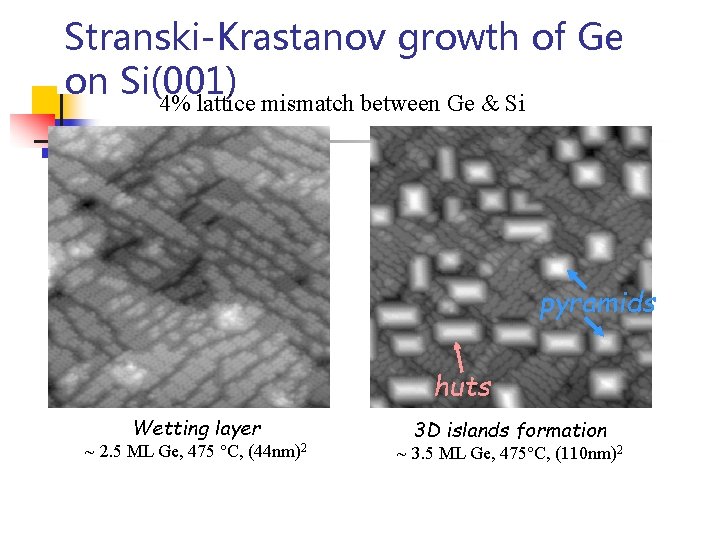
Stranski-Krastanov growth of Ge on Si(001) 4% lattice mismatch between Ge & Si pyramids huts Wetting layer ~ 2. 5 ML Ge, 475 °C, (44 nm)2 3 D islands formation ~ 3. 5 ML Ge, 475°C, (110 nm)2
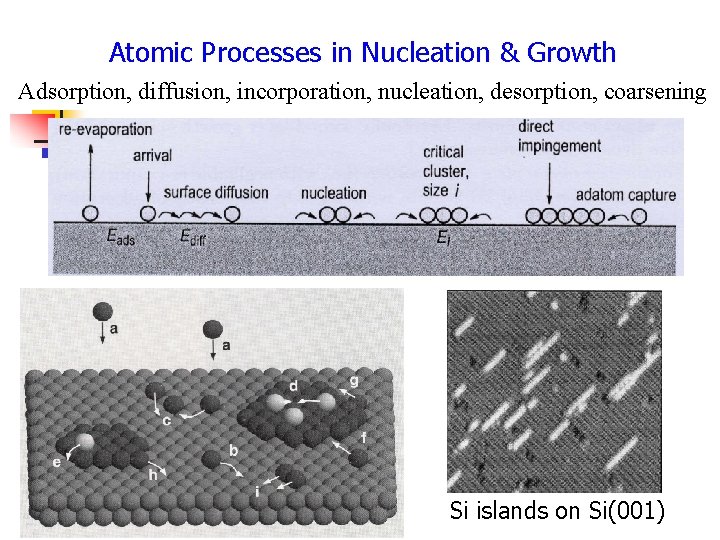
Atomic Processes in Nucleation & Growth Adsorption, diffusion, incorporation, nucleation, desorption, coarsening Si islands on Si(001)
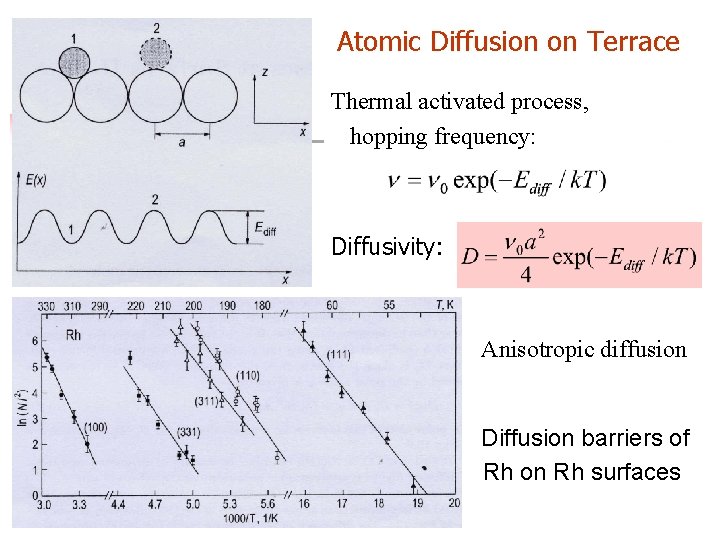
Atomic Diffusion on Terrace Thermal activated process, hopping frequency: Diffusivity: Anisotropic diffusion Diffusion barriers of Rh on Rh surfaces
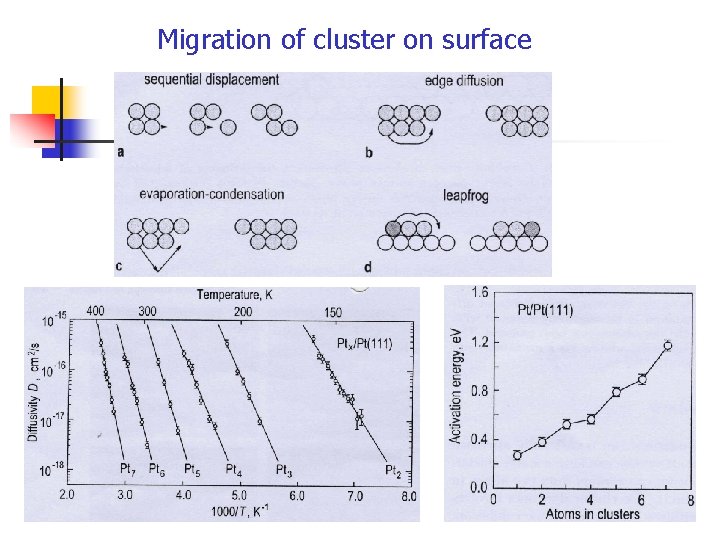
Migration of cluster on surface
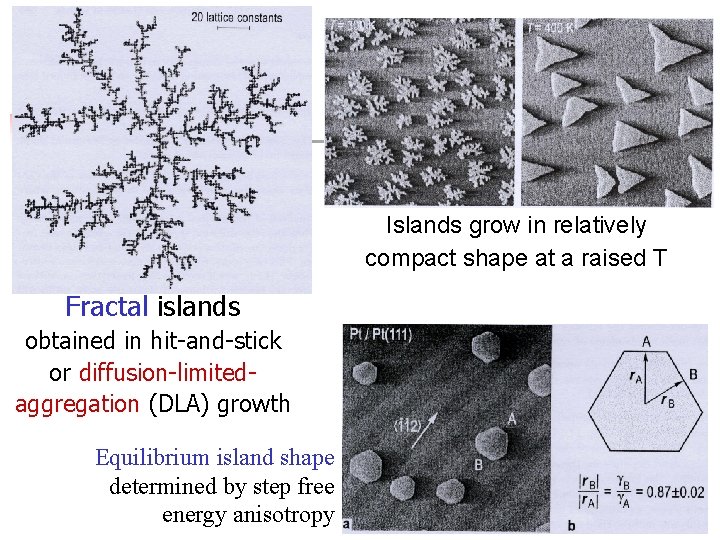
Islands grow in relatively compact shape at a raised T Fractal islands obtained in hit-and-stick or diffusion-limitedaggregation (DLA) growth Equilibrium island shape determined by step free energy anisotropy
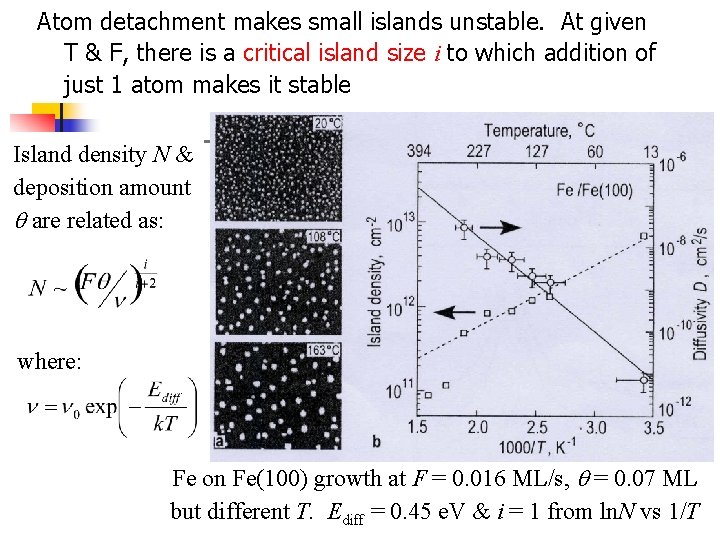
Atom detachment makes small islands unstable. At given T & F, there is a critical island size i to which addition of just 1 atom makes it stable Island density N & deposition amount are related as: where: Fe on Fe(100) growth at F = 0. 016 ML/s, = 0. 07 ML but different T. Ediff = 0. 45 e. V & i = 1 from ln. N vs 1/T
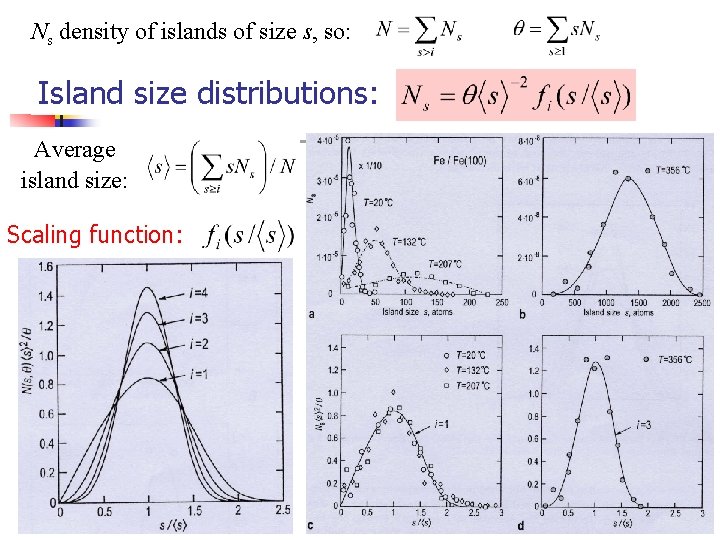
Ns density of islands of size s, so: Island size distributions: Average island size: Scaling function:
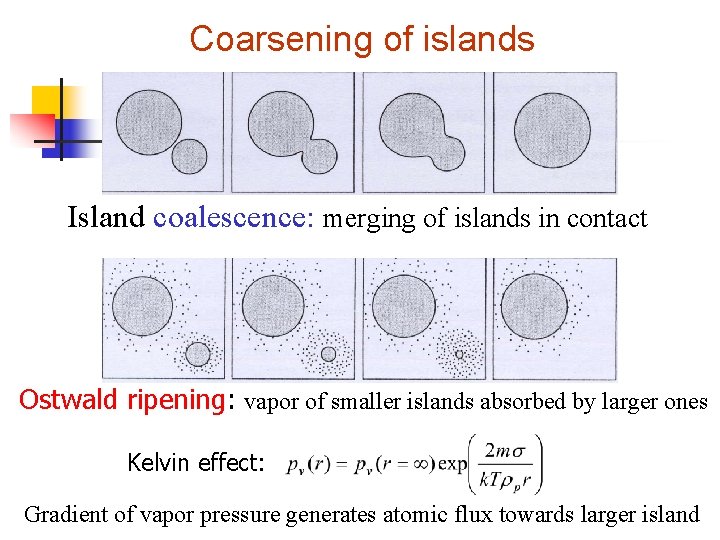
Coarsening of islands Island coalescence: merging of islands in contact Ostwald ripening: vapor of smaller islands absorbed by larger ones Kelvin effect: Gradient of vapor pressure generates atomic flux towards larger island
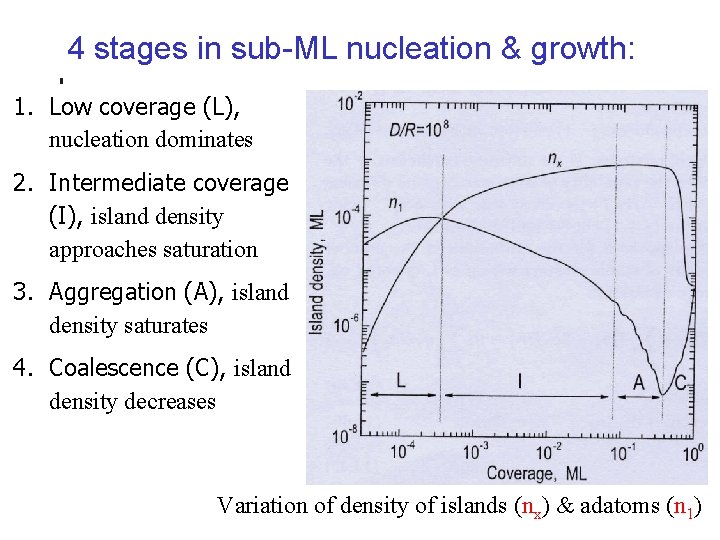
4 stages in sub-ML nucleation & growth: 1. Low coverage (L), nucleation dominates 2. Intermediate coverage (I), island density approaches saturation 3. Aggregation (A), island density saturates 4. Coalescence (C), island density decreases Variation of density of islands (nx) & adatoms (n 1)
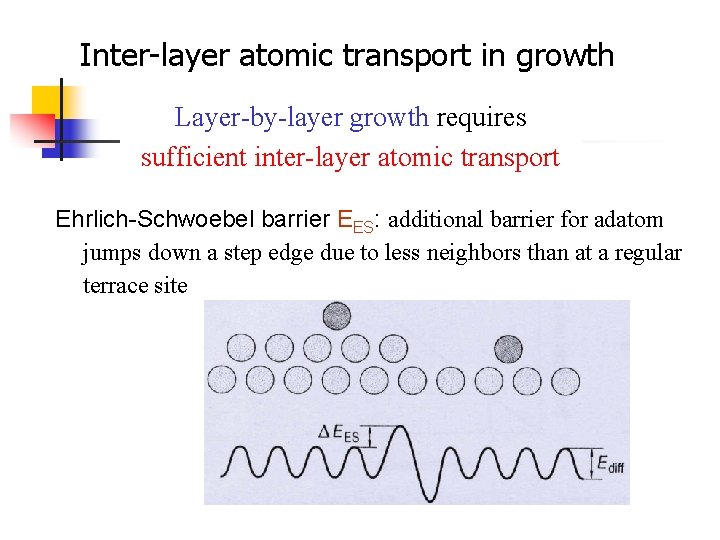
Inter-layer atomic transport in growth Layer-by-layer growth requires sufficient inter-layer atomic transport Ehrlich-Schwoebel barrier EES: additional barrier for adatom jumps down a step edge due to less neighbors than at a regular terrace site
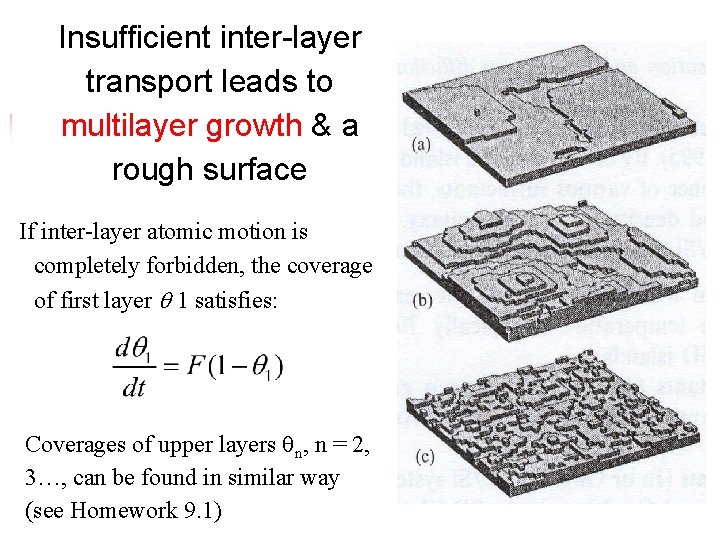
Insufficient inter-layer transport leads to multilayer growth & a rough surface If inter-layer atomic motion is completely forbidden, the coverage of first layer 1 satisfies: Coverages of upper layers n, n = 2, 3…, can be found in similar way (see Homework 9. 1)
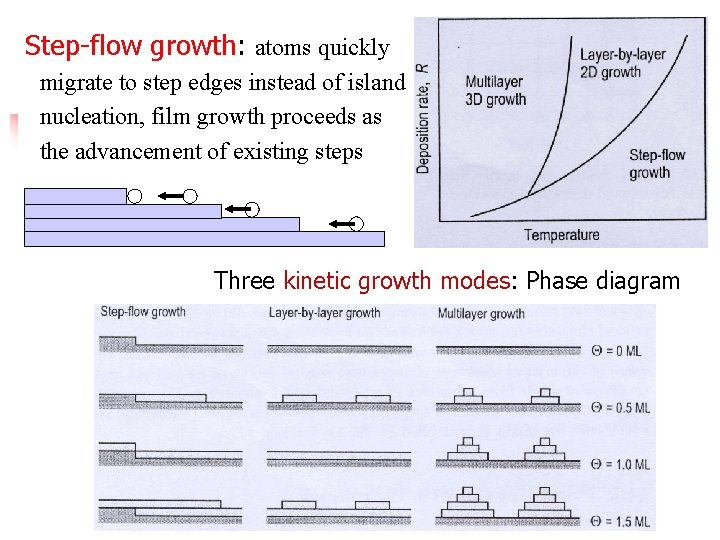
Step-flow growth: atoms quickly migrate to step edges instead of island nucleation, film growth proceeds as the advancement of existing steps Three kinetic growth modes: Phase diagram
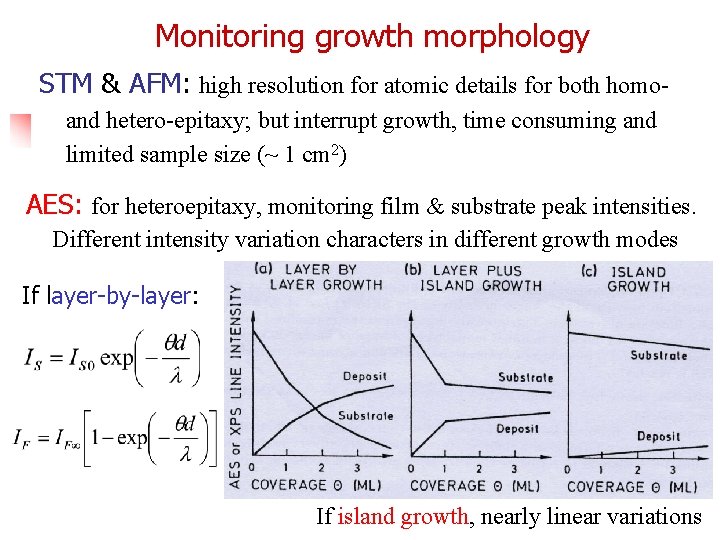
Monitoring growth morphology STM & AFM: high resolution for atomic details for both homoand hetero-epitaxy; but interrupt growth, time consuming and limited sample size (~ 1 cm 2) AES: for heteroepitaxy, monitoring film & substrate peak intensities. Different intensity variation characters in different growth modes If layer-by-layer: If island growth, nearly linear variations
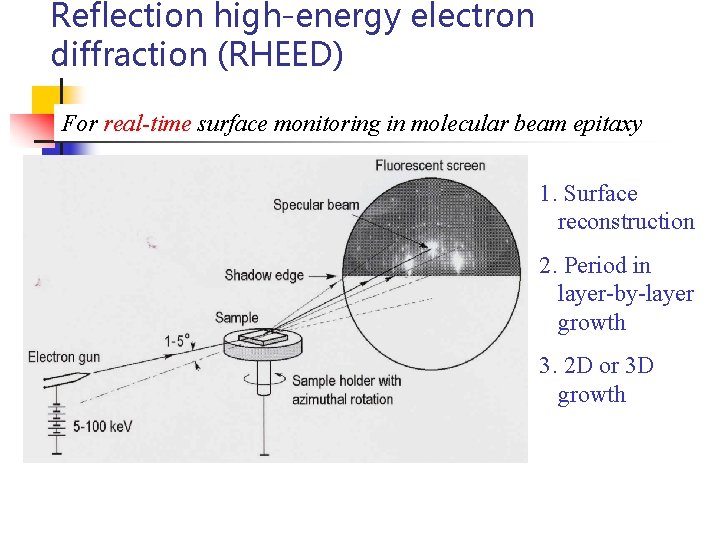
Reflection high-energy electron diffraction (RHEED) For real-time surface monitoring in molecular beam epitaxy 1. Surface reconstruction 2. Period in layer-by-layer growth 3. 2 D or 3 D growth
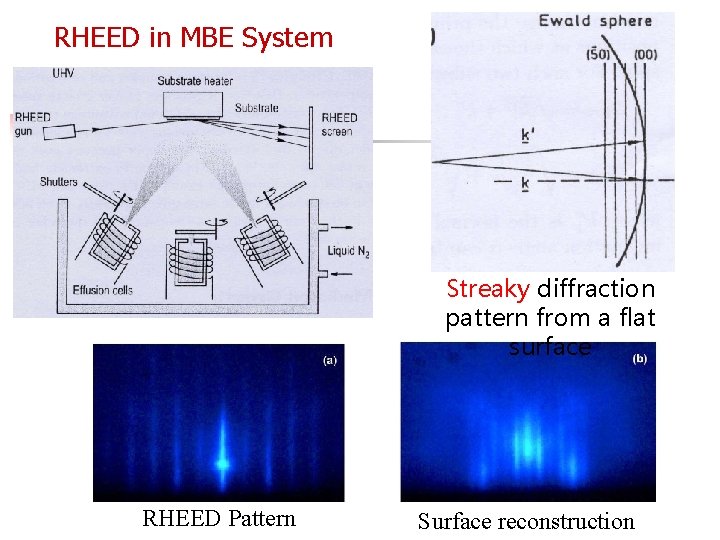
RHEED in MBE System Streaky diffraction pattern from a flat surface RHEED Pattern Surface reconstruction
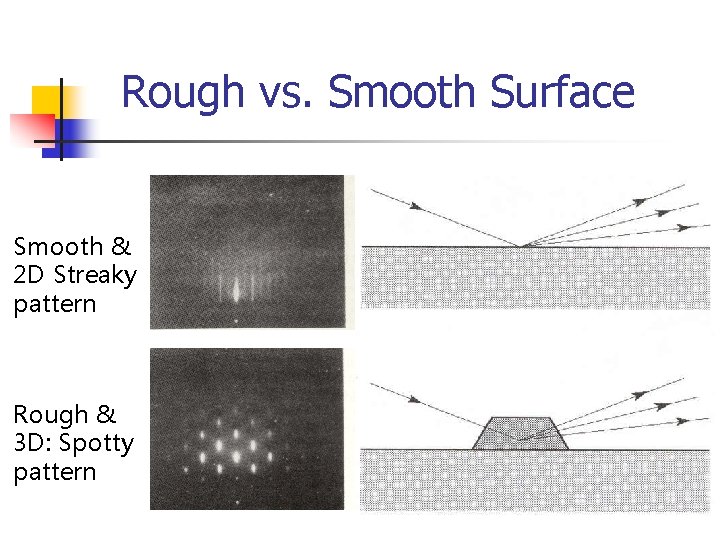
Rough vs. Smooth Surface Smooth & 2 D Streaky pattern Rough & 3 D: Spotty pattern
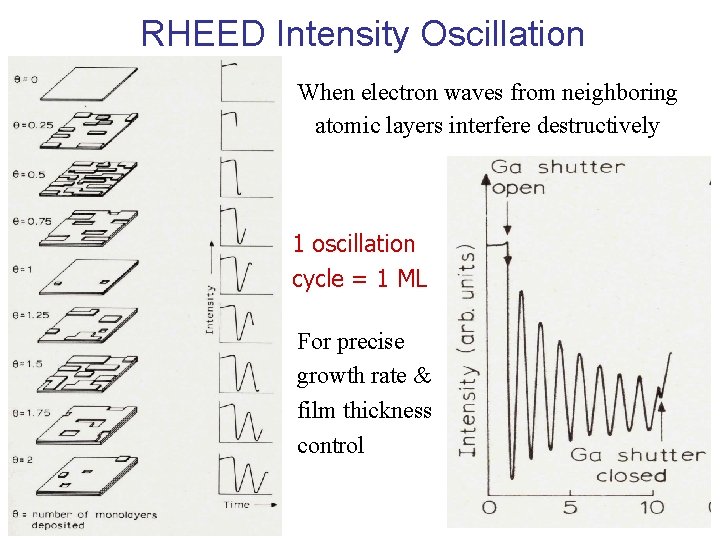
RHEED Intensity Oscillation When electron waves from neighboring atomic layers interfere destructively 1 oscillation cycle = 1 ML For precise growth rate & film thickness control
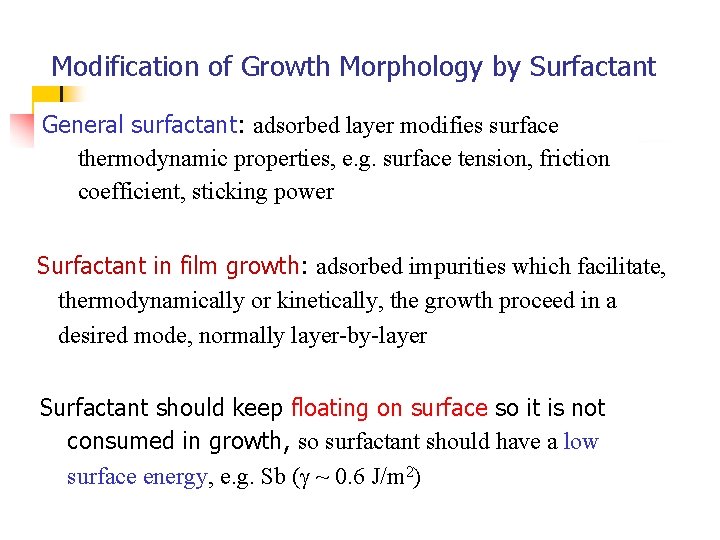
Modification of Growth Morphology by Surfactant General surfactant: adsorbed layer modifies surface thermodynamic properties, e. g. surface tension, friction coefficient, sticking power Surfactant in film growth: adsorbed impurities which facilitate, thermodynamically or kinetically, the growth proceed in a desired mode, normally layer-by-layer Surfactant should keep floating on surface so it is not consumed in growth, so surfactant should have a low surface energy, e. g. Sb ( ~ 0. 6 J/m 2)
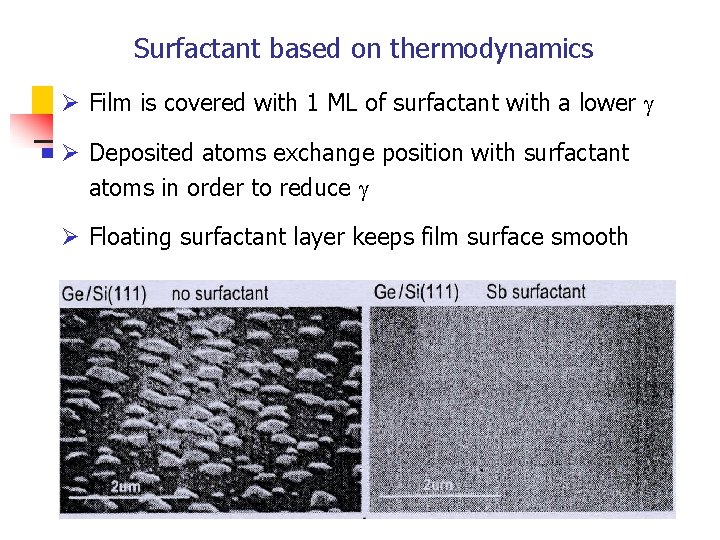
Surfactant based on thermodynamics Ø Film is covered with 1 ML of surfactant with a lower Ø Deposited atoms exchange position with surfactant atoms in order to reduce Ø Floating surfactant layer keeps film surface smooth
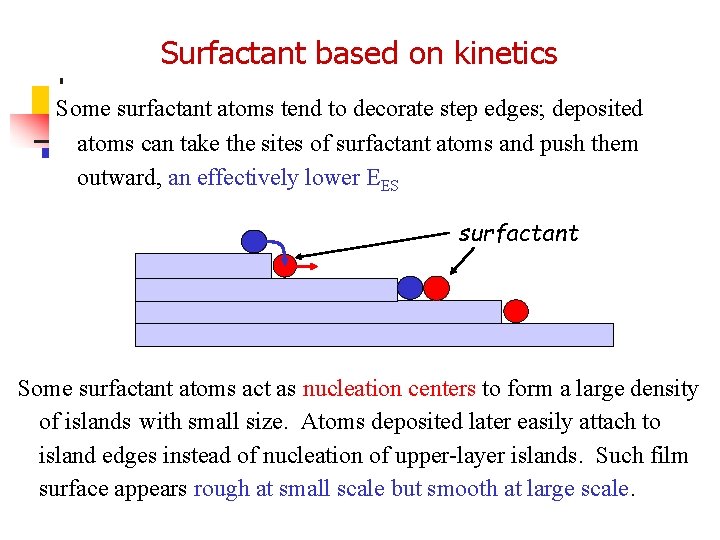
Surfactant based on kinetics Some surfactant atoms tend to decorate step edges; deposited atoms can take the sites of surfactant atoms and push them outward, an effectively lower EES surfactant Some surfactant atoms act as nucleation centers to form a large density of islands with small size. Atoms deposited later easily attach to island edges instead of nucleation of upper-layer islands. Such film surface appears rough at small scale but smooth at large scale.