
PBS SYSTEMS AT TIERS 2 and 3 Presenters
PBS SYSTEMS AT TIERS 2 and 3 Presenters: Chris Borgmeier Kent Mc. Intosh
Schedule n Sessions 9: 00 to 3: 30 ¨ Lunch n 12 to 1 Day 5: Nov. 2 (Making Connections)
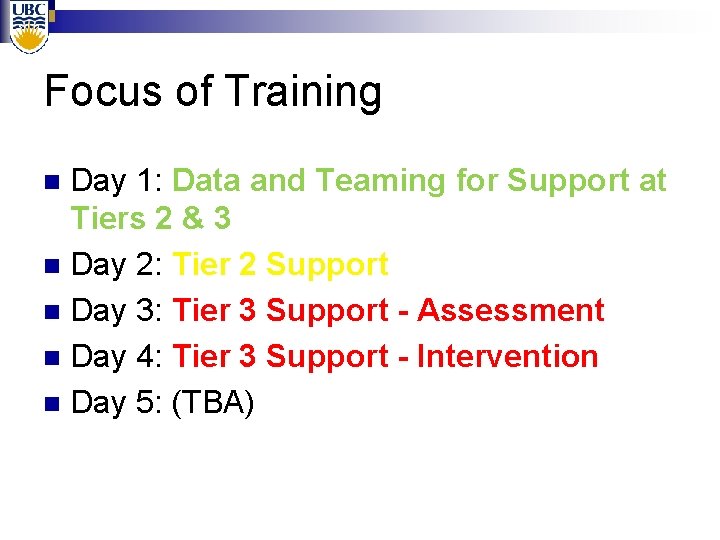
Focus of Training Day 1: Data and Teaming for Support at Tiers 2 & 3 n Day 2: Tier 2 Support n Day 3: Tier 3 Support - Assessment n Day 4: Tier 3 Support - Intervention n Day 5: (TBA) n
Today’s Agenda Introductions n Using the Triangle to Organize Interventions n Data and Teaming at Tiers 2 and 3 n
Introductions n Please share with the group: ¨ Your name, district, and role ¨ Your experience with FBA and function-based support ¨ What you came here to learn
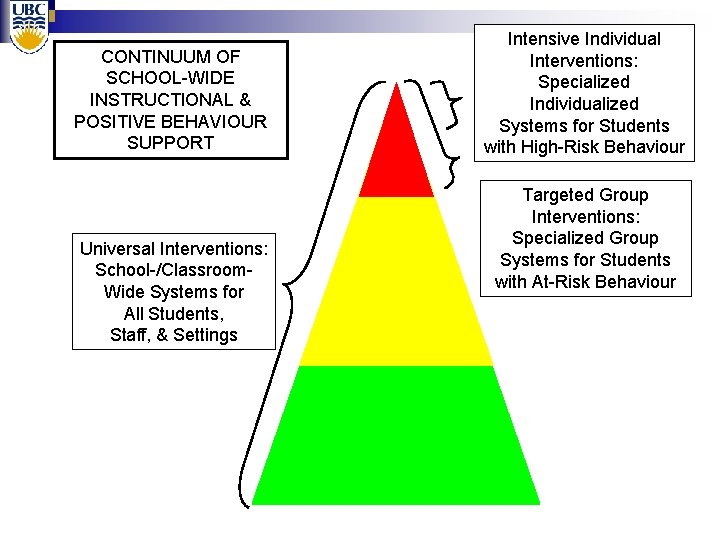
CONTINUUM OF SCHOOL-WIDE INSTRUCTIONAL & POSITIVE BEHAVIOUR SUPPORT Universal Interventions: School-/Classroom. Wide Systems for All Students, Staff, & Settings Intensive Individual Interventions: Specialized Individualized Systems for Students with High-Risk Behaviour Targeted Group Interventions: Specialized Group Systems for Students with At-Risk Behaviour
Universal PBS Systems 1. 2. 3. 4. 5. Define school-wide expectations Teach expectations and socialemotional competencies Monitor and acknowledge prosocial behaviour Provide instructional consequences for problem behaviour Collect information and use it for decision-making
Targeted Interventions n Efficient systems for students who need additional support beyond universal programs ¨ Continuously available ¨ Rapid access (within 72 hrs. ) ¨ Consistent with school-wide system ¨ All school staff have access/knowledge n Should work for most (but not all) students
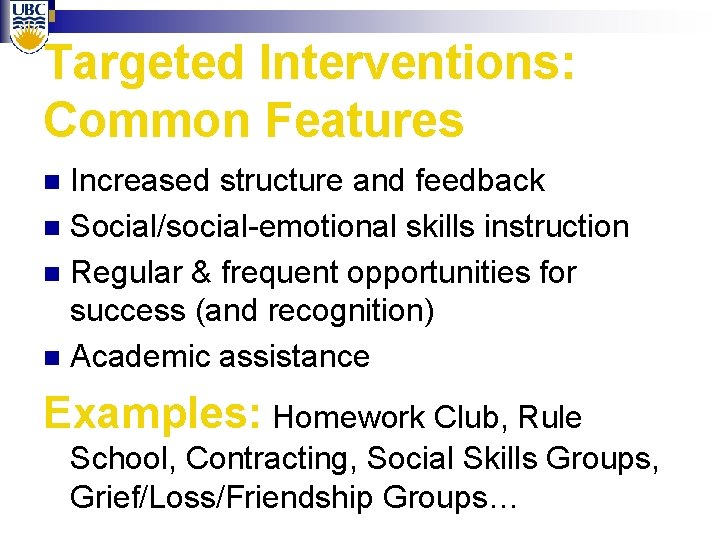
Targeted Interventions: Common Features Increased structure and feedback n Social/social-emotional skills instruction n Regular & frequent opportunities for success (and recognition) n Academic assistance n Examples: Homework Club, Rule School, Contracting, Social Skills Groups, Grief/Loss/Friendship Groups…
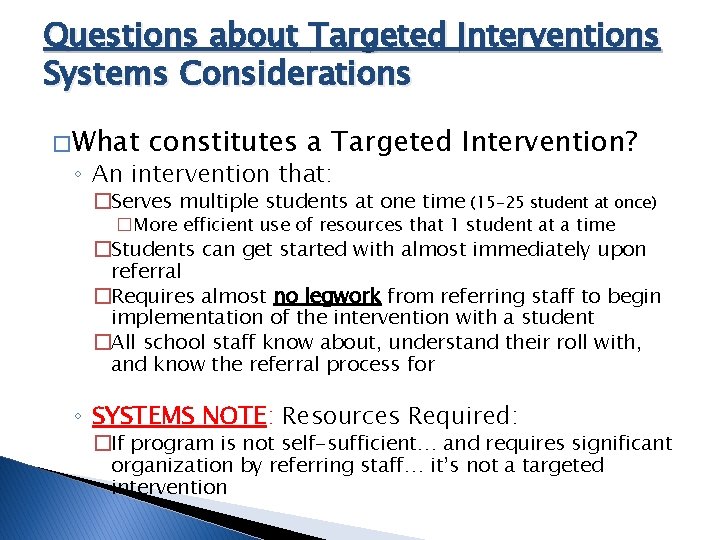
Questions about Targeted Interventions Systems Considerations � What constitutes a Targeted Intervention? ◦ An intervention that: �Serves multiple students at one time (15 -25 student at once) �More efficient use of resources that 1 student at a time �Students can get started with almost immediately upon referral �Requires almost no legwork from referring staff to begin implementation of the intervention with a student �All school staff know about, understand their roll with, and know the referral process for ◦ SYSTEMS NOTE: Resources Required: �If program is not self-sufficient… and requires significant organization by referring staff… it’s not a targeted intervention
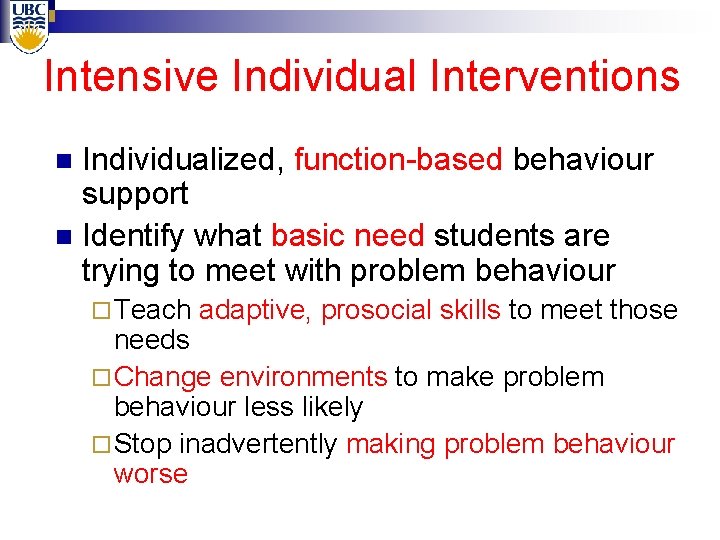
Intensive Individual Interventions Individualized, function-based behaviour support n Identify what basic need students are trying to meet with problem behaviour n ¨ Teach adaptive, prosocial skills to meet those needs ¨ Change environments to make problem behaviour less likely ¨ Stop inadvertently making problem behaviour worse

Investigating your Systems of Support CSI Maps
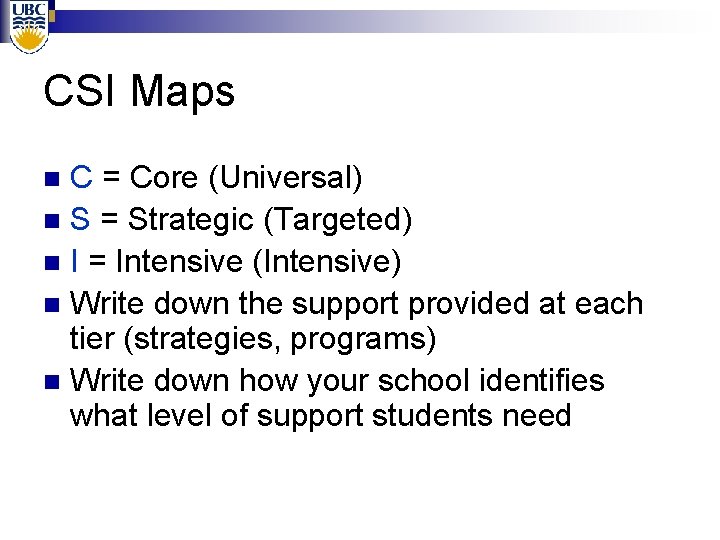
CSI Maps C = Core (Universal) n S = Strategic (Targeted) n I = Intensive (Intensive) n Write down the support provided at each tier (strategies, programs) n Write down how your school identifies what level of support students need n
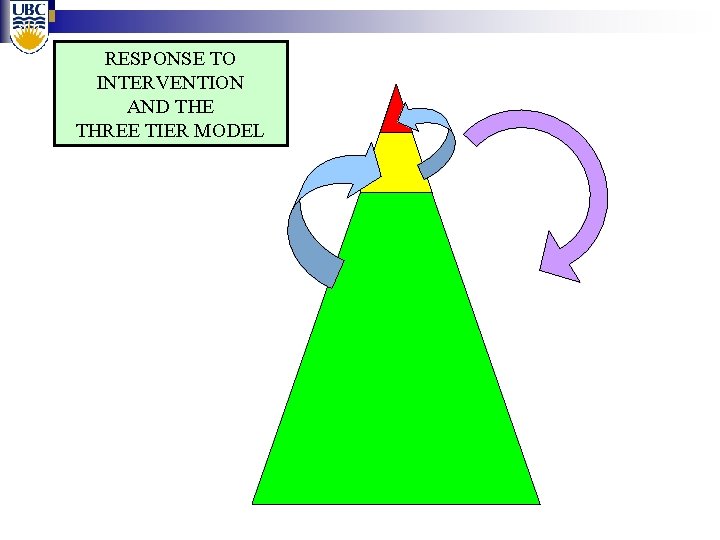
RESPONSE TO INTERVENTION AND THE THREE TIER MODEL
CSI Maps C = Core (Universal) n S = Strategic (Targeted) n I = Intensive (Intensive) n Write down the support provided at each tier (strategies, programs) n Write down how your school identifies what level of support students need n

CSI Maps: Interpretation 1. Identify GAPS in: Support 2. Assessment 1. 2. 3. Consider priorities for filling gaps How are you going to choose?
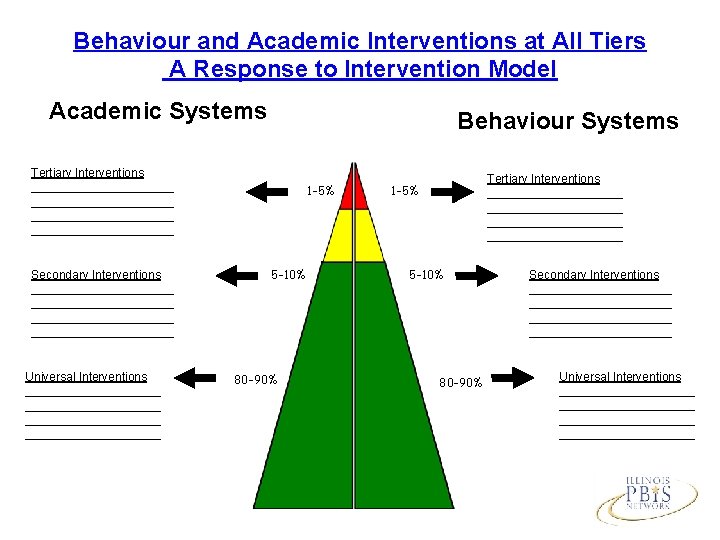
Behaviour and Academic Interventions at All Tiers A Response to Intervention Model Academic Systems Behaviour Systems Tertiary Interventions ___________________ Secondary Interventions ___________________ Universal Interventions __________________ 1 -5% 5 -10% 80 -90% Tertiary Interventions __________________ 1 -5% 5 -10% 80 -90% Secondary Interventions ___________________ Universal Interventions __________________
What do your schools’ individual student support systems look like? 1. How are students who need help identified? ¨ 2. How are behaviour plans created? ¨ 3. Followed whatever the last workshop said How do you know if plans are in place? ¨ 4. Whenever the teacher is at wit’s end I thought it was done once we made the plan! How do you know if they are working? ¨ Why are you still asking me these questions?
- Slides: 18