
PBL CURRICULUM STRUCTURE WHAT DOES PBL LOOK LIKE
PBL CURRICULUM STRUCTURE: WHAT DOES PBL LOOK LIKE? Dr. Cindy Hmelo-Silver Andi Gomoll School of Education Indiana University, Bloomington
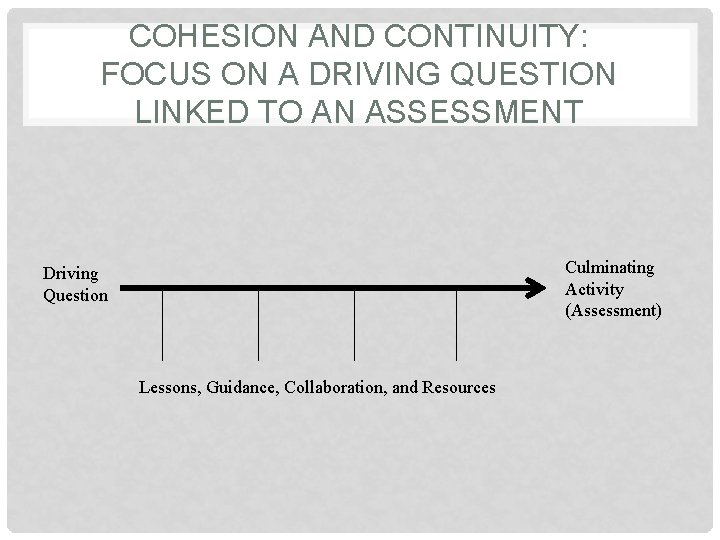
COHESION AND CONTINUITY: FOCUS ON A DRIVING QUESTION LINKED TO AN ASSESSMENT Culminating Activity (Assessment) Driving Question Lessons, Guidance, Collaboration, and Resources
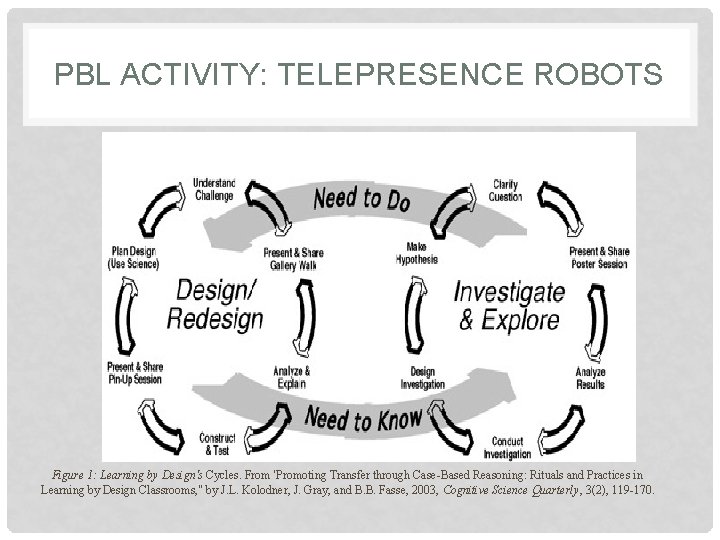
PBL ACTIVITY: TELEPRESENCE ROBOTS Figure 1: Learning by Design's Cycles. From 'Promoting Transfer through Case-Based Reasoning: Rituals and Practices in Learning by Design Classrooms, " by J. L. Kolodner, J. Gray, and B. B. Fasse, 2003, Cognitive Science Quarterly, 3(2), 119 -170.
SCAFFOLDED INSTRUCTION • Assumption: ALL students can perform at a higher level with appropriate structure and support • (And this is really important!) “[I don’t prefer PBL]. This is mainly due to the extreme lack of direction that seemed to always be present with this approach [problem-based learning]. Of the information I did learn in this fashion [problem-based learning], I feel much less confident that I got everything I needed to get out of the subjects taught in this manner [problem-based learning]. ” (EE student) Yadav, A. , Subedi, D. , & Lundeberg, M. (2011). Problem-based Learning: Influence on Students’ Learning in an Electrical Engineering Course. Journal of Engineering, 100(2), 253 -280.
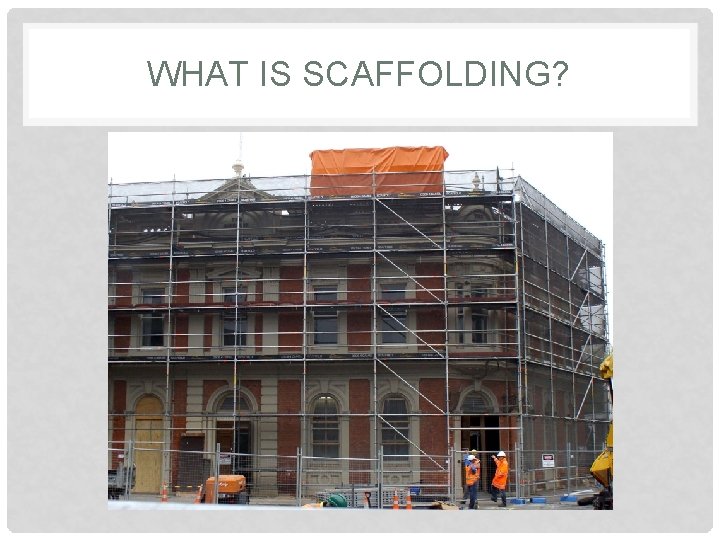
WHAT IS SCAFFOLDING?
SCAFFOLDED INSTRUCTION • Hard Scaffolding • Support planned in advance based on typical difficulties • Built into structure of learning environment or into available tools or resources • Soft Scaffolding • Timely support provided by the teacher based upon learner responses • Adaptive and contingent
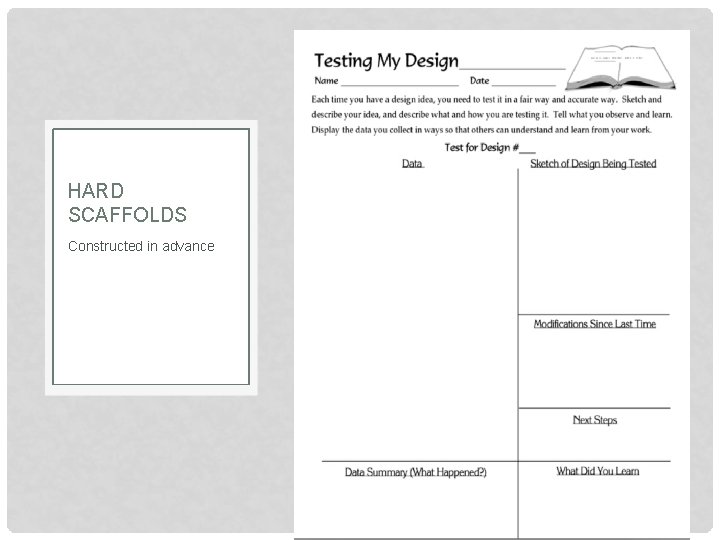
HARD SCAFFOLDS Constructed in advance

SOFT SCAFFOLDING • Example of Soft Scaffolding
TYPES OF HARD SCAFFOLDS* • Communicating process • Design diaries model design process • Fixed in advance • Eliciting articulation • Criteria or rubrics for gallery walk provide structure for students to reflect on what they see • KWL chart elicits students ideas (but also communicates process) • Conceptual- asking students to reflect on how particular ideas helped them in their designs? • What kinds of scaffolds can we help provide to support the design process?
OUTLINING THE CONTENT AND SUPPORT • What do students NEED to know to address question and complete culminating activity? • Don’t release them to the world! • What resources do students need? • Don’t overwhelm them! • What supports and hard scaffolds do they need? • In what sequence do they need the information and resources?

QUESTIONS AND DISCUSSION https: //iu. instructure. com/courses/15019 66/pages/unit-1 -companion-robot
- Slides: 11