
PBIS UNIVERSAL SCREENING Webinar Presented by The VTPBi

PBIS UNIVERSAL SCREENING Webinar Presented by: The VTPBi. S Team
Agenda What is screening? Why would you want it? What does it look like? Can we try? How do we get started?
Materials You will need: -Universal Screening Flowchart -Sample Systematic Screener for Behavior Disorders Form -Basc-2 Form
Negative Outcomes for Unidentified and Untreated Youth • Poor grades • Impaired personal relationships • High school dropout • Unemployment • Incarceration • Substance abuse • Suicide
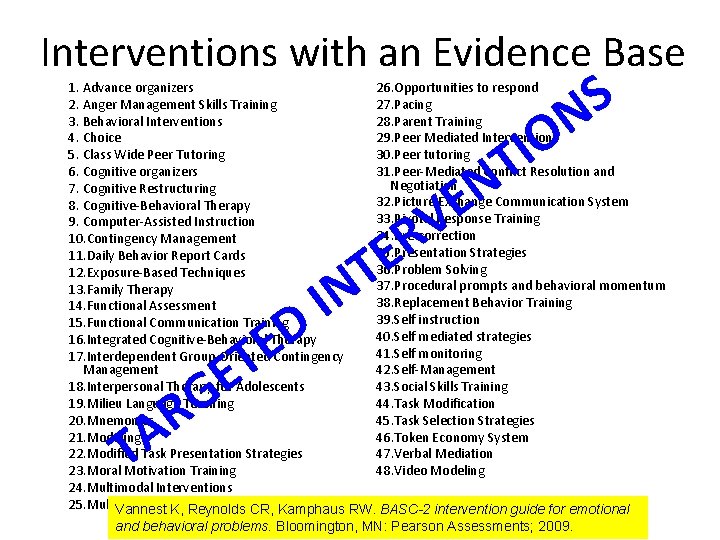
Interventions with an Evidence Base S N 1. Advance organizers 26. Opportunities to respond 2. Anger Management Skills Training 27. Pacing 28. Parent Training 3. Behavioral Interventions 29. Peer Mediated Interventions 4. Choice 30. Peer tutoring 5. Class Wide Peer Tutoring 31. Peer-Mediated Conflict Resolution and 6. Cognitive organizers Negotiation 7. Cognitive Restructuring 32. Picture Exchange Communication System 8. Cognitive-Behavioral Therapy 33. Pivotal Response Training 9. Computer-Assisted Instruction 34. Pre-correction 10. Contingency Management 35. Presentation Strategies 11. Daily Behavior Report Cards 36. Problem Solving 12. Exposure-Based Techniques 37. Procedural prompts and behavioral momentum 13. Family Therapy 38. Replacement Behavior Training 14. Functional Assessment 39. Self instruction 15. Functional Communication Training 40. Self mediated strategies 16. Integrated Cognitive-Behavioral Therapy 41. Self monitoring 17. Interdependent Group-Oriented Contingency 42. Self-Management 43. Social Skills Training 18. Interpersonal Therapy for Adolescents 44. Task Modification 19. Milieu Language Teaching 45. Task Selection Strategies 20. Mnemonics 46. Token Economy System 21. Modeling 47. Verbal Mediation 22. Modified Task Presentation Strategies 48. Video Modeling 23. Moral Motivation Training 24. Multimodal Interventions 25. Multisystemic Vannest Therapy K, Reynolds CR, Kamphaus RW. BASC-2 intervention guide for emotional O I T N E G R T E A T D E V R E I T N and behavioral problems. Bloomington, MN: Pearson Assessments; 2009.
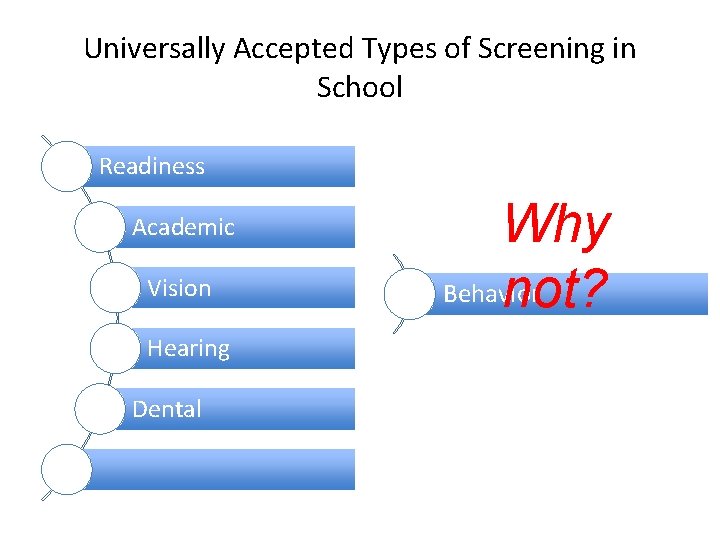
Universally Accepted Types of Screening in School Readiness Academic Vision Hearing Dental Why Behavior not?
Why Universal Screening? • To find students whose problems are not immediately obvious and identify problems with a high degree of accuracy • Early identification leads to early intervention • To be more effective and efficient in selecting interventions based on data.
Aren’t ODRs Enough? Students with externalizing internalizing problems?
Take Five! How does your school determine what interventions to use with students?
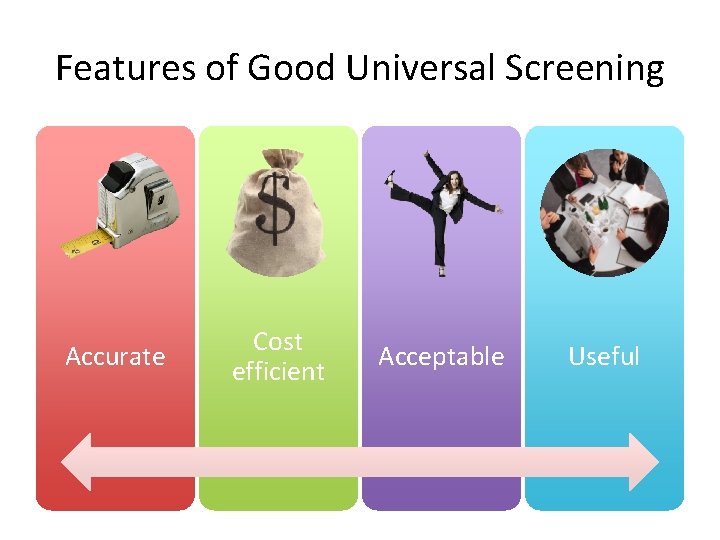
Features of Good Universal Screening Accurate Cost efficient Acceptable Useful
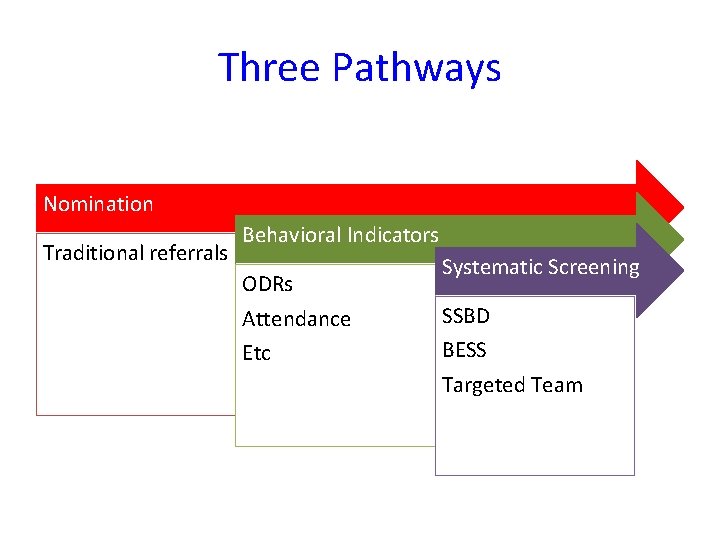
Three Pathways Nomination Traditional referrals Behavioral Indicators ODRs Attendance Etc Systematic Screening SSBD BESS Targeted Team
NOMINATION Universal Screening: SSBD Background Information The Systematic Screening for Behavior Disorders (SSBD) (Walker and Severson, 1992) – Developed as a school-wide (Universal) screening tool for children in grades 1 -6 – Identifies behaviors that may impede academic and social functioning – Leads to earlier intervention – May reduce need formalized “requests for assistance”
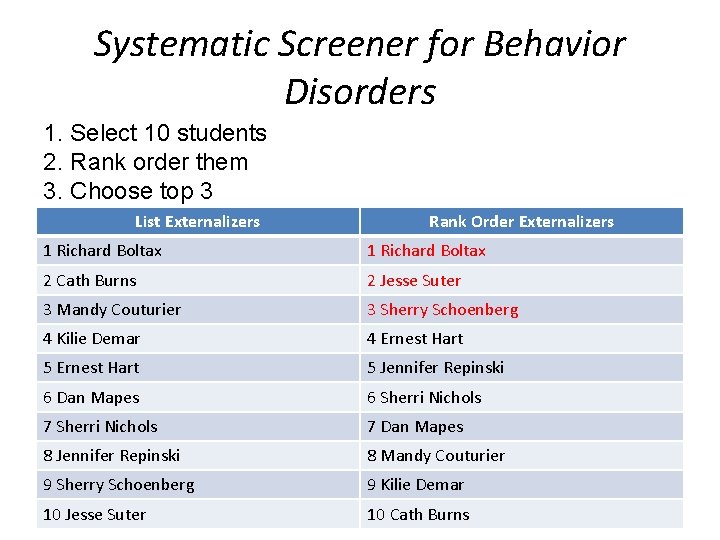
Systematic Screener for Behavior Disorders 1. Select 10 students 2. Rank order them 3. Choose top 3 List Externalizers Rank Order Externalizers 1 Richard Boltax 2 Cath Burns 2 Jesse Suter 3 Mandy Couturier 3 Sherry Schoenberg 4 Kilie Demar 4 Ernest Hart 5 Jennifer Repinski 6 Dan Mapes 6 Sherri Nichols 7 Dan Mapes 8 Jennifer Repinski 8 Mandy Couturier 9 Sherry Schoenberg 9 Kilie Demar 10 Jesse Suter 10 Cath Burns
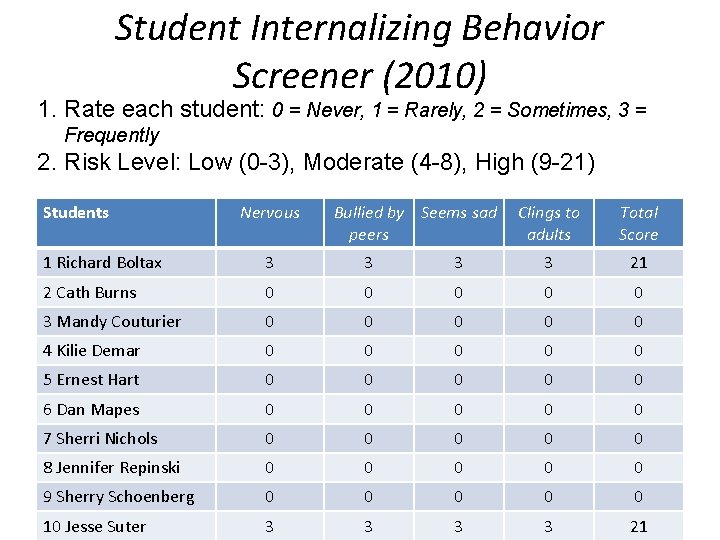
Student Internalizing Behavior Screener (2010) 1. Rate each student: 0 = Never, 1 = Rarely, 2 = Sometimes, 3 = Frequently 2. Risk Level: Low (0 -3), Moderate (4 -8), High (9 -21) Students Nervous Bullied by Seems sad peers Clings to adults Total Score 1 Richard Boltax 3 3 21 2 Cath Burns 0 0 0 3 Mandy Couturier 0 0 0 4 Kilie Demar 0 0 0 5 Ernest Hart 0 0 0 6 Dan Mapes 0 0 0 7 Sherri Nichols 0 0 0 8 Jennifer Repinski 0 0 0 9 Sherry Schoenberg 0 0 0 10 Jesse Suter 3 3 21
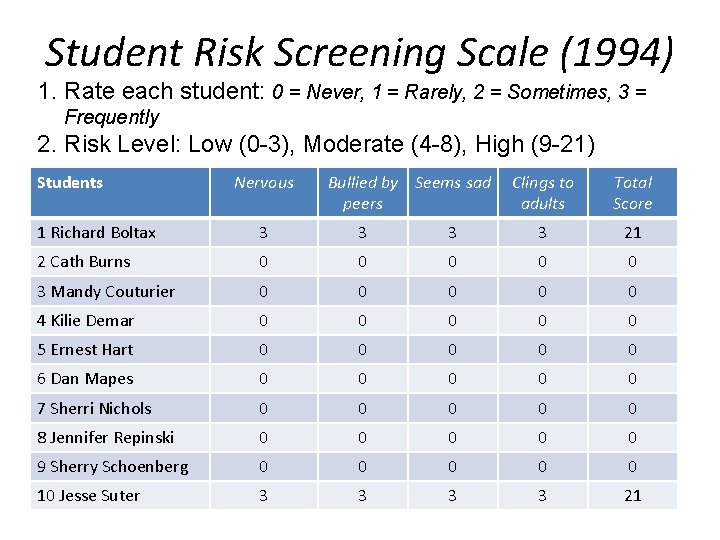
Student Risk Screening Scale (1994) 1. Rate each student: 0 = Never, 1 = Rarely, 2 = Sometimes, 3 = Frequently 2. Risk Level: Low (0 -3), Moderate (4 -8), High (9 -21) Students Nervous Bullied by Seems sad peers Clings to adults Total Score 1 Richard Boltax 3 3 21 2 Cath Burns 0 0 0 3 Mandy Couturier 0 0 0 4 Kilie Demar 0 0 0 5 Ernest Hart 0 0 0 6 Dan Mapes 0 0 0 7 Sherri Nichols 0 0 0 8 Jennifer Repinski 0 0 0 9 Sherry Schoenberg 0 0 0 10 Jesse Suter 3 3 21
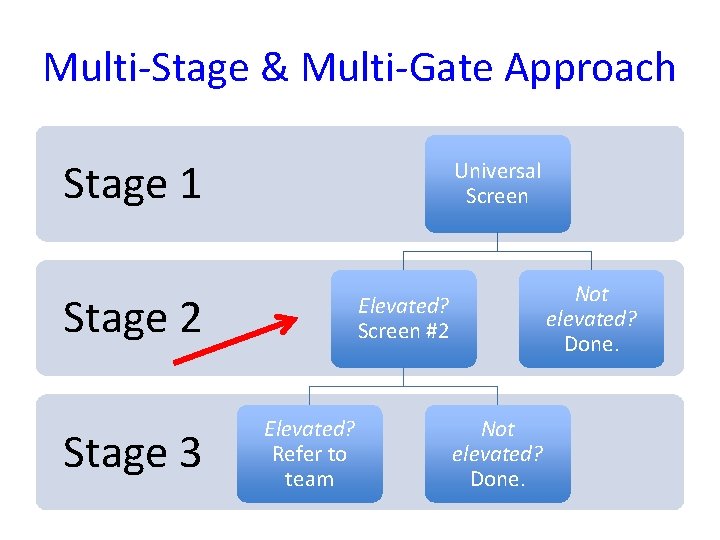
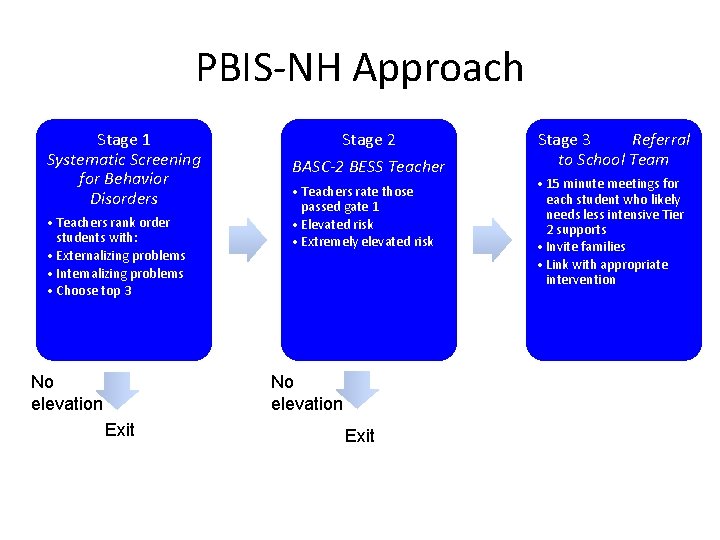
Multi-Stage & Multi-Gate Approach Stage 1 Universal Screen Stage 2 Stage 3 Not elevated? Done. Elevated? Screen #2 Elevated? Refer to team Not elevated? Done.
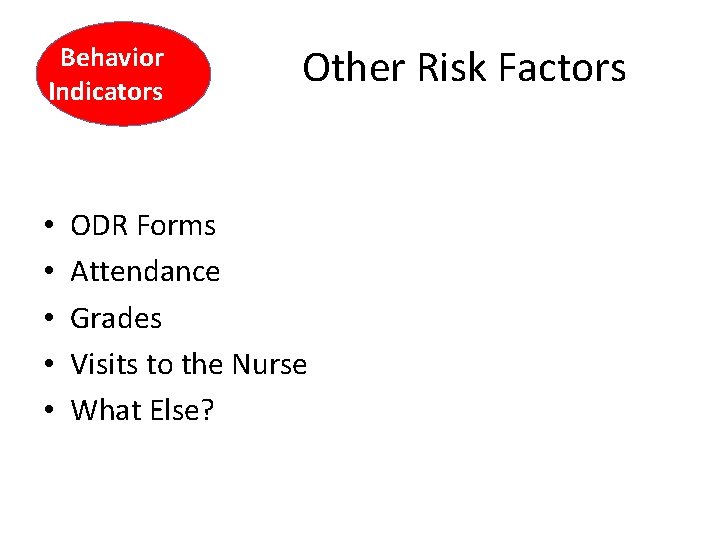
Behavior Indicators • • • Other Risk Factors ODR Forms Attendance Grades Visits to the Nurse What Else?
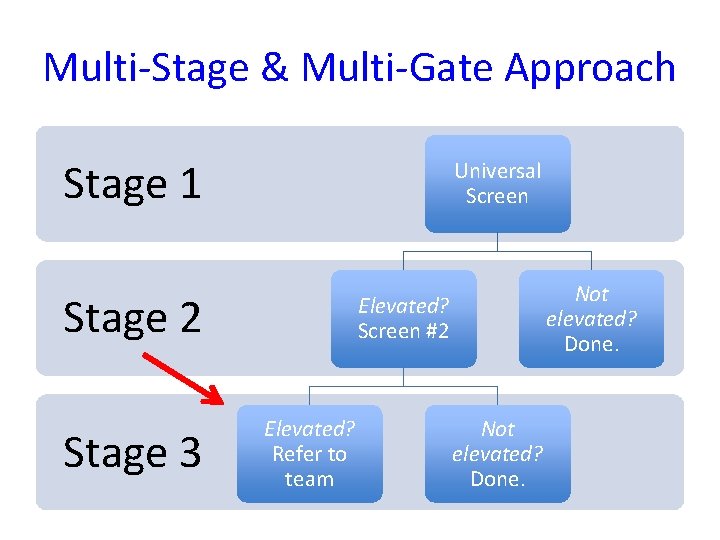
Multi-Stage & Multi-Gate Approach Stage 1 Universal Screen Stage 2 Stage 3 Not elevated? Done. Elevated? Screen #2 Elevated? Refer to team Not elevated? Done.
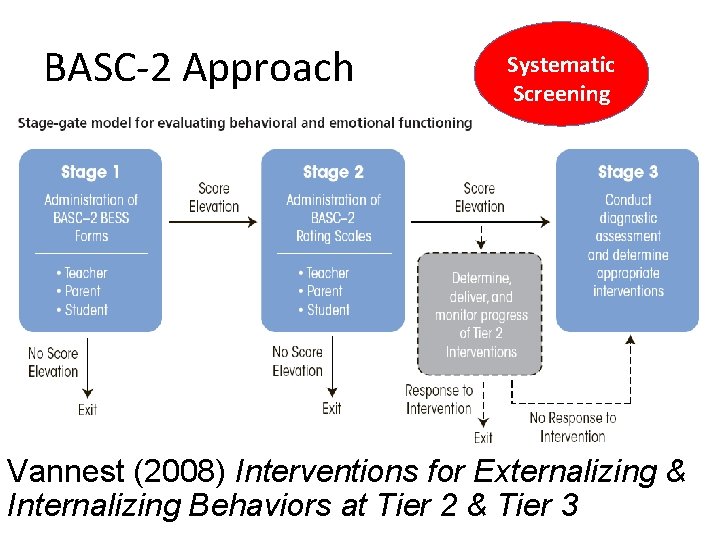
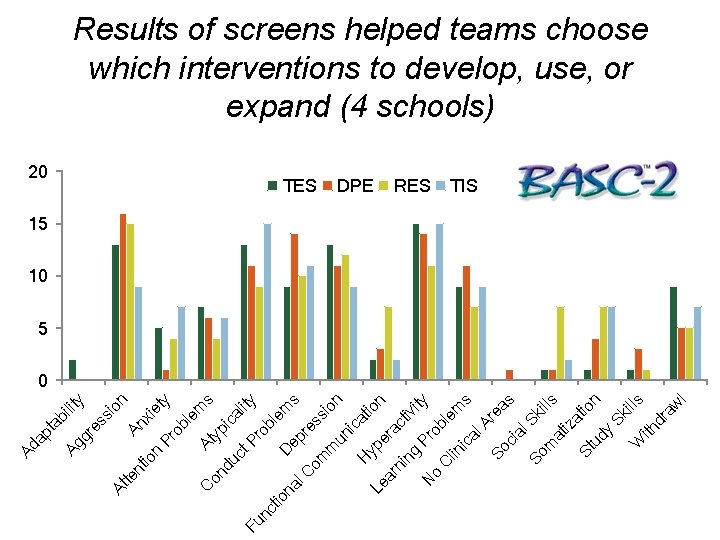
BASC-2 Approach Systematic Screening Vannest (2008) Interventions for Externalizing & Internalizing Behaviors at Tier 2 & Tier 3
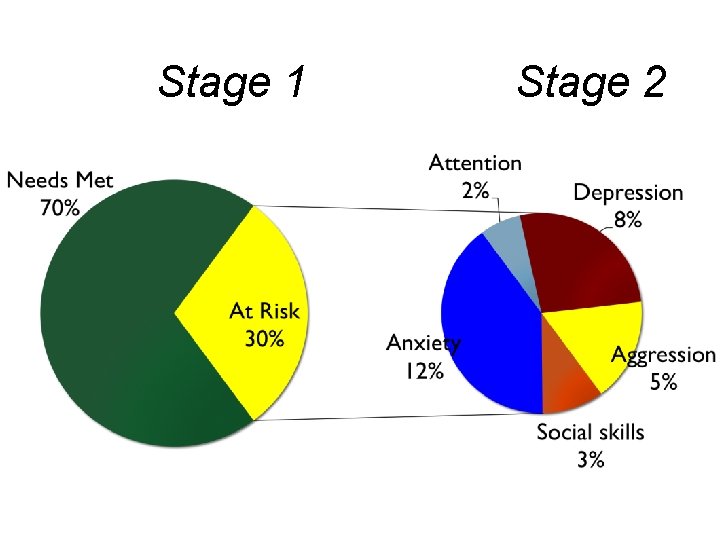
Stage 1 Stage 2
ab ilit y gr es si on At te An nt xi io et n y Pr ob le m At C s on yp du ic al ct ity Fu Pr ob nc le tio m D na e s pr l. C om ess io m n un ic at H y Le pe ion ar ra ni ng ctiv ity Pr N ob o C le lin m ic s al Ar ea So s ci al Sk So ills m at iz at St i ud on y Sk ills W ith dr aw l Ag ap t Ad Results of screens helped teams choose which interventions to develop, use, or expand (4 schools) 20 TES DPE RES TIS 15 10 5 0
PBIS-NH Approach Stage 1 Systematic Screening for Behavior Disorders • Teachers rank order students with: • Externalizing problems • Internalizing problems • Choose top 3 No elevation Stage 2 BASC-2 BESS Teacher • Teachers rate those passed gate 1 • Elevated risk • Extremely elevated risk No elevation Exit Stage 3 Referral to School Team • 15 minute meetings for each student who likely needs less intensive Tier 2 supports • Invite families • Link with appropriate intervention
Screening Tips • Recommended twice / year (October & February) • Group administration of Stage 1 • Teachers should have known students for at least one month • Review definitions / examples of externalizing and internalizing problems
So pretty simple, right? Well… • Family’s right to privacy (opt out option) • Clear & efficient systems to support process • Training & TA • Availability of supports • Policy and liability issues • What else?
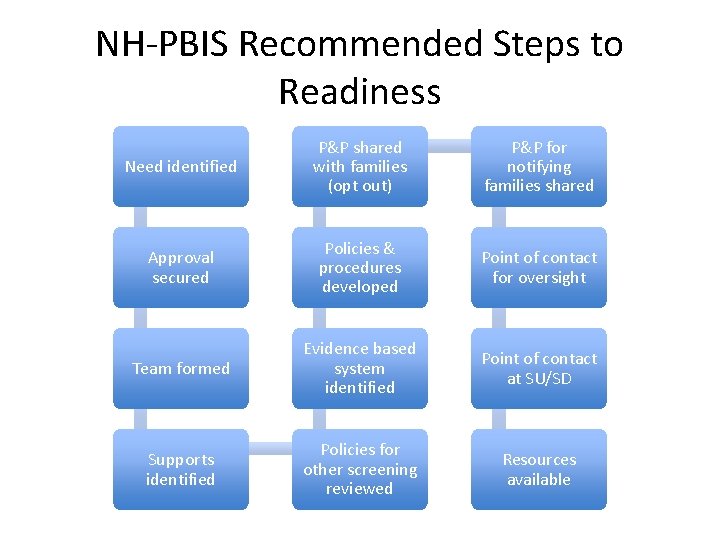
NH-PBIS Recommended Steps to Readiness Need identified P&P shared with families (opt out) P&P for notifying families shared Approval secured Policies & procedures developed Point of contact for oversight Team formed Evidence based system identified Point of contact at SU/SD Supports identified Policies for other screening reviewed Resources available
How to Get Started Preparation for Screening Before actual screening–– • Have a solid Targeted PBIS system (with interventions) already in place. • Tie in to existing PBIS systems (integration, NOT addon). • Identify what your school’s risk factors, or other behavior indicators you will track • Create a calendar for when you screenings will occur • Provide plan for seamless transition from screening to intervention
How to Get Started Preparation for Screening Select a Coordinator–– Someone with strong: • Organizational skills • Leadership skills • Experience with assessment tools (e. g. , BASC, Conners)
How to Get Started Preparation for Screening Before actual screening–– • Provide plan for seamless transition from screening to intervention • Provide teacher training • Provide Parental notification of screening and parental consent to intervene with youth identified by SSBD
What Next? 1. Review Universal Screening Steps to Readiness 2. Where’s your school in this process? 3. Other system tools?
Now What? Review all & complete one for your student • • BASC-2 BESS Teacher Form, Systematic Screening for Behavior Disorders, Student Risk Screening Scale, Student Internalizing Behavior Screener

Thank You!
- Slides: 32