
PBIS Team Training 4 C PBIS in the
PBIS Team Training 4 C PBIS in the Classroom (TFI 1. 8) Responding to Behavior (TFI 1. 6) Day 4: Response to Behavior in the Classroom (TFI 1. 6 & 1. 8)
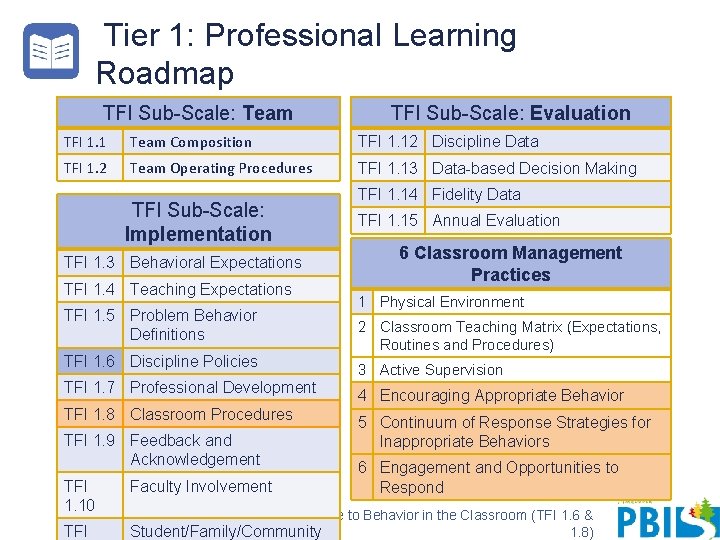
Tier 1: Professional Learning Roadmap TFI Sub-Scale: Team TFI Sub-Scale: Evaluation TFI 1. 1 Team Composition TFI 1. 12 Discipline Data TFI 1. 2 Team Operating Procedures TFI 1. 13 Data-based Decision Making TFI Sub-Scale: Implementation TFI 1. 3 Behavioral Expectations TFI 1. 4 Teaching Expectations TFI 1. 5 Problem Behavior Definitions TFI 1. 6 Discipline Policies TFI 1. 7 Professional Development TFI 1. 8 Classroom Procedures TFI 1. 9 Feedback and Acknowledgement TFI 1. 10 TFI Faculty Involvement TFI 1. 14 Fidelity Data TFI 1. 15 Annual Evaluation 6 Classroom Management Practices 1 Physical Environment 2 Classroom Teaching Matrix (Expectations, Routines and Procedures) 3 Active Supervision 4 Encouraging Appropriate Behavior 5 Continuum of Response Strategies for Inappropriate Behaviors 6 Engagement and Opportunities to Respond Day 4: Response to Behavior in the Classroom (TFI 1. 6 & 1. 8) Student/Family/Community
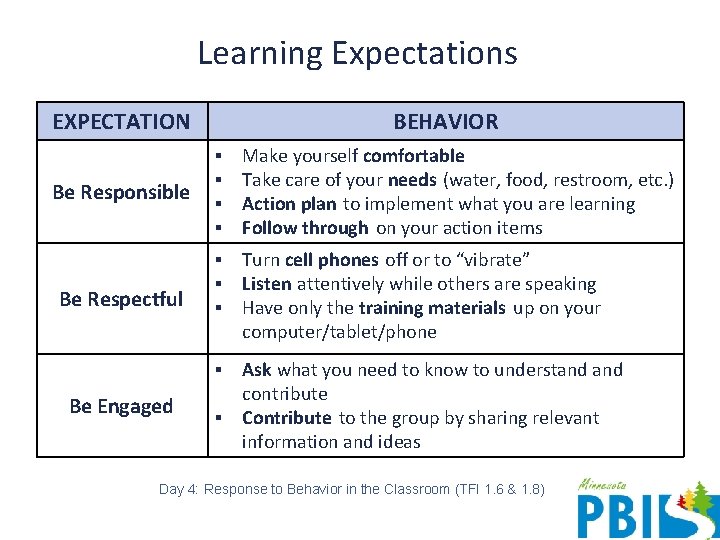
Learning Expectations EXPECTATION Be Responsible Be Respectful Be Engaged BEHAVIOR ▪ ▪ Make yourself comfortable Take care of your needs (water, food, restroom, etc. ) Action plan to implement what you are learning Follow through on your action items ▪ Turn cell phones off or to “vibrate” ▪ Listen attentively while others are speaking ▪ Have only the training materials up on your computer/tablet/phone ▪ Ask what you need to know to understand contribute ▪ Contribute to the group by sharing relevant information and ideas Day 4: Response to Behavior in the Classroom (TFI 1. 6 & 1. 8)
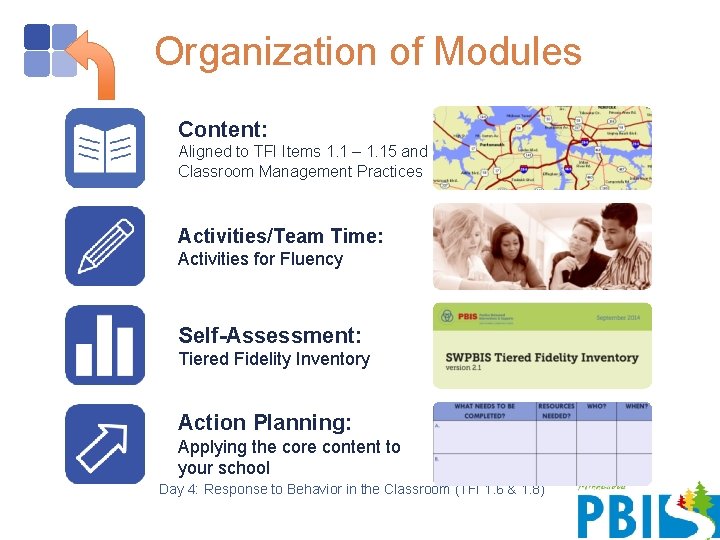
Organization of Modules Content: Aligned to TFI Items 1. 1 – 1. 15 and Classroom Management Practices Activities/Team Time: Activities for Fluency Self-Assessment: Tiered Fidelity Inventory Action Planning: Applying the core content to your school Day 4: Response to Behavior in the Classroom (TFI 1. 6 & 1. 8)
How Do You Respond? Day 4: Response to Behavior in the Classroom (TFI 1. 6 & 1. 8)
Research Based Behavior Principles ▪ Behavior is learned. ▪ Behavior can be changed. ▪ Lasting behavioral change is more likely with positive rather than punitive techniques. ▪ No student should be intentionally or unintentionally humiliated or belittled. Day 4: Response to Behavior in the Classroom (TFI 1. 6 & 1. 8)
2 Minute Chat At your table, discuss which one of the behavioral principles on the previous slide you would anticipate is the hardest for your staff to embrace. Day 4: Response to Behavior in the Classroom (TFI 1. 6 & 1. 8)
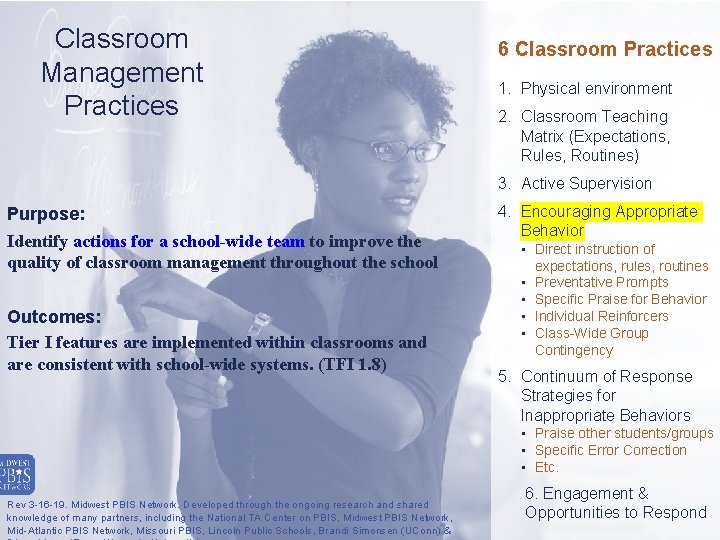
Classroom Management Practices 6 Classroom Practices 1. Physical environment 2. Classroom Teaching Matrix (Expectations, Rules, Routines) 3. Active Supervision Purpose: Identify actions for a school-wide team to improve the quality of classroom management throughout the school Outcomes: Tier I features are implemented within classrooms and are consistent with school-wide systems. (TFI 1. 8) 4. Encouraging Appropriate Behavior ▪ Direct instruction of expectations, rules, routines ▪ Preventative Prompts ▪ Specific Praise for Behavior ▪ Individual Reinforcers ▪ Class-Wide Group Contingency 5. Continuum of Response Strategies for Inappropriate Behaviors • Praise other students/groups • Specific Error Correction • Etc. Rev 3 -16 -19. Midwest PBIS Network. Developed through the ongoing research and shared 4 B Responding knowledge of many partners, including the National TA Center on PBIS, Midwest PBIS Network, Mid-Atlantic PBIS Network, Missouri PBIS, Lincoln Public Schools, Brandi Simonsen (UConn) & 6. Engagement & Opportunities to Respond to Behavior
Encouraging Appropriate Behavior A set of strategies that encourage appropriate behavior by instructing what is expected, communicating positive examples, giving specific feedback, and motivating students with reinforcers designed to promote a growth mindset and community inclusion. Rev 7 -2419 Day 4: Response to Behavior in the Classroom (TFI 1. 6 & 1. 8)
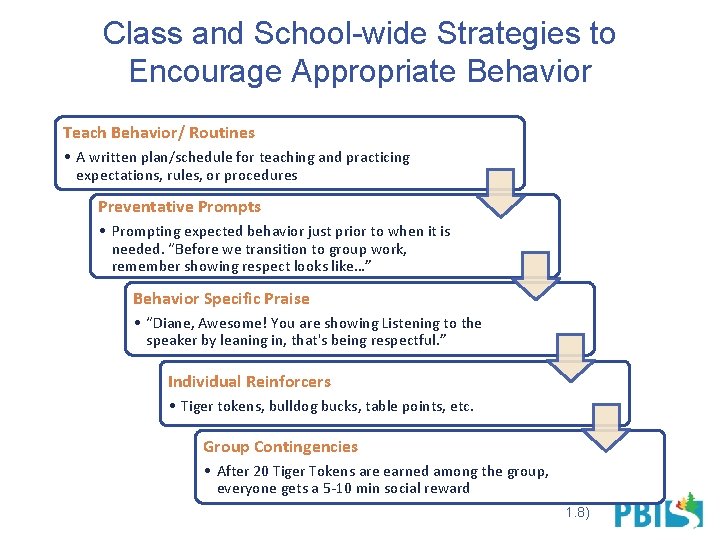
Class and School-wide Strategies to Encourage Appropriate Behavior Teach Behavior/ Routines • A written plan/schedule for teaching and practicing expectations, rules, or procedures Preventative Prompts • Prompting expected behavior just prior to when it is needed. “Before we transition to group work, remember showing respect looks like…” Behavior Specific Praise • “Diane, Awesome! You are showing Listening to the speaker by leaning in, that's being respectful. ” Individual Reinforcers • Tiger tokens, bulldog bucks, table points, etc. Group Contingencies • After 20 Tiger Tokens are earned among the group, everyone gets a 5 -10 socialinreward Day 4: Response tomin Behavior the Classroom (TFI 1. 6 & 1. 8)
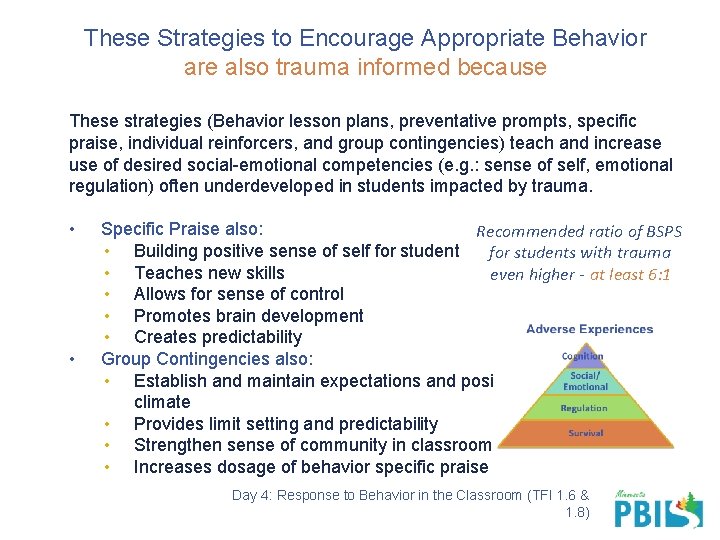
These Strategies to Encourage Appropriate Behavior are also trauma informed because These strategies (Behavior lesson plans, preventative prompts, specific praise, individual reinforcers, and group contingencies) teach and increase use of desired social-emotional competencies (e. g. : sense of self, emotional regulation) often underdeveloped in students impacted by trauma. • • Specific Praise also: Recommended ratio of BSPS • Building positive sense of self for students with trauma • Teaches new skills even higher - at least 6: 1 • Allows for sense of control • Promotes brain development • Creates predictability Group Contingencies also: • Establish and maintain expectations and positive climate • Provides limit setting and predictability • Strengthen sense of community in classroom • Increases dosage of behavior specific praise Day 4: Response to Behavior in the Classroom (TFI 1. 6 & 1. 8)
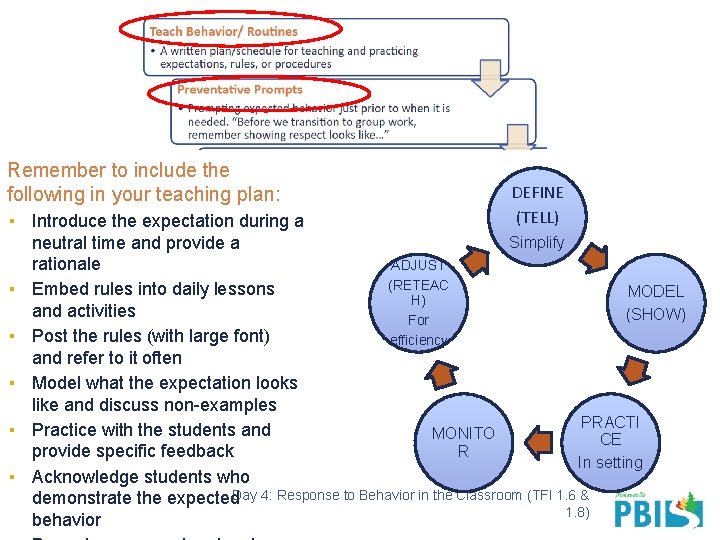
Remember to include the following in your teaching plan: DEFINE (TELL) ▪ Introduce the expectation during a Simplify neutral time and provide a rationale ADJUST (RETEAC ▪ Embed rules into daily lessons MODEL H) and activities (SHOW) For ▪ Post the rules (with large font) efficiency and refer to it often ▪ Model what the expectation looks like and discuss non-examples PRACTI ▪ Practice with the students and MONITO CE R provide specific feedback In setting ▪ Acknowledge students who demonstrate the expected. Day 4: Response to Behavior in the Classroom (TFI 1. 6 & 1. 8) behavior
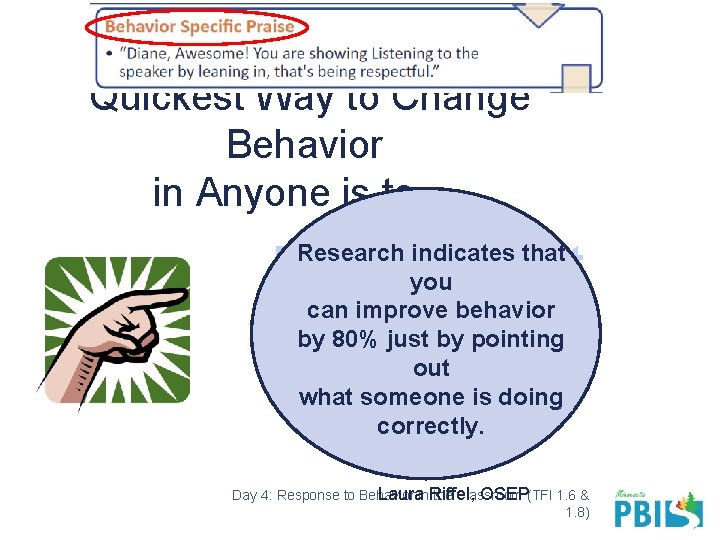
Quickest Way to Change Behavior in Anyone is to… Point out what they’re doing right! Research indicates that you can improve behavior by 80% just by pointing out what someone is doing correctly. Laurain. Riffel, OSEP(TFI 1. 6 & Day 4: Response to Behavior the Classroom 1. 8)
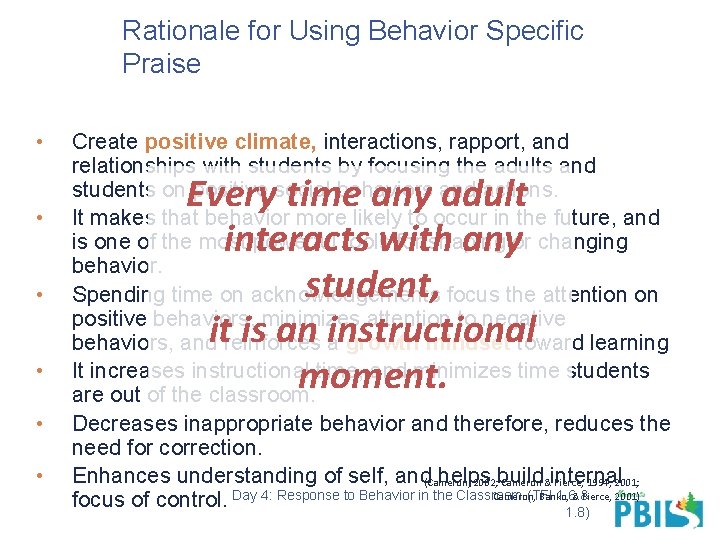
Rationale for Using Behavior Specific Praise • • • Create positive climate, interactions, rapport, and relationships with students by focusing the adults and students on positive social behaviors and actions. It makes that behavior more likely to occur in the future, and is one of the most powerful tools for shaping or changing behavior. Spending time on acknowledgements focus the attention on positive behaviors, minimizes attention to negative behaviors, and reinforces a growth mindset toward learning It increases instructional time, and minimizes time students are out of the classroom. Decreases inappropriate behavior and therefore, reduces the need for correction. Enhances understanding of self, and(Cameron, helps 2002; build Cameron &internal Pierce, 1994, 2001; Cameron, Banko, Pierce, 2001) Day 4: Response to Behavior in the Classroom (TFI 1. 6& & focus of control. 1. 8) Every time any adult interacts with any student, it is an instructional moment.
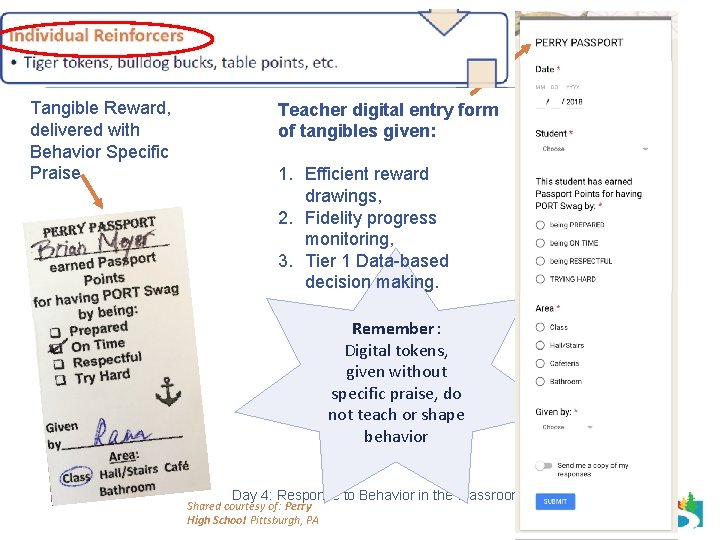
Tangible Reward, delivered with Behavior Specific Praise Teacher digital entry form of tangibles given: 1. Efficient reward drawings, 2. Fidelity progress monitoring, 3. Tier 1 Data-based decision making. Remember: Digital tokens, given without specific praise, do not teach or shape behavior Day 4: Response to Behavior in the Classroom (TFI 1. 6 & 1. 8) Shared courtesy of: Perry High School Pittsburgh, PA
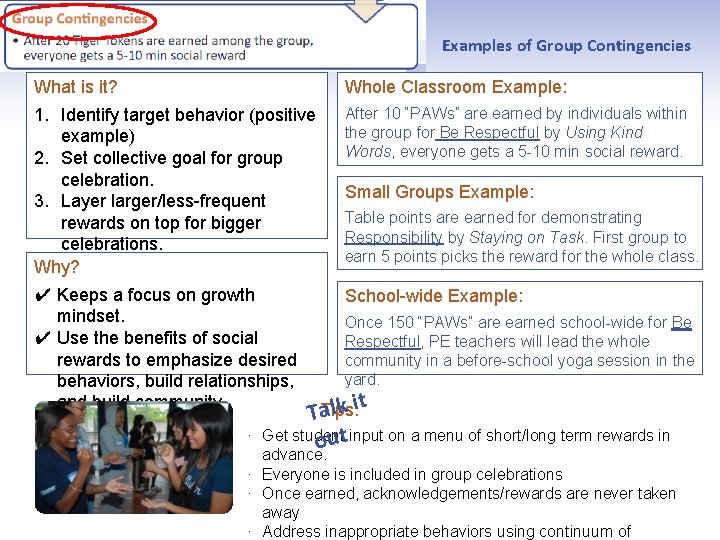
Examples of Group Contingencies What is it? Whole Classroom Example: 1. Identify target behavior (positive example) 2. Set collective goal for group celebration. 3. Layer larger/less-frequent rewards on top for bigger celebrations. Why? After 10 “PAWs” are earned by individuals within the group for Be Respectful by Using Kind Words, everyone gets a 5 -10 min social reward. ✔ Keeps a focus on growth mindset. ✔ Use the benefits of social rewards to emphasize desired behaviors, build relationships, and build community. School-wide Example: ∙ Small Groups Example: Table points are earned for demonstrating Responsibility by Staying on Task. First group to earn 5 points picks the reward for the whole class. Once 150 “PAWs” are earned school-wide for Be Respectful, PE teachers will lead the whole community in a before-school yoga session in the yard. alk it TTips: Get student utinput on a menu of short/long term rewards in o advance. ∙ Everyone is included in group celebrations ∙ 4: Once earned, acknowledgements/rewards are Day Response to Behavior in the Classroom (TFI 1. 6 & never taken 1. 8) away ∙ Address inappropriate behaviors using continuum of
Reflecting on your Classroom Management System ▪ Pro-active or reactive? ▪ Does your system include teaching, pre-correcting, subtle re-directs before consequence? ▪ Does your system include re-teaching as part of consequence? ▪ Does your system acknowledge students when they are displaying appropriate behaviors? ▪ Do you take acknowledgments away once they are earned? ▪ Does your system publicly shame students for negative behavior? Day 4: Response to Behavior in the Classroom (TFI 1. 6 & 1. 8)
Encouraging Appropriate Behavior - Turn & Talk With your team, pinpoint 2 key learnings about Encouraging Appropriate Behavior that need to be brought back to your entire staff. Day 4: Response to Behavior in the Classroom (TFI 1. 6 & 1. 8)
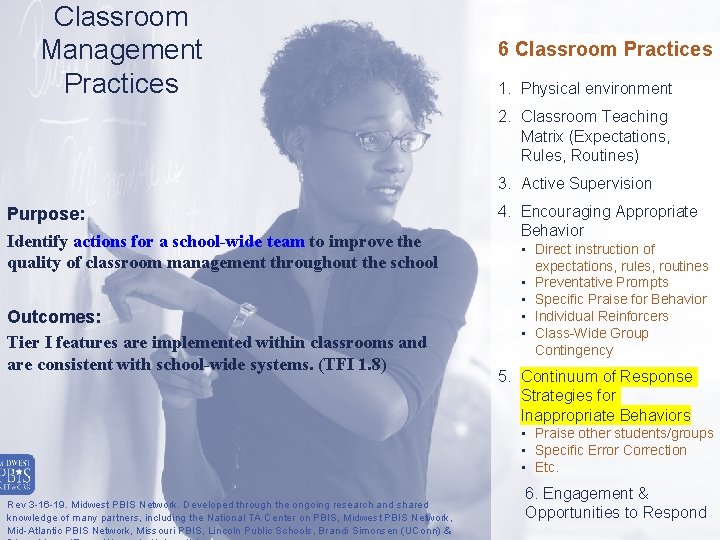
Classroom Management Practices 6 Classroom Practices 1. Physical environment 2. Classroom Teaching Matrix (Expectations, Rules, Routines) 3. Active Supervision Purpose: Identify actions for a school-wide team to improve the quality of classroom management throughout the school Outcomes: Tier I features are implemented within classrooms and are consistent with school-wide systems. (TFI 1. 8) 4. Encouraging Appropriate Behavior ▪ Direct instruction of expectations, rules, routines ▪ Preventative Prompts ▪ Specific Praise for Behavior ▪ Individual Reinforcers ▪ Class-Wide Group Contingency 5. Continuum of Response Strategies for Inappropriate Behaviors • Praise other students/groups • Specific Error Correction • Etc. Rev 3 -16 -19. Midwest PBIS Network. Developed through the ongoing research and shared 4 B Responding knowledge of many partners, including the National TA Center on PBIS, Midwest PBIS Network, Mid-Atlantic PBIS Network, Missouri PBIS, Lincoln Public Schools, Brandi Simonsen (UConn) & 6. Engagement & Opportunities to Respond to Behavior
Rationale for Using a Continuum of Strategies to Respond to Inappropriate Behavior • Highly effective teachers have a toolkit of respectful strategies that diminish the frequency, intensity, and/or duration of inappropriate behaviors. • A continuum is necessary because no single strategy is effective for all students or all behaviors. • Strategies should recognize the function of the behavior and be applied with a growth mindset toward student development. Day 4: Response to Behavior in the Classroom (TFI 1. 6 & 1. 8)
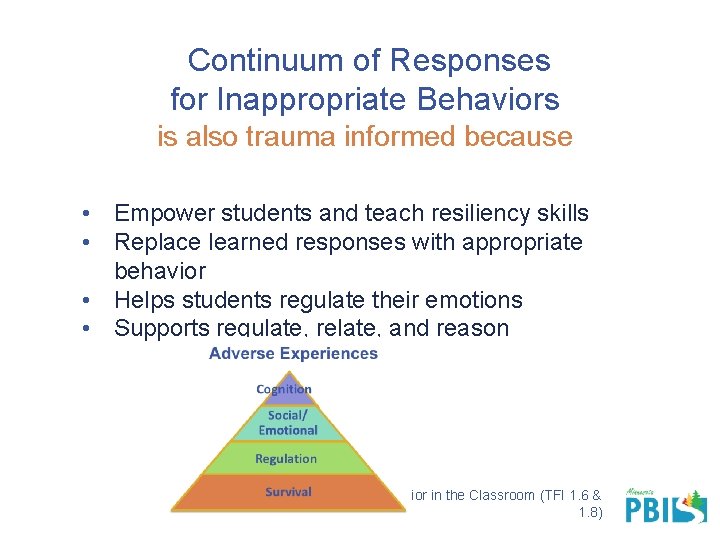
Continuum of Responses for Inappropriate Behaviors is also trauma informed because • Empower students and teach resiliency skills • Replace learned responses with appropriate behavior • Helps students regulate their emotions • Supports regulate, relate, and reason Day 4: Response to Behavior in the Classroom (TFI 1. 6 & 1. 8)
Day 4: Response to Behavior in the Classroom (TFI 1. 6 & 1. 8)
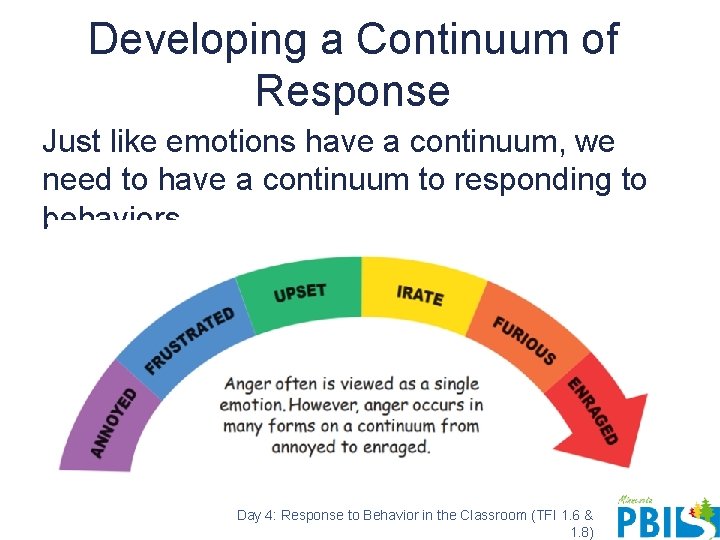
Developing a Continuum of Response Just like emotions have a continuum, we need to have a continuum to responding to behaviors Day 4: Response to Behavior in the Classroom (TFI 1. 6 & 1. 8)
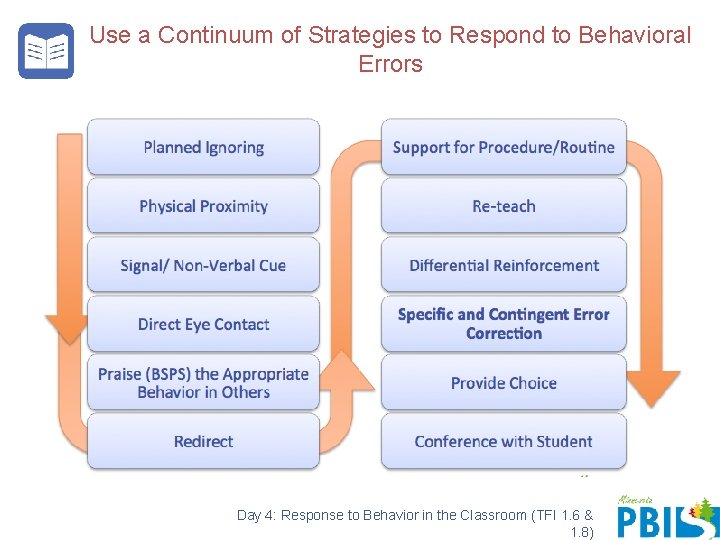
Use a Continuum of Strategies to Respond to Behavioral Errors Day 4: Response to Behavior in the Classroom (TFI 1. 6 & 1. 8)
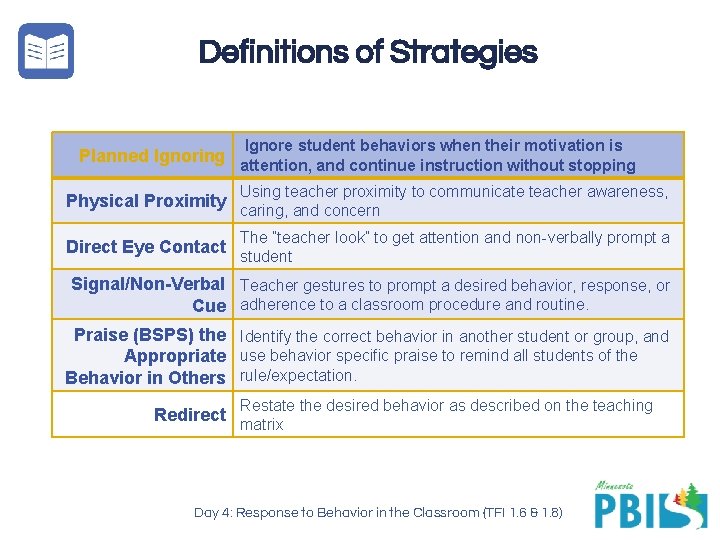
Definitions of Strategies Ignore student behaviors when their motivation is Planned Ignoring attention, and continue instruction without stopping Using teacher proximity to communicate teacher awareness, Physical Proximity caring, and concern The ”teacher look” to get attention and non-verbally prompt a Direct Eye Contact student Signal/Non-Verbal Teacher gestures to prompt a desired behavior, response, or Cue adherence to a classroom procedure and routine. Praise (BSPS) the Identify the correct behavior in another student or group, and Appropriate use behavior specific praise to remind all students of the Behavior in Others rule/expectation. Restate the desired behavior as described on the teaching Redirect matrix Day 4: Response to Behavior in the Classroom (TFI 1. 6 & 1. 8)
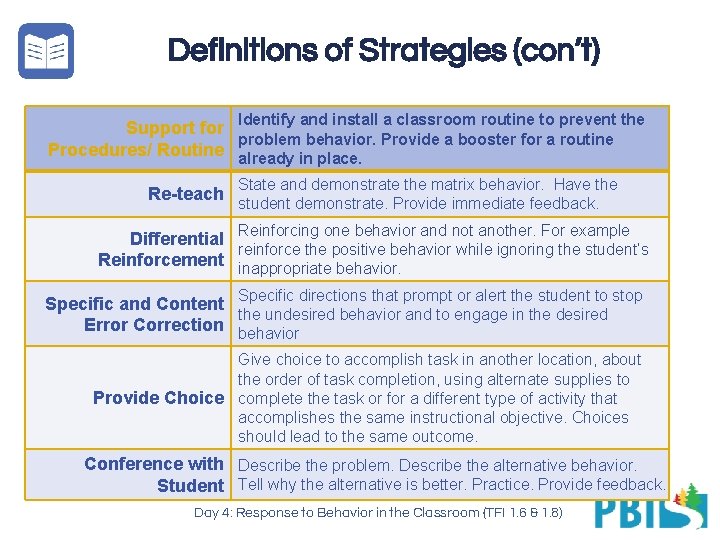
Definitions of Strategies (con’t) Identify and install a classroom routine to prevent the Support for problem behavior. Provide a booster for a routine Procedures/ Routine already in place. State and demonstrate the matrix behavior. Have the Re-teach student demonstrate. Provide immediate feedback. Reinforcing one behavior and not another. For example Differential reinforce the positive behavior while ignoring the student’s Reinforcement inappropriate behavior. Specific directions that prompt or alert the student to stop Specific and Content the undesired behavior and to engage in the desired Error Correction behavior Give choice to accomplish task in another location, about the order of task completion, using alternate supplies to Provide Choice complete the task or for a different type of activity that accomplishes the same instructional objective. Choices should lead to the same outcome. Conference with Describe the problem. Describe the alternative behavior. Student Tell why the alternative is better. Practice. Provide feedback. Day 4: Response to Behavior in the Classroom (TFI 1. 6 & 1. 8)
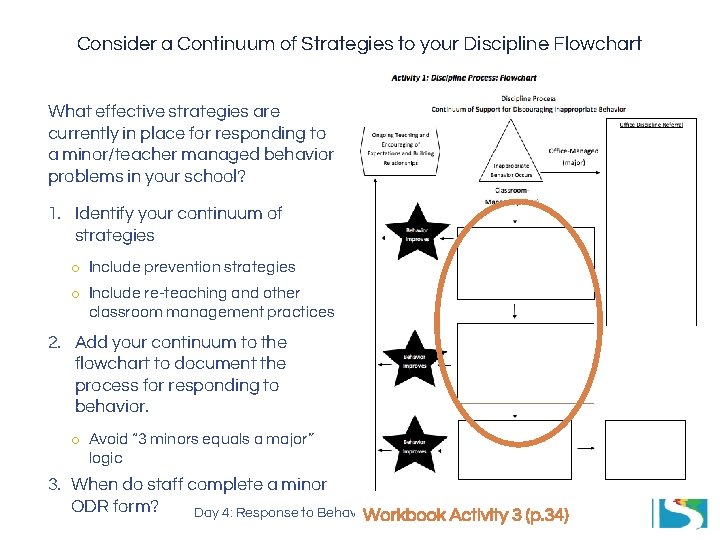
Consider a Continuum of Strategies to your Discipline Flowchart What effective strategies are currently in place for responding to a minor/teacher managed behavior problems in your school? 1. Identify your continuum of strategies o Include prevention strategies o Include re-teaching and other classroom management practices 2. Add your continuum to the flowchart to document the process for responding to behavior. o Avoid “ 3 minors equals a major” logic 3. When do staff complete a minor ODR form? Day 4: Response to Behavior in the Classroom (TFI 1. 6 & 1. 8) Workbook Activity 3 (p. 34)
Planning Continuum of Strategies Discuss the definitions from the previous two slides with a shoulder partner, and consider: 1) If any should be included on your school’s discipline flowchart (write these down on a post-it) 2) What PD is required to ensure all staff implement those strategies with fidelity? 3) Come back as a whole team to discuss your post-its Day 4: Response to Behavior in the Classroom (TFI 1. 6 & 1. 8)
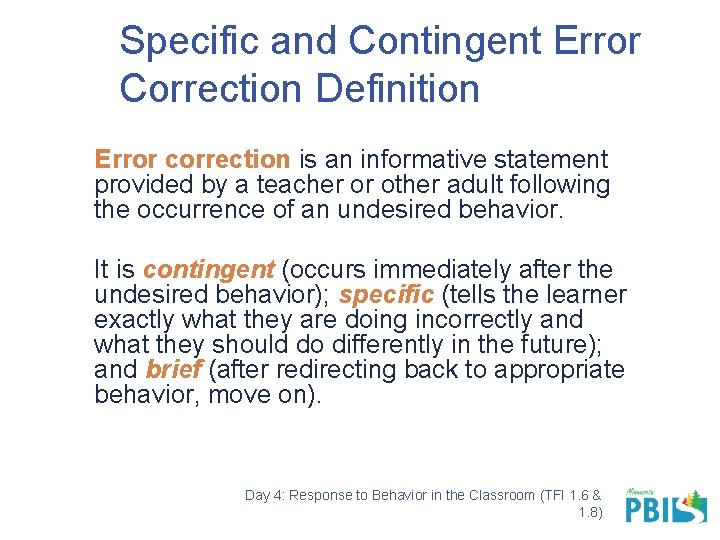
Specific and Contingent Error Correction Definition Error correction is an informative statement provided by a teacher or other adult following the occurrence of an undesired behavior. It is contingent (occurs immediately after the undesired behavior); specific (tells the learner exactly what they are doing incorrectly and what they should do differently in the future); and brief (after redirecting back to appropriate behavior, move on). Day 4: Response to Behavior in the Classroom (TFI 1. 6 & 1. 8)
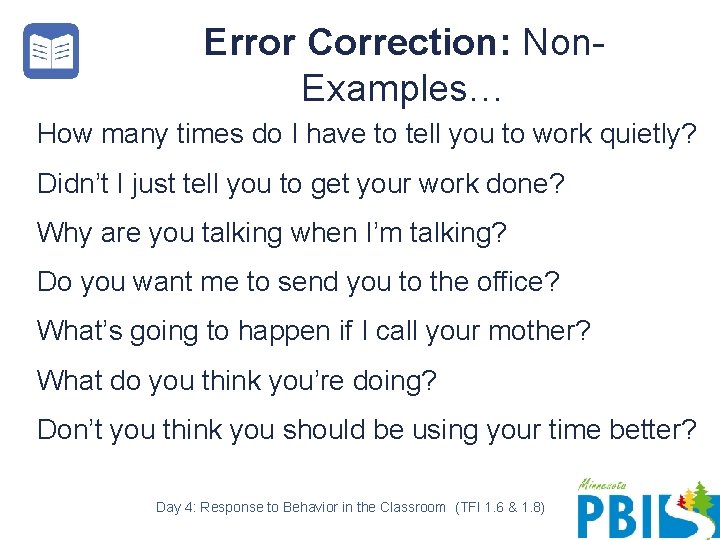
Error Correction: Non. Examples… How many times do I have to tell you to work quietly? Didn’t I just tell you to get your work done? Why are you talking when I’m talking? Do you want me to send you to the office? What’s going to happen if I call your mother? What do you think you’re doing? Don’t you think you should be using your time better? Day 4: Response to Behavior in the Classroom (TFI 1. 6 & 1. 8)
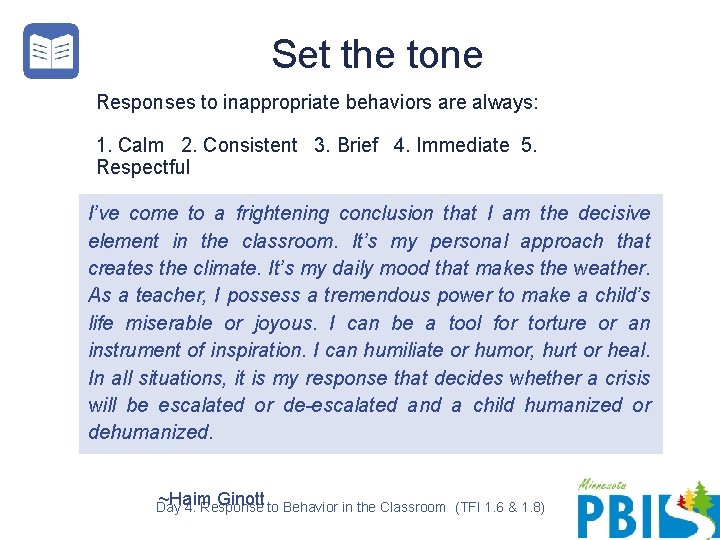
Set the tone Responses to inappropriate behaviors are always: 1. Calm 2. Consistent 3. Brief 4. Immediate 5. Respectful I’ve come to a frightening conclusion that I am the decisive element in the classroom. It’s my personal approach that creates the climate. It’s my daily mood that makes the weather. As a teacher, I possess a tremendous power to make a child’s life miserable or joyous. I can be a tool for torture or an instrument of inspiration. I can humiliate or humor, hurt or heal. In all situations, it is my response that decides whether a crisis will be escalated or de-escalated and a child humanized or dehumanized. ~Haim Ginott Day 4: Response to Behavior in the Classroom (TFI 1. 6 & 1. 8)
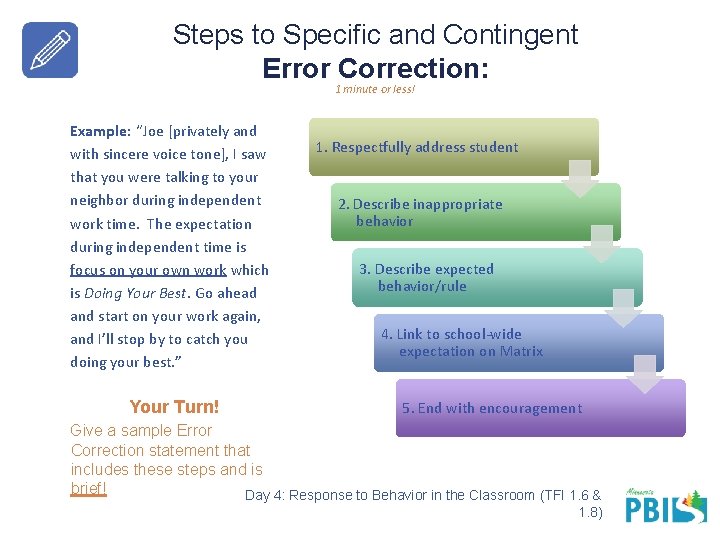
Steps to Specific and Contingent Error Correction: 1 minute or less! Example: “Joe [privately and with sincere voice tone], I saw that you were talking to your neighbor during independent work time. The expectation during independent time is focus on your own work which is Doing Your Best. Go ahead and start on your work again, and I’ll stop by to catch you doing your best. ” Your Turn! 1. Respectfully address student 2. Describe inappropriate behavior 3. Describe expected behavior/rule 4. Link to school-wide expectation on Matrix 5. End with encouragement Give a sample Error Correction statement that includes these steps and is brief! Day 4: Response to Behavior in the Classroom (TFI 1. 6 & 1. 8)
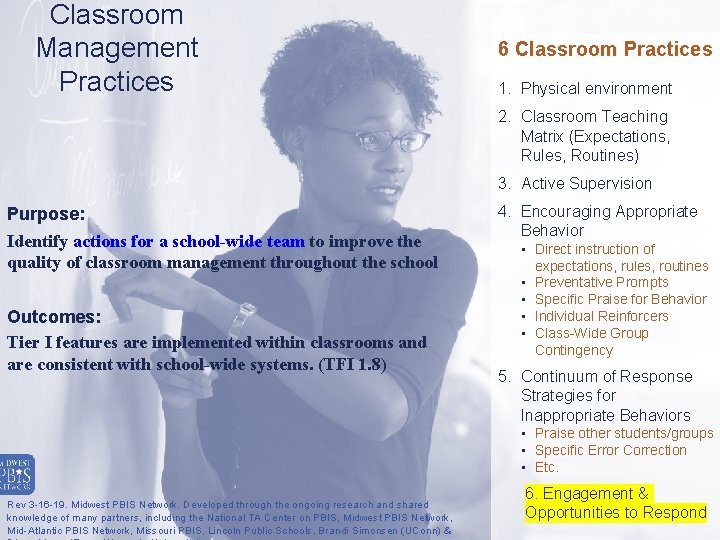
Classroom Management Practices 6 Classroom Practices 1. Physical environment 2. Classroom Teaching Matrix (Expectations, Rules, Routines) 3. Active Supervision Purpose: Identify actions for a school-wide team to improve the quality of classroom management throughout the school Outcomes: Tier I features are implemented within classrooms and are consistent with school-wide systems. (TFI 1. 8) 4. Encouraging Appropriate Behavior ▪ Direct instruction of expectations, rules, routines ▪ Preventative Prompts ▪ Specific Praise for Behavior ▪ Individual Reinforcers ▪ Class-Wide Group Contingency 5. Continuum of Response Strategies for Inappropriate Behaviors • Praise other students/groups • Specific Error Correction • Etc. Rev 3 -16 -19. Midwest PBIS Network. Developed through the ongoing research and shared 4 B Responding knowledge of many partners, including the National TA Center on PBIS, Midwest PBIS Network, Mid-Atlantic PBIS Network, Missouri PBIS, Lincoln Public Schools, Brandi Simonsen (UConn) & 6. Engagement & Opportunities to Respond to Behavior
Increase Academic Engagement Use of Multiple Opportunities To Respond (OTR) includes strategies to increase all students being engaged in the content simultaneously through various group engagement strategies. Examples of group engagement strategies: think, pair, share; response boards; choral response, computer programs (e. g. Kahoot); small group work; etc. Day 4: Response to Behavior in the Classroom (TFI 1. 6 & 1. 8)
Rationales for Increasing Academic Opportunities to Respond Research indicates that using high rates of OTRs during instruction results in increases in accurate academic responses and desired behaviors and decreases in undesired behaviors. • The more students spend involved in learning activities, the more they learn. • Additionally, increased rates of responding and the subsequent improved learning tend to increase the amount of material that can be covered. • When teachers increase their rates of opportunities to respond, student on-task behavior and correct responses increase while disruptive behavior decreases. • Shown to improve reading and math performance. • Provides continual feedback for the teacher on student learning and the effectiveness of teaching strategies. (Barbetta, Heron, & Howard, Carnine, 1976; 1994; Day 1993; 4: Response to Heward, Behavior in Sutherland, the Classroom (TFI 1. 6 & 1. 8) Alder, & Gunter, 2003; Sutherland & Wehby, 2001; West & Sloane, 1986).
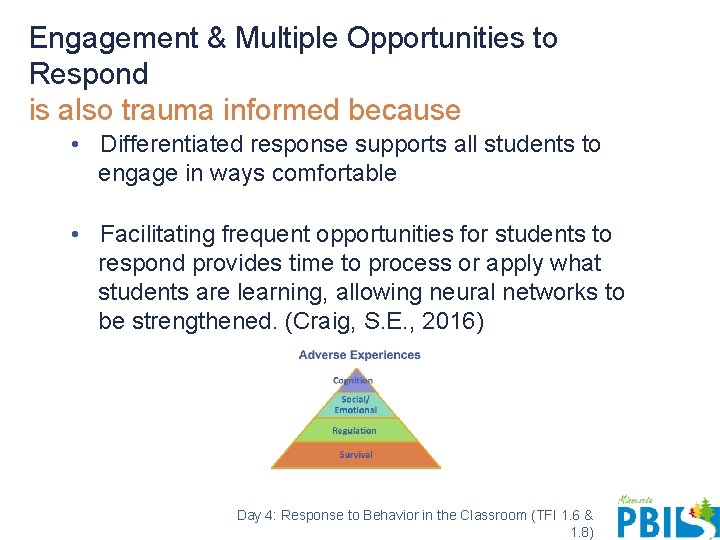
Engagement & Multiple Opportunities to Respond is also trauma informed because • Differentiated response supports all students to engage in ways comfortable • Facilitating frequent opportunities for students to respond provides time to process or apply what students are learning, allowing neural networks to be strengthened. (Craig, S. E. , 2016) Day 4: Response to Behavior in the Classroom (TFI 1. 6 & 1. 8)
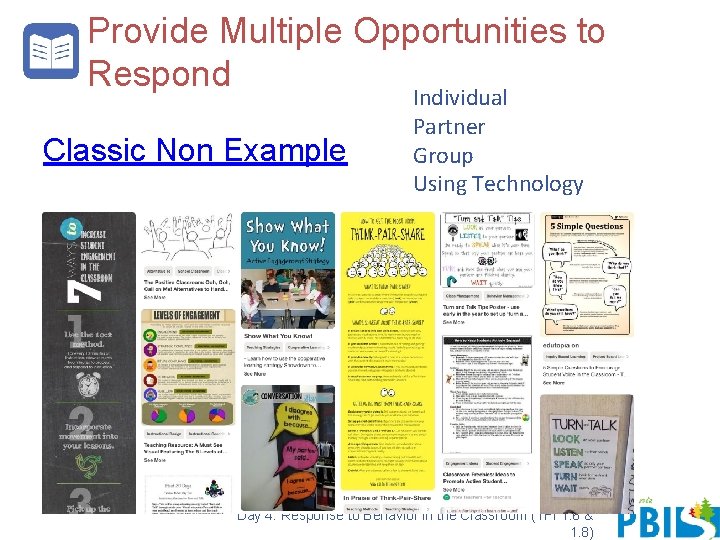
Provide Multiple Opportunities to Respond Classic Non Example Individual Partner Group Using Technology Day 4: Response to Behavior in the Classroom (TFI 1. 6 & 1. 8)
Guidelines for Response Rates • Teacher talk should be no more than 40 -50% of instructional time. • New material: a minimum of 4 -6 responses per minute with 80% accuracy. • Review of previously learned material: 8 -12 responses per minute with 90% accuracy. (Council for Exceptional. Day Children, 1987; 4: Response to Behavior in the Classroom (TFI 1. 6 & 1. 8) Reinke, Herman & Stormont, 2013)
Example of Opportunities to Respond This scenario demonstrates the practice of providing numerous opportunities to respond and engage students. Shortly after science class started, the teacher announced, “We have a small block of ice and the same size block of butter. Tell your neighbor which one would melt first. ” A few seconds later the teacher said, “Please write down in one sentence an explanation for your answer. ” A few minutes later, the teacher told the students to share with their neighbor what they had written. Shortly thereafter, the teacher called on one student to tell the class her answer. The teacher then asked students to give a thumb down if anyone disagreed, and so on. (Colvin, 2009, p. 48) Day 4: Response to Behavior in the Classroom (TFI 1. 6 & 1. 8)
Opportunities to Respond Turn & Talk What are the Opportunities to Respond in this scenario? Shortly after science class started, the teacher announced, “We have a small block of ice and the same size block of butter. Tell your neighbor which one would melt first. ” A few seconds later the teacher said, “Please write down in one sentence an explanation for your answer. ” A few minutes later, the teacher told the students to share with their neighbor what they had written. Shortly thereafter, the teacher called on one student to tell the class her answer. The teacher then asked Response students to give a thumb down if anyone disagreed, Choral and so on. (Colvin, Individual small Response Cards 2009, or p. 48) Signalin group questioning Technology g Non-verbal Day response 4: Response to Behavior in the Classroom (TFI 1. 6 & 1. 8) Wait/think
Provide Professional Development It is critical to create a safe and nurturing climate for teachers to improve their skills. ▪ When school leadership provides the resources staff need to adapt to improve their classroom management skills, the process progresses more smoothly. Based on the work of Marzano, Waters, Mc. Nulty (2005) Day 4: Response to Behavior in the Classroom (TFI 1. 6 & 1. 8)
Shifting to Positive Behavior Support • We know what evidence based classroom management practices look like. • We have a science to support implementation. • We have tools to describe and illustrate what implementing evidence based classroom management “looks like. ” So, what are we waiting for? Day 4: Response to Behavior in the Classroom (TFI 1. 6 & 1. 8)
Team Time Refer to pages ______ in workbook 1. Think about the second 3 components of classroom PBIS we have discussed: ▪ Encouraging Appropriate Behavior, Continuum of Response, Opportunities to Respond 2. Use the workbook to find activities to support your work: ▪ Encouraging Behavior methods ▪ Continuum of Response in your Flowchart ▪ Professional Development for Staff 3. Begin thinking about how you will bring this at your school. Day 4: Response to Behavior in the Classroom (TFI 1. 6 & 1. 8)
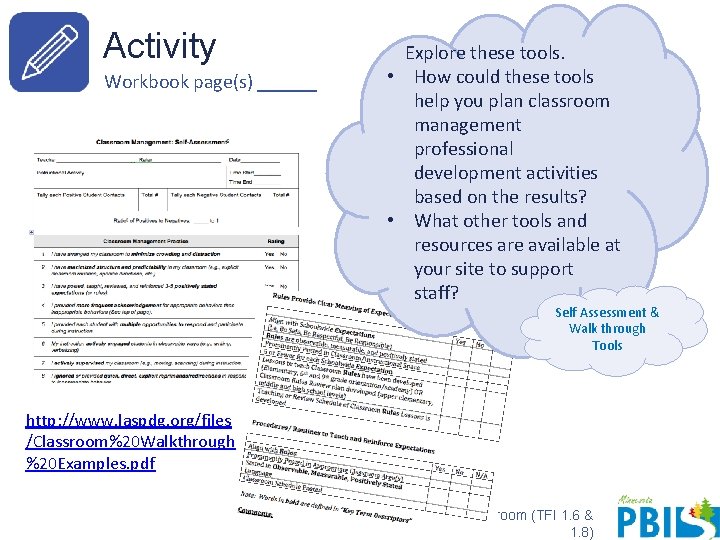
Activity Workbook page(s) ______ Explore these tools. • How could these tools help you plan classroom management professional development activities based on the results? • What other tools and resources are available at your site to support staff? Self Assessment & Walk through Tools http: //www. laspdg. org/files /Classroom%20 Walkthrough %20 Examples. pdf Day 4: Response to Behavior in the Classroom (TFI 1. 6 & 1. 8)
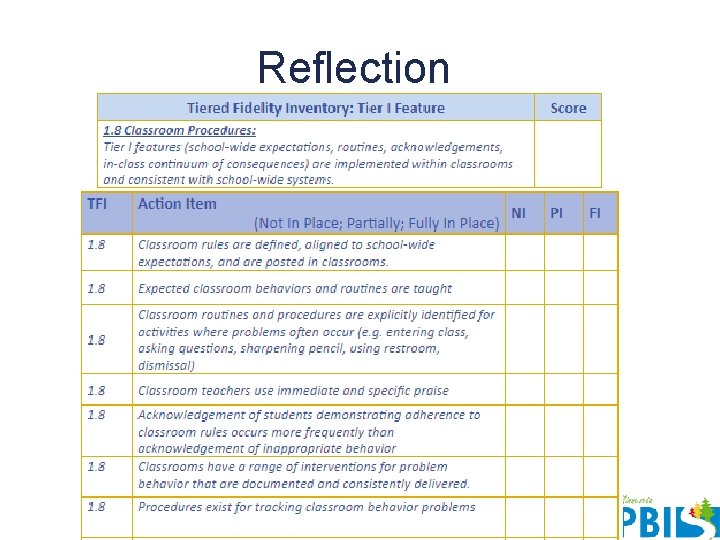
Reflection 5 A Classroom (TFI 1. 8)
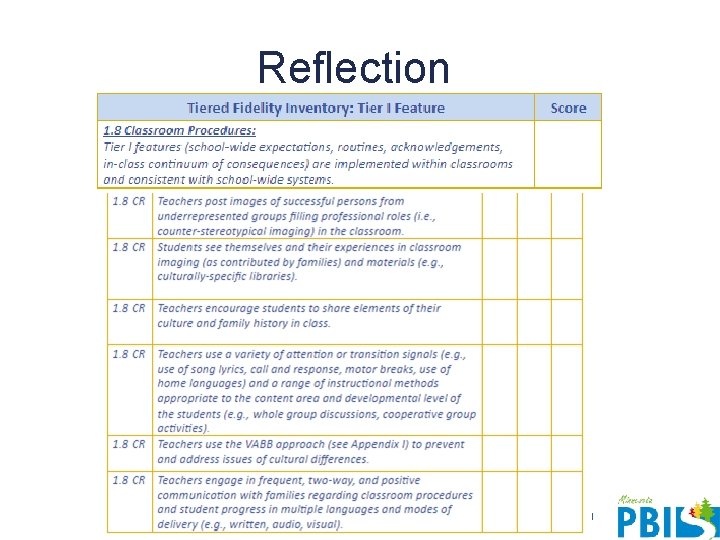
Reflection 5 A Classroom (TFI 1. 8)
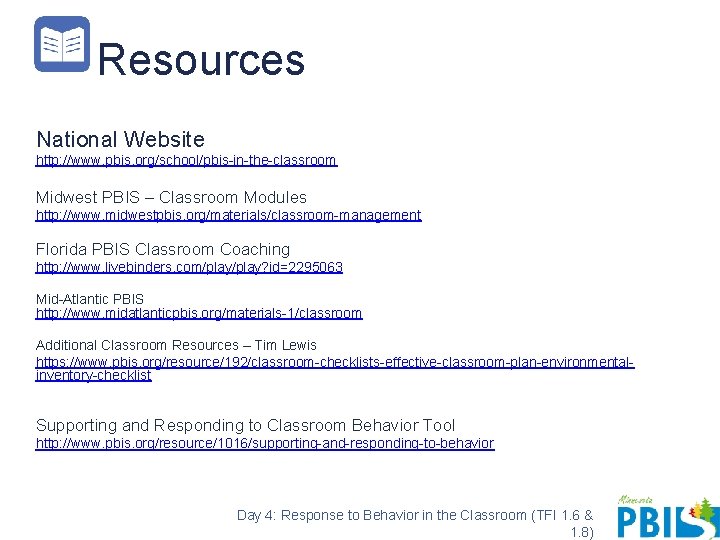
Resources National Website http: //www. pbis. org/school/pbis-in-the-classroom Midwest PBIS – Classroom Modules http: //www. midwestpbis. org/materials/classroom-management Florida PBIS Classroom Coaching http: //www. livebinders. com/play? id=2295063 Mid-Atlantic PBIS http: //www. midatlanticpbis. org/materials-1/classroom Additional Classroom Resources – Tim Lewis https: //www. pbis. org/resource/192/classroom-checklists-effective-classroom-plan-environmentalinventory-checklist Supporting and Responding to Classroom Behavior Tool http: //www. pbis. org/resource/1016/supporting-and-responding-to-behavior Day 4: Response to Behavior in the Classroom (TFI 1. 6 & 1. 8)
Appreciation is given to the following for their contributions to this Professional Learning: Day 4: Response to Behavior in the Classroom (TFI 1. 6 & 1. 8)
- Slides: 48