
PBIS Team Training 3 D Problem Behavior Definitions
PBIS Team Training 3 D Problem Behavior Definitions & Discipline Policies (TFI 1. 5 & 1. 6) Thank you to Midwest PBIS Network, Mid-Atlantic PBIS Network, Missouri Schoolwide PBS, Virginia Dept of Ed PBIS, and other National Partners for their contributions Day 3: Problem Behavior Definitions & Discipline Policies (TFI 1. 5 & 1. 6)
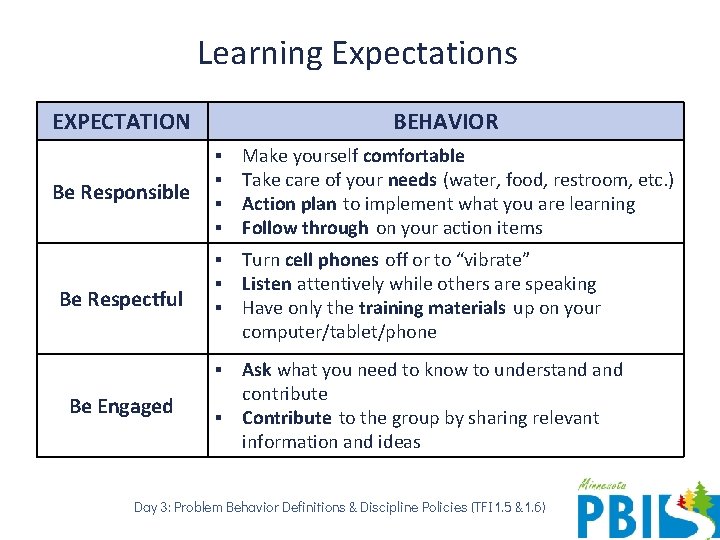
Learning Expectations EXPECTATION Be Responsible Be Respectful Be Engaged BEHAVIOR ▪ ▪ Make yourself comfortable Take care of your needs (water, food, restroom, etc. ) Action plan to implement what you are learning Follow through on your action items ▪ Turn cell phones off or to “vibrate” ▪ Listen attentively while others are speaking ▪ Have only the training materials up on your computer/tablet/phone ▪ Ask what you need to know to understand contribute ▪ Contribute to the group by sharing relevant information and ideas Day 3: Problem Behavior Definitions & Discipline Policies (TFI 1. 5 & 1. 6)
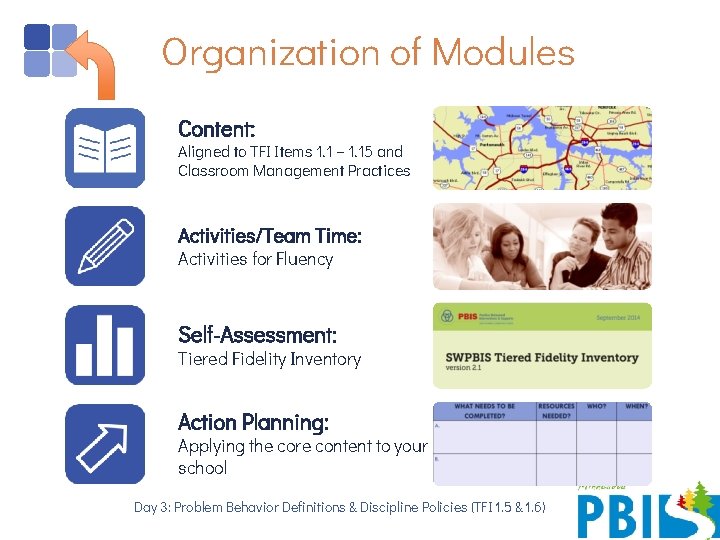
Organization of Modules Content: Aligned to TFI Items 1. 1 – 1. 15 and Classroom Management Practices Activities/Team Time: Activities for Fluency Self-Assessment: Tiered Fidelity Inventory Action Planning: Applying the core content to your school Day 3: Problem Behavior Definitions & Discipline Policies (TFI 1. 5 & 1. 6)
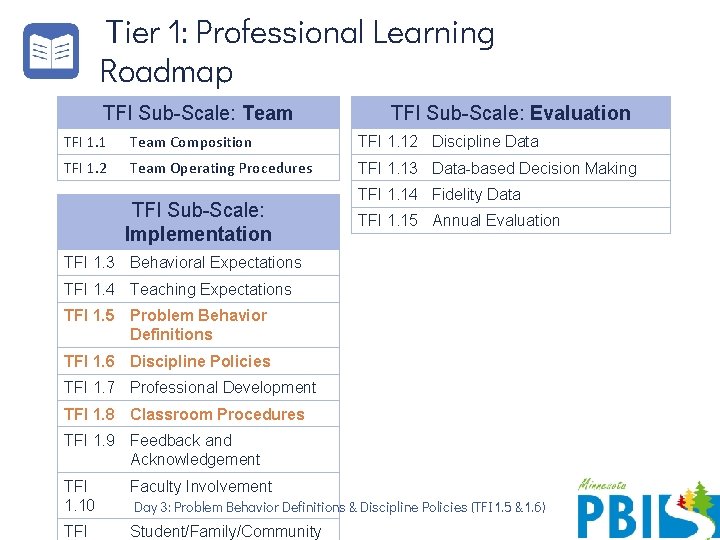
Tier 1: Professional Learning Roadmap TFI Sub-Scale: Team TFI Sub-Scale: Evaluation TFI 1. 1 Team Composition TFI 1. 12 Discipline Data TFI 1. 2 Team Operating Procedures TFI 1. 13 Data-based Decision Making TFI Sub-Scale: Implementation TFI 1. 14 Fidelity Data TFI 1. 15 Annual Evaluation TFI 1. 3 Behavioral Expectations TFI 1. 4 Teaching Expectations TFI 1. 5 Problem Behavior Definitions TFI 1. 6 Discipline Policies TFI 1. 7 Professional Development TFI 1. 8 Classroom Procedures TFI 1. 9 Feedback and Acknowledgement TFI 1. 10 Faculty Involvement TFI Student/Family/Community Day 3: Problem Behavior Definitions & Discipline Policies (TFI 1. 5 & 1. 6)
TFI 1. 5 & 1. 6 Purpose & Outcomes Purpose: Prepare and plan for facilitating implementation of effective discipline procedures Outcomes: 1. 5 Problem Behavior Definitions: School has clear definitions for behaviors that interfere with academic and social success and a clear policy/ procedure (e. g. , flowchart) for addressing office-managed versus staff-managed problems 1. 6 Discipline Policies: School policies and procedures describe and emphasize proactive, instructive, and/or restorative approaches to student behavior that are implemented consistently Day 3: Problem Behavior Definitions & Discipline Policies (TFI 1. 5 & 1. 6)
Rationale for Discipline Definitions and Policies Clearly defined procedures support consistency with responding to behavioral infractions. Consistency creates the conditions for increased structure, feelings of safety, and a positive learning environment. Differentiating between behaviors addressed in the classroom, versus those addressed by administration, can: • improve consistency within the classroom • provide more meaningful information for problem solving • increase instructional minutes • free up administrative time spent on discipline. Day 3: Problem Behavior Definitions & Discipline Policies (TFI 1. 5 & 1. 6)
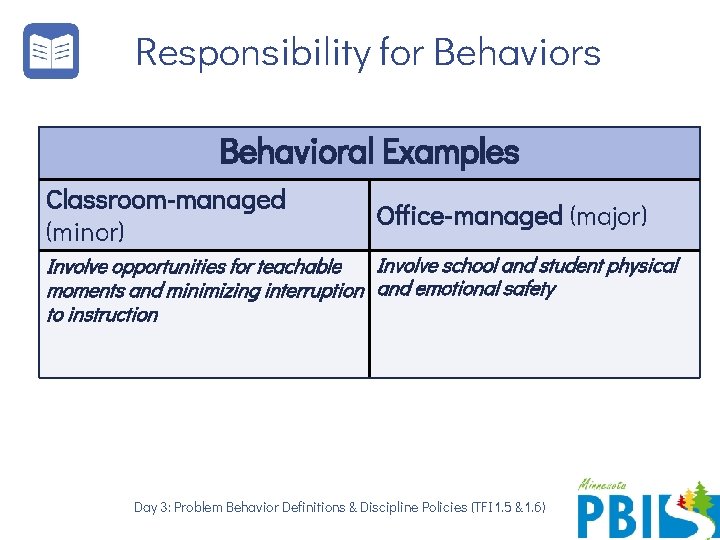
Responsibility for Behaviors Behavioral Examples Classroom-managed (minor) Office-managed (major) Involve school and student physical Involve opportunities for teachable moments and minimizing interruption and emotional safety to instruction Day 3: Problem Behavior Definitions & Discipline Policies (TFI 1. 5 & 1. 6)
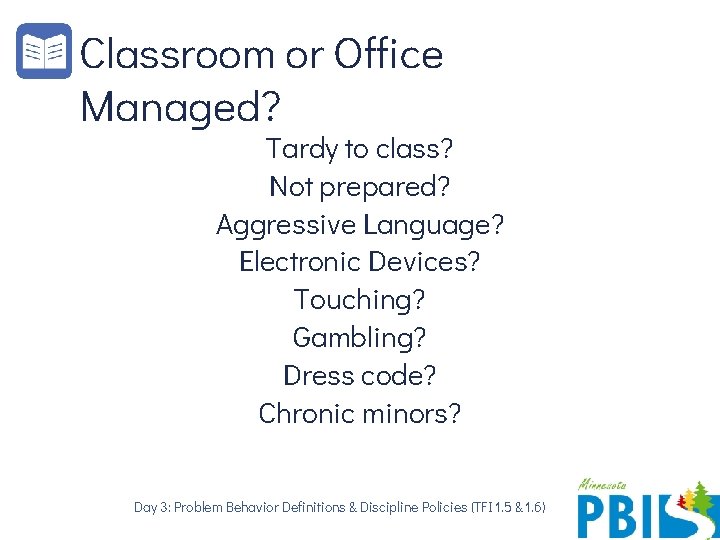
Classroom or Office Managed? Tardy to class? Not prepared? Aggressive Language? Electronic Devices? Touching? Gambling? Dress code? Chronic minors? Day 3: Problem Behavior Definitions & Discipline Policies (TFI 1. 5 & 1. 6)
How does your school/district differentiate between classroom and office managed behaviors? Day 3: Problem Behavior Definitions & Discipline Policies (TFI 1. 5 & 1. 6)
Defining Behaviors • The SWIS developers have definitions for problem behaviors that can be used by anyone regardless of the data system they use. • The definitions are clear, observable, and can be measurable. Day 3: Problem Behavior Definitions & Discipline Policies (TFI 1. 5 & 1. 6)

Minor Examples Day 3: Problem Behavior Definitions & Discipline Policies (TFI 1. 5 & 1. 6) See Workbook Pages 30 - 31
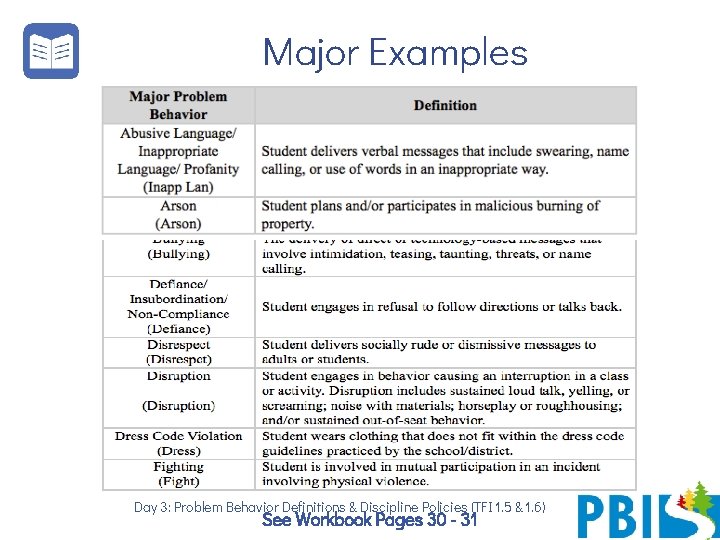
Major Examples Day 3: Problem Behavior Definitions & Discipline Policies (TFI 1. 5 & 1. 6) See Workbook Pages 30 - 31
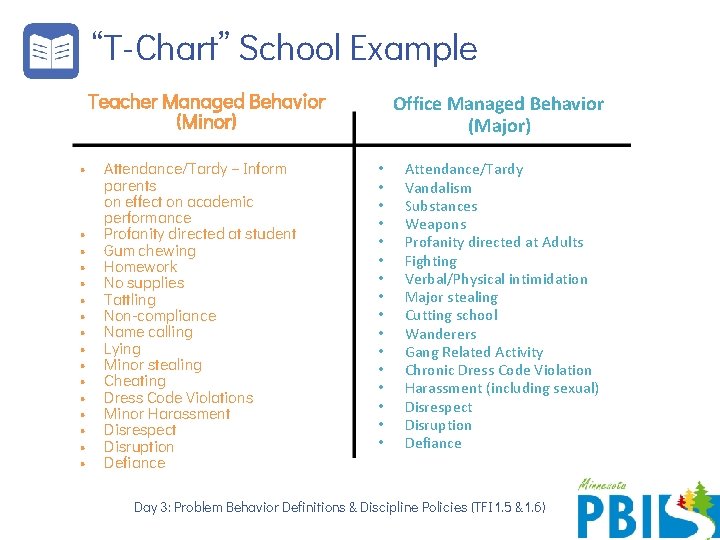
“T-Chart” School Example Teacher Managed Behavior (Minor) • • • • Attendance/Tardy – Inform parents on effect on academic performance Profanity directed at student Gum chewing Homework No supplies Tattling Non-compliance Name calling Lying Minor stealing Cheating Dress Code Violations Minor Harassment Disrespect Disruption Defiance Office Managed Behavior (Major) • • • • Attendance/Tardy Vandalism Substances Weapons Profanity directed at Adults Fighting Verbal/Physical intimidation Major stealing Cutting school Wanderers Gang Related Activity Chronic Dress Code Violation Harassment (including sexual) Disrespect Disruption Defiance Day 3: Problem Behavior Definitions & Discipline Policies (TFI 1. 5 & 1. 6)
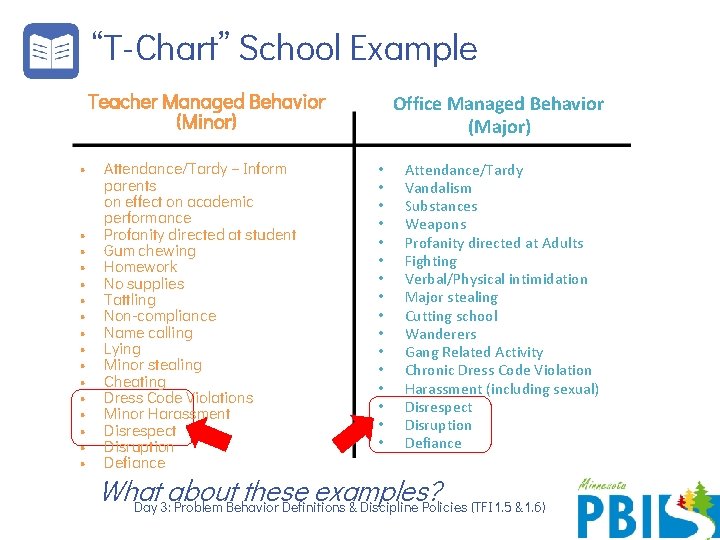
“T-Chart” School Example Teacher Managed Behavior (Minor) • • • • Attendance/Tardy – Inform parents on effect on academic performance Profanity directed at student Gum chewing Homework No supplies Tattling Non-compliance Name calling Lying Minor stealing Cheating Dress Code Violations Minor Harassment Disrespect Disruption Defiance Office Managed Behavior (Major) • • • • Attendance/Tardy Vandalism Substances Weapons Profanity directed at Adults Fighting Verbal/Physical intimidation Major stealing Cutting school Wanderers Gang Related Activity Chronic Dress Code Violation Harassment (including sexual) Disrespect Disruption Defiance What about these examples? Day 3: Problem Behavior Definitions & Discipline Policies (TFI 1. 5 & 1. 6)
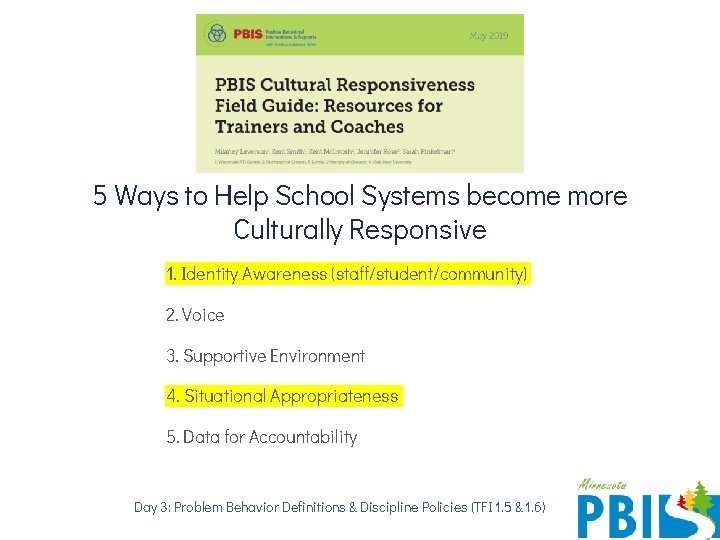
5 Ways to Help School Systems become more Culturally Responsive 1. Identity Awareness (staff/student/community) 2. Voice 3. Supportive Environment 4. Situational Appropriateness 5. Data for Accountability Day 3: Problem Behavior Definitions & Discipline Policies (TFI 1. 5 & 1. 6)
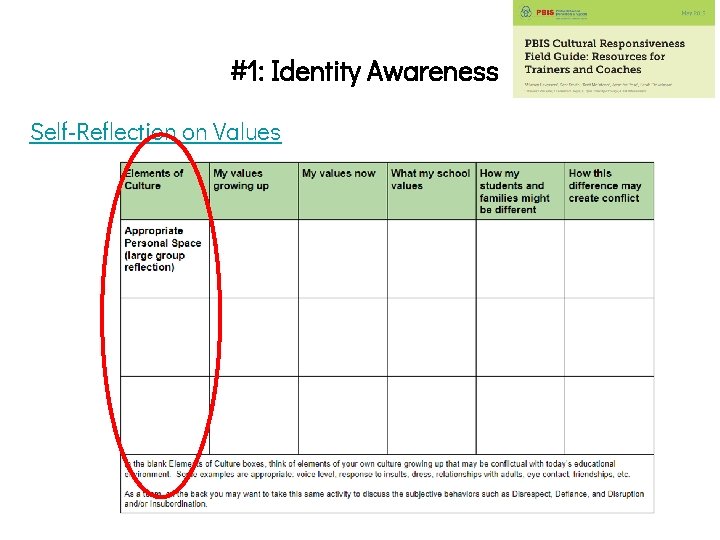
#1: Identity Awareness Self-Reflection on Values
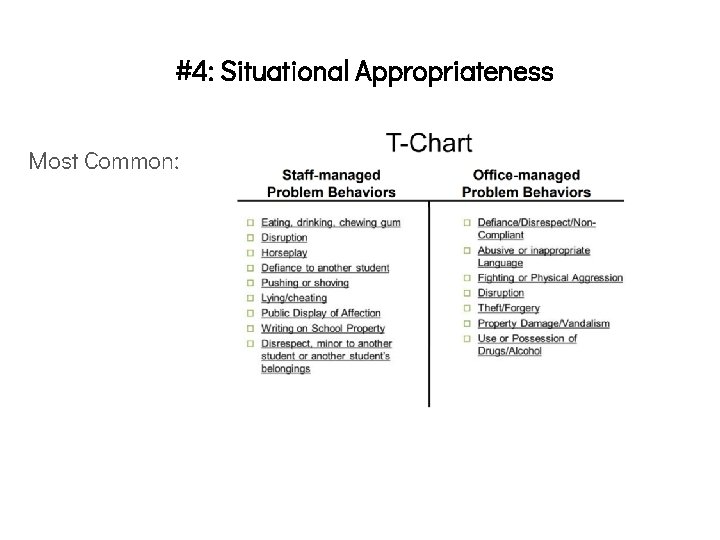
#4: Situational Appropriateness Most Common:
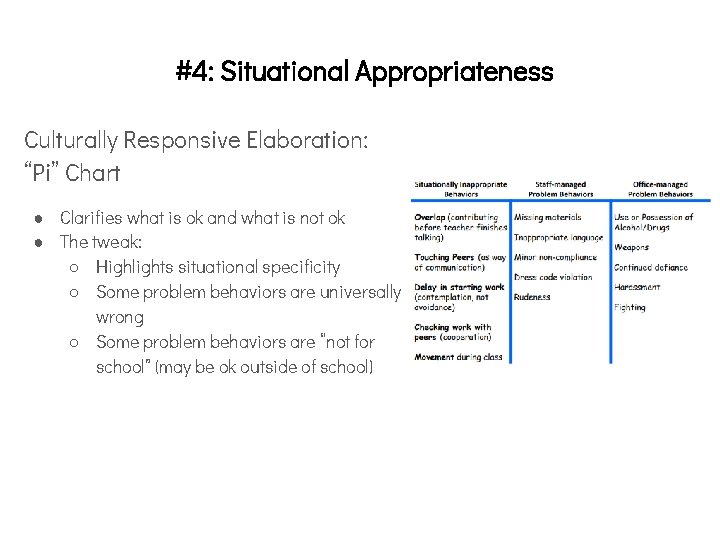
#4: Situational Appropriateness Culturally Responsive Elaboration: “Pi” Chart ● Clarifies what is ok and what is not ok ● The tweak: ○ Highlights situational specificity ○ Some problem behaviors are universally wrong ○ Some problem behaviors are “not for school” (may be ok outside of school)
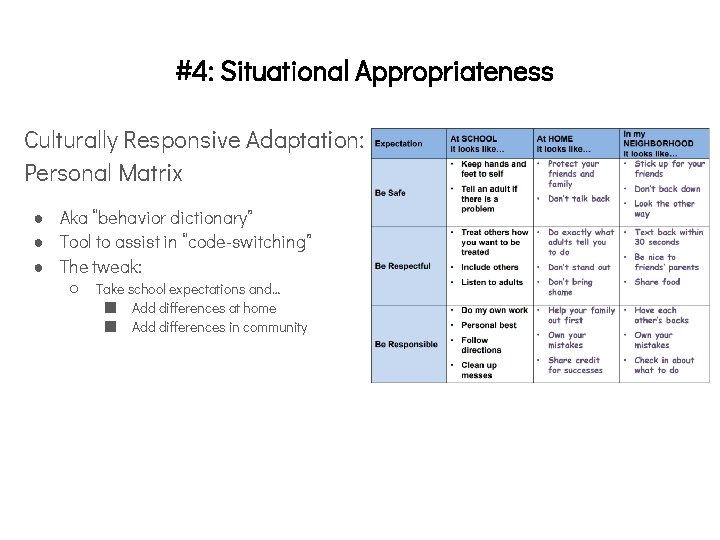
#4: Situational Appropriateness Culturally Responsive Adaptation: Personal Matrix ● Aka “behavior dictionary” ● Tool to assist in “code-switching” ● The tweak: ○ Take school expectations and… ■ Add differences at home ■ Add differences in community
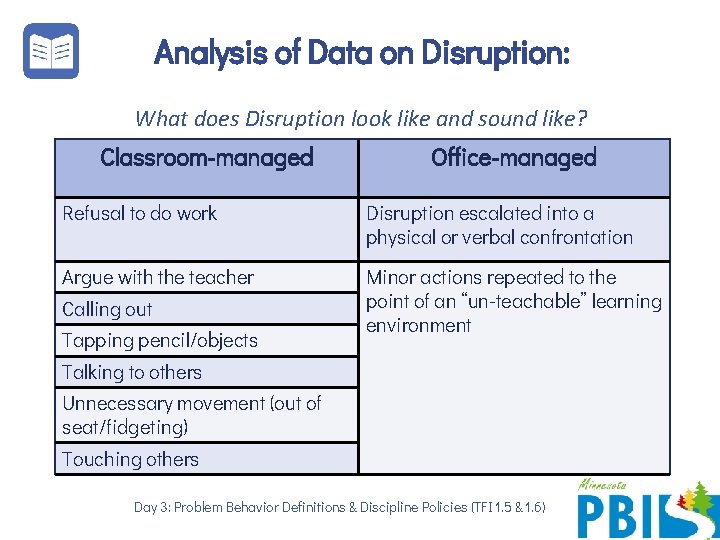
Analysis of Data on Disruption: What does Disruption look like and sound like? Classroom-managed Office-managed Refusal to do work Disruption escalated into a physical or verbal confrontation Argue with the teacher Minor actions repeated to the point of an “un-teachable” learning environment Calling out Tapping pencil/objects Talking to others Unnecessary movement (out of seat/fidgeting) Touching others Day 3: Problem Behavior Definitions & Discipline Policies (TFI 1. 5 & 1. 6)
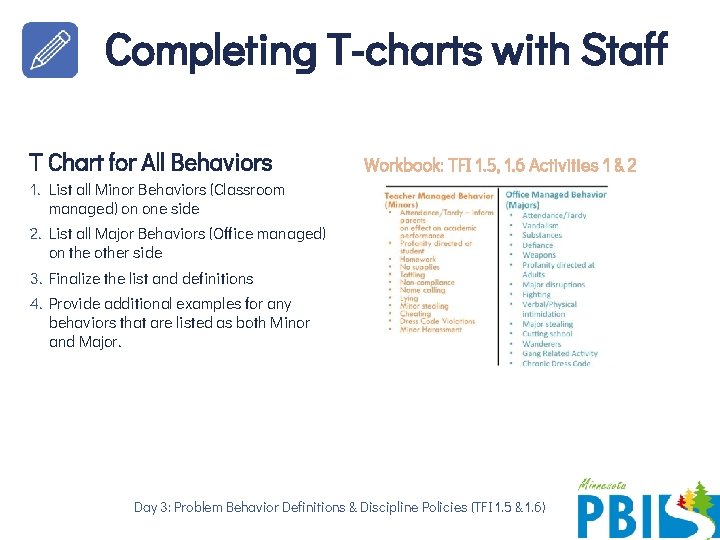
Completing T-charts with Staff T Chart for All Behaviors Workbook: TFI 1. 5, 1. 6 Activities 1 & 2 1. List all Minor Behaviors (Classroom managed) on one side 2. List all Major Behaviors (Office managed) on the other side 3. Finalize the list and definitions 4. Provide additional examples for any behaviors that are listed as both Minor and Major. Day 3: Problem Behavior Definitions & Discipline Policies (TFI 1. 5 & 1. 6)
“When everyone handles infractions with instructional correction procedures, students learn that what happens when they misbehave is procedure not personal. ” ~Bob Algozzine Day 3: Problem Behavior Definitions & Discipline Policies (TFI 1. 5 & 1. 6)
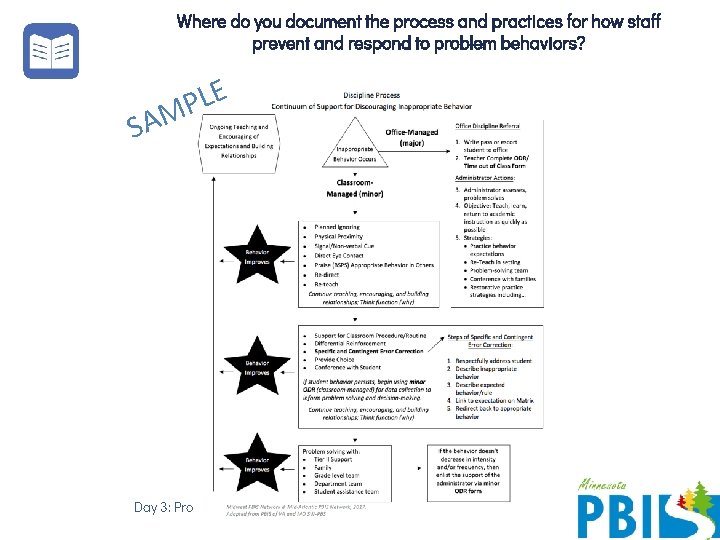
Where do you document the process and practices for how staff prevent and respond to problem behaviors? LE P M SA Day 3: Problem Behavior Definitions & Discipline Policies (TFI 1. 5 & 1. 6)
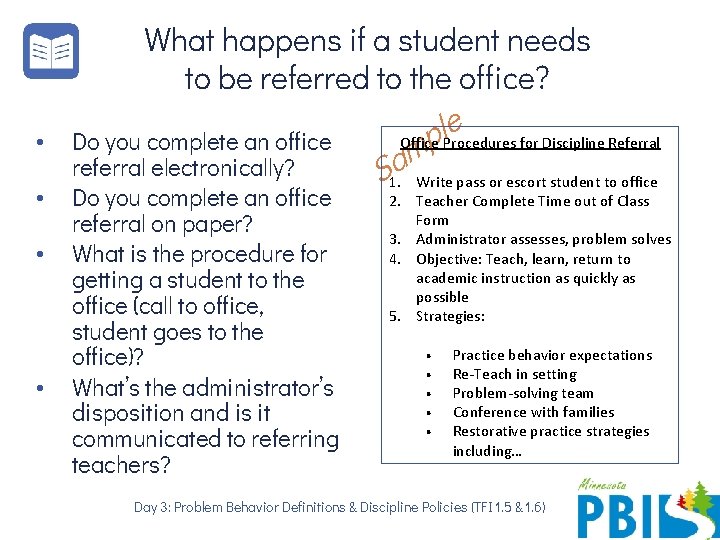
What happens if a student needs to be referred to the office? • • Do you complete an office referral electronically? Do you complete an office referral on paper? What is the procedure for getting a student to the office (call to office, student goes to the office)? What’s the administrator’s disposition and is it communicated to referring teachers? le p m a S 1. Write pass or escort student to office Office Procedures for Discipline Referral 2. Teacher Complete Time out of Class Form 3. Administrator assesses, problem solves 4. Objective: Teach, learn, return to academic instruction as quickly as possible 5. Strategies: ∙ ∙ ∙ Practice behavior expectations Re-Teach in setting Problem-solving team Conference with families Restorative practice strategies including… Day 3: Problem Behavior Definitions & Discipline Policies (TFI 1. 5 & 1. 6)
What is the purpose of the office discipline referral form? Is it used as an intervention? Is it used to collect data? Day 3: Problem Behavior Definitions & Discipline Policies (TFI 1. 5 & 1. 6)
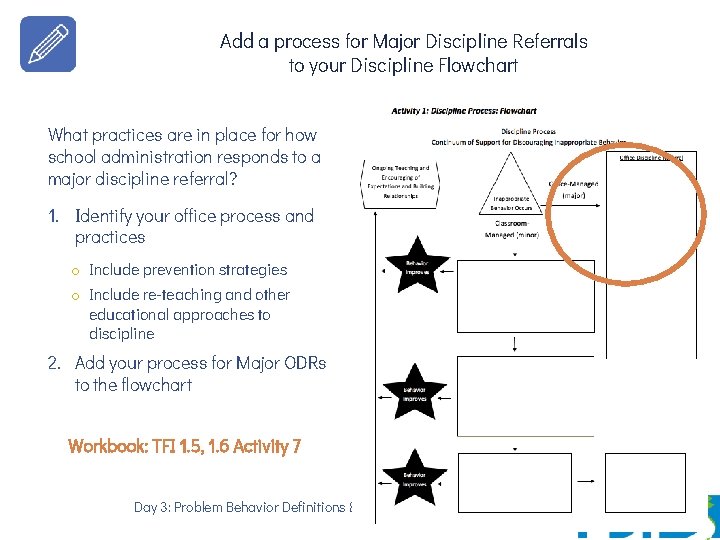
Add a process for Major Discipline Referrals to your Discipline Flowchart What practices are in place for how school administration responds to a major discipline referral? 1. Identify your office process and practices o Include prevention strategies o Include re-teaching and other educational approaches to discipline 2. Add your process for Major ODRs to the flowchart Workbook: TFI 1. 5, 1. 6 Activity 7 Day 3: Problem Behavior Definitions & Discipline Policies (TFI 1. 5 & 1. 6) Office Procedure s and Practices
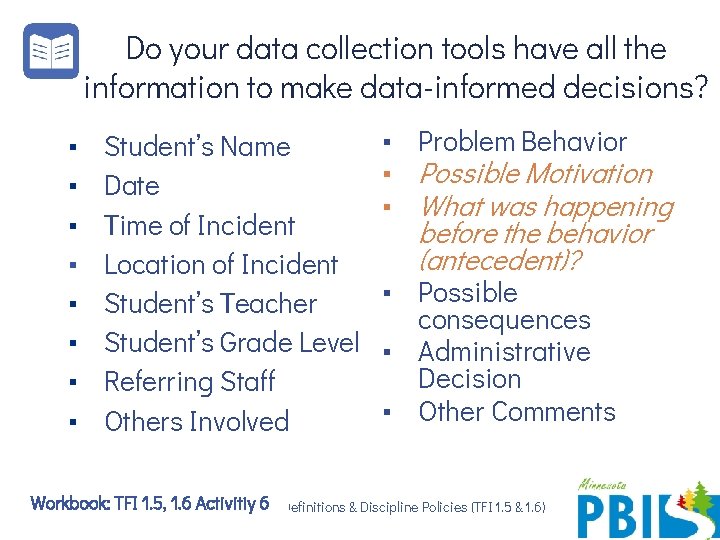
Do your data collection tools have all the information to make data-informed decisions? ▪ ▪ ▪ ▪ Student’s Name Date Time of Incident Location of Incident Student’s Teacher Student’s Grade Level Referring Staff Others Involved ▪ Problem Behavior ▪ Possible Motivation ▪ What was happening before the behavior (antecedent)? ▪ Possible consequences ▪ Administrative Decision ▪ Other Comments Workbook: TFIDay 1. 5, 3: 1. 6 Activitiy 6 Definitions & Discipline Policies (TFI 1. 5 & 1. 6) Problem Behavior
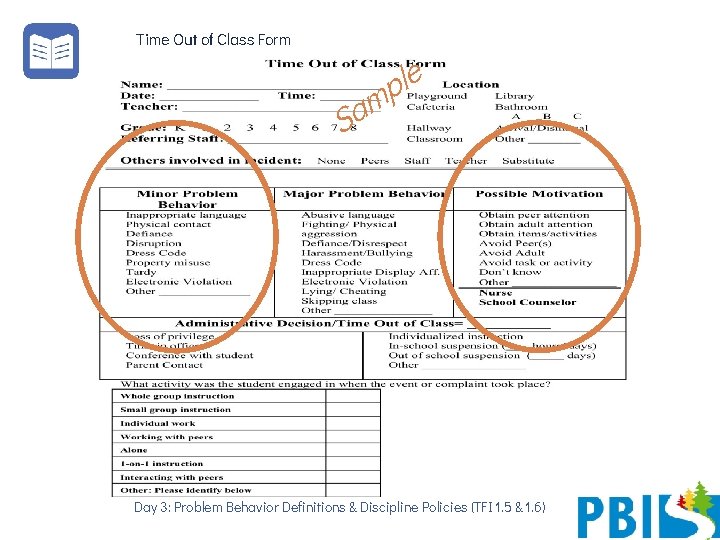
Time Out of Class Form e l p m Sa Day 3: Problem Behavior Definitions & Discipline Policies (TFI 1. 5 & 1. 6)
Your Referral Form Does it collect all of the info needed? Does everyone know where to find them? Does everyone know how to fill them out? Just the facts No previous info (yesterday, a week ago, etc. ) No opinions Day 3: Problem Behavior Definitions & Discipline Policies (TFI 1. 5 & 1. 6)
Create Your Office Referral Form Workbook: TFI 1. 5, 1. 6 Activity 7 ❑ Review “Constructing your Office Referral” resource in the workbook ❑ Review sample data collection tools for office-managed (major) ❑ Review your current office discipline referral and identify data fields to add ❑ Identify when and how you will provide support staff to use data collection tools Day 3: Problem Behavior Definitions & Discipline Policies (TFI 1. 5 & 1. 6)
TFI 1. 5 & 1. 6 Problem Behavior Definitions & Discipline Policies SELF-ASSESSMENT 1. Complete TFI item(s) 2. Assess additional action items at end of module ACTION PLANNING 1. Add action items to Action plan 2. Plan for PD 3. Add to your Staff Presentation PPT Day 3: Problem Behavior Definitions & Discipline Policies (TFI 1. 5 & 1. 6)
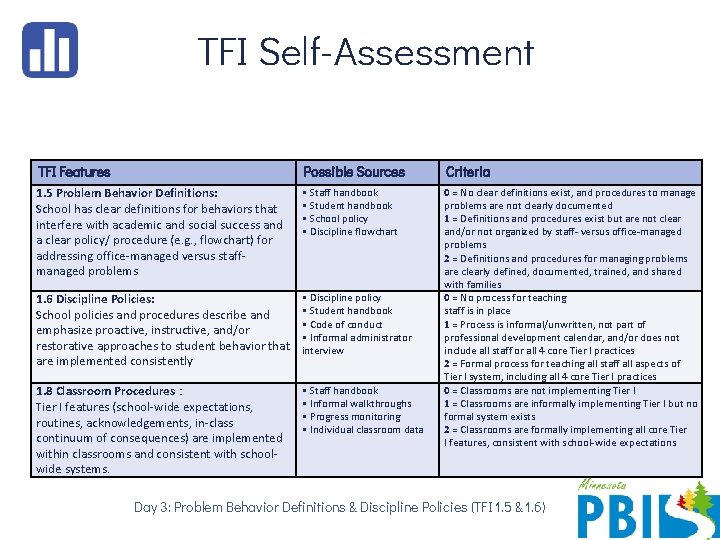
TFI Self-Assessment TFI Features Possible Sources Criteria 1. 5 Problem Behavior Definitions: School has clear definitions for behaviors that interfere with academic and social success and a clear policy/ procedure (e. g. , flowchart) for addressing office-managed versus staffmanaged problems • Staff handbook • Student handbook • School policy • Discipline flowchart 1. 6 Discipline Policies: School policies and procedures describe and emphasize proactive, instructive, and/or restorative approaches to student behavior that are implemented consistently • Discipline policy • Student handbook • Code of conduct • Informal administrator interview 1. 8 Classroom Procedures : Tier I features (school-wide expectations, routines, acknowledgements, in-class continuum of consequences) are implemented within classrooms and consistent with schoolwide systems. • Staff handbook • Informal walkthroughs • Progress monitoring • Individual classroom data 0 = No clear definitions exist, and procedures to manage problems are not clearly documented 1 = Definitions and procedures exist but are not clear and/or not organized by staff- versus office-managed problems 2 = Definitions and procedures for managing problems are clearly defined, documented, trained, and shared with families 0 = No process for teaching staff is in place 1 = Process is informal/unwritten, not part of professional development calendar, and/or does not include all staff or all 4 core Tier I practices 2 = Formal process for teaching all staff all aspects of Tier I system, including all 4 core Tier I practices 0 = Classrooms are not implementing Tier I 1 = Classrooms are informally implementing Tier I but no formal system exists 2 = Classrooms are formally implementing all core Tier I features, consistent with school-wide expectations Day 3: Problem Behavior Definitions & Discipline Policies (TFI 1. 5 & 1. 6)
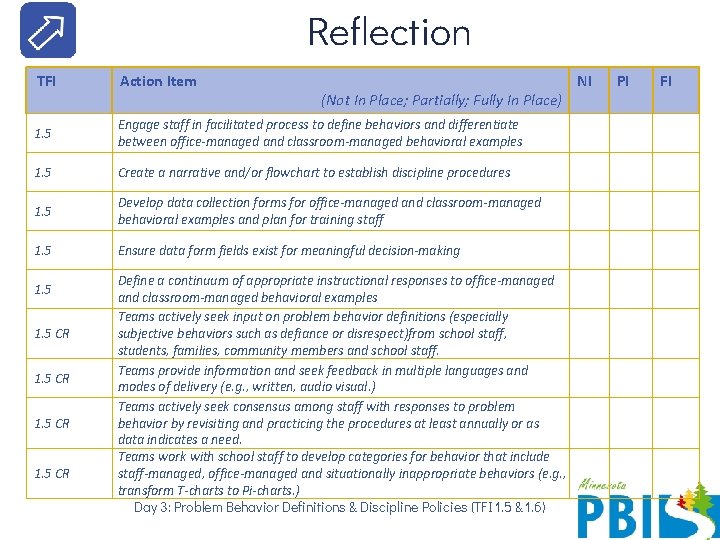
Reflection TFI Action Item 1. 5 Engage staff in facilitated process to define behaviors and differentiate between office-managed and classroom-managed behavioral examples 1. 5 Create a narrative and/or flowchart to establish discipline procedures 1. 5 Develop data collection forms for office-managed and classroom-managed behavioral examples and plan for training staff 1. 5 Ensure data form fields exist for meaningful decision-making 1. 5 CR (Not In Place; Partially; Fully In Place) Define a continuum of appropriate instructional responses to office-managed and classroom-managed behavioral examples Teams actively seek input on problem behavior definitions (especially subjective behaviors such as defiance or disrespect)from school staff, students, families, community members and school staff. Teams provide information and seek feedback in multiple languages and modes of delivery (e. g. , written, audio visual. ) Teams actively seek consensus among staff with responses to problem behavior by revisiting and practicing the procedures at least annually or as data indicates a need. Teams work with school staff to develop categories for behavior that include staff-managed, office-managed and situationally inappropriate behaviors (e. g. , transform T-charts to Pi-charts. ) Day 3: Problem Behavior Definitions & Discipline Policies (TFI 1. 5 & 1. 6) NI PI FI
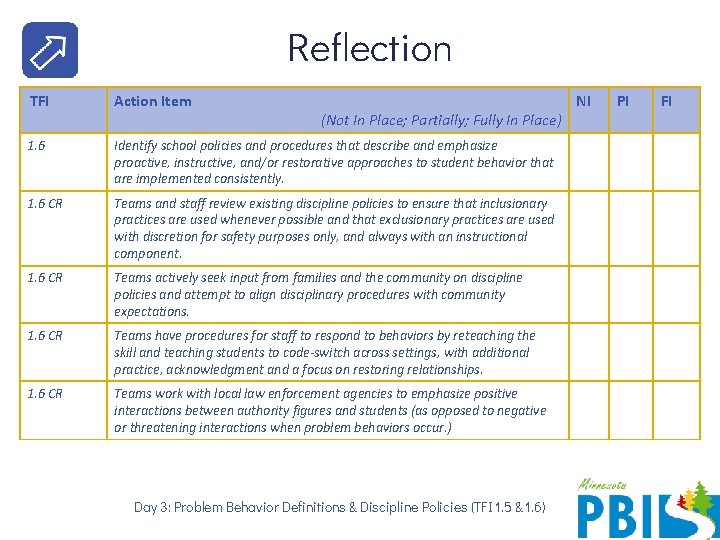
Reflection TFI Action Item 1. 6 Identify school policies and procedures that describe and emphasize proactive, instructive, and/or restorative approaches to student behavior that are implemented consistently. 1. 6 CR Teams and staff review existing discipline policies to ensure that inclusionary practices are used whenever possible and that exclusionary practices are used with discretion for safety purposes only, and always with an instructional component. 1. 6 CR Teams actively seek input from families and the community on discipline policies and attempt to align disciplinary procedures with community expectations. 1. 6 CR Teams have procedures for staff to respond to behaviors by reteaching the skill and teaching students to code-switch across settings, with additional practice, acknowledgment and a focus on restoring relationships. 1. 6 CR Teams work with local law enforcement agencies to emphasize positive interactions between authority figures and students (as opposed to negative or threatening interactions when problem behaviors occur. ) (Not In Place; Partially; Fully In Place) Day 3: Problem Behavior Definitions & Discipline Policies (TFI 1. 5 & 1. 6) NI PI FI
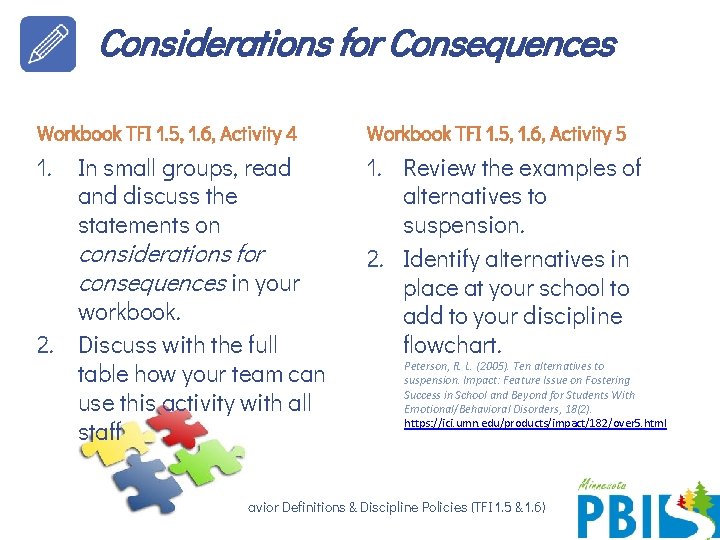
Considerations for Consequences Workbook TFI 1. 5, 1. 6, Activity 4 Workbook TFI 1. 5, 1. 6, Activity 5 1. Review the examples of alternatives to suspension. 2. Identify alternatives in place at your school to add to your discipline flowchart. In small groups, read and discuss the statements on considerations for consequences in your workbook. 2. Discuss with the full table how your team can use this activity with all staff Peterson, R. L. (2005). Ten alternatives to suspension. Impact: Feature Issue on Fostering Success in School and Beyond for Students With Emotional/Behavioral Disorders, 18(2). https: //ici. umn. edu/products/impact/182/over 5. html Day 3: Problem Behavior Definitions & Discipline Policies (TFI 1. 5 & 1. 6)
Appreciation is given to the following for their contributions to this Professional Learning: Day 3: Problem Behavior Definitions & Discipline Policies (TFI 1. 5 & 1. 6)
- Slides: 36