
PBIS Team Training 2 B Fidelity Data TFI
PBIS Team Training 2 B Fidelity Data (TFI 1. 14) Annual Evaluation (TFI 1. 15 )
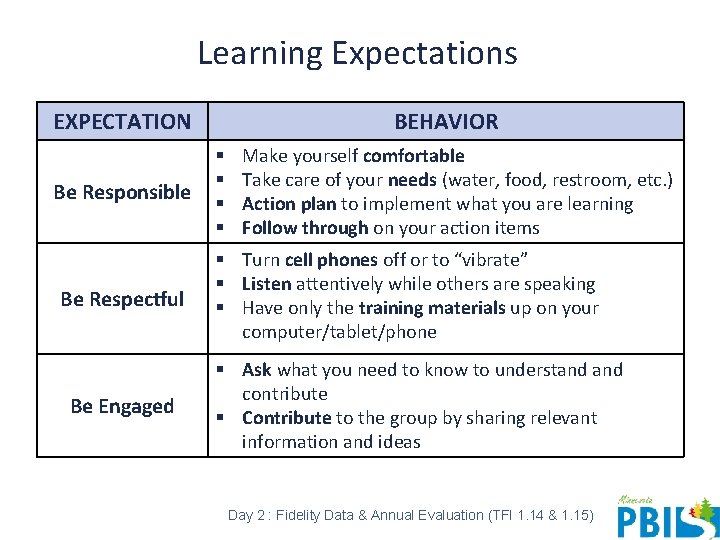
Learning Expectations EXPECTATION Be Responsible Be Respectful Be Engaged BEHAVIOR § § Make yourself comfortable Take care of your needs (water, food, restroom, etc. ) Action plan to implement what you are learning Follow through on your action items § Turn cell phones off or to “vibrate” § Listen attentively while others are speaking § Have only the training materials up on your computer/tablet/phone § Ask what you need to know to understand contribute § Contribute to the group by sharing relevant information and ideas Day 2 : Fidelity Data & Annual Evaluation (TFI 1. 14 & 1. 15)
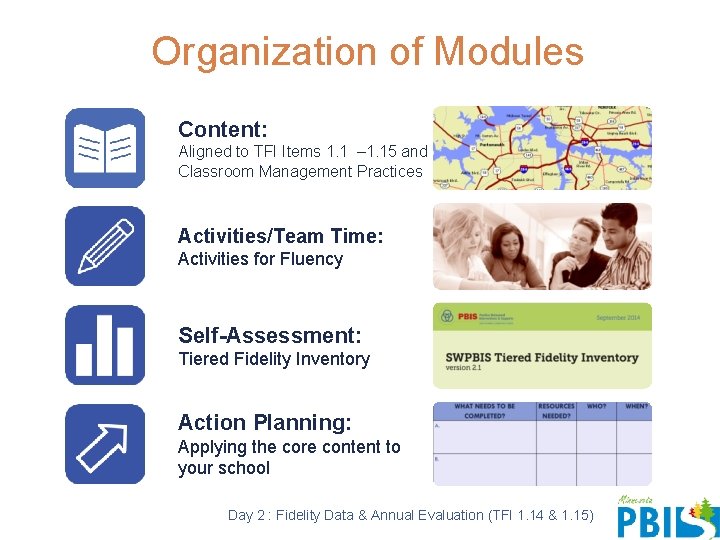
Organization of Modules Content: Aligned to TFI Items 1. 1 – 1. 15 and Classroom Management Practices Activities/Team Time: Activities for Fluency Self-Assessment: Tiered Fidelity Inventory Action Planning: Applying the core content to your school Day 2 : Fidelity Data & Annual Evaluation (TFI 1. 14 & 1. 15)
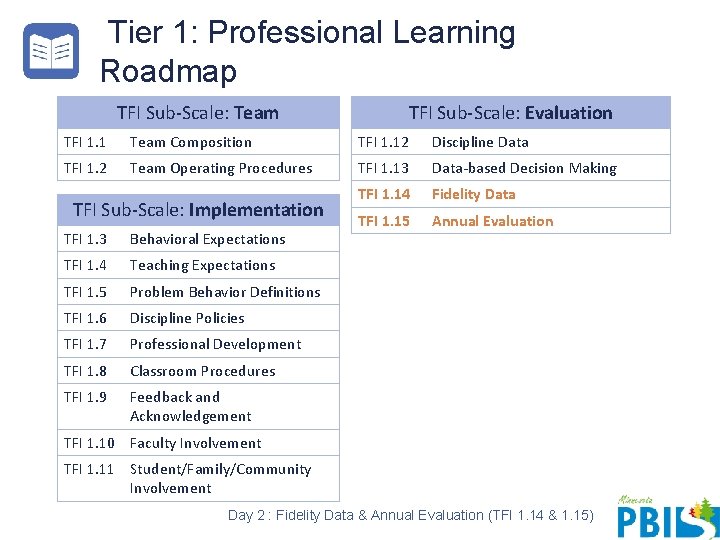
Tier 1: Professional Learning Roadmap TFI Sub-Scale: Team TFI Sub-Scale: Evaluation TFI 1. 1 Team Composition TFI 1. 12 Discipline Data TFI 1. 2 Team Operating Procedures TFI 1. 13 Data-based Decision Making TFI 1. 14 Fidelity Data TFI 1. 15 Annual Evaluation TFI Sub-Scale: Implementation TFI 1. 3 Behavioral Expectations TFI 1. 4 Teaching Expectations TFI 1. 5 Problem Behavior Definitions TFI 1. 6 Discipline Policies TFI 1. 7 Professional Development TFI 1. 8 Classroom Procedures TFI 1. 9 Feedback and Acknowledgement TFI 1. 10 Faculty Involvement TFI 1. 11 Student/Family/Community Involvement Day 2 : Fidelity Data & Annual Evaluation (TFI 1. 14 & 1. 15)
Fidelity Data and Evaluation Purpose & Outcomes Purpose: Prepare to measure fidelity and outcomes of all Tier 1 efforts using multiple forms of data Outcomes: • Tier I team reviews and uses SWPBIS fidelity e. g. , Tiered Fidelity Inventory (TFI), SAS, data at least annually. (TFI 1. 14) • Tier I team documents fidelity and effectiveness (including on academic outcomes) of Tier I practices at least annually (including yearly- year comparisons) that are shared with stakeholders (staff, families, community, district) in a usable format. (TFI 1. 15) Day 2 : Fidelity Data & Annual Evaluation (TFI 1. 14 & 1. 15)
Definition Evaluation is the iterative process for determining (a) how successful we are at implementing PBIS, and guiding (b) our planning to continue or improve that success. Evaluation is multi-faceted and relies on the integration of data from other systems: expectations, acknowledgements, classroom and discipline. Day 2 : Fidelity Data & Annual Evaluation (TFI 1. 14 & 1. 15)
Rationale Evaluation systems are a way to hold ourselves accountable, celebrate our successes, and change our PBIS implementation based on data. Evaluation helps us see the big picture and fit in all the small details. Day 2 : Fidelity Data & Annual Evaluation (TFI 1. 14 & 1. 15)
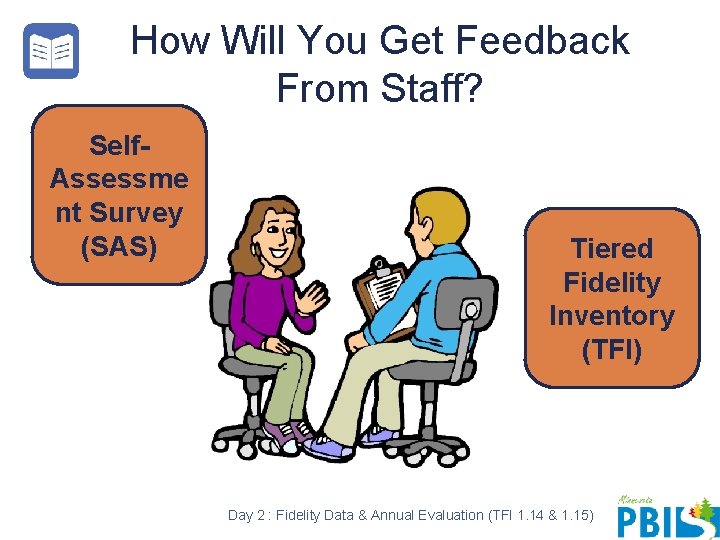
How Will You Get Feedback From Staff? Self. Assessme nt Survey (SAS) Tiered Fidelity Inventory (TFI) Day 2 : Fidelity Data & Annual Evaluation (TFI 1. 14 & 1. 15)
Self-Assessment Survey (SAS) § WHAT: Annual assessment of staff perception of PBIS implementation § WHO: All school staff § WHEN: Annually – preferably spring § WHY: Identifies implementation status and improvement priority for School Wide, Classroom, Non-classroom and Individual Student Systems § WHERE: www. PBISApps. org Day 2 : Fidelity Data & Annual Evaluation (TFI 1. 14 & 1. 15)
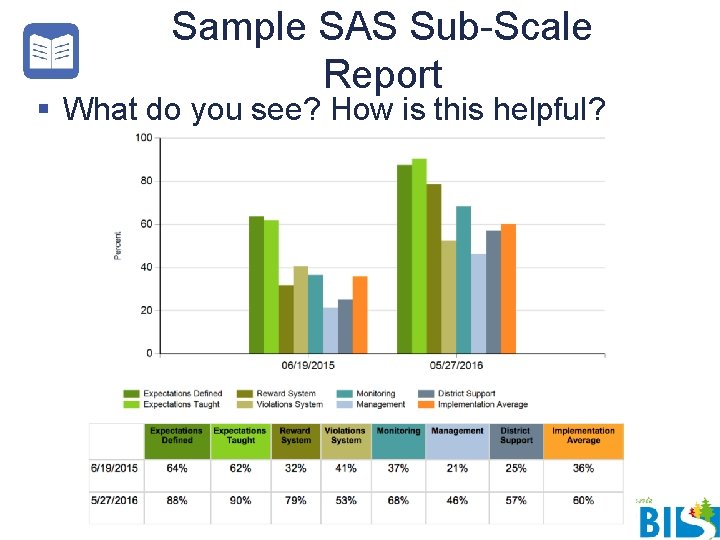
Sample SAS Sub-Scale Report § What do you see? How is this helpful? Day 2 : Fidelity Data & Annual Evaluation (TFI 1. 14 & 1. 15)
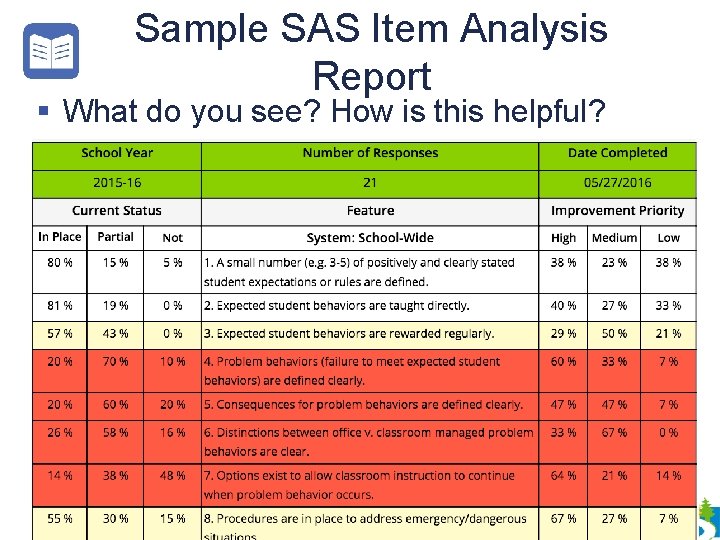
Sample SAS Item Analysis Report § What do you see? How is this helpful? Day 2 : Fidelity Data & Annual Evaluation (TFI 1. 14 & 1. 15)
Tiered Fidelity Inventory (TFI) § Assists teams in finding areas of implementation strength and needs § Completed by PBIS team members and coach at the same time. § Goal: 70% or more of total points for implementation Day 2 : Fidelity Data & Annual Evaluation (TFI 1. 14 & 1. 15)
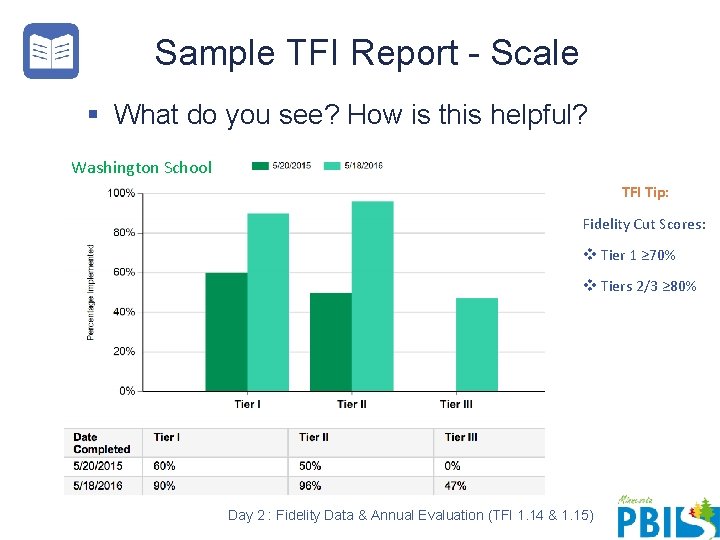
Sample TFI Report - Scale § What do you see? How is this helpful? Washington School TFI Tip: Fidelity Cut Scores: v Tier 1 ≥ 70% v Tiers 2/3 ≥ 80% Day 2 : Fidelity Data & Annual Evaluation (TFI 1. 14 & 1. 15)
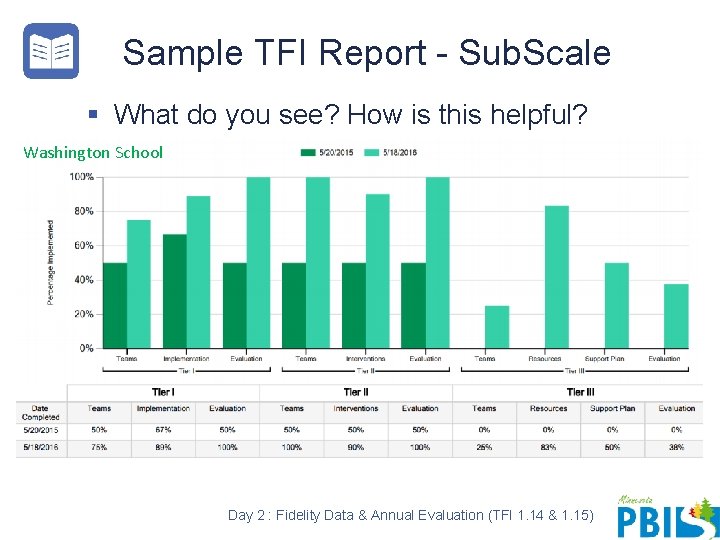
Sample TFI Report - Sub. Scale § What do you see? How is this helpful? Washington School Day 2 : Fidelity Data & Annual Evaluation (TFI 1. 14 & 1. 15)
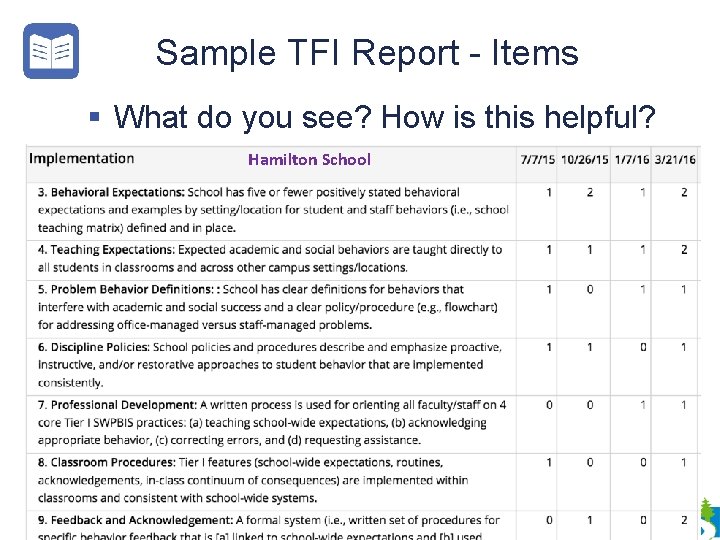
Sample TFI Report - Items § What do you see? How is this helpful? Hamilton School Day 2 : Fidelity Data & Annual Evaluation (TFI 1. 14 & 1. 15)
Setting Up PBIS Assessments for your schools 1. Identify a coordinator who will open and close surveys, and generate graphs for all schools. § Overview of PBIS Assessments: • https: //www. pbisapps. org/Resources/Pages/ PBIS-Assessment-Overview-Webinar. aspx § Complete PBIS Assessments User's Manual: • https: //www. pbisapps. org/Resources/SWIS% 20 Publications/PBIS%20 Assessment%20 Us ers%20 Manual. pdf Day 2 : Fidelity Data & Annual Evaluation (TFI 1. 14 & 1. 15)
Day to Day… § The SAS and TFI provide perception data § Teachers § Team and coach § There are other “quick” ways to evaluate teachers use of PBIS Tier 1 practices Day 2 : Fidelity Data & Annual Evaluation (TFI 1. 14 & 1. 15)
Day to Day… Continued § Share data on office referrals § Ask if accurate § Share counts for acknowledgements. Consider: § Teacher names pre-printed on slips/tickets § Tracking by grade level § Teachers making a quick frequency count Day 2 : Fidelity Data & Annual Evaluation (TFI 1. 14 & 1. 15)
Outcomes § Our fidelity and perception data are important in relation to our Tier I outcome data. § Office referral § Attendance Day 2 : Fidelity Data & Annual Evaluation (TFI 1. 14 & 1. 15)
Activity 1. What are the different types of data your team will be using to make decisions about the PBIS implementation? 2. What kind of “statement” do you need to be able to make regarding your data? - What are the pieces of that statement? 3. What is your elevator speech for when colleagues ask you about “all this data collection”? Workbook: Fidelity Data and Evaluation Activity 1 Day 2 : Fidelity Data & Annual Evaluation (TFI 1. 14 & 1. 15)
Do you believe in me? https: //www. youtube. com/watch? v=Fma 3 Lvo 7 e 7 A Day 2 : Fidelity Data & Annual Evaluation (TFI 1. 14 & 1. 15)
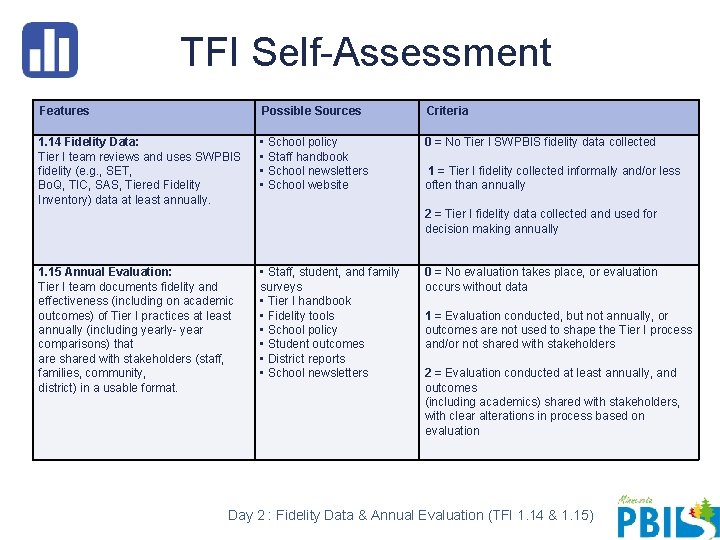
TFI Self-Assessment Features Possible Sources Criteria 1. 14 Fidelity Data: Tier I team reviews and uses SWPBIS fidelity (e. g. , SET, Bo. Q, TIC, SAS, Tiered Fidelity Inventory) data at least annually. • School policy • Staff handbook • School newsletters • School website 0 = No Tier I SWPBIS fidelity data collected 1 = Tier I fidelity collected informally and/or less often than annually 2 = Tier I fidelity data collected and used for decision making annually 1. 15 Annual Evaluation: Tier I team documents fidelity and effectiveness (including on academic outcomes) of Tier I practices at least annually (including yearly- year comparisons) that are shared with stakeholders (staff, families, community, district) in a usable format. • Staff, student, and family surveys • Tier I handbook • Fidelity tools • School policy • Student outcomes • District reports • School newsletters 0 = No evaluation takes place, or evaluation occurs without data 1 = Evaluation conducted, but not annually, or outcomes are not used to shape the Tier I process and/or not shared with stakeholders 2 = Evaluation conducted at least annually, and outcomes (including academics) shared with stakeholders, with clear alterations in process based on evaluation Day 2 : Fidelity Data & Annual Evaluation (TFI 1. 14 & 1. 15)
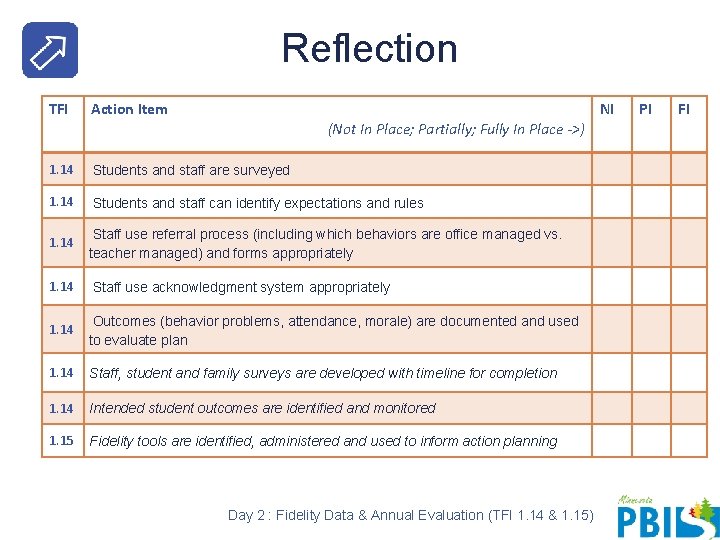
Reflection TFI Action Item 1. 14 Students and staff are surveyed 1. 14 Students and staff can identify expectations and rules 1. 14 Staff use referral process (including which behaviors are office managed vs. teacher managed) and forms appropriately 1. 14 Staff use acknowledgment system appropriately 1. 14 Outcomes (behavior problems, attendance, morale) are documented and used to evaluate plan 1. 14 Staff, student and family surveys are developed with timeline for completion 1. 14 Intended student outcomes are identified and monitored 1. 15 Fidelity tools are identified, administered and used to inform action planning (Not In Place; Partially; Fully In Place ->) NI Day 2 : Fidelity Data & Annual Evaluation (TFI 1. 14 & 1. 15) PI FI
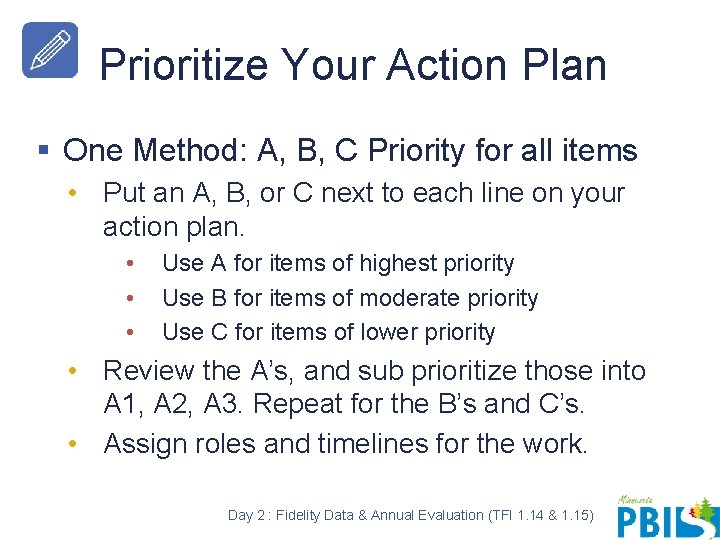
Prioritize Your Action Plan § One Method: A, B, C Priority for all items • Put an A, B, or C next to each line on your action plan. • • • Use A for items of highest priority Use B for items of moderate priority Use C for items of lower priority • Review the A’s, and sub prioritize those into A 1, A 2, A 3. Repeat for the B’s and C’s. • Assign roles and timelines for the work. Day 2 : Fidelity Data & Annual Evaluation (TFI 1. 14 & 1. 15)
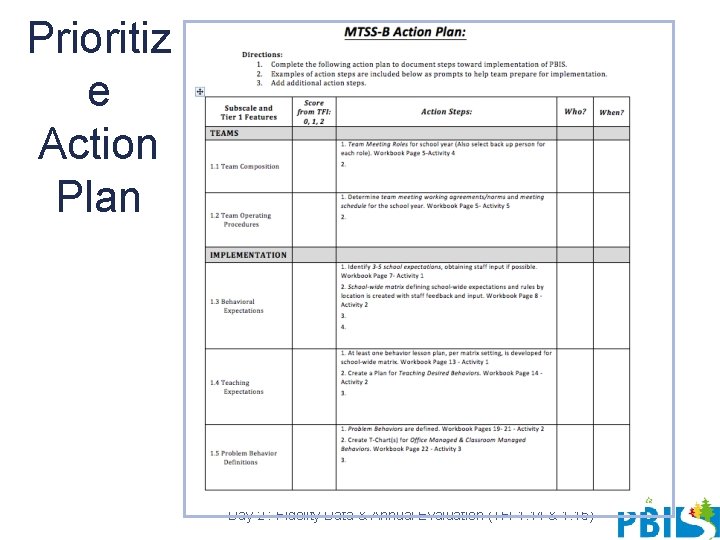
Prioritiz e Action Plan Day 2 : Fidelity Data & Annual Evaluation (TFI 1. 14 & 1. 15)
Appreciation is given to the following for their contributions to this Professional Learning: Day 2 : Fidelity Data & Annual Evaluation (TFI 1. 14 & 1. 15)
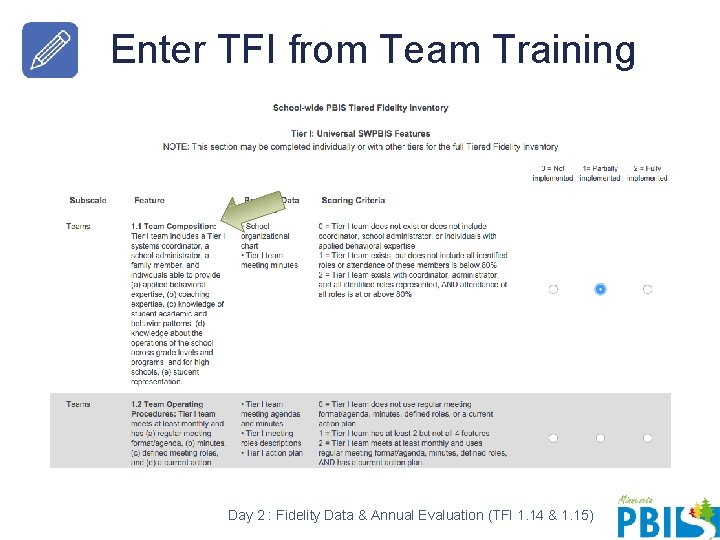
Enter TFI from Team Training Day 2 : Fidelity Data & Annual Evaluation (TFI 1. 14 & 1. 15)
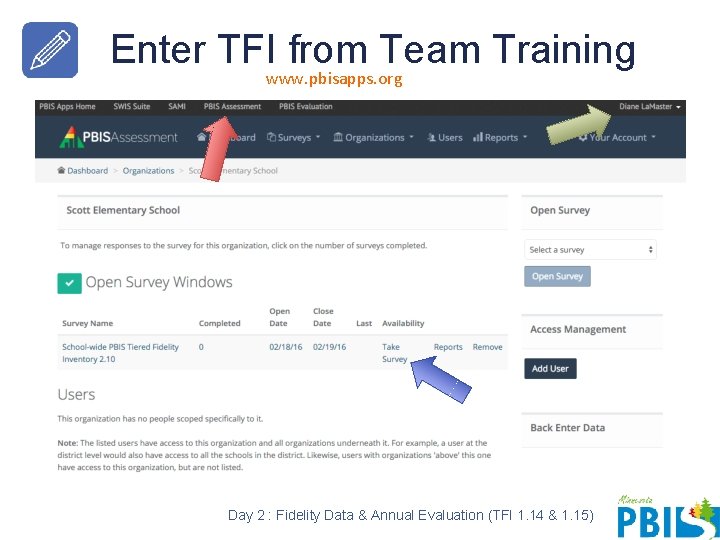
Enter TFI from Team Training www. pbisapps. org Day 2 : Fidelity Data & Annual Evaluation (TFI 1. 14 & 1. 15)
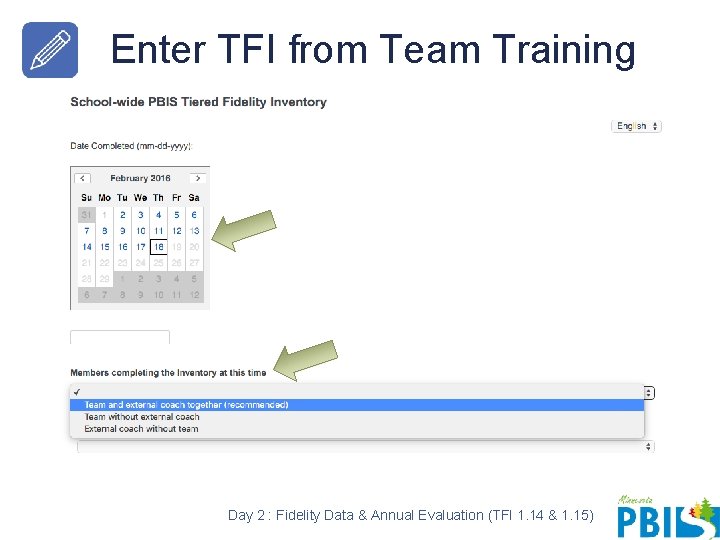
Enter TFI from Team Training Day 2 : Fidelity Data & Annual Evaluation (TFI 1. 14 & 1. 15)
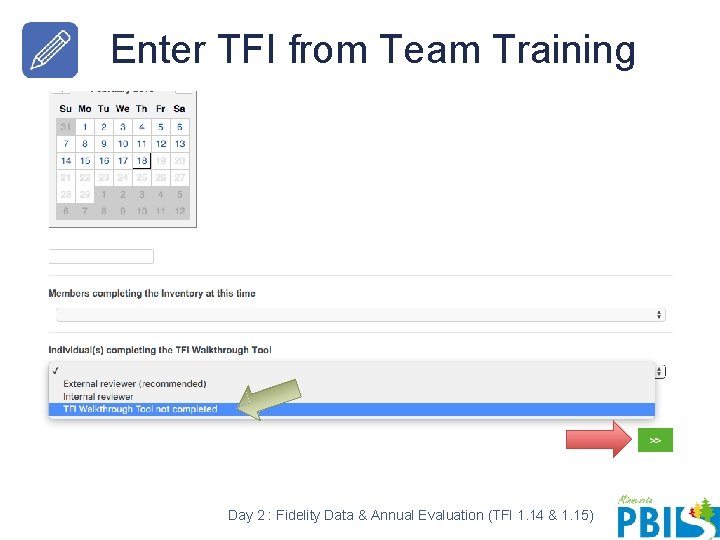
Enter TFI from Team Training Day 2 : Fidelity Data & Annual Evaluation (TFI 1. 14 & 1. 15)
Taking/Submitting TFI You are taking Tier 1 of the TFI After Tier I is done…. . scroll down to the bottom of the page CLICK NEXT Scroll down to the bottom of the page and CLICK SUBMIT You should get a confirmation of your submission Day 2 : Fidelity Data & Annual Evaluation (TFI 1. 14 & 1. 15)
- Slides: 31