
PBIS Positive Behavior Interventions Supports Version 3 0
PBIS Positive Behavior Interventions & Supports Version 3. 0, Rev. 1. 16. 2012 This is a presentation of the Illinois PBIS Network. All rights reserved.
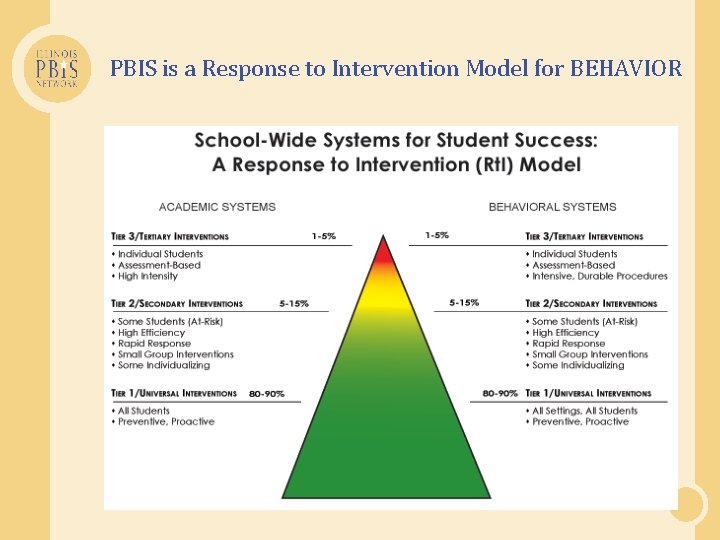
PBIS is a Response to Intervention Model for BEHAVIOR
PBIS at Millburn Elementary PREPARED AND RESPECTFUL TOGETHER Entering our third year of implementation at the Tier 1/Universal (all students) level Recognized by PBIS IL Network Currently planning for the implementation of Tier 2, the secondary level of supports phase
PBIS at Millburn Elementary Students will continue to receive red “Do Your Part” or “DYP” tickets for acknowledgement of positive behaviors. DYP tickets can be used to enter school-wide or gradelevel raffles, to trade in for pencils or other trinkets, etc. The lunchtime PART Mart has been discontinued. Students can earn yellow “Bus Star” tickets for positive behaviors observed by their bus drivers while riding the bus. Data on the school’s progress toward decreasing behavior referrals will be shared with students at monthly, schoolwide “celebrations. ” All students receive social-emotional learning instruction during “Second Step” sessions with their teacher once a week.
PBIS/Tier 2 Secondary Levels of Support Version 3. 0, Rev. 1. 16. 2012 This is a presentation of the Illinois PBIS Network. All rights reserved.
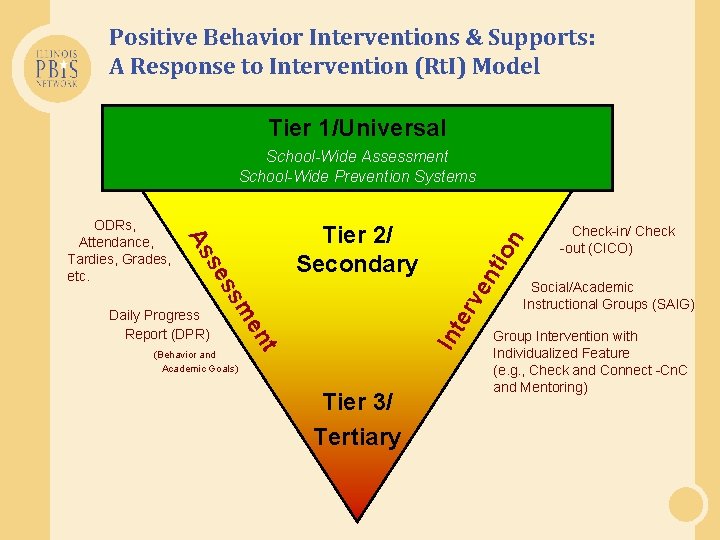
Positive Behavior Interventions & Supports: A Response to Intervention (Rt. I) Model Tier 1/Universal School-Wide Assessment School-Wide Prevention Systems nt Int nt (Behavior and Academic Goals) er me ve ss se Daily Progress Report (DPR) ion Tier 2/ Secondary As ODRs, Attendance, Tardies, Grades, etc. Tier 3/ Tertiary Check-in/ Check -out (CICO) Social/Academic Instructional Groups (SAIG) Group Intervention with Individualized Feature (e. g. , Check and Connect -Cn. C and Mentoring)
Check-in Check-out (CICO)
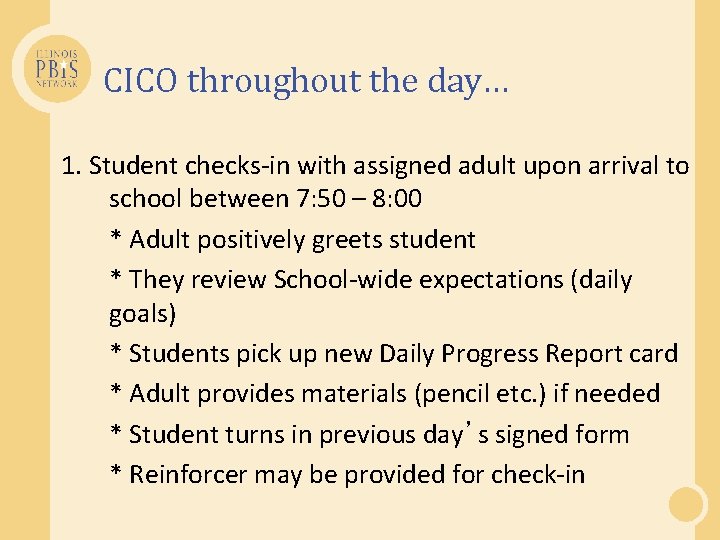
CICO throughout the day… 1. Student checks-in with assigned adult upon arrival to school between 7: 50 – 8: 00 * Adult positively greets student * They review School-wide expectations (daily goals) * Students pick up new Daily Progress Report card * Adult provides materials (pencil etc. ) if needed * Student turns in previous day’s signed form * Reinforcer may be provided for check-in
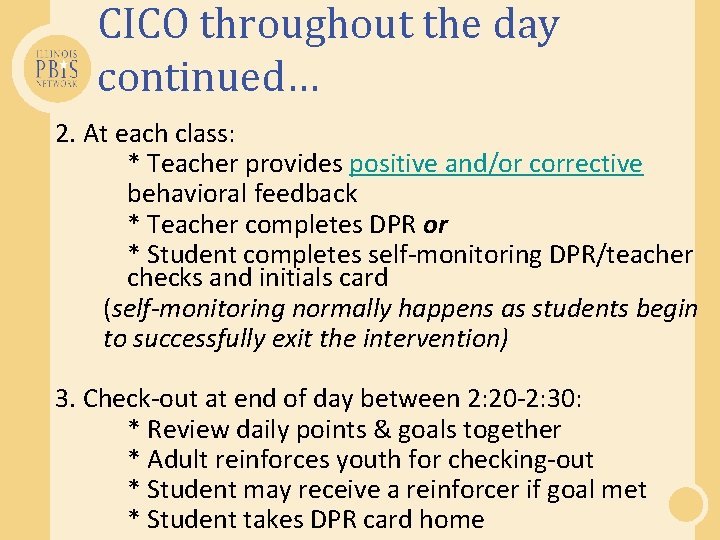
CICO throughout the day continued… 2. At each class: * Teacher provides positive and/or corrective behavioral feedback * Teacher completes DPR or * Student completes self-monitoring DPR/teacher checks and initials card (self-monitoring normally happens as students begin to successfully exit the intervention) 3. Check-out at end of day between 2: 20 -2: 30: * Review daily points & goals together * Adult reinforces youth for checking-out * Student may receive a reinforcer if goal met * Student takes DPR card home
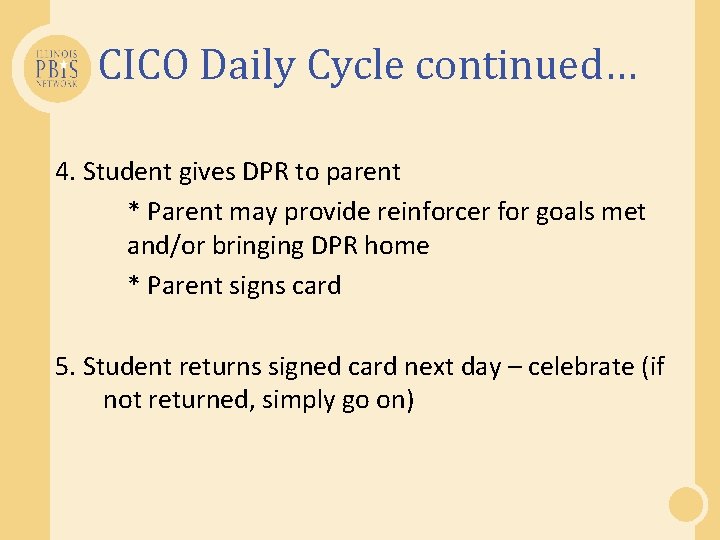
CICO Daily Cycle continued… 4. Student gives DPR to parent * Parent may provide reinforcer for goals met and/or bringing DPR home * Parent signs card 5. Student returns signed card next day – celebrate (if not returned, simply go on)
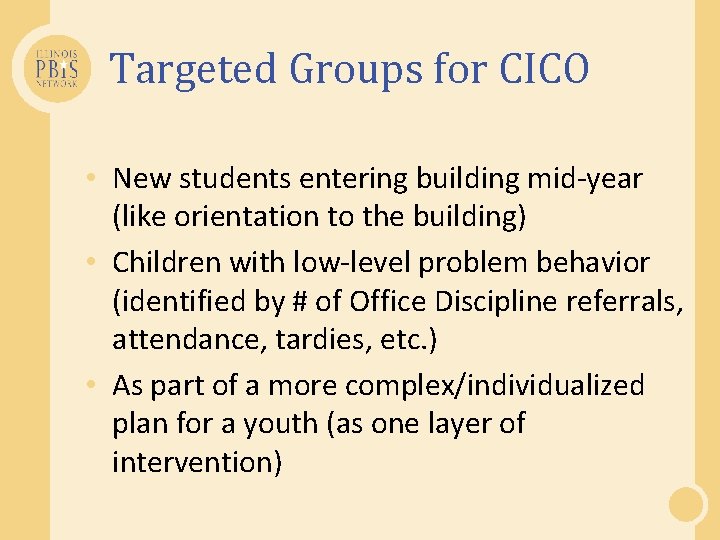
Targeted Groups for CICO • New students entering building mid-year (like orientation to the building) • Children with low-level problem behavior (identified by # of Office Discipline referrals, attendance, tardies, etc. ) • As part of a more complex/individualized plan for a youth (as one layer of intervention)
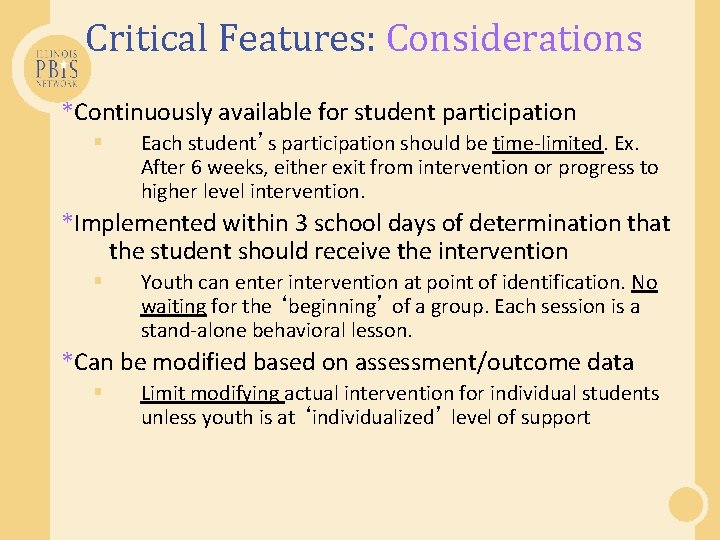
Critical Features: Considerations *Continuously available for student participation § Each student’s participation should be time-limited. Ex. After 6 weeks, either exit from intervention or progress to higher level intervention. *Implemented within 3 school days of determination that the student should receive the intervention § Youth can enter intervention at point of identification. No waiting for the ‘beginning’ of a group. Each session is a stand-alone behavioral lesson. *Can be modified based on assessment/outcome data § Limit modifying actual intervention for individual students unless youth is at ‘individualized’ level of support
Types of Student Outcome Data used to progress monitoring and assess for transition… • • Points earned on Daily Progress Report (DPR) Reduction in ODRs Attendance improvement Reduction in In School Suspensions Reduction in Out of School Suspensions Improvement in grades Reduction of tardies
Data-based Decision-rules a) Identification for CICO: § Youth is identified by Universal Screener or has 3 or more ODRs. b) Progress-monitoring: § DPR data is collected daily & reviewed every week. Data is collected for 6 weeks. c) Exiting/transitioning: § Youth received a total of 80% of DPR points averaged per day/week for 6 weeks and has had no new ODRs. Youth will be transitioned into being a CICO student mentor.
Social and Academic Instructional Groups
Social/Academic Instructional Groups Students enter SAIG groups if CICO was not successful § Three types of skills-building groups: § 1) Pro-social skills § 2) Problem-solving skills § 3) Academic Behavior skills • Best if involves use of Daily Progress Report • These are often the skill groups facilitated by Social Workers, Counselors & Psychologists § However, may consider other providers
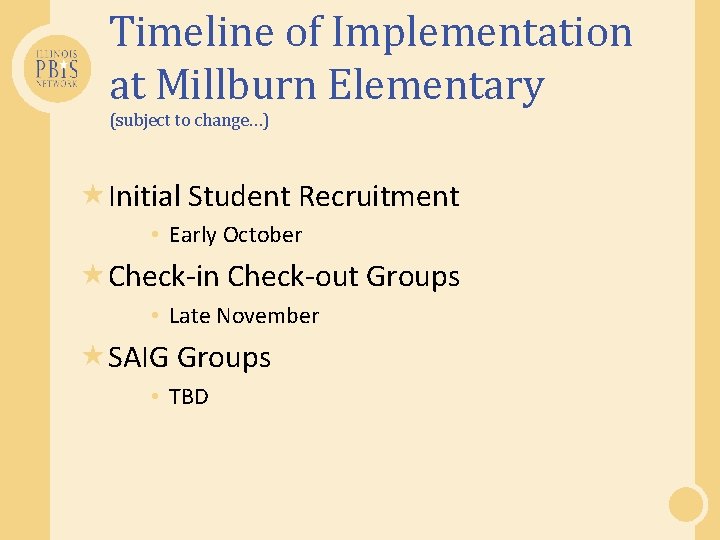
Timeline of Implementation at Millburn Elementary (subject to change…) Initial Student Recruitment • Early October Check-in Check-out Groups • Late November SAIG Groups • TBD
- Slides: 17