
PBIS in the Classroom Teaching Procedures to Improve
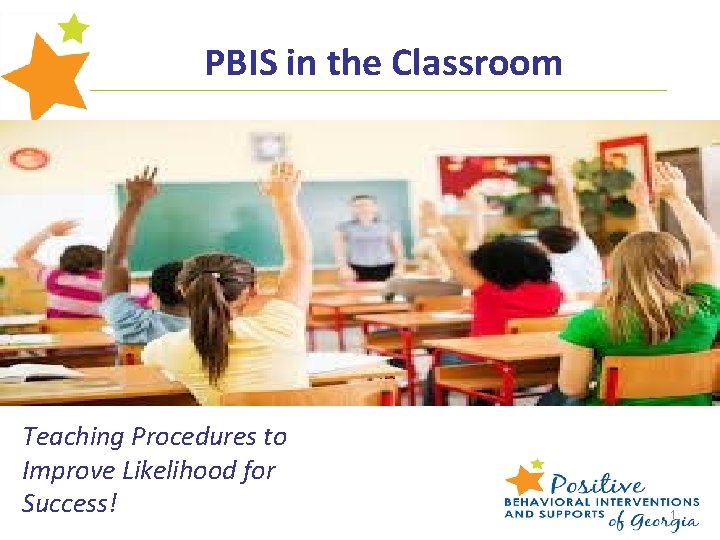
PBIS in the Classroom Teaching Procedures to Improve Likelihood for Success! 1
Objectives
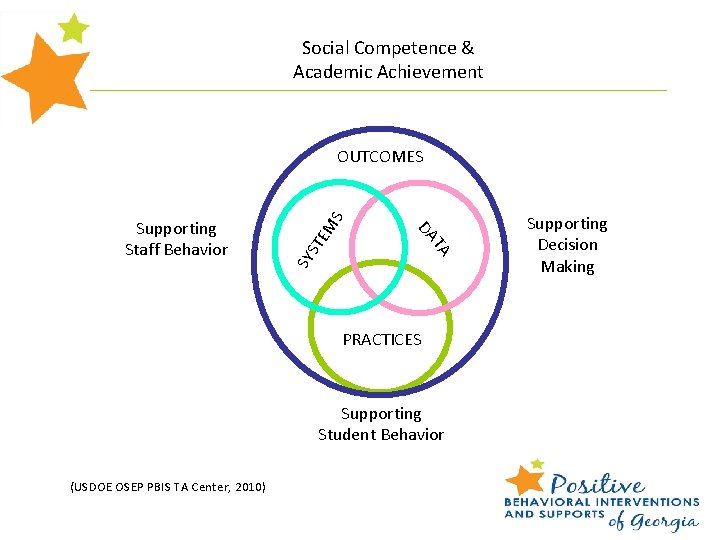
Social Competence & Academic Achievement ST E SY TA DA Supporting Staff Behavior MS OUTCOMES PRACTICES Supporting Student Behavior (USDOE OSEP PBIS TA Center, 2010) Supporting Decision Making
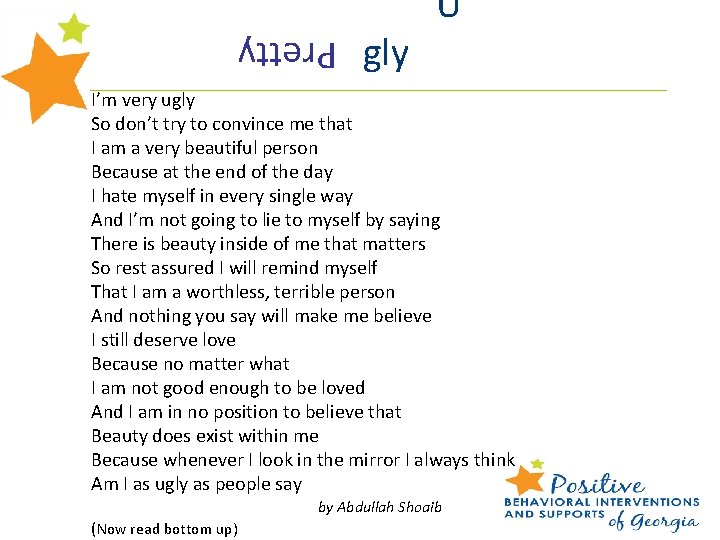
gly U Pretty I’m very ugly So don’t try to convince me that I am a very beautiful person Because at the end of the day I hate myself in every single way And I’m not going to lie to myself by saying There is beauty inside of me that matters So rest assured I will remind myself That I am a worthless, terrible person And nothing you say will make me believe I still deserve love Because no matter what I am not good enough to be loved And I am in no position to believe that Beauty does exist within me Because whenever I look in the mirror I always think Am I as ugly as people say by Abdullah Shoaib (Now read bottom up)
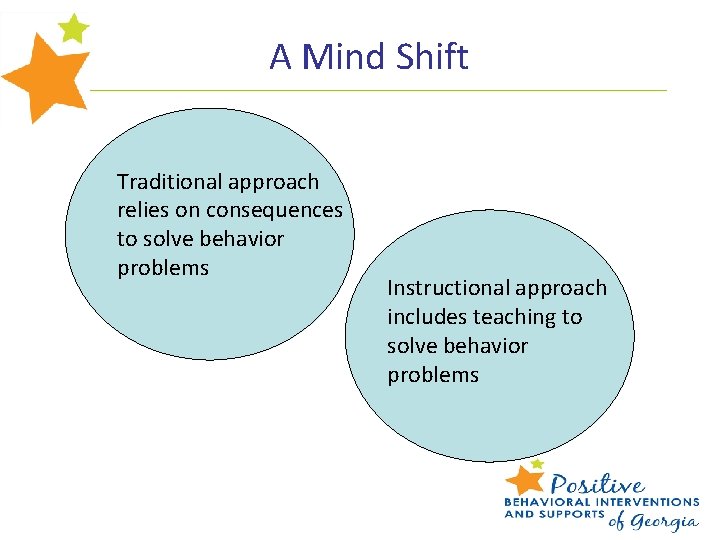
A Mind Shift Traditional approach relies on consequences to solve behavior problems Instructional approach includes teaching to solve behavior problems
Developing Classroom Developing your Classroom Matrix Expectations 6
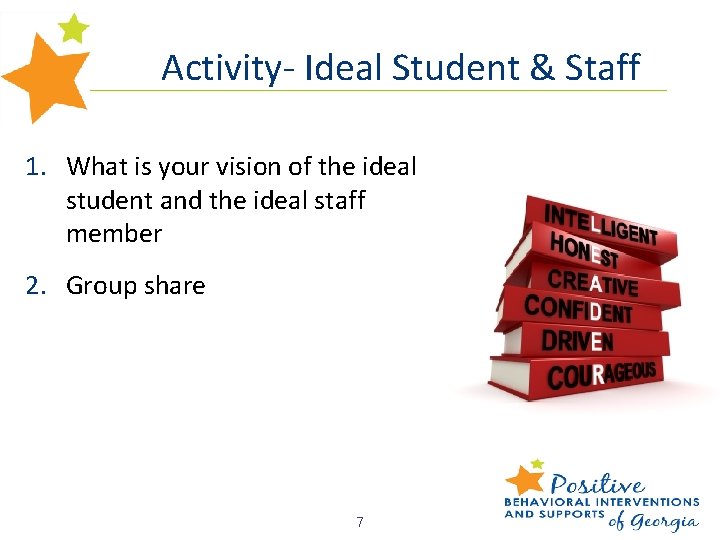
Activity- Ideal Student & Staff 1. What is your vision of the ideal student and the ideal staff member 2. Group share 7
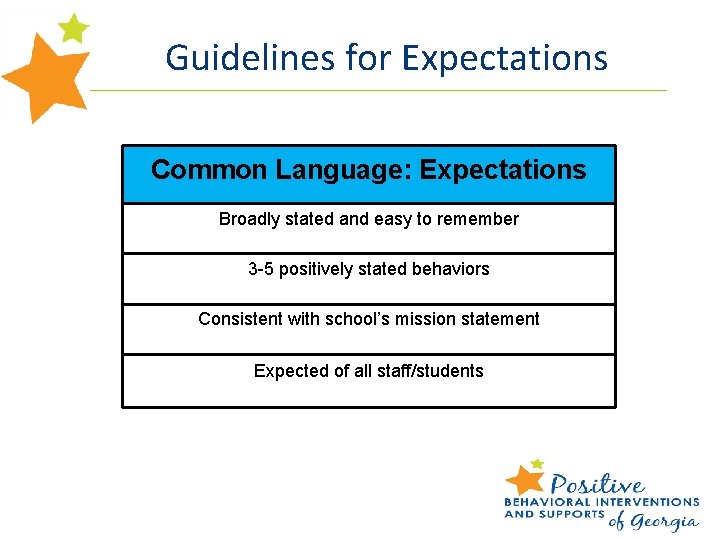
Guidelines for Expectations Common Language: Expectations Broadly stated and easy to remember 3 -5 positively stated behaviors Consistent with school’s mission statement Expected of all staff/students

Expectation Examples 9

Expectation Examples 10
Activity- PBIS Expectations Use the ideal student/staff activity to develop a draft of 3 -5 classroom expectations to begin developing your matrix. 11
Developing Procedures and Routines 12
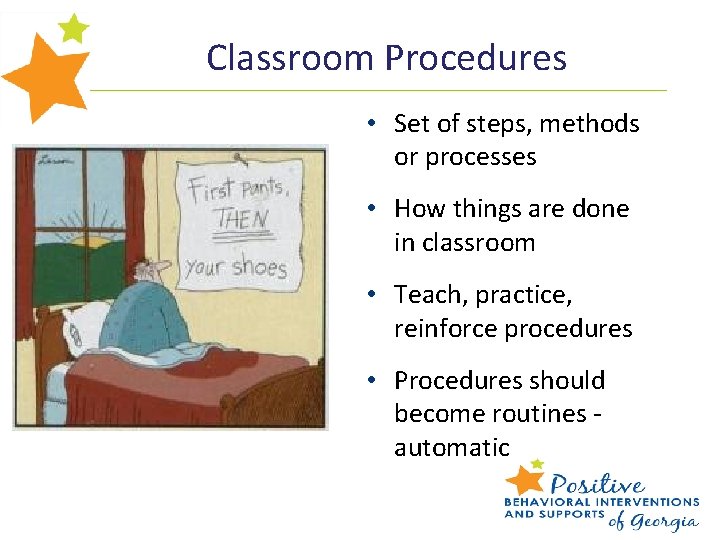
Classroom Procedures • Set of steps, methods or processes • How things are done in classroom • Teach, practice, reinforce procedures • Procedures should become routines automatic
Examples of Activities Elementary Secondary • Entering Classroom • Entering classroom • Lining up • Turning in assignments • Seat work • Group work • Learning position (ex. , feet on floor) • Lab work • Raise hand to talk • Sharpening pencil • How to ask for help • Asking for help • Managing materials • Restroom/water break • Transitions
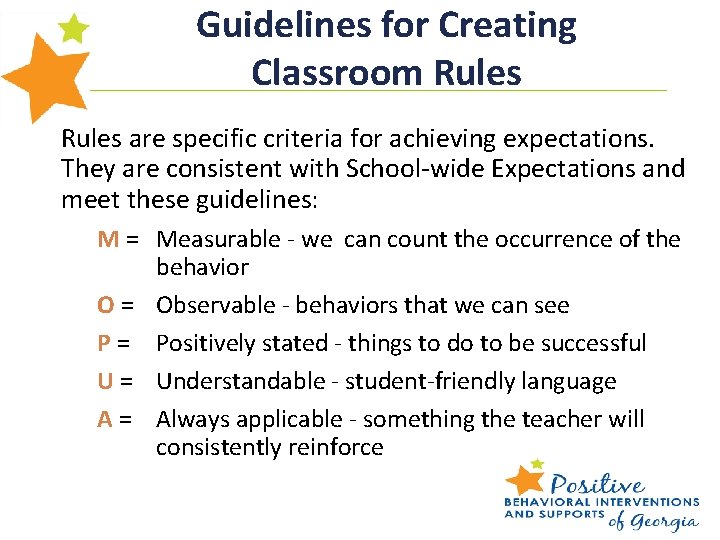
Guidelines for Creating Classroom Rules are specific criteria for achieving expectations. They are consistent with School-wide Expectations and meet these guidelines: M = Measurable - we can count the occurrence of the behavior O = Observable - behaviors that we can see P = Positively stated - things to do to be successful U = Understandable - student-friendly language A = Always applicable - something the teacher will consistently reinforce
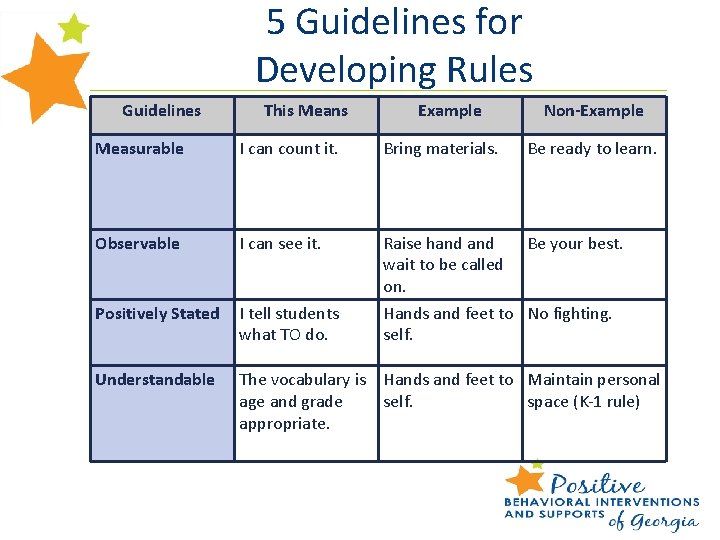
5 Guidelines for Developing Rules Guidelines This Means Example Non-Example Measurable I can count it. Bring materials. Be ready to learn. Observable I can see it. Positively Stated I tell students what TO do. Raise hand Be your best. wait to be called on. Hands and feet to No fighting. self. Understandable The vocabulary is Hands and feet to Maintain personal age and grade self. space (K-1 rule) appropriate.

Replacement Behaviors Problem Behavior in Your Classroom 1. Students talk out during discussions. Replacement Behaviors (What you want Students to do instead? ) 1. Raise hand to talk during discussions. 2. Students don’t hand in complete work. 2. Hand in complete work. 3. Students are tardy. 3. Be on time to class…in seat ready to start when bell rings 4. Bring all materials and equipment to class. 4. Students don’t have their stuff 5. Students cuss 6. Push each other when lining up 5. Use appropriate language with students and adults. 6. Walk and keep hands & feet to self.
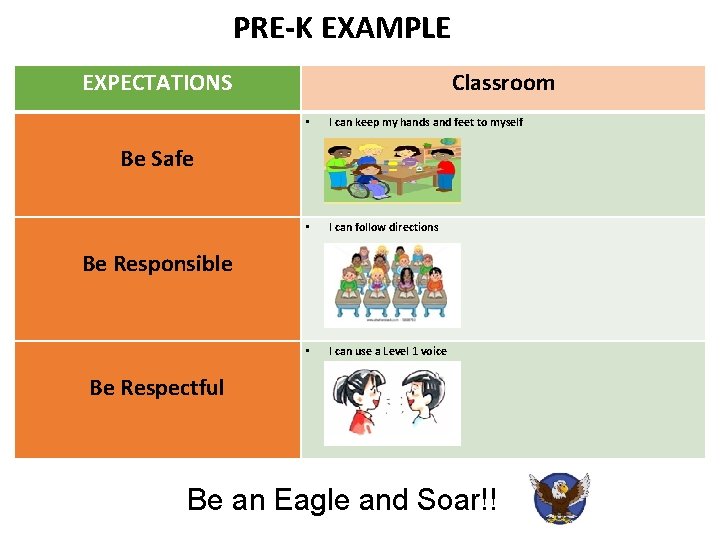
PRE-K EXAMPLE EXPECTATIONS Classroom • I can keep my hands and feet to myself • I can follow directions • I can use a Level 1 voice Be Safe Be Responsible Be Respectful Be an Eagle and Soar!!
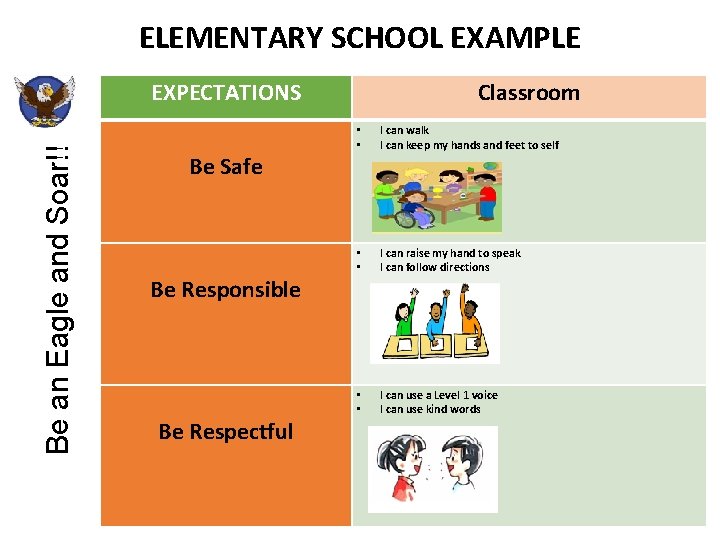
ELEMENTARY SCHOOL EXAMPLE Be an Eagle and Soar!! EXPECTATIONS Classroom • • I can walk I can keep my hands and feet to self • • I can raise my hand to speak I can follow directions • • I can use a Level 1 voice I can use kind words Be Safe Be Responsible Be Respectful
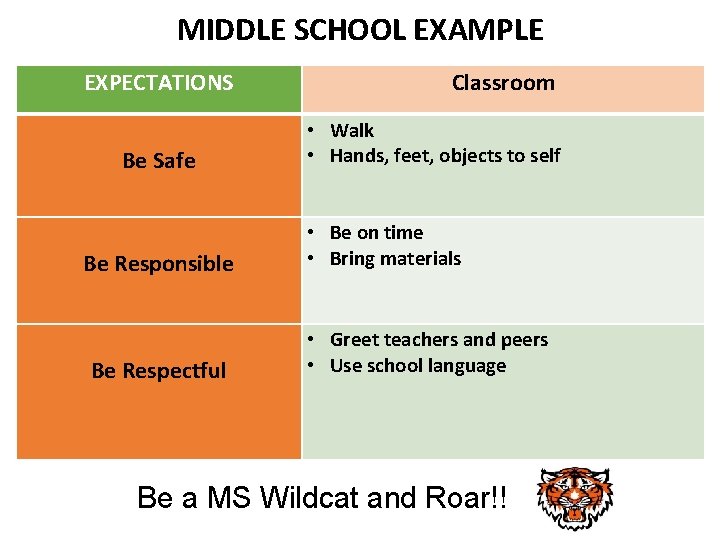
MIDDLE SCHOOL EXAMPLE EXPECTATIONS Be Safe Be Responsible Be Respectful Classroom • Walk • Hands, feet, objects to self • Be on time • Bring materials • Greet teachers and peers • Use school language Be a MS Wildcat and Roar!!
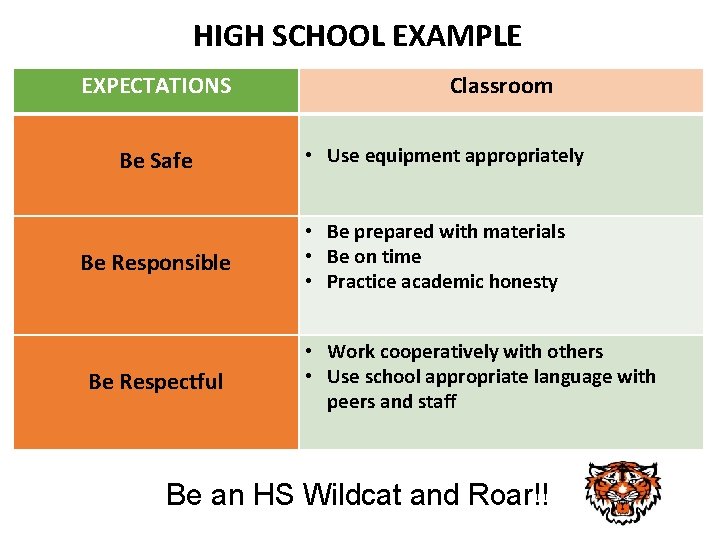
HIGH SCHOOL EXAMPLE EXPECTATIONS Be Safe Be Responsible Be Respectful Classroom • Use equipment appropriately • Be prepared with materials • Be on time • Practice academic honesty • Work cooperatively with others • Use school appropriate language with peers and staff Be an HS Wildcat and Roar!!
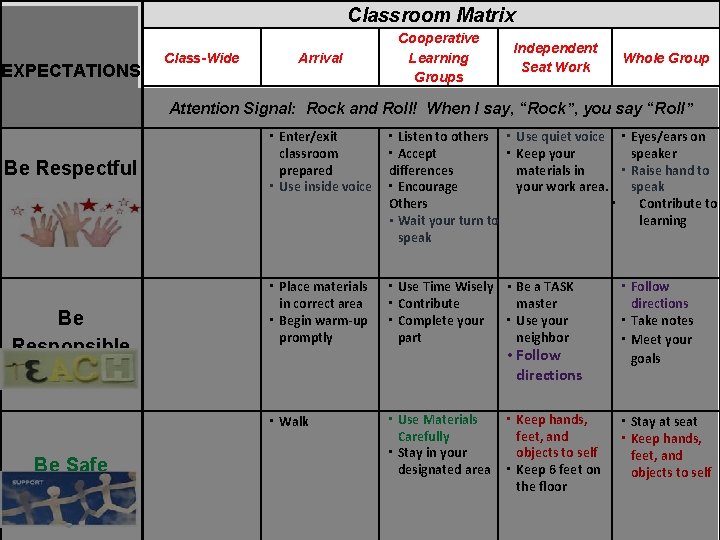
Classroom Matrix EXPECTATIONS Class-Wide Arrival Cooperative Learning Groups Independent Seat Work Whole Group Attention Signal: Rock and Roll! When I say, “Rock”, you say “Roll” Be Respectful Be Responsible Be Safe • Enter/exit classroom prepared • Use inside voice • Listen to others • Use quiet voice • Eyes/ears on • Accept • Keep your speaker differences materials in • Raise hand to • Encourage your work area. speak Others • Contribute to • Wait your turn to learning speak • Place materials in correct area • Begin warm-up promptly • Use Time Wisely • Be a TASK • Contribute master • Complete your • Use your part neighbor • Follow directions • Take notes • Meet your goals • Walk • Use Materials Carefully • Stay in your designated area • Stay at seat • Keep hands, feet, and objects to self • Follow directions • Keep hands, feet, and objects to self • Keep 6 feet on the floor
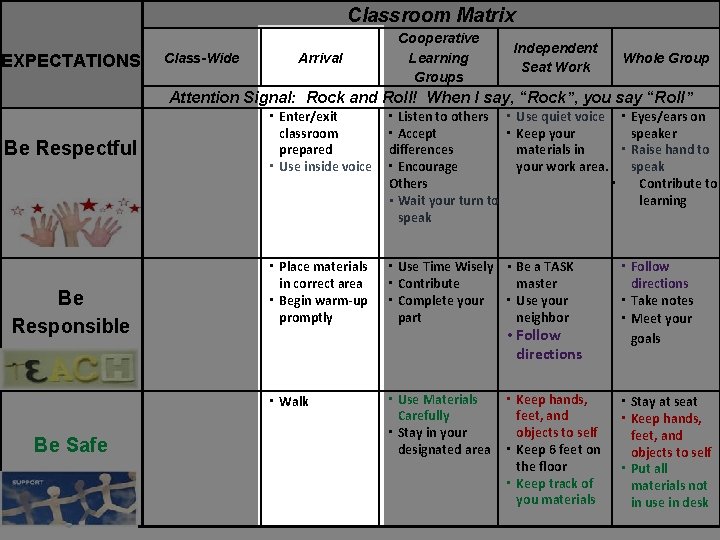
Classroom Matrix EXPECTATIONS Class-Wide Arrival Cooperative Learning Groups Independent Seat Work Whole Group Attention Signal: Rock and Roll! When I say, “Rock”, you say “Roll” Be Respectful Be Responsible Be Safe • Enter/exit classroom prepared • Use inside voice • Listen to others • Use quiet voice • Eyes/ears on • Accept • Keep your speaker differences materials in • Raise hand to • Encourage your work area. speak Others • Contribute to • Wait your turn to learning speak • Place materials in correct area • Begin warm-up promptly • Use Time Wisely • Be a TASK • Contribute master • Complete your • Use your part neighbor • Follow directions • Take notes • Meet your goals • Walk • Use Materials Carefully • Stay in your designated area • Stay at seat • Keep hands, feet, and objects to self • Put all materials not in use in desk • Follow directions • Keep hands, feet, and objects to self • Keep 6 feet on the floor • Keep track of you materials
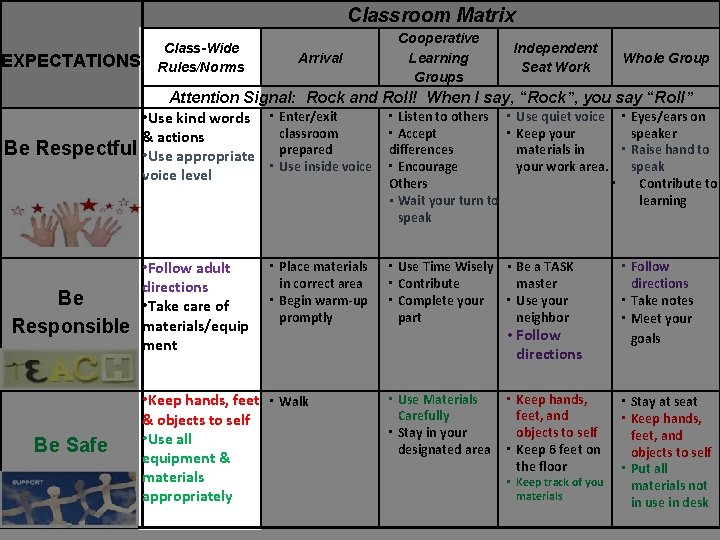
Classroom Matrix EXPECTATIONS Be Class-Wide Rules/Norms Arrival Cooperative Learning Groups Independent Seat Work Whole Group Attention Signal: Rock and Roll! When I say, “Rock”, you say “Roll” • Listen to others • Use quiet voice • Eyes/ears on • Use kind words • Enter/exit classroom • Accept • Keep your speaker & actions differences materials in • Raise hand to Respectful • Use appropriate prepared • Use inside voice • Encourage your work area. speak voice level Others • Contribute to • Wait your turn to speak Be Responsible Be Safe • Follow adult directions • Take care of materials/equip ment • Place materials in correct area • Begin warm-up promptly • Keep hands, feet • Walk & objects to self • Use all equipment & materials appropriately learning • Use Time Wisely • Be a TASK • Contribute master • Complete your • Use your part neighbor • Follow directions • Take notes • Meet your goals • Use Materials Carefully • Stay in your designated area • Stay at seat • Keep hands, feet, and objects to self • Put all materials not in use in desk • Follow directions • Keep hands, feet, and objects to self • Keep 6 feet on the floor • Keep track of you materials
Creating Your Classroom Rules • Develop classroom rules for one activity in your classroom.
Teaching Procedures
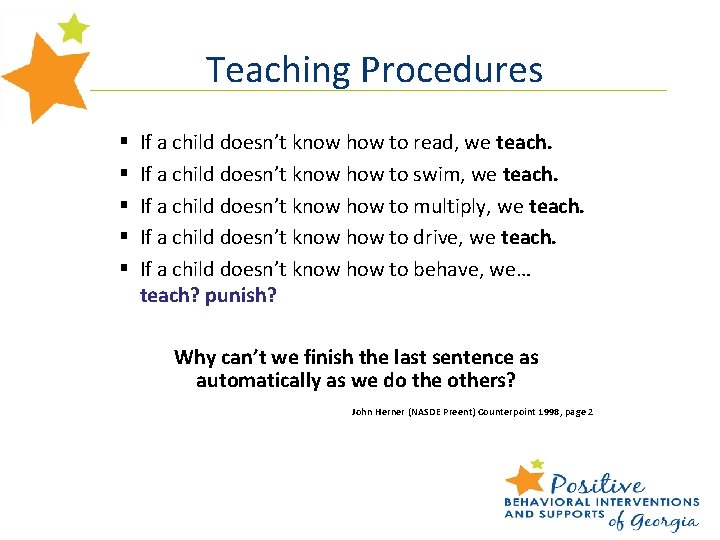
Teaching Procedures § § § If a child doesn’t know how to read, we teach. If a child doesn’t know how to swim, we teach. If a child doesn’t know how to multiply, we teach. If a child doesn’t know how to drive, we teach. If a child doesn’t know how to behave, we… teach? punish? Why can’t we finish the last sentence as automatically as we do the others? John Herner (NASDE Preent) Counterpoint 1998, page 2
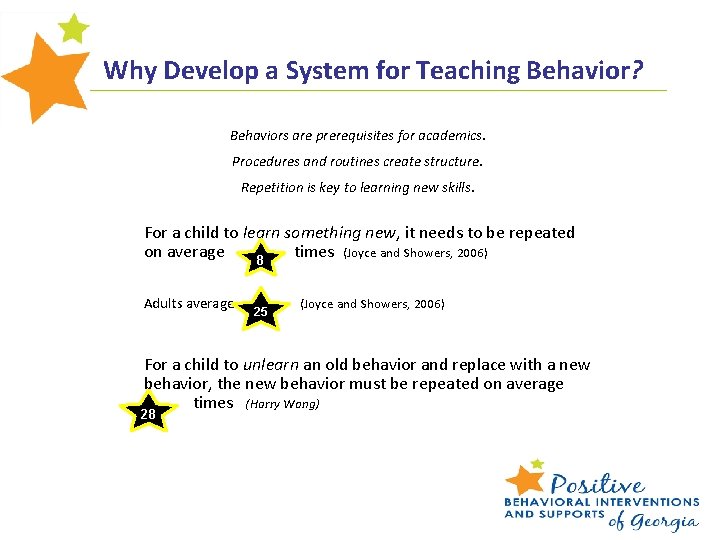
Why Develop a System for Teaching Behavior? Behaviors are prerequisites for academics. Procedures and routines create structure. Repetition is key to learning new skills. For a child to learn something new, it needs to be repeated on average ? times (Joyce and Showers, 2006) 8 Adults average ? 25 (Joyce and Showers, 2006) For a child to unlearn an old behavior and replace with a new behavior, the new behavior must be repeated on average ? times (Harry Wong) 28
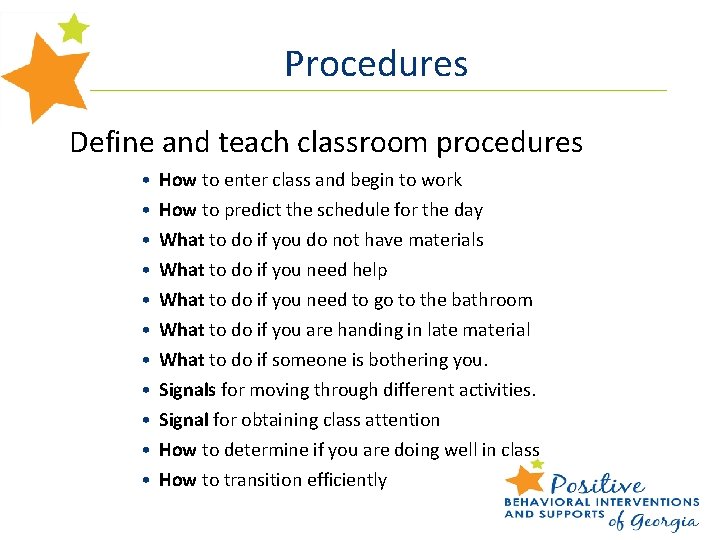
Procedures Define and teach classroom procedures • • • How to enter class and begin to work How to predict the schedule for the day What to do if you do not have materials What to do if you need help What to do if you need to go to the bathroom What to do if you are handing in late material What to do if someone is bothering you. Signals for moving through different activities. Signal for obtaining class attention How to determine if you are doing well in class How to transition efficiently
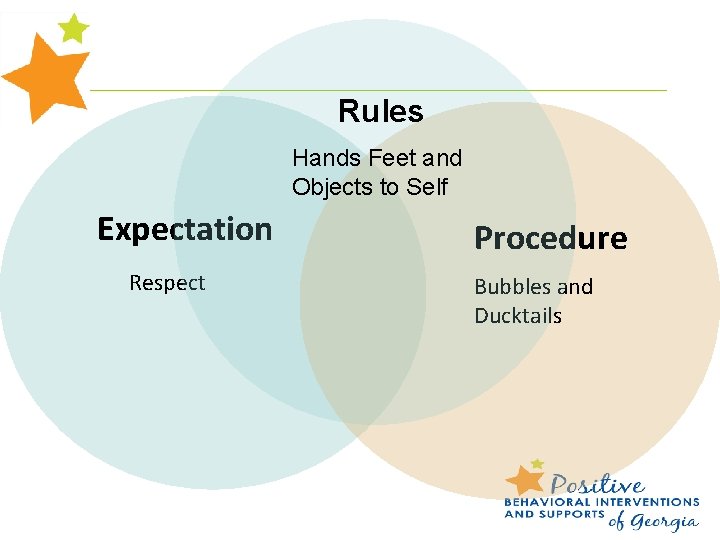
Rules Hands Feet and Objects to Self Expectation Respect Procedure Bubbles and Ducktails
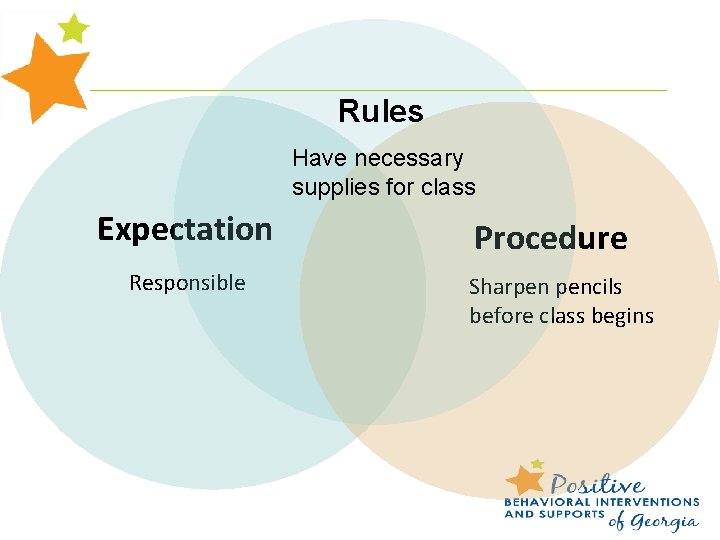
Rules Have necessary supplies for class Expectation Responsible Procedure Sharpen pencils before class begins
Telling is not Teaching If you don’t have time to do it right, when will you have time to do it over? -John Wooden
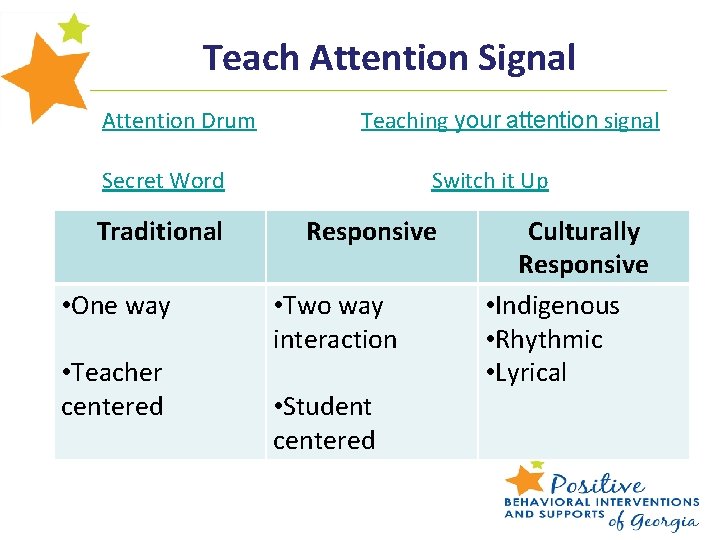
Teach Attention Signal Attention Drum Teaching your attention signal Secret Word Traditional • One way • Teacher centered Switch it Up Responsive • Two way interaction • Student centered Culturally Responsive • Indigenous • Rhythmic • Lyrical
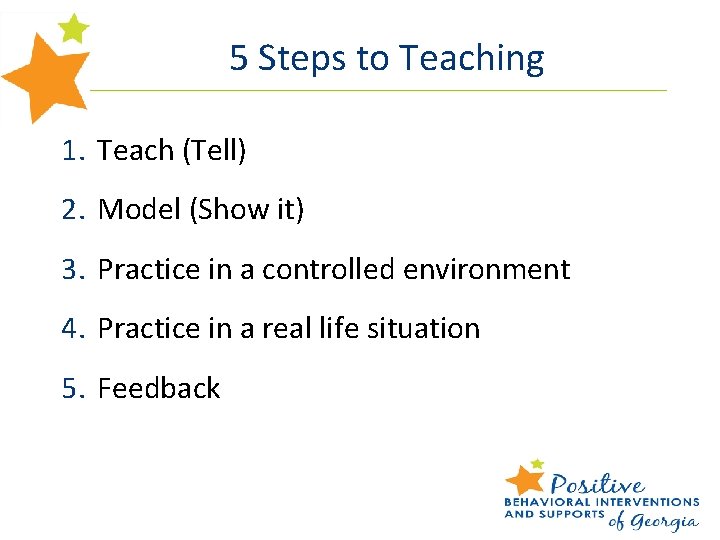
5 Steps to Teaching 1. Teach (Tell) 2. Model (Show it) 3. Practice in a controlled environment 4. Practice in a real life situation 5. Feedback
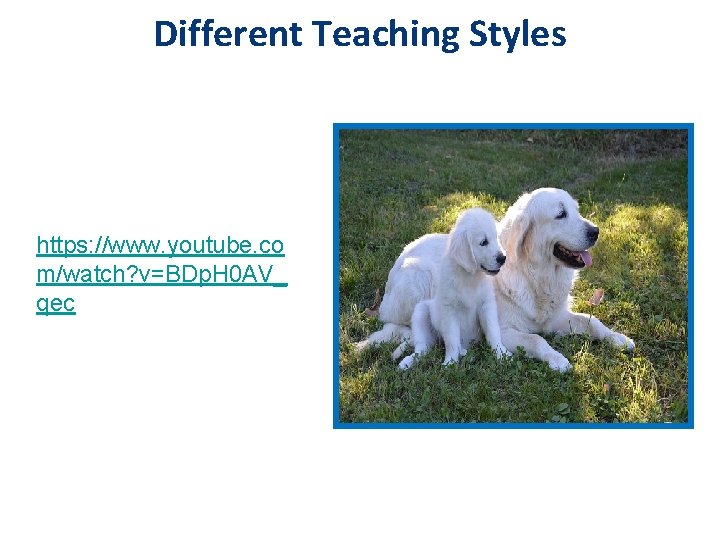
Different Teaching Styles https: //www. youtube. co m/watch? v=BDp. H 0 AV_ qec
Self Reflection 1. Complete the Self-Reflection Checklist 2. Identify one or two areas that you would like to improve
Tony Feldmann – afeldmann@doe. k 12. ga. us Ben Moore – bmoore@doe. k 12. ga. us 38
- Slides: 38