
PBIS in the Classroom Creating Positive Effective Classrooms
PBIS in the Classroom: Creating Positive & Effective Classrooms Sheldon Loman sloman@uoregon. edu
Entry Activity (p. 1) Think about your classroom Complete the Classroom Management Checklist For “In Place Status” mark: Full, Partial or Not. For questions with a “Y” (Yes) or an “N” (No) circle those letters for those items
Supporting Social Behavior Positive & Effective Classrooms n Instruction of both academic and social behavior through teaching important rules and developing routines and physical arrangements to maximize the probability that students will be successful with those rules in school and in life. Positive Behavior Support n Modifying environmental characteristics Prediction & Prevention via effective instructional environments n Developing a range of supports for students
Positive & Effective Classrooms How do create positive & effective classrooms? 5 P’s n Prior Planning Prevents Poor Performance Teach, Review, Reward n Re-teach
Components of Classroom PBS 1. Develop expectations & rules 2. Develop reward system 3. Identify range of consequences for problem behavior 4. Teach system 5. Consistently implement 6. Analyze data to identify problems 7. Implement environmental change

Components of Classroom PBS 1. Develop rules & expectations n 3 -5 Group similar behaviors Consider developmental level Only those you are prepared to reinforce n n n Positively Stated Consistent w/ Schoolwide Tied to assessment May evolve over time Ms. Musner liked to go over a few of her rules on the first day of school
Anticipate & Pre-correct to avoid chronic behavior problems Pre-correction- prompting the expected behavior prior to an activity/routine. Provide activities for students to engage in if they complete work quickly.

Mapping School-wide Rules to Classroom Behavioral Expectations (pg. 2) Use Your School’s Rules (e. g. , Safe, Respectful, Responsible) & define what that looks like in your room Map out what you expect for start of day, entering classroom, etc. Examples on page 3
Components of Classroom PBS 1. Develop expectations & rules 2. Develop acknowledgement/reward system 3. Identify range of consequences for problem behavior 4. Teach system 5. Consistently implement 6. Analyze data to identify problems 7. Implement environmental change
Components of Classroom PBS 2. DEVELOP REWARD SYSTEM Rationale n n n Increase likelihood of pro-social behavior Focus student and staff attention on pro-social behavior Improve class climate Pitfalls n n “Rewards are bribes” “We shouldn’t have to reward kids!”
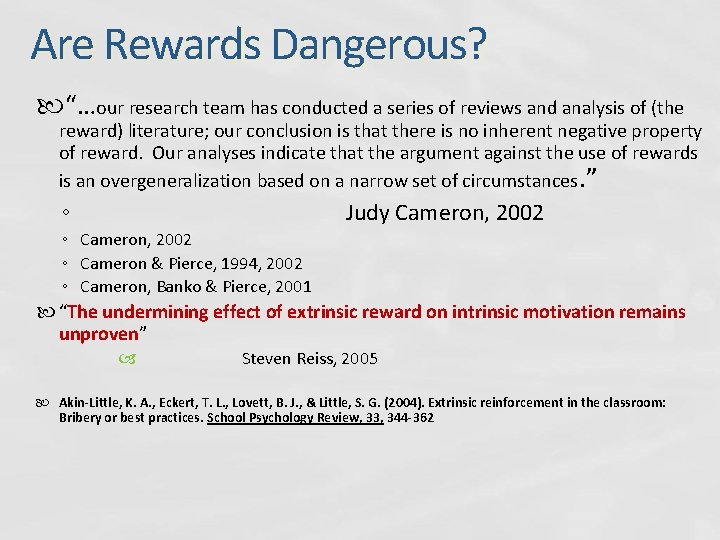
Are Rewards Dangerous? “…our research team has conducted a series of reviews and analysis of (the reward) literature; our conclusion is that there is no inherent negative property of reward. Our analyses indicate that the argument against the use of rewards is an overgeneralization based on a narrow set of circumstances. ” ◦ Judy Cameron, 2002 ◦ Cameron & Pierce, 1994, 2002 ◦ Cameron, Banko & Pierce, 2001 “The undermining effect of extrinsic reward on intrinsic motivation remains unproven” Steven Reiss, 2005 Akin-Little, K. A. , Eckert, T. L. , Lovett, B. J. , & Little, S. G. (2004). Extrinsic reinforcement in the classroom: Bribery or best practices. School Psychology Review, 33, 344 -362
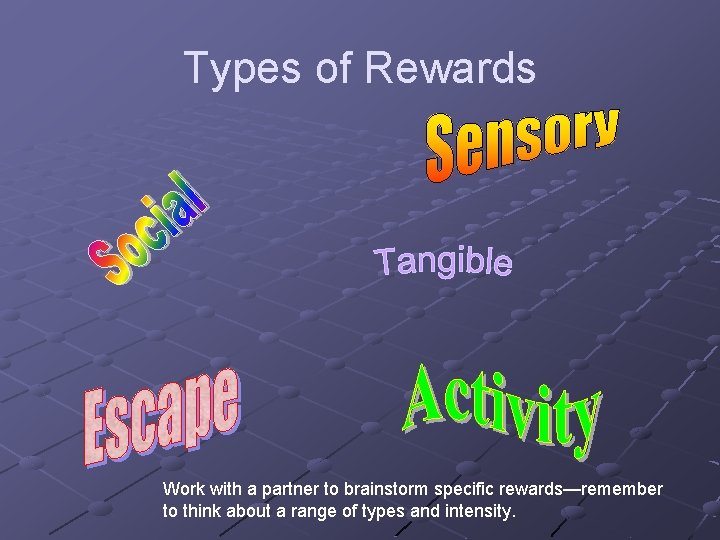
Types of Rewards Work with a partner to brainstorm specific rewards—remember to think about a range of types and intensity.
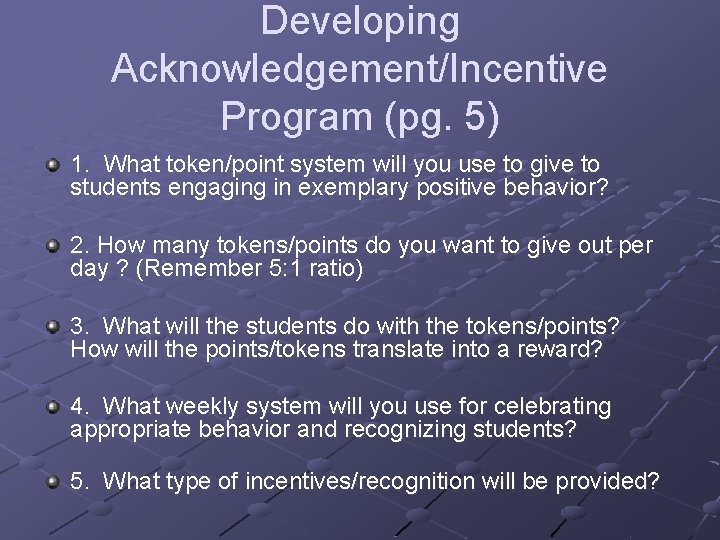
Developing Acknowledgement/Incentive Program (pg. 5) 1. What token/point system will you use to give to students engaging in exemplary positive behavior? 2. How many tokens/points do you want to give out per day ? (Remember 5: 1 ratio) 3. What will the students do with the tokens/points? How will the points/tokens translate into a reward? 4. What weekly system will you use for celebrating appropriate behavior and recognizing students? 5. What type of incentives/recognition will be provided?
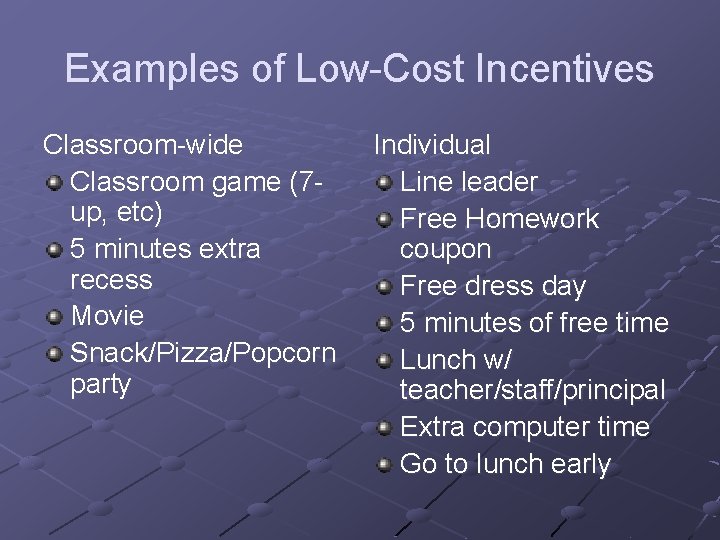
Examples of Low-Cost Incentives Classroom-wide Classroom game (7 up, etc) 5 minutes extra recess Movie Snack/Pizza/Popcorn party Individual Line leader Free Homework coupon Free dress day 5 minutes of free time Lunch w/ teacher/staff/principal Extra computer time Go to lunch early

Components of Classroom PBS 1. Develop expectations & rules 2. Develop reward system 3. Identify range of consequences for problem behavior 4. Teach system 5. Consistently implement 6. Analyze data to identify problems 7. Implement environmental change
Classroom PBS Traditional Consequences Often Are Not Effective Not aligned with school-wide expectations Rules are not clearly defined No system for teaching rules exists System for rewarding appropriate behaviors is absent Consequence is unrelated to the function of the behavior
3. Continuum of Discipline Procedures (pg. 6) Align consequences with rule violation Develop hierarchy from least to most severe consequences Consider function of behavior Know which problems are referred to office and which are not
Ideas for Behavioral Warning System (pg. 7) 1. Develop a visual warning system for minor behavioral infractions in your classroom 1. What behaviors result in an infraction of classroom rules? Identify consequences for the different levels of the classroom system. Example Level 1 = Warning Level 2 = Written Apology Level 3 = Time owed/Missed Recess/Rule School Level 4 = Office Referral
Work Smarter—be proactive Develop a strategy to Pre-teach/Precorrect behavior before starting the activities in which chronic behavior problems occur.
Behavioral Response: “Buddy Teachers” (pg. 8) What behavior should result in a referral to your Buddy Teacher’s Room? What should the student do in the Buddy Teacher’s room? Identify: n n Who is your buddy teacher? Where to sit? What should student do while out of the classroom? How long to stay?
Components of Classroom PBS 1. Develop expectations & rules 2. Develop reward system 3. Identify range of consequences for problem behavior 4. Teach system 5. Consistently implement 6. Analyze data to identify problems 7. Implement environmental change
4. Teach system & expectations What to teach n n n Expectations— clearly defined Setting/routine-specific rules Rewards Teach in setting Use examples and non-examples Teach, teach, and re-teach
Activity: Lesson Plan (pg. 4) Identify an expected behavior from pg. 2 Provide a rationale Identify a range of positive and negative examples n n Positive examples: include the target behavior Negative examples: are not the target behavior Practice/role play activities Prompting expected behavior Assess student progress lesson for teaching behavior 1. doc
Dealing with Seriously Non-Compliant/ Physically Dangerous Students Do not engage in power struggles n n n Shown to be very ineffective May actually be reinforcing the behavior Yelling, nagging, belittling, threatening, and other displays of anger are ineffective
Components of Classroom PBS 1. Develop expectations & rules 2. Develop reward system 3. Identify range of consequences for problem behavior 4. Teach system 5. Consistently implement 6. Analyze data to identify problems 7. Implement environmental change
Classroom Management Instruction: Consistent Feedback How we teach will impact student behavior!
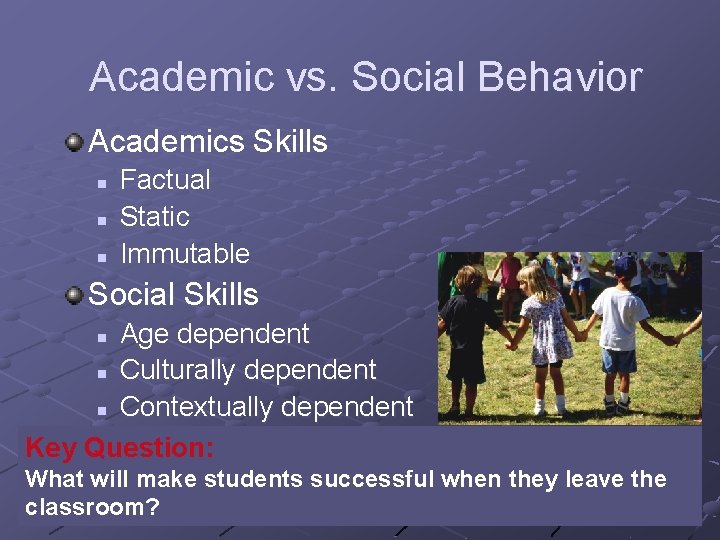
Academic vs. Social Behavior Academics Skills n n n Factual Static Immutable Social Skills Age dependent n Culturally dependent n Contextually dependent Key Question: n What will make students successful when they leave the classroom?
If a child doesn’t know how to read, we teach. If a child doesn’t know how to swim, we teach. If a child doesn’t know how to multiply, we teach. If a child doesn’t know how to behave, we ____.
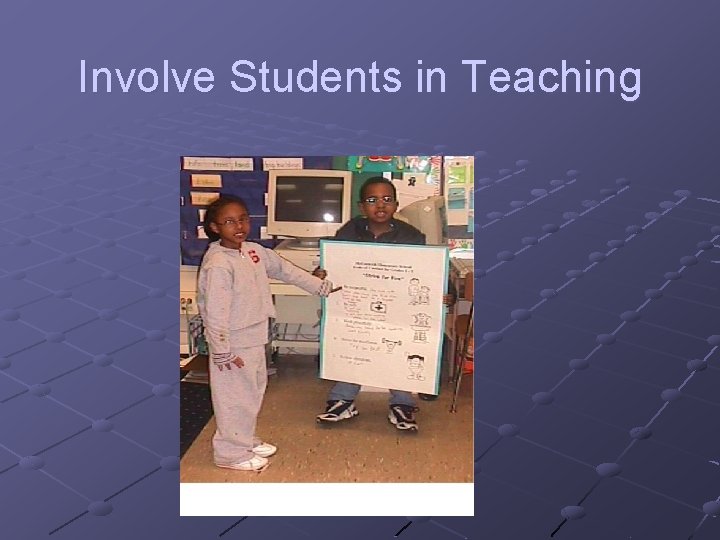
Involve Students in Teaching
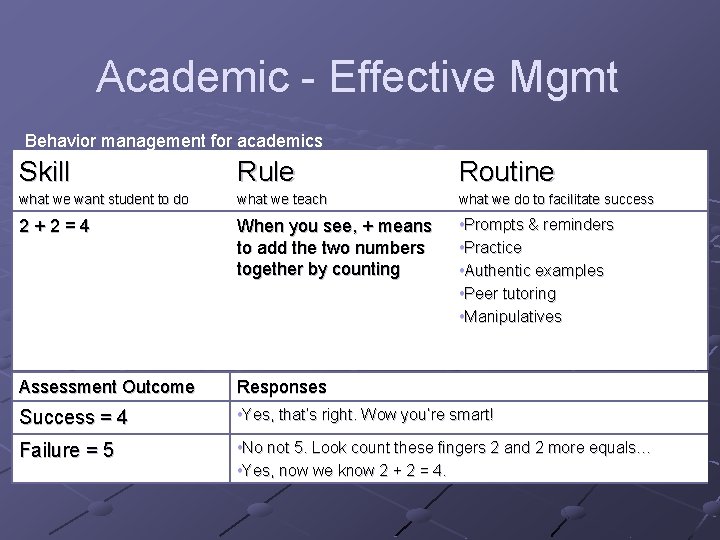
Academic - Effective Mgmt Behavior management for academics Skill Rule Routine what we want student to do what we teach what we do to facilitate success 2+2=4 When you see, + means to add the two numbers together by counting • Prompts & reminders • Practice • Authentic examples • Peer tutoring • Manipulatives Assessment Outcome Responses Success = 4 • Yes, that’s right. Wow you’re smart! Failure = 5 • No not 5. Look count these fingers 2 and 2 more equals… • Yes, now we know 2 + 2 = 4.
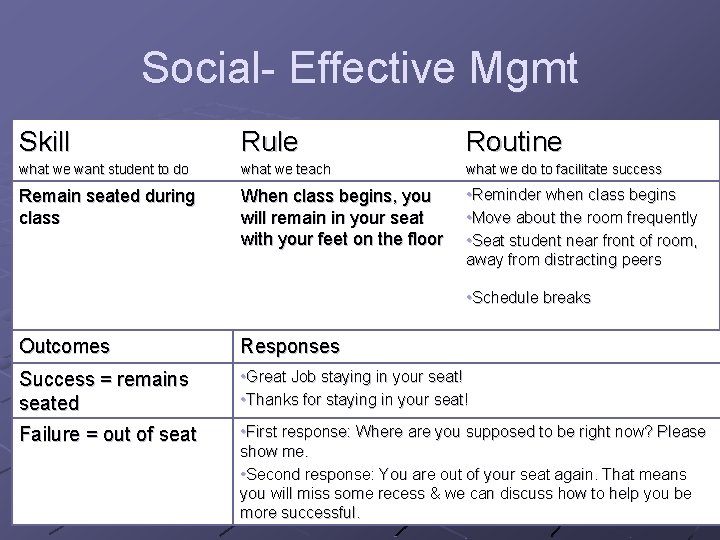
Social- Effective Mgmt Skill Rule Routine what we want student to do what we teach what we do to facilitate success Remain seated during class When class begins, you will remain in your seat with your feet on the floor • Reminder when class begins • Move about the room frequently • Seat student near front of room, away from distracting peers • Schedule breaks Outcomes Responses Success = remains seated • Great Job staying in your seat! • Thanks for staying in your seat! Failure = out of seat • First response: Where are you supposed to be right now? Please show me. • Second response: You are out of your seat again. That means you will miss some recess & we can discuss how to help you be more successful.
Characteristics of Effective Classrooms -low incidence of behavior problems -high success rates (80% or better) -Academic learning time/engaged time -time with materials or activities related to the outcome measures that are being used
Effective instruction is related to higher success rate and fewer behavior problems!
Creating High Levels of Success Prompts, Cues, & Pre-corrects Select the least intrusive prompt necessary Plan to fade prompts Try to first use prompts as prevention Use prompts as first level of correction
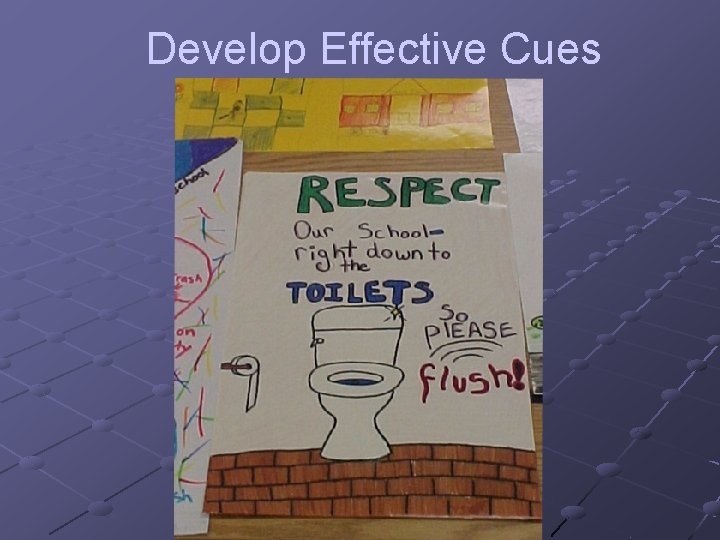
Develop Effective Cues
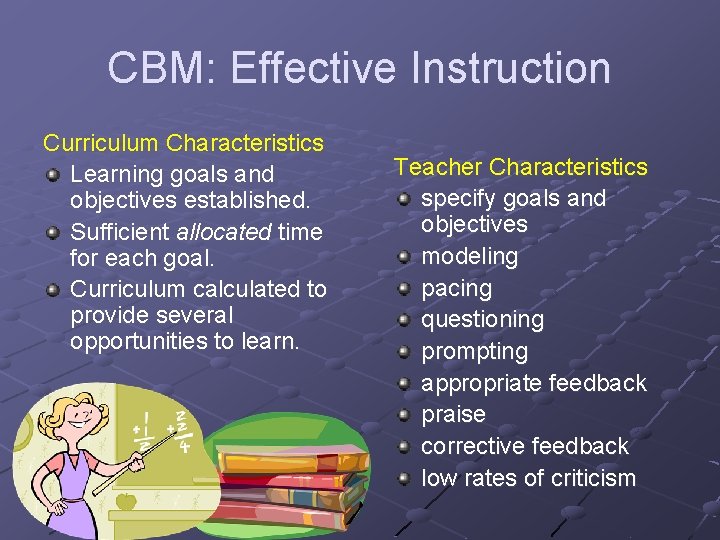
CBM: Effective Instruction Curriculum Characteristics Learning goals and objectives established. Sufficient allocated time for each goal. Curriculum calculated to provide several opportunities to learn. Teacher Characteristics specify goals and objectives modeling pacing questioning prompting appropriate feedback praise corrective feedback low rates of criticism
Components of Classroom PBS 1. Develop expectations & rules 2. Develop reward system 3. Identify range of consequences for problem behavior 4. Teach system 5. Consistently implement 6. Analyze data to identify problems 7. Implement environmental change
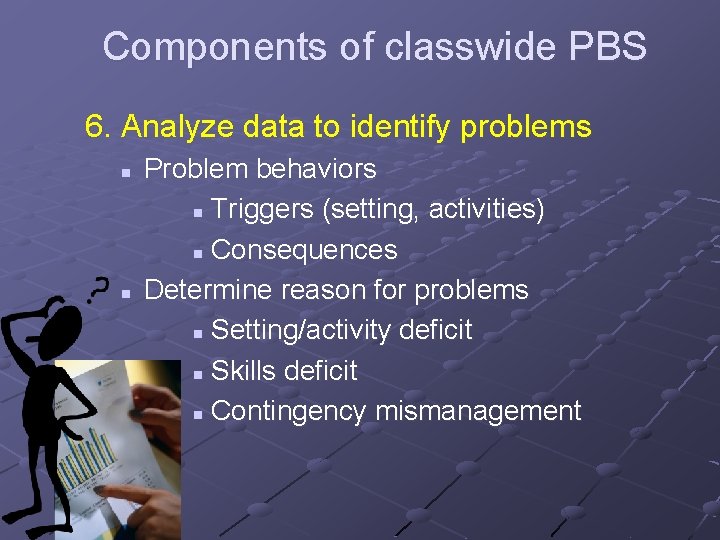
Components of classwide PBS 6. Analyze data to identify problems n n Problem behaviors n Triggers (setting, activities) n Consequences Determine reason for problems n Setting/activity deficit n Skills deficit n Contingency mismanagement
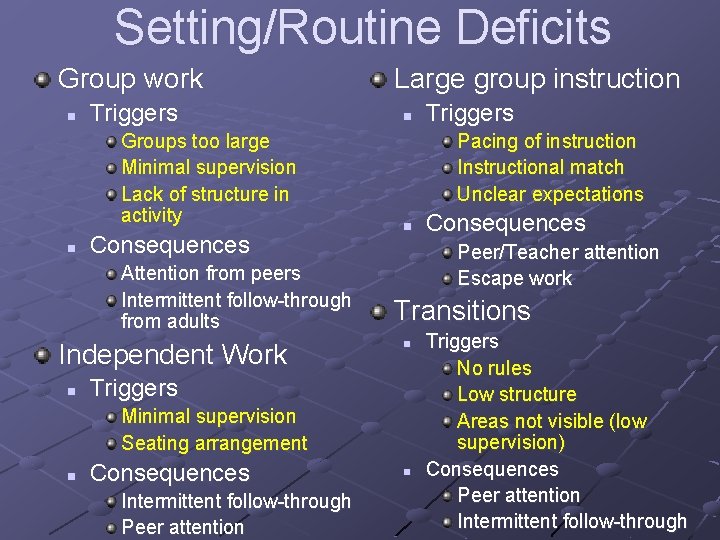
Setting/Routine Deficits Group work n Triggers Groups too large Minimal supervision Lack of structure in activity n Consequences Attention from peers Intermittent follow-through from adults Independent Work n Large group instruction n Pacing of instruction Instructional match Unclear expectations n Transitions n Triggers Consequences Intermittent follow-through Peer attention Consequences Peer/Teacher attention Escape work Minimal supervision Seating arrangement n Triggers No rules Low structure Areas not visible (low supervision) Consequences Peer attention Intermittent follow-through
Components of Classroom PBS 1. Develop expectations & rules 2. Develop reward system 3. Identify range of consequences for problem behavior 4. Teach system 5. Consistently implement 6. Analyze data to identify problems 7. Implement environmental change
Deficits: Implement Change Do we need to alter environment/routine? n Remember ICE Instruction, Curriculum, Environment. Do we need to teach or review skills? Do we need to set up (or modify) reward/ consequence system?
Components of Classroom PBS Develop expectations & rules Develop reward system Identify range of consequences for problem behavior Teach system Consistently implement! Analyze data to identify problems Implement environmental change
PBS in the Classroom Remember • Supporting social behavior is an on-going process. • We must plan and be consistent. • We must teach, review, and reward (and reteach) positive behavior. • Problem behavior is a result of environmentstudent interactions. • Instruction, setting, student, activity, & other variables impact behavior
Plan for Positive & Effective Classrooms (p. 9) Look at checklist from beginning of session (pg. 1) & n The rest of the hand out pages. Plan next steps to create a positive & effective classroom. Questions? sloman@uoregon. edu
- Slides: 44