
PBGL A HighPerformance DistributedMemory Parallel Graph Library Andrew
PBGL: A High-Performance Distributed-Memory Parallel Graph Library Andrew Lumsdaine Indiana University lums@osl. iu. edu

My Goal in Life o Performance with elegance
Introduction o Overview of our highperformance, industrial strength, graph library n n n o o Comprehensive features Impressive results Separation of concerns Lessons on software use and reuse Thoughts on advancing high-performance (parallel) software
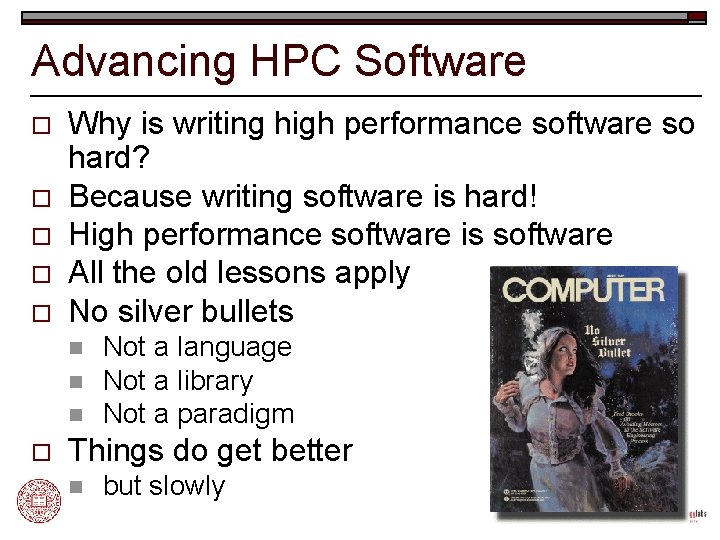
Advancing HPC Software o o o Why is writing high performance software so hard? Because writing software is hard! High performance software is software All the old lessons apply No silver bullets n n n o Not a language Not a library Not a paradigm Things do get better n but slowly
Advancing HPC Software Progress, far from consisting in change, Progress, far from depends Progress, faron from consisting in change, retentiveness. consisting in. Those change, who depends on the cannot remember retentiveness. past are condemned to repeat it.
Advancing HPC Software o Name the two most important pieces of HPC software over last 20 years n n o o BLAS MPI Why are these so important? Why did they succeed?
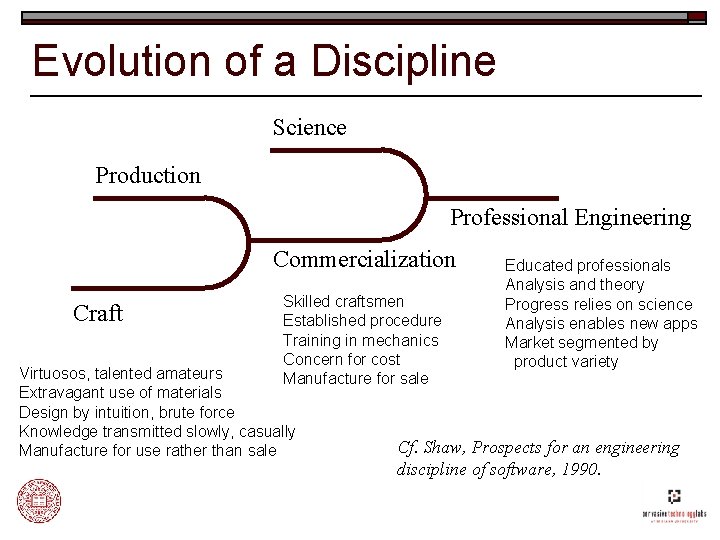
Evolution of a Discipline Science Production Professional Engineering Commercialization Craft Skilled craftsmen Established procedure Training in mechanics Concern for cost Manufacture for sale Virtuosos, talented amateurs Extravagant use of materials Design by intuition, brute force Knowledge transmitted slowly, casually Manufacture for use rather than sale Educated professionals Analysis and theory Progress relies on science Analysis enables new apps Market segmented by product variety Cf. Shaw, Prospects for an engineering discipline of software, 1990.
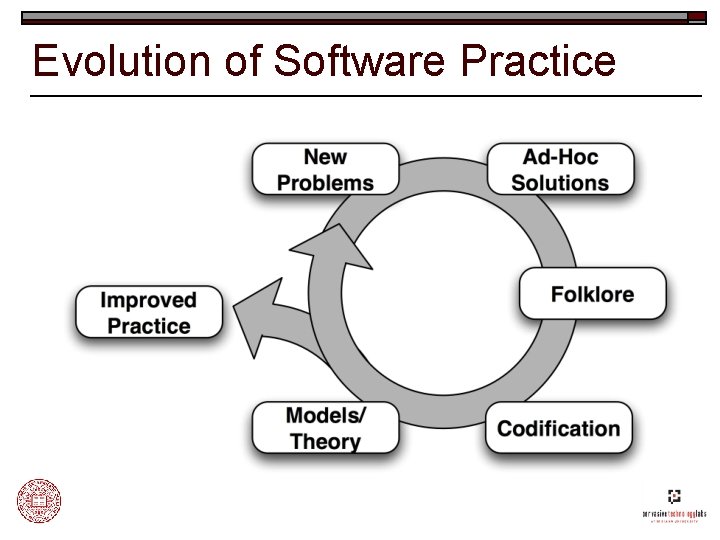
Evolution of Software Practice
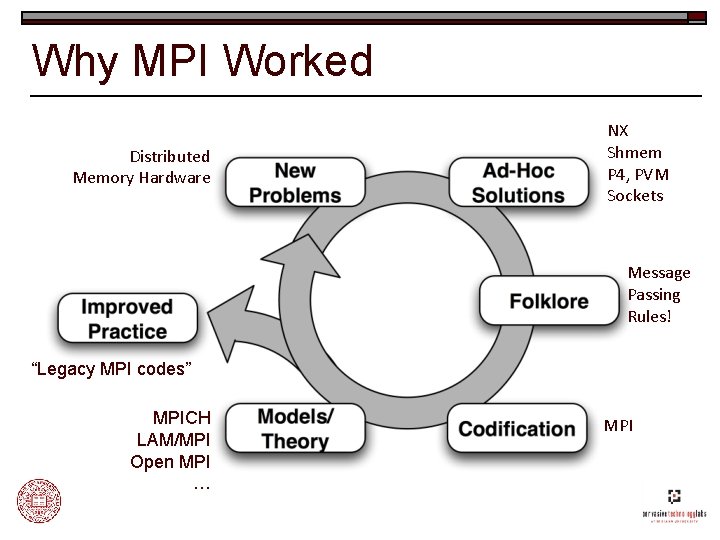
Why MPI Worked Distributed Memory Hardware NX Shmem P 4, PVM Sockets Message Passing Rules! “Legacy MPI codes” MPICH LAM/MPI Open MPI … MPI
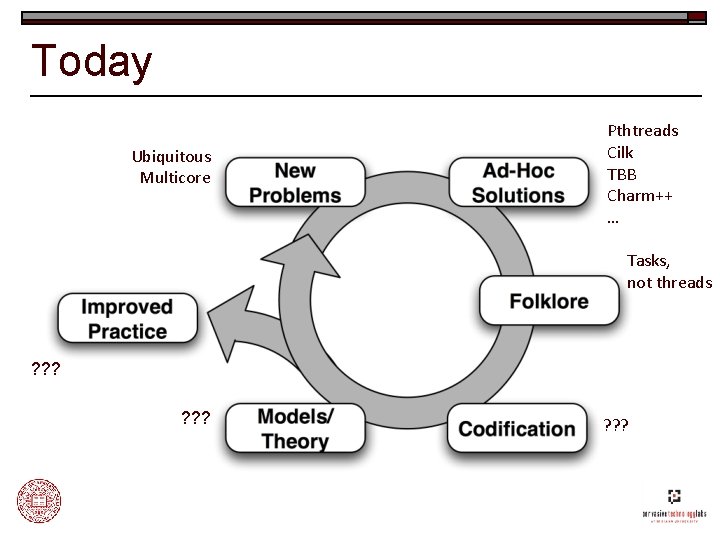
Today Ubiquitous Multicore Pthtreads Cilk TBB Charm++ … Tasks, not threads ? ? ?
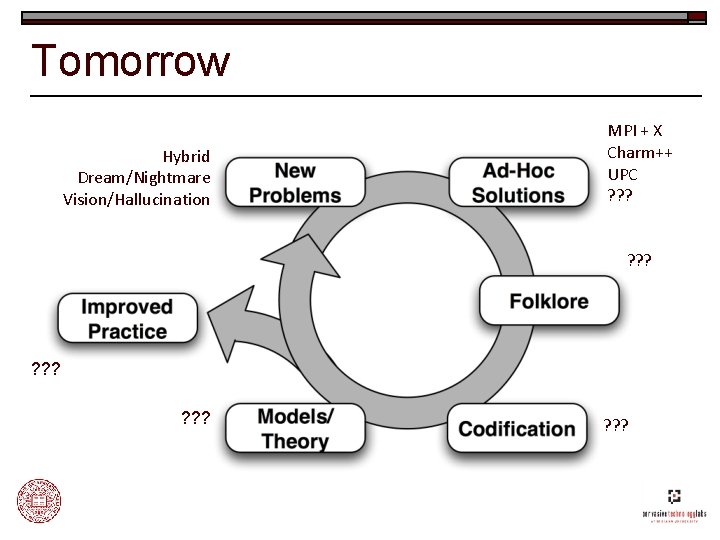
Tomorrow Hybrid Dream/Nightmare Vision/Hallucination MPI + X Charm++ UPC ? ? ? ? ? ?
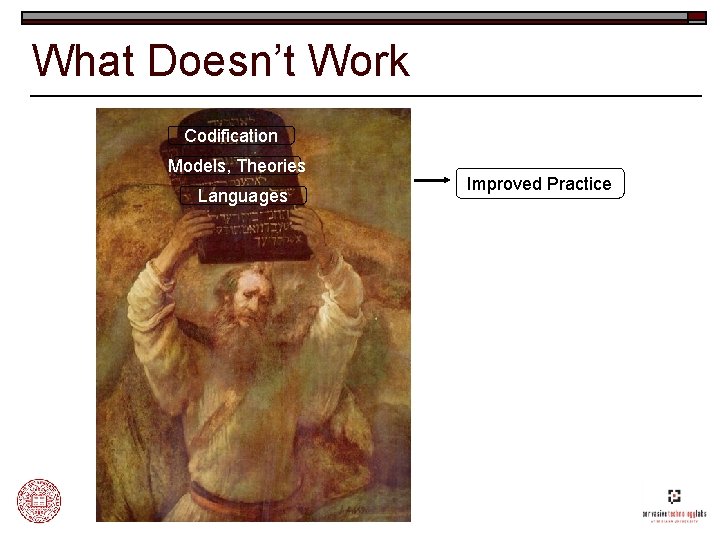
What Doesn’t Work Codification Models, Theories Languages Improved Practice
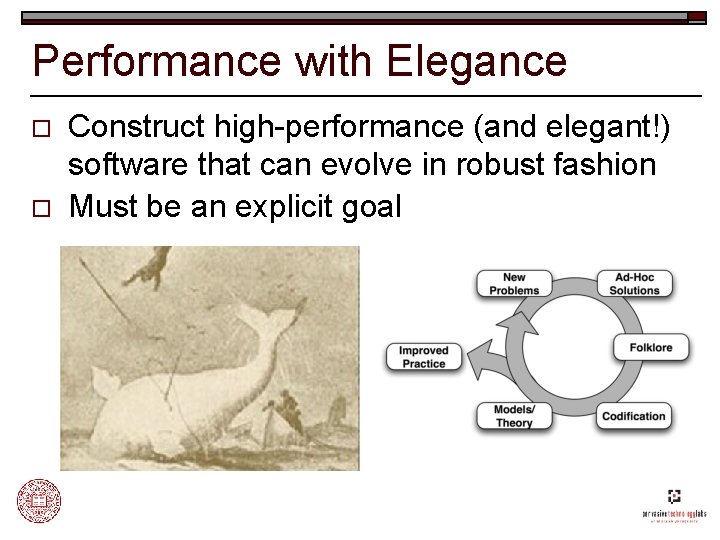
Performance with Elegance o o Construct high-performance (and elegant!) software that can evolve in robust fashion Must be an explicit goal
The Parallel Boost Graph Library o Goal: To build a generic library of efficient, scalable, distributed-memory parallel graph algorithms. o Approach: Apply advanced software paradigm (Generic Programming) to categorize and describe the domain of parallel graph algorithms. Separate concerns. Reuse sequential BGL software base. o Result: Parallel BGL. Saved years of effort.
Graph Computations o Irregular and unbalanced Non-local Data driven High data to computation ratio o Intuition from solving PDEs may not apply o o o
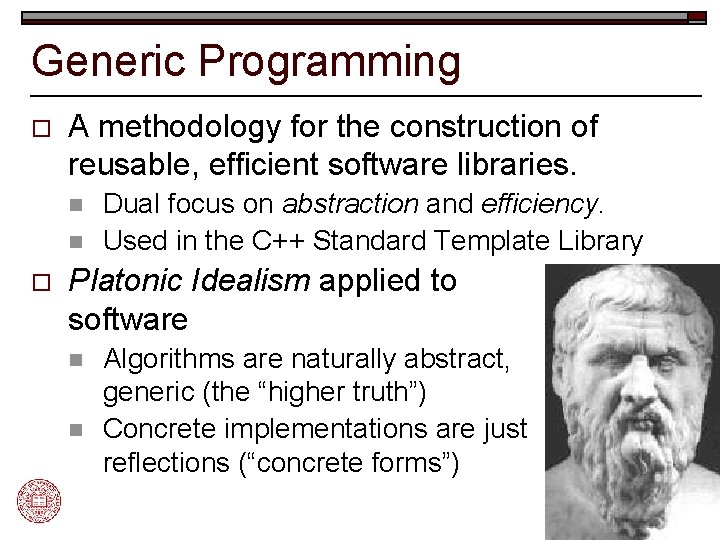
Generic Programming o A methodology for the construction of reusable, efficient software libraries. n n o Dual focus on abstraction and efficiency. Used in the C++ Standard Template Library Platonic Idealism applied to software n n Algorithms are naturally abstract, generic (the “higher truth”) Concrete implementations are just reflections (“concrete forms”)
Generic Programming Methodology o o Study the concrete implementations of an algorithm Lift away unnecessary requirements to produce a more abstract algorithm n n o Catalog these requirements. Bundle requirements into concepts. Repeat the lifting process until we have obtained a generic algorithm that: n n Instantiates to efficient concrete implementations. Captures the essence of the “higher truth” of that algorithm.
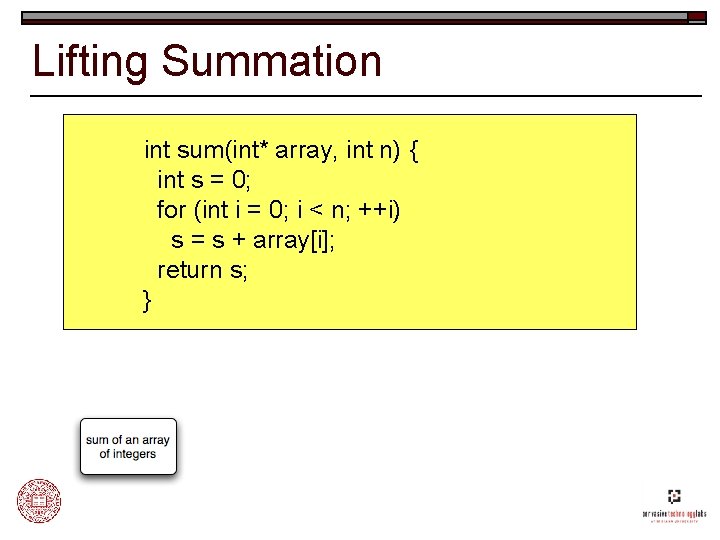
Lifting Summation int sum(int* array, int n) { int s = 0; for (int i = 0; i < n; ++i) s = s + array[i]; return s; }
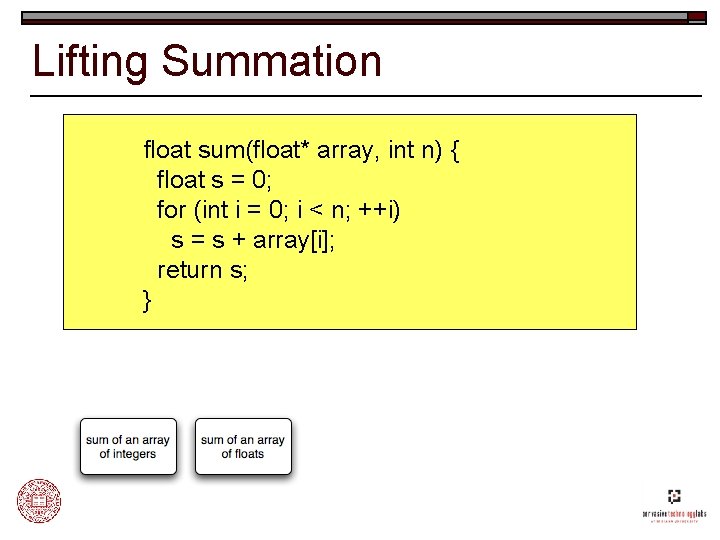
Lifting Summation float sum(float* array, int n) { float s = 0; for (int i = 0; i < n; ++i) s = s + array[i]; return s; }
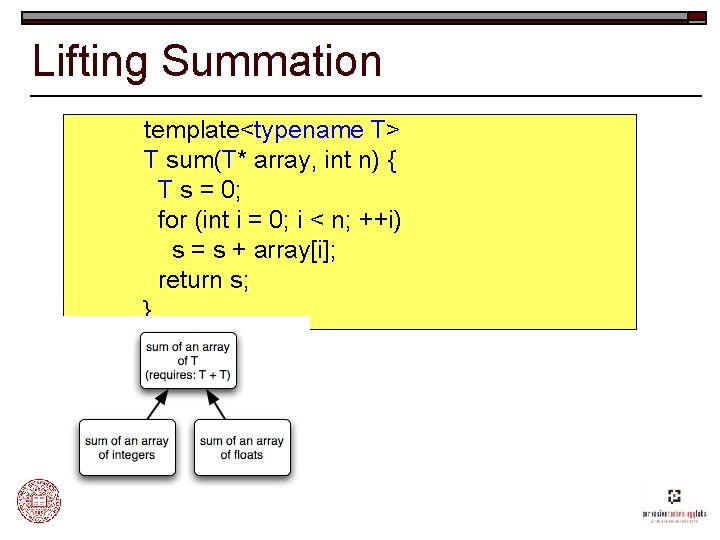
Lifting Summation template<typename T> T sum(T* array, int n) { T s = 0; for (int i = 0; i < n; ++i) s = s + array[i]; return s; }
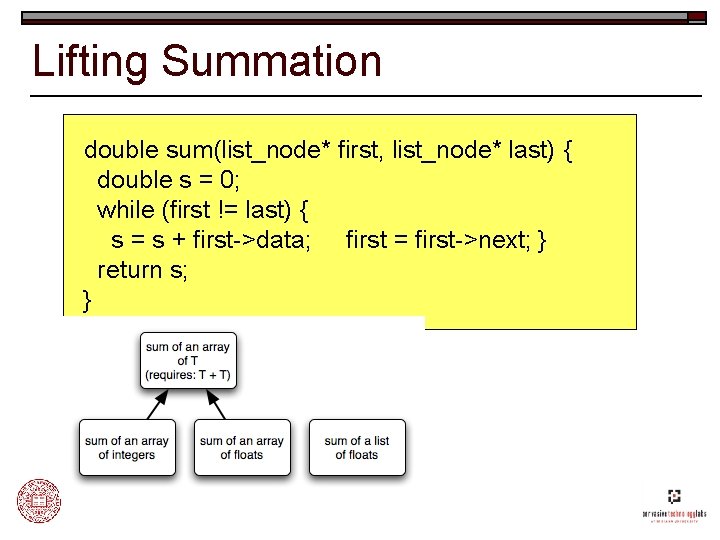
Lifting Summation double sum(list_node* first, list_node* last) { double s = 0; while (first != last) { s = s + first->data; first = first->next; } return s; }
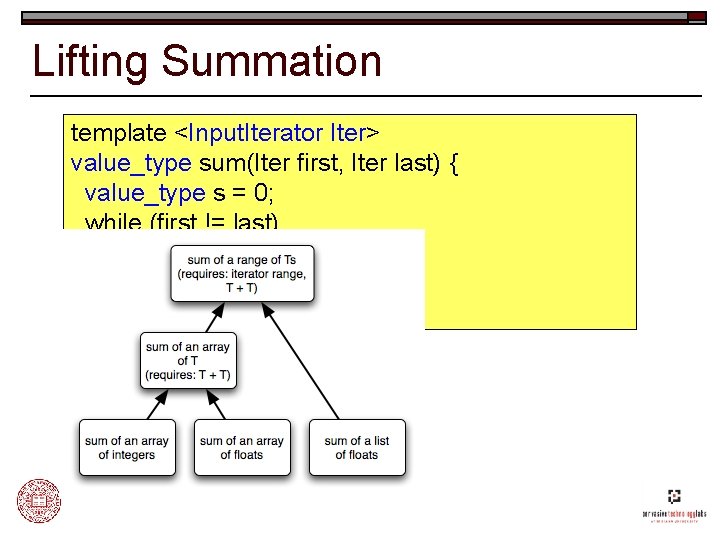
Lifting Summation template <Input. Iterator Iter> value_type sum(Iter first, Iter last) { value_type s = 0; while (first != last) s = s + *first++; return s; }
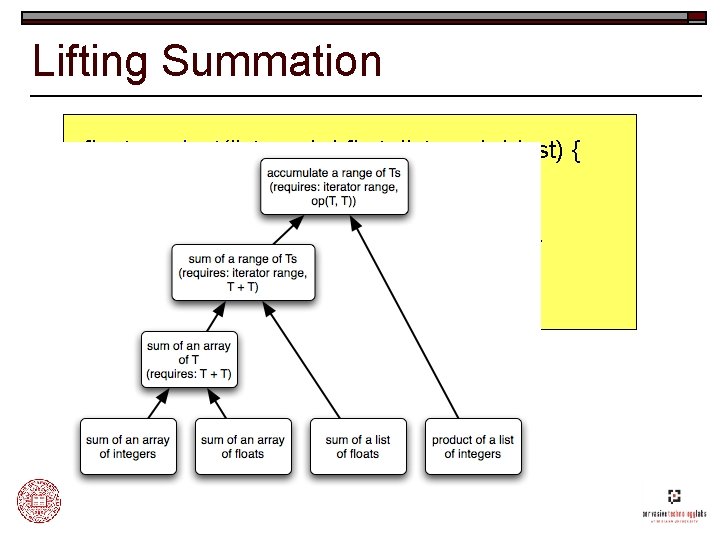
Lifting Summation float product(list_node* first, list_node* last) { float s = 1; while (first != last) { s = s * first->data; first = first->next; } return s; }
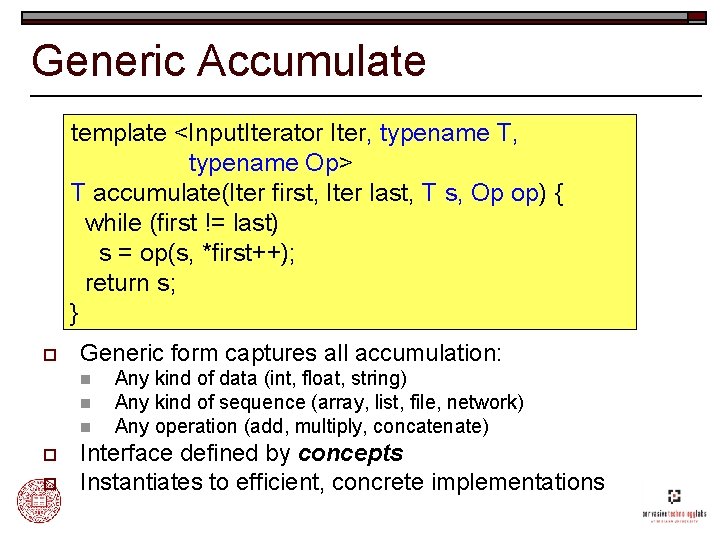
Generic Accumulate template <Input. Iterator Iter, typename T, typename Op> T accumulate(Iter first, Iter last, T s, Op op) { while (first != last) s = op(s, *first++); return s; } o Generic form captures all accumulation: n n n o o Any kind of data (int, float, string) Any kind of sequence (array, list, file, network) Any operation (add, multiply, concatenate) Interface defined by concepts Instantiates to efficient, concrete implementations
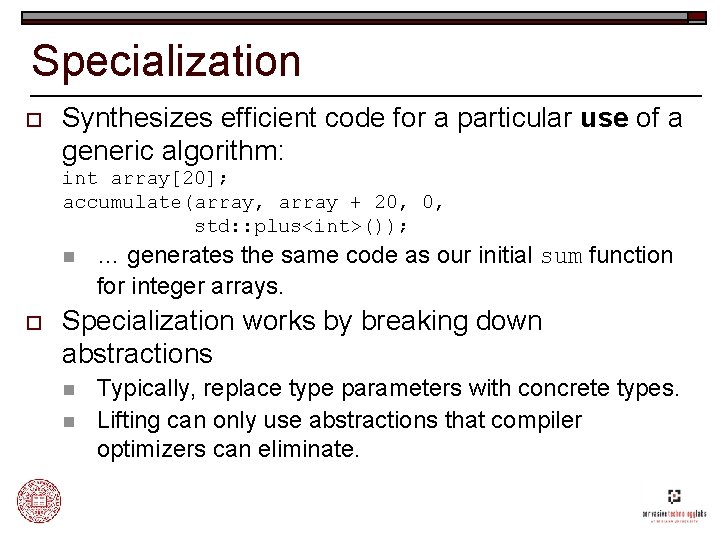
Specialization o Synthesizes efficient code for a particular use of a generic algorithm: int array[20]; accumulate(array, array + 20, 0, std: : plus<int>()); n o … generates the same code as our initial sum function for integer arrays. Specialization works by breaking down abstractions n n Typically, replace type parameters with concrete types. Lifting can only use abstractions that compiler optimizers can eliminate.
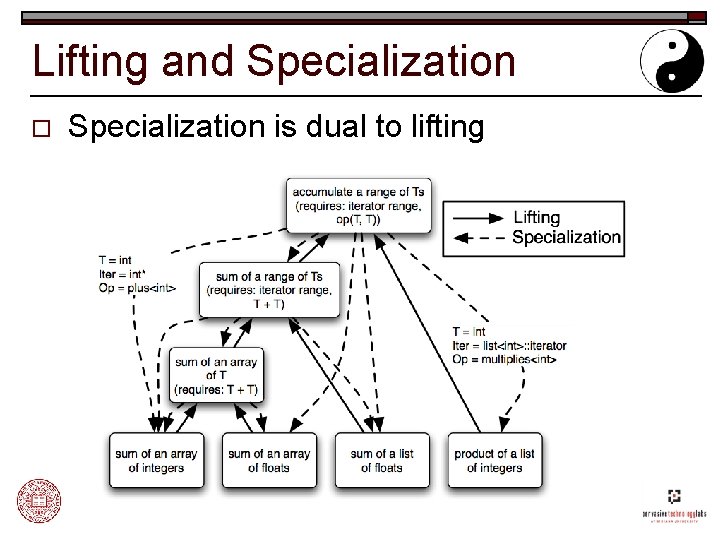
Lifting and Specialization o Specialization is dual to lifting
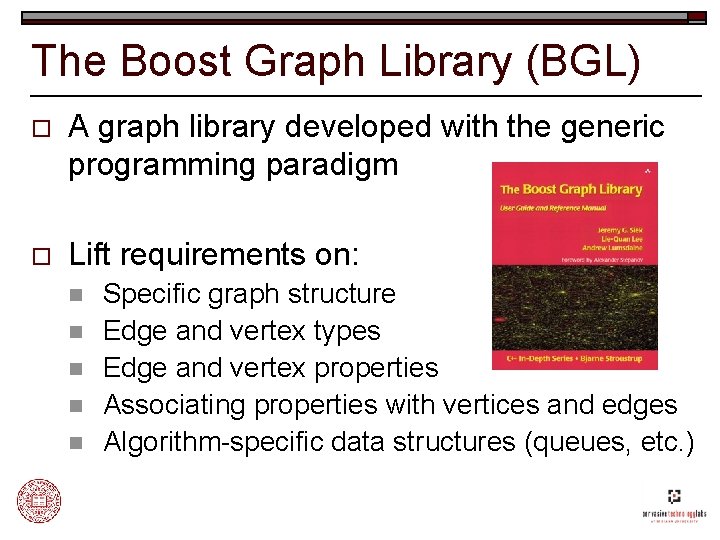
The Boost Graph Library (BGL) o A graph library developed with the generic programming paradigm o Lift requirements on: n n n Specific graph structure Edge and vertex types Edge and vertex properties Associating properties with vertices and edges Algorithm-specific data structures (queues, etc. )
The Boost Graph Library (BGL) o Comprehensive and mature n n n o ~10 years of research and development Many users, contributors outside of the OSL Steadily evolving Written in C++ n n n Generic Highly customizable Highly efficient o Storage and execution
BGL: Algorithms (partial list) o o o Searches (breadth-first, depth-first, A*) Single-source shortest paths (Dijkstra, Bellman. Ford, DAG) All-pairs shortest paths (Johnson, Floyd-Warshall) Minimum spanning tree (Kruskal, Prim) Components (connected, strongly connected, biconnected) Maximum cardinality matching o o o o o Max-flow (Edmonds. Karp, push-relabel) Sparse matrix ordering (Cuthill-Mc. Kee, King, Sloan, minimum degree) Layout (Kamada-Kawai, Fruchterman-Reingold, Gursoy-Atun) Betweenness centrality Page. Rank Isomorphism Vertex coloring Transitive closure Dominator tree
BGL: Graph Data Structures o Graphs: n n n o Adaptors: n n o adjacency_list: highly configurable with user-specified containers for vertices and edges adjacency_matrix compressed_sparse_row subgraphs, filtered graphs, reverse graphs LEDA and Stanford Graph. Base Or, use your own…
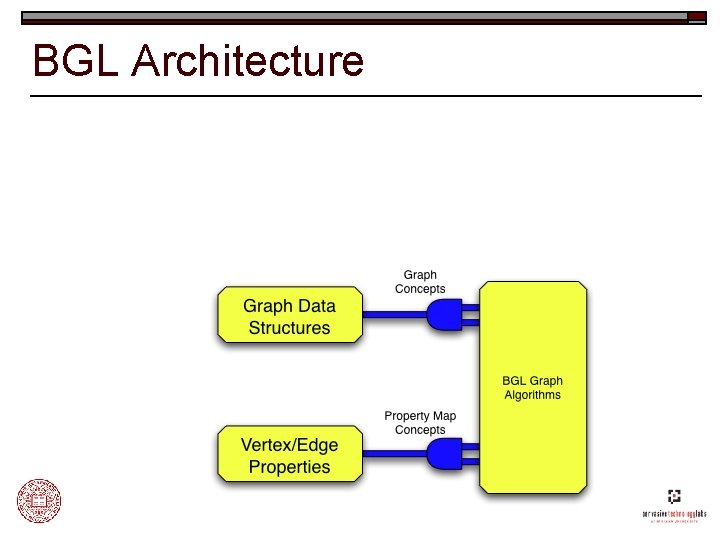
BGL Architecture
Parallelizing the BGL o Starting with the sequential BGL… o Three ways to build new algorithms or data structures 1. 2. 3. Lift away restrictions that make the component sequential (unifying parallel and sequential) Wrap the sequential component in a distribution -aware manner. Implement any entirely new, parallel component.
Lifting for Parallelism o Remove assumptions made by most sequential algorithms: n n A single, shared address space. A single “thread” of execution. o Platonic ideal: unify parallel and sequential algorithms o Our goal: Build the Parallel BGL by lifting the sequential BGL.
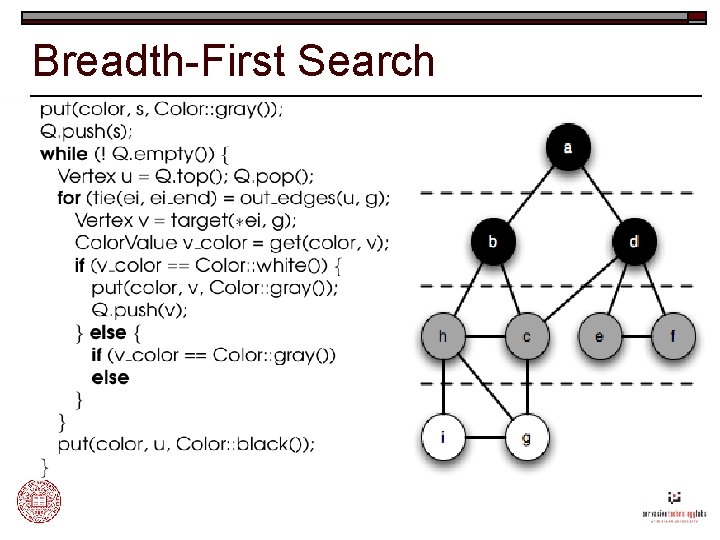
Breadth-First Search
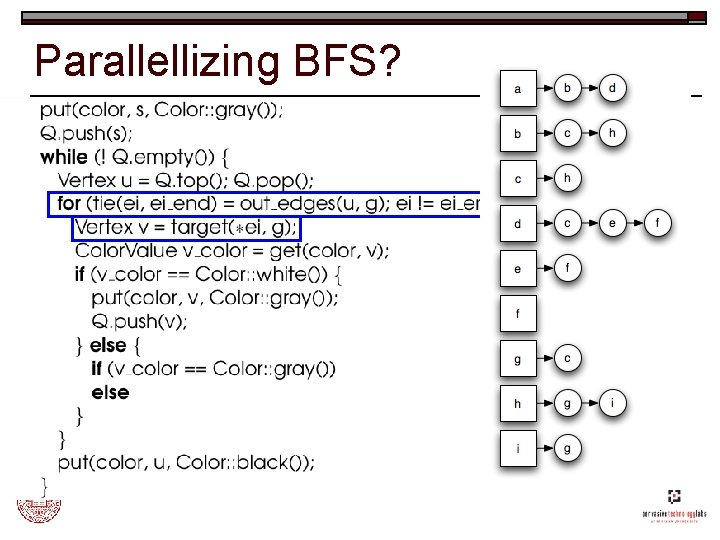
Parallellizing BFS?
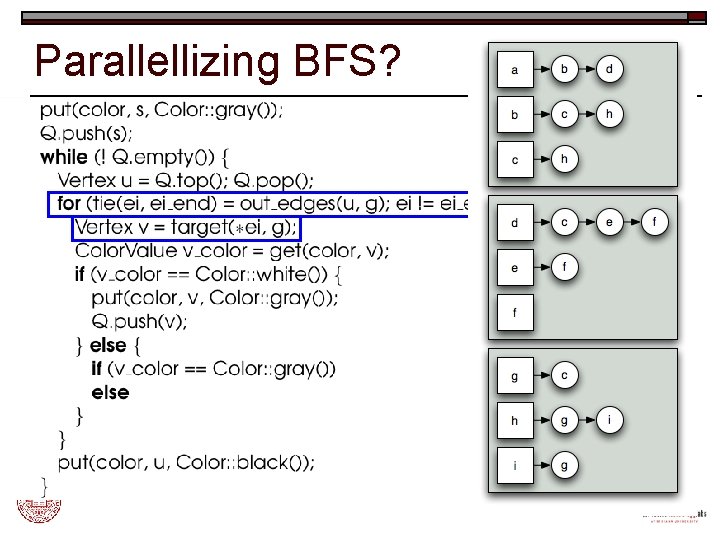
Parallellizing BFS?
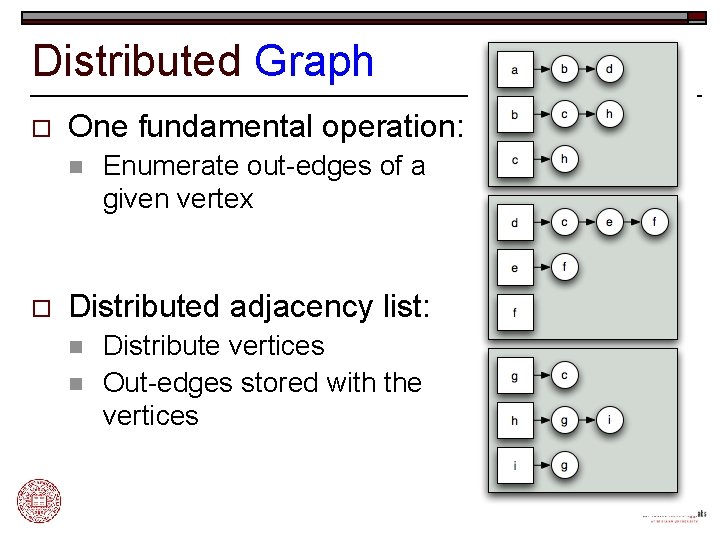
Distributed Graph o One fundamental operation: n o Enumerate out-edges of a given vertex Distributed adjacency list: n n Distribute vertices Out-edges stored with the vertices
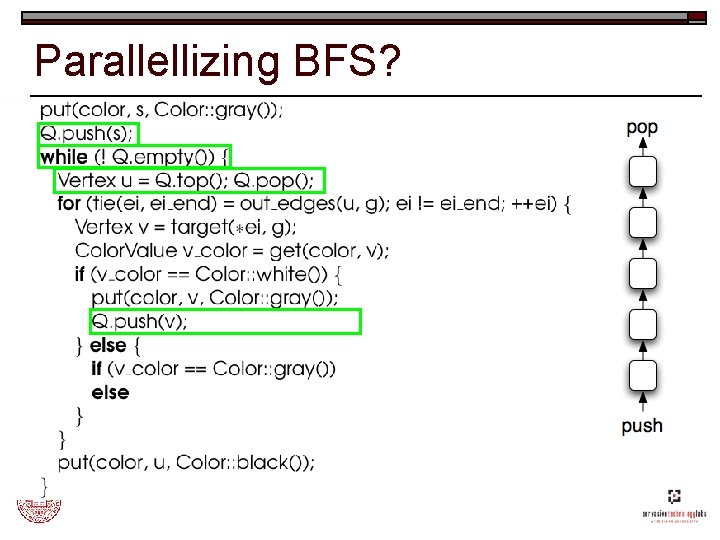
Parallellizing BFS?
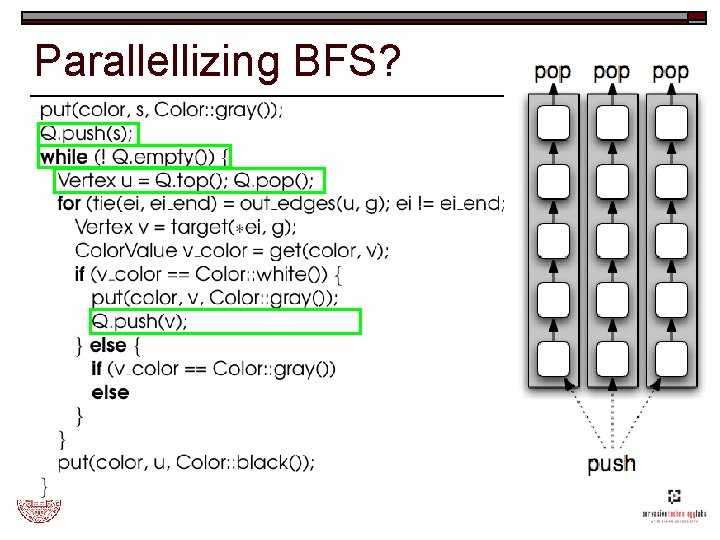
Parallellizing BFS?
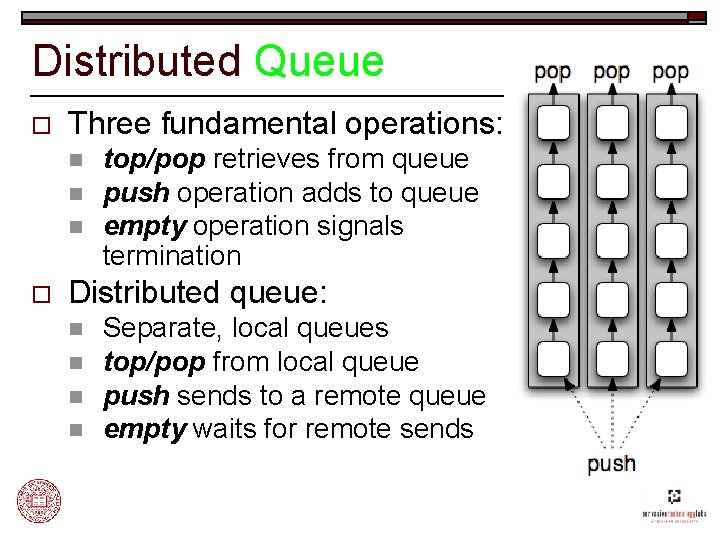
Distributed Queue o Three fundamental operations: n n n o top/pop retrieves from queue push operation adds to queue empty operation signals termination Distributed queue: n n Separate, local queues top/pop from local queue push sends to a remote queue empty waits for remote sends
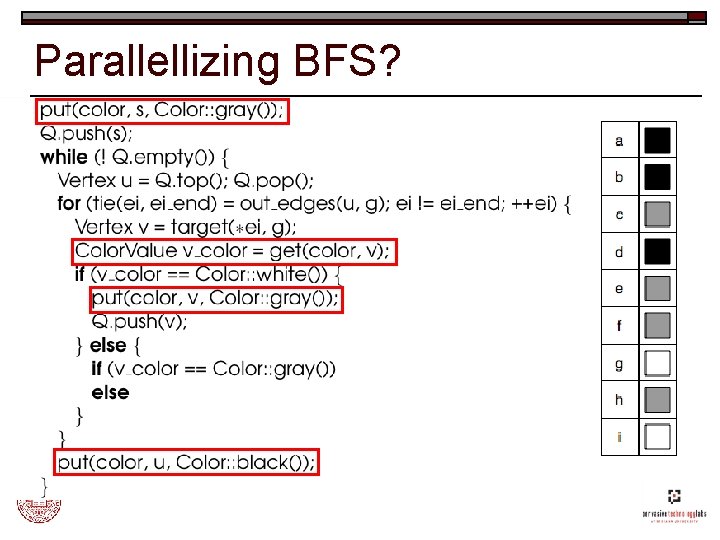
Parallellizing BFS?
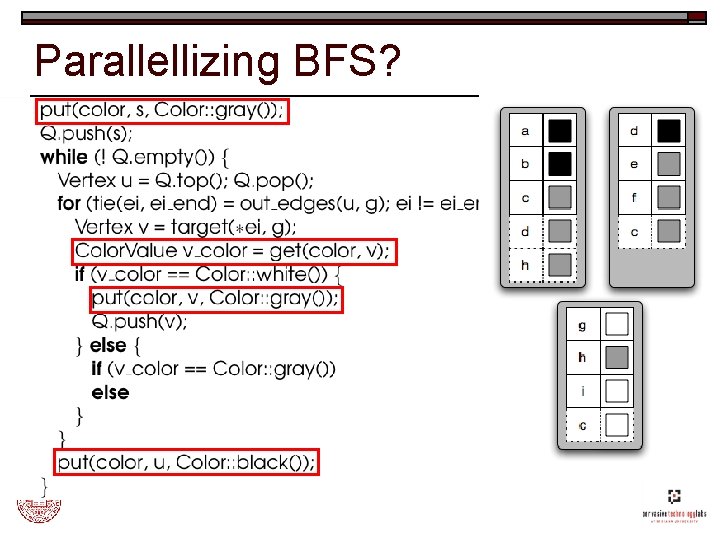
Parallellizing BFS?
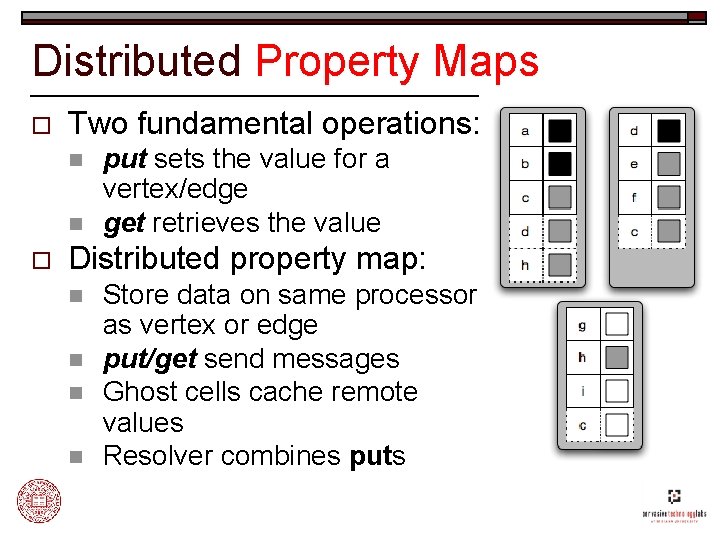
Distributed Property Maps o Two fundamental operations: n n o put sets the value for a vertex/edge get retrieves the value Distributed property map: n n Store data on same processor as vertex or edge put/get send messages Ghost cells cache remote values Resolver combines puts
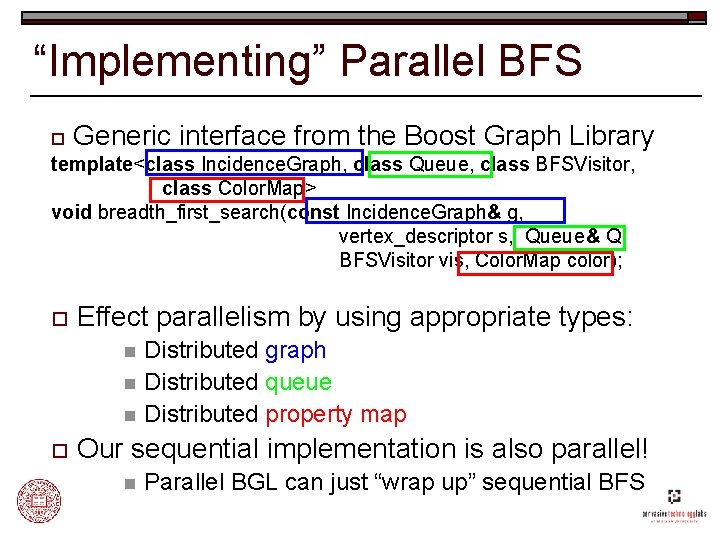
“Implementing” Parallel BFS o Generic interface from the Boost Graph Library template<class Incidence. Graph, class Queue, class BFSVisitor, class Color. Map> void breadth_first_search(const Incidence. Graph& g, vertex_descriptor s, Queue& Q, BFSVisitor vis, Color. Map color); o Effect parallelism by using appropriate types: Distributed graph n Distributed queue n Distributed property map n o Our sequential implementation is also parallel! n Parallel BGL can just “wrap up” sequential BFS
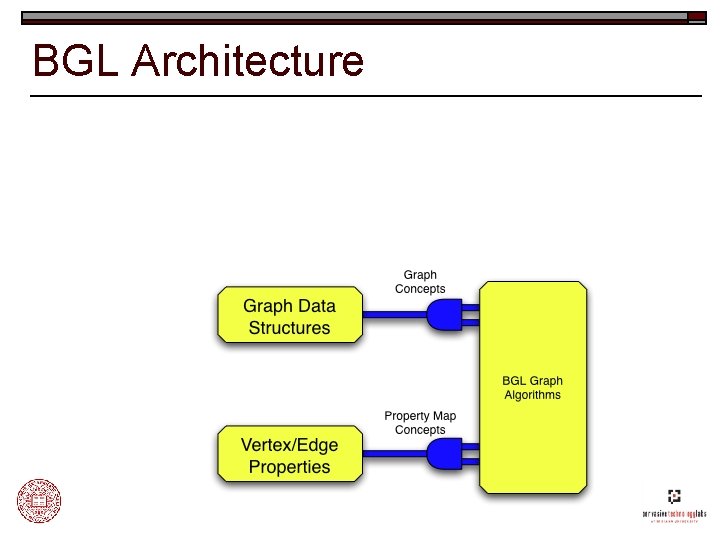
BGL Architecture
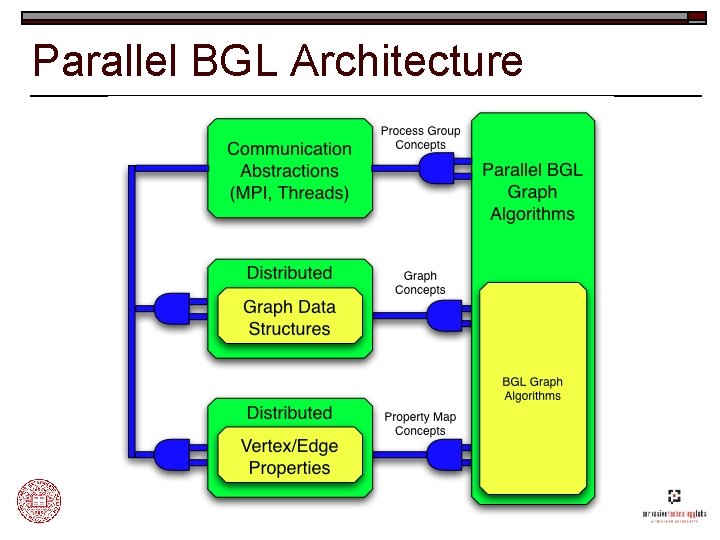
Parallel BGL Architecture
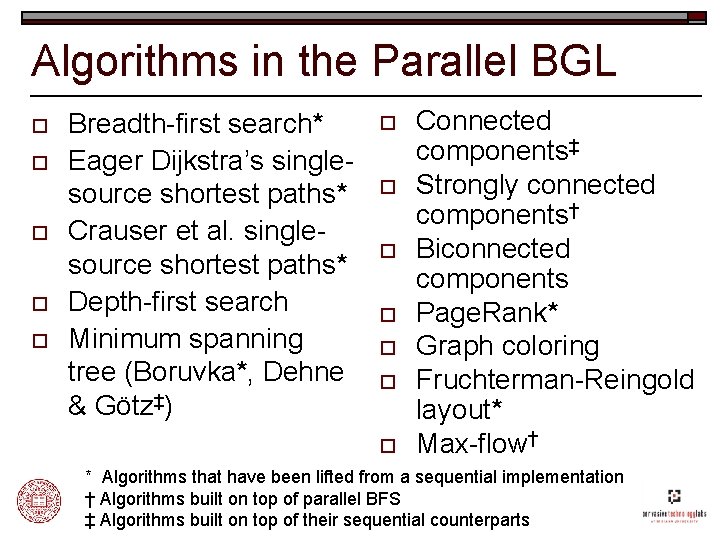
Algorithms in the Parallel BGL o o o Breadth-first search* Eager Dijkstra’s singlesource shortest paths* Crauser et al. singlesource shortest paths* Depth-first search Minimum spanning tree (Boruvka*, Dehne & Götz‡) o o o o Connected components‡ Strongly connected components† Biconnected components Page. Rank* Graph coloring Fruchterman-Reingold layout* Max-flow† * Algorithms that have been lifted from a sequential implementation † Algorithms built on top of parallel BFS ‡ Algorithms built on top of their sequential counterparts
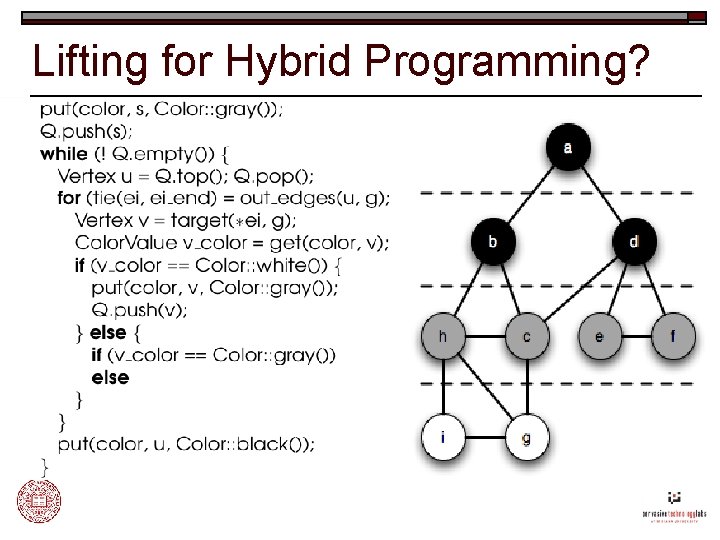
Lifting for Hybrid Programming?
Abstraction and Performance o o Myth: Abstraction is the enemy of performance. The BGL sparse-matrix ordering routines perform on par with hand-tuned Fortran codes. n o Other generic C++ libraries have had similar successes (MTL, Blitz++, POOMA) Reality: Poor use of abstraction can result in poor performance. n Use abstractions the compiler can eliminate.
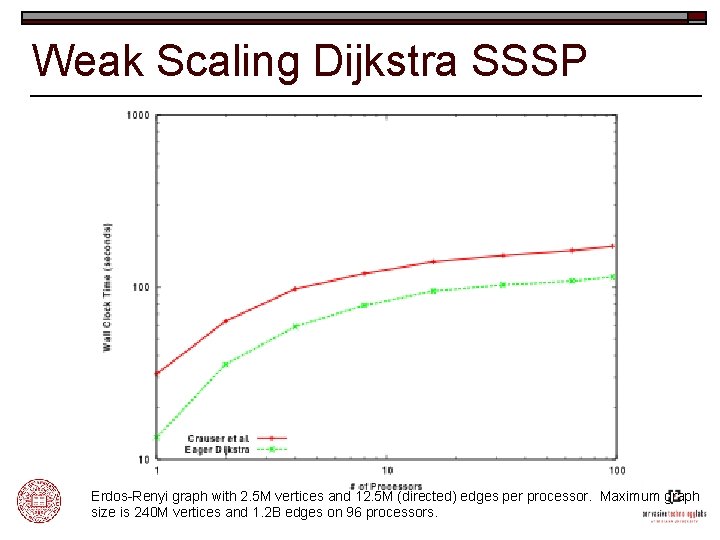
Weak Scaling Dijkstra SSSP Erdos-Renyi graph with 2. 5 M vertices and 12. 5 M (directed) edges per processor. Maximum graph size is 240 M vertices and 1. 2 B edges on 96 processors.
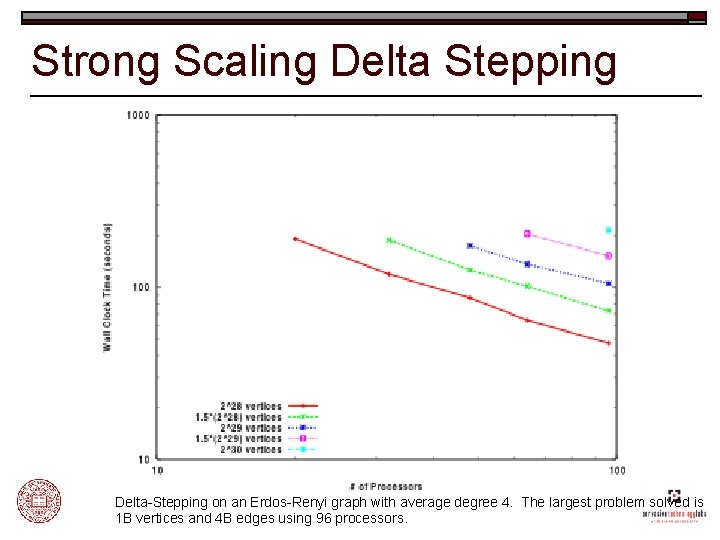
Strong Scaling Delta Stepping Delta-Stepping on an Erdos-Renyi graph with average degree 4. The largest problem solved is 1 B vertices and 4 B edges using 96 processors.
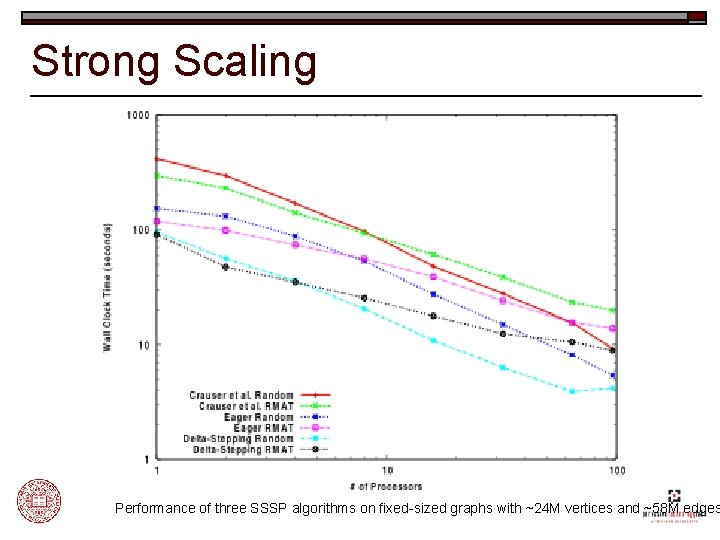
Strong Scaling Performance of three SSSP algorithms on fixed-sized graphs with ~24 M vertices and ~58 M edges
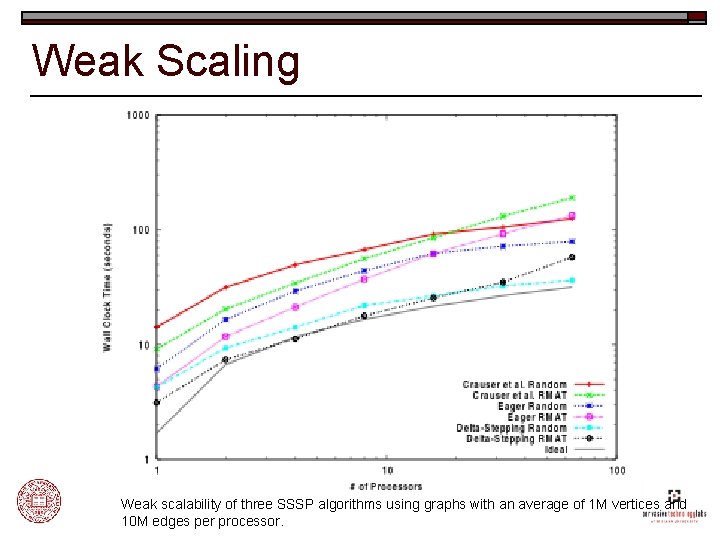
Weak Scaling Weak scalability of three SSSP algorithms using graphs with an average of 1 M vertices and 10 M edges per processor.
The BGL Family o The Original (sequential) BGL o BGL-Python o The Parallel BGL o Parallel BGL-Python o (Parallel) BGL-VTK
For More Information… o o (Sequential) Boost Graph Library http: //www. boost. org/libs/graph/doc Parallel Boost Graph Library http: //www. osl. iu. edu/research/pbgl Python Bindings for (Parallel) BGL http: //www. osl. iu. edu/~dgregor/bgl-python Contacts: n n n Andrew Lumsdaine lums@osl. iu. edu Jeremiah Willcock jewillco@osl. iu. edu Nick Edmonds ngedmonds@osl. iu. edu
Summary o Effective software practices evolve from effective software practices n o Explicitly study this in context of HPC Parallel BGL n n n Generic parallel graph algorithms for distributedmemory parallel computers Reusable for different applications, graph structures, communication layers, etc Efficient, scalable
Questions?
Disclaimer o o Some images in this talk were cut and pasted from web sites found with Google Image Search and are used without permission. I claim their inclusion in this talk is permissible as fair use. Please do not redistribute this talk.

- Slides: 59