
PBG 430 Gene Regulation Part 2 Interlocus Interactions
PBG 430 Gene Regulation – Part 2: Inter-locus Interactions Locus A Locus B Allele A Allele a Allele B Phenotype Allele b
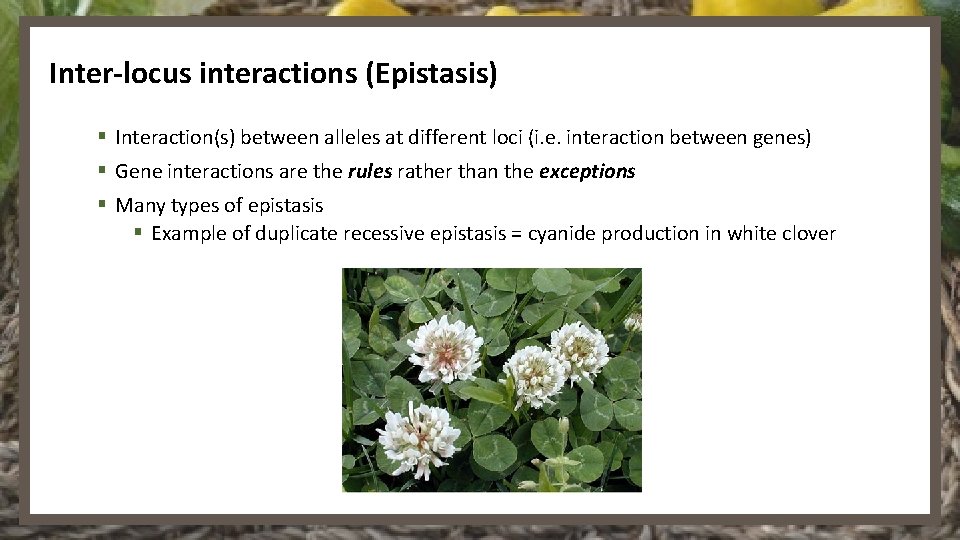
Inter-locus interactions (Epistasis) § Interaction(s) between alleles at different loci (i. e. interaction between genes) § Gene interactions are the rules rather than the exceptions § Many types of epistasis § Example of duplicate recessive epistasis = cyanide production in white clover
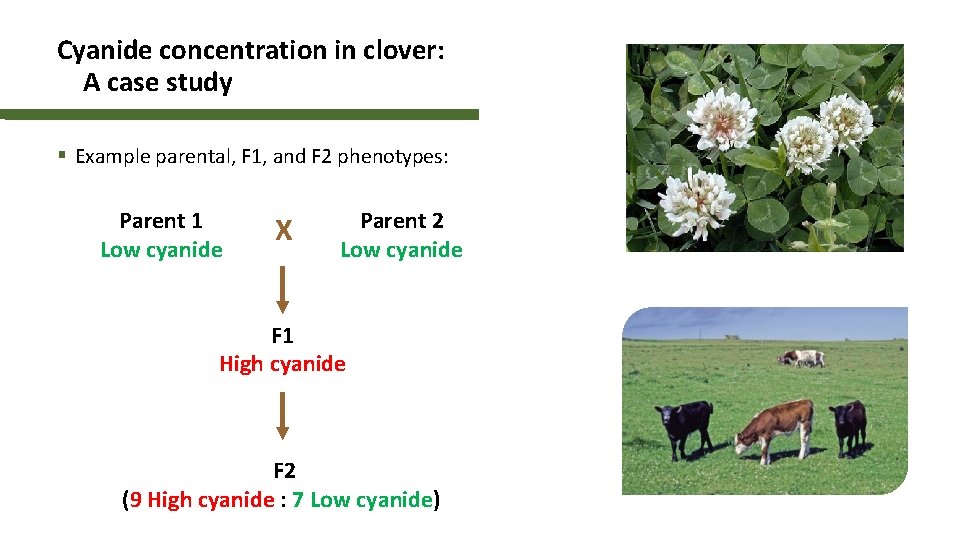
Cyanide concentration in clover: A case study § Example parental, F 1, and F 2 phenotypes: Parent 1 Low cyanide X Parent 2 Low cyanide F 1 High cyanide F 2 (9 High cyanide : 7 Low cyanide)
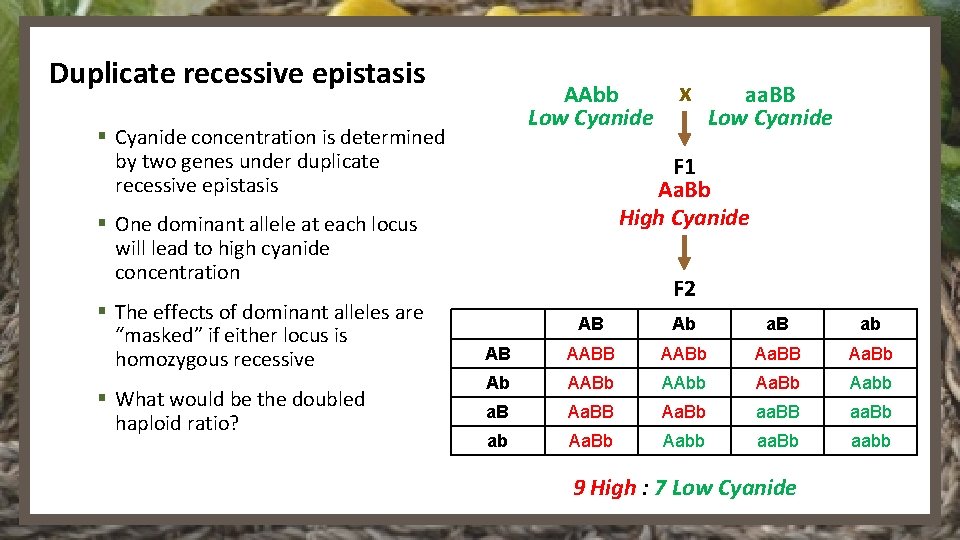
Duplicate recessive epistasis AAbb Low Cyanide § Cyanide concentration is determined by two genes under duplicate recessive epistasis § What would be the doubled haploid ratio? aa. BB Low Cyanide F 1 Aa. Bb High Cyanide § One dominant allele at each locus will lead to high cyanide concentration § The effects of dominant alleles are “masked” if either locus is homozygous recessive x F 2 AB Ab a. B ab AB AABb Aa. BB Aa. Bb Ab AABb AAbb Aa. Bb Aabb a. B Aa. Bb aa. BB aa. Bb ab Aa. Bb Aabb aa. Bb aabb 9 High : 7 Low Cyanide
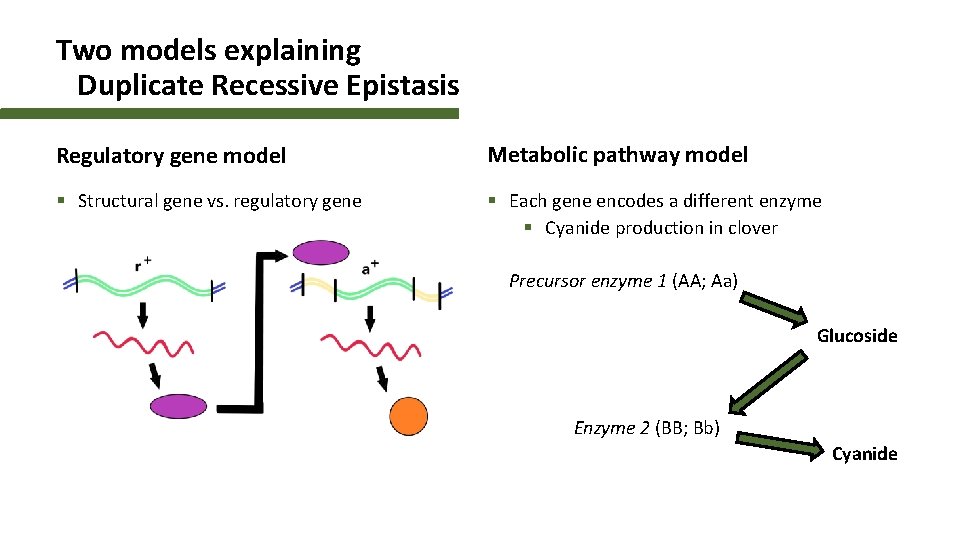
Two models explaining Duplicate Recessive Epistasis Regulatory gene model Metabolic pathway model § Structural gene vs. regulatory gene § Each gene encodes a different enzyme § Cyanide production in clover Precursor enzyme 1 (AA; Aa) Glucoside Enzyme 2 (BB; Bb) Cyanide
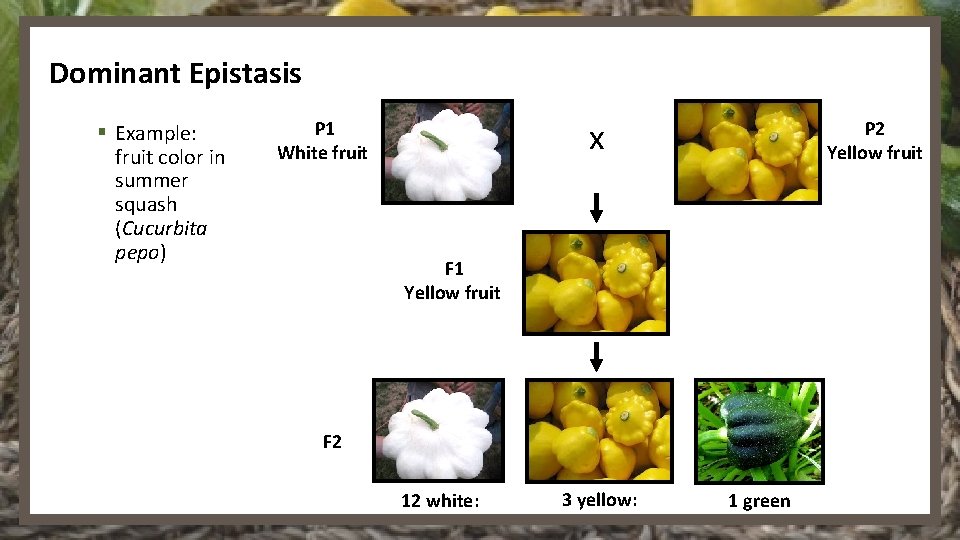
Dominant Epistasis § Example: fruit color in summer squash (Cucurbita pepo) x P 1 White fruit P 2 Yellow fruit F 1 Yellow fruit F 2 12 white: 3 yellow: 1 green
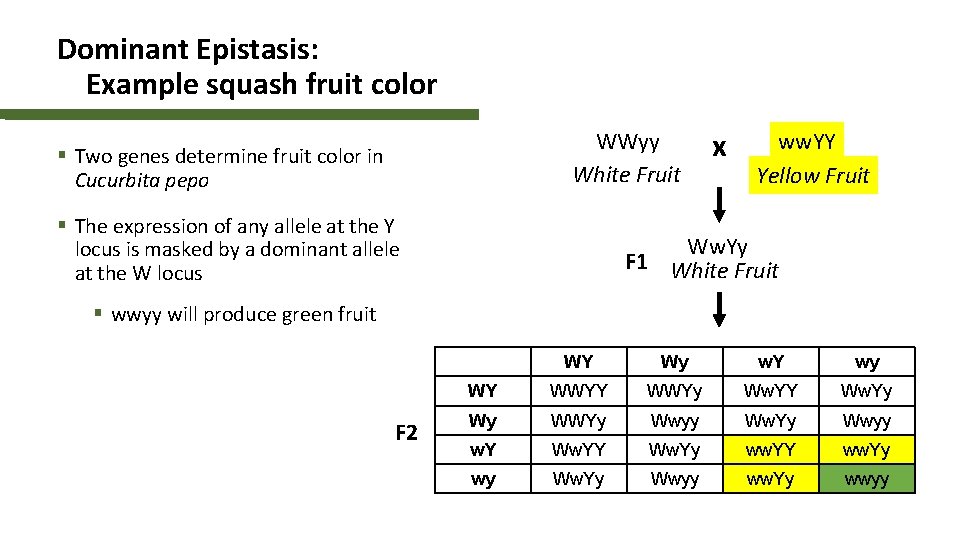
Dominant Epistasis: Example squash fruit color WWyy White Fruit § Two genes determine fruit color in Cucurbita pepo § The expression of any allele at the Y locus is masked by a dominant allele at the W locus x ww. YY Yellow Fruit Ww. Yy F 1 White Fruit § wwyy will produce green fruit F 2 WY Wy w. Y wy WY WWYy Ww. YY Ww. Yy Wy WWYy Wwyy Ww. Yy Wwyy w. Y Ww. Yy ww. YY ww. Yy wy Ww. Yy Wwyy ww. Yy wwyy
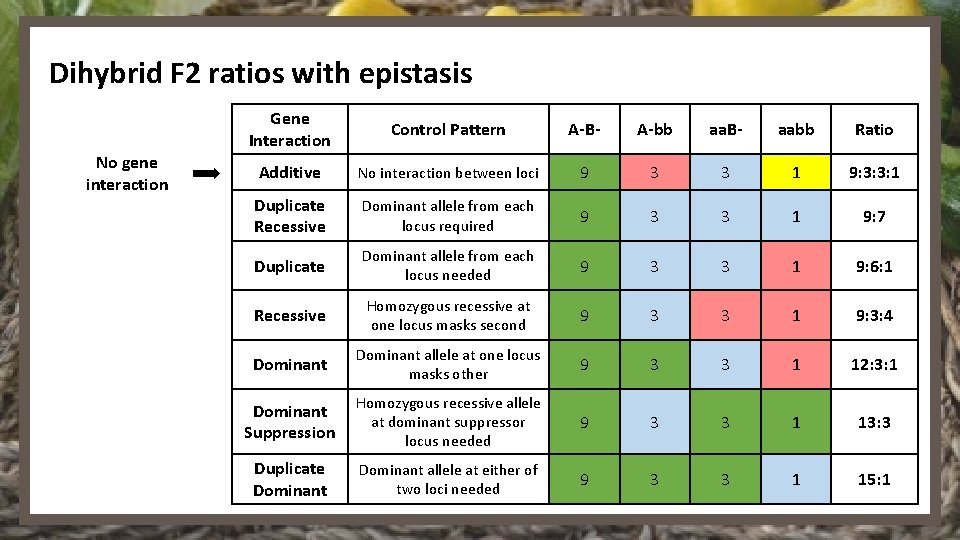
Dihybrid F 2 ratios with epistasis No gene interaction Gene Interaction Control Pattern A-B- A-bb aa. B- aabb Ratio Additive No interaction between loci 9 3 3 1 9: 3: 3: 1 Duplicate Recessive Dominant allele from each locus required 9 3 3 1 9: 7 Duplicate Dominant allele from each locus needed 9 3 3 1 9: 6: 1 Recessive Homozygous recessive at one locus masks second 9 3 3 1 9: 3: 4 Dominant allele at one locus masks other 9 3 3 1 12: 3: 1 Dominant Suppression Homozygous recessive allele at dominant suppressor locus needed 9 3 3 1 13: 3 Duplicate Dominant allele at either of two loci needed 9 3 3 1 15: 1
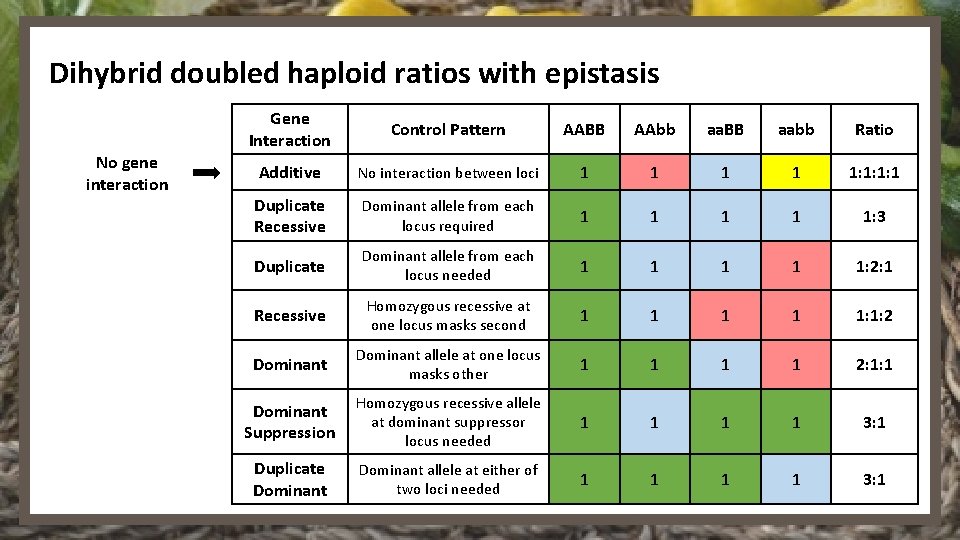
Dihybrid doubled haploid ratios with epistasis No gene interaction Gene Interaction Control Pattern AABB AAbb aa. BB aabb Ratio Additive No interaction between loci 1 1 1: 1: 1: 1 Duplicate Recessive Dominant allele from each locus required 1 1 1: 3 Duplicate Dominant allele from each locus needed 1 1 1: 2: 1 Recessive Homozygous recessive at one locus masks second 1 1 1: 1: 2 Dominant allele at one locus masks other 1 1 2: 1: 1 Dominant Suppression Homozygous recessive allele at dominant suppressor locus needed 1 1 3: 1 Duplicate Dominant allele at either of two loci needed 1 1 3: 1
Vernalization sensitivity: An important trait showing epistasis § In vernalization-sensitive genotypes, exposure to low temperatures is required for a timely transition from the vegetative to the reproductive growth stage § Why is vernalization a trait of interest? § Flowering time is related to productivity (yield) § Vernalization sensitivity is often correlated with low temperature tolerance, which is required for winter survival § Fall-planted, low temperature-tolerant cereal crops a tool for dealing with climate change and improve water use efficiency from winter precipitation § Is vernalization-sensitivity a pre-requisite for low temperature tolerance?
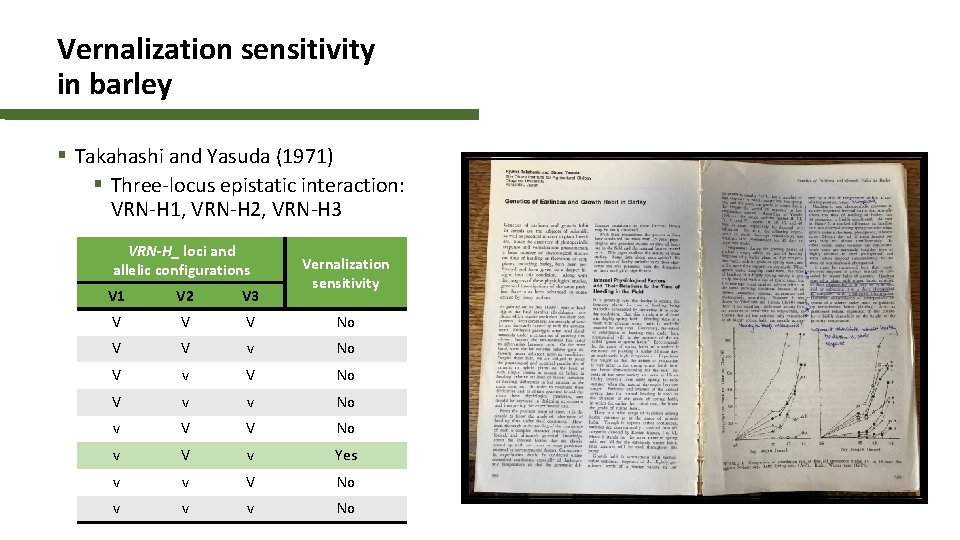
Vernalization sensitivity in barley § Takahashi and Yasuda (1971) § Three-locus epistatic interaction: VRN-H 1, VRN-H 2, VRN-H 3 VRN-H_ loci and allelic configurations Vernalization sensitivity V 1 V 2 V 3 V V V No V V v No V v V No V v v No v V V No v V v Yes v v V No v v v No
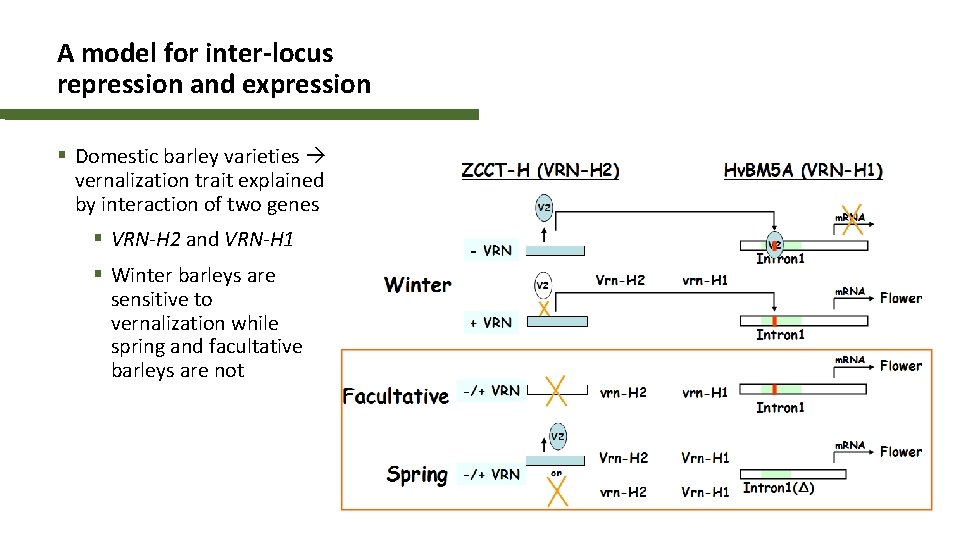
A model for inter-locus repression and expression § Domestic barley varieties vernalization trait explained by interaction of two genes § VRN-H 2 and VRN-H 1 § Winter barleys are sensitive to vernalization while spring and facultative barleys are not
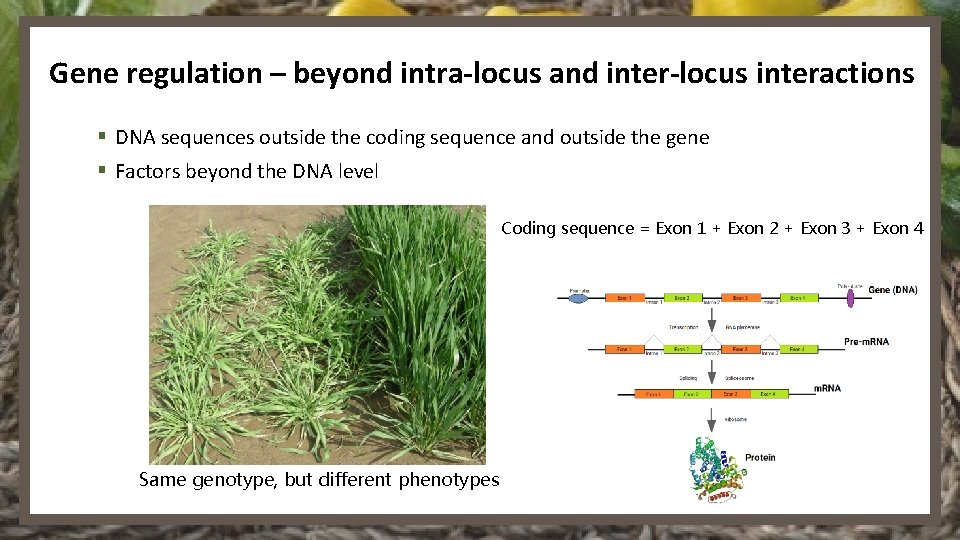
Gene regulation – beyond intra-locus and inter-locus interactions § DNA sequences outside the coding sequence and outside the gene § Factors beyond the DNA level Coding sequence = Exon 1 + Exon 2 + Exon 3 + Exon 4 Same genotype, but different phenotypes
Gene regulation summary § Outside coding sequence § Promoters - constitutive, tissue-specific, inducible: § Ca. MV 35 S (constitutive), Glutelin GT 1 (tissue-specific), Cis-Jasmone (inducible) § Outside gene (i. e. another gene) § Transcription factors - Facilitate, enhance, repress: § Vrs 1, Nud, VRN-H 2 § Beyond DNA level § RNAi: § mi. RNA, si. RNA, hn. RNA, lnc. RNA, pu. RNA, sh. RNA, sno. RNA, ti. RNA, …. § m. RNA stability - minutes to months: § 5’ cap, 3’ tail protect m. RNA from nucleases § Chromatin remodeling: § Accessibility of DNA to transcription machinery § Level of condensation/compaction, DNA methylation § Translational and post-translational modification of proteins: § Protein synthesis rate, transport, stability, activity § Gene coding sequence § Inter- and intra-locus interactions
By now, you should be able to… § Define epistasis. § Use cyanide production in clover (a type of Duplicate Recessive Epistasis) and fruit color in summer squash (a type of Dominant Epistasis) as examples for your explanation. § Describe the two models proposed to explain Duplicate Recessive Epistasis. For each model, explain why a loss of function in either locus will produce the mutant phenotype. § Given a type of epistasis (we will limit ourselves to the two types covered in detail – digenic Duplicate Recessive and Dominant), and the genotype of the parents, predict the phenotypic ratios in an F 2 and in a doubled haploid (produced from the F 1) generation. § Differentiate three growth habits possible in barley based on vernalization sensitivity, cold tolerance, and planting time. § For each growth habit, explain the genetic cause of vernalization (in)sensitivity based on the 2 -locus model (assuming the third locus is homozygous). § Describe other ways in which genes are regulated, besides inter- and intra-locus interactions. § Remember, genes can be regulated by DNA sequences outside the coding sequence of a gene, outside genes, and even by factors beyond the DNA level. Give examples of gene regulation mechanisms that can affect phenotype without changing the genotype.
- Slides: 15