
PB 202 MACROECONOMICS CHAPTER 5 MONEY AND MONETARY
PB 202 MACROECONOMICS CHAPTER 5 MONEY AND MONETARY POLICY
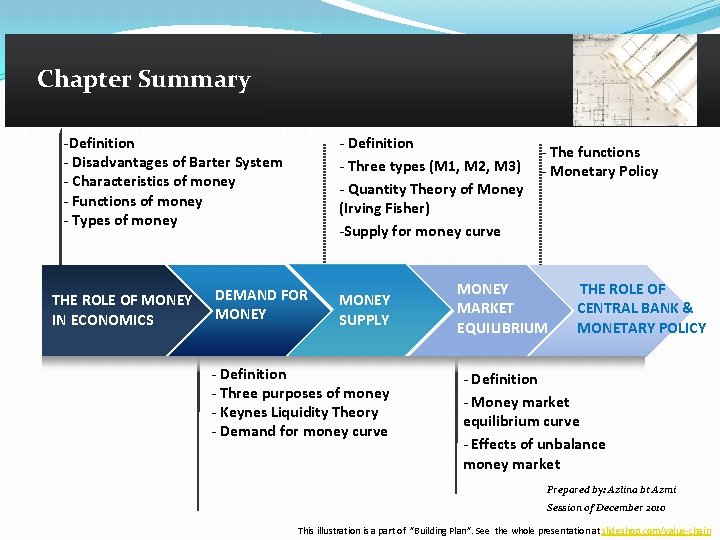
Chapter Summary Arrow Process Why use graphics from Power. Pointing. com? -Definition - Disadvantages of Barter System - Characteristics of money - Functions of money - Types of money THE ROLE OF MONEY IN ECONOMICS - Definition - Three types (M 1, M 2, M 3) - Quantity Theory of Money (Irving Fisher) -Supply for money curve DEMAND FOR MONEY SUPPLY - Definition - Three purposes of money - Keynes Liquidity Theory - Demand for money curve - The functions - Monetary Policy MONEY MARKET EQUILIBRIUM THE ROLE OF CENTRAL BANK & MONETARY POLICY - Definition - Money market equilibrium curve - Effects of unbalance money market Prepared by: Azlina bt Azmi Session of December 2010 This illustration is a part of ”Building Plan”. See the whole presentation at slideshop. com/value-chain
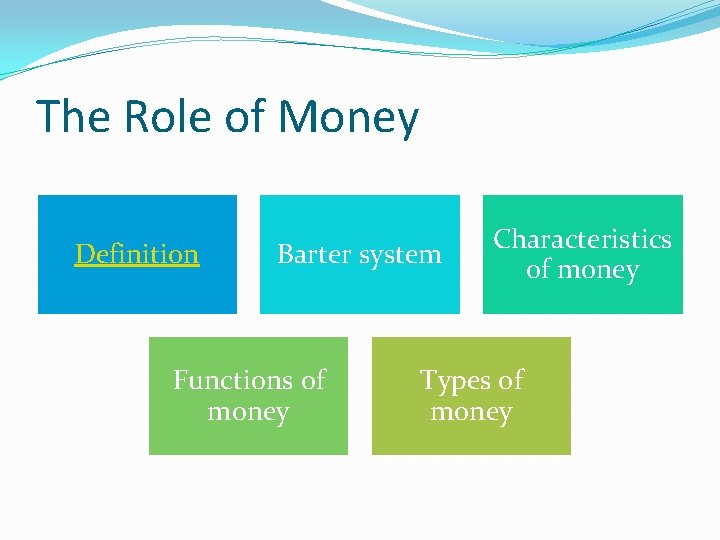
The Role of Money Definition Barter system Functions of money Characteristics of money Types of money
What is money? �Money is any commodity that is generally acceptable as a payment for good and services �Money is anything that acts as a medium of exchange
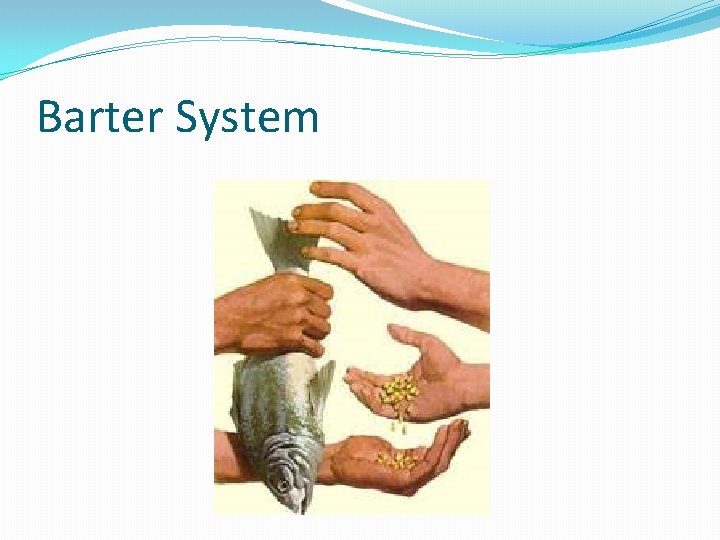
Barter System
What is Barter System? �Before the evolution of money, barter trade was practiced �Barter refer to the direct exchange of one good for another good, rather than for money �For example, if you have rice but wants chickens, you need to find a person who has chickens and willing to exchange his chickens to rice
Disadvantages of Barter System �Lack of Coincidence of wants �Barter transactions can be possible only when two persons desiring exchange of commodities should have such commodities which are mutually needed by each other. �For example, if Ram wants cloth, which Shyma has, then Ram should have such commodity which Shyam wants. �Wasting time in the process of exchange

Disadvantages of Barter System �Lack of Store of Value �In a barter economy, the store of value could be done only in the form of commodities. However, we all know that commodities are perishable and they cannot be kept for a long time in the store.
Characteristics of Money �Liquidity �Money is immediately available to spend without any additional expense �Bon/real estate – to make them liquid, often involve expenses such as brokerage fees & time delays �Portable & Divisible �Easily to reach from our pockets and turn into change to buy items at various price �Uniform �The value of money must be uniform to avoid differences in value
Functions of Money �Medium of exchange �Primary function of money �Removes the problem of coincidence of wants �Providing much more convenient method of exchange
Functions of Money �Money as unit of account �The function of money to provide a common measurement of the relative goods and services �Without money, we face difficulty of pricing goods and services �Example: how many pizzas equals to movie tickets or else? �Only know when we compare with value of money �If the price of one pizza is RM 10, and the price of one movie ticket is RM 5, then one pizza equals to two movies tickets
Functions of Money �Money as store of value �Serves as store of value in exchange for some item in the future �You can bury money in your backyard, or store it under your mattress for a month or years and not worry of spoiling it �However, inflation can destroy money’s store-in-value function
Types of Money �Commodity money �Is any item that has its own value �Is used as a means of payments �Example: shells, beads, cattle
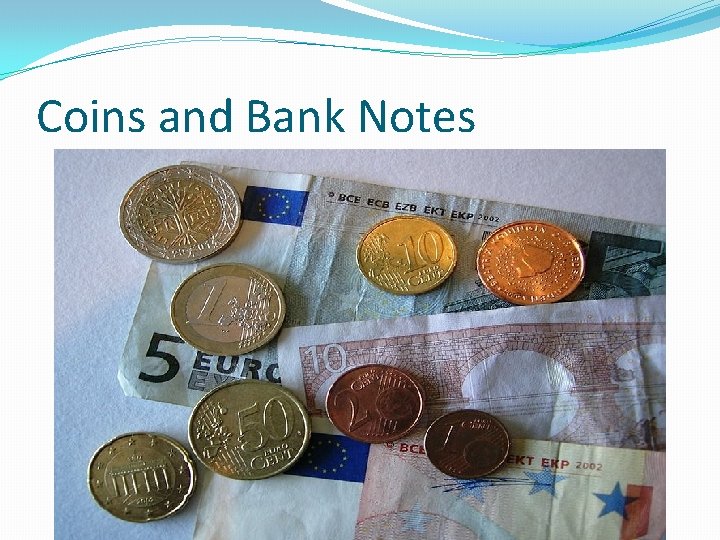
Coins and Bank Notes
Types of Money �Fiat money �‘Fiat’ is Latin word means ‘let it be done’ �Is anything that government has ordered or declared to be money �Is issued by Central Bank of a country �Fiat money includes coins and paper money which are called currency
Types of Money �Legal tender �Is paper money that a government has approved to be accepted as a mean of payments �Example: in Malaysia, Ringgit Malaysia (RM) is a legal tender for any payment �All transactions in Malaysia will be in RM
Types of Money �Token Money �Refers to money which has a lower metallic value than its face value �Example: coins produced in Malaysia

Types of Money �Demand deposits �Is money that is transferable by way of cheques �Also known as bank deposits or currents account
QUESTION �Are credit cards money? (6 marks) �Can debit cards be considered as a money? (6 marks) �Find any THREE (3) advantages of barter system (6 marks)
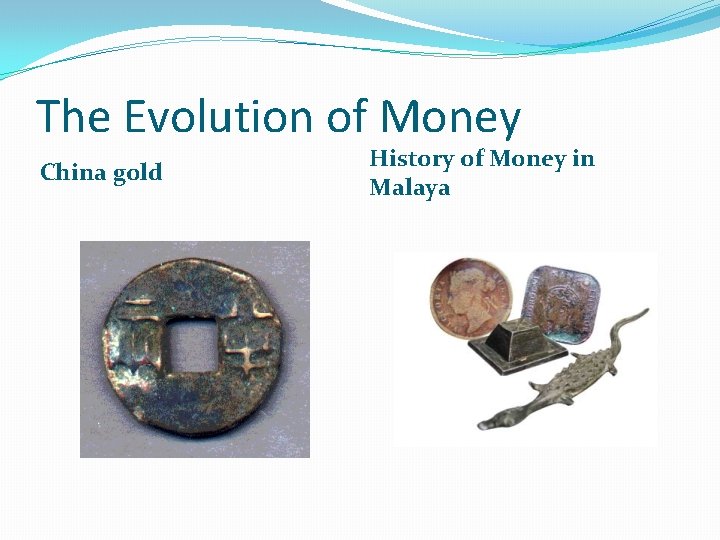
The Evolution of Money China gold History of Money in Malaya
DEMAND FOR MONEY Definition Three purpose demand for money Keynes Liquidity Theory Demand for money curve
What is Money Demand? �The desire of households and businesses to hold assets in the form of money �Demand for money is sometimes called the demand for liquidity �The liquidity of money leaves people like to hold/demand for money �Questions �Why people tend to hold money? �What purposes people like demand for money? �Will be explain by Keynes Liquidity Theory
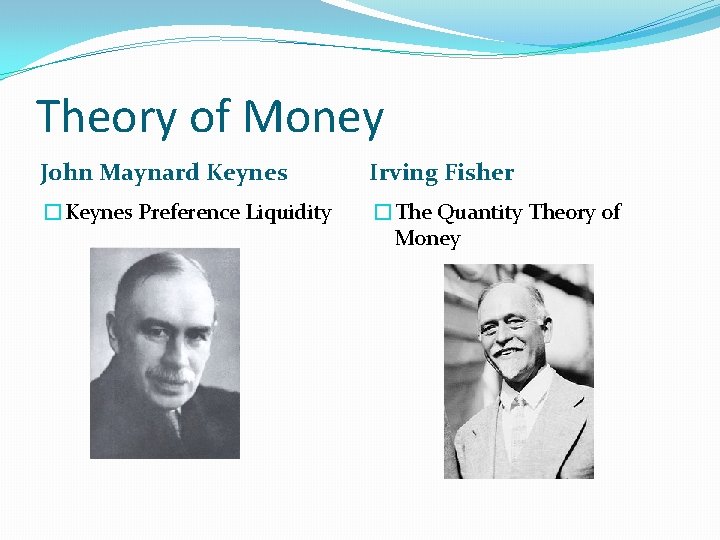
Keynes Liquidity Theory �John Maynard Keynes, in his book (1936) The General Theory of Employment, Interest & Money, gave three (3) important motives why people demand for money �Transactions Demand for Money �Precautionary Demand for Money �Speculative Demand for Money
Transactions Demand for Money �People expect to make transactions for goods and services �How much people hold for money is depending on how much they spent on their transactions for goods and services �Example: �A person on vacation might demand more money then on a typical day �Wealthier people might also demand more money because their average daily expenditure are higher than the average people
Precautionary Demand for Money �People like to hold money for unpredictable expenses �Example: car breakdown, hospital, accidents
Speculative Demand for Money �The purpose of people holding money for speculative is to take advantage of expected future changes in the price of bonds, stocks or other financial assets �People like to invest when interest rate is high �Therefore, speculative demand for money is related to interest rate effects
Demand for Money Curve �Arise from three motives for holding money �Represents the quantity of money people hold at different possible interest rates �An inverse relationship between the quantity of money demanded and the interest rate �People hold more money (Md) when interest rate is lower (r ) �Md , r
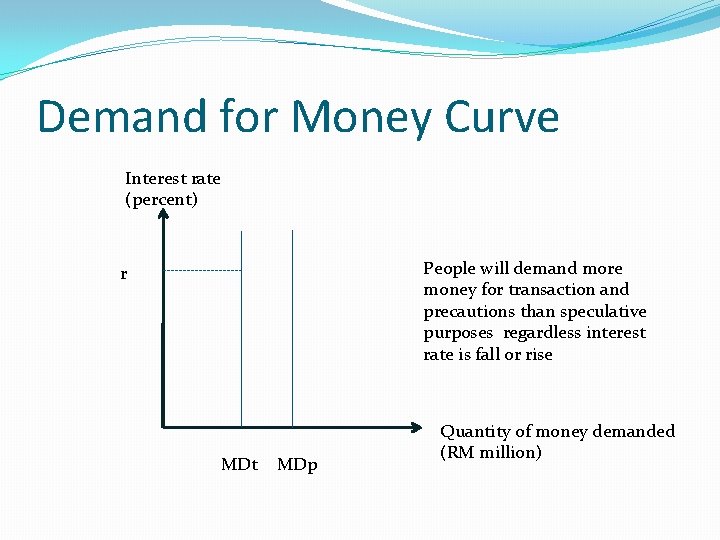
Demand for Money Curve Interest rate (percent) People will demand more money for transaction and precautions than speculative purposes regardless interest rate is fall or rise r MDt MDp Quantity of money demanded (RM million)
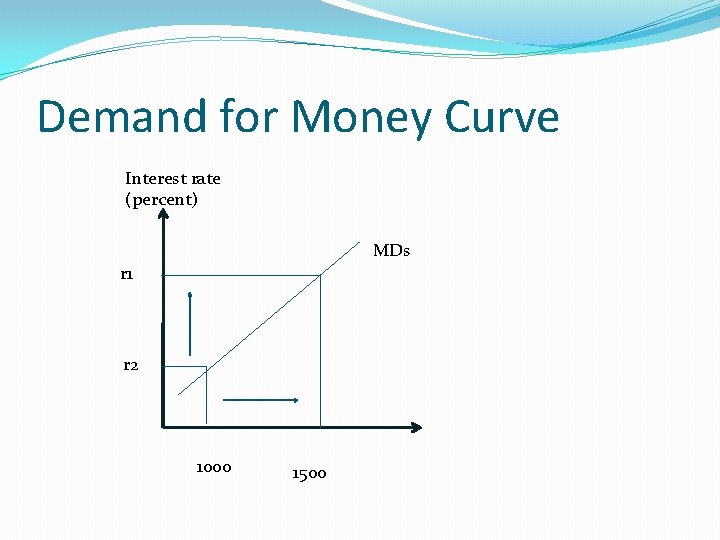
Demand for Money Curve Interest rate (percent) MDs r 1 r 2 1000 1500
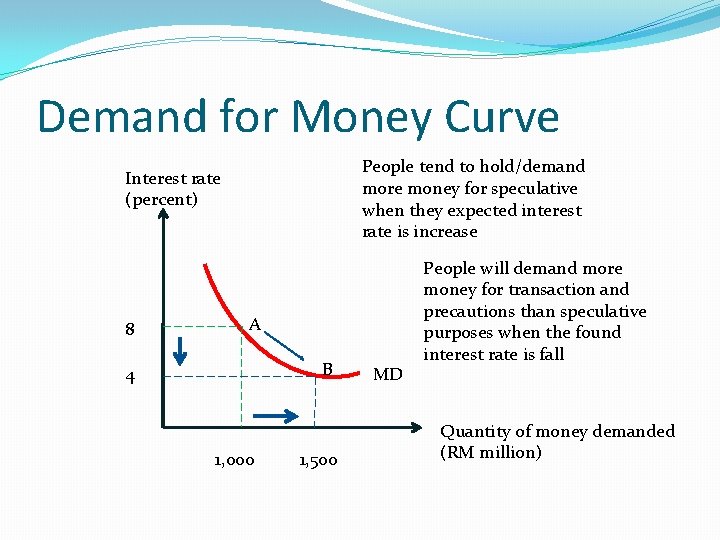
Demand for Money Curve People tend to hold/demand more money for speculative when they expected interest rate is increase Interest rate (percent) 8 A B 4 1, 000 1, 500 MD People will demand more money for transaction and precautions than speculative purposes when the found interest rate is fall Quantity of money demanded (RM million)
MONEY SUPPLY Definition Three types (M 1, M 2, M 3) Quantity Theory of Money by Irving Fisher Supply for Money Curve
What is Money Supply? �Money supply is money that control by Central Bank �Money supply does not respond to change in the interest rate �Therefore, the supply for money curve is vertical line �The methods used to measure supply are called M 1, M 2 and M 3
M 1: Narrow Money �M 1 is the narrowest definition of the supply of money �M 1 is also money that directly used for transactions �Consists: �Currency – includes coins and paper money issued by Bank Negara Malaysia �Checkable Deposits – also called as demand deposits �Therefore ; M 1 = Currency + Checkable Deposits
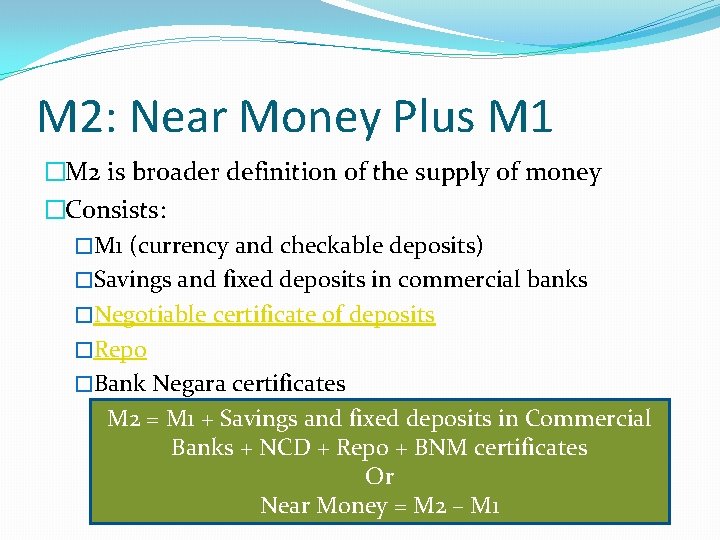
M 2: Near Money Plus M 1 �M 2 is broader definition of the supply of money �Consists: �M 1 (currency and checkable deposits) �Savings and fixed deposits in commercial banks �Negotiable certificate of deposits �Repo �Bank Negara certificates M 2 = M 1 + Savings and fixed deposits in Commercial Banks + NCD + Repo + BNM certificates Or Near Money = M 2 – M 1
What is NCD? �With a minimum face value of $100, 000 �Bought most often by large institutional investor �Money instrument that can easily transferable from one party to another �Can be easily bought / sold between different parties �Example: Yankee CD, issued in US market (New York) by a branch of a foreign bank
What is REPO? �Short term borrowing for dealers in government securities �The dealer sells the government securities to investors, usually on an overnight basis, and buys them back the following day �Classified as a money market-market instrument �Usually raise short-term capital
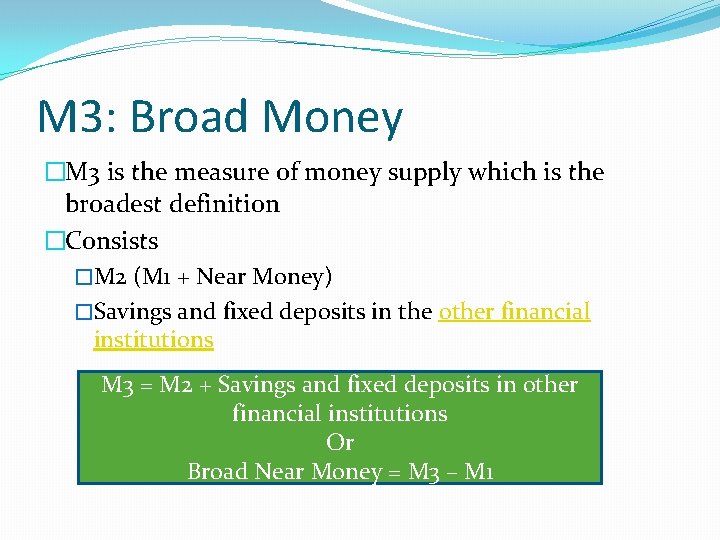
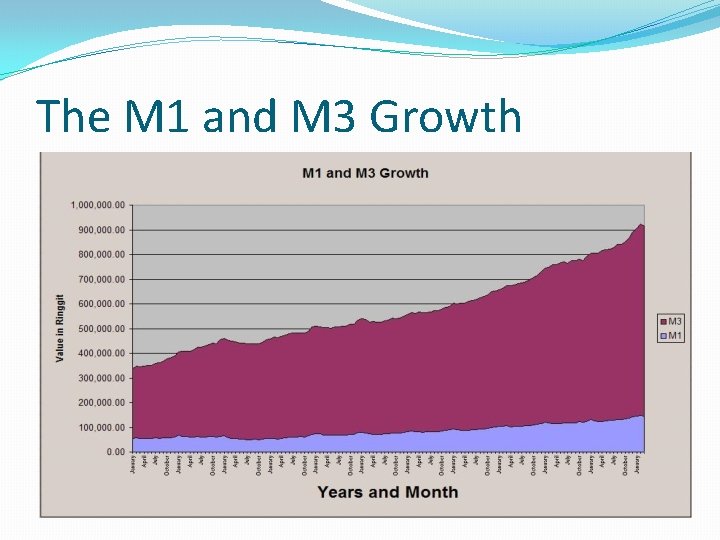
M 3: Broad Money �M 3 is the measure of money supply which is the broadest definition �Consists �M 2 (M 1 + Near Money) �Savings and fixed deposits in the other financial institutions M 3 = M 2 + Savings and fixed deposits in other financial institutions Or Broad Near Money = M 3 – M 1
Other Financial Institution • • Non-bank private sector Finance companies Merchant bank/investment bank Discount houses
The M 1 and M 3 Growth
Theory of Money John Maynard Keynes Irving Fisher �Keynes Preference Liquidity �The Quantity Theory of Money
Fisher’s Quantity Theory of Money �At the beginning of 20’s century, the economist, Irving Fisher proposed the first explicit equation for calculating the quantity money in economics �Also known as “Fisher equation”, assumed that all the transactions require money to change hand �The quantity theory of money explained that the changes in money supply are related to changes in price level
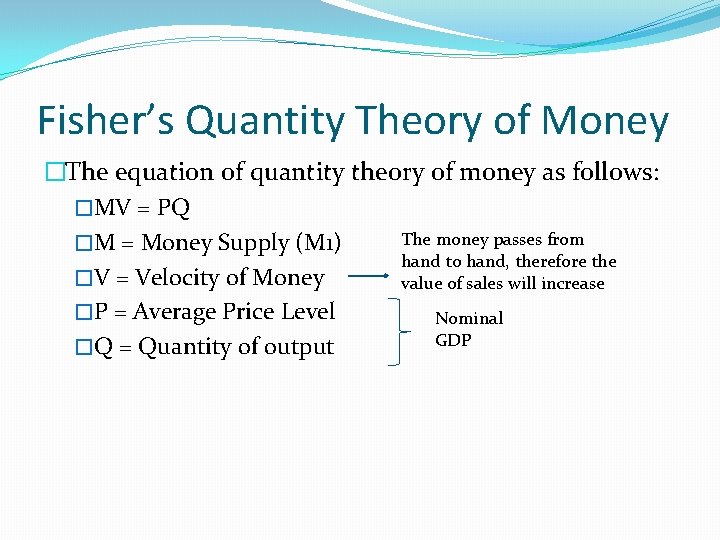
Fisher’s Quantity Theory of Money �The equation of quantity theory of money as follows: �MV = PQ The money passes from �M = Money Supply (M 1) hand to hand, therefore the �V = Velocity of Money value of sales will increase �P = Average Price Level Nominal GDP �Q = Quantity of output
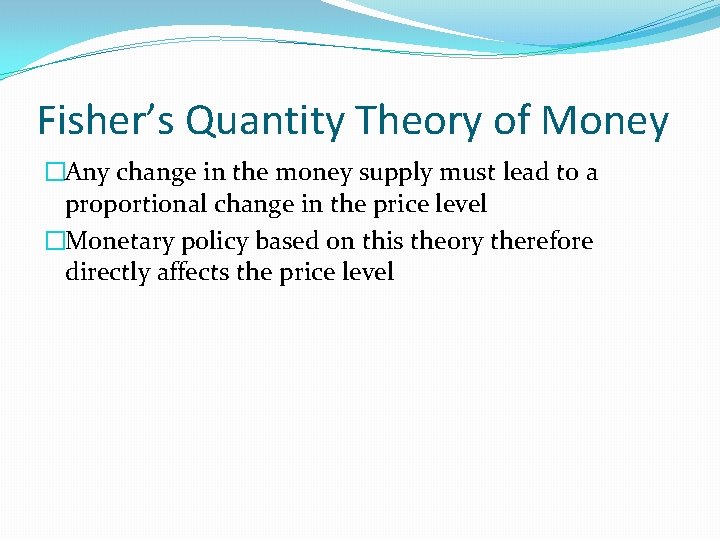
Fisher’s Quantity Theory of Money �Any change in the money supply must lead to a proportional change in the price level �Monetary policy based on this theory therefore directly affects the price level
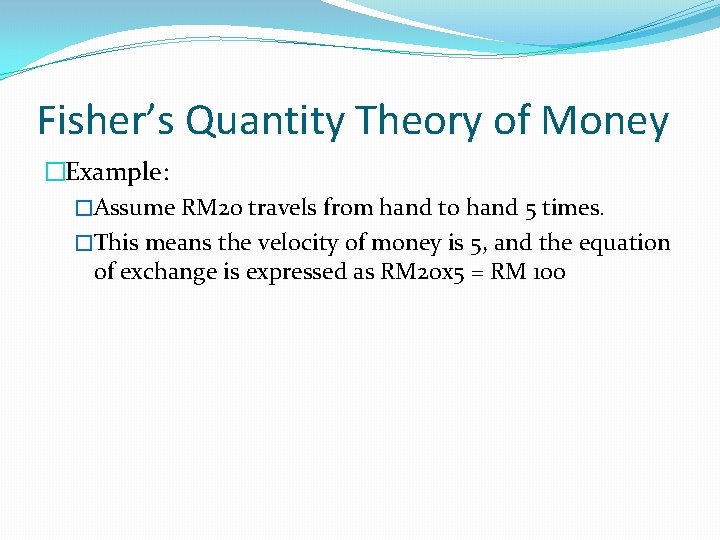
Fisher’s Quantity Theory of Money �Example: �Assume RM 20 travels from hand to hand 5 times. �This means the velocity of money is 5, and the equation of exchange is expressed as RM 20 x 5 = RM 100
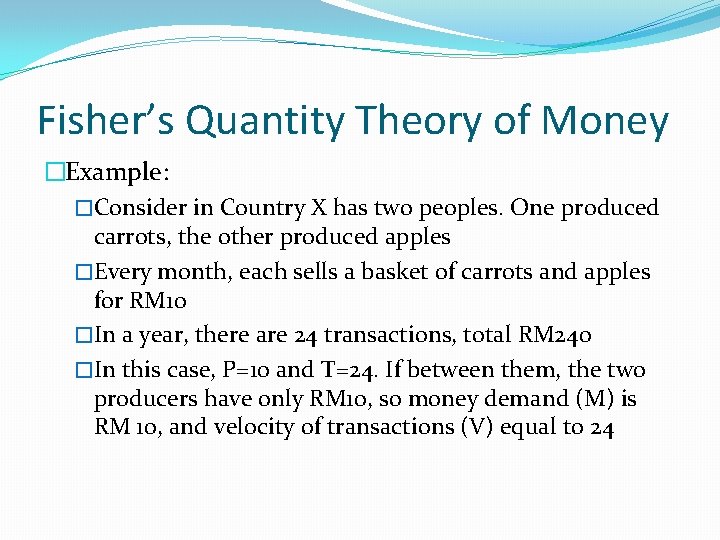
Fisher’s Quantity Theory of Money �Example: �Consider in Country X has two peoples. One produced carrots, the other produced apples �Every month, each sells a basket of carrots and apples for RM 10 �In a year, there are 24 transactions, total RM 240 �In this case, P=10 and T=24. If between them, the two producers have only RM 10, so money demand (M) is RM 10, and velocity of transactions (V) equal to 24
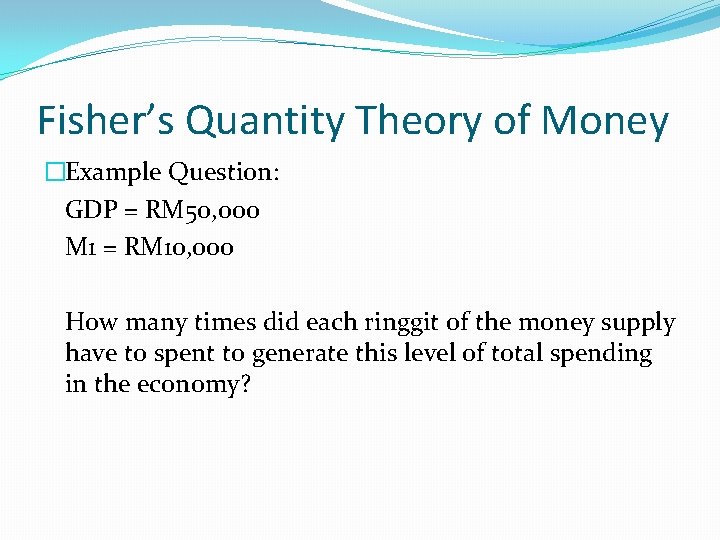
Fisher’s Quantity Theory of Money �Example Question: GDP = RM 50, 000 M 1 = RM 10, 000 How many times did each ringgit of the money supply have to spent to generate this level of total spending in the economy?
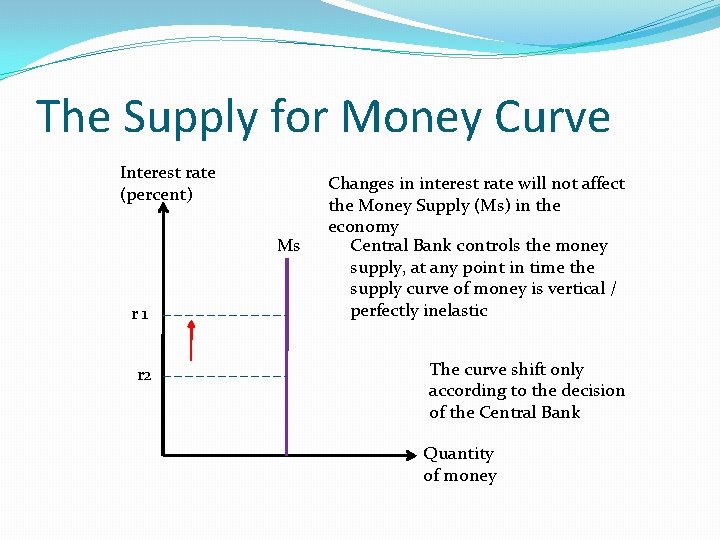
The Supply for Money Curve Interest rate (percent) Ms r 1 r 2 Changes in interest rate will not affect the Money Supply (Ms) in the economy Central Bank controls the money supply, at any point in time the supply curve of money is vertical / perfectly inelastic The curve shift only according to the decision of the Central Bank Quantity of money
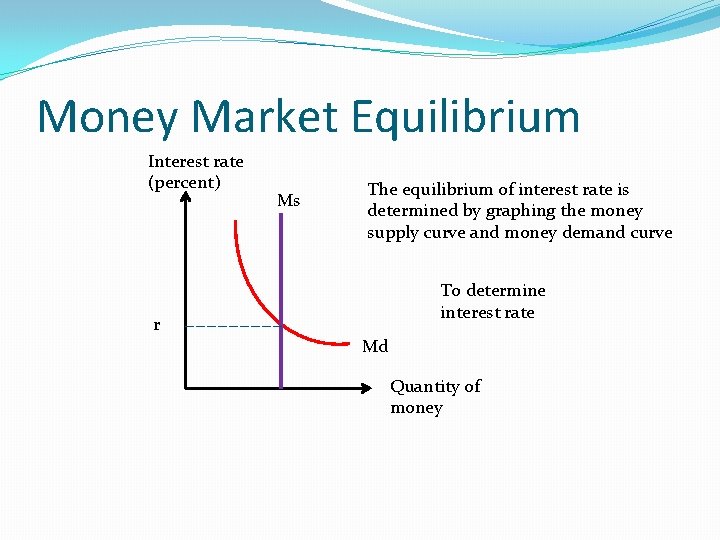
Money Market Equilibrium Interest rate (percent) Ms The equilibrium of interest rate is determined by graphing the money supply curve and money demand curve To determine interest rate r Md Quantity of money
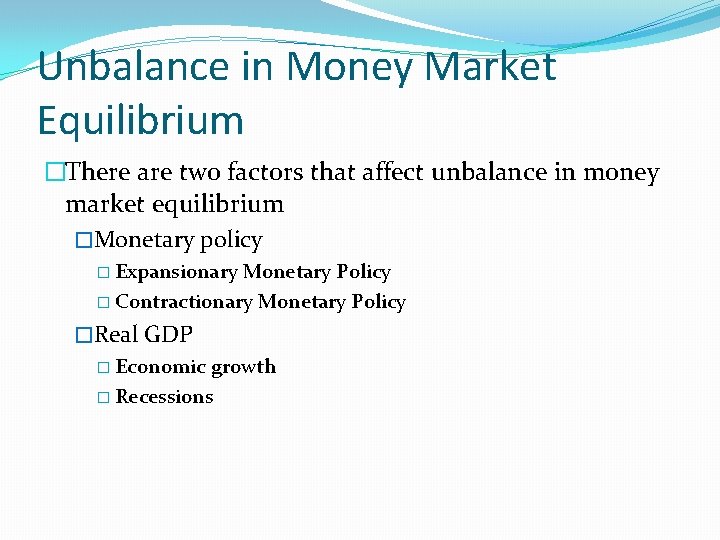
Unbalance in Money Market Equilibrium �There are two factors that affect unbalance in money market equilibrium �Monetary policy � Expansionary Monetary Policy � Contractionary Monetary Policy �Real GDP � Economic growth � Recessions
Unbalance in Money Market Equilibrium �Monetary Policy �Expansionary Monetary Policy - leads to increase in money supply. Therefore, the money supply curve shift to the right �Contractionary Monetary Policy – leads to decrease in money supply. Therefore, the money supply curve shift to the left
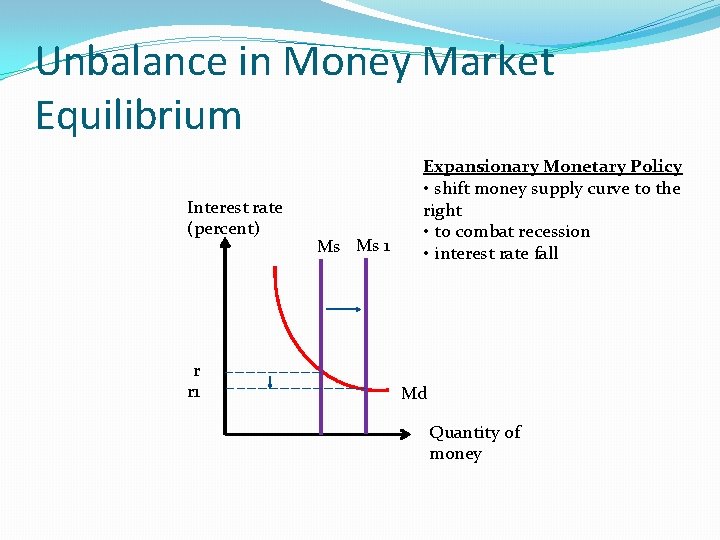
Unbalance in Money Market Equilibrium Interest rate (percent) r r 1 Ms Ms 1 Expansionary Monetary Policy • shift money supply curve to the right • to combat recession • interest rate fall Md Quantity of money
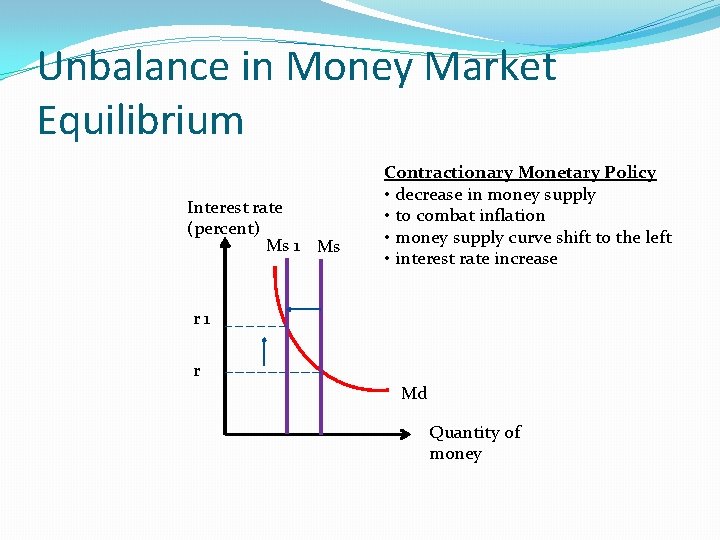
Unbalance in Money Market Equilibrium Interest rate (percent) Ms 1 Ms Contractionary Monetary Policy • decrease in money supply • to combat inflation • money supply curve shift to the left • interest rate increase r 1 r Md Quantity of money
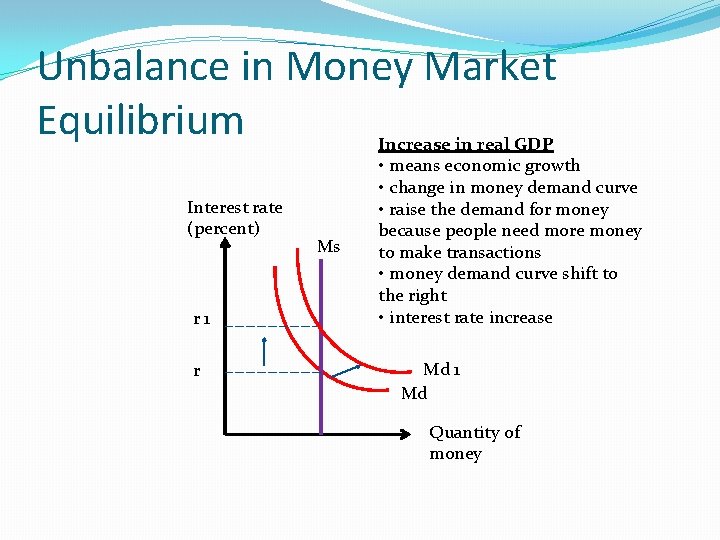
Unbalance in Money Market Equilibrium Interest rate (percent) r 1 r Ms Increase in real GDP • means economic growth • change in money demand curve • raise the demand for money because people need more money to make transactions • money demand curve shift to the right • interest rate increase Md 1 Md Quantity of money
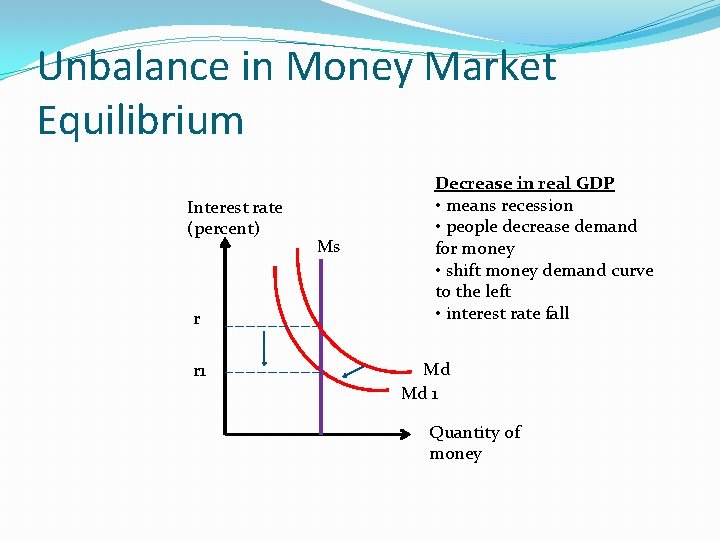
Unbalance in Money Market Equilibrium Interest rate (percent) r r 1 Ms Decrease in real GDP • means recession • people decrease demand for money • shift money demand curve to the left • interest rate fall Md Md 1 Quantity of money
Tools of Monetary Policy Open Market Operation (OMO) Reserve Requirement Ratio (r. r) Discount Rate (d. r)
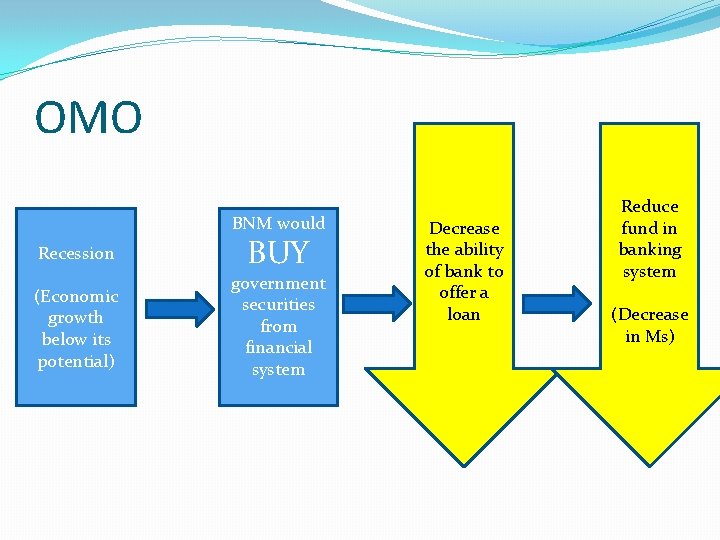
How it’s work �Central Bank (BNM) will used either these THREE tools in order to withdraw/inject the fund (cash) into the banking system �Would be influence money supply in the economy �During inflation, BNM used contractionary policy (reduce Ms) �During recession, BNM used expansionary policy (increase Ms)
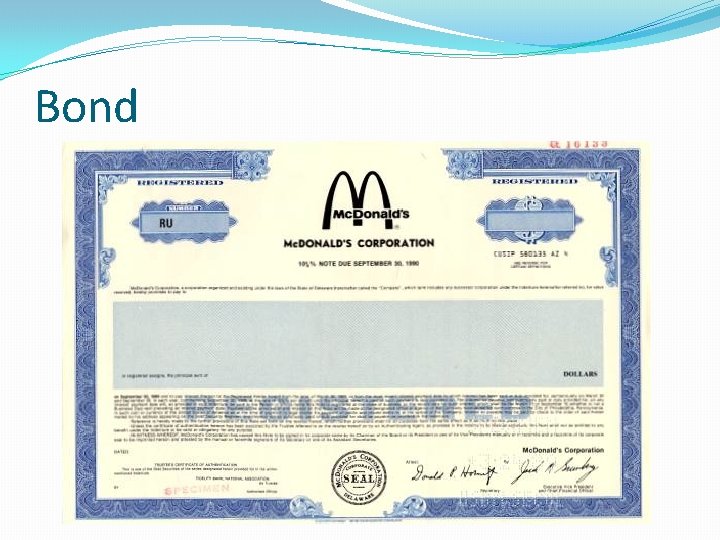
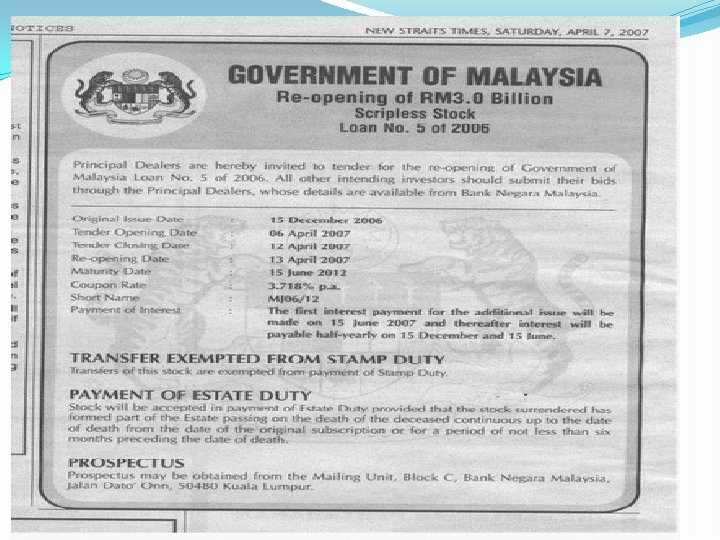
What is OMO? �Open market operation �Purchasing & selling of Malaysian Government securities in financial market to influence the size of bank deposits �Government has authorized the BNM to buy and sell government securities �Who is buy/sell this? ---- BNM & banking system �Inflation ---- BNM buys the securities �Recession ------- BNM sells the securities
Bond
OMO BNM would Recession (Economic growth below its potential) BUY government securities from financial system Decrease the ability of bank to offer a loan Reduce fund in banking system (Decrease in Ms)
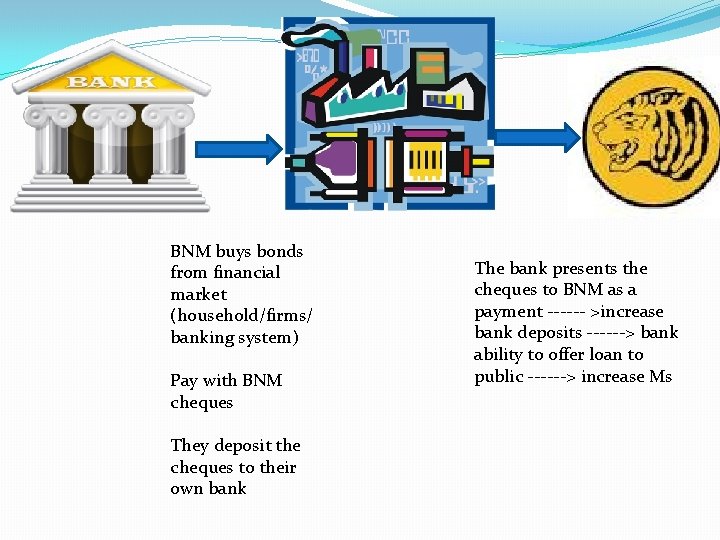
BNM buys bonds from financial market (household/firms/ banking system) Pay with BNM cheques They deposit the cheques to their own bank The bank presents the cheques to BNM as a payment ------ >increase bank deposits ------> bank ability to offer loan to public ------> increase Ms
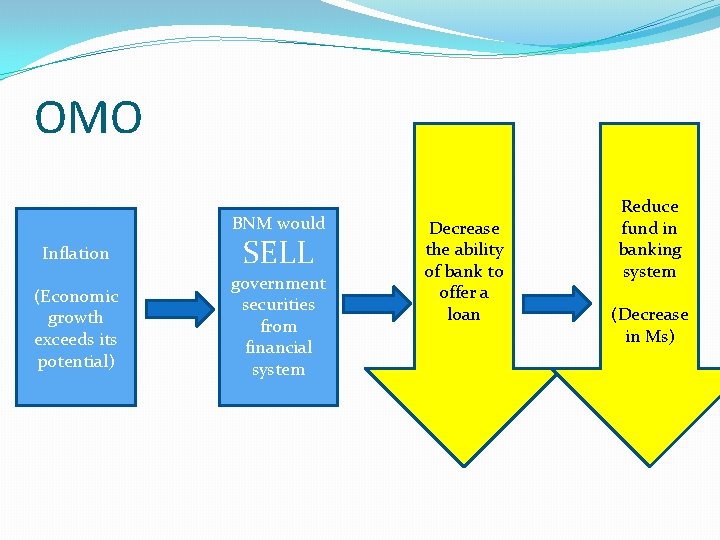
OMO BNM would Inflation (Economic growth exceeds its potential) SELL government securities from financial system Decrease the ability of bank to offer a loan Reduce fund in banking system (Decrease in Ms)
OMO �In Malaysia, OMO is not effective as the public holds very little government securities (less than 3%) because low rate of interest �the largest buyers are the insurance companies
Reserve Requirement Ratio (RR) �Regulations on the minimum amount of reserves that banks must hold against deposits �BNM has the power by law to alter the required minimum reserve ratio �Also known as Cash Reserve Ratio (CRR) �Banking institutions (commercial banks, investment banks and Islamic banks) are required to maintain balances in the reserve requirement account base on the reserve requirement rate �reserve requirements influence how much money the banking system can create with each RM of reserves
Decrease (RR) �For example, if the reserve ratio in the Malaysia is determined by the BNM to be 11%, this means all banks must have 11% of their depositors' money on reserve in the bank. �So, if a bank has deposits of RM 100, 000 it is required to have RM 11, 000 on reserve account in BNM �Therefore, the balance RM 89, 000 will hold by bank �Able to give a loan to public �Increase Ms -------> during recession
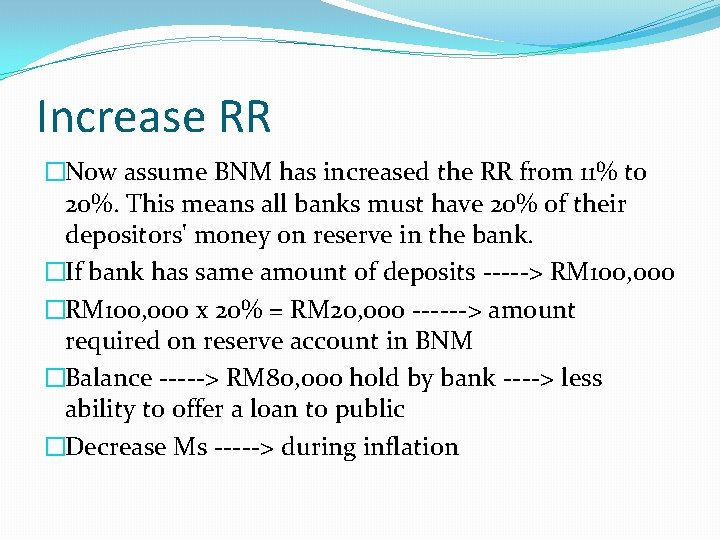
Increase RR �Now assume BNM has increased the RR from 11% to 20%. This means all banks must have 20% of their depositors' money on reserve in the bank. �If bank has same amount of deposits -----> RM 100, 000 �RM 100, 000 x 20% = RM 20, 000 ------> amount required on reserve account in BNM �Balance -----> RM 80, 000 hold by bank ----> less ability to offer a loan to public �Decrease Ms -----> during inflation
Discount Rate �Banks may borrow from BNM �The interest rate on the loans that BNM makes to banks is called the discount rate �A bank borrows from BNM when it has too few reserves to meet reserve requirements �This might occur because the bank made too many loans �BNM can alter the money supply by changing the discount rate
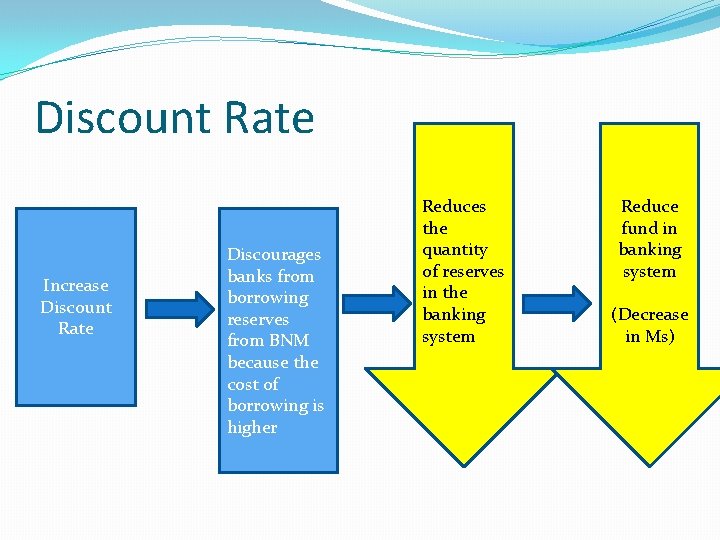
Discount Rate Increase Discount Rate Discourages banks from borrowing reserves from BNM because the cost of borrowing is higher Reduces the quantity of reserves in the banking system Reduce fund in banking system (Decrease in Ms)
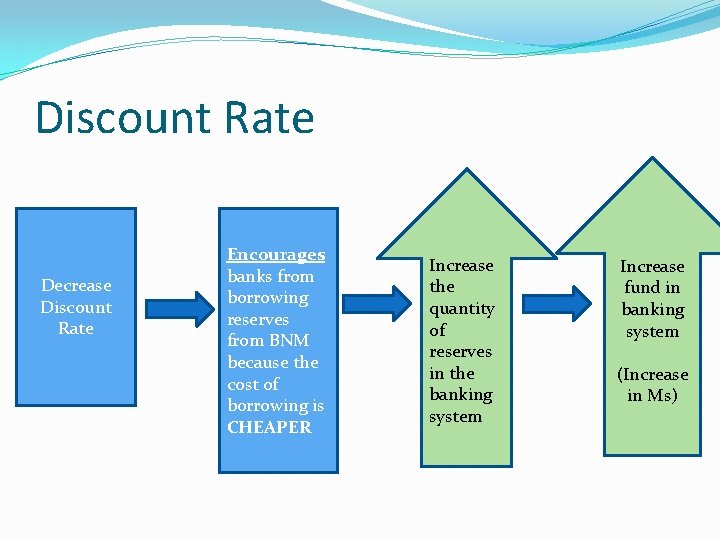
Discount Rate Decrease Discount Rate Encourages banks from borrowing reserves from BNM because the cost of borrowing is CHEAPER Increase the quantity of reserves in the banking system Increase fund in banking system (Increase in Ms)
The Role of Central Bank Definition The functions The implementation of Monetary Policy
The Role of Central Bank �The Central bank is an important financial institution in every country �It plays an active role in implementing government’s economic policy �Also called as reserve bank or monetary authority �It’s role consist: �Issues the currency �Provide the nation’s money supply �Controlling interest rates �Lender of the last resort
The Functions of Central Bank �Sole right of note issue: The Central Bank has the monopoly note issues governed by certain regulation which is enforced by the state �Banker to the state: The Central Bank acts as a banker and financial adviser to the government that keeps government principal account, manages national debt and holds the cash balances of government �Banker’s bank: it keeps cash reserve to the commercial banks and they can keeps the deposits with the Central Bank
The Functions of Central Bank �Lender to the last resort: The Central Bank helps the member banks in times of crisis �To promote monetary stability and financial structure: in terms of price stability, eradicate poverty and restructuring society �A holder of the country’s stock of gold and foreign currency reserves
The Role of Commercial Banks Definitions The functions Credit creation
Commercial Banks �Plays an important role in today’s financial framework �Is an institution that is owned by the private sector and is profit-making institution �Earning income from providing banking services (opening current and savings account, safe deposit boxes, etc) �Local commercial banks – Affin Bank Berhad, Am. Bank (M) Berhad, Malayan Banking Berhad �Foreign commercial banks – Citibank Berhad, HSBC Bank (M) Berhad
Functions �Accepting deposits from customers – savings deposit and fixed deposits �Provide loans and advances – housing loans, car loans, education loans, personal loans to the public and earn profits by imposing an interest �Provide other facilities and services – foreign exchange transactions, bank draft, cheques, traveler’s cheque, purchase and sell stock exchange securities, advice on financial matters, ATM machines, credit cards, etc
Credit creation �What is credit creation? �The money that commercial banks supply is called credit creation �The process started from the depositors deposit to the bank �Then bank use the deposit to give loan to the public �But bank cannot lend the entire deposits because they need to fulfill required reserves as stated by Central Bank �The process continues and lead to increase in money supply
- Slides: 78