
Payroll Accounting 2013 Bernard J Bieg and Judith

Payroll Accounting 2013 Bernard J. Bieg and Judith A. Toland CHAPTER 6 ANALYZING & JOURNALIZING PAYROLL TRANSACTIONS Developed by Lisa Swallow, CPA CMA MS
Learning Objectives • Record payrolls in appropriate records • Understand various deductions taken from • • employees’ gross pay Journalize entries to record payroll and payroll taxes Post to general ledger Explain recording of payroll tax deposits Understand need for end-of-period adjustments
Accounting for Payroll Transactions Payroll requires entering data (in order) in the following places Payroll Register • Employee Earnings Records • General Journal • Journalize gross wages and withholdings • Journalize payroll taxes and workers’ compensation • Journalize period-end accruals • • Post to General Ledger LO-1
Recording Gross Payroll & Withholdings Enter information into accounting system Gross payroll is debited • Each withholding tax is credited to a liability • All other payroll deductions are liabilities as well • LO-1
Methods of Paying Wages & Salaries • Check Sometimes separate payroll account maintained to make bank reconciliation process easier • • Electronic payment methods • EFTS (electronic funds transfer system) • • Electronic records created showing bank, account # and net pay Pay cards allow employer to deposit payroll into prepaid card Card utilized like debit or credit card • Many employees who do not have bank accounts use these • • Electronic paystubs alleviate need for paper paystubs • Final pay • Many states set time limit between termination and final wage pay out (depends upon whether worker left voluntarily) • CA and MI require immediate payment if employee is fired LO-3

Journal Entries to Record Payroll • Journal Entry #1 - Record gross wages, withholdings and net pay • Journal Entry #2 - Record employer’s payroll tax expense These two journal entries are always the same in format. You must make both of them every time you issue any paycheck (even if cutting a check for one day’s wages, for example). LO-3

Journal Entry #1 • Debit Wage Expense for gross payroll • Credit each withholding account - they are all liabilities • Credit cash (or wages payable) for net payroll Journal entry #1 Wage Expense 1, 845. 00 FICA Taxes Payable - OASDI 77. 49 FICA Taxes Payable - HI 26. 75 Employees FIT Payable 174. 00 SIT Payable Group Insurance Payments W/H Cash 50. 00 191. 00 1, 325. 76 LO-3
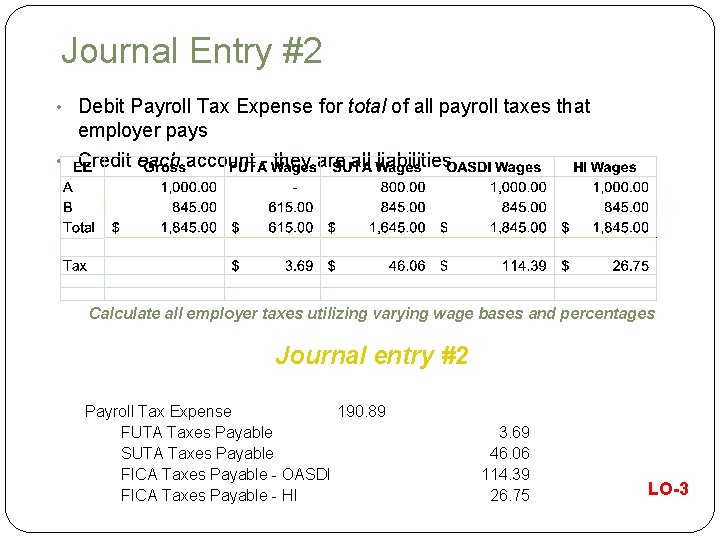
Journal Entry #2 • Debit Payroll Tax Expense for total of all payroll taxes that employer pays • Credit each account - they are all liabilities Calculate all employer taxes utilizing varying wage bases and percentages Journal entry #2 Payroll Tax Expense 190. 89 FUTA Taxes Payable SUTA Taxes Payable FICA Taxes Payable - OASDI FICA Taxes Payable - HI 3. 69 46. 06 114. 39 26. 75 LO-3
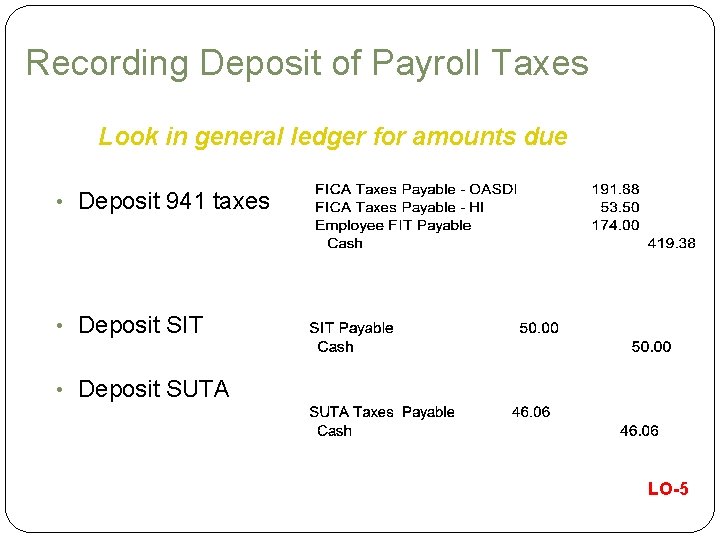
Recording Deposit of Payroll Taxes Look in general ledger for amounts due • Deposit 941 taxes • Deposit SIT • Deposit SUTA LO-5
Workers’ Compensation Insurance • Workers’ compensation is an expense for the employer, who is required to purchase insurance to protect employees against work related injuries/disabilities • Laws differ by state • Premiums often calculated based on employment classification – stated in terms of $100 per payroll • Pay premiums in advance based on projected wages • Then, at year-end, report actual wages and pay additional premium or may receive credit towards LO-5 next year
- Slides: 10