
Pavlov 1927 CLASSICAL CONDITIONING AND HIS FAMOUS EXPERIMENT
- Slides: 11
Pavlov (1927) CLASSICAL CONDITIONING AND HIS FAMOUS EXPERIMENT ON SALIVATION IN DOGS
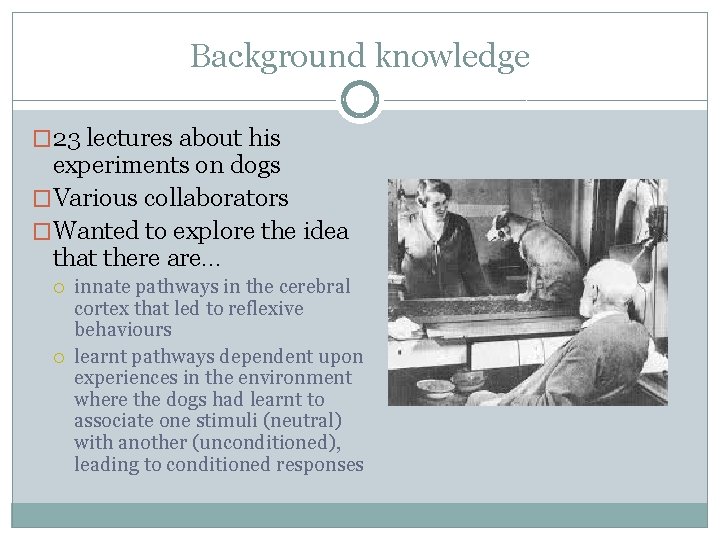
Background knowledge � 23 lectures about his experiments on dogs �Various collaborators �Wanted to explore the idea that there are… innate pathways in the cerebral cortex that led to reflexive behaviours learnt pathways dependent upon experiences in the environment where the dogs had learnt to associate one stimuli (neutral) with another (unconditioned), leading to conditioned responses
Background cont’d �He notes that different dogs respond in different ways (individual differences) and that if a dog is not alert, it may not be conditioned at all or it could take longer than usual. �He explains his use of the scientific method and how important this was in controlling other stimuli that could affect the process
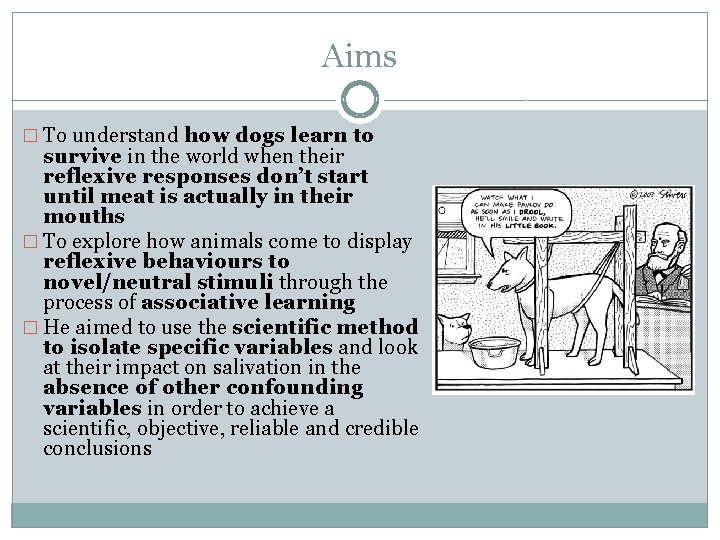
Aims � To understand how dogs learn to survive in the world when their reflexive responses don’t start until meat is actually in their mouths � To explore how animals come to display reflexive behaviours to novel/neutral stimuli through the process of associative learning � He aimed to use the scientific method to isolate specific variables and look at their impact on salivation in the absence of other confounding variables in order to achieve a scientific, objective, reliable and credible conclusions
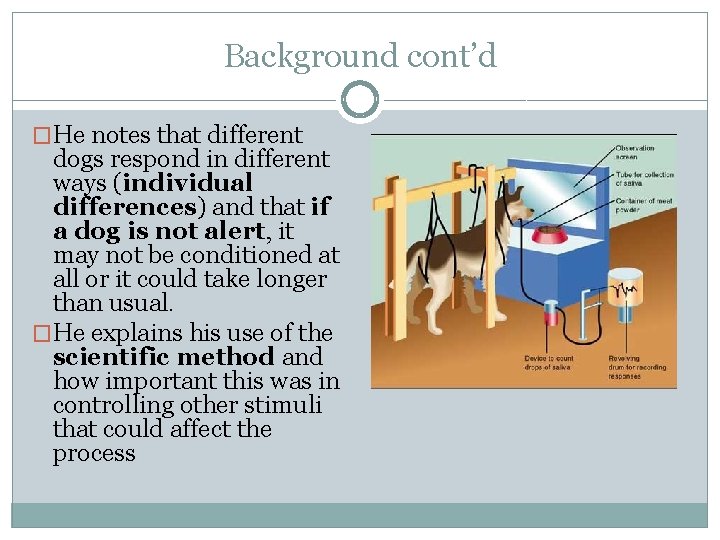
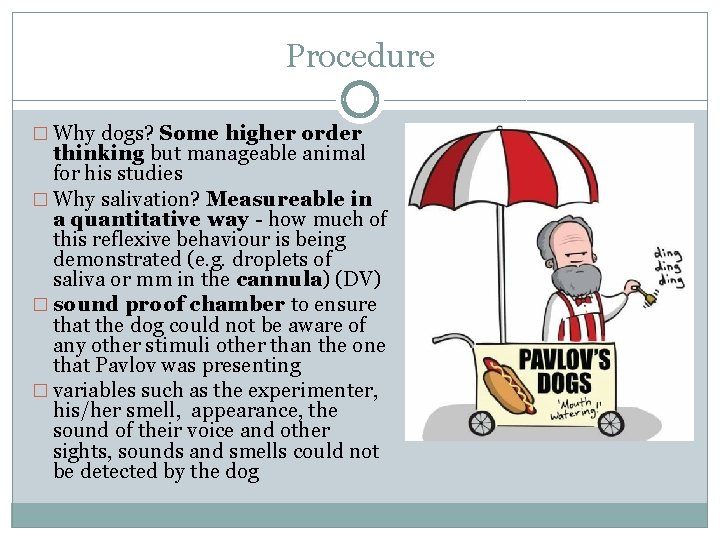
Procedure � Why dogs? Some higher order thinking but manageable animal for his studies � Why salivation? Measureable in a quantitative way - how much of this reflexive behaviour is being demonstrated (e. g. droplets of saliva or mm in the cannula) (DV) � sound proof chamber to ensure that the dog could not be aware of any other stimuli other than the one that Pavlov was presenting � variables such as the experimenter, his/her smell, appearance, the sound of their voice and other sights, sounds and smells could not be detected by the dog
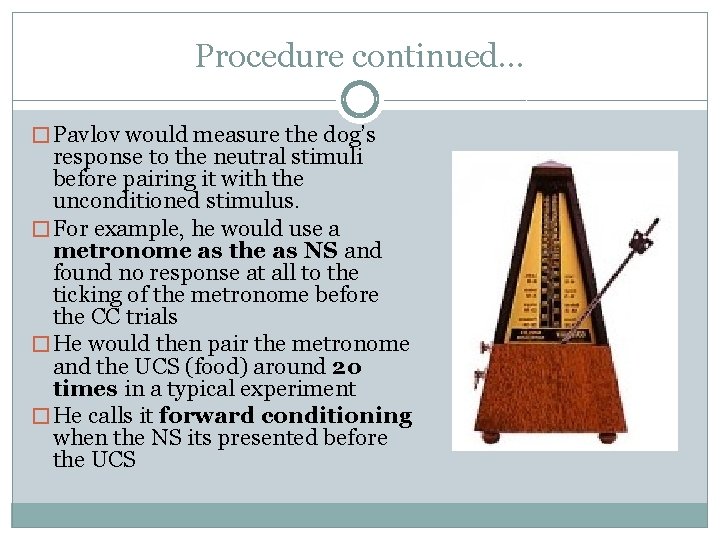
Procedure continued… � Pavlov would measure the dog’s response to the neutral stimuli before pairing it with the unconditioned stimulus. � For example, he would use a metronome as the as NS and found no response at all to the ticking of the metronome before the CC trials � He would then pair the metronome and the UCS (food) around 2 o times in a typical experiment � He calls it forward conditioning when the NS its presented before the UCS
The order to the NS and UCS �Pavlov had also used a buzzer of increasing volume in some of his studies �He showed that if you give the food (UCS) 5 -10 seconds before the buzzer (NS) CC does not occur, e. g. the dog will not salivate to the buzzer alone �He then showed that if the buzzer occurred before the meat, CC did occur.
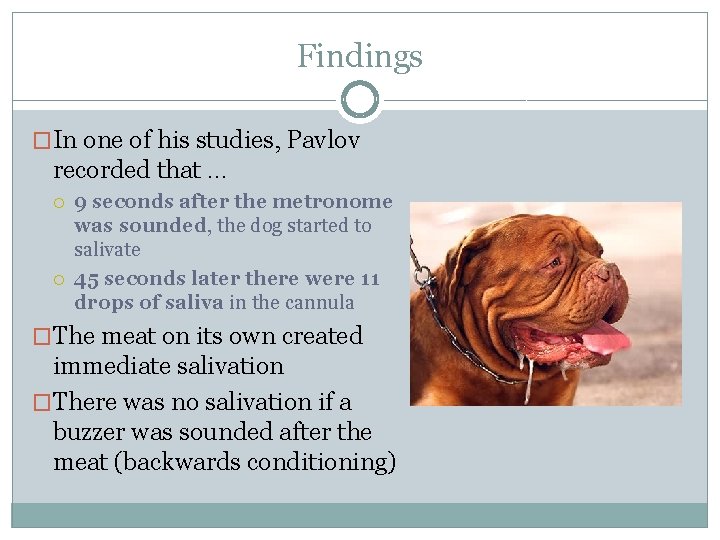
Findings �In one of his studies, Pavlov recorded that … 9 seconds after the metronome was sounded, the dog started to salivate 45 seconds later there were 11 drops of saliva in the cannula �The meat on its own created immediate salivation �There was no salivation if a buzzer was sounded after the meat (backwards conditioning)
Findings cont’d �The buzzer paired just once with meat seemed to also elicit salivation! �Pavlov notes that dogs must be alert and with no other distracting stimuli for the association to be learnt �Further findings; you could also describe the findings relating to extinction, spontaneous recovery and higher order conditioning
Conclusions �Pavlov refers to the process of “signalisation” in the brain, a word he uses to describe the link that has been made that signals the dog to start salivating when it hears the metronome/bell/buzzer �He says the process is highly sensitive to interference from external stimuli �and that dogs shows individual differences in terms of how they behave
Issues and Debates � Practical issues in the design and implementation of research � Psychology as a science � Development over time - link to the recent work of Karekan et al (2012) using fm. RI scanning � Practical and ethical issues relating to using animals in experiments � Reductionism � Nature and nurture � Social control (conversion therapy was based on this idea) � Use of psych knowledge in society; aversion therapy for alcoholism, behavioural therapy for phobias