
Pavements Concrete Concrete Rigid pavement Used where strength
- Slides: 17
Pavements
Concrete • Concrete – Rigid pavement • Used where strength is an issue • Runways, interstates and major roads – Continuous reinforcing • Must have a good base and joints and cracks must be sealed • Long life – 50 years • Major rehab is a major problem
Concrete • Forming and pouring – Old way – set forms and have equipment ride the forms • Paving train – mix, place, finish, cure all in one train of equip • Standard forms 10 ft long 8 – 12 inches deep – New Way • Slip form, Use 0 slump concrete • Machine pulls form with it slab comes out finished • F 8 -1, 8 -2
Concrete • Roller Compacted Concrete – Dam construction, landfills – 0 slump concrete is placed on a site and compacted w/vibratory roller – Higher strength, low air entrainment
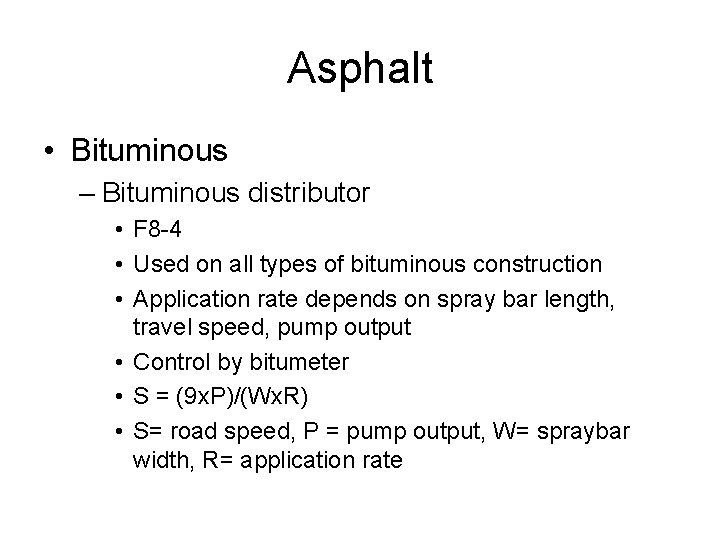
Asphalt • Bituminous – Bituminous distributor • F 8 -4 • Used on all types of bituminous construction • Application rate depends on spray bar length, travel speed, pump output • Control by bitumeter • S = (9 x. P)/(Wx. R) • S= road speed, P = pump output, W= spraybar width, R= application rate
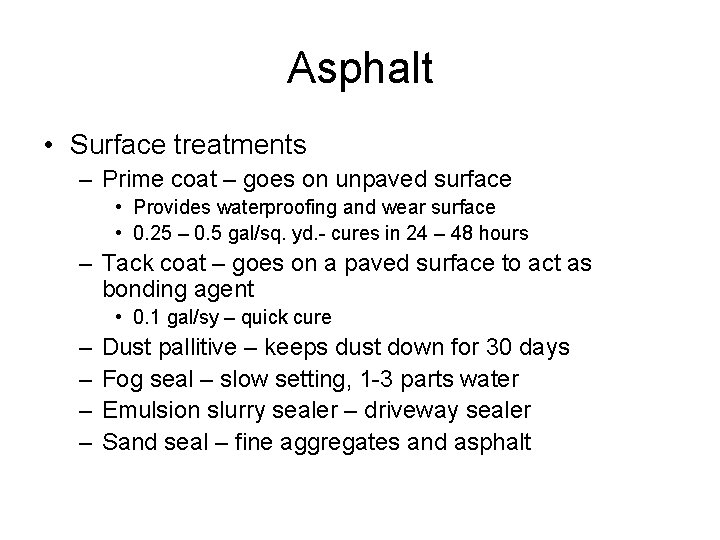
Asphalt • Surface treatments – Prime coat – goes on unpaved surface • Provides waterproofing and wear surface • 0. 25 – 0. 5 gal/sq. yd. - cures in 24 – 48 hours – Tack coat – goes on a paved surface to act as bonding agent • 0. 1 gal/sy – quick cure – – Dust pallitive – keeps dust down for 30 days Fog seal – slow setting, 1 -3 parts water Emulsion slurry sealer – driveway sealer Sand seal – fine aggregates and asphalt
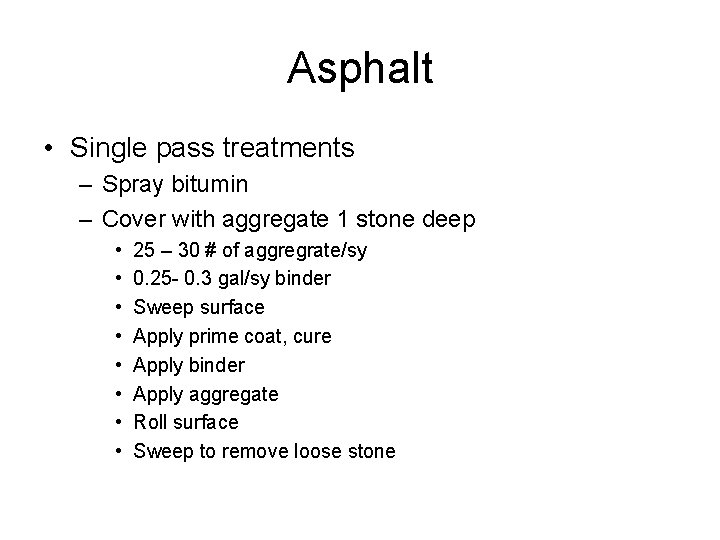
Asphalt • Single pass treatments – Spray bitumin – Cover with aggregate 1 stone deep • • 25 – 30 # of aggregrate/sy 0. 25 - 0. 3 gal/sy binder Sweep surface Apply prime coat, cure Apply binder Apply aggregate Roll surface Sweep to remove loose stone
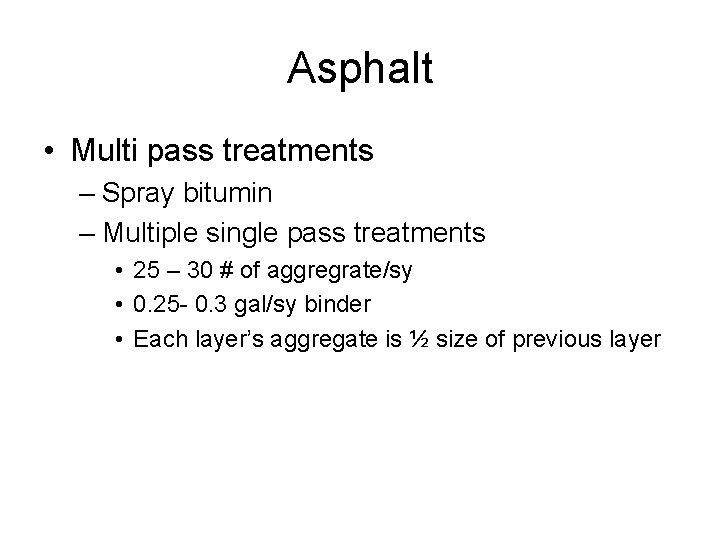
Asphalt • Multi pass treatments – Spray bitumin – Multiple single pass treatments • 25 – 30 # of aggregrate/sy • 0. 25 - 0. 3 gal/sy binder • Each layer’s aggregate is ½ size of previous layer
Asphalt • Asphalt Paving – Hot mix – high type pavements – Cold mix – patching – Penetration macadam – old way of paving • Place and compact 4” of coarse aggregate • Cover with asphalt binder and a smaller aggregate (key aggregate) and rolled
Asphalt • Road Mix – Mixed on roadway – Grader, rotary mixer, travel plants – Hard to get a consistent result
Asphalt • Hot Mix (HMA) –highest form of asphalt pavement – Can be used as soon as compacted and cooled to ambient temp – Flexible, frost resistant • Cold mix – like hot mix – Advantages – can haul long distances, stockpile, – Disadvantages – slow curing, low initial stability, difficult to compact in cold weather
Asphalt • Hot mix paving operations – Delivery of asphalt mix, spreading and compaction – Spreader couples with the delivery truck and pushes it along as asphalt is unloaded – Spreader spreads and compacts – Spreader consists of pusher unit and screed unit – Spreaders control depth and width of pavement using laser, stringline, shoe to control screed elevation
Asphalt • Towed pavers – smaller jobs – usually driveways – Max width 10 ft – Large paver • To lay a 3” deep, 12 ft wide, strip at 50 ft/min need 600 tons/hr of asphalt
Asphalt • Compacting immediately after spreading – Breakdown rolling – provides initial compaction - static steel rollers with drive wheel forward – Intermediate rolling – pneumatic rollers – better surface sealing – Finish rolling – tandem steel rollers – final compaction
Asphalt • Superpave – Developed due to asphalt concrete failures • Uses lower asphalt content , crushed stone and optimizes for local conditions- NYS thruway uses 7 different mixes
Repair and Rehab • Highways – Resurface, restoration, rehabilitation and reconstruction – 4 Rs – Resurfacing surface treatments, overlays, – Restoration and Rehab – return highway to acceptable condition • Planning or milling top layer , fixing lower level, repave – Reconstruction – complete redo of roadway
Repair and Rehab • Recycling pavement – Concrete is broken up and sent to a recycling plant which removes steel and crushes concrete into aggregate – Asphalt is milled and recycled in an asphalt plant F- 8 -10&8 -11 – HMWK Ch 7 # 2, 3, 9 Ch 8 # 5, 7, 9