
Pavement Vehicle Interactions Does it Matter for Virginia

![Calibration/Validation | Asphalt Lit. Data DISSIPATED ENERGY [MJ/km] 1, 4 c= 100 km/h Calibration](https://slidetodoc.com/presentation_image_h2/011cbc638259ef9bcea84eeb84c292e1/image-9.jpg "Calibration/Validation | Asphalt Lit. Data DISSIPATED ENERGY [MJ/km] 1, 4 c= 100 km/h Calibration")
![New Feature: Temperature and Speed Dependence DISSIPATED ENERGY [MJ/km] 0, 35 0, 3 0,](https://slidetodoc.com/presentation_image_h2/011cbc638259ef9bcea84eeb84c292e1/image-10.jpg "New Feature: Temperature and Speed Dependence DISSIPATED ENERGY [MJ/km] 0, 35 0, 3 0,")




- Slides: 49
Pavement Vehicle Interactions – Does it Matter for Virginia? Franz-Josef Ulm, Mehdi Akbarian, Arghavan Louhghalam ACPA. Virginia Concrete Conference March 6, 2014 With the support of the VDOT Team – Thank YOU!
Motivation: Carbon Management Pavement design and performance: – Fuel saving – Cost saving – GHG reduction • Strategy for reducing air pollution! non profit support group for the Route 29 Bypass Slide 2
OUTLINE • • This is not about Concrete vs. Asphalt, this is about unleashing opportunities for Greenhouse Gas savings Pavement-Vehicle Interaction: • – Roughness/ Vehicle Dissipation – Deflection/ Pavement Dissipation Data Application: • Carbon Management: how to move forward – US Network – VA Network 3 Slide 3
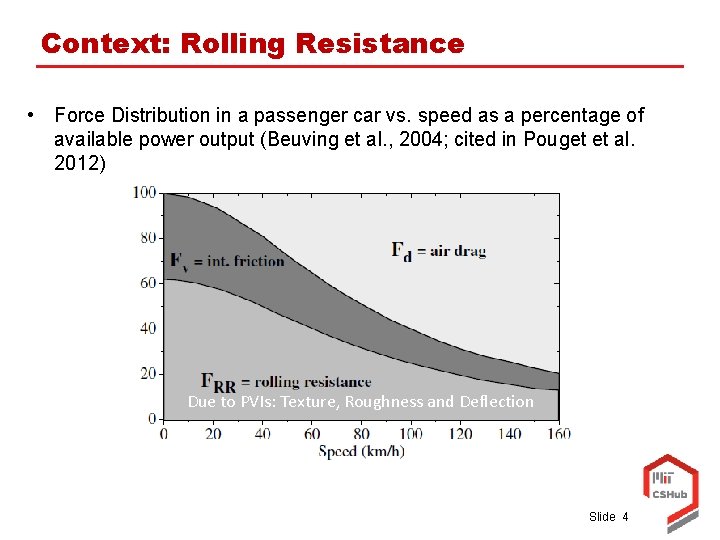
Context: Rolling Resistance • Force Distribution in a passenger car vs. speed as a percentage of available power output (Beuving et al. , 2004; cited in Pouget et al. 2012) Due to PVIs: Texture, Roughness and Deflection Slide 4
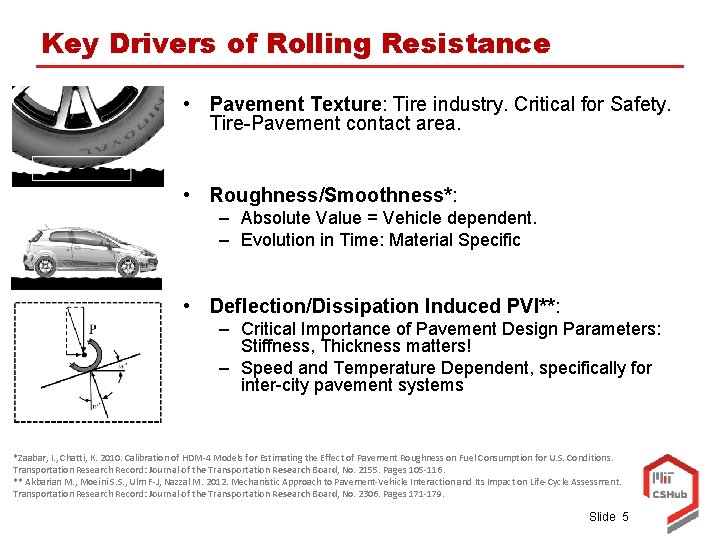
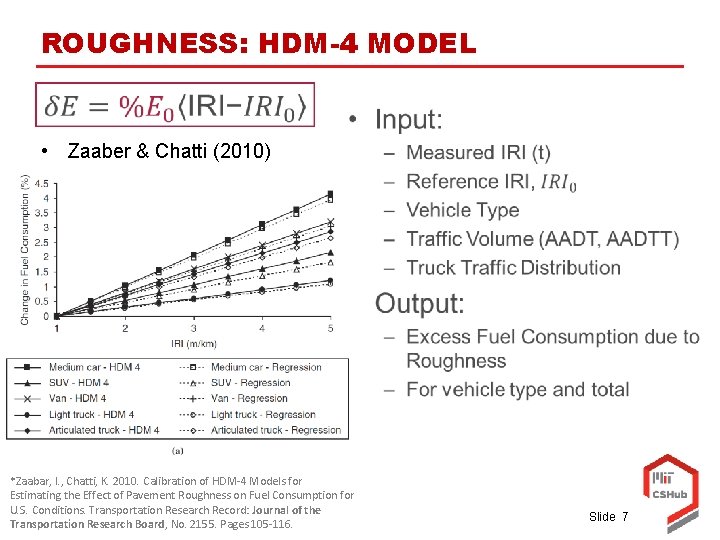
Key Drivers of Rolling Resistance • Pavement Texture: Tire industry. Critical for Safety. Tire-Pavement contact area. • Roughness/Smoothness*: – Absolute Value = Vehicle dependent. – Evolution in Time: Material Specific • Deflection/Dissipation Induced PVI**: – Critical Importance of Pavement Design Parameters: Stiffness, Thickness matters! – Speed and Temperature Dependent, specifically for inter-city pavement systems *Zaabar, I. , Chatti, K. 2010. Calibration of HDM-4 Models for Estimating the Effect of Pavement Roughness on Fuel Consumption for U. S. Conditions. Transportation Research Record: Journal of the Transportation Research Board, No. 2155. Pages 105 -116. ** Akbarian M. , Moeini S. S. , Ulm F-J, Nazzal M. 2012. Mechanistic Approach to Pavement-Vehicle Interaction and Its Impact on Life-Cycle Assessment. Transportation Research Record: Journal of the Transportation Research Board, No. 2306. Pages 171 -179. Slide 5
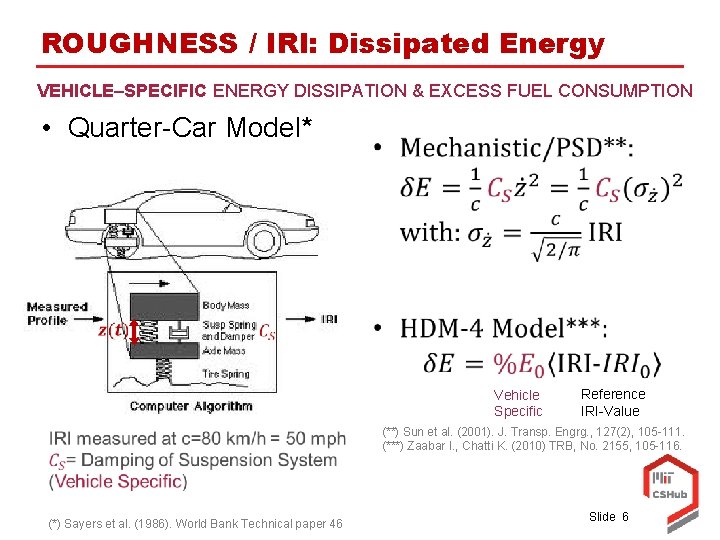
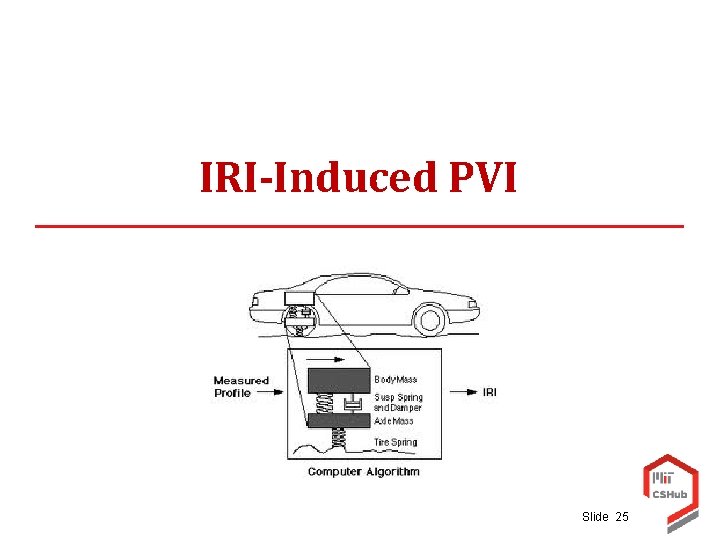
ROUGHNESS / IRI: Dissipated Energy VEHICLE–SPECIFIC ENERGY DISSIPATION & EXCESS FUEL CONSUMPTION • Quarter-Car Model* • Vehicle Specific Reference IRI-Value (**) Sun et al. (2001). J. Transp. Engrg. , 127(2), 105 -111. (***) Zaabar I. , Chatti K. (2010) TRB, No. 2155, 105 -116. (*) Sayers et al. (1986). World Bank Technical paper 46 Slide 6
ROUGHNESS: HDM-4 MODEL • • Zaaber & Chatti (2010) *Zaabar, I. , Chatti, K. 2010. Calibration of HDM-4 Models for Estimating the Effect of Pavement Roughness on Fuel Consumption for U. S. Conditions. Transportation Research Record: Journal of the Transportation Research Board, No. 2155. Pages 105 -116. Slide 7
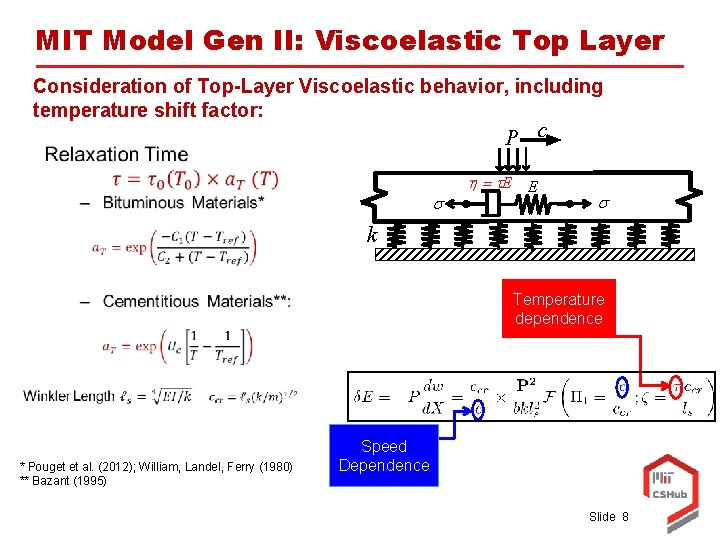
MIT Model Gen II: Viscoelastic Top Layer Consideration of Top-Layer Viscoelastic behavior, including temperature shift factor: P c s h = t. E E s k Temperature dependence * Pouget et al. (2012); William, Landel, Ferry (1980) ** Bazant (1995) Speed Dependence Slide 8
Calibration/Validation | Asphalt Lit. Data DISSIPATED ENERGY [MJ/km] 1, 4 c= 100 km/h Calibration c=100 km/h 1, 2 • Model-Based Simulations 1 0, 8 Pouget et al. (2012) 0, 6 MIT Model 0, 4 0, 2 0 0 1, 6 80 c= 50 km/h Validation c=50 km/h 1, 4 DISSIPATED ENERGY [MJ/km] 20 40 60 TEMPERATURE [Deg. C] 1, 2 1 0, 8 Pouget et al. (2012) 0, 6 MIT Model 0, 4 0, 2 0 0 20 40 60 TEMPERATURE [Deg. C] 80 Slide 9
New Feature: Temperature and Speed Dependence DISSIPATED ENERGY [MJ/km] 0, 35 0, 3 0, 25 0, 2 0, 15 68 Deg. F 0, 1 Gen I 50 Deg. F 0, 05 0 0 50 100 SPEED [km/h] (Example taken from Pouget et al. (2012) Slide 10
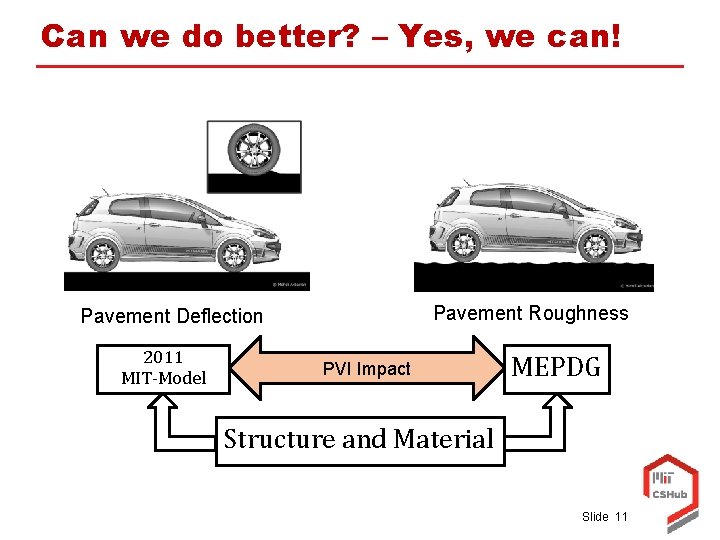
Can we do better? – Yes, we can! Pavement Roughness Pavement Deflection 2011 MIT-Model PVI Impact MEPDG Structure and Material Slide 11
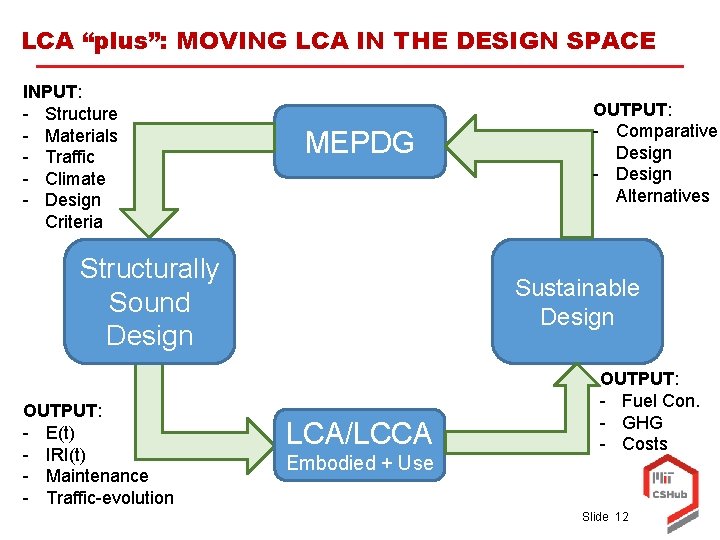
LCA “plus”: MOVING LCA IN THE DESIGN SPACE INPUT: - Structure - Materials - Traffic - Climate - Design Criteria MEPDG Structurally Sound Design OUTPUT: - E(t) - IRI(t) - Maintenance - Traffic-evolution OUTPUT: - Comparative Design - Design Alternatives Sustainable Design LCA/LCCA Embodied + Use OUTPUT: - Fuel Con. - GHG - Costs Slide 12
Network Application US and VA Slide 13
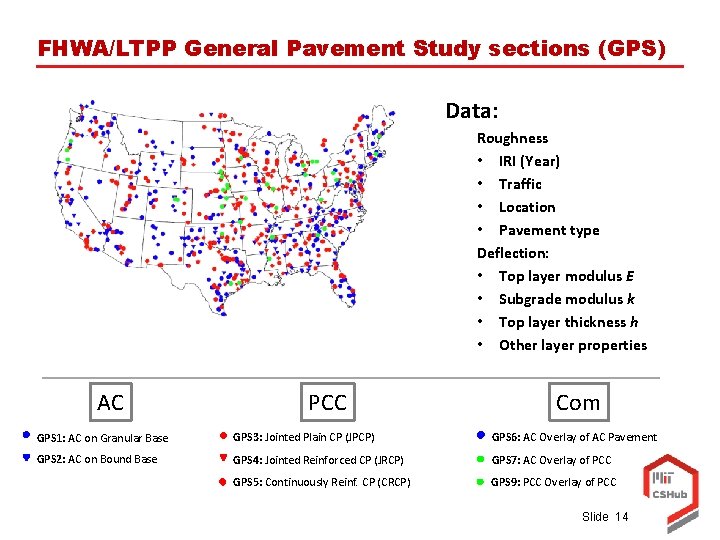
FHWA/LTPP General Pavement Study sections (GPS) Data: Roughness • IRI (Year) • Traffic • Location • Pavement type Deflection: • Top layer modulus E • Subgrade modulus k • Top layer thickness h • Other layer properties AC PCC Com GPS 1: AC on Granular Base GPS 3: Jointed Plain CP (JPCP) GPS 6: AC Overlay of AC Pavement GPS 2: AC on Bound Base GPS 4: Jointed Reinforced CP (JRCP) GPS 7: AC Overlay of PCC GPS 5: Continuously Reinf. CP (CRCP) GPS 9: PCC Overlay of PCC Slide 14
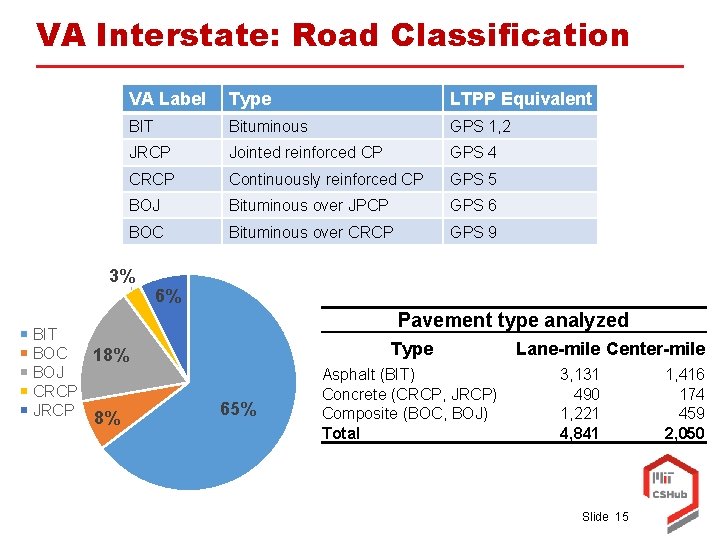
VA Interstate: Road Classification VA Label Type LTPP Equivalent BIT Bituminous GPS 1, 2 JRCP Jointed reinforced CP GPS 4 CRCP Continuously reinforced CP GPS 5 BOJ Bituminous over JPCP GPS 6 BOC Bituminous over CRCP GPS 9 3% BIT BOC 18% BOJ CRCP JRCP 8% 6% Pavement type analyzed Type 65% Asphalt (BIT) Concrete (CRCP, JRCP) Composite (BOC, BOJ) Total Lane-mile Center-mile 3, 131 490 1, 221 4, 841 Slide 15 1, 416 174 459 2, 050
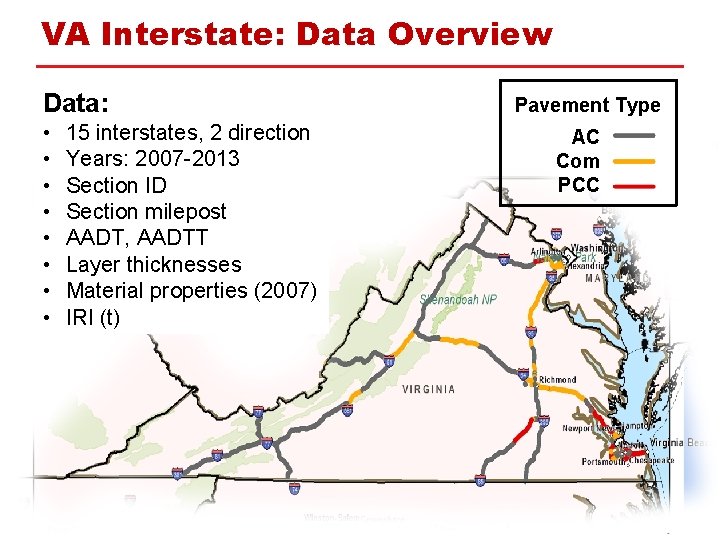
VA Interstate: Data Overview Data: • • 15 interstates, 2 direction Years: 2007 -2013 Section ID Section milepost AADT, AADTT Layer thicknesses Material properties (2007) IRI (t) Pavement Type AC Com PCC Slide 16
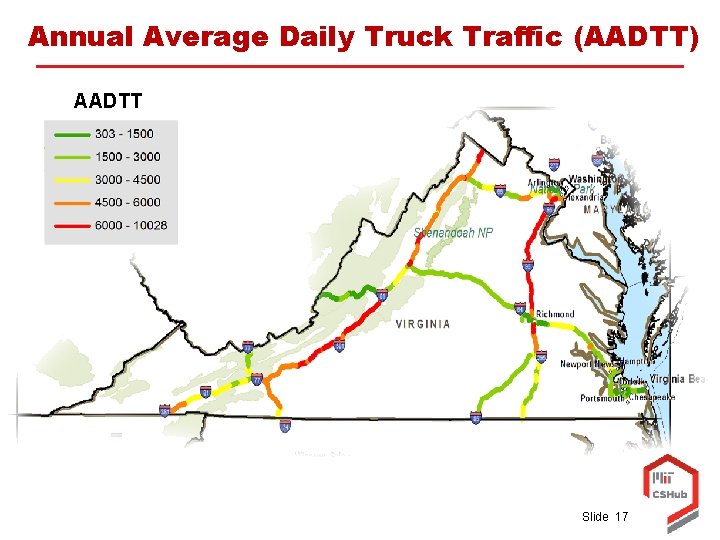
Annual Average Daily Truck Traffic (AADTT) AADTT Slide 17
Deflection -Induced PVI Slide 18
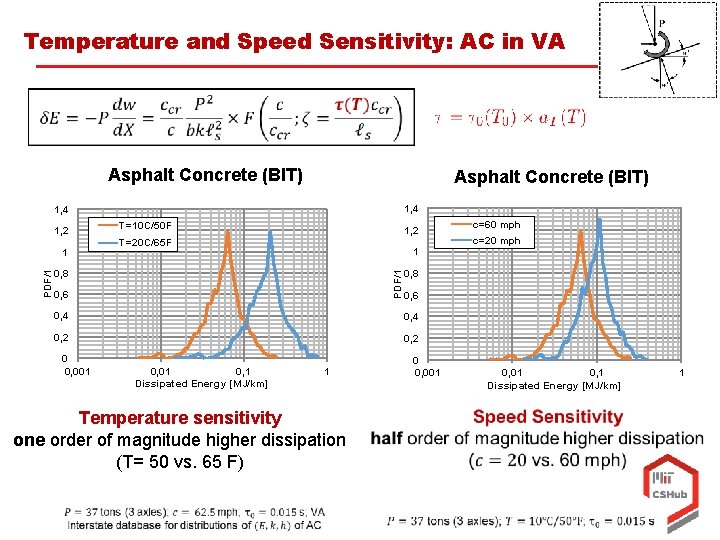
Temperature and Speed Sensitivity: AC in VA Asphalt Concrete (BIT) 1, 4 1, 2 T=20 C/65 F 1 0, 8 PDF/1 1 T=10 C/50 F 0, 6 0, 4 0, 2 0, 01 0, 1 Dissipated Energy [MJ/km] 1 c=20 mph 0, 8 0, 4 0 0, 001 c=60 mph 0 0, 001 0, 1 Dissipated Energy [MJ/km] Temperature sensitivity one order of magnitude higher dissipation (T= 50 vs. 65 F) Slide 19 1
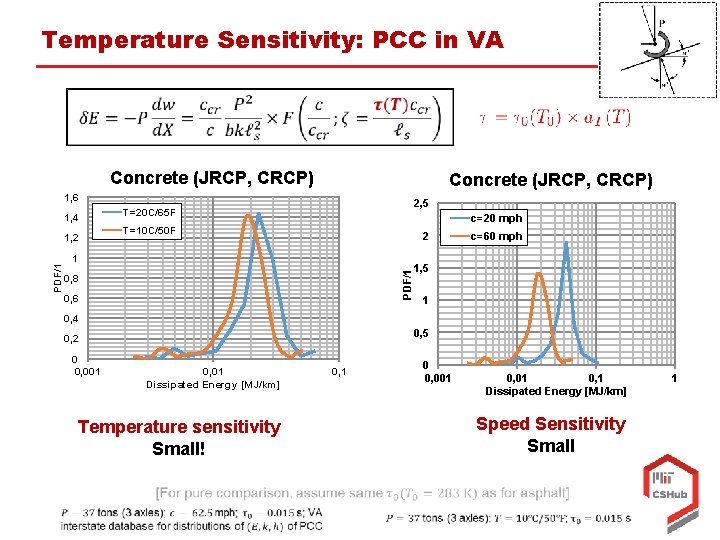
Temperature Sensitivity: PCC in VA Concrete (JRCP, CRCP) 1, 6 1, 4 c=20 mph T=10 C/50 F 1, 2 2 1 PDF/1 2, 5 T=20 C/65 F 0, 8 0, 6 c=60 mph 1, 5 1 0, 4 0, 5 0, 2 0 0, 001 0, 01 Dissipated Energy [MJ/km] Temperature sensitivity Small! 0, 1 0 0, 001 0, 1 Dissipated Energy [MJ/km] Speed Sensitivity Small Slide 20 1
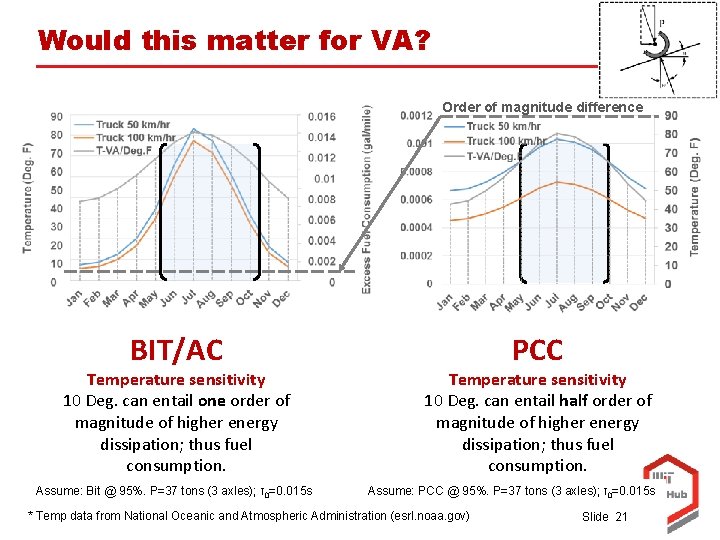
Would this matter for VA? Order of magnitude difference BIT/AC Temperature sensitivity 10 Deg. can entail one order of magnitude of higher energy dissipation; thus fuel consumption. Assume: Bit @ 95%. P=37 tons (3 axles); τ0=0. 015 s PCC Temperature sensitivity 10 Deg. can entail half order of magnitude of higher energy dissipation; thus fuel consumption. Assume: PCC @ 95%. P=37 tons (3 axles); τ0=0. 015 s * Temp data from National Oceanic and Atmospheric Administration (esrl. noaa. gov) Slide 21
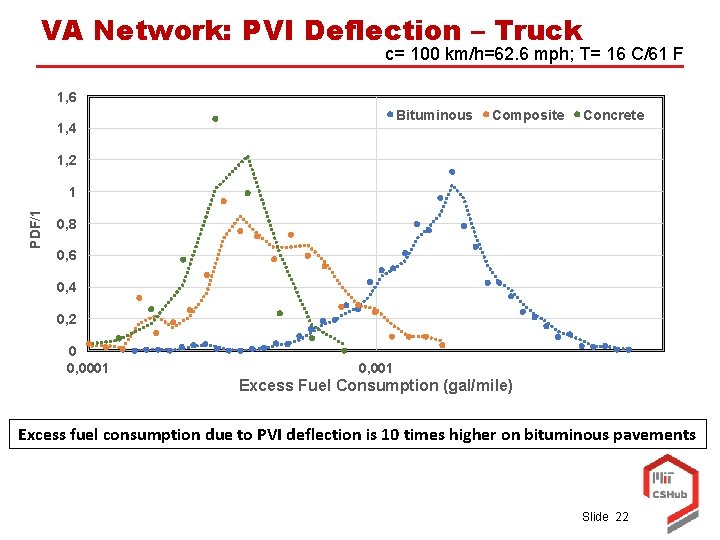
VA Network: PVI Deflection – Truck c= 100 km/h=62. 6 mph; T= 16 C/61 F 1, 6 Bituminous 1, 4 Composite Concrete 1, 2 PDF/1 1 0, 8 0, 6 0, 4 0, 2 0 0, 0001 0, 001 Excess Fuel Consumption (gal/mile) Excess fuel consumption due to PVI deflection is 10 times higher on bituminous pavements Slide 22
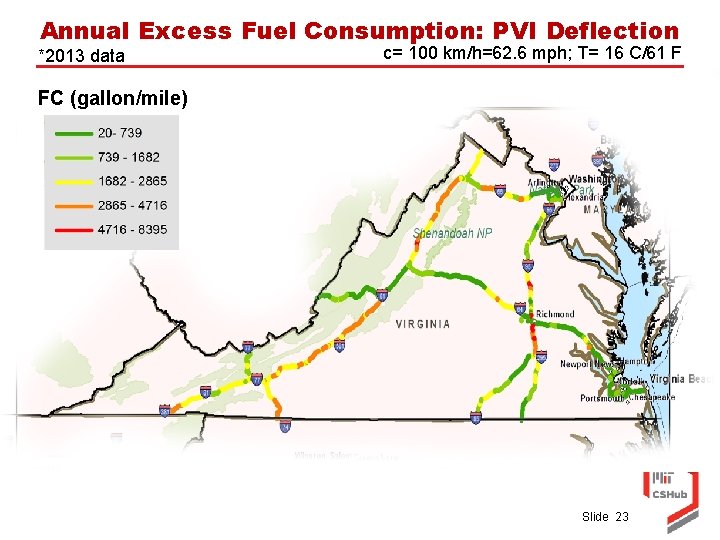
Annual Excess Fuel Consumption: PVI Deflection *2013 data c= 100 km/h=62. 6 mph; T= 16 C/61 F FC (gallon/mile) Slide 23
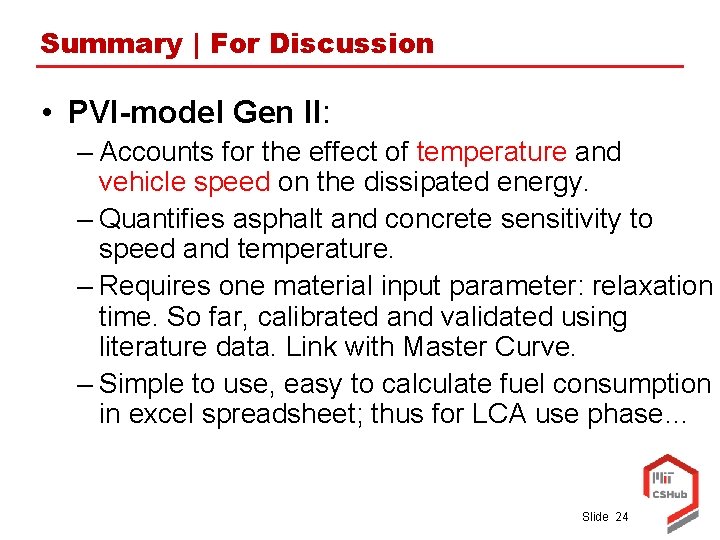
Summary | For Discussion • PVI-model Gen II: – Accounts for the effect of temperature and vehicle speed on the dissipated energy. – Quantifies asphalt and concrete sensitivity to speed and temperature. – Requires one material input parameter: relaxation time. So far, calibrated and validated using literature data. Link with Master Curve. – Simple to use, easy to calculate fuel consumption in excel spreadsheet; thus for LCA use phase… Slide 24
IRI-Induced PVI Slide 25
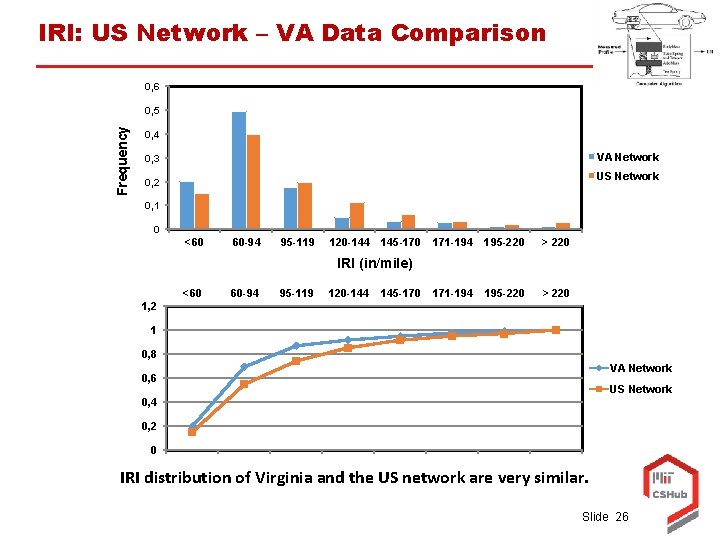
IRI: US Network – VA Data Comparison 0, 6 Frequency 0, 5 0, 4 VA Network 0, 3 US Network 0, 2 0, 1 0 <60 60 -94 95 -119 120 -144 145 -170 171 -194 195 -220 > 220 IRI (in/mile) <60 60 -94 95 -119 120 -144 145 -170 1, 2 1 0, 8 VA Network 0, 6 US Network 0, 4 0, 2 0 IRI distribution of Virginia and the US network are very similar. Slide 26
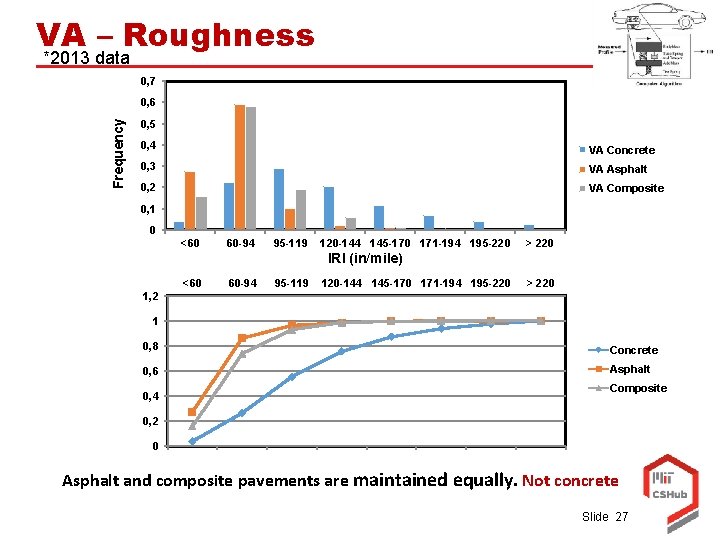
VA – Roughness *2013 data 0, 7 Frequency 0, 6 0, 5 0, 4 VA Concrete 0, 3 VA Asphalt 0, 2 VA Composite 0, 1 0 <60 60 -94 95 -119 120 -144 145 -170 171 -194 195 -220 > 220 IRI (in/mile) <60 60 -94 95 -119 120 -144 145 -170 171 -194 195 -220 > 220 1, 2 1 0, 8 Concrete 0, 6 Asphalt 0, 4 Composite 0, 2 0 Asphalt and composite pavements are maintained equally. Not concrete Slide 27
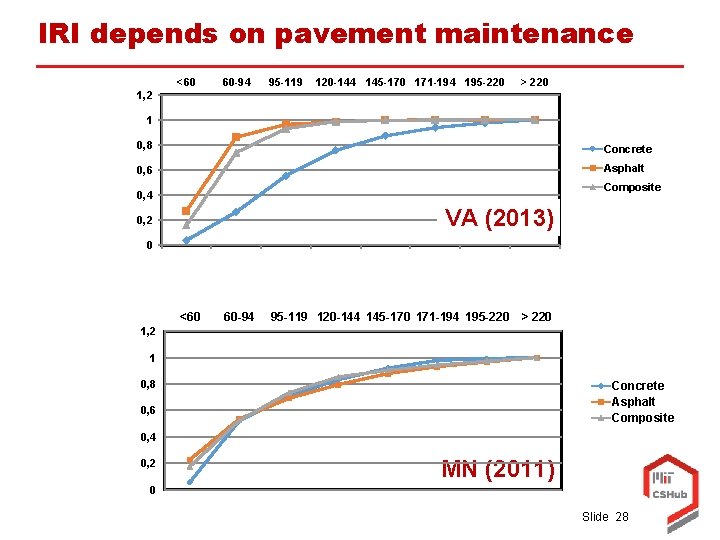
IRI depends on pavement maintenance <60 60 -94 95 -119 120 -144 145 -170 171 -194 195 -220 > 220 1, 2 1 0, 8 Concrete 0, 6 Asphalt Composite 0, 4 VA (2013) 0, 2 0 <60 60 -94 95 -119 120 -144 145 -170 171 -194 195 -220 > 220 1, 2 1 0, 8 Concrete Asphalt Composite 0, 6 0, 4 0, 2 MN (2011) 0 Slide 28
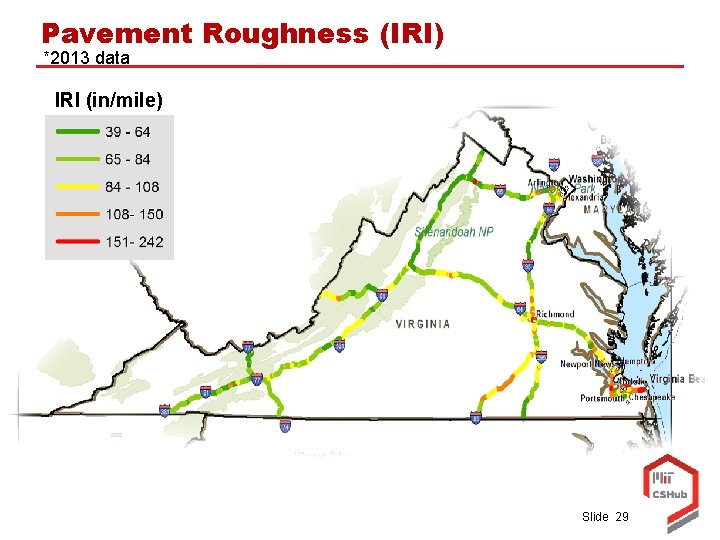
Pavement Roughness (IRI) *2013 data IRI (in/mile) Slide 29
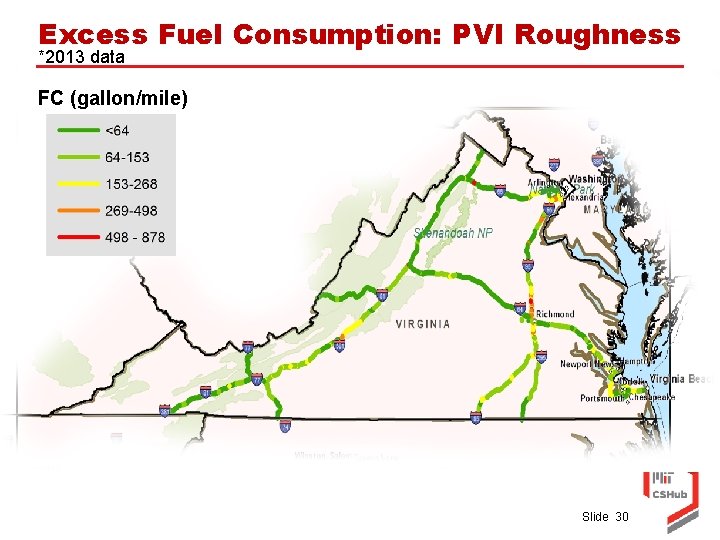
Excess Fuel Consumption: PVI Roughness *2013 data FC (gallon/mile) Slide 30
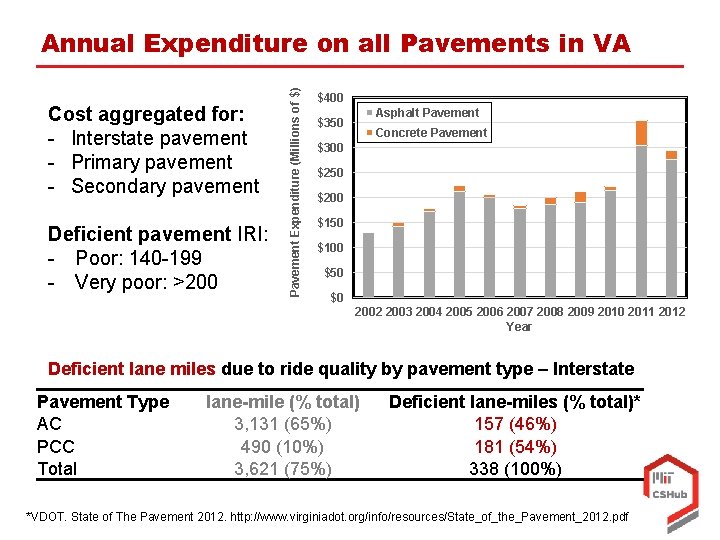
Cost aggregated for: - Interstate pavement - Primary pavement - Secondary pavement Deficient pavement IRI: - Poor: 140 -199 - Very poor: >200 Pavement Expenditure (Millions of $) Annual Expenditure on all Pavements in VA $400 Asphalt Pavement $350 Concrete Pavement $300 $250 $200 $150 $100 $50 $0 2002 2003 2004 2005 2006 2007 2008 2009 2010 2011 2012 Year Deficient lane miles due to ride quality by pavement type – Interstate Pavement Type AC PCC Total lane-mile (% total) 3, 131 (65%) 490 (10%) 3, 621 (75%) Deficient lane-miles (% total)* 157 (46%) 181 (54%) 338 (100%) *VDOT. State of The Pavement 2012. http: //www. virginiadot. org/info/resources/State_of_the_Pavement_2012. pdf Slide 31
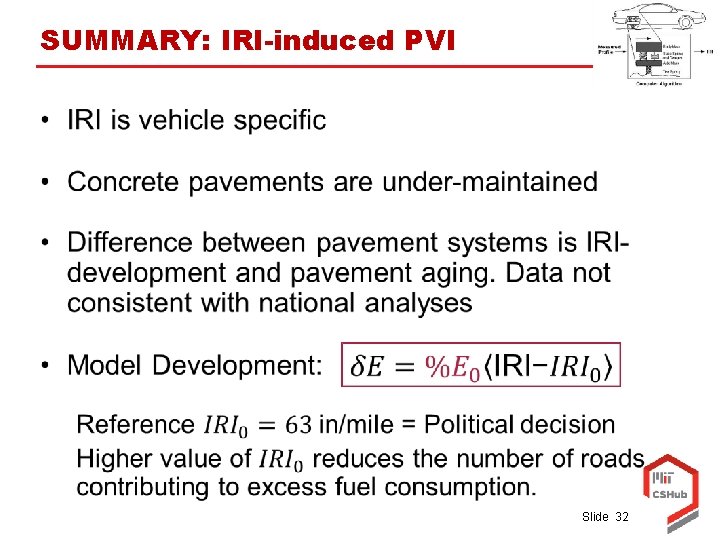
SUMMARY: IRI-induced PVI • Slide 32
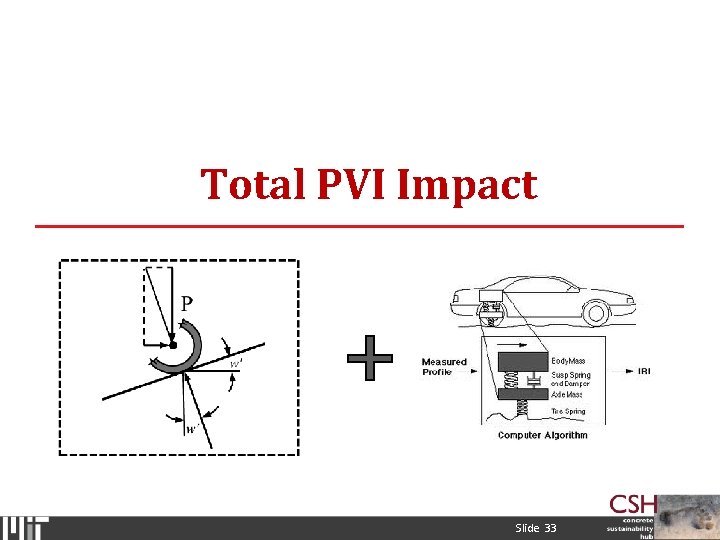
Total PVI Impact Slide 33
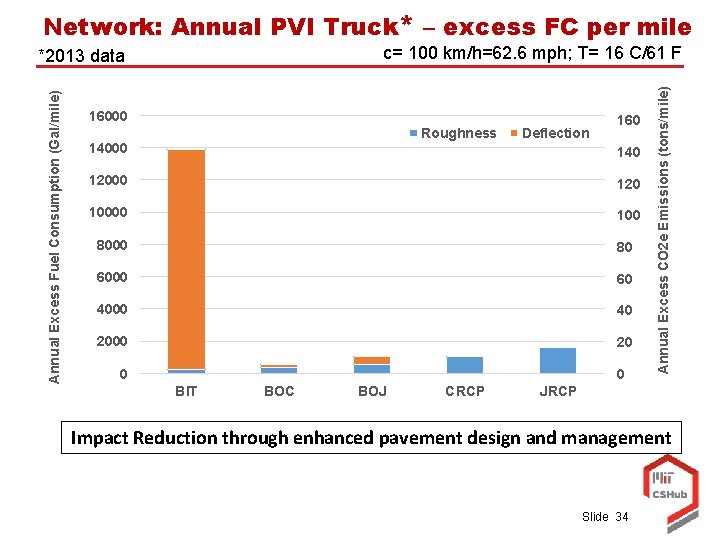
Network: Annual PVI Truck* – excess FC per mile Annual Excess Fuel Consumption (Gal/mile) 16000 Roughness 14000 Deflection 160 140 12000 120 10000 100 80 6000 60 4000 40 2000 20 0 0 BIT BOC BOJ CRCP Annual Excess CO 2 e Emissions (tons/mile) c= 100 km/h=62. 6 mph; T= 16 C/61 F *2013 data JRCP Impact Reduction through enhanced pavement design and management Slide 34
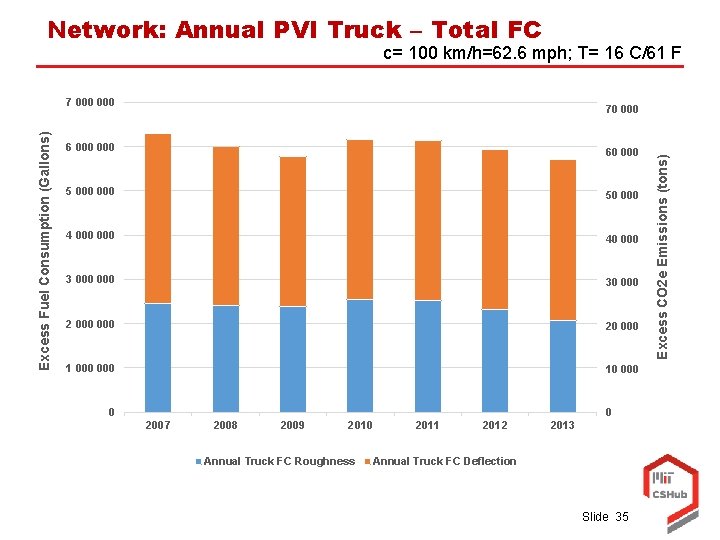
Network: Annual PVI Truck – Total FC c= 100 km/h=62. 6 mph; T= 16 C/61 F 70 000 60 000 50 000 40 000 30 000 20 000 10 000 0 0 2007 2008 2009 2010 Annual Truck FC Roughness 2011 2012 2013 Annual Truck FC Deflection Slide 35 Excess CO 2 e Emissions (tons) Excess Fuel Consumption (Gallons) 7 000
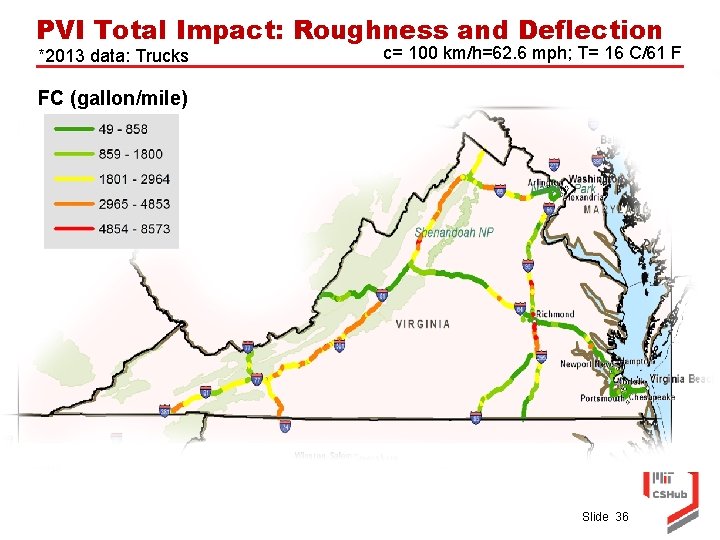
PVI Total Impact: Roughness and Deflection *2013 data: Trucks c= 100 km/h=62. 6 mph; T= 16 C/61 F FC (gallon/mile) Slide 36
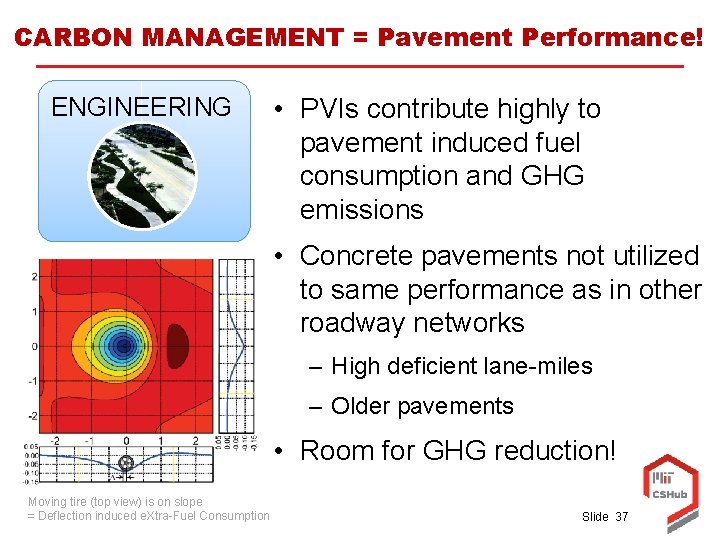
CARBON MANAGEMENT = Pavement Performance! ENGINEERING 100% • PVIs contribute highly to pavement induced fuel consumption and GHG emissions • Concrete pavements not utilized to same performance as in other roadway networks – High deficient lane-miles – Older pavements • Room for GHG reduction! Moving tire (top view) is on slope = Deflection induced e. Xtra-Fuel Consumption Slide 37
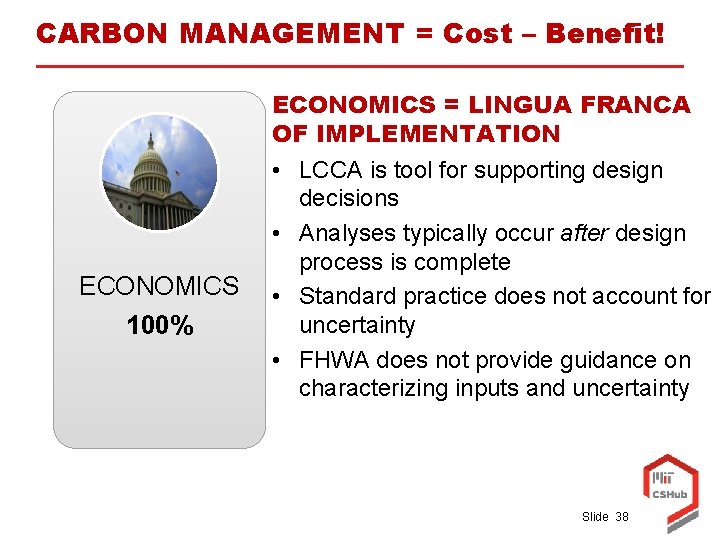
CARBON MANAGEMENT = Cost – Benefit! ECONOMICS 100% ECONOMICS = LINGUA FRANCA OF IMPLEMENTATION • LCCA is tool for supporting design decisions • Analyses typically occur after design process is complete • Standard practice does not account for uncertainty • FHWA does not provide guidance on characterizing inputs and uncertainty Slide 38
LCCA VALUE PROPOSITION • Context: $ 2 Trillion Infra-structure renewal job within tightest budgetary constraints. • Problem: Volatility of construction materials pricing for a fiscally sound decision making. ECONOMICS Decision Makers (local, national, and beyond) * Swei, Gregory & Kirchain (2013) • Solution*: A new LCCA methodology with probabilistic cost modeling of pavement projects, so that decisionmakers: – Understand the risk of an investment; – Select a design based on risk perspective. I M P L E M E N T A T I O N @ State Level: Case Study Slide 39 INVEST – INNOVATE – INVIGORATE - IMPLEMENT
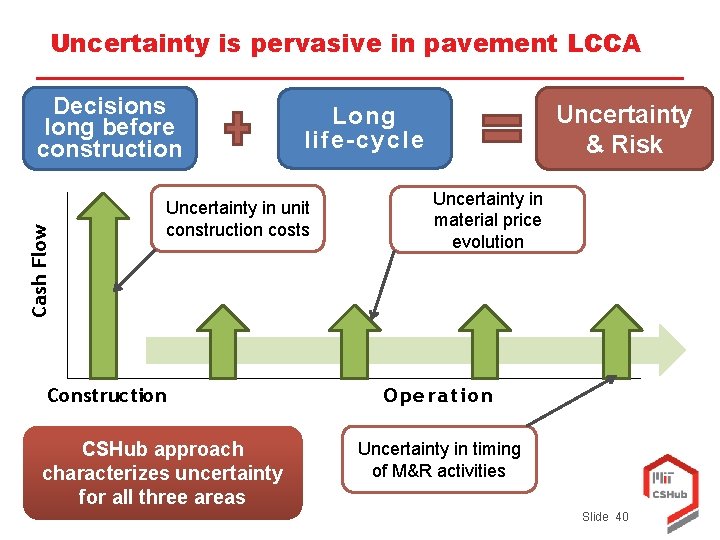
Uncertainty is pervasive in pavement LCCA Cash Flow Decisions long before construction Uncertainty in unit construction costs Construction CSHub approach characterizes uncertainty for all three areas Uncertainty & Risk Long life-cycle Uncertainty in material price evolution Operation Uncertainty in timing of M&R activities Slide 40
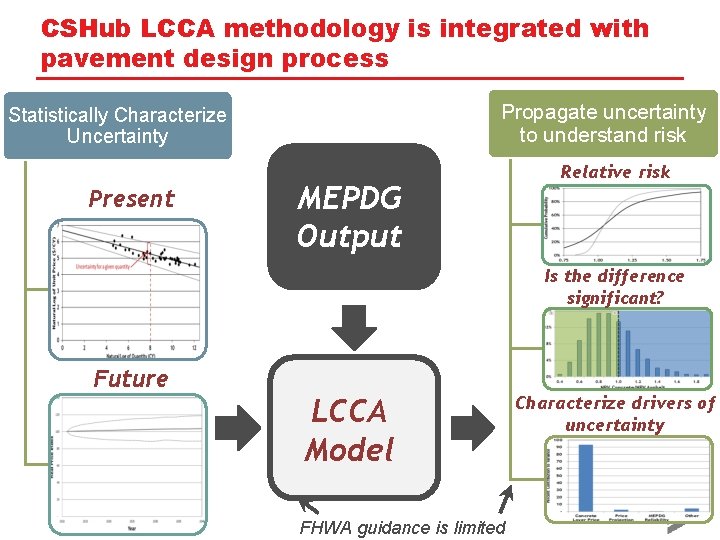
CSHub LCCA methodology is integrated with pavement design process Propagate uncertainty to understand risk Statistically Characterize Uncertainty Present MEPDG Output Relative risk Is the difference significant? Future LCCA Model FHWA guidance is limited Characterize drivers of uncertainty Slide 41
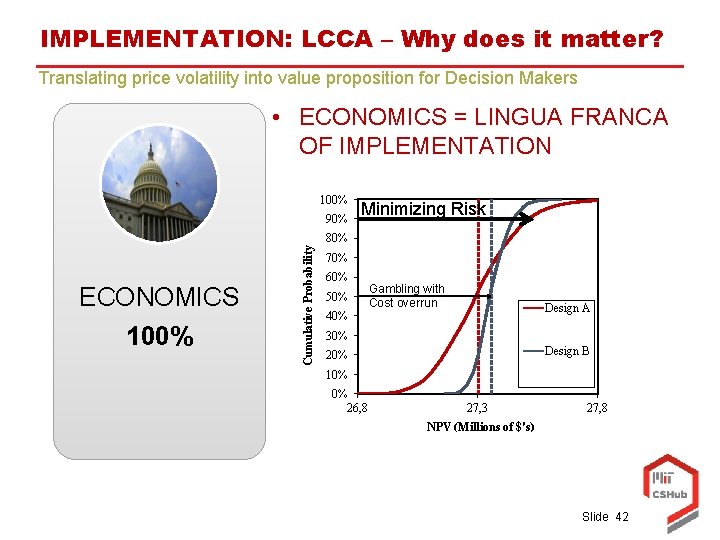
IMPLEMENTATION: LCCA – Why does it matter? Translating price volatility into value proposition for Decision Makers • ECONOMICS = LINGUA FRANCA OF IMPLEMENTATION 100% 90% Minimizing Risk ECONOMICS 100% Cumulative Probability 80% 70% 60% 50% Gambling with Cost overrun Design A 40% 30% Design B 20% 10% 0% 26, 8 27, 3 27, 8 NPV (Millions of $'s) Slide 42
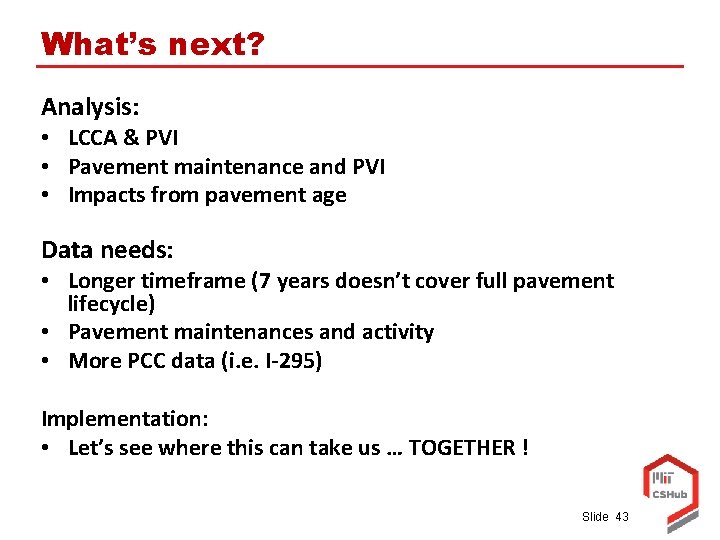
What’s next? Analysis: • LCCA & PVI • Pavement maintenance and PVI • Impacts from pavement age Data needs: • Longer timeframe (7 years doesn’t cover full pavement lifecycle) • Pavement maintenances and activity • More PCC data (i. e. I-295) Implementation: • Let’s see where this can take us … TOGETHER ! Slide 43
We seek your input! Thank you. References: • Louhghalam, A. ; Akbarian, M. , Ulm, F-J. (2013) Fluegge's Conjecture: Dissipation vs. Deflection Induced Pavement-Vehicle-Interactions (PVI); J. Engrg. Mech. , ASCE. • Louhghalam, A. ; Akbarian, M. , Ulm, F-J. (2013) Scaling relations of dissipation-induced pavement-vehicleinteractions; TRB. • http: //web. mit. edu/cshub/ Slide 44
Predicting the future? • Beyond my pay grade, but… • CARBON MANAGEMENT is a vehicle of INFRASTUCTURE MANAGEMENT • Quantitative Sustainability • Together, let’s make it a reality… Slide 45
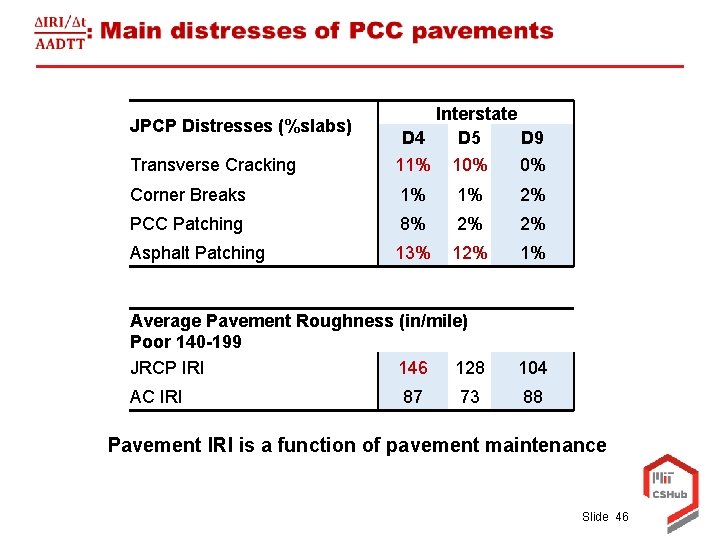
JPCP Distresses (%slabs) Interstate D 4 D 5 D 9 Transverse Cracking 11% 10% 0% Corner Breaks 1% 1% 2% PCC Patching 8% 2% 2% Asphalt Patching 13% 12% 1% Average Pavement Roughness (in/mile) Poor 140 -199 JRCP IRI 146 128 104 AC IRI 88 87 73 Pavement IRI is a function of pavement maintenance Slide 46
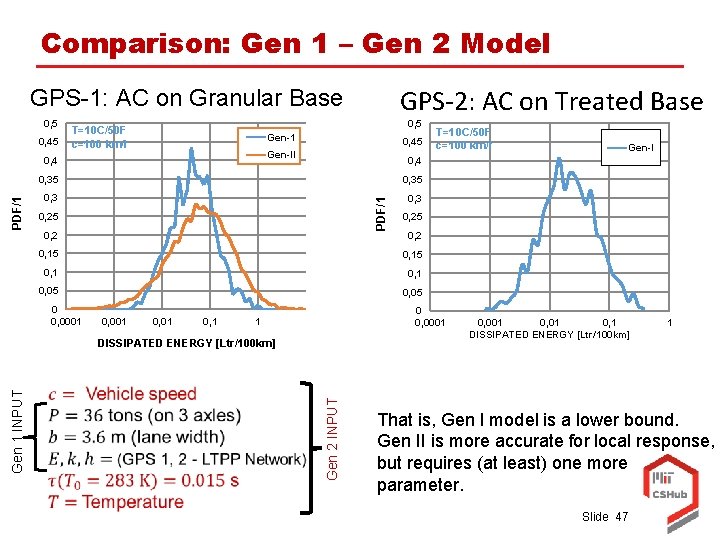
Comparison: Gen 1 – Gen 2 Model GPS-2: AC on Treated Base GPS-1: AC on Granular Base 0, 5 0, 45 T=10 C/50 F (+/- 10 C) c=100 km/h (62. 5 mph) Gen-1 Gen-II 0, 4 0, 3 PDF/1 0, 35 0, 2 0, 15 0, 1 0, 05 0 0, 0001 0, 1 1 DISSIPATED ENERGY [Ltr/100 km] Gen 2 INPUT Gen 1 INPUT DISSIPATED ENERGY [Ltr/100 km] Slide 47
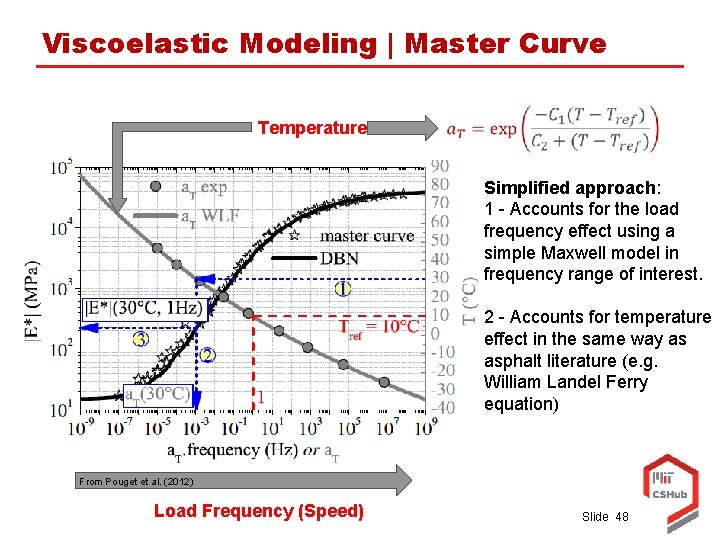
Viscoelastic Modeling | Master Curve Temperature Simplified approach: 1 - Accounts for the load frequency effect using a simple Maxwell model in frequency range of interest. 2 - Accounts for temperature effect in the same way as asphalt literature (e. g. William Landel Ferry equation) From Pouget et al. (2012) Load Frequency (Speed) Slide 48
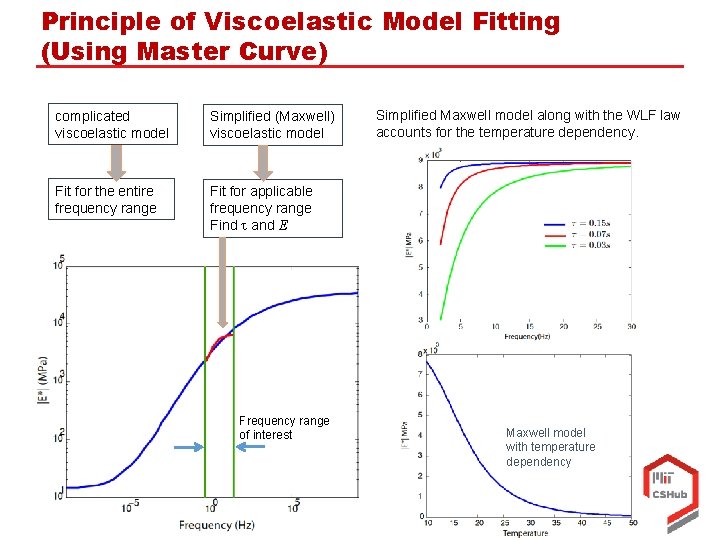
Principle of Viscoelastic Model Fitting (Using Master Curve) complicated viscoelastic model Simplified (Maxwell) viscoelastic model Fit for the entire frequency range Fit for applicable frequency range Find t and E Frequency range of interest Simplified Maxwell model along with the WLF law accounts for the temperature dependency. Maxwell model with temperature dependency Slide 49