
Pavement Management Sarah Mc Dougall Pavement Management Engineer


- Slides: 14
Pavement Management Sarah Mc. Dougall Pavement Management Engineer M&R Workshop – Feb 19 th 2014
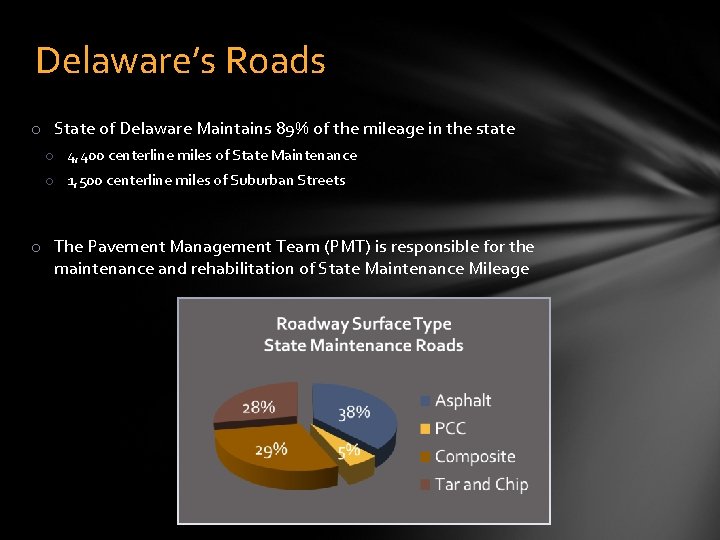
Delaware’s Roads o State of Delaware Maintains 89% of the mileage in the state o 4, 400 centerline miles of State Maintenance o 1, 500 centerline miles of Suburban Streets o The Pavement Management Team (PMT) is responsible for the maintenance and rehabilitation of State Maintenance Mileage
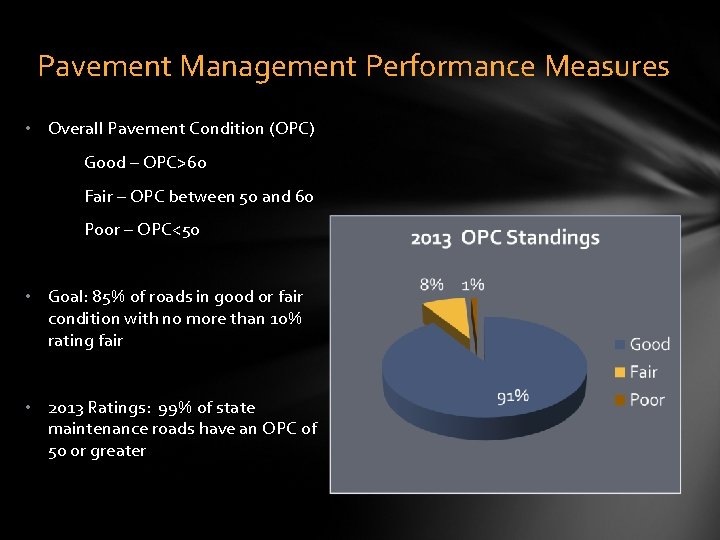
Pavement Management Performance Measures • Overall Pavement Condition (OPC) Good – OPC>60 Fair – OPC between 50 and 60 Poor – OPC<50 • Goal: 85% of roads in good or fair condition with no more than 10% rating fair • 2013 Ratings: 99% of state maintenance roads have an OPC of 50 or greater
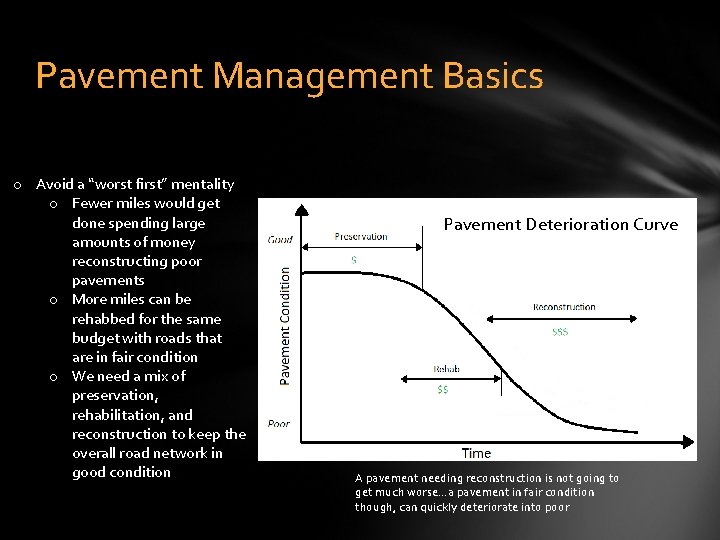
Pavement Management Basics o Avoid a “worst first” mentality o Fewer miles would get done spending large amounts of money reconstructing poor pavements o More miles can be rehabbed for the same budget with roads that are in fair condition o We need a mix of preservation, rehabilitation, and reconstruction to keep the overall road network in good condition Pavement Deterioration Curve A pavement needing reconstruction is not going to get much worse…a pavement in fair condition though, can quickly deteriorate into poor
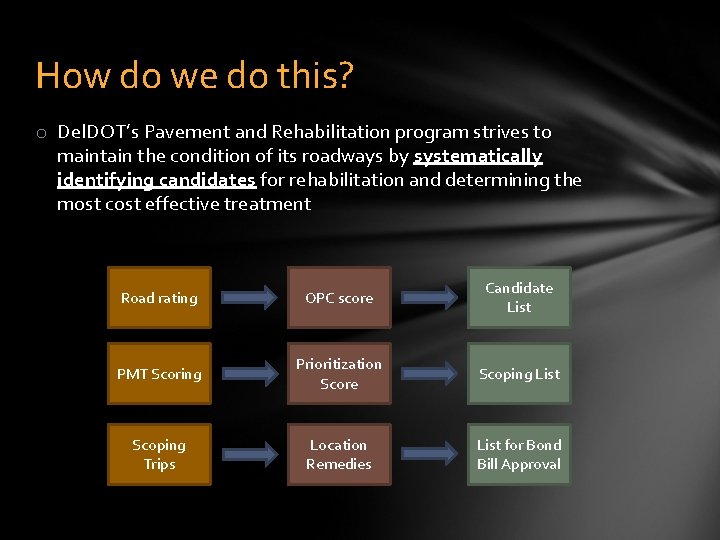
How do we do this? o Del. DOT’s Pavement and Rehabilitation program strives to maintain the condition of its roadways by systematically identifying candidates for rehabilitation and determining the most cost effective treatment Road rating OPC score Candidate List PMT Scoring Prioritization Score Scoping List Scoping Trips Location Remedies List for Bond Bill Approval
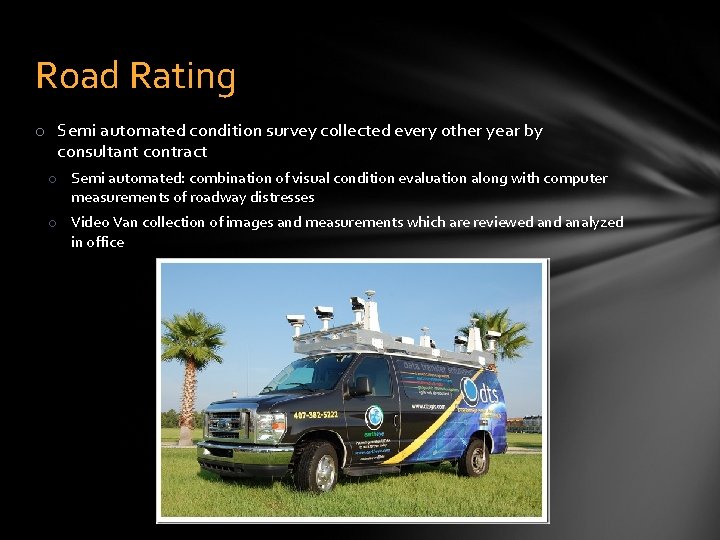
Road Rating o Semi automated condition survey collected every other year by consultant contract o Semi automated: combination of visual condition evaluation along with computer measurements of roadway distresses o Video Van collection of images and measurements which are reviewed analyzed in office
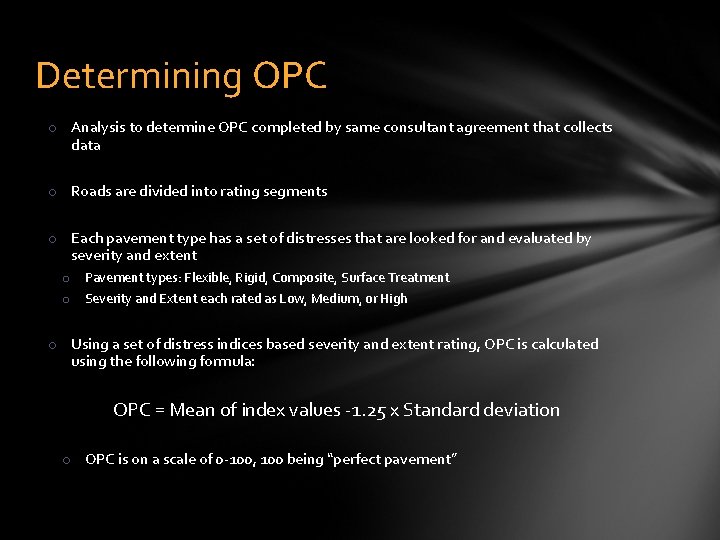
Determining OPC o Analysis to determine OPC completed by same consultant agreement that collects data o Roads are divided into rating segments o Each pavement type has a set of distresses that are looked for and evaluated by severity and extent o Pavement types: Flexible, Rigid, Composite, Surface Treatment o Severity and Extent each rated as Low, Medium, or High o Using a set of distress indices based severity and extent rating, OPC is calculated using the following formula: OPC = Mean of index values -1. 25 x Standard deviation o OPC is on a scale of 0 -100, 100 being “perfect pavement”
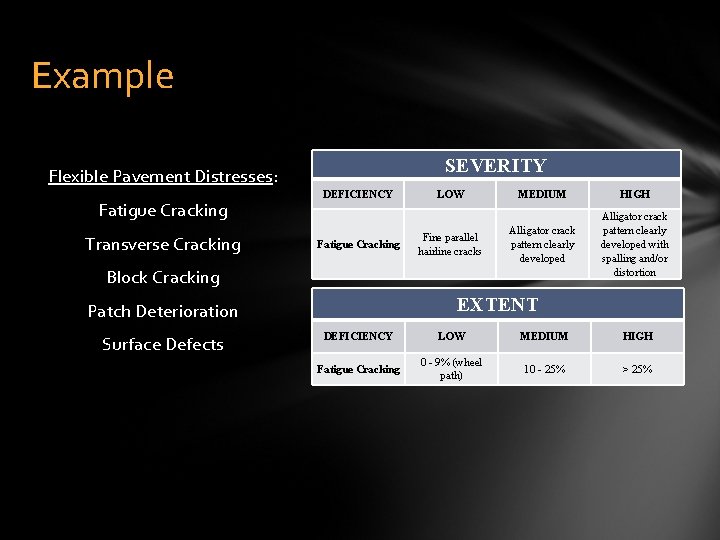
Example SEVERITY Flexible Pavement Distresses: Fatigue Cracking Transverse Cracking DEFICIENCY Fatigue Cracking LOW Fine parallel hairline cracks MEDIUM HIGH Alligator crack pattern clearly developed with spalling and/or distortion Block Cracking EXTENT Patch Deterioration Surface Defects DEFICIENCY LOW MEDIUM HIGH Fatigue Cracking 0 - 9% (wheel path) 10 - 25% > 25%
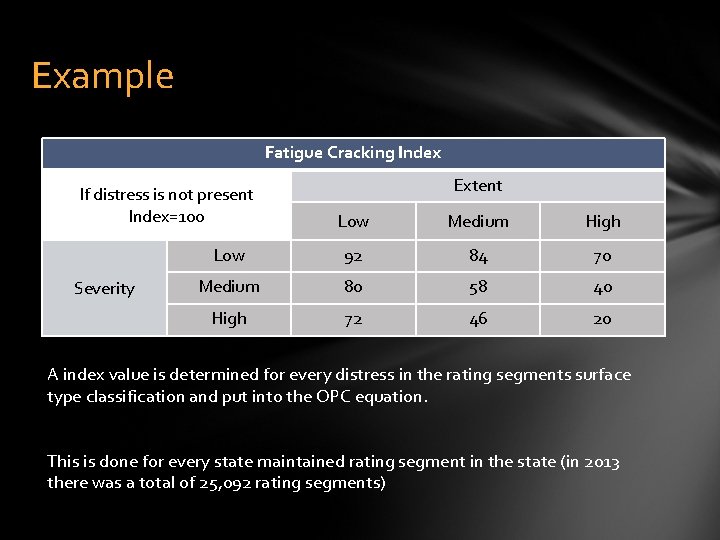
Example Fatigue Cracking Index If distress is not present Index=100 Severity Extent Low Medium High Low 92 84 70 Medium 80 58 40 High 72 46 20 A index value is determined for every distress in the rating segments surface type classification and put into the OPC equation. This is done for every state maintained rating segment in the state (in 2013 there was a total of 25, 092 rating segments)
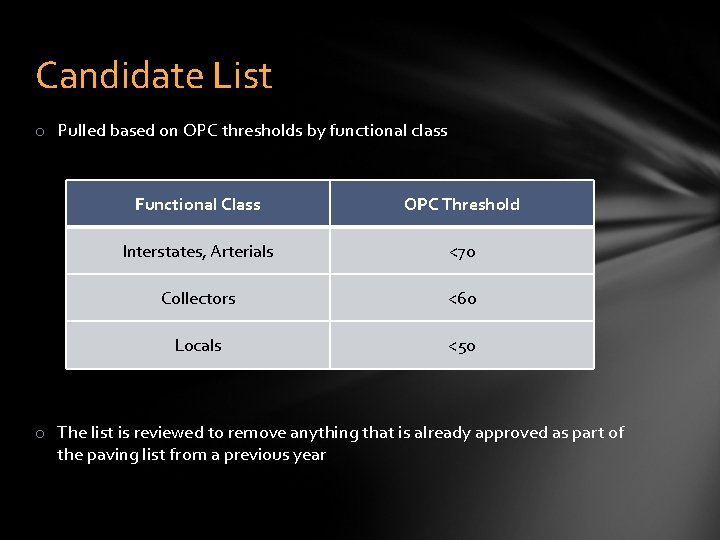
Candidate List o Pulled based on OPC thresholds by functional class Functional Class OPC Threshold Interstates, Arterials <70 Collectors <60 Locals <50 o The list is reviewed to remove anything that is already approved as part of the paving list from a previous year
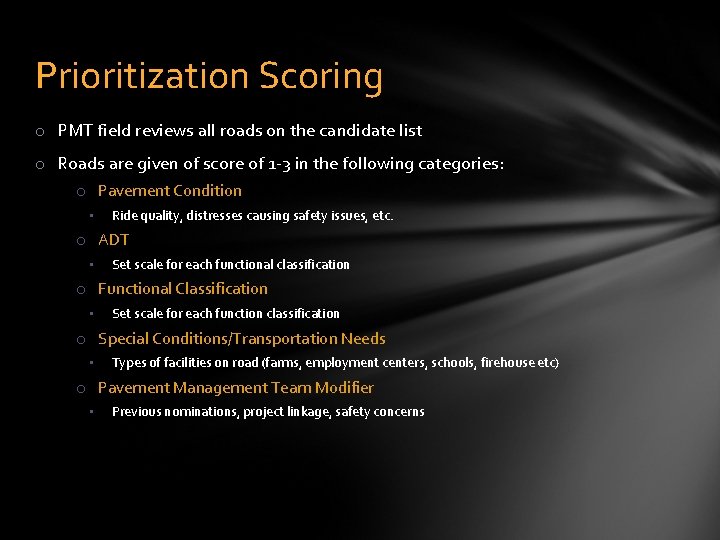
Prioritization Scoring o PMT field reviews all roads on the candidate list o Roads are given of score of 1 -3 in the following categories: o Pavement Condition • Ride quality, distresses causing safety issues, etc. o ADT • Set scale for each functional classification o Functional Classification • Set scale for each function classification o Special Conditions/Transportation Needs • Types of facilities on road (farms, employment centers, schools, firehouse etc) o Pavement Management Team Modifier • Previous nominations, project linkage, safety concerns
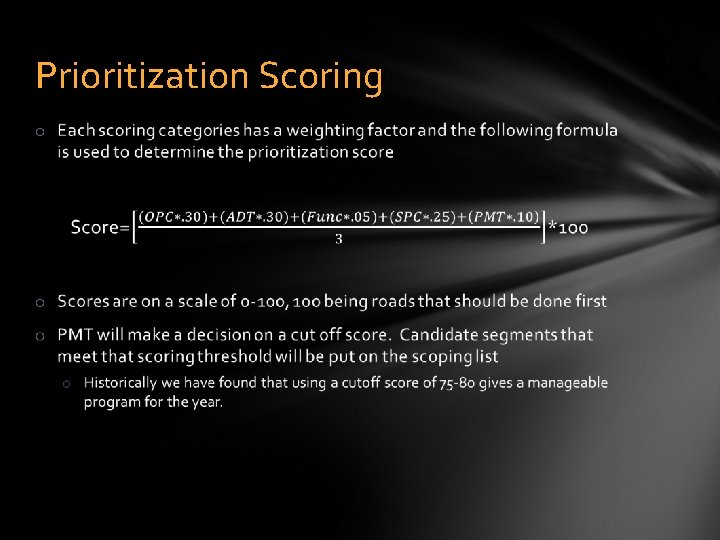
Prioritization Scoring
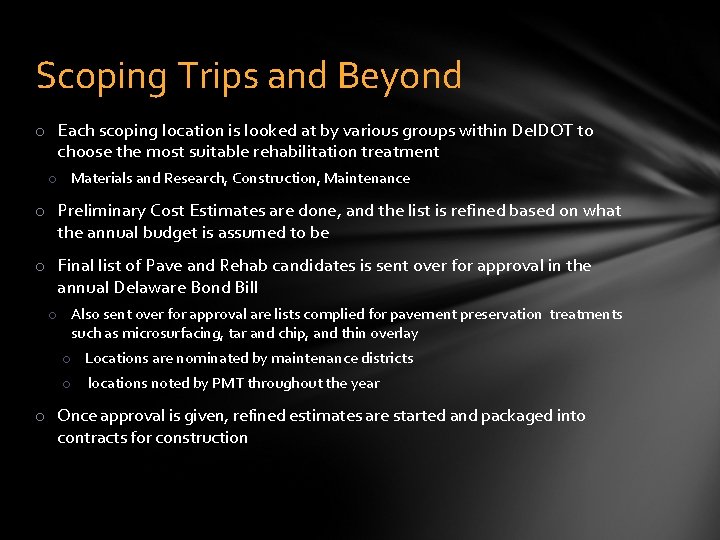
Scoping Trips and Beyond o Each scoping location is looked at by various groups within Del. DOT to choose the most suitable rehabilitation treatment o Materials and Research, Construction, Maintenance o Preliminary Cost Estimates are done, and the list is refined based on what the annual budget is assumed to be o Final list of Pave and Rehab candidates is sent over for approval in the annual Delaware Bond Bill o Also sent over for approval are lists complied for pavement preservation treatments such as microsurfacing, tar and chip, and thin overlay o Locations are nominated by maintenance districts o locations noted by PMT throughout the year o Once approval is given, refined estimates are started and packaged into contracts for construction
Questions?