
Pavel Buividovich Regensburg Germany in collaboration with M
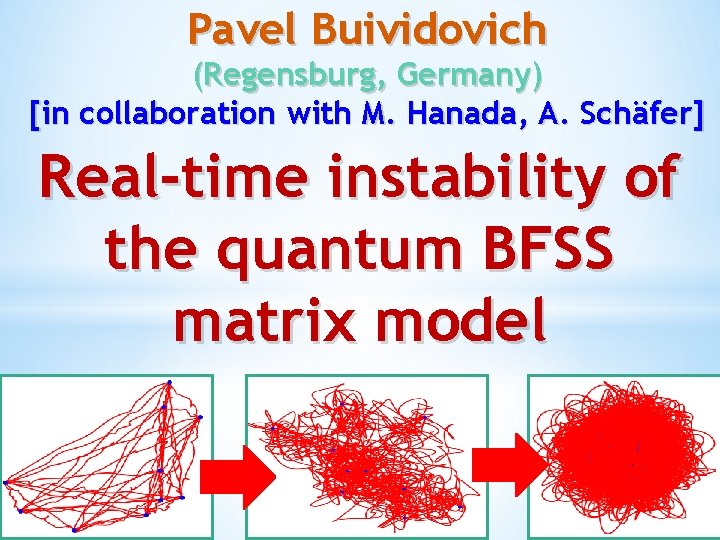
Pavel Buividovich (Regensburg, Germany) [in collaboration with M. Hanada, A. Schäfer] Real-time instability of the quantum BFSS matrix model
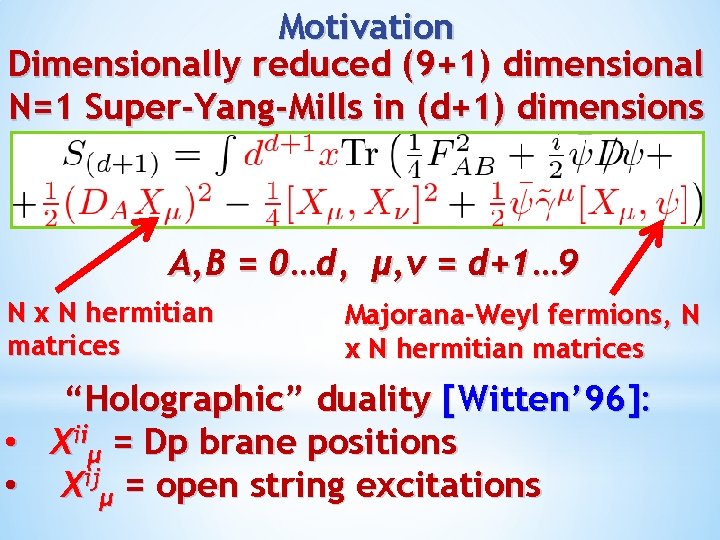
Motivation Dimensionally reduced (9+1) dimensional N=1 Super-Yang-Mills in (d+1) dimensions A, B = 0…d, μ, ν = d+1… 9 N x N hermitian matrices Majorana-Weyl fermions, N x N hermitian matrices “Holographic” duality [Witten’ 96]: • Xiiμ = Dp brane positions • Xijμ = open string excitations
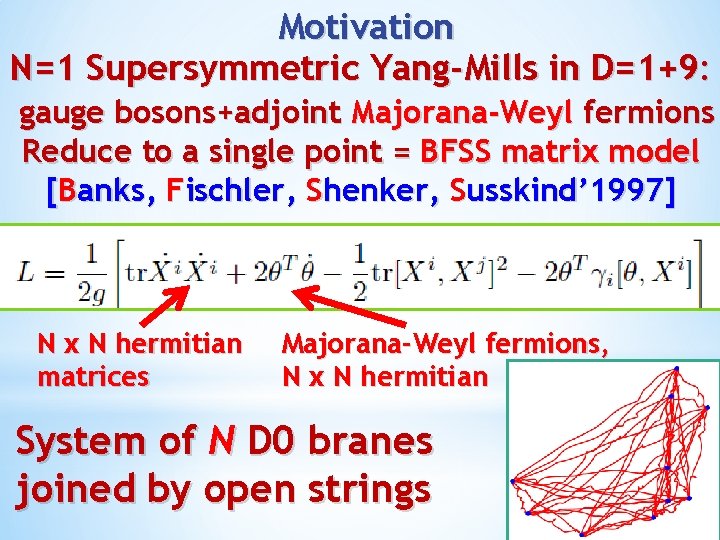
Motivation N=1 Supersymmetric Yang-Mills in D=1+9: gauge bosons+adjoint Majorana-Weyl fermions Reduce to a single point = BFSS matrix model [Banks, Fischler, Shenker, Susskind’ 1997] N x N hermitian matrices Majorana-Weyl fermions, N x N hermitian System of N D 0 branes joined by open strings
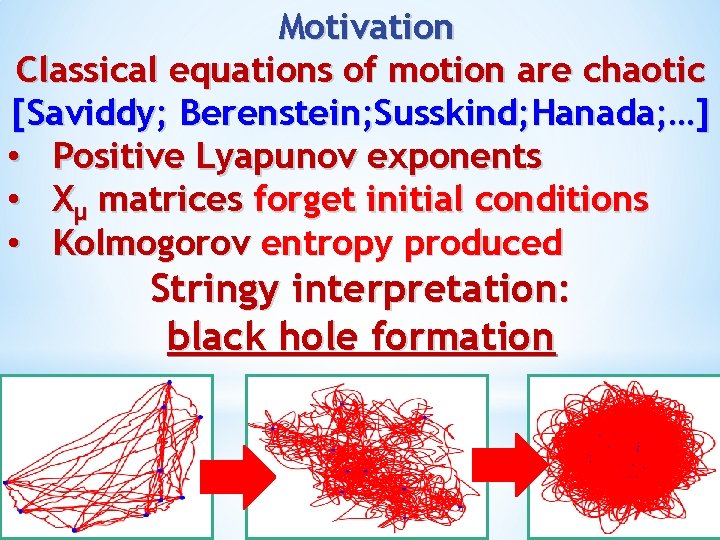
Motivation Classical equations of motion are chaotic [Saviddy; Berenstein; Susskind; Hanada; …] • Positive Lyapunov exponents • Xμ matrices forget initial conditions • Kolmogorov entropy produced Stringy interpretation: black hole formation
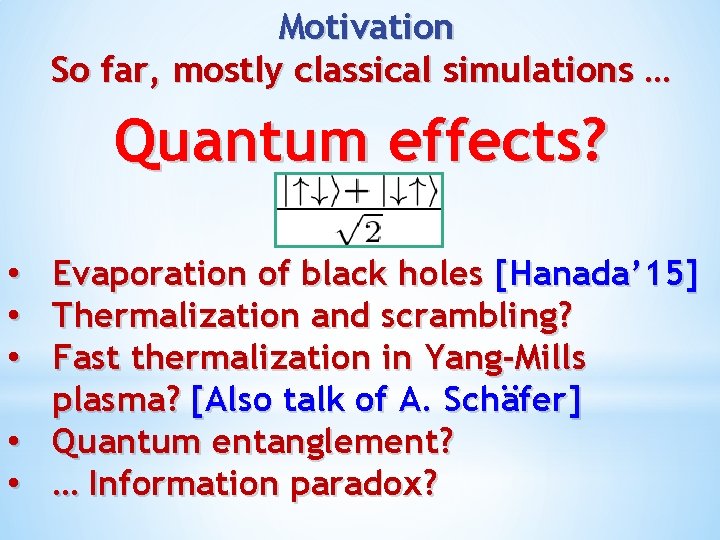
Motivation So far, mostly classical simulations … Quantum effects? Evaporation of black holes [Hanada’ 15] Thermalization and scrambling? Fast thermalization in Yang-Mills plasma? [Also talk of A. Schäfer] • Quantum entanglement? • … Information paradox? • • •
In this talk: Numerical methods to address all these questions • Classical-statistical approximation: effect of fermions black hole “evaporation” • Beyond classical-statistical: quantum fluctuations of gauge fields • Semi-analytic solutions based on truncated Heisenber equations
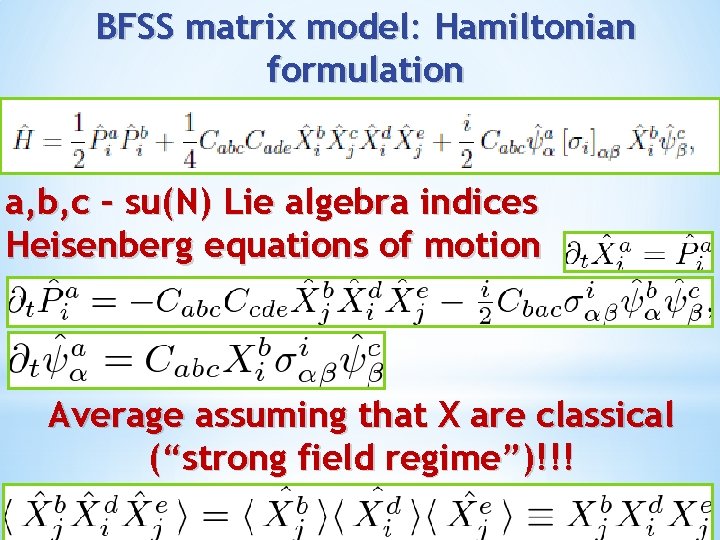
BFSS matrix model: Hamiltonian formulation a, b, c – su(N) Lie algebra indices Heisenberg equations of motion Average assuming that X are classical (“strong field regime”)!!!
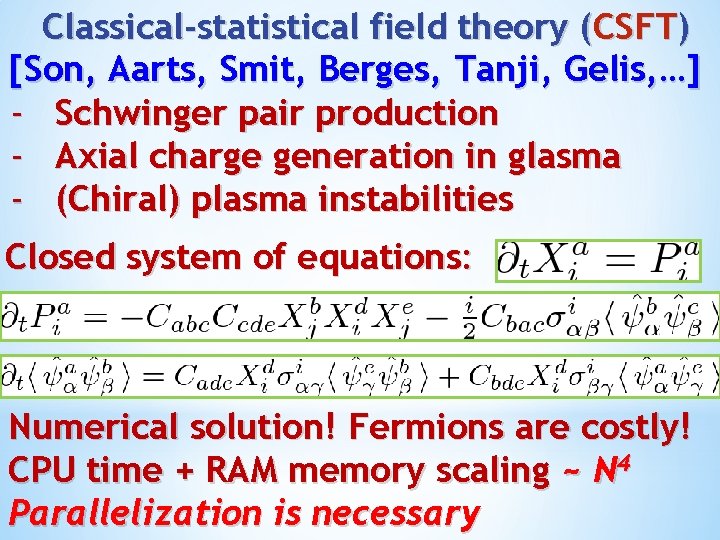
Classical-statistical field theory (CSFT) [Son, Aarts, Smit, Berges, Tanji, Gelis, …] - Schwinger pair production - Axial charge generation in glasma - (Chiral) plasma instabilities Closed system of equations: Numerical solution! Fermions are costly! CPU time + RAM memory scaling ~ N 4 Parallelization is necessary
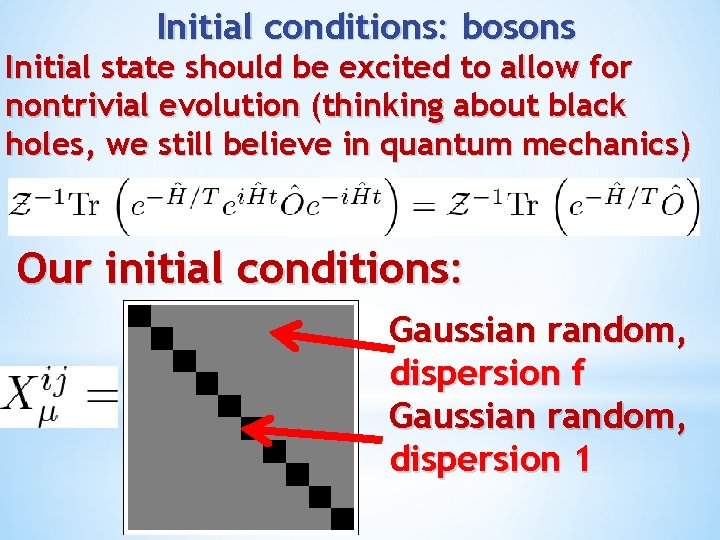
Initial conditions: bosons Initial state should be excited to allow for nontrivial evolution (thinking about black holes, we still believe in quantum mechanics) Our initial conditions: Gaussian random, dispersion f Gaussian random, dispersion 1
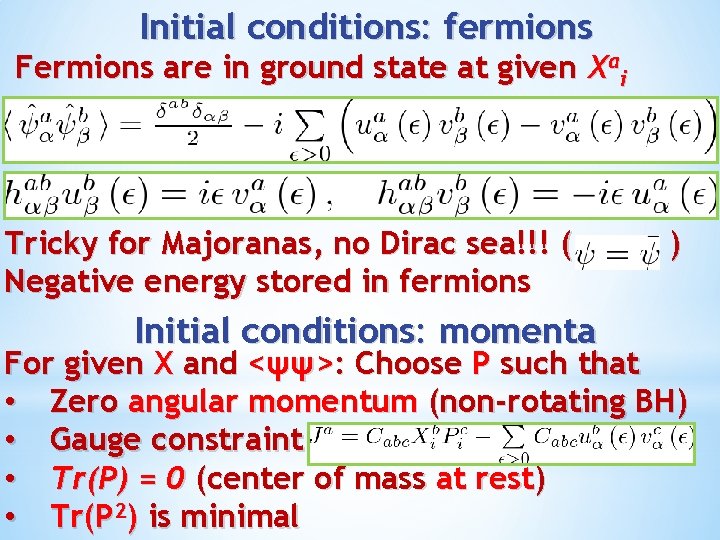
Initial conditions: fermions Fermions are in ground state at given Xai Tricky for Majoranas, no Dirac sea!!! ( Negative energy stored in fermions Initial conditions: momenta ) For given X and <ψψ>: Choose P such that • Zero angular momentum (non-rotating BH) • Gauge constraint • Tr(P) = 0 (center of mass at rest) • Tr(P 2) is minimal
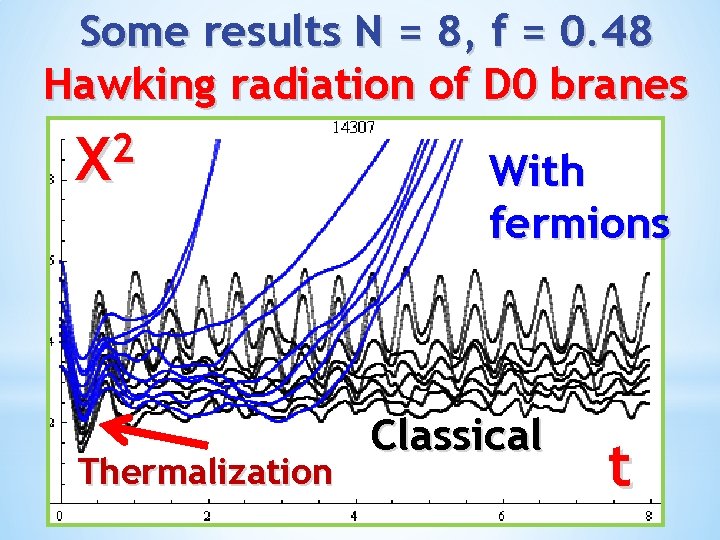
Some results N = 8, f = 0. 48 Hawking radiation of D 0 branes 2 X Thermalization With fermions Classical t
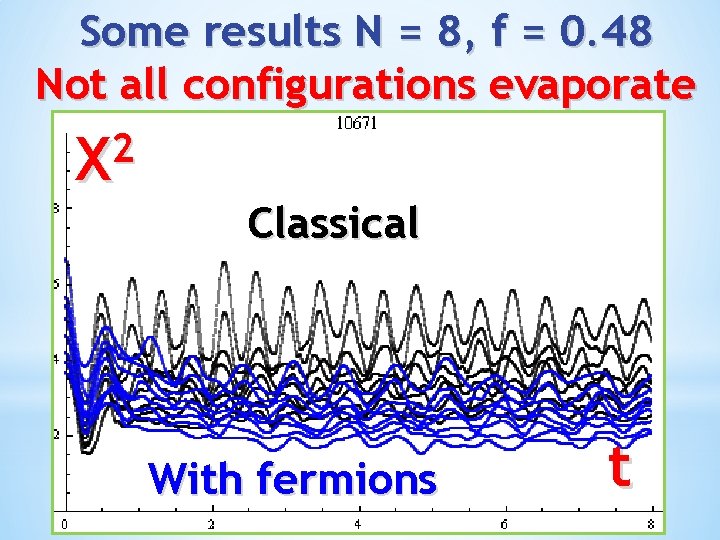
Some results N = 8, f = 0. 48 Not all configurations evaporate 2 X Classical With fermions t
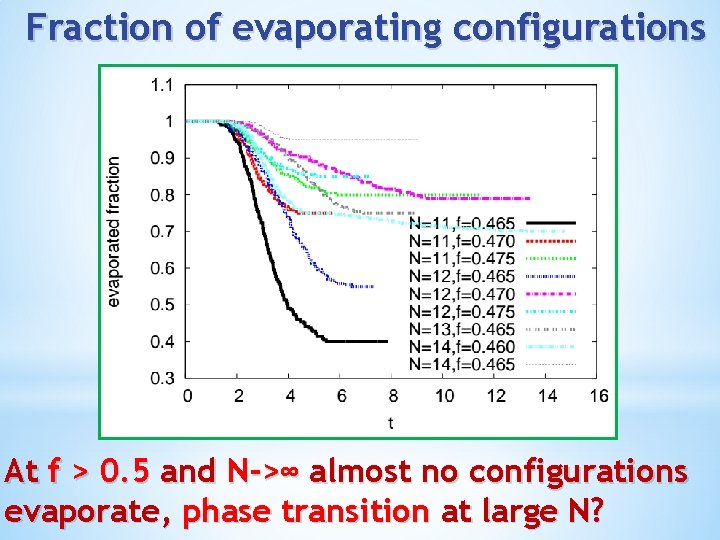
Fraction of evaporating configurations At f > 0. 5 and N->∞ almost no configurations evaporate, phase transition at large N?
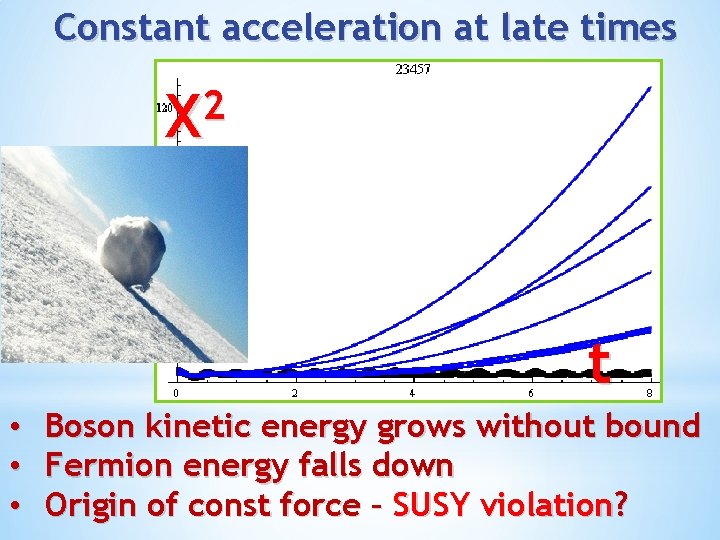
Constant acceleration at late times 2 X t • • • Boson kinetic energy grows without bound Fermion energy falls down Origin of const force – SUSY violation?
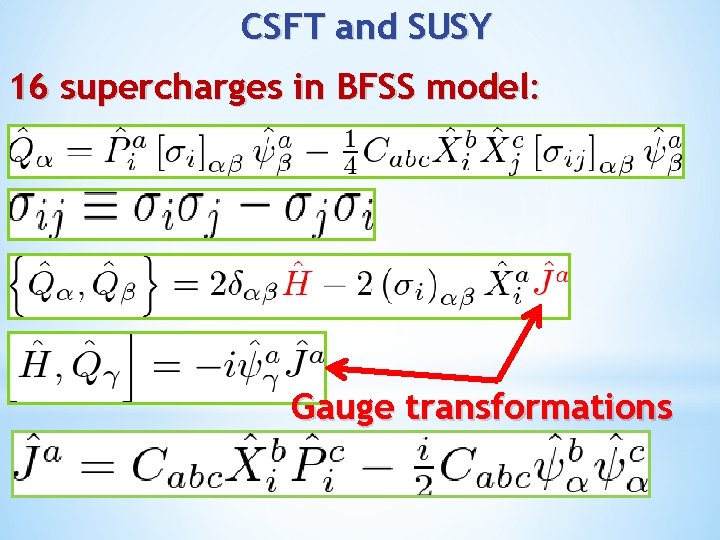
CSFT and SUSY 16 supercharges in BFSS model: Gauge transformations
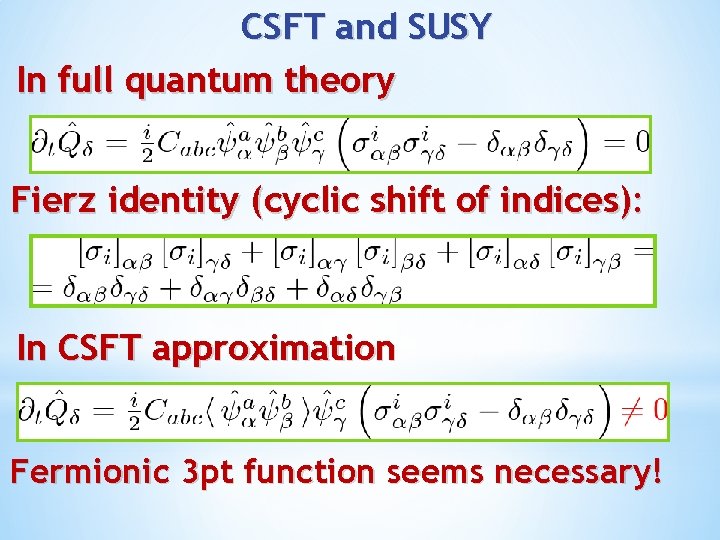
CSFT and SUSY In full quantum theory Fierz identity (cyclic shift of indices): In CSFT approximation Fermionic 3 pt function seems necessary!
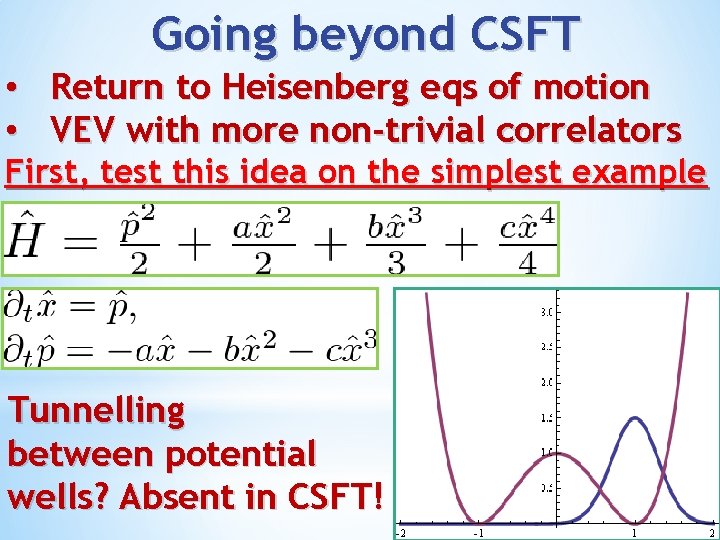
Going beyond CSFT • Return to Heisenberg eqs of motion • VEV with more non-trivial correlators First, test this idea on the simplest example Tunnelling between potential wells? Absent in CSFT!
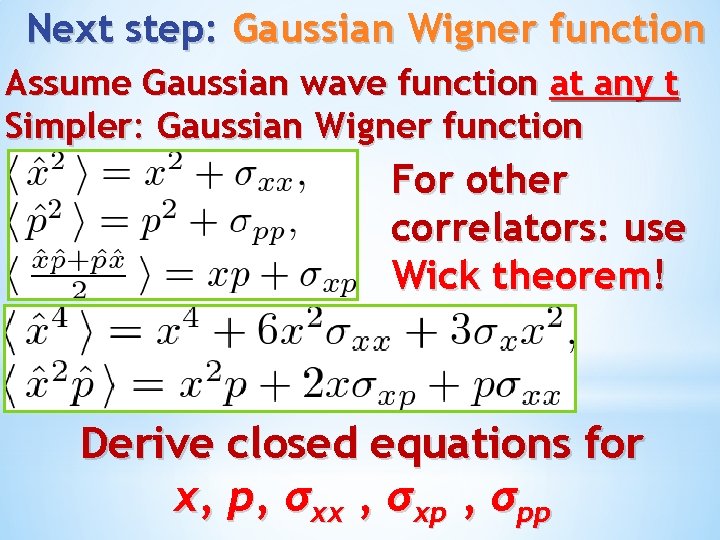
Next step: Gaussian Wigner function Assume Gaussian wave function at any t Simpler: Gaussian Wigner function For other correlators: use Wick theorem! Derive closed equations for x, p, σxx , σxp , σpp
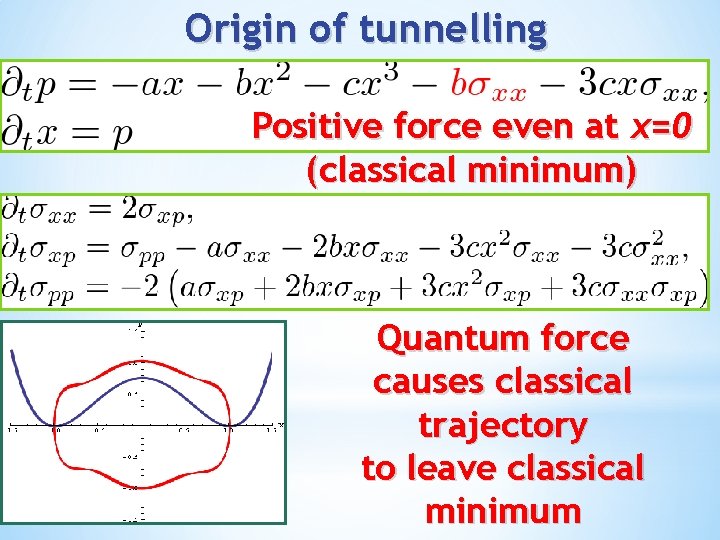
Origin of tunnelling Positive force even at x=0 (classical minimum) Quantum force causes classical trajectory to leave classical minimum
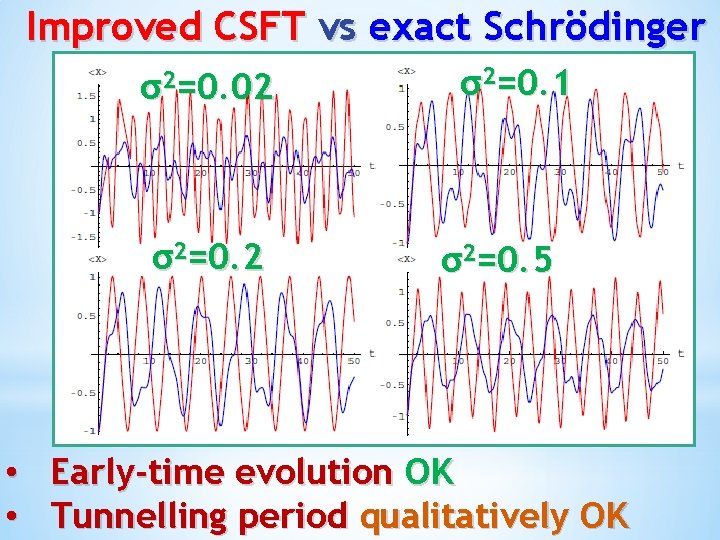
Improved CSFT vs exact Schrödinger σ2=0. 02 σ2=0. 1 σ2=0. 5 • Early-time evolution OK • Tunnelling period qualitatively OK
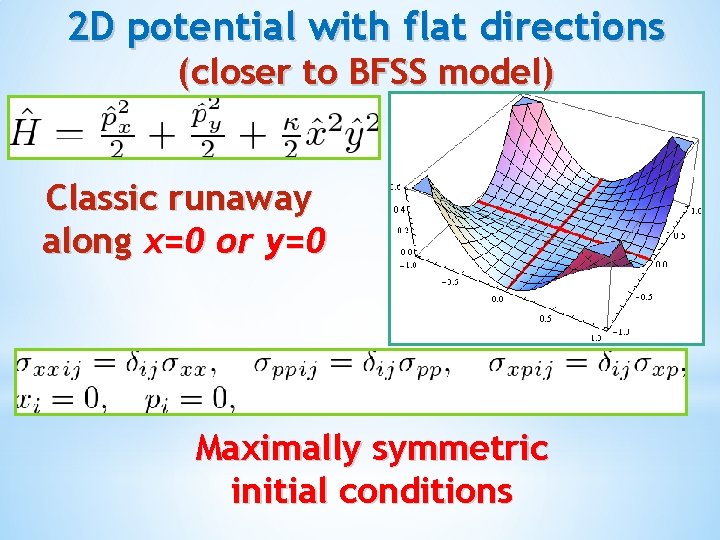
2 D potential with flat directions (closer to BFSS model) Classic runaway along x=0 or y=0 Maximally symmetric initial conditions
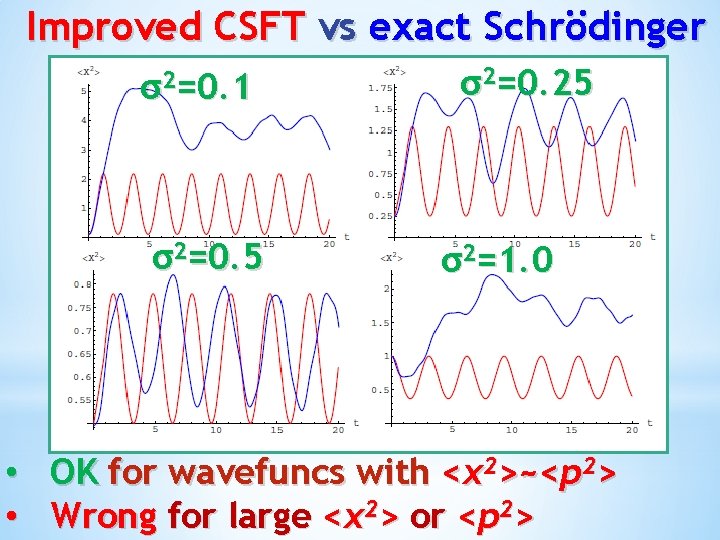
Improved CSFT vs exact Schrödinger σ2=0. 1 σ2=0. 5 σ2=0. 25 σ2=1. 0 • OK for wavefuncs with <x 2>~<p 2> • Wrong for large <x 2> or <p 2>
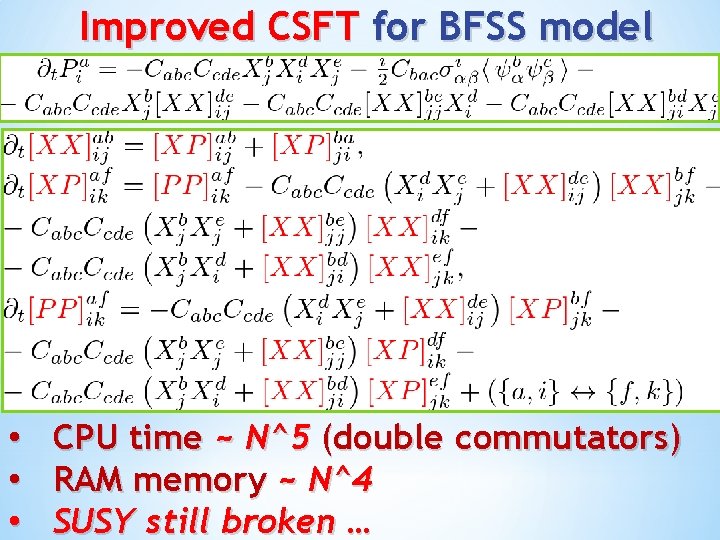
Improved CSFT for BFSS model • • • CPU time ~ N^5 (double commutators) RAM memory ~ N^4 SUSY still broken …
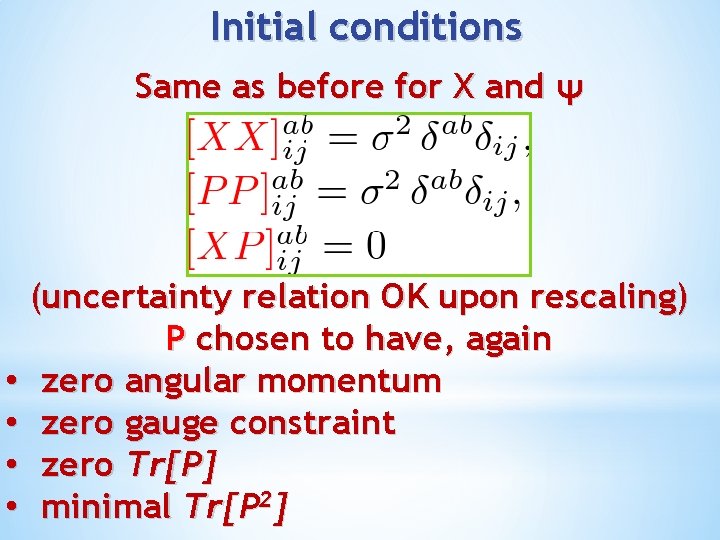
Initial conditions Same as before for X and ψ (uncertainty relation OK upon rescaling) P chosen to have, again • zero angular momentum • zero gauge constraint • zero Tr[P] • minimal Tr[P 2]
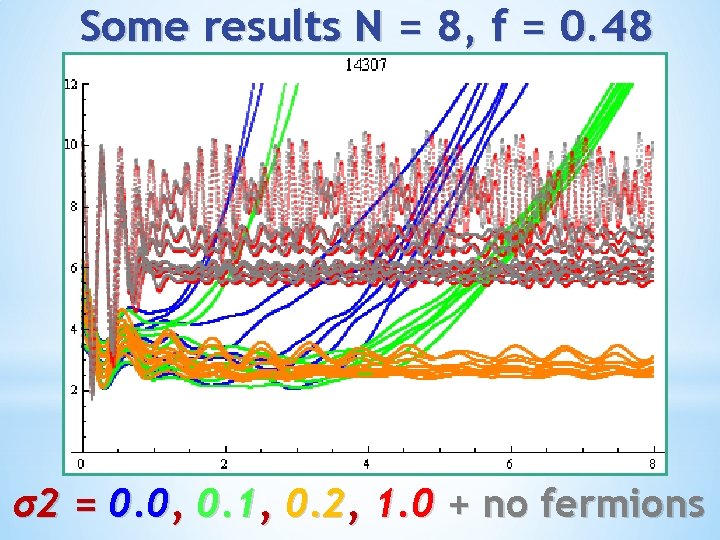
Some results N = 8, f = 0. 48 σ2 = 0. 0, 0. 1, 0. 2, 1. 0 + no fermions
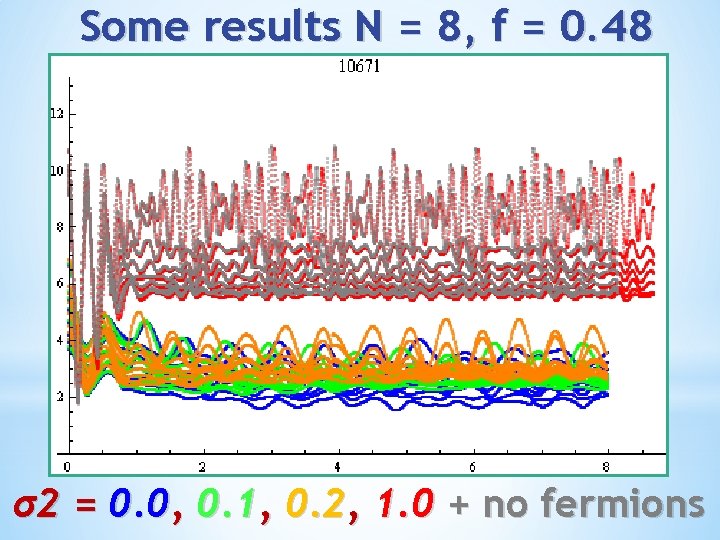
Some results N = 8, f = 0. 48 σ2 = 0. 0, 0. 1, 0. 2, 1. 0 + no fermions
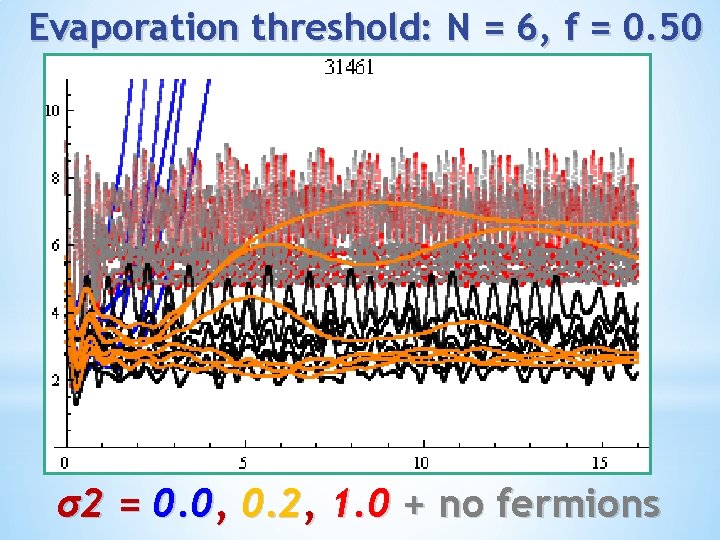
Evaporation threshold: N = 6, f = 0. 50 σ2 = 0. 0, 0. 2, 1. 0 + no fermions
Quantum fluctuations vs evaporation Quantum fluctuations of X variables suppress evaporation!!! • Small σ2: evaporation becomes slower • Intermediate σ2: no evaporation • Large σ2: fermions negligible • Fine-tuning with realistic initial conditions? Exact solutions with high symmetry? What effect quantum fluctuations of X have on classical dynamics?
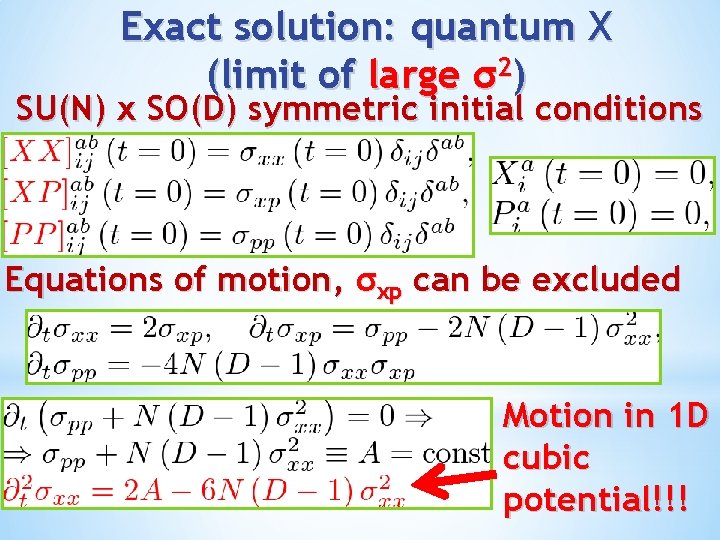
Exact solution: quantum X (limit of large σ2) SU(N) x SO(D) symmetric initial conditions Equations of motion, σxp can be excluded Motion in 1 D cubic potential!!!

Exact solution: quantum X, maxsym Larger than ¼, (uncertainty relation) ü Always periodic oscillations ü Always safely within potential well ü “Quantum” tunnelling only to X 2<0? ? ?
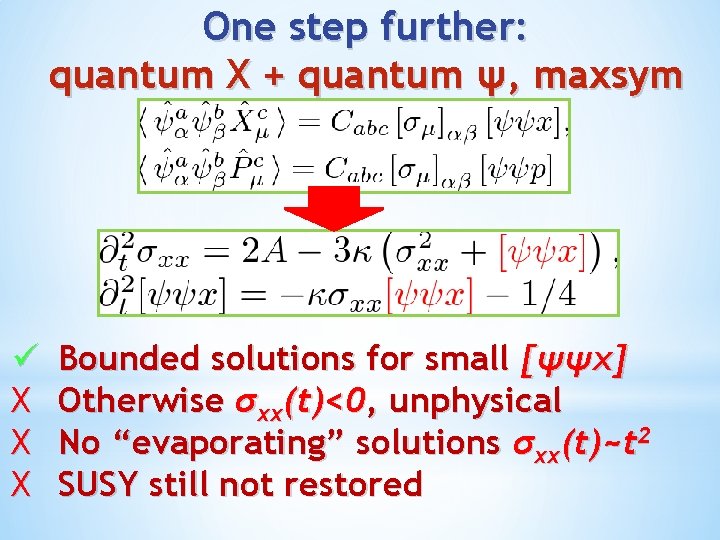
One step further: quantum X + quantum ψ, maxsym ü X X X Bounded solutions for small [ψψx] Otherwise σxx(t)<0, unphysical No “evaporating” solutions σxx(t)~t 2 SUSY still not restored
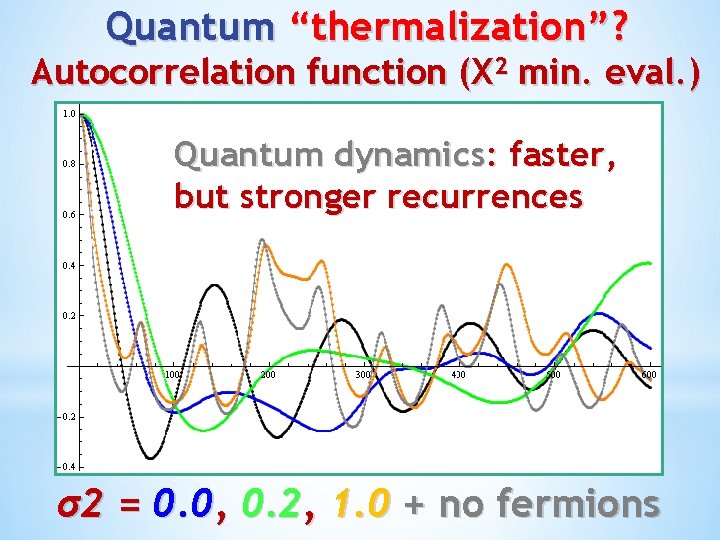
Quantum “thermalization”? Autocorrelation function (X 2 min. eval. ) Quantum dynamics: faster, but stronger recurrences σ2 = 0. 0, 0. 2, 1. 0 + no fermions
Summary • Quantum fermions in BFSS model trigger real-time instability, “black hole evaporation”? • Not all configurations “evaporate” • Artificial acceleration at large distances • Quantum fluctuations of X coordinates suppress instability • Is “fine tuning” possible with realistic initial conditions? • Faster “quantum” thermalization?
- Slides: 33