
Pausal Forms and Prosodic Structure in Tiberian Hebrew
Pausal Forms and Prosodic Structure in Tiberian Hebrew Vincent De. Caen & B. Elan Dresher University of Toronto Montreal-Ottawa-Toronto Phonology/Phonetics Workshop MOT 2018 Mc. Master University, March 24– 25, 2018

Ernest John Revell 1934 -2017 In Memoriam 2
1. Introduction 3
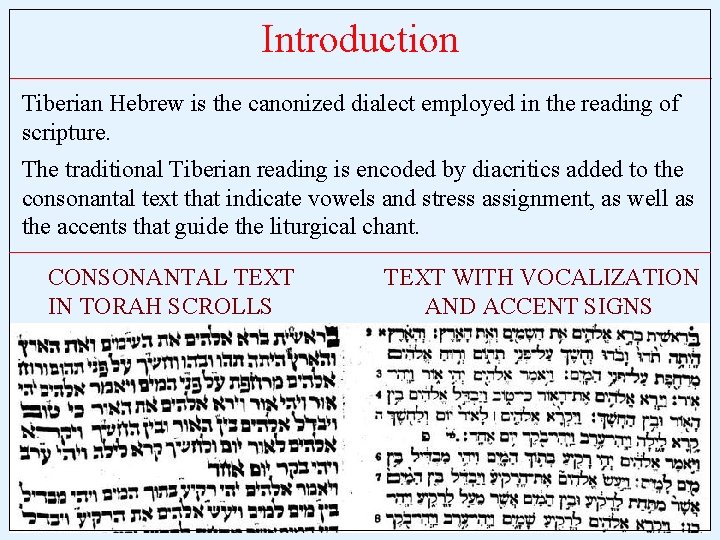
Introduction Tiberian Hebrew is the canonized dialect employed in the reading of scripture. The traditional Tiberian reading is encoded by diacritics added to the consonantal text that indicate vowels and stress assignment, as well as the accents that guide the liturgical chant. CONSONANTAL TEXT IN TORAH SCROLLS TEXT WITH VOCALIZATION AND ACCENT SIGNS 4
Introduction Variation in Tiberian segmental phonology is sensitive to the right edges of units, demarcated by the accents. These domains correspond crosslinguistically to phonological word (clitic group), phonological phrase, intonational phrase, and utterance. Hence the accents provide a detailed prosodic representation as well as a guide to the liturgical chant. 5
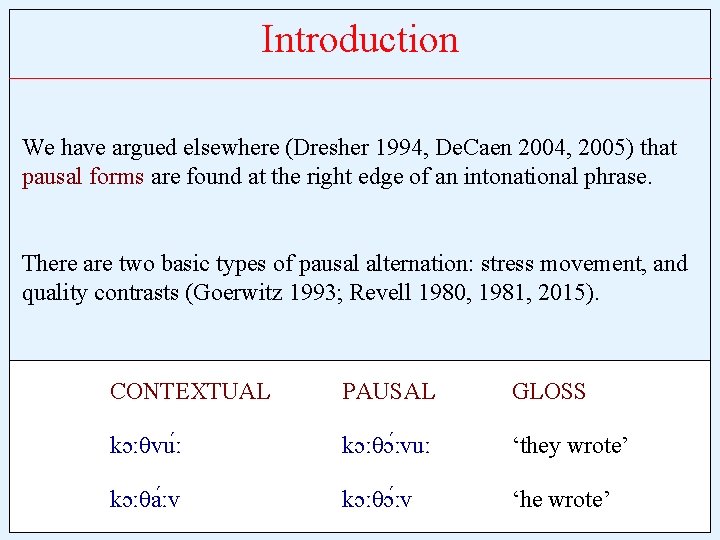
Introduction We have argued elsewhere (Dresher 1994, De. Caen 2004, 2005) that pausal forms are found at the right edge of an intonational phrase. There are two basic types of pausal alternation: stress movement, and quality contrasts (Goerwitz 1993; Revell 1980, 1981, 2015). CONTEXTUAL PAUSAL GLOSS kɔːθvu ː kɔːθɔ ːvuː ‘they wrote’ kɔːθa ːv kɔːθɔ ːv ‘he wrote’ 6
Introduction One might assume that there is a consistent correlation between the pausal forms and particular accents. That assumption is wrong: the accentual phrasing does not predict where pausal forms are found. Hence the longstanding conundrum: why isn’t pause coordinated with the prosodic representation? Revell (2015) examines cases where pausal and accentual representations apparently diverge. On the basis of such contradictions, he argues that pauses were fixed at an earlier stage than the accents: two stages, and perhaps two reading traditions. 7
Introduction We will propose a theory of how pausal forms, ex hypothesi marking the right edges of intonational phrases, came to co-exist with a prosodic structure that does not suit them. We argue that the mismatch between pausal forms and accentual phrasing is inevitable because of the design of the accent system. Mismatches are not due to two different traditions, rather to a flaw in the Tiberian theory of prosodic structure. 8
2. Prosodic representation: Phonological and intonational phrases 9
The prosodic hierarchy Prosodic representation mediates the relationship between phonology and syntax. On this view, a prosodic hierarchy organizes domains in which phonological rules operate. Thus, Selkirk (1984; 1986); Nespor & Vogel (1986); Hayes (1989). 10
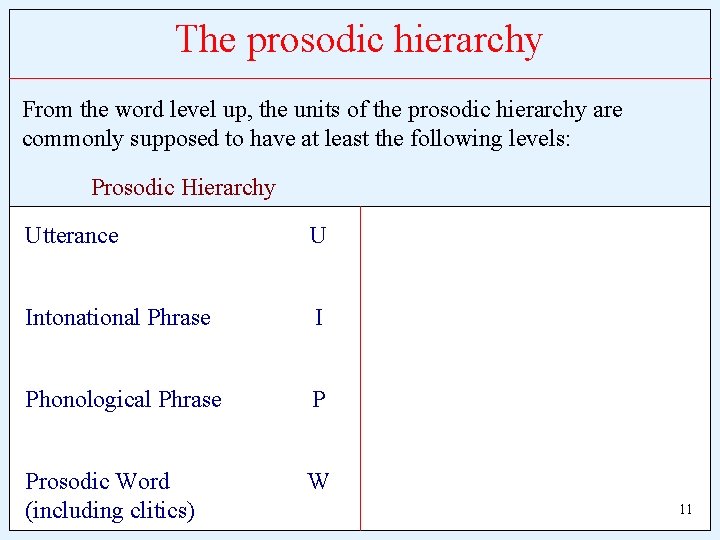
The prosodic hierarchy From the word level up, the units of the prosodic hierarchy are commonly supposed to have at least the following levels: Prosodic Hierarchy Utterance U Intonational Phrase I Phonological Phrase P Prosodic Word (including clitics) W 11
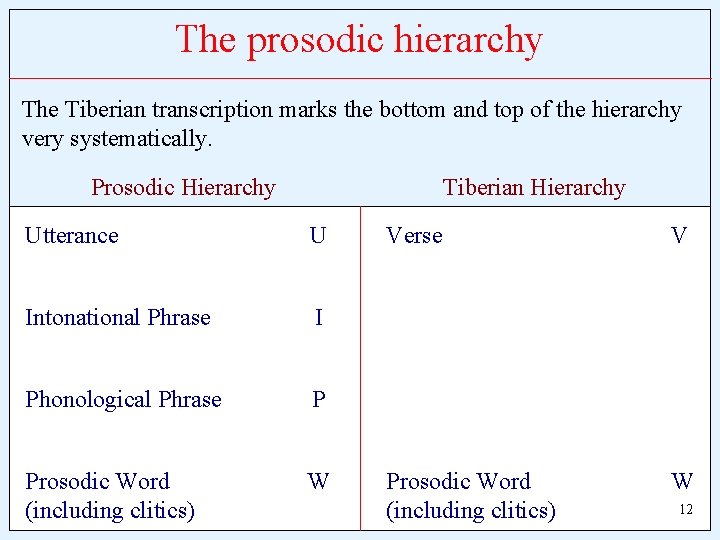
The prosodic hierarchy The Tiberian transcription marks the bottom and top of the hierarchy very systematically. Prosodic Hierarchy Tiberian Hierarchy Utterance U Intonational Phrase I Phonological Phrase P Prosodic Word (including clitics) W Verse V Prosodic Word (including clitics) W 12
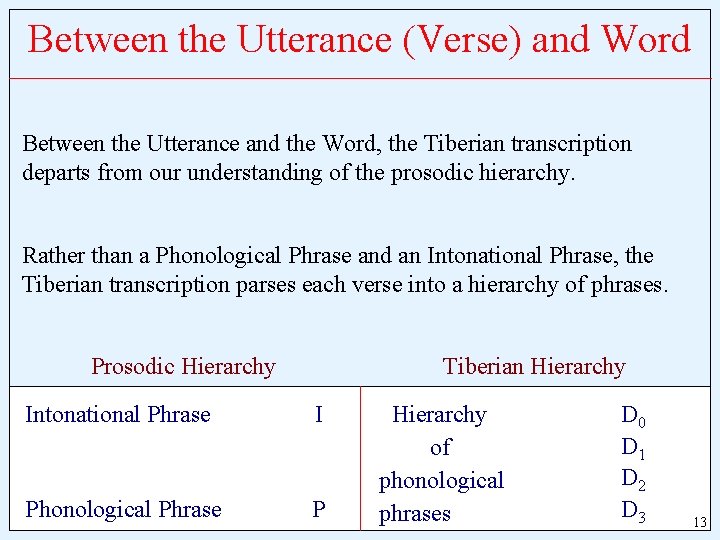
Between the Utterance (Verse) and Word Between the Utterance and the Word, the Tiberian transcription departs from our understanding of the prosodic hierarchy. Rather than a Phonological Phrase and an Intonational Phrase, the Tiberian transcription parses each verse into a hierarchy of phrases. Prosodic Hierarchy Tiberian Hierarchy Intonational Phrase I Phonological Phrase P Hierarchy of phonological phrases D 0 D 1 D 2 D 3 13
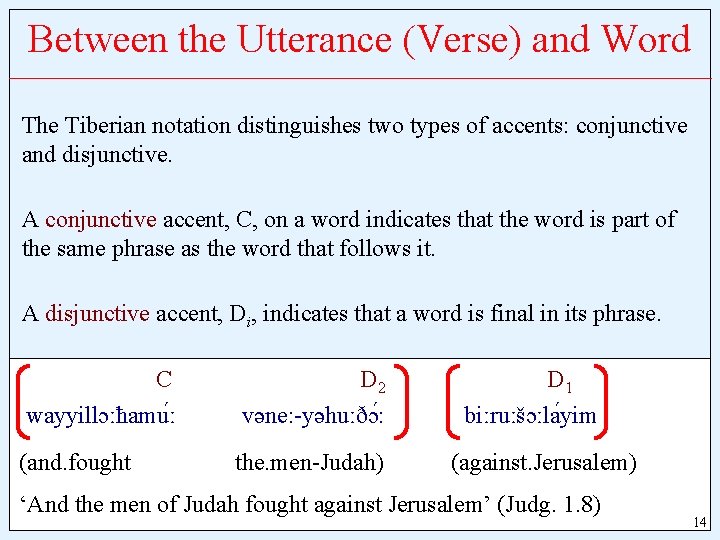
Between the Utterance (Verse) and Word The Tiberian notation distinguishes two types of accents: conjunctive and disjunctive. A conjunctive accent, C, on a word indicates that the word is part of the same phrase as the word that follows it. A disjunctive accent, Di, indicates that a word is final in its phrase. C wayyillɔːħamu ː (and. fought D 2 vəne: -yəhuːðɔ : the. men-Judah) D 1 biːruːšɔːla yim (against. Jerusalem) ‘And the men of Judah fought against Jerusalem’ (Judg. 1. 8) 14
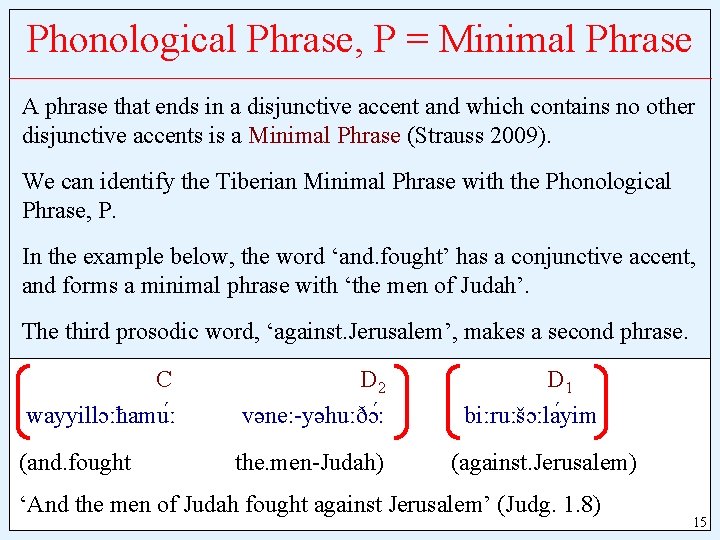
Phonological Phrase, P = Minimal Phrase A phrase that ends in a disjunctive accent and which contains no other disjunctive accents is a Minimal Phrase (Strauss 2009). We can identify the Tiberian Minimal Phrase with the Phonological Phrase, P. In the example below, the word ‘and. fought’ has a conjunctive accent, and forms a minimal phrase with ‘the men of Judah’. The third prosodic word, ‘against. Jerusalem’, makes a second phrase. C wayyillɔːħamu ː (and. fought D 2 vəne: -yəhuːðɔ : the. men-Judah) D 1 biːruːšɔːla yim (against. Jerusalem) ‘And the men of Judah fought against Jerusalem’ (Judg. 1. 8) 15
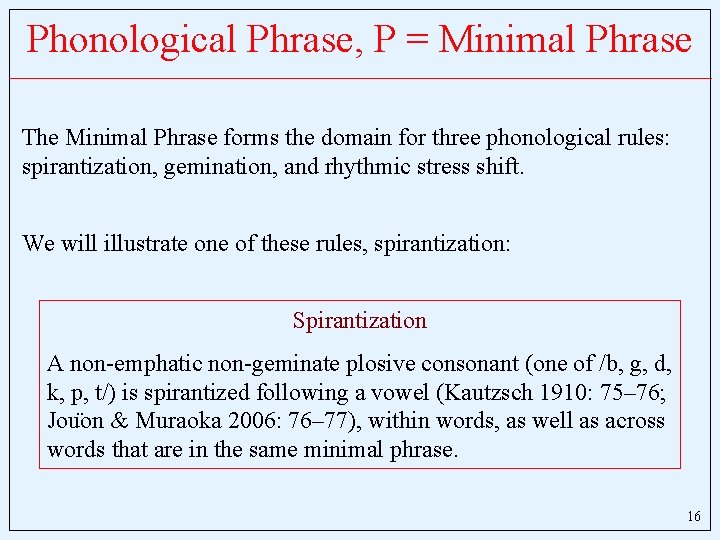
Phonological Phrase, P = Minimal Phrase The Minimal Phrase forms the domain for three phonological rules: spirantization, gemination, and rhythmic stress shift. We will illustrate one of these rules, spirantization: Spirantization A non-emphatic non-geminate plosive consonant (one of /b, g, d, k, p, t/) is spirantized following a vowel (Kautzsch 1910: 75– 76; Jou on & Muraoka 2006: 76– 77), within words, as well as across words that are in the same minimal phrase. 16
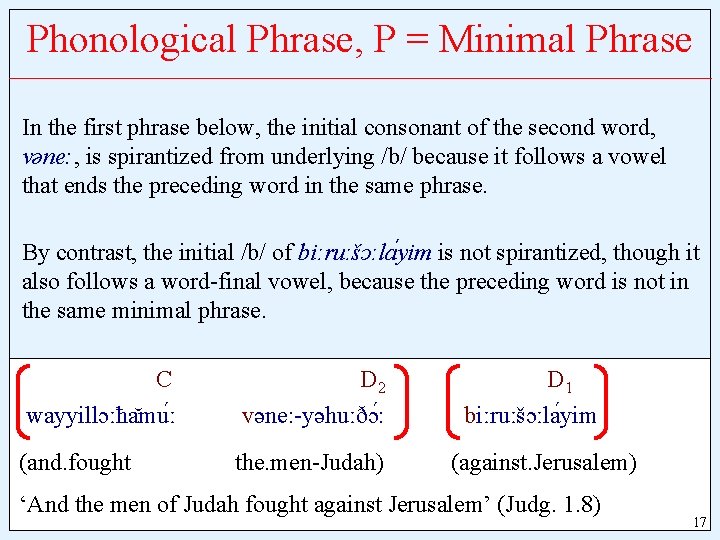
Phonological Phrase, P = Minimal Phrase In the first phrase below, the initial consonant of the second word, vəne: , is spirantized from underlying /b/ because it follows a vowel that ends the preceding word in the same phrase. By contrast, the initial /b/ of biːruːšɔːla yim is not spirantized, though it also follows a word-final vowel, because the preceding word is not in the same minimal phrase. C wayyillɔːħa mu ː (and. fought D 2 vəne: -yəhuːðɔ : the. men-Judah) D 1 biːruːšɔːla yim (against. Jerusalem) ‘And the men of Judah fought against Jerusalem’ (Judg. 1. 8) 17
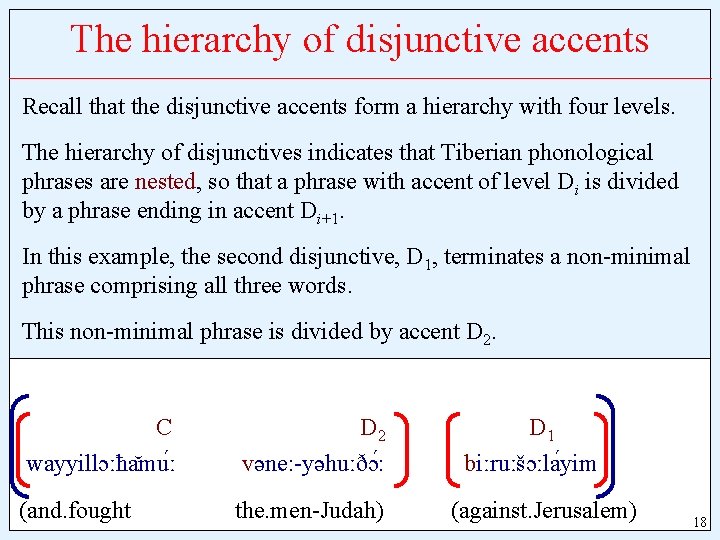
The hierarchy of disjunctive accents Recall that the disjunctive accents form a hierarchy with four levels. The hierarchy of disjunctives indicates that Tiberian phonological phrases are nested, so that a phrase with accent of level Di is divided by a phrase ending in accent Di+1. In this example, the second disjunctive, D 1, terminates a non-minimal phrase comprising all three words. This non-minimal phrase is divided by accent D 2. C wayyillɔːħa mu ː (and. fought D 2 vəne: -yəhuːðɔ : the. men-Judah) D 1 biːruːšɔːla yim (against. Jerusalem) 18

The hierarchy of disjunctive accents The prosodic structure can be represented as a tree, where a phrase ending in a disjunctive Di is itself labelled Di. Here, the inner phrase is labelled D 2, and the entire phrase is a D 1 D 2 C wayyillɔːħa mu ː (and. fought D 2 vəne: -yəhuːðɔ : the. men-Judah) D 1 biːruːšɔːla yim (against. Jerusalem) 19
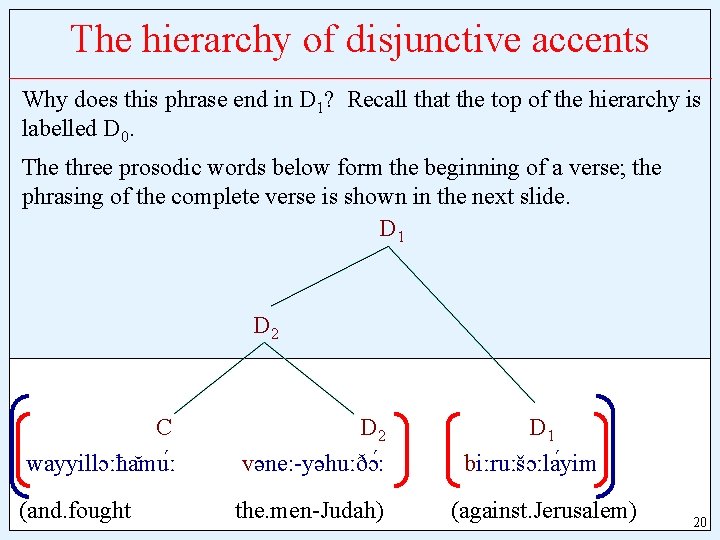
The hierarchy of disjunctive accents Why does this phrase end in D 1? Recall that the top of the hierarchy is labelled D 0. The three prosodic words below form the beginning of a verse; the phrasing of the complete verse is shown in the next slide. D 1 D 2 C wayyillɔːħa mu ː (and. fought D 2 vəne: -yəhuːðɔ : the. men-Judah) D 1 biːruːšɔːla yim (against. Jerusalem) 20
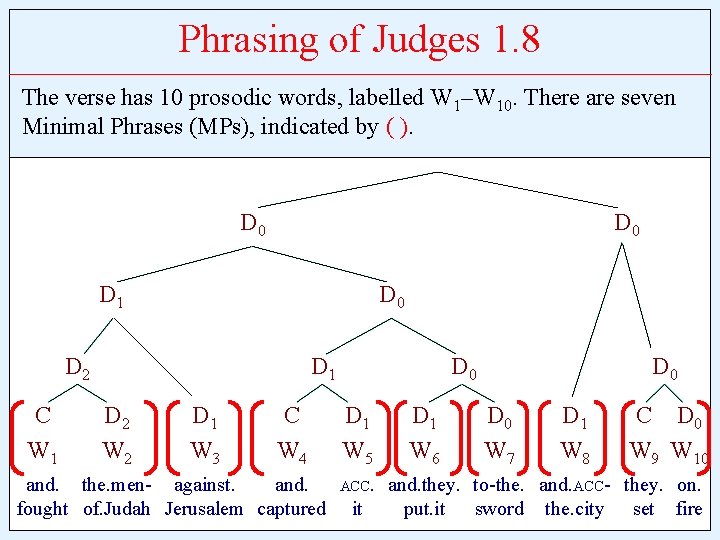
Phrasing of Judges 1. 8 The verse has 10 prosodic words, labelled W 1–W 10. There are seven Minimal Phrases (MPs), indicated by ( ). D 0 D 1 D 0 D 2 C W 1 D 2 W 2 D 1 W 3 C W 4 and. the. men- against. and. fought of. Judah Jerusalem captured D 0 D 1 W 5 ACC. it D 1 W 6 D 0 W 7 D 1 W 8 C D 0 W 9 W 10 and. they. to-the. and. ACC- they. on. put. it sword the. city set fire
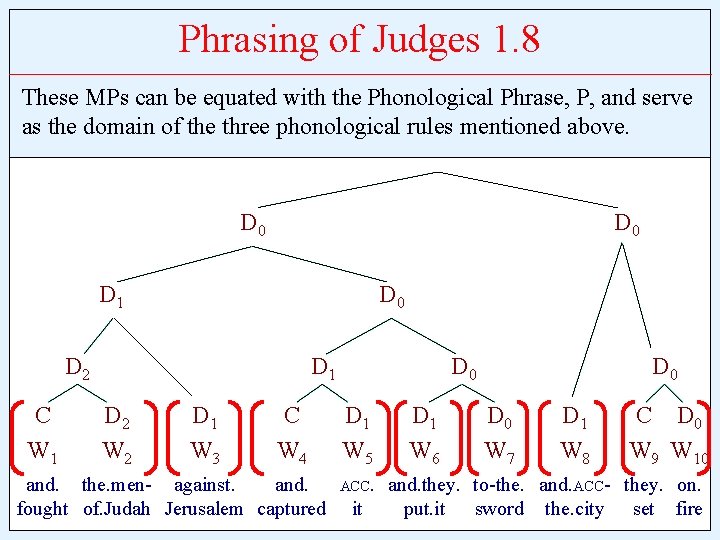
Phrasing of Judges 1. 8 These MPs can be equated with the Phonological Phrase, P, and serve as the domain of the three phonological rules mentioned above. D 0 D 1 D 0 D 2 C W 1 D 2 W 2 D 1 W 3 C W 4 and. the. men- against. and. fought of. Judah Jerusalem captured D 0 D 1 W 5 ACC. it D 1 W 6 D 0 W 7 D 1 W 8 C D 0 W 9 W 10 and. they. to-the. and. ACC- they. on. put. it sword the. city set fire
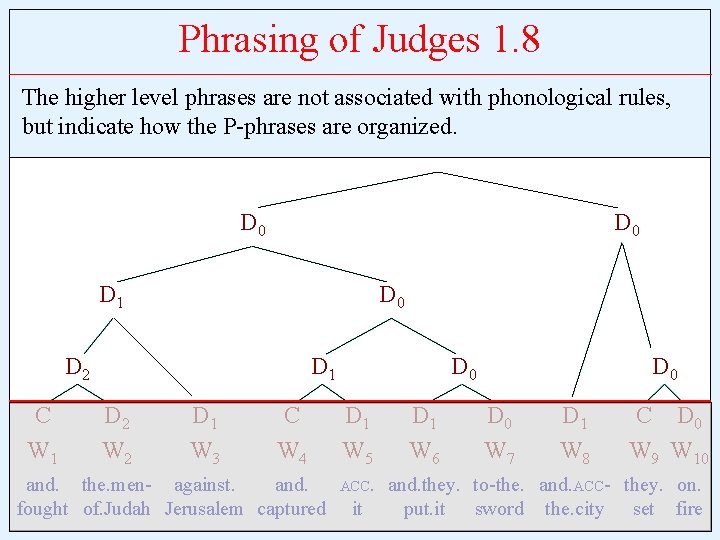
Phrasing of Judges 1. 8 The higher level phrases are not associated with phonological rules, but indicate how the P-phrases are organized. D 0 D 1 D 0 D 2 C W 1 D 2 W 2 D 1 W 3 C W 4 and. the. men- against. and. fought of. Judah Jerusalem captured D 0 D 1 W 5 ACC. it D 1 W 6 D 0 W 7 D 1 W 8 C D 0 W 9 W 10 and. they. to-the. and. ACC- they. on. put. it sword the. city set fire
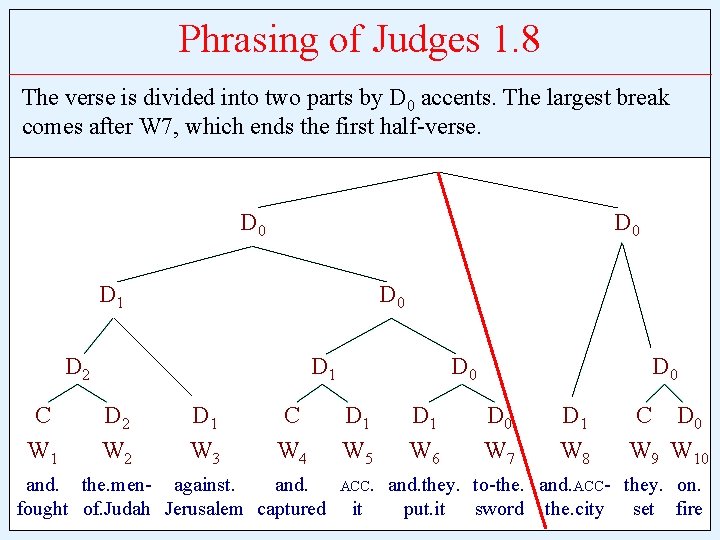
Phrasing of Judges 1. 8 The verse is divided into two parts by D 0 accents. The largest break comes after W 7, which ends the first half-verse. D 0 D 1 D 0 D 2 C W 1 D 2 W 2 D 1 W 3 C W 4 and. the. men- against. and. fought of. Judah Jerusalem captured D 0 D 1 W 5 ACC. it D 1 W 6 D 0 W 7 D 1 W 8 C D 0 W 9 W 10 and. they. to-the. and. ACC- they. on. put. it sword the. city set fire
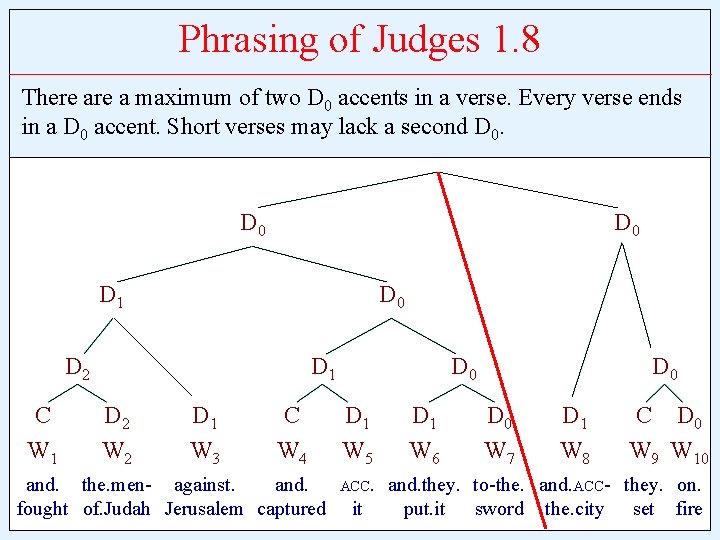
Phrasing of Judges 1. 8 There a maximum of two D 0 accents in a verse. Every verse ends in a D 0 accent. Short verses may lack a second D 0 D 1 D 0 D 2 C W 1 D 2 W 2 D 1 W 3 C W 4 and. the. men- against. and. fought of. Judah Jerusalem captured D 0 D 1 W 5 ACC. it D 1 W 6 D 0 W 7 D 1 W 8 C D 0 W 9 W 10 and. they. to-the. and. ACC- they. on. put. it sword the. city set fire
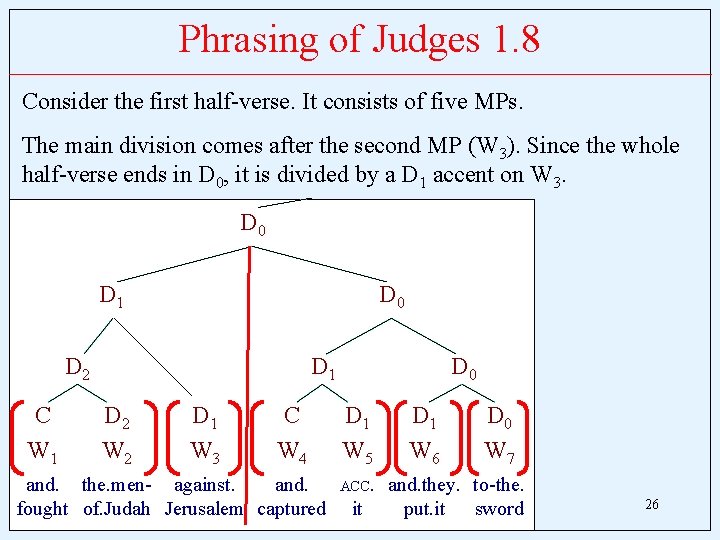
Phrasing of Judges 1. 8 Consider the first half-verse. It consists of five MPs. The main division comes after the second MP (W 3). Since the whole half-verse ends in D 0, it is divided by a D 1 accent on W 3. D 0 D 1 D 0 D 2 C W 1 D 2 W 2 D 1 W 3 C W 4 and. the. men- against. and. fought of. Judah Jerusalem captured D 0 D 1 W 5 ACC. it D 1 W 6 D 0 W 7 and. they. to-the. put. it sword 26
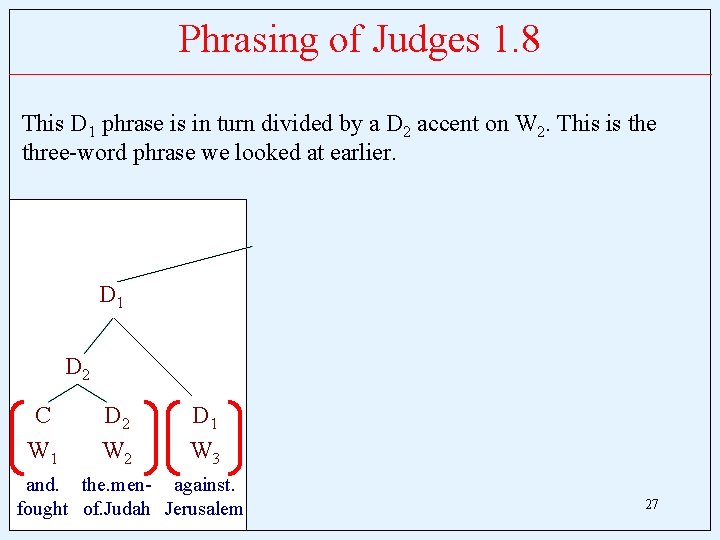
Phrasing of Judges 1. 8 This D 1 phrase is in turn divided by a D 2 accent on W 2. This is the three-word phrase we looked at earlier. D 1 D 2 C W 1 D 2 W 2 D 1 W 3 and. the. men- against. fought of. Judah Jerusalem 27
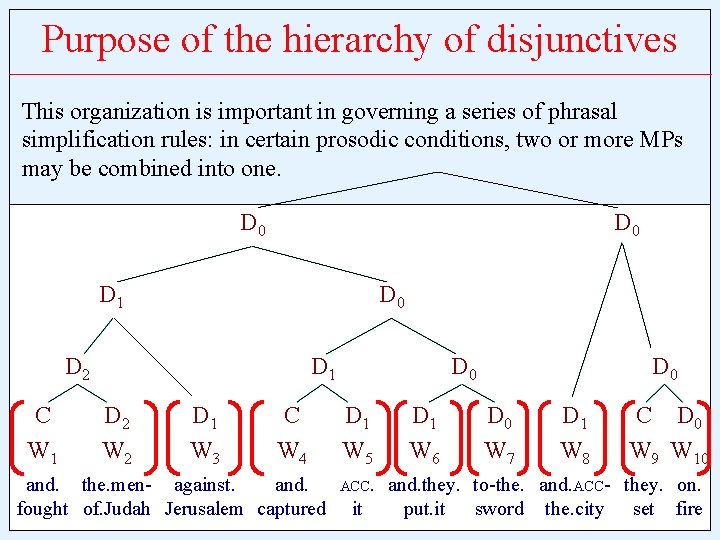
Purpose of the hierarchy of disjunctives This organization is important in governing a series of phrasal simplification rules: in certain prosodic conditions, two or more MPs may be combined into one. D 0 D 1 D 0 D 2 C W 1 D 2 W 2 D 1 W 3 C W 4 and. the. men- against. and. fought of. Judah Jerusalem captured D 0 D 1 W 5 ACC. it D 1 W 6 D 0 W 7 D 1 W 8 C D 0 W 9 W 10 and. they. to-the. and. ACC- they. on. put. it sword the. city set fire
3. Pausal forms and the Intonational Phrase 29
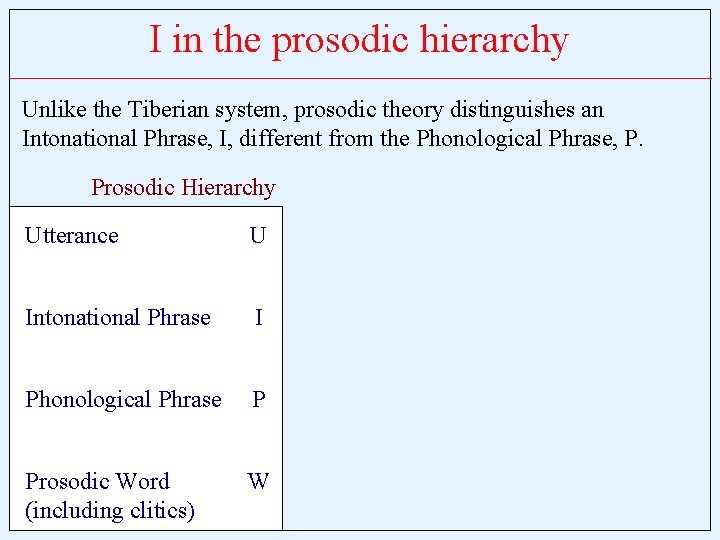
I in the prosodic hierarchy Unlike the Tiberian system, prosodic theory distinguishes an Intonational Phrase, I, different from the Phonological Phrase, P. Prosodic Hierarchy Utterance U Intonational Phrase I Phonological Phrase P Prosodic Word (including clitics) W

The Intonational Phrase, I, is the domain of the intonation contour. The right-edge of such phrases coincides with pausal positions. It is observed that certain syntactic structures induce the pause of an intonational phrase. The most relevant for the Hebrew text are lists and non-restrictive relative clauses. Pausal positions are not determined entirely by the syntax. Prosodic factors such as speech tempo, and rhetorical pause and emphasis also play a role. 31
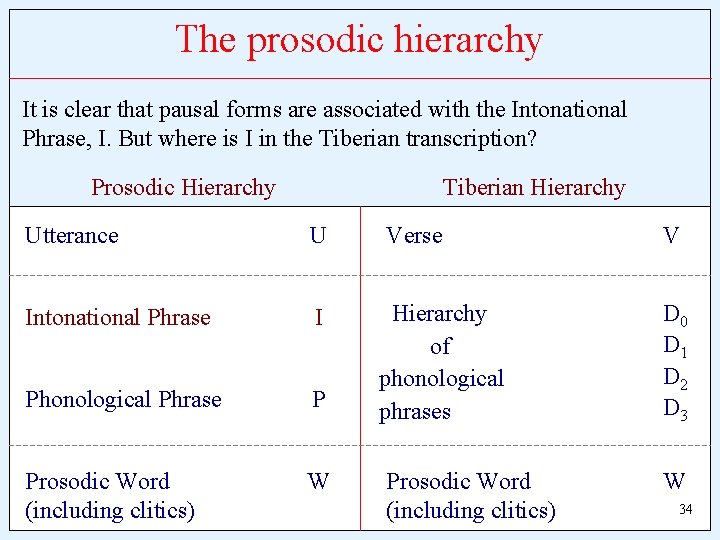
The prosodic hierarchy It is clear that pausal forms are associated with the Intonational Phrase, I. But where is I in the Tiberian transcription? Prosodic Hierarchy Tiberian Hierarchy Utterance U Verse V Intonational Phrase I Phonological Phrase P Hierarchy of phonological phrases D 0 D 1 D 2 D 3 Prosodic Word (including clitics) W 34
4. Why pausal forms cannot align with the Tiberian system of accents 35
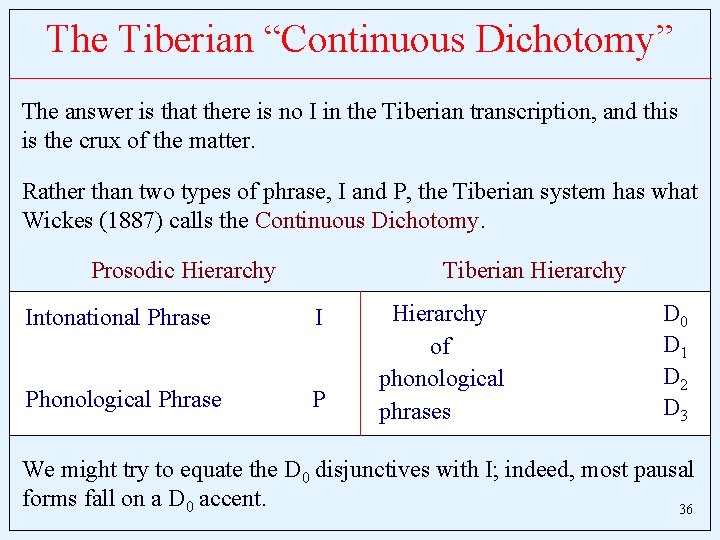
The Tiberian “Continuous Dichotomy” The answer is that there is no I in the Tiberian transcription, and this is the crux of the matter. Rather than two types of phrase, I and P, the Tiberian system has what Wickes (1887) calls the Continuous Dichotomy. Prosodic Hierarchy Tiberian Hierarchy Intonational Phrase I Phonological Phrase P Hierarchy of phonological phrases D 0 D 1 D 2 D 3 We might try to equate the D 0 disjunctives with I; indeed, most pausal forms fall on a D 0 accent. 36
The Tiberian “Continuous Dichotomy” The problem is that there are only, at most, two D 0 accents for each verse; but I-phrases are not limited in this way. We can include lower-level disjunctive accents as also representing I; but this would fail to account for the fact that these accents are more commonly associated with contextual forms. The Tiberian system simply does not have the flexibility to represent I -phrases in whatever part of the prosodic tree that they may occur in, due to the vagaries of the syntactic, semantic, and prosodic factors that are associated with I-phrases. 37
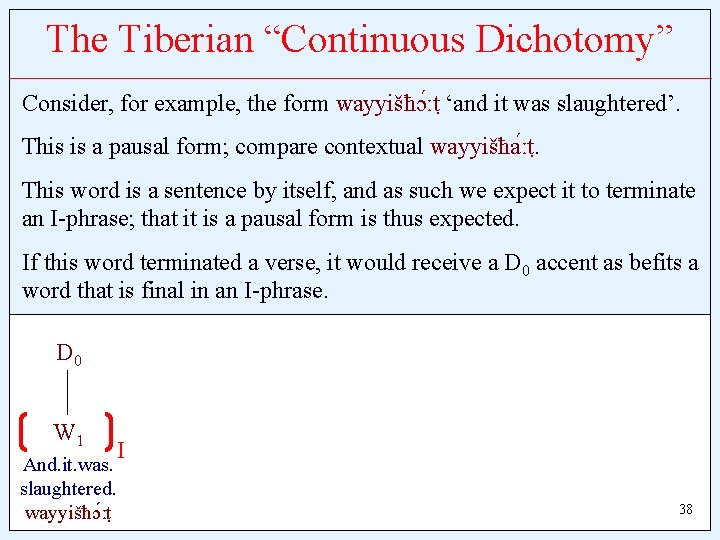
The Tiberian “Continuous Dichotomy” Consider, for example, the form wayyišħɔ ːṭ ‘and it was slaughtered’. This is a pausal form; compare contextual wayyišħa ːṭ. This word is a sentence by itself, and as such we expect it to terminate an I-phrase; that it is a pausal form is thus expected. If this word terminated a verse, it would receive a D 0 accent as befits a word that is final in an I-phrase. D 0 W 1 And. it. was. slaughtered. wayyišħɔ ːṭ I 38
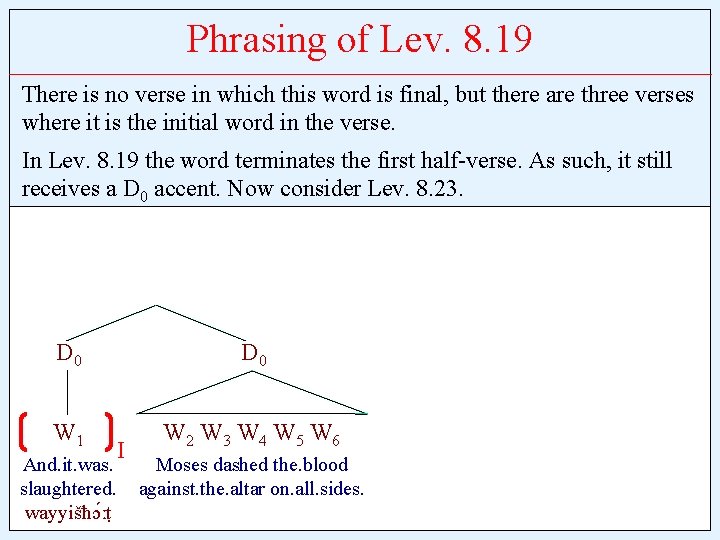
Phrasing of Lev. 8. 19 There is no verse in which this word is final, but there are three verses where it is the initial word in the verse. In Lev. 8. 19 the word terminates the first half-verse. As such, it still receives a D 0 accent. Now consider Lev. 8. 23. D 0 W 1 W 2 W 3 W 4 W 5 W 6 And. it. was. slaughtered. wayyišħɔ ːṭ I Moses dashed the. blood against. the. altar on. all. sides.
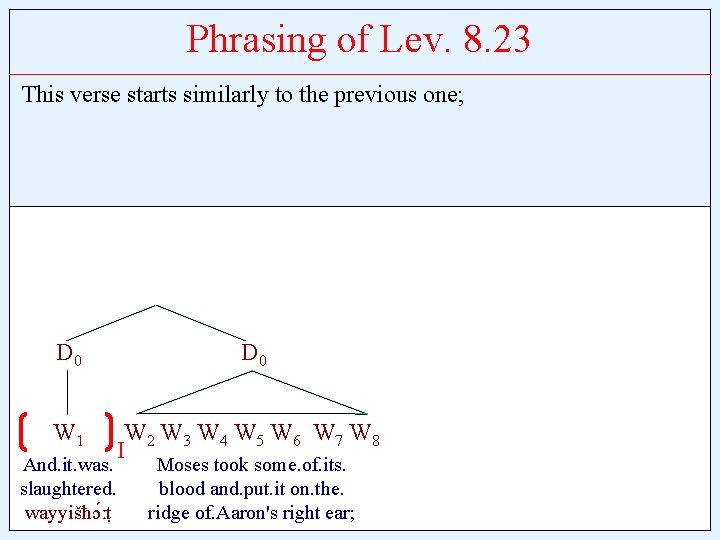
Phrasing of Lev. 8. 23 This verse starts similarly to the previous one; D 0 W 1 W 2 W 3 W 4 W 5 W 6 W 7 W 8 I And. it. was. slaughtered. wayyišħɔ ːṭ Moses took some. of. its. blood and. put. it on. the. ridge of. Aaron's right ear;
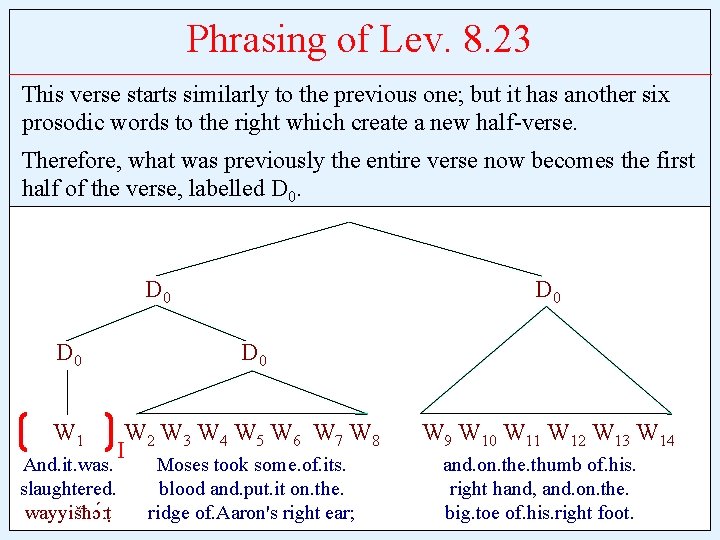
Phrasing of Lev. 8. 23 This verse starts similarly to the previous one; but it has another six prosodic words to the right which create a new half-verse. Therefore, what was previously the entire verse now becomes the first half of the verse, labelled D 0 D 0 W 1 W 2 W 3 W 4 W 5 W 6 W 7 W 8 I And. it. was. slaughtered. wayyišħɔ ːṭ Moses took some. of. its. blood and. put. it on. the. ridge of. Aaron's right ear; W 9 W 10 W 11 W 12 W 13 W 14 and. on. the. thumb of. his. right hand, and. on. the. big. toe of. his. right foot.
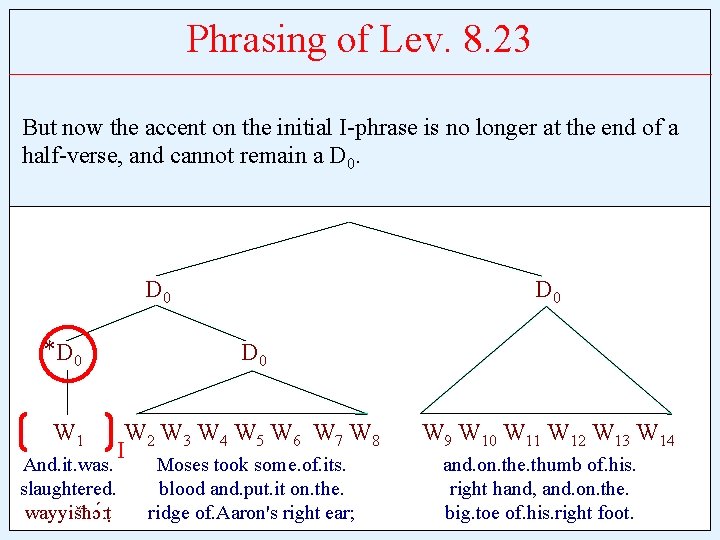
Phrasing of Lev. 8. 23 But now the accent on the initial I-phrase is no longer at the end of a half-verse, and cannot remain a D 0 * D 0 W 1 W 2 W 3 W 4 W 5 W 6 W 7 W 8 I And. it. was. slaughtered. wayyišħɔ ːṭ Moses took some. of. its. blood and. put. it on. the. ridge of. Aaron's right ear; W 9 W 10 W 11 W 12 W 13 W 14 and. on. the. thumb of. his. right hand, and. on. the. big. toe of. his. right foot.
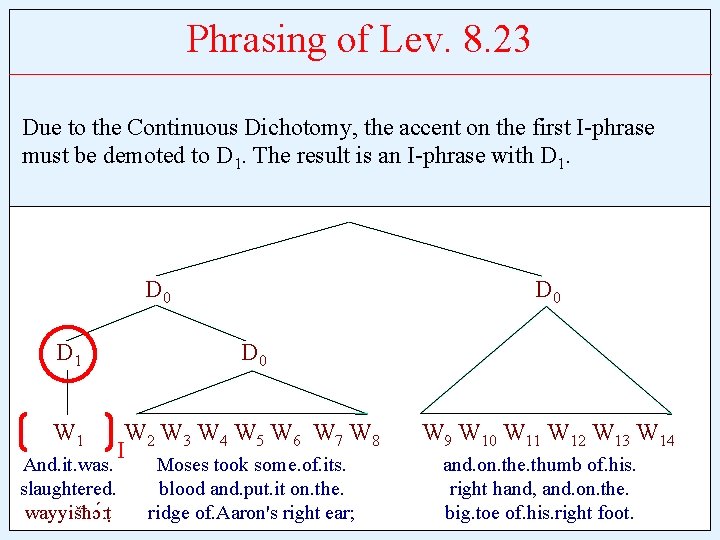
Phrasing of Lev. 8. 23 Due to the Continuous Dichotomy, the accent on the first I-phrase must be demoted to D 1. The result is an I-phrase with D 1. D 0 D 1 D 0 W 1 W 2 W 3 W 4 W 5 W 6 W 7 W 8 I And. it. was. slaughtered. wayyišħɔ ːṭ Moses took some. of. its. blood and. put. it on. the. ridge of. Aaron's right ear; W 9 W 10 W 11 W 12 W 13 W 14 and. on. the. thumb of. his. right hand, and. on. the. big. toe of. his. right foot.
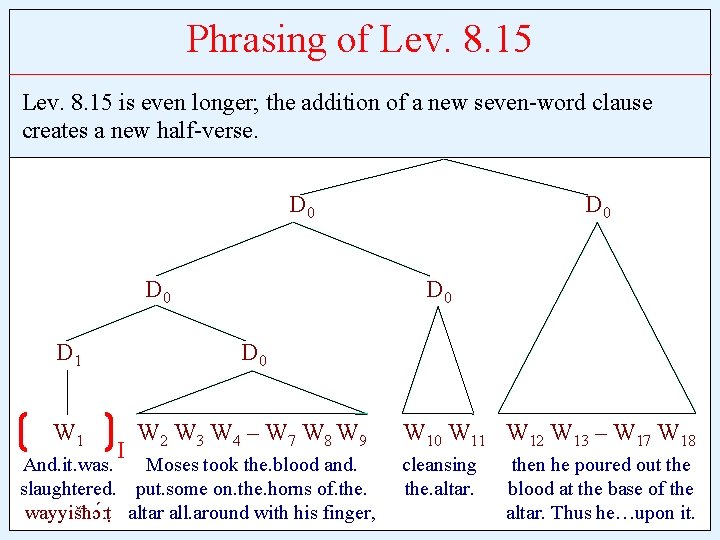
Phrasing of Lev. 8. 15 is even longer; the addition of a new seven-word clause creates a new half-verse. D 0 D 0 D 1 D 0 W 1 W 2 W 3 W 4 – W 7 W 8 W 9 I D 0 And. it. was. Moses took the. blood and. slaughtered. put. some on. the. horns of. the. wayyišħɔ ːṭ altar all. around with his finger, W 10 W 11 W 12 W 13 – W 17 W 18 cleansing the. altar. then he poured out the blood at the base of the altar. Thus he…upon it.
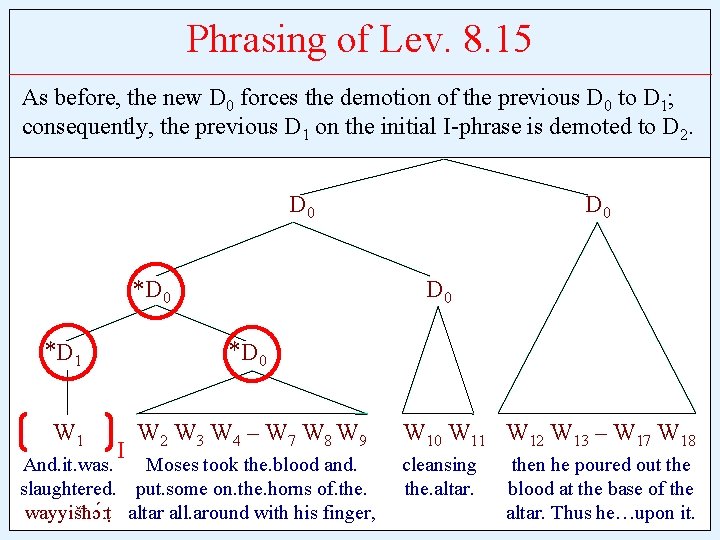
Phrasing of Lev. 8. 15 As before, the new D 0 forces the demotion of the previous D 0 to D 1; consequently, the previous D 1 on the initial I-phrase is demoted to D 2. D 0 * D 1 * D 0 W 1 W 2 W 3 W 4 – W 7 W 8 W 9 I D 0 And. it. was. Moses took the. blood and. slaughtered. put. some on. the. horns of. the. wayyišħɔ ːṭ altar all. around with his finger, W 10 W 11 W 12 W 13 – W 17 W 18 cleansing the. altar. then he poured out the blood at the base of the altar. Thus he…upon it.
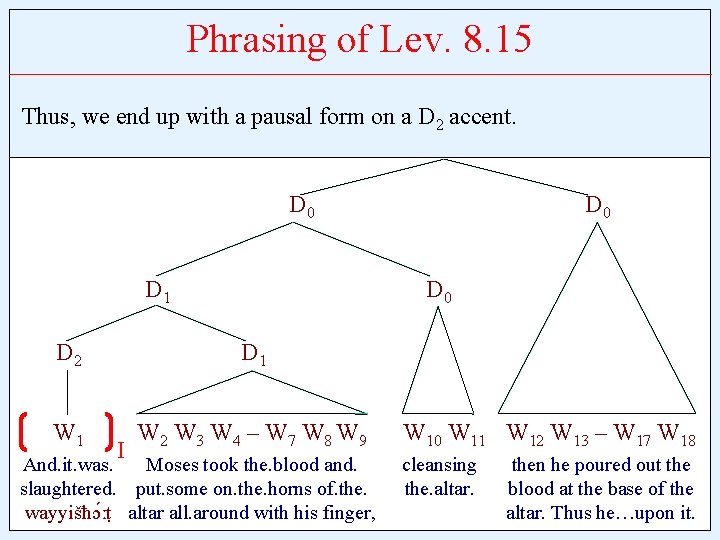
Phrasing of Lev. 8. 15 Thus, we end up with a pausal form on a D 2 accent. D 0 D 1 D 0 D 2 D 1 W 2 W 3 W 4 – W 7 W 8 W 9 I D 0 And. it. was. Moses took the. blood and. slaughtered. put. some on. the. horns of. the. wayyišħɔ ːṭ altar all. around with his finger, W 10 W 11 W 12 W 13 – W 17 W 18 cleansing the. altar. then he poured out the blood at the base of the altar. Thus he…upon it.
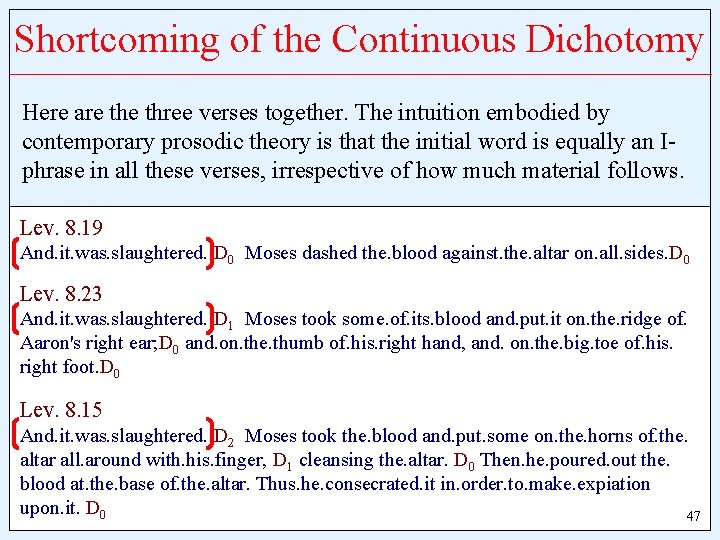
Shortcoming of the Continuous Dichotomy Here are three verses together. The intuition embodied by contemporary prosodic theory is that the initial word is equally an Iphrase in all these verses, irrespective of how much material follows. Lev. 8. 19 And. it. was. slaughtered. D 0 Moses dashed the. blood against. the. altar on. all. sides. D 0 Lev. 8. 23 And. it. was. slaughtered. D 1 Moses took some. of. its. blood and. put. it on. the. ridge of. Aaron's right ear; D 0 and. on. the. thumb of. his. right hand, and. on. the. big. toe of. his. right foot. D 0 Lev. 8. 15 And. it. was. slaughtered. D 2 Moses took the. blood and. put. some on. the. horns of. the. altar all. around with. his. finger, D 1 cleansing the. altar. D 0 Then. he. poured. out the. blood at. the. base of. the. altar. Thus. he. consecrated. it in. order. to. make. expiation upon. it. D 0 47
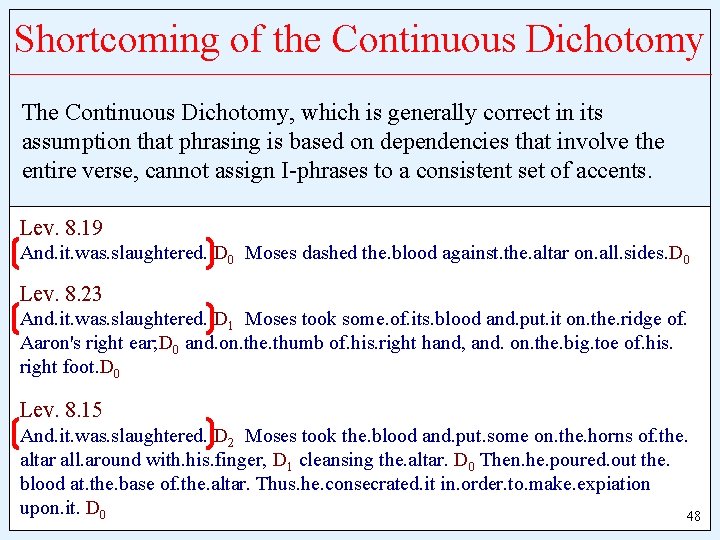
Shortcoming of the Continuous Dichotomy The Continuous Dichotomy, which is generally correct in its assumption that phrasing is based on dependencies that involve the entire verse, cannot assign I-phrases to a consistent set of accents. Lev. 8. 19 And. it. was. slaughtered. D 0 Moses dashed the. blood against. the. altar on. all. sides. D 0 Lev. 8. 23 And. it. was. slaughtered. D 1 Moses took some. of. its. blood and. put. it on. the. ridge of. Aaron's right ear; D 0 and. on. the. thumb of. his. right hand, and. on. the. big. toe of. his. right foot. D 0 Lev. 8. 15 And. it. was. slaughtered. D 2 Moses took the. blood and. put. some on. the. horns of. the. altar all. around with. his. finger, D 1 cleansing the. altar. D 0 Then. he. poured. out the. blood at. the. base of. the. altar. Thus. he. consecrated. it in. order. to. make. expiation upon. it. D 0 48
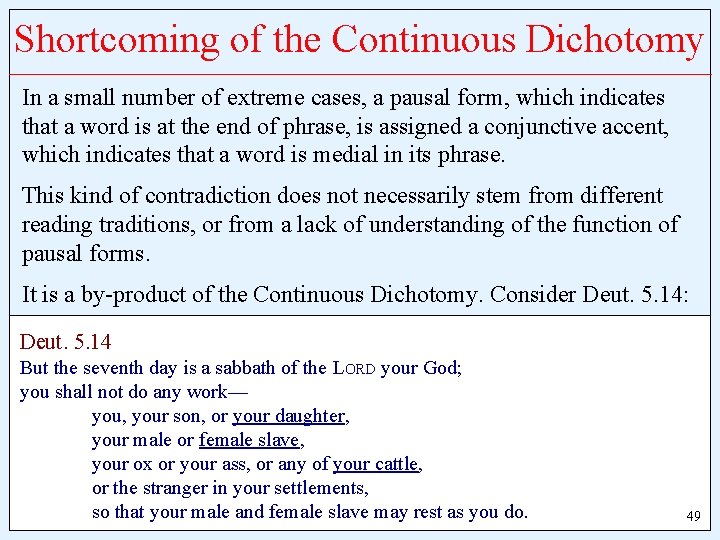
Shortcoming of the Continuous Dichotomy In a small number of extreme cases, a pausal form, which indicates that a word is at the end of phrase, is assigned a conjunctive accent, which indicates that a word is medial in its phrase. This kind of contradiction does not necessarily stem from different reading traditions, or from a lack of understanding of the function of pausal forms. It is a by-product of the Continuous Dichotomy. Consider Deut. 5. 14: Deut. 5. 14 But the seventh day is a sabbath of the LORD your God; you shall not do any work— you, your son, or your daughter, your male or female slave, your ox or your ass, or any of your cattle, or the stranger in your settlements, so that your male and female slave may rest as you do. 49
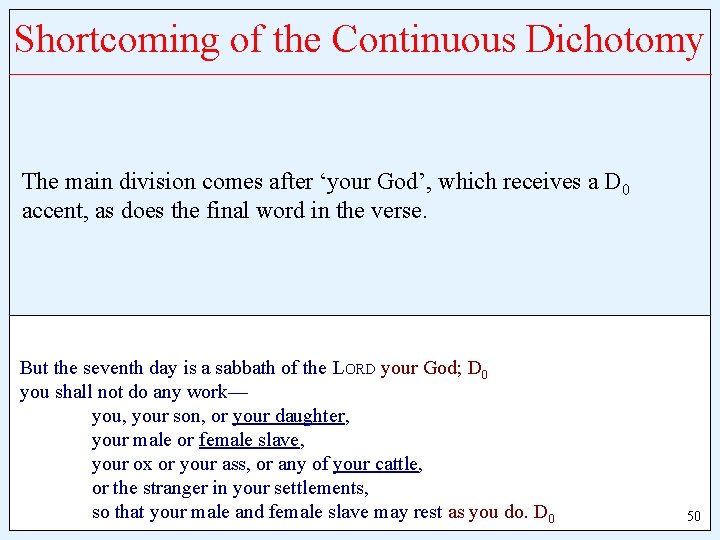
Shortcoming of the Continuous Dichotomy The main division comes after ‘your God’, which receives a D 0 accent, as does the final word in the verse. But the seventh day is a sabbath of the LORD your God; D 0 you shall not do any work— you, your son, or your daughter, your male or female slave, your ox or your ass, or any of your cattle, or the stranger in your settlements, so that your male and female slave may rest as you do. D 0 50
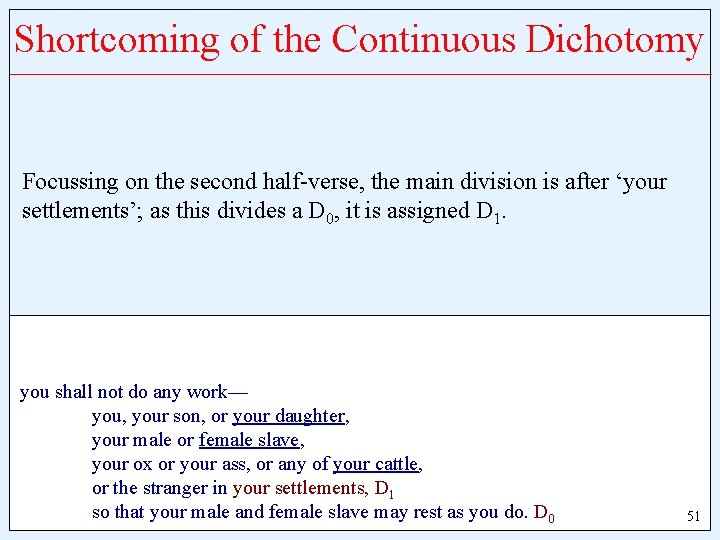
Shortcoming of the Continuous Dichotomy Focussing on the second half-verse, the main division is after ‘your settlements’; as this divides a D 0, it is assigned D 1. you shall not do any work— you, your son, or your daughter, your male or female slave, your ox or your ass, or any of your cattle, or the stranger in your settlements, D 1 so that your male and female slave may rest as you do. D 0 51
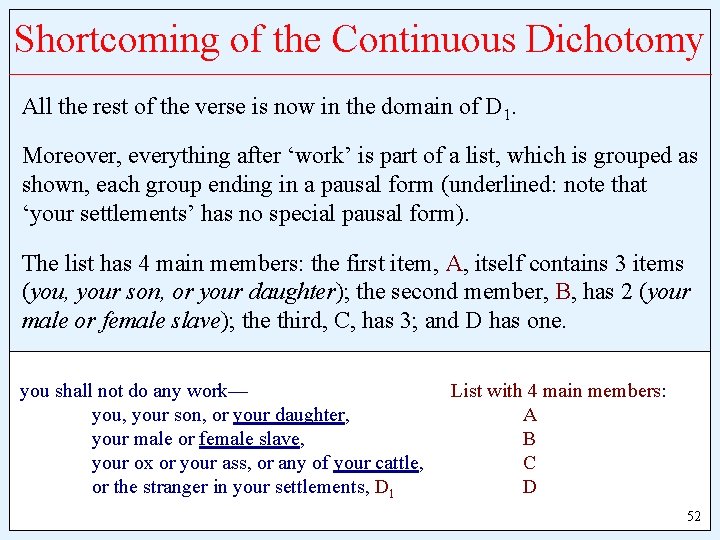
Shortcoming of the Continuous Dichotomy All the rest of the verse is now in the domain of D 1. Moreover, everything after ‘work’ is part of a list, which is grouped as shown, each group ending in a pausal form (underlined: note that ‘your settlements’ has no special pausal form). The list has 4 main members: the first item, A, itself contains 3 items (you, your son, or your daughter); the second member, B, has 2 (your male or female slave); the third, C, has 3; and D has one. you shall not do any work— you, your son, or your daughter, your male or female slave, your ox or your ass, or any of your cattle, or the stranger in your settlements, D 1 List with 4 main members: A B C D 52
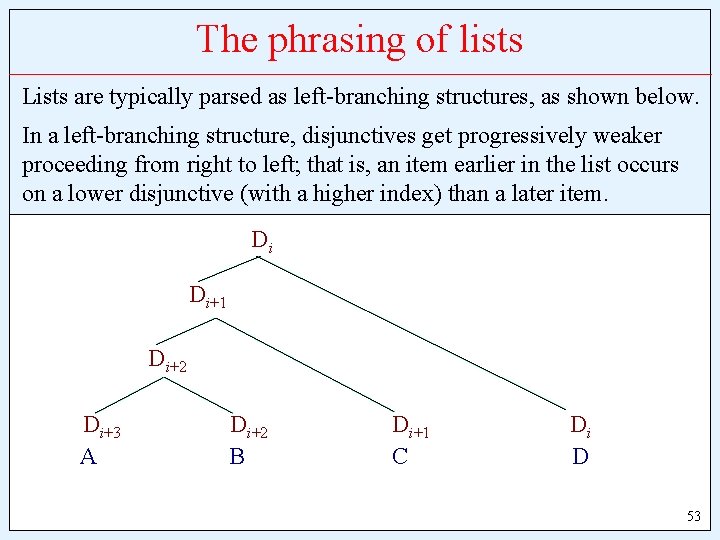
The phrasing of lists Lists are typically parsed as left-branching structures, as shown below. In a left-branching structure, disjunctives get progressively weaker proceeding from right to left; that is, an item earlier in the list occurs on a lower disjunctive (with a higher index) than a later item. Di Di+1 Di+2 Di+3 A Di+2 B Di+1 C Di D 53
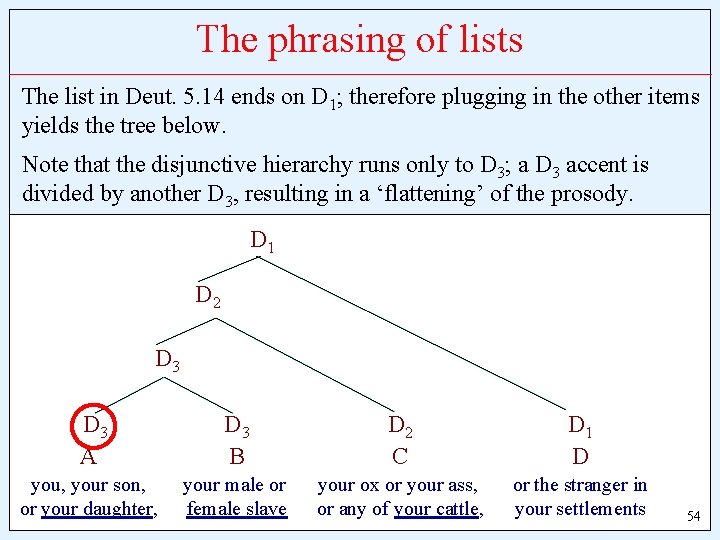
The phrasing of lists The list in Deut. 5. 14 ends on D 1; therefore plugging in the other items yields the tree below. Note that the disjunctive hierarchy runs only to D 3; a D 3 accent is divided by another D 3, resulting in a ‘flattening’ of the prosody. D 1 D 2 D 3 A D 3 B D 2 C D 1 D you, your son, or your daughter, your male or female slave your ox or your ass, or any of your cattle, or the stranger in your settlements 54
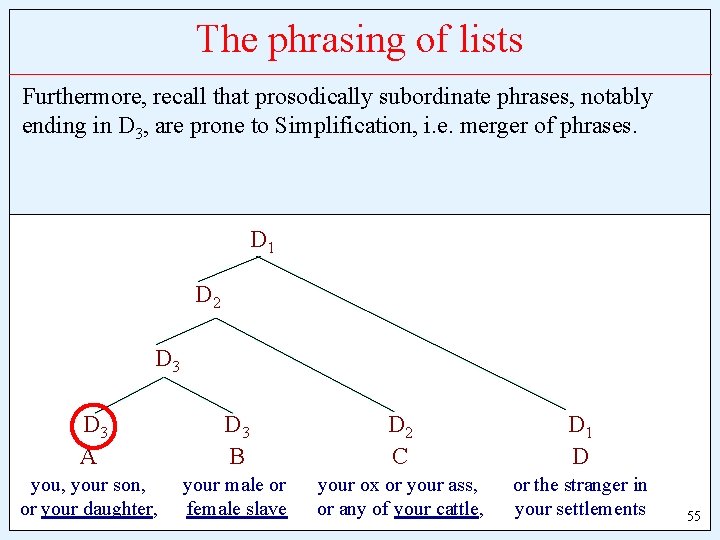
The phrasing of lists Furthermore, recall that prosodically subordinate phrases, notably ending in D 3, are prone to Simplification, i. e. merger of phrases. D 1 D 2 D 3 A D 3 B D 2 C D 1 D you, your son, or your daughter, your male or female slave your ox or your ass, or any of your cattle, or the stranger in your settlements 55
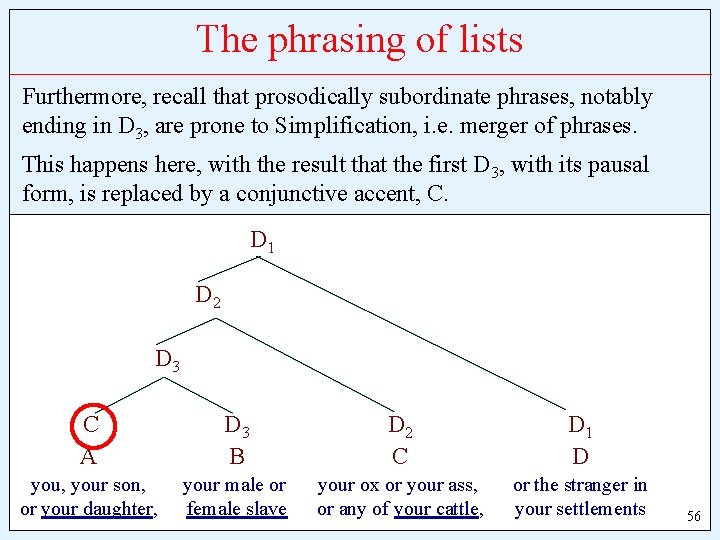
The phrasing of lists Furthermore, recall that prosodically subordinate phrases, notably ending in D 3, are prone to Simplification, i. e. merger of phrases. This happens here, with the result that the first D 3, with its pausal form, is replaced by a conjunctive accent, C. D 1 D 2 D 3 C A D 3 B D 2 C D 1 D you, your son, or your daughter, your male or female slave your ox or your ass, or any of your cattle, or the stranger in your settlements 56
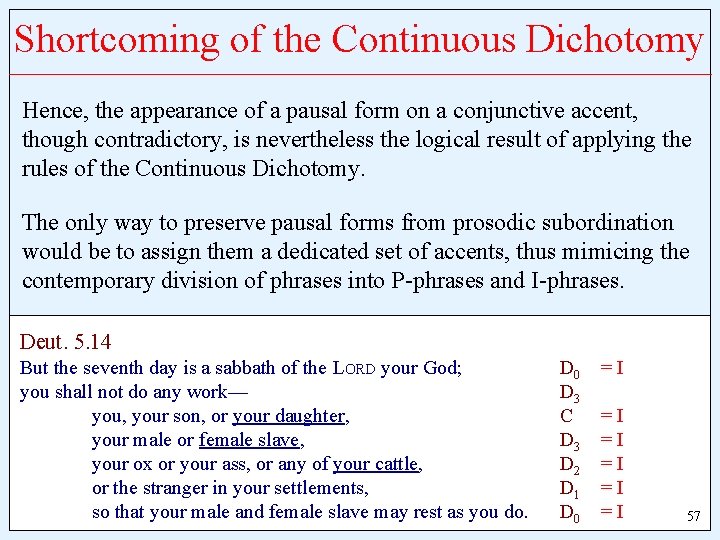
Shortcoming of the Continuous Dichotomy Hence, the appearance of a pausal form on a conjunctive accent, though contradictory, is nevertheless the logical result of applying the rules of the Continuous Dichotomy. The only way to preserve pausal forms from prosodic subordination would be to assign them a dedicated set of accents, thus mimicing the contemporary division of phrases into P-phrases and I-phrases. Deut. 5. 14 But the seventh day is a sabbath of the LORD your God; you shall not do any work— you, your son, or your daughter, your male or female slave, your ox or your ass, or any of your cattle, or the stranger in your settlements, so that your male and female slave may rest as you do. D 0 D 3 C D 3 D 2 D 1 D 0 =I =I =I 57
5. Conclusion 58
Conclusion Aronoff (1985: 28) writes that “any orthography must…involve a linguistic theory”; that is, the Masoretic transcription is not a pure record of recitation, but is filtered through a theory, in this case, the Continuous Dichotomy and hierarchy of disjunctive accents. We agree with Revell’s (2015: 6) conclusion that “the vocalization (including the stress patterns of the words) was fixed in the reading tradition first, and the melody marked by the accents came into use later. ” However, it does not follow that the vocalization, including the pausal forms, derive from a different reading tradition from the one that created the accents. 59
Conclusion Nor does it necessarily follow that the lack of coordination between the pausal forms and the accents indicates that the function of the latter was no longer apparent to the Masoretes. We have argued that the Tiberian system of accents simply does not have the means of ensuring that pausal forms will be systematically assigned to certain accents in a predictable way. The fact that they nevertheless recorded pausal forms even when they do not fit well with the accents is evidence that their over-riding goal was to faithfully represent the recitation tradition as they received it. 60
Montreal-Ottawa-Toronto Phonology/Phonetics Workshop THANK YOU! MOT 2018 Mc. Master University, March 24– 25, 2018
References Aronoff, Mark. 1985. Orthography and linguistic theory: The syntactic basis of Masoretic Hebrew punctuation. Language 61(1): 28– 72. Bierwisch, Manfred. 1966. Regein für die Intonation deutscher Sätze. Studia Grammatica 7: Untersuchungen über Akzent und Intonation im Deutschen, ed. by Manfred Bierwisch, 99– 201. Berlin: Akademie -Verlag. Bing, Janet. 1979. Aspects of English prosody. Doctoral dissertation, University of Massachusetts, Amherst. De. Caen, Vincent. 2004. The Pausal Phrase in Tiberian Aramaic and the reflexes of *i. Journal of Semitic Studies 49(2): 215– 224. De. Caen, Vincent. 2005. On the distribution of major and minor pause in Tiberian Hebrew in the light of the variants of the second person independent pronouns. Journal of Semitic Studies 50(2): 321– 327. 62
References Dresher, B. Elan. 1994. The prosodic basis of the Tiberian Hebrew system of accents. Language 70(1): 1– 52. Dresher, B. Elan. 2009. The word in Tiberian Hebrew. In The nature of the word: Essays in honor of Paul Kiparsky, ed. by Kristen Hanson & Sharon Inkelas, 95– 111. Cambridge, MA: MIT Press. Goerwitz, Richard L. 1993. Tiberian Hebrew pausal forms. Doctoral dissertation, University of Chicago. Hayes, Bruce. 1989. The prosodic hierarchy in meter. In Rhythm and meter, ed. by Paul Kiparsky & Gilbert Youmans, 201– 260. Orlando, FL: Academic Press. Jou on, Paul & Takamitsu Muraoka. 2006. A grammar of Biblical Hebrew. Rev. ed. Rome: Pontifical Biblical Institute Press. Kautzsch, Emil (ed. ). 1910. Gesenius’ Hebrew grammar. Translated by 63 A. E. Cowley. Oxford: Clarendon Press.
References Khan, Geoffrey. 1987. Vowel length and syllable structure in the Tiberian tradition of Biblical Hebrew. Journal of Semitic Studies 32(1): 23– 82. Nespor, Marina & Irene Vogel. 1986. Prosodic phonology. Dordrecht: Foris. Prince, Alan S. 1975. The phonology and morphology of Tiberian Hebrew. Doctoral dissertation, MIT, Cambridge, MA. Revell, E. J. 1980. Pausal forms in Biblical Hebrew: Their function, origin and significance. Journal of Semitic Studies 25: 165– 179. Revell, E. J. 1981. Pausal forms and the structure of Biblical poetry. Vetus Testamentum 31: 186– 199. Revell, E. J. 2015. The pausal system: Divisions in the Hebrew Biblical text as marked by voweling and stress position. Edited by Raymond de Hoop & Paul Sanders. Sheffield: Sheffield Phoenix Press. 64
References Selkirk, Elisabeth O. 1978. On prosodic structure and its relation to syntactic structure. Paper presented at the Conference on Mental Representation in Phonology. In Nordic Prosody II, ed. by Thorstein Fretheim, 111– 140. Trondheim: TAPIR, 1981. Selkirk, Elisabeth O. 1984. Phonology and syntax: The relation between sound and structure. Cambridge, MA: MIT Press. Selkirk, Elisabeth O. 1986. On derived domains in sentence phonology. Phonology Yearbook 3: 371– 405. Strauss, Tobie. 2009. The effects of prosodic and other factors on the parsing of the biblical text by the accents of the 21 books [in Hebrew]. Doctoral dissertation, The Hebrew University of Jerusalem. 65
Montreal-Ottawa-Toronto Phonology/Phonetics Workshop MOT 2018 Mc. Master University, March 24– 25, 2018
- Slides: 64