
PAULS THIRD JOURNEY Acts 18 23 Spring 54


- Slides: 75
PAUL’S THIRD JOURNEY
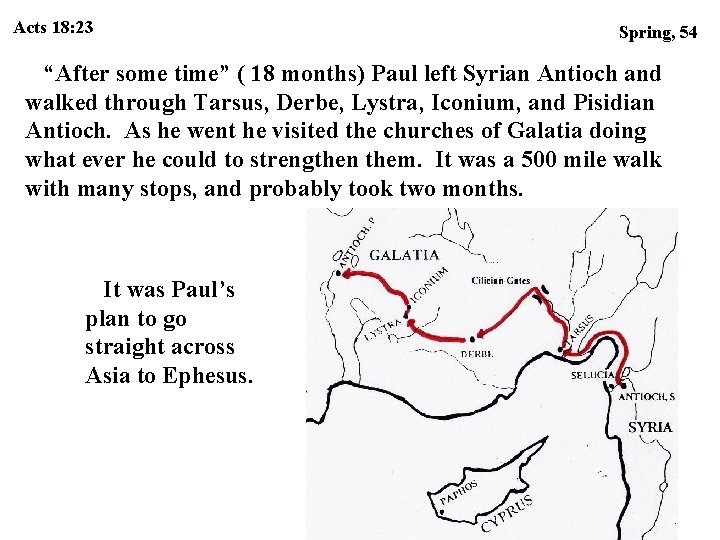
Acts 18: 23 Spring, 54 “After some time” ( 18 months) Paul left Syrian Antioch and walked through Tarsus, Derbe, Lystra, Iconium, and Pisidian Antioch. As he went he visited the churches of Galatia doing what ever he could to strengthen them. It was a 500 mile walk with many stops, and probably took two months. It was Paul’s plan to go straight across Asia to Ephesus.
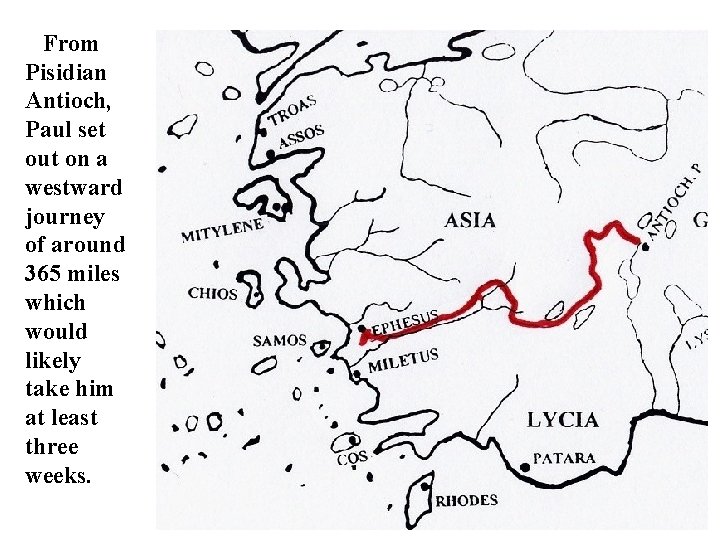
From Pisidian Antioch, Paul set out on a westward journey of around 365 miles which would likely take him at least three weeks.
Acts 18: 24 -28 As Paul was walking toward Ephesus, an Egyptian from Alexandria named Apollos, was already in Ephesus telling folks what he knew about Jesus. He was an eloquent speaker, but his knowledge was incomplete. He baptized believers with the baptism of John, for their protection in the coming battle between God and Satan. In Ephesus, Aquila and Priscilla took Apollos aside and explained the gospel “more accurately” from what they had learned from Paul. Then the church in Ephesus sent Apollos on his way to Achaia, where he spoke boldly. Acts 19: 1 early Summer, 54 Even as Paul was nearing Ephesus, Apollos was speaking in Corinth, and it was already early summer.
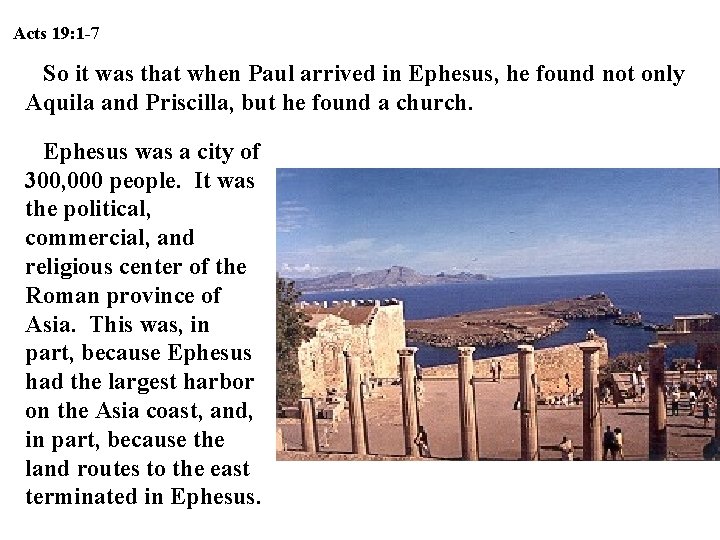
Acts 19: 1 -7 So it was that when Paul arrived in Ephesus, he found not only Aquila and Priscilla, but he found a church. Ephesus was a city of 300, 000 people. It was the political, commercial, and religious center of the Roman province of Asia. This was, in part, because Ephesus had the largest harbor on the Asia coast, and, in part, because the land routes to the east terminated in Ephesus.
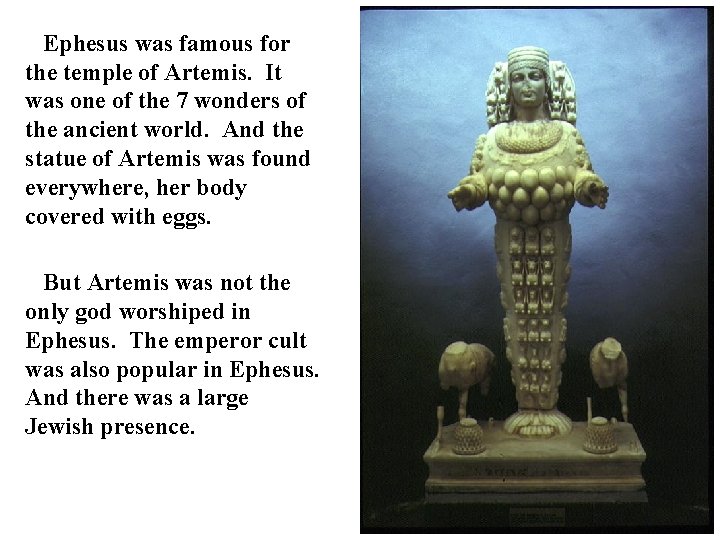
Ephesus was famous for the temple of Artemis. It was one of the 7 wonders of the ancient world. And the statue of Artemis was found everywhere, her body covered with eggs. But Artemis was not the only god worshiped in Ephesus. The emperor cult was also popular in Ephesus. And there was a large Jewish presence.
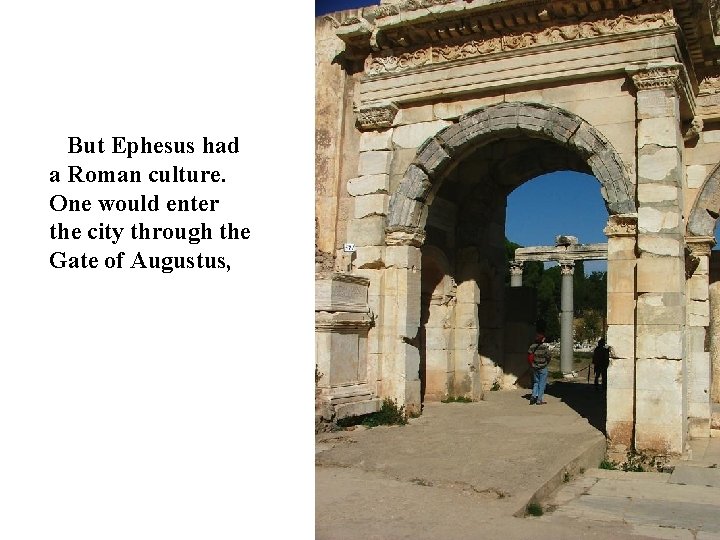
But Ephesus had a Roman culture. One would enter the city through the Gate of Augustus,
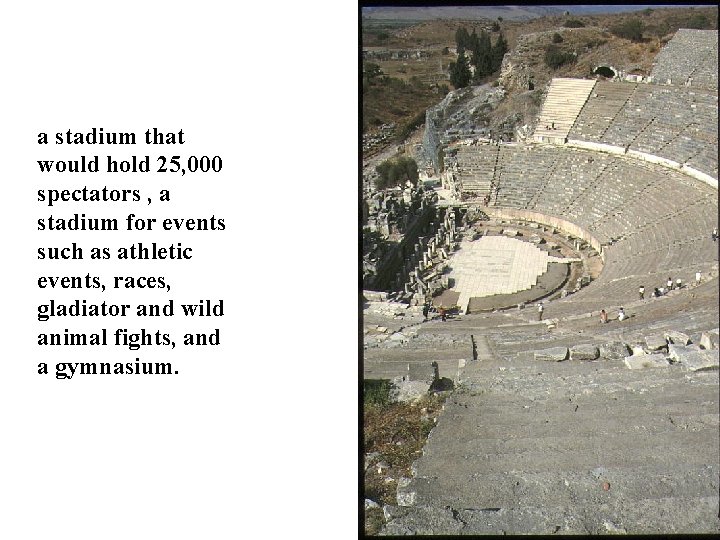
a stadium that would hold 25, 000 spectators , a stadium for events such as athletic events, races, gladiator and wild animal fights, and a gymnasium.
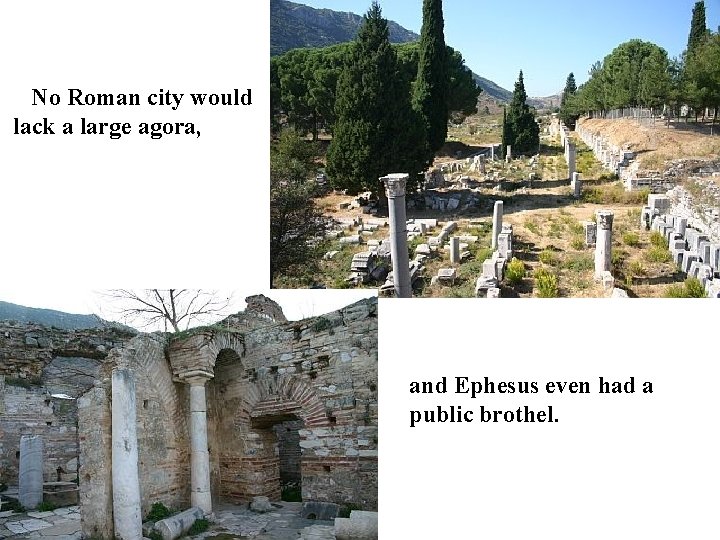
No Roman city would lack a large agora, and Ephesus even had a public brothel.
When Paul arrived he found that around a dozen Ephesians believers had been baptized with John’s baptism and had never been taught about the Holy Spirit. Paul immediately baptized them in the name of Jesus and they received the Holy Spirit. Acts 19: 8 Summer, 54 Paul spent the summer speaking to the Jews. Some representatives of Chloe came through Ephesus and spoke to Paul about the situation. Others arrived with a letter from supporters in Corinth during this time. Acts 19: 11 -20 There were cases where Jewish exorcists tried to cast out demons “in the name of the Jesus that Paul proclaims”.
There was even a case where the seven sons of a Jewish priest named Sceva tried to cast out demons in the name of Jesus, but the demons attacked them. Some became believers that had been practicing “magic”. They publicly burned their “spell books” when they became believers. 2 Corinthians 12: 18 Fall, 54 It was in the Fall of 54 that Paul wrote his first letter to the Corinthians. Meanwhile Timothy went through Macedonia to Corinth, arriving after the letter. He was poorly received and returned quickly.
Paul wrote to a divided church. Paul had founded the church, but two other leaders (Apollos and Peter) had visited, and now had followers. Each of the three groups had their own understanding of the Gospel, and each had some more extreme adherence. The “Church” consisted of separate house churches that might have 15 -20 adults that could meet in a small house. First, there were Paul's Gentile followers, most of who were just 'regular folks', to whom he sent the letter. They saw Paul as their 'father in the faith' and looked to Paul for guidance. The extremist wing interpreted Paul's teaching on freedom from law as freedom to do what ever 'felt good'. Sexual promiscuity (rather than marriage), gluttony and drunkenness, continued former idol worship practices (such as eating rituals worshiping idols), and even taking advantage of other believers for personal gain (this brought on a lawsuit).
Secondly, there were the followers of Apollos. He came from Alexandria Egypt and spoke like a Greek philosopher. He attracted a following among the intellectual Greeks by his emphasis on knowledge and wisdom. He was in Corinth even as Paul wrote the letter in Ephesus. The extremists of this group were beginning to believe in a secret wisdom that God revealed to select believers. This knowledge would help them to escape from this evil world which had entrapped their spirits inside physical bodies (since marriage brought babies that trapped more spirits in physical bodies, and when the body died the spirit had a chance to escape from this evil physical world and rejoin God, marriage was to be avoided and there would be no resurrection).
Thirdly, there were the followers of Cephus (Peter). These were Hellenistic Jews. Jesus was the Messiah, sent by God to bring the Jews into a spiritual kingdom. Their upbringing in the Torah had taught them how important the law was to a community. The extremists of the group believed that while the gospel of faith in God would save them, the law was also necessary for that salvation. God expected appropriate behavior and the Judgment was based on their ability to fulfill the law (so don't eat food offered to idols) and tradition (of course folks should be married). 1 Corinthians Fall, 54 For Paul, there is only one God (8: 6). God is faithful (1: 9). God sustains us (3: 6) and in the end will judge (5: 13) or commend (4: 5). Our faith is in God's power (2: 5) and we give thanks to God for the grace he has extended to us (1: 4).
God raised Christ from the grave (15: 4) and the Son is subject to the Father (15: 28). God the Father, through Christ, called Paul (1: 1). Through Christ, God has given us grace (1: 4) having called us into fellowship (1: 9). We are God's servants (3: 9) and through Christ we receive peace (1: 3) and victory (15: 57). But to the majority of people, the Gospel of forgiveness, based on faith, is intellectually barren. Paul proclaims the cross of Christ (1: 22 -23). What appears to be God's weakness is, in actuality, strength [because it fosters faith] (1: 25). The Jews want proof, so the cross is a stumbling block and the Greeks want insight and understanding of this foolishness (1: 22 -23). God's focus on faith, hope and love, in a world of power, revenge and greed, is a mystery to most who could not see God's wisdom (2: 13). Paul was not as eloquent as Apollos (2: 1) instead he displayed the Spirit (2: 4).
The Gospel set us free from law. All things are lawful to believers, but not all things are beneficial (6: 12). We must control our freedom so as to not tempt others beyond their ability to resist (8: 9). We should not use are freedom for personal gain, but to build up the Church (10: 24). Any believer that is knowingly violating the Spirit of Christ should be avoided (5: 11). Some are using their freedom, without control, in order to make a party out of the Lord's Supper. They act like pagans, as gluttons and drunks, while other believers sit by hungry (11: 21). You come together to eat the Lord's Supper, so do it together. Eat bread and drink wine to remember Jesus and proclaim Christ (11: 23 -26).
The Spirit gives gifts for the good of the Church (12: 7). Gifts should be used to build up the Church (14: 26) not cause dissention. All things done in public should be done in good order (14: 40) because God brings peace and order (14: 33). And though we are individuals, we are all of one body (12: 27). There are many parts, but only one body (12: 12). We should work together for the common good (12: 14 -26). Love underlies every spiritual gift (13: 3). The body depends on faith, hope and love (which is the most important between believers) (13: 13). Despite arguments to the contrary, there will be a resurrection of the dead. If there were no resurrection, then God could not have raised Christ from the dead (15: 13). But God did raise Christ (15: 20). Our physical bodies will die and we will be raised with a spiritual body (15: 44), which is immortal (15: 53).
One future event made a huge difference in how Paul interacted with this world. He believed that the Day of the Lord was imminent (7: 26). Do not, therefore, allow yourself to be distracted by anything (7: 32). The Judgment is near, so do not attempt to change what is wrong around you (7: 20). But do not be afraid, God will judge according to what is in your heart (4: 5). END Acts 19: 9 -10 During the next two years Paul stayed in Ephesus and spoke to the Gentiles. But instead of meeting in the synagogue Paul would usually meet in the Hall of Tyrannus to proclaim the gospel. 1 Corinthians 16: 5 -8 Spring, 55 Paul made a trip straight to Corinth. He left after Passover. This was a “painful” visit and Paul left very soon, and very concerned, and returned to Ephesus.
Summer, 55 For the next 18 months Paul used Ephesus as a base, and visited many cities, proclaiming the Gospel and founding churches at places like Smyrna, Pergamum, Thyatira, Sardis, and Philadelphia? 2 Corinthians 12: 18 Fall, 55 Then, in the Fall of 55, Paul sent Titus and a travel companion to visit Corinth. When Titus returned with the news that the situation was even worse now then when Paul last visited, Paul wrote a 'painful' letter and sent it to Corinth with Titus with instructions to meet him in Troas in the spring.
2 Corinthians (10 -13) [Painful letter] The three extremist groups had become more extreme since Paul's second visit to Corinth in 55. The "Epicureans" were ignoring Paul's call for self control (12: 21), the "proto Gnostics" were teaching a Jesus with secret knowledge (11: 4), and the "Judiazers", who’s representatives had arrived with glowing letters (3: 1) stating that they were now in charge of the Corinthian church (10: 14), were adamant about the need for the law (11: 22). They had demeaned Paul and, through fancy logic, had brought his actions into question. Paul was accused of deceiving the Corinthians (12: 16) by "acting" humble. Then they said that Paul is really weak when present because he was afraid of them, but he talks tough in letters (10: 10).
"Open your eyes and see what I did, don't try to impugn my motives. You were once convinced that by your faith you belonged to Christ (10: 7). I am afraid that your thoughts will lead you astray (11: 3). "Since you seem to like 'worldly fools' (11: 19), let me be one also. True, we did not charge you any money for the gospel, oops" (11: 7). "I did not 'lord it over you', my bad (11: 7). I did not take advantage of you, shame on me" (11: 21). "How can I be compared with these "super-apostles? They say I don't 'stack up'. I am all the Jew they could hope to be (11: 22). I have suffered more for the Gospel then they can imagine (11: 23 -28). They are nothing beside me. Compared to me they are servants of Satan (11: 12 -15). And they call me weak? They are correct in one way! I am weak, so that I may be strong in Christ (12: 10). The Lord said to me that His power was made perfect in my weakness (12: 9). I will therefore only truly boast of my weaknesses" (11: 30). END
Acts 19: 21 -22 When Paul had sent Titus to Corinth in the fall of 55, he had already decided to visit Macedonia before going to Corinth. Titus was to meet him at Troas in the spring. That would give Titus plenty of time to help the Corinthians get things ‘straightened out’. Paul sent Timothy and Erastus ahead to Macedonia to prepare for his arrival, but had to wait for Timothy to return to Ephesus before he could actually begin his trip. Acts 19: 23 -41 Spring, 56 Paul’s message regarding the foolishness of worshiping idols made with human hands, was heard by enough people such that at least one silversmith became concerned that there would be a smaller market for his Artemis statues. Demetrius got the merchants agitated enough such that they went out and got the citizens of Ephesus to riot in support of their goddess.
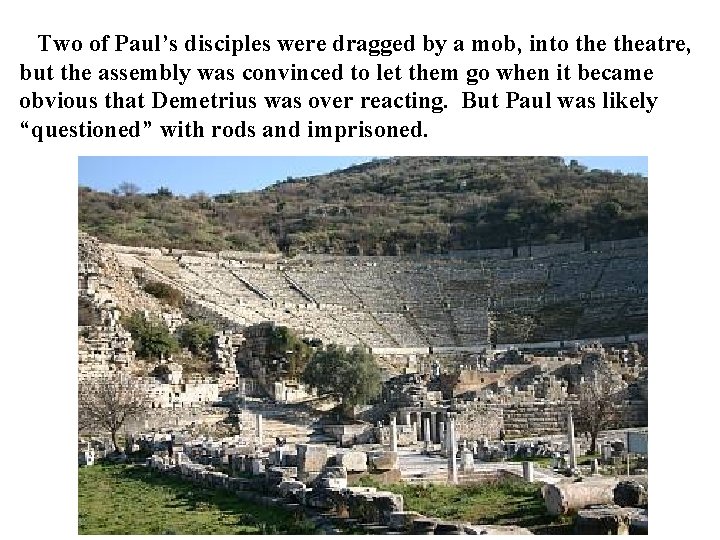
Two of Paul’s disciples were dragged by a mob, into theatre, but the assembly was convinced to let them go when it became obvious that Demetrius was over reacting. But Paul was likely “questioned” with rods and imprisoned.
Paul writes to Philemon, whom he has never met, in Colossae. Onesimus, Philemon’s slave, has become a believer, and has been serving Paul, during his imprisonment in Ephesus, for some time now. Paul wants Onesimus to continue to serve him, but feels that it is wrong to allow Onesimus to remain without permission from Philemon. Paul asks that Onesimus be allowed to return to Paul to serve him. Paul knows that the loss of a slaves’ service is an expensive gift, but Paul really needs Onesimus. Philemon From Paul, a slave of Christ, and Timothy. To Philemon and the church that meets in his house.
I know your reputation as a person that loves all believers, regardless of their background. And your Faith in Jesus Christ, who guides our lives. We have a partnership in the Faith and we are more effective for the ministry when you see how much good can result by a course of action. Being with you brings peace to the spirits of the believers fortunate enough to be around you, my brother in Christ. Let me get to the point. As an apostle, I have the right to expect you to do what Christ desires of you. But instead, I appeal to you, as Christ's ambassador, and now in prison because I represent our Lord, our Savior. During my imprisonment, Onesimus, who you thought lost from you forever, has become as close to me as though he were my own son, and I would, in Christ, ask to have him.
"Mr. Useful" was only another slave to you, but now he is valuable to me, and potentially more useful to you. He is my heart, my only son, your nephew in Christ, and I send him back to you. I wanted to keep him with me as though you had given his services to me, he is such a comfort, but I could not do that without your permission. Such a decision should be yours to make and no pressure should be applied to force you to do so. When he escaped from your services, you could not have suspected that he may have been guided to me by the Spirit of God, but he has become our brother in Christ for eternity. You and I are partners in the Gospel of Christ. Imagine how you would greet me if I visited you. Greet Onesimus like that when he comes. Any, and all, debt that he owes you, I will pay as though you were transferring ownership of Onesimus to me. I will repay you all his debt (here is my signature on this document, if you want it).
Through my efforts you also have become a child of God and will receive eternal life. I really want you to accept Onesimus as a brother in Christ and charge his past to my account. Make me glad in the Lord. (If I know you, you will go out of your way to do even more then I ask, such is your reputation). So, prepare a guest room, as though for me. END [There is every chance that Philemon did more than Paul actually requested. Philemon not only accepted Onesimus as a believer, he seems to have set him free and sent him back to Paul. ] [Then, around 115 AD, Ignatius mentions an Onesimus as bishop of Ephesus. Onesimus began a collection of Paul’s letters and made sure that this personal note was included when hundreds of others were not. ]
Philemon, having received Paul’s letter, had sent Onesimus back to Paul as a freeman. Now, some time later, Paul writes a letter to the Philippians. When the Philippians heard that Paul was in prison, and had lost the services of Onesimus, they sent Epaphroditus to Paul to serve him. But Epaphroditus took ill, and almost died. When Paul heard of their concern, he decided to send Epaphroditus back to them. So he wrote them a letter and sent the letter and Epaphroditus back to Philippi with Timothy. Paul plans to visit the Philippians as soon as Timothy returns and if Paul is released from prison.
Philippians Paul, having been beaten with rods and put into prison, has been given cause to rejoice. Epaphroditus has brought him great news. With a sense of joy, he remembers just how strong in the faith the believers in Philippi are (1: 1 ff). And even Paul's current situation has seen some believers embolden, and going out to proclaim the Gospel (1: 12 ff). So whether Paul dies and goes to be with Christ, or lives and continues His work, Paul will be filled with joy (1: 19 ff). Paul has been informed that the Philippians are still being persecuted by pagan Gentiles, as they had done to Paul when THEY beat him with rods and put him in prison on his first visit to Philippi. You must continue to be of the same mind as Christ, and love them by telling them about Christ (1: 27 ff).
Christ did not try to take advantage of His position (as Satan had done). Instead, he appeared as we are, was obedient to God's will to have faith, even when faced with death on the cross. That is why He is called "Christ" (the Messiah) (2: 6 ff). Should I be taken from you, be cautious, and let God's Spirit guide you. Once the Lord's will has been revealed, be united. Do not continue to argue or mutter 'under your breath'. When I face the Lord, I will boast about how you hold tight to the Word (2: 12 ff). You have sent Epaphroditus to help me. He was ill and almost died, as you have heard. God spared him for me. I know how concerned you are, so I am sending him to you. He risked his life for the Gospel, and has served you well (2: 25 ff).
What follows is a warning I have written to others, but it bears repeating. Beware of the Messianic Jews that want to add the requirements of The Law to The Gospel in order for you to be saved. I am a Jew, but it's advantages are as nothing compared to the Gospel. I am righteous before God because of my faith in Christ, and for NO other reason (3: 1 ff). The past is nothing! Always think of what is ahead in Christ. Don't set your minds on the physical. Even our Earthly bodies will be transformed by Christ. Rejoice in our Lord. Don't worry about anything. After all, the Lord is near. Pray and give thanks, and the peace of God will guard your hearts and minds in Christ (3: 8 ff).
Continue in your faith, as you have been taught, and if something new seems good, consider it carefully. I am grateful for your concern for me, but I am content. I can do what ever is necessary for the Gospel through Christ who strengthens me. Thank you for your desire to send me help. Your sacrifice will be remembered and I pray that God will satisfy all your needs (4: 4 ff). END
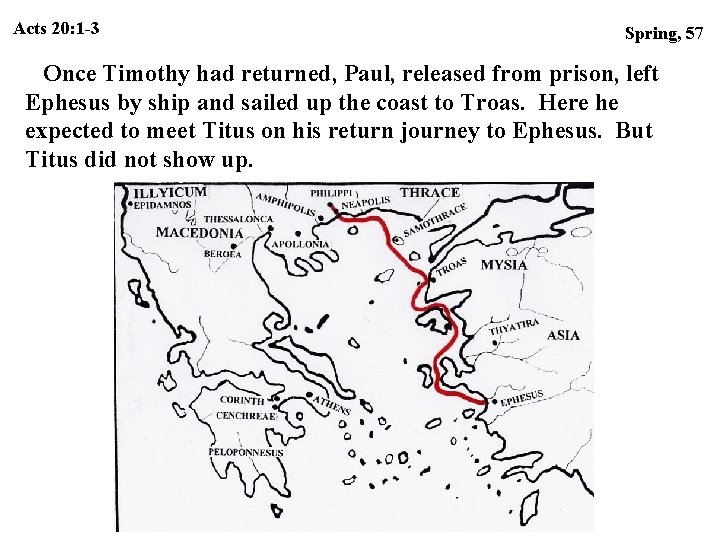
Acts 20: 1 -3 Spring, 57 Once Timothy had returned, Paul, released from prison, left Ephesus by ship and sailed up the coast to Troas. Here he expected to meet Titus on his return journey to Ephesus. But Titus did not show up.
Paul then continued his journey to Neapolis and then to Philippi. It was there that Titus caught up with Paul. He had very good news about what was happening in Corinth. Over winter the Corinthians had evicted the rebellious member and once again looked to Paul for leadership. Paul wrote his 'reconciled' letter and sent it south with Titus, while Paul stayed in Macedonia. 2 Corinthians (1 -9) [The “reconciled” letter] Spring, 57 Paul was thankful to God for all aspects of his life, even the troubles (1: 3). The troubles, which were many (6: 4 -5), require that they place their trust in God (1: 10). Suffering develops reliance on God (1: 9). The believer is required to walk by faith, and not by sight (5: 7). The letter of the law kills, but the spirit of the gospel gives life (3: 6).
The past difficulties that had been between Paul and the Corinthians had grieved Paul's 'painful' letter had grieved the Corinthians, which led to their repentance, which leads to their salvation (6: 7 -10). Now, once again, the Corinthians are Paul's glory, his "letter of recommendation" (3: 2), and his boast (1: 14). His hope had been unshaken (1: 7) but now he has complete confidence in them (7: 16). Believers have been transformed and are a new creation (5: 17). God, through Christ, has reconciled the world to Himself (5: 19). Paul has a ministry of reconciliation (5: 18), rejoices in the changes at Corinth (7: 7), looks forward to being reconciled with the Corinthians (5: 20), and being raised with them into God's presence (4: 14).
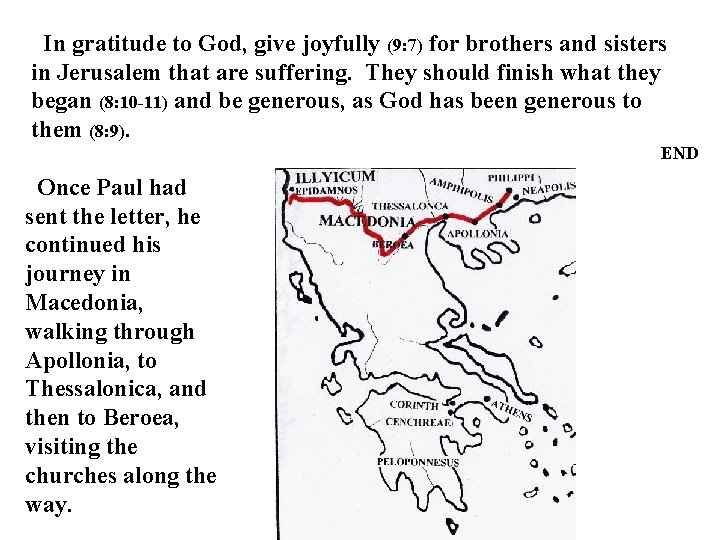
In gratitude to God, give joyfully (9: 7) for brothers and sisters in Jerusalem that are suffering. They should finish what they began (8: 10 -11) and be generous, as God has been generous to them (8: 9). END Once Paul had sent the letter, he continued his journey in Macedonia, walking through Apollonia, to Thessalonica, and then to Beroea, visiting the churches along the way.
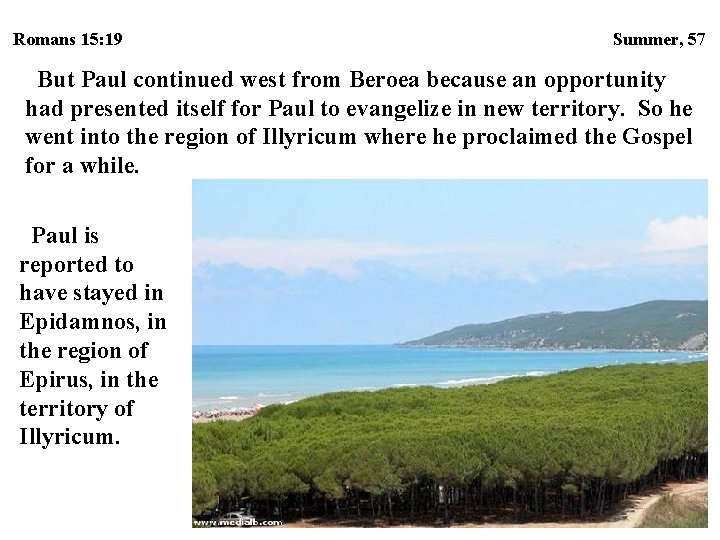
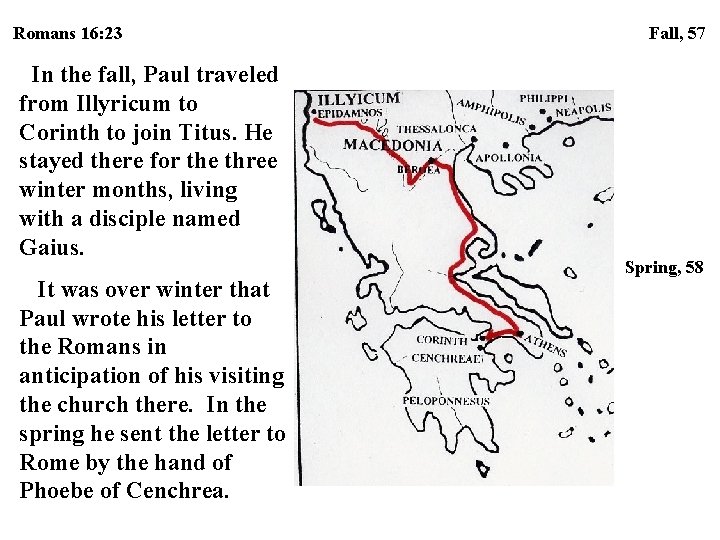
Romans 15: 19 Summer, 57 But Paul continued west from Beroea because an opportunity had presented itself for Paul to evangelize in new territory. So he went into the region of Illyricum where he proclaimed the Gospel for a while. Paul is reported to have stayed in Epidamnos, in the region of Epirus, in the territory of Illyricum.
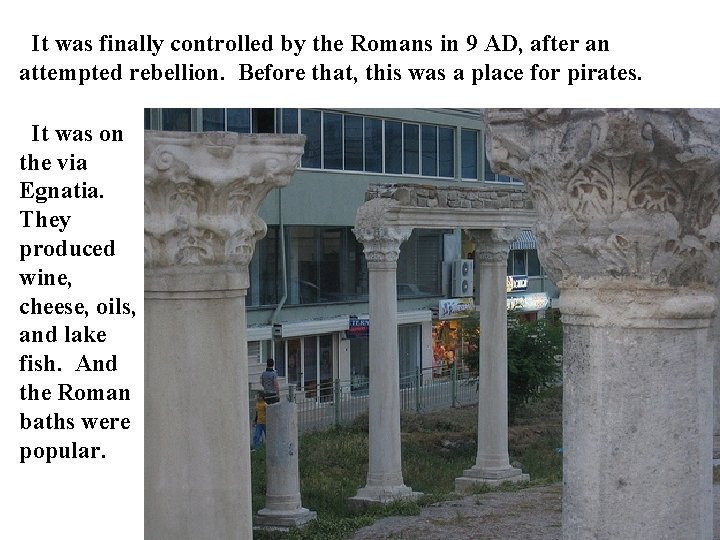
It was finally controlled by the Romans in 9 AD, after an attempted rebellion. Before that, this was a place for pirates. It was on the via Egnatia. They produced wine, cheese, oils, and lake fish. And the Roman baths were popular.
Romans 16: 23 In the fall, Paul traveled from Illyricum to Corinth to join Titus. He stayed there for the three winter months, living with a disciple named Gaius. It was over winter that Paul wrote his letter to the Romans in anticipation of his visiting the church there. In the spring he sent the letter to Rome by the hand of Phoebe of Cenchrea. Fall, 57 Spring, 58
Romans Paul's stop in Corinth, for the winter of 57/58, was probably the most relaxed of his missionary years. Among friends, and a fairly calm situation, left Paul time to reflect. He had long desired to visit Rome, and the house churches there (1: 13) on his way to a new missionary field in Spain (15: 23 -24). But first he would have to take the collection from Macedonia and Achaia to Jerusalem, for the relief of the poor believers there (15: 25 -26). But then he would come to Rome (15: 28). The letter, to the churches in the capital of the empire, would introduce Paul, and was an opportunity to set out more fully Paul's well organized and mature understanding of the Gospel. Paul especially wanted to see what he could do to reconcile the believers and the Jews, particularly considering the expulsion of 49.
Paul is not sure of how he will be received in Rome, so he 'bends over backwards' in order to not un-necessarily offend the Jews, nor does he want to 'tread on the toes' of those who founded the church (as had happened to Paul in Corinth). Paul perceived his mission as bringing about faith among the Gentiles, by preaching the Gospel (1: 5). The Gospel was promised in the Scripture (1: 2) and brought to fulfillment at the resurrection of Christ (1: 4). To the Jews was entrusted The Law (3: 2) but they misunderstood the law (9: 32). It was not the works that saved, but rather their faith in God, as with Abraham (4: 3)[To do anything that is required - earns only it’s immediate reward. To do something because you WANT to, expecting no reward, is what God desires]. The Jews were thus blinded, and that allowed the Gospel to be brought to the Gentiles, who's example would open the eyes of the Jews (11: 11 -12) and save those who will have faith (11: 26).
For Paul the world is under the power of sin (3: 9). The wages of sin is death (3: 23). The law shows us what sin is (3: 20) and condemns us (7: 7) who have not fulfilled the whole law. All have fallen short of fulfilling the law (3: 23). But when one puts their faith in Christ, they die to sin (6: 11) and sin loses power over them (6: 14). But the believer has been made right (justified) with God, through the faith of Jesus (3: 25). God justifies us (8: 33) as a gift (3: 24) which we receive through our faith in Christ (5: 1). The Grace of God will save us from the wrath of God (5: 9) which would be the result of the demands of the law (4: 15). On the "day" of judgment, there will be no condemnation for those who put their faith in Christ (8: 1). But God will judge all others according to their deeds (2: 6). The "Good" will receive eternal life, and the "Wicked" will receive destruction (2: 7 -8). And God will not be fooled. God will look into their hearts for their motives (2: 16).
The behavior of the ungodly is recognizable (1: 18 -32). Believers should not live like unbelievers (8: 5), but should behave like children of God by following the lead of the Holy Spirit (8: 14). Paul describes numerous examples of appropriate behavior (12: 6 -15: 13). The Gospel is the "power of God for salvation, to everyone who has faith" (1: 16). From the beginning, God knew that "one day" He would call forth a people to live by faith (8: 29 -30). They would not live by seeing themselves earn their way to heaven. Instead, they would have to follow God "blindly" and live with hope (8: 24). END
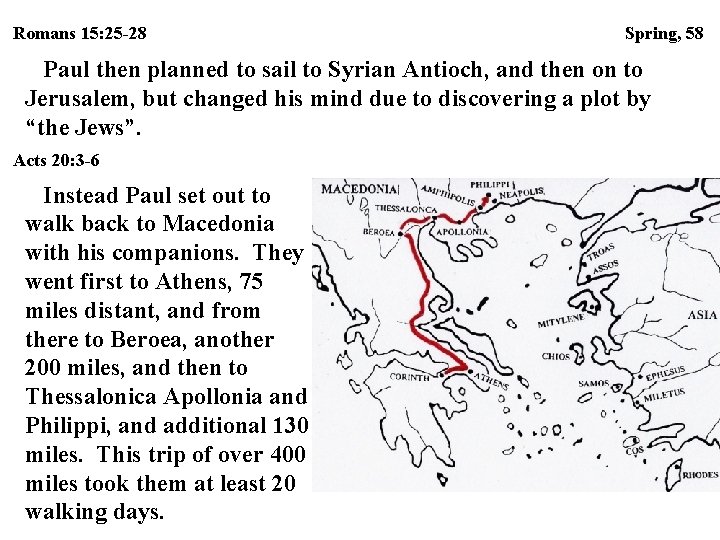
Romans 15: 25 -28 Spring, 58 Paul then planned to sail to Syrian Antioch, and then on to Jerusalem, but changed his mind due to discovering a plot by “the Jews”. Acts 20: 3 -6 Instead Paul set out to walk back to Macedonia with his companions. They went first to Athens, 75 miles distant, and from there to Beroea, another 200 miles, and then to Thessalonica Apollonia and Philippi, and additional 130 miles. This trip of over 400 miles took them at least 20 walking days.
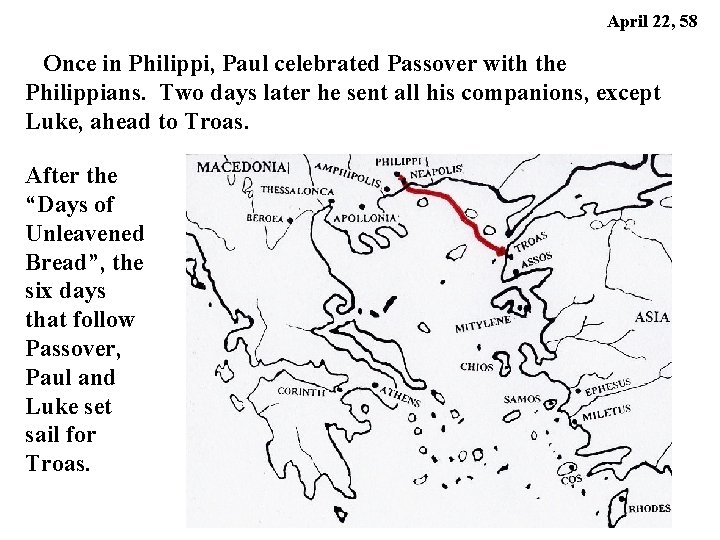
April 22, 58 Once in Philippi, Paul celebrated Passover with the Philippians. Two days later he sent all his companions, except Luke, ahead to Troas. After the “Days of Unleavened Bread”, the six days that follow Passover, Paul and Luke set sail for Troas.
Acts 20: 7 -12 They stayed seven days in Troas. On the Sunday before Paul was about to leave, the church gathered for communion. The believers continued to press Paul with questions, and Paul continued to talk with them late into the evening. Around midnight they were still in conversation when Eutychus, who had been sitting on the window sill, drifted off toward sleep and fell from the window of the three story home in which they were meeting. He seemed to be dead. When Paul examined Eutychus he told the folks gathered that Eutychus was not dead. They took Eutychus away to recover while Paul went back to the upper room to continue to spend time with the believers.
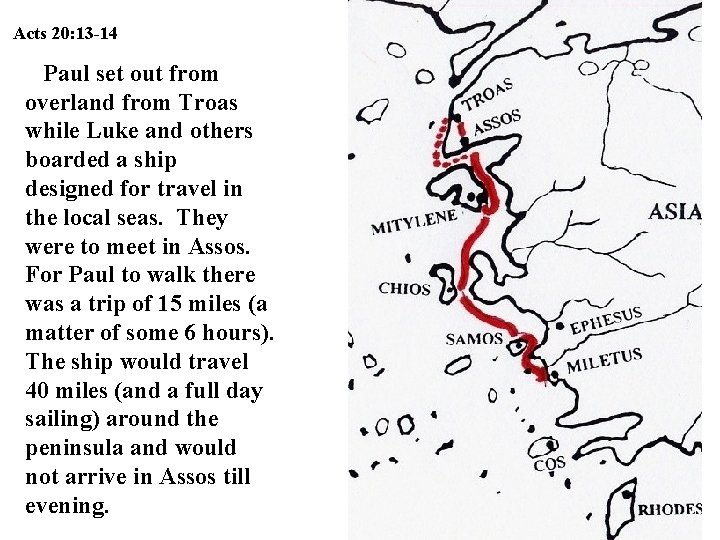
Acts 20: 13 -14 Paul set out from overland from Troas while Luke and others boarded a ship designed for travel in the local seas. They were to meet in Assos. For Paul to walk there was a trip of 15 miles (a matter of some 6 hours). The ship would travel 40 miles (and a full day sailing) around the peninsula and would not arrive in Assos till evening.
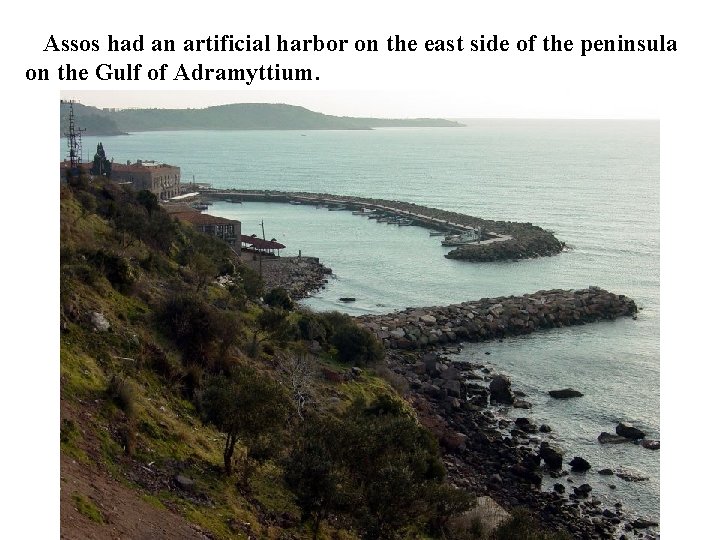
Assos had an artificial harbor on the east side of the peninsula on the Gulf of Adramyttium.
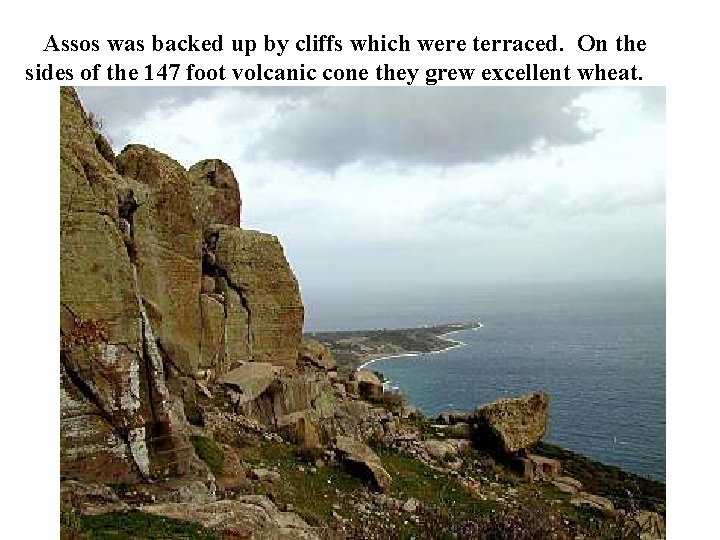
Assos was backed up by cliffs which were terraced. On the sides of the 147 foot volcanic cone they grew excellent wheat.
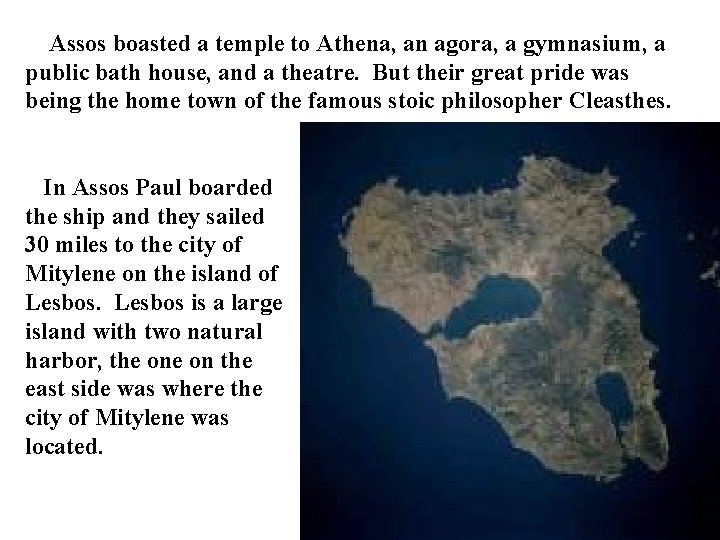
Assos boasted a temple to Athena, an agora, a gymnasium, a public bath house, and a theatre. But their great pride was being the home town of the famous stoic philosopher Cleasthes. In Assos Paul boarded the ship and they sailed 30 miles to the city of Mitylene on the island of Lesbos is a large island with two natural harbor, the on the east side was where the city of Mitylene was located.
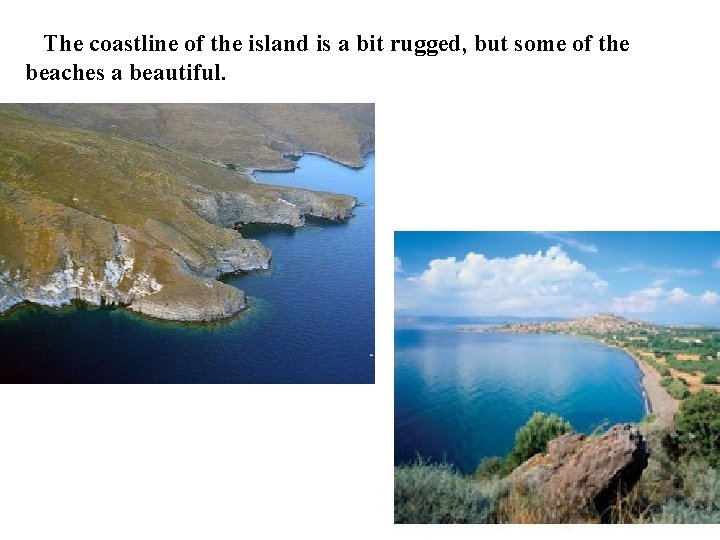
The coastline of the island is a bit rugged, but some of the beaches a beautiful.
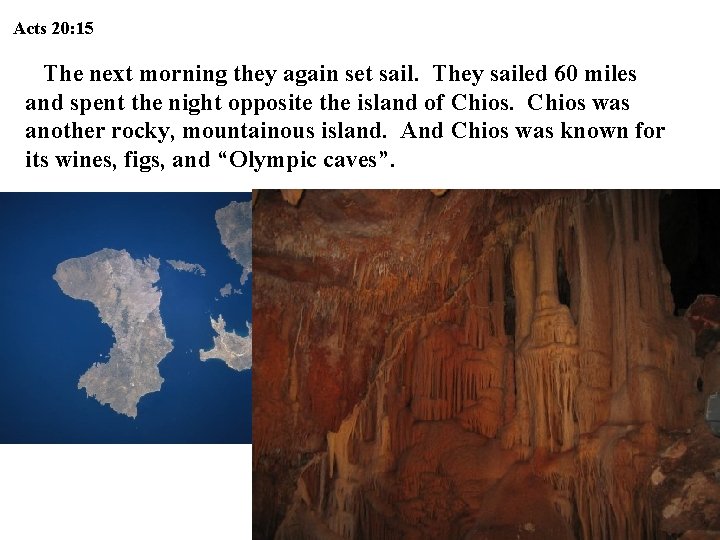
Acts 20: 15 The next morning they again set sail. They sailed 60 miles and spent the night opposite the island of Chios was another rocky, mountainous island. And Chios was known for its wines, figs, and “Olympic caves”.
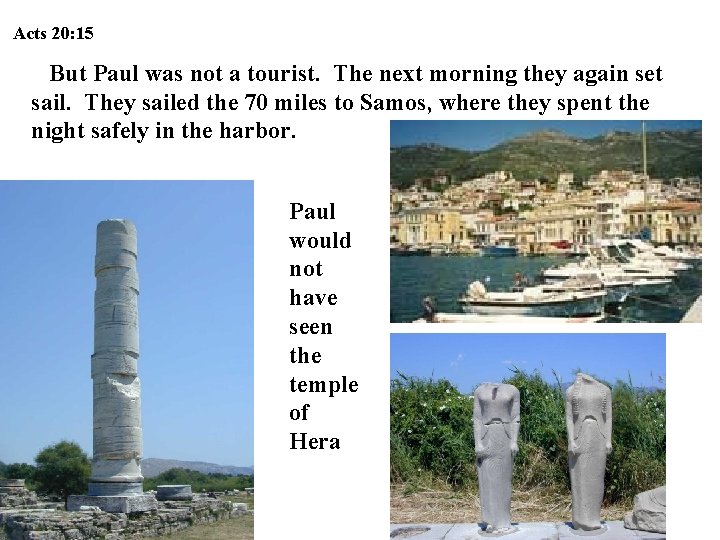
Acts 20: 15 But Paul was not a tourist. The next morning they again set sail. They sailed the 70 miles to Samos, where they spent the night safely in the harbor. Paul would not have seen the temple of Hera
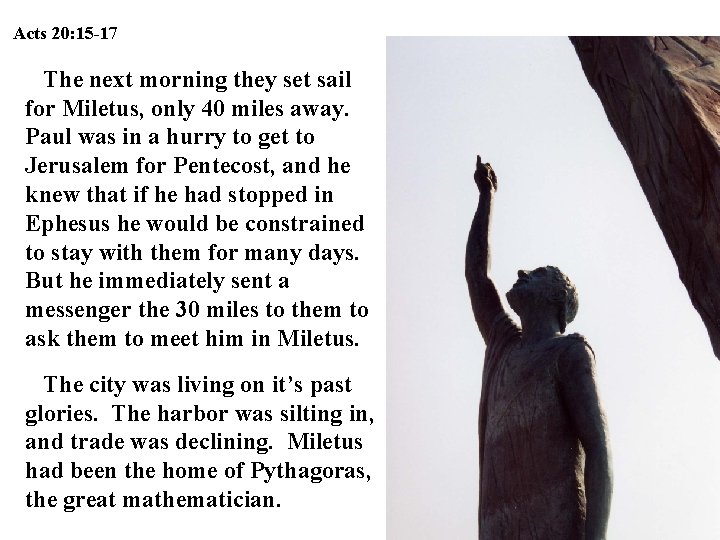
Acts 20: 15 -17 The next morning they set sail for Miletus, only 40 miles away. Paul was in a hurry to get to Jerusalem for Pentecost, and he knew that if he had stopped in Ephesus he would be constrained to stay with them for many days. But he immediately sent a messenger the 30 miles to them to ask them to meet him in Miletus. The city was living on it’s past glories. The harbor was silting in, and trade was declining. Miletus had been the home of Pythagoras, the great mathematician.
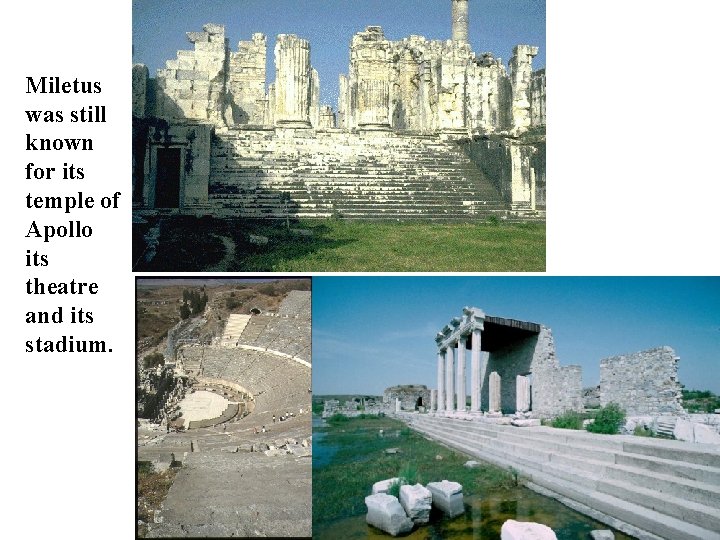
Miletus was still known for its temple of Apollo its theatre and its stadium.
Acts 20: 18 -38 The next evening Paul met with the church leaders that had come to Miletus to meet with him. Paul shared with them his sense of impending imprisonment, with which the Holy Spirit had convicted him. It was now three weeks after Passover. Paul parted company with the Ephesians the next morning amidst a sense of loss. And with many tears and prayers they parted.
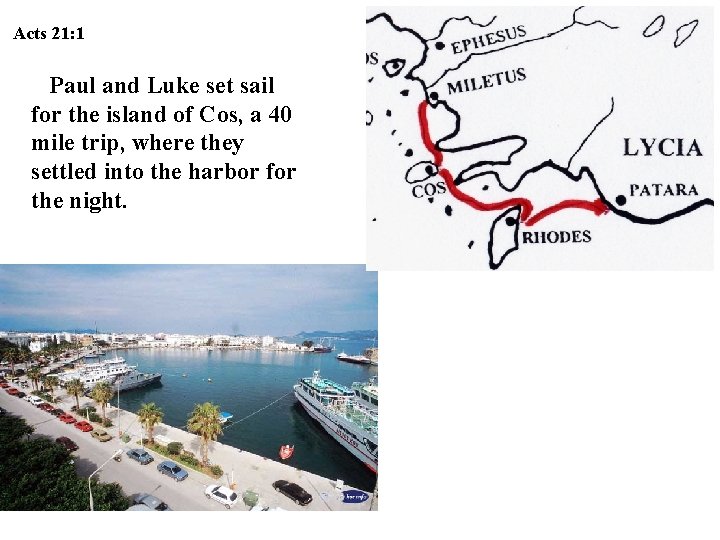
Acts 21: 1 Paul and Luke set sail for the island of Cos, a 40 mile trip, where they settled into the harbor for the night.
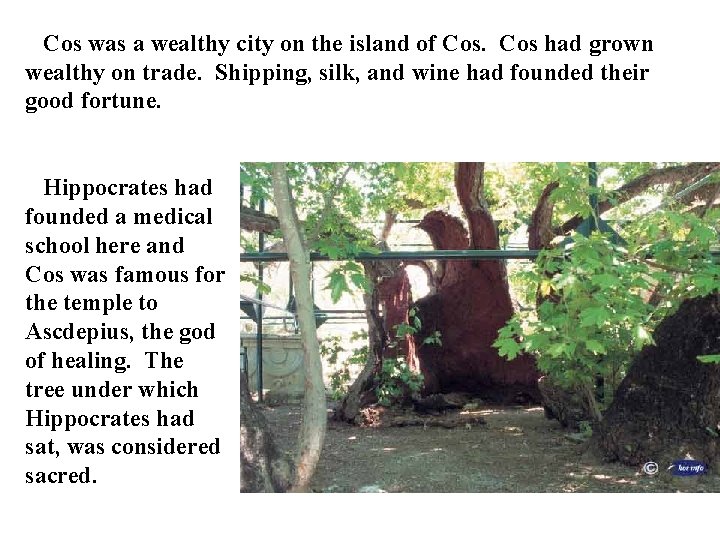
Cos was a wealthy city on the island of Cos had grown wealthy on trade. Shipping, silk, and wine had founded their good fortune. Hippocrates had founded a medical school here and Cos was famous for the temple to Ascdepius, the god of healing. The tree under which Hippocrates had sat, was considered sacred.
The city of Cos was immune from taxes, a benefit given to them by Caesar and Cos had one of the largest Jewish settlements in the Aegean. But Paul saw none of this. The next morning they were sailing the 50 miles to Rhodes was a prosperous trade center. It was a strong supporter of Rome and a protector of Greek shipping. It was a vacation resort for Romans, and the emperor Tiberius had spent eight years on the island. It was a mountainous island with a safe harbor, in the summer, on the east side of the island.
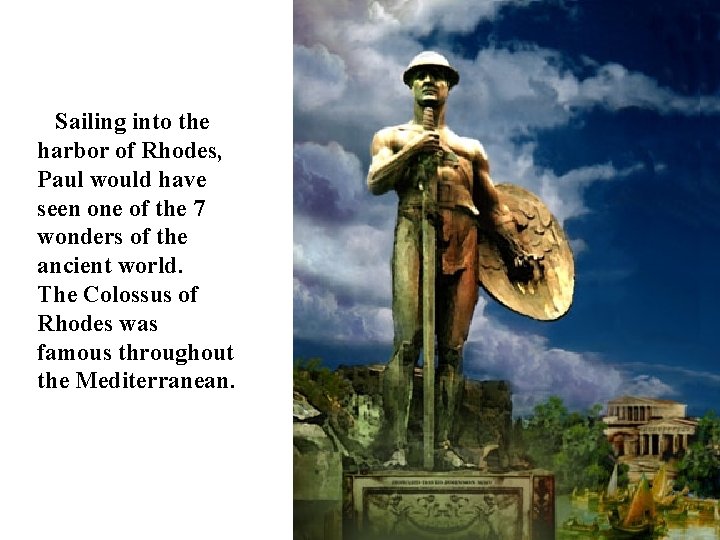
Sailing into the harbor of Rhodes, Paul would have seen one of the 7 wonders of the ancient world. The Colossus of Rhodes was famous throughout the Mediterranean.
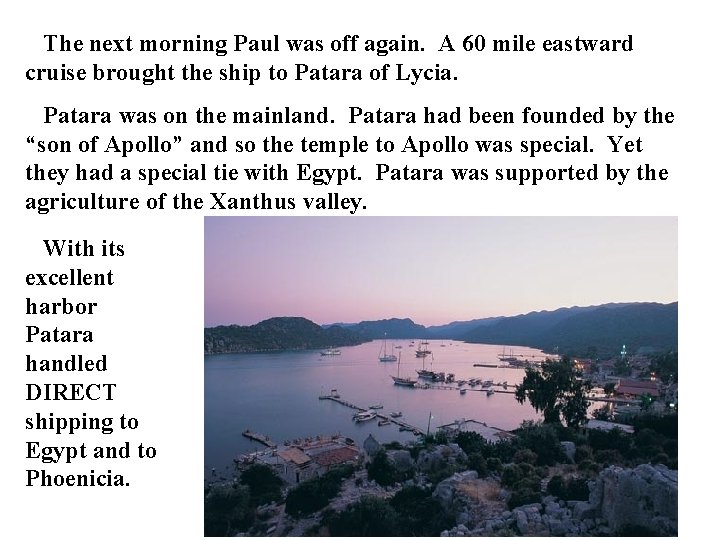
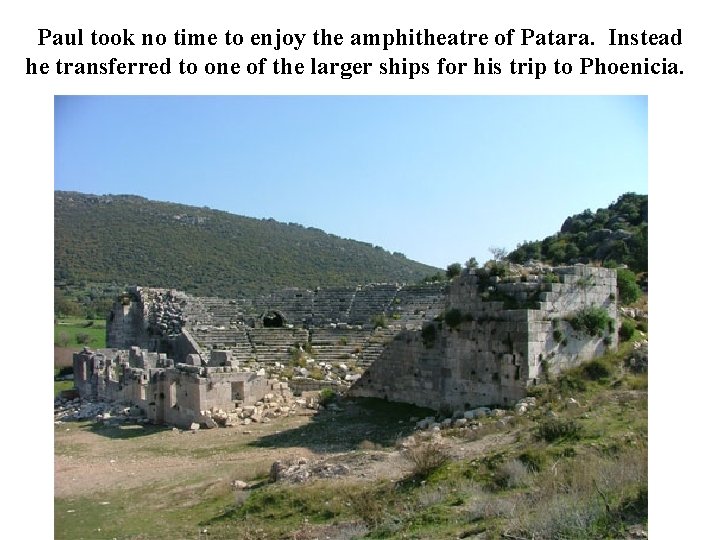
The next morning Paul was off again. A 60 mile eastward cruise brought the ship to Patara of Lycia. Patara was on the mainland. Patara had been founded by the “son of Apollo” and so the temple to Apollo was special. Yet they had a special tie with Egypt. Patara was supported by the agriculture of the Xanthus valley. With its excellent harbor Patara handled DIRECT shipping to Egypt and to Phoenicia.
Paul took no time to enjoy the amphitheatre of Patara. Instead he transferred to one of the larger ships for his trip to Phoenicia.
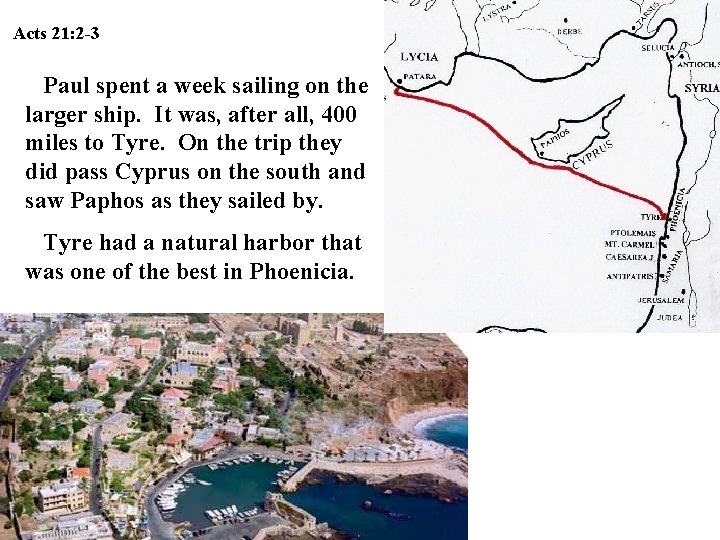
Acts 21: 2 -3 Paul spent a week sailing on the larger ship. It was, after all, 400 miles to Tyre. On the trip they did pass Cyprus on the south and saw Paphos as they sailed by. Tyre had a natural harbor that was one of the best in Phoenicia.
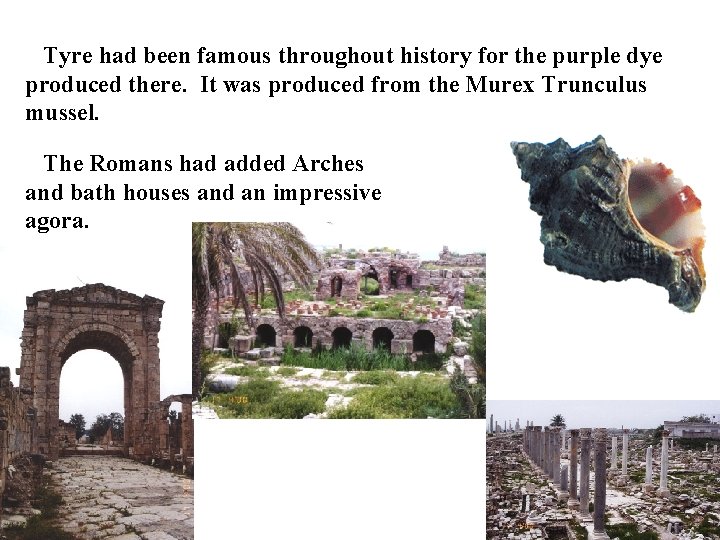
Tyre had been famous throughout history for the purple dye produced there. It was produced from the Murex Trunculus mussel. The Romans had added Arches and bath houses and an impressive agora.
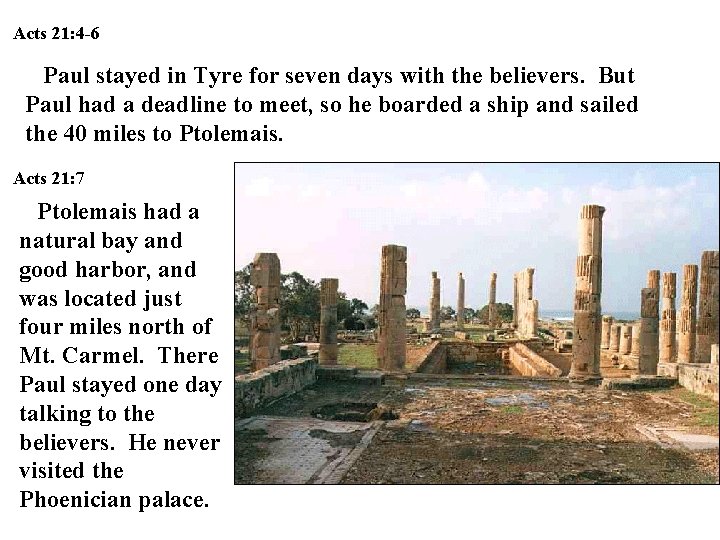
Acts 21: 4 -6 Paul stayed in Tyre for seven days with the believers. But Paul had a deadline to meet, so he boarded a ship and sailed the 40 miles to Ptolemais. Acts 21: 7 Ptolemais had a natural bay and good harbor, and was located just four miles north of Mt. Carmel. There Paul stayed one day talking to the believers. He never visited the Phoenician palace.
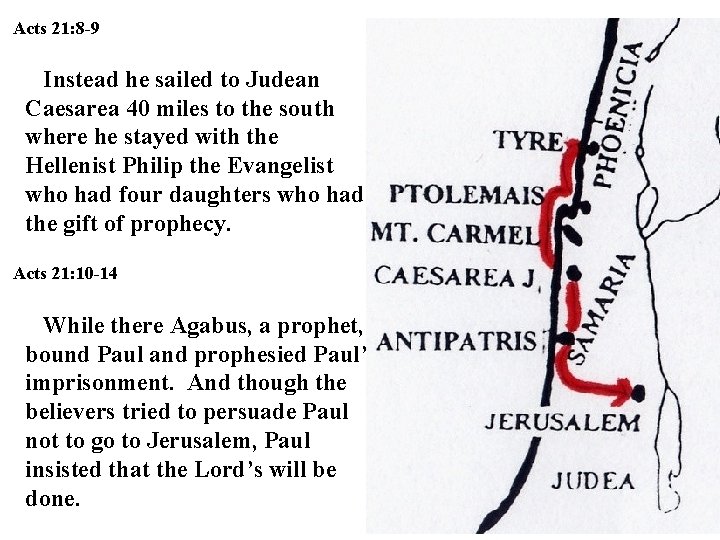
Acts 21: 8 -9 Instead he sailed to Judean Caesarea 40 miles to the south where he stayed with the Hellenist Philip the Evangelist who had four daughters who had the gift of prophecy. Acts 21: 10 -14 While there Agabus, a prophet, bound Paul and prophesied Paul’s imprisonment. And though the believers tried to persuade Paul not to go to Jerusalem, Paul insisted that the Lord’s will be done.
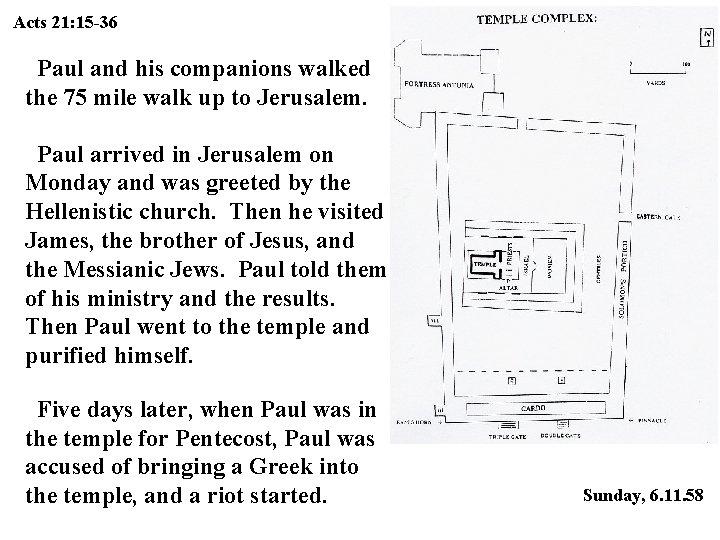
Acts 21: 15 -36 Paul and his companions walked the 75 mile walk up to Jerusalem. Paul arrived in Jerusalem on Monday and was greeted by the Hellenistic church. Then he visited James, the brother of Jesus, and the Messianic Jews. Paul told them of his ministry and the results. Then Paul went to the temple and purified himself. Five days later, when Paul was in the temple for Pentecost, Paul was accused of bringing a Greek into the temple, and a riot started. Sunday, 6. 11. 58
Acts 21: 37 -40 Paul was in the process of being killed when the Romans stopped the beating. He was arrested and put in chains while the tribune asked what was happening. Paul was taken up the steps of the fortress of Antonia. He volunteered to calm the crowds, and was allowed to address them. Acts 22: 1 -24 When Paul said that he had been sent to the Gentiles, the crowd got angry and Paul was taken inside for his own protection. Acts 22: 24 -30 The tribune ordered Paul examined by flogging but, when he found out that Paul was a Roman citizen, he immediately had Paul untied. Then the tribune arranged to have the Chief Priest and his council meet with Paul the next day.
Acts 23: 1 -10 Monday, 6. 12. 58 At the meeting Paul stood before Ananias the Chief Priest. Then Paul manipulated the council by basing his argument on the old debate of resurrection from the dead. The Pharisees believe in a resurrection while the Sadducees did not. But when the debate got ‘hot’, the Romans removed Paul for his safety. Acts 23: 11 That night the Lord appeared to Paul in prison and told him that he must go to Rome to testify on behalf of his faith. Acts 23: 12 -30 The next morning some Jews vowed to kill Paul. But when Paul’s nephew found out and informed Paul, Paul sent him to tell the Romans. The Romans immediately arranged to get Paul out of Jerusalem.
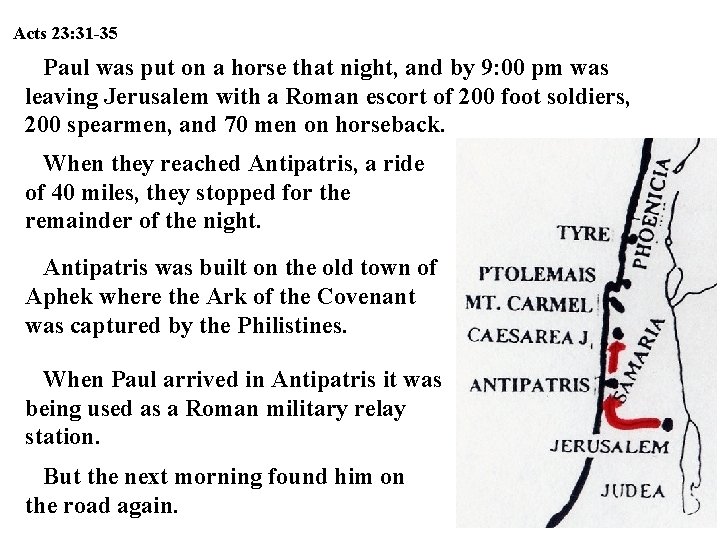
Acts 23: 31 -35 Paul was put on a horse that night, and by 9: 00 pm was leaving Jerusalem with a Roman escort of 200 foot soldiers, 200 spearmen, and 70 men on horseback. When they reached Antipatris, a ride of 40 miles, they stopped for the remainder of the night. Antipatris was built on the old town of Aphek where the Ark of the Covenant was captured by the Philistines. When Paul arrived in Antipatris it was being used as a Roman military relay station. But the next morning found him on the road again.
Acts 23: 33 -35 Paul was delivered to Governor Felix in Caesarea, 35 miles distant. He was put in a holding cell and arrangements made for his accusers to be in Caesarea within five days for a hearing. Acts 24: 1 -27 Monday, 6. 19. 58 Five days later Paul was accused of being an agitator of the Nazarenes, and that he attempted to profane the temple. Then Paul gave his defense. He had not brought a Greek into the temple and he told his story.
Felix decided to postpone judgment until the Roman tribune arrived in Caesarea, and hoping for a bribe. Paul was ordered to be kept in custody but was not prevented from having folks visit him. He was kept here for two years. Fall, 59 It was during this two years that Paul wrote a letter to the Colossians. Paul has never visited the churches of the Lycus River valley (Colossae, Laodicea, Hierapolis) but wants to send them a brief letter with Onesimus (who was set free three years earlier by Philemon in order to minister with Paul). Paul also sends Tychicus along to this church founded by Epaphras, who had made the journey to Caesarea to talk to Paul about the situation in the Lycus valley churches.
Colossians The early gnostic Gentiles are teaching that the Diety is pure spirit. But the further away one gets, the more layers of a physical nature encase it, till finally the human body has trapped a spark of soul. The god of the creation of the physical trap, called Demiurge, has an army of elemental spirits, called Archons, that keep the soul trapped. The Gentiles teach that they have secret knowledge that will enable souls to finally escape this evil world by weaving past the many elemental spirits. Paul writes that the God dwells perfectly in Christ (2: 9) and that there is no trap except sin (2: 13) which has been overcome by God's forgiveness (1: 14). Christ, through whom all things were created (1: 16), is the one who has authority over all powers (1: 15 -16, 2: 10).
God has always had a plan for the salvation of believers, and has finally made known that former mystery (1: 26). The "mystery" is that we will be saved by our faith in Christ and our hope is in heaven (1: 27, 2: 2). Through baptism (2: 12) we become part of Christ's body, the Church (1: 18). Through faith, we have hope (1: 27), and will enter the kingdom (1: 13). Don't be fooled by logic (2: 4) that seems like wisdom (2: 23), but is nothing more then empty words (2: 8). Not works, rituals, idol worship, or human thinking will help (2: 16 -22). Avoid inappropriate behavior (3: 5, 8 -9). Instead, seek the things of God (3: 2) and act appropriately (3: 12 -17). END In the summer of 60, Felix was replaced by Festus.