
Patterns Sequences Lesson 1 Define Some people say
- Slides: 8
Patterns & Sequences Lesson 1
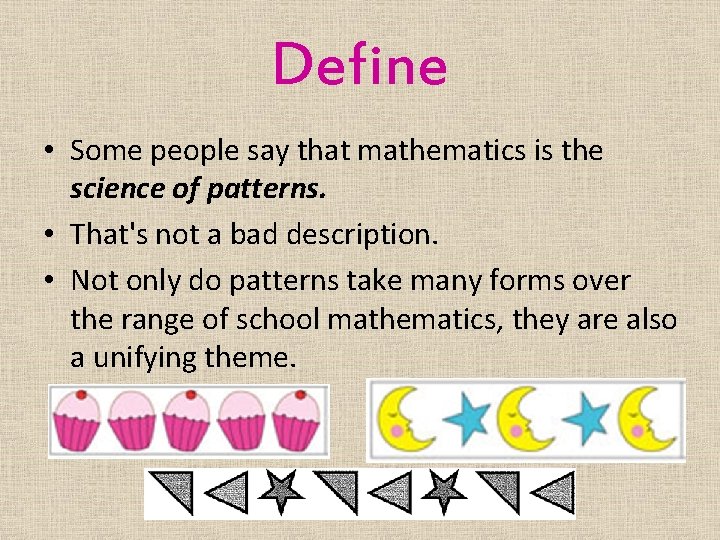
Define • Some people say that mathematics is the science of patterns. • That's not a bad description. • Not only do patterns take many forms over the range of school mathematics, they are also a unifying theme.
Continued… • Number patterns—such as 3, 6, 9, 12—are familiar to us since they are among the patterns we first learn as young students. • How can you tell if a number sequence is a pattern? • A number sequence is a pattern if the sequence follows a specific rule.
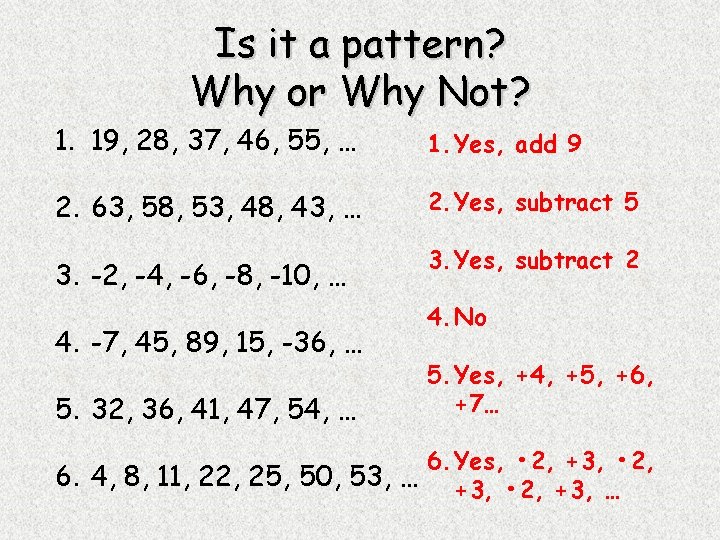
Is it a pattern? Why or Why Not? 1. 19, 28, 37, 46, 55, … 1. Yes, add 9 2. 63, 58, 53, 48, 43, … 2. Yes, subtract 5 3. -2, -4, -6, -8, -10, … 4. -7, 45, 89, 15, -36, … 5. 32, 36, 41, 47, 54, … 3. Yes, subtract 2 4. No 5. Yes, +4, +5, +6, +7… 6. Yes, • 2, +3, • 2, 6. 4, 8, 11, 22, 25, 50, 53, … +3, • 2, +3, …
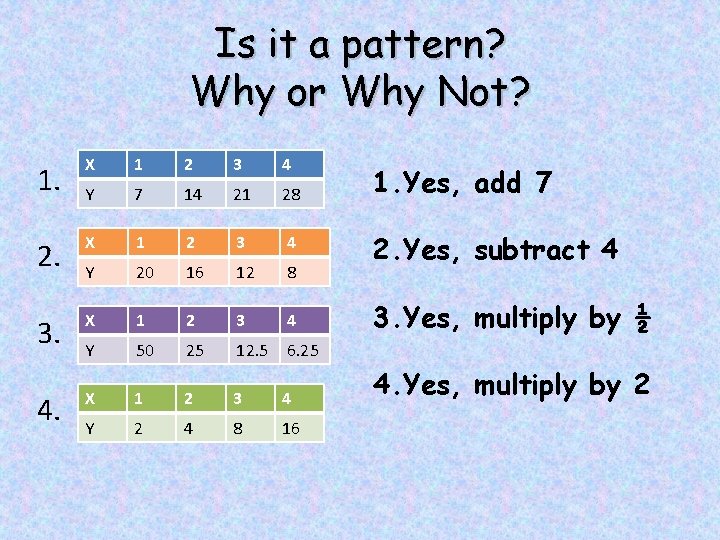
Is it a pattern? Why or Why Not? 1. X 1 2 3 4 Y 7 14 21 28 2. X 1 2 3 4 Y 20 16 12 8 3. X 1 2 3 4 Y 50 25 12. 5 6. 25 4. X 1 2 3 4 Y 2 4 8 16 1. Yes, add 7 2. Yes, subtract 4 3. Yes, multiply by ½ 4. Yes, multiply by 2
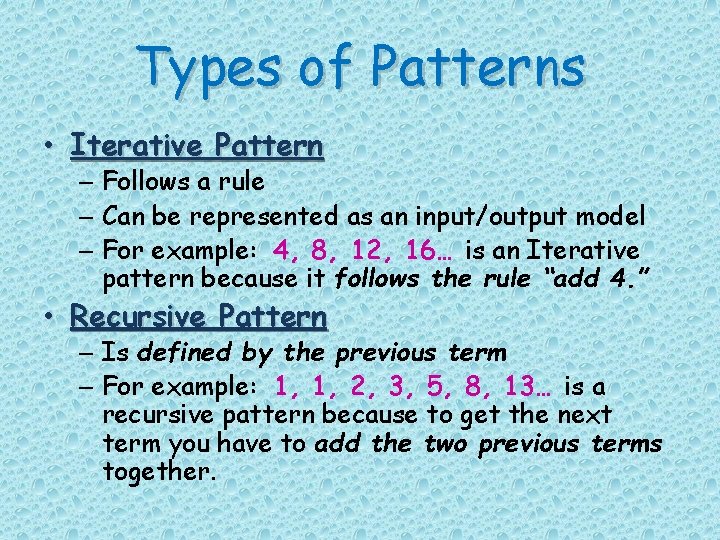
Types of Patterns • Iterative Pattern – Follows a rule – Can be represented as an input/output model – For example: 4, 8, 12, 16… is an Iterative pattern because it follows the rule “add 4. ” • Recursive Pattern – Is defined by the previous term – For example: 1, 1, 2, 3, 5, 8, 13… is a recursive pattern because to get the next term you have to add the two previous terms together.
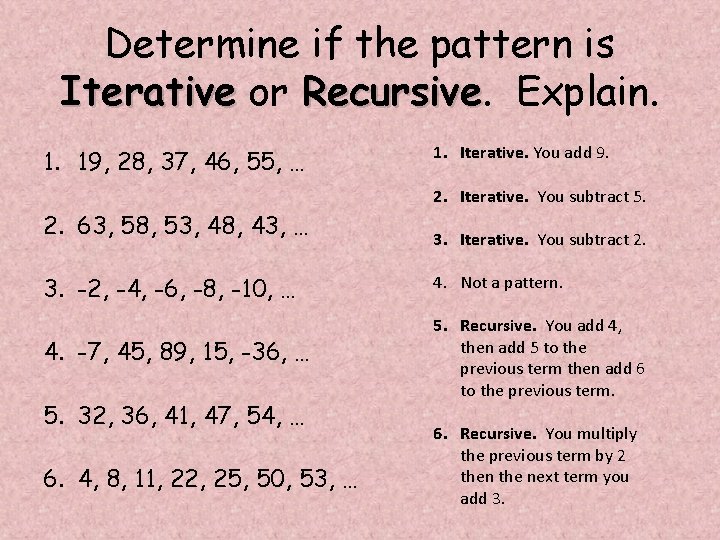
Determine if the pattern is Iterative or Recursive Explain. 1. 19, 28, 37, 46, 55, … 1. Iterative. You add 9. 2. Iterative. You subtract 5. 2. 63, 58, 53, 48, 43, … 3. Iterative. You subtract 2. 3. -2, -4, -6, -8, -10, … 4. Not a pattern. 4. -7, 45, 89, 15, -36, … 5. Recursive. You add 4, then add 5 to the previous term then add 6 to the previous term. 5. 32, 36, 41, 47, 54, … 6. 4, 8, 11, 22, 25, 50, 53, … 6. Recursive. You multiply the previous term by 2 then the next term you add 3.
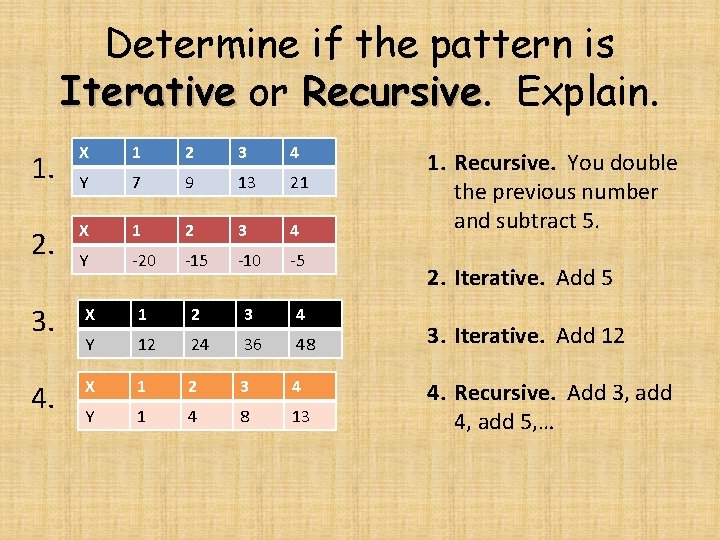
Determine if the pattern is Iterative or Recursive Explain. 1. X 1 2 3 4 Y 7 9 13 21 2. X 1 2 3 4 Y -20 -15 -10 -5 3. X 1 2 3 4 Y 12 24 36 48 4. X 1 2 3 4 Y 1 4 8 13 1. Recursive. You double the previous number and subtract 5. 2. Iterative. Add 5 3. Iterative. Add 12 4. Recursive. Add 3, add 4, add 5, …