
Patterns of Inheritance CHAPTER 8 PART A Principles







- Slides: 60
Patterns of Inheritance CHAPTER 8 PART A
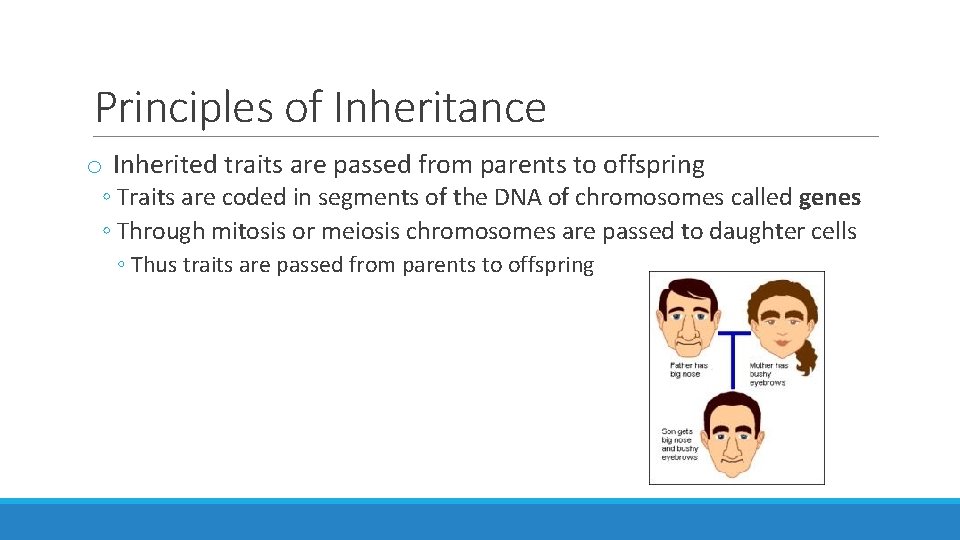
Principles of Inheritance o Inherited traits are passed from parents to offspring ◦ Traits are coded in segments of the DNA of chromosomes called genes ◦ Through mitosis or meiosis chromosomes are passed to daughter cells ◦ Thus traits are passed from parents to offspring
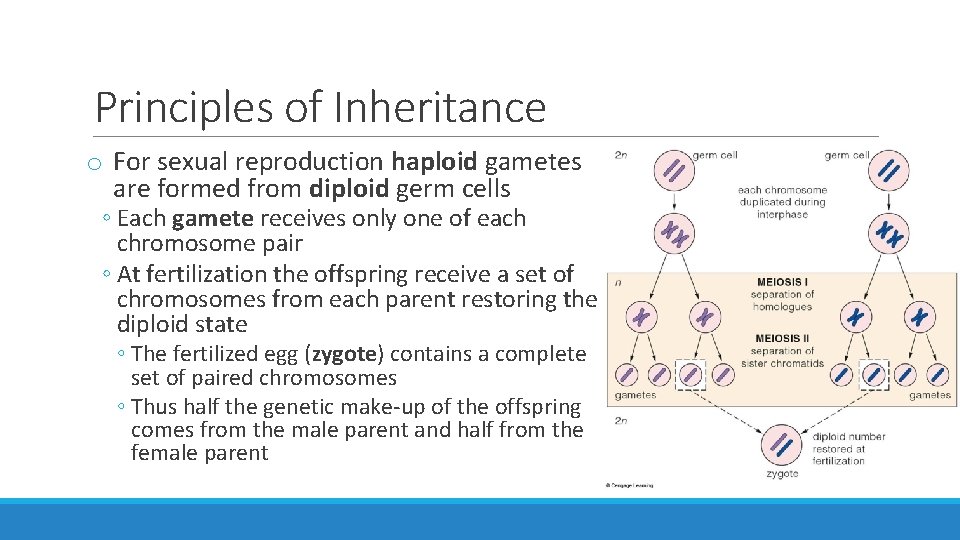
Principles of Inheritance o For sexual reproduction haploid gametes are formed from diploid germ cells ◦ Each gamete receives only one of each chromosome pair ◦ At fertilization the offspring receive a set of chromosomes from each parent restoring the diploid state ◦ The fertilized egg (zygote) contains a complete set of paired chromosomes ◦ Thus half the genetic make-up of the offspring comes from the male parent and half from the female parent
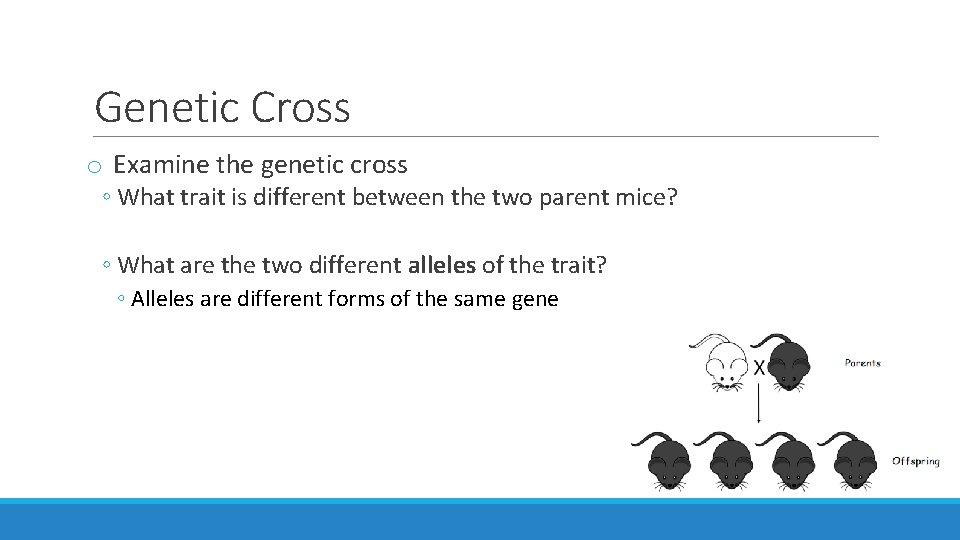
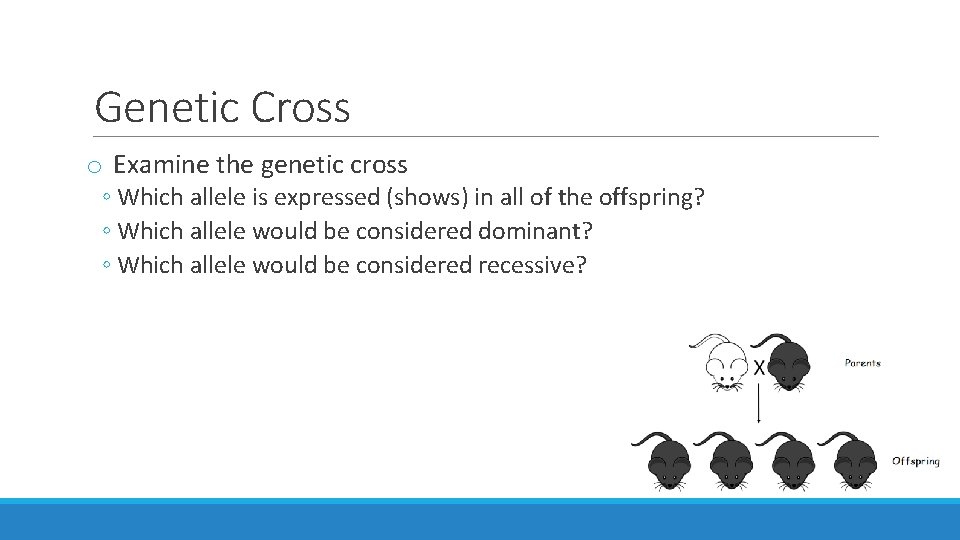
Genetic Cross o Examine the genetic cross ◦ What trait is different between the two parent mice? ◦ What are the two different alleles of the trait? ◦ Alleles are different forms of the same gene
Genetic Cross o Examine the genetic cross ◦ What trait is different between the two parent mice? ◦ Fur coat color ◦ There is a gene that codes for coat color ◦ What are the two different alleles of the trait? ◦ Alleles are different forms of the same gene ◦ Light and dark fur
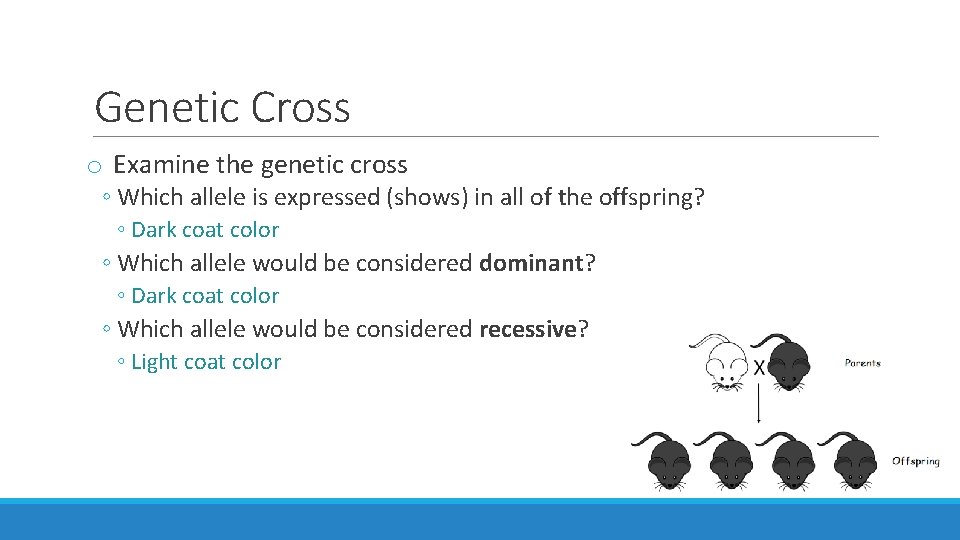
Genetic Cross o Examine the genetic cross ◦ Which allele is expressed (shows) in all of the offspring? ◦ Which allele would be considered dominant? ◦ Which allele would be considered recessive?
Genetic Cross o Examine the genetic cross ◦ Which allele is expressed (shows) in all of the offspring? ◦ Dark coat color ◦ Which allele would be considered dominant? ◦ Dark coat color ◦ Which allele would be considered recessive? ◦ Light coat color
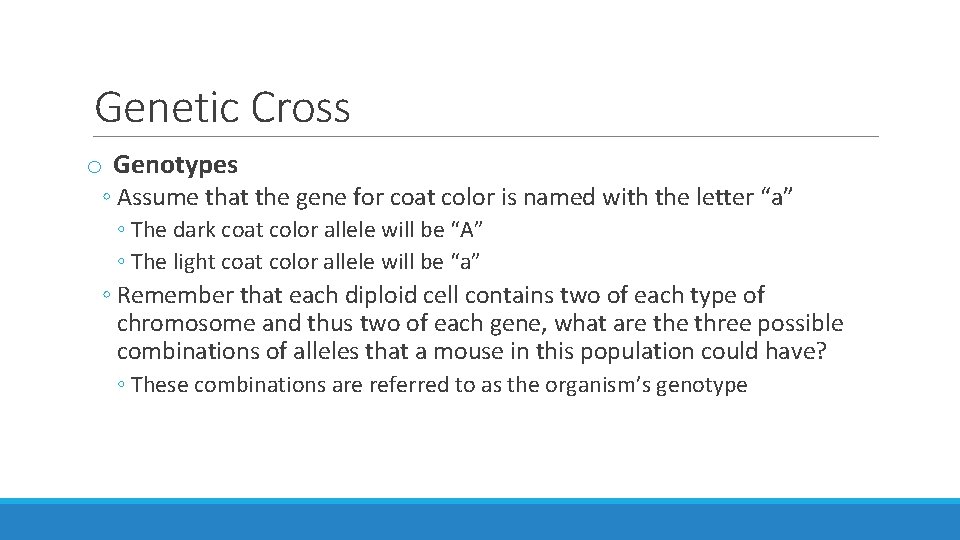
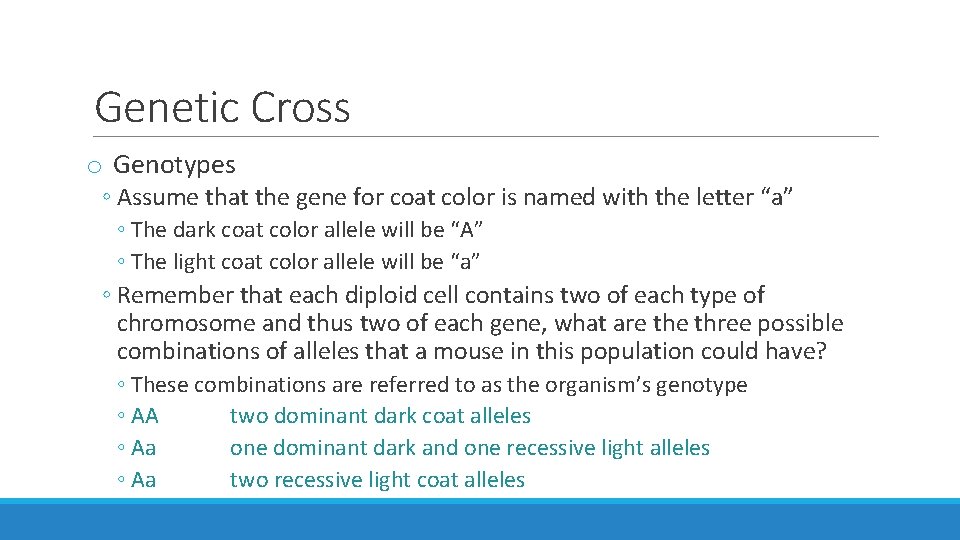
Genetic Cross o Genotypes ◦ Assume that the gene for coat color is named with the letter “a” ◦ The dark coat color allele will be “A” ◦ The light coat color allele will be “a” ◦ Remember that each diploid cell contains two of each type of chromosome and thus two of each gene, what are three possible combinations of alleles that a mouse in this population could have? ◦ These combinations are referred to as the organism’s genotype
Genetic Cross o Genotypes ◦ Assume that the gene for coat color is named with the letter “a” ◦ The dark coat color allele will be “A” ◦ The light coat color allele will be “a” ◦ Remember that each diploid cell contains two of each type of chromosome and thus two of each gene, what are three possible combinations of alleles that a mouse in this population could have? ◦ These combinations are referred to as the organism’s genotype ◦ AA two dominant dark coat alleles ◦ Aa one dominant dark and one recessive light alleles ◦ Aa two recessive light coat alleles
Genetic Cross o Genotypes ◦ Which of the possible genotypes are homozygous or heterozygous? ◦ Homo = the same ◦ Hetero = different ◦ Homozygous ◦ Heterozygous
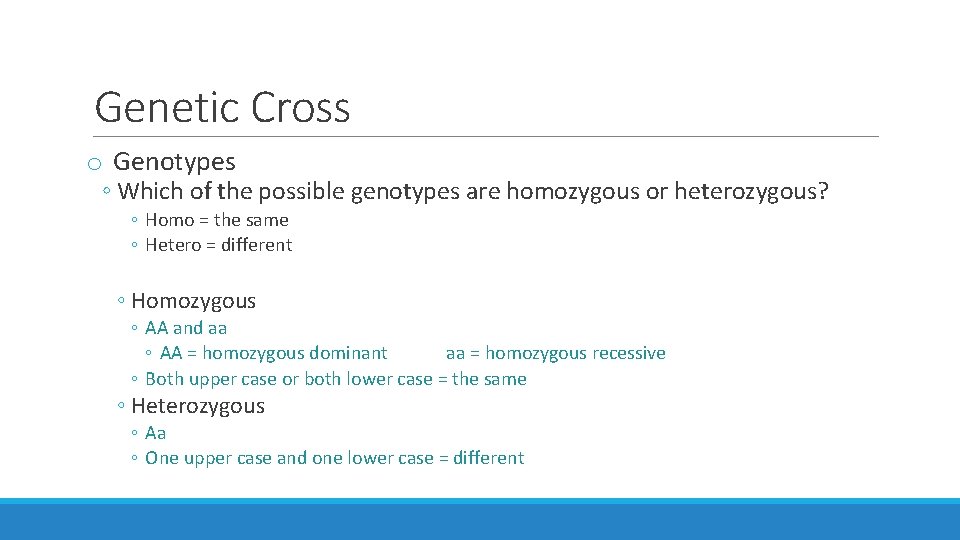
Genetic Cross o Genotypes ◦ Which of the possible genotypes are homozygous or heterozygous? ◦ Homo = the same ◦ Hetero = different ◦ Homozygous ◦ AA and aa ◦ AA = homozygous dominant aa = homozygous recessive ◦ Both upper case or both lower case = the same ◦ Heterozygous ◦ Aa ◦ One upper case and one lower case = different
Genetic Cross o Phenotypes ◦ The phenotype is the observable traits expressed by the combination of alleles each organism has for a given gene ◦ What will the phenotype be for each genotype? ◦ AA ◦ Aa ◦ aa
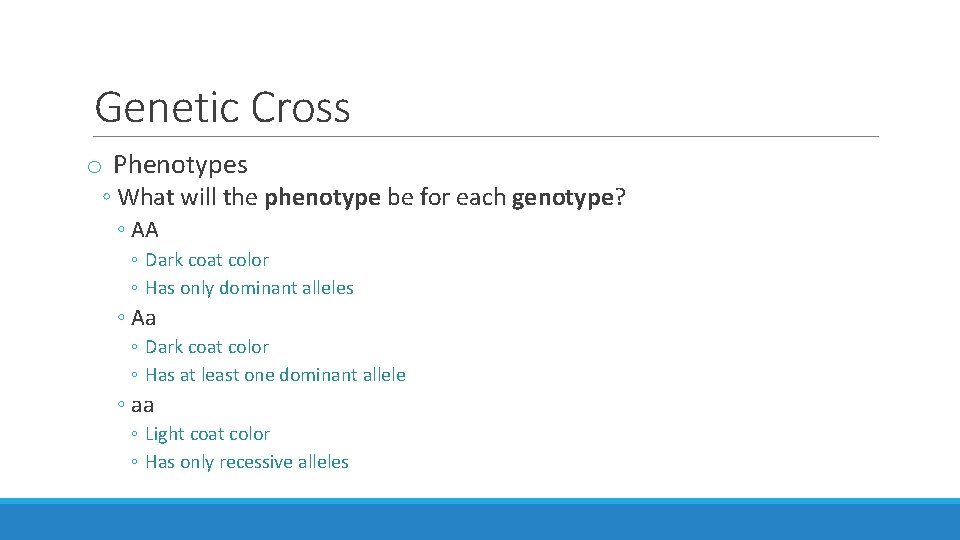
Genetic Cross o Phenotypes ◦ What will the phenotype be for each genotype? ◦ AA ◦ Dark coat color ◦ Has only dominant alleles ◦ Aa ◦ Dark coat color ◦ Has at least one dominant allele ◦ aa ◦ Light coat color ◦ Has only recessive alleles
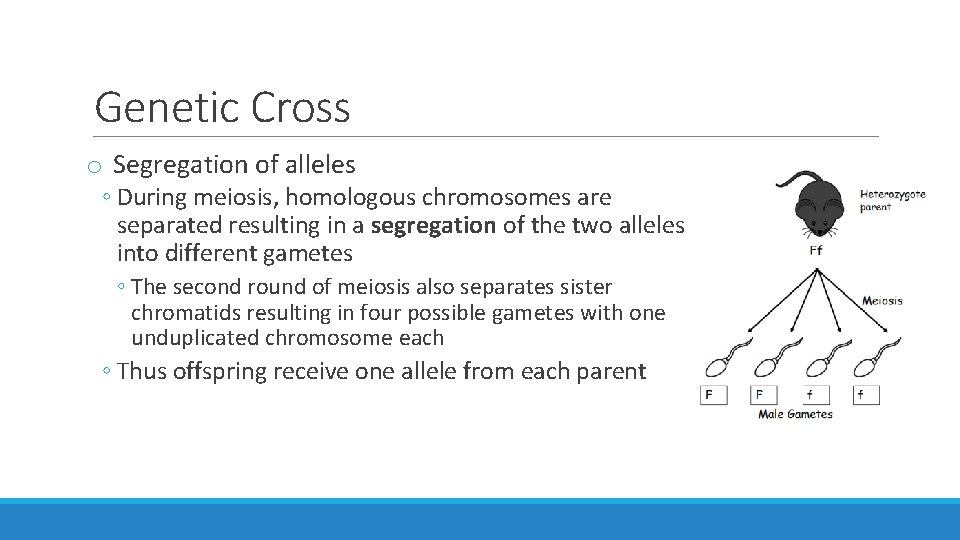
Genetic Cross o Segregation of alleles ◦ During meiosis, homologous chromosomes are separated resulting in a segregation of the two alleles into different gametes ◦ The second round of meiosis also separates sister chromatids resulting in four possible gametes with one unduplicated chromosome each ◦ Thus offspring receive one allele from each parent
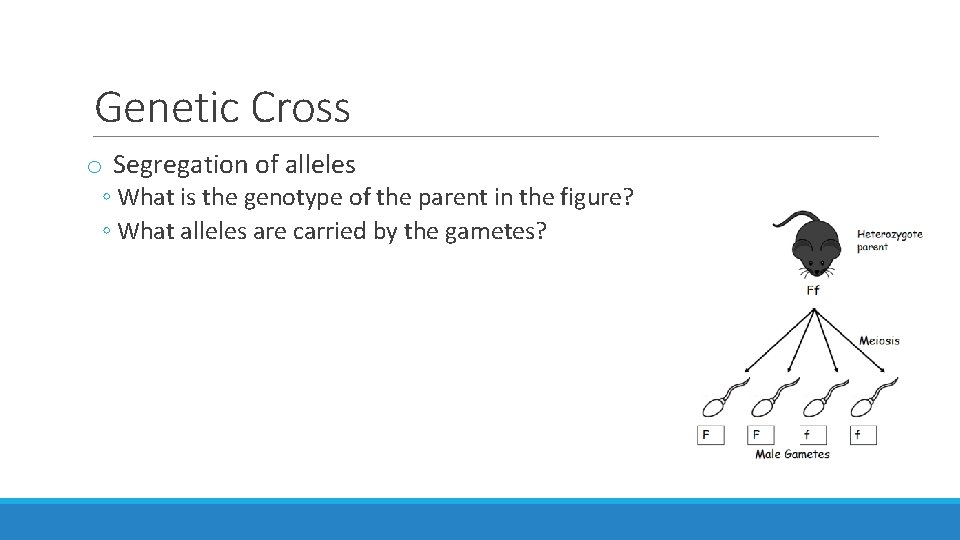
Genetic Cross o Segregation of alleles ◦ What is the genotype of the parent in the figure? ◦ What alleles are carried by the gametes?
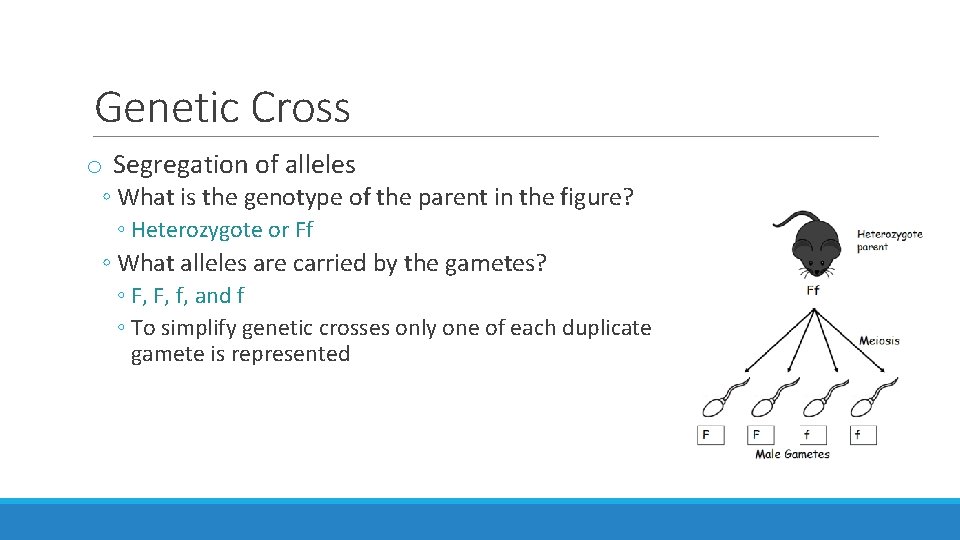
Genetic Cross o Segregation of alleles ◦ What is the genotype of the parent in the figure? ◦ Heterozygote or Ff ◦ What alleles are carried by the gametes? ◦ F, F, f, and f ◦ To simplify genetic crosses only one of each duplicate gamete is represented
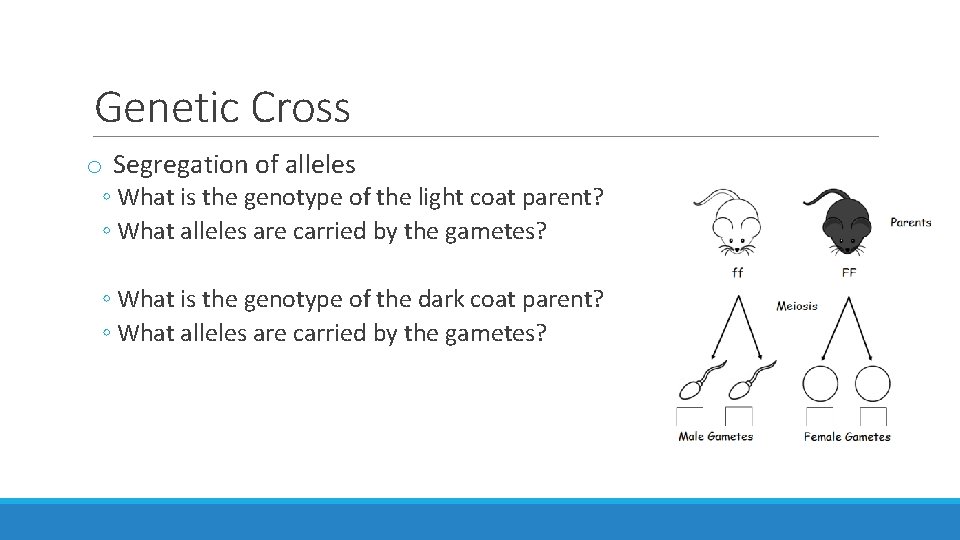
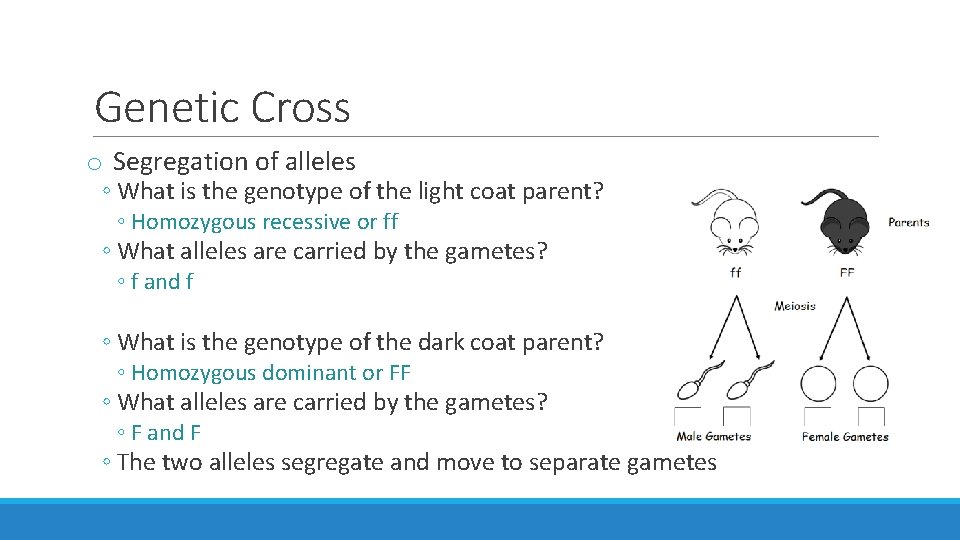
Genetic Cross o Segregation of alleles ◦ What is the genotype of the light coat parent? ◦ What alleles are carried by the gametes? ◦ What is the genotype of the dark coat parent? ◦ What alleles are carried by the gametes?
Genetic Cross o Segregation of alleles ◦ What is the genotype of the light coat parent? ◦ Homozygous recessive or ff ◦ What alleles are carried by the gametes? ◦ f and f ◦ What is the genotype of the dark coat parent? ◦ Homozygous dominant or FF ◦ What alleles are carried by the gametes? ◦ F and F ◦ The two alleles segregate and move to separate gametes
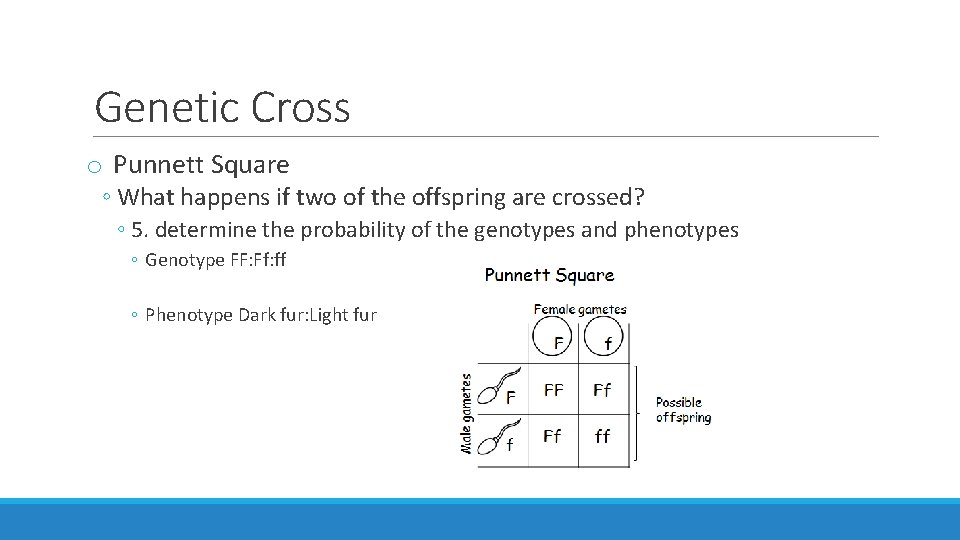
Genetic Cross o Punnett Square ◦ During fertilization either possible sperm could fuse with either possible ovum ◦ A Punnett square can be used to determine all possible gamete combinations and predict what traits the offspring might inherit from the parents
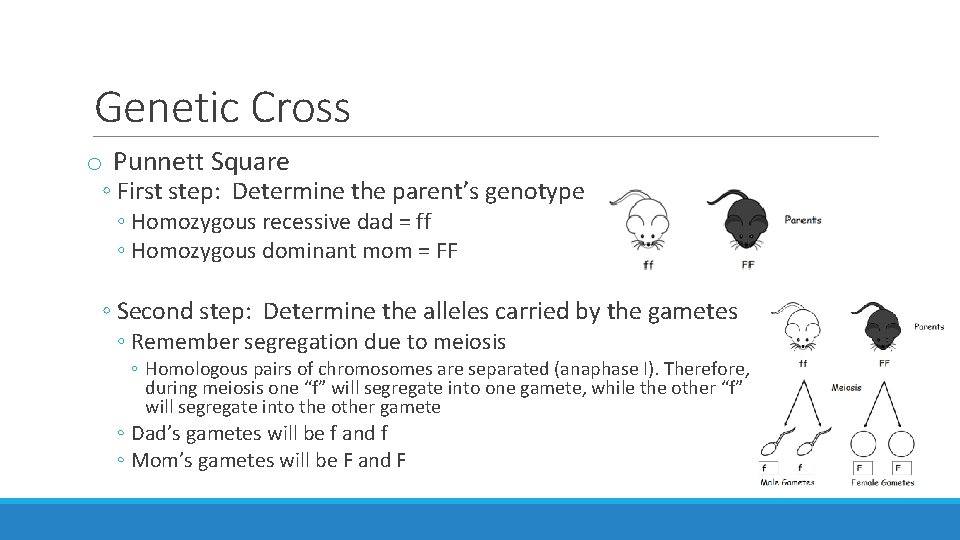
Genetic Cross o Punnett Square ◦ First step: Determine the parent’s genotype ◦ Homozygous recessive dad = ff ◦ Homozygous dominant mom = FF ◦ Second step: Determine the alleles carried by the gametes ◦ Remember segregation due to meiosis ◦ Homologous pairs of chromosomes are separated (anaphase I). Therefore, during meiosis one “f” will segregate into one gamete, while the other “f” will segregate into the other gamete ◦ Dad’s gametes will be f and f ◦ Mom’s gametes will be F and F
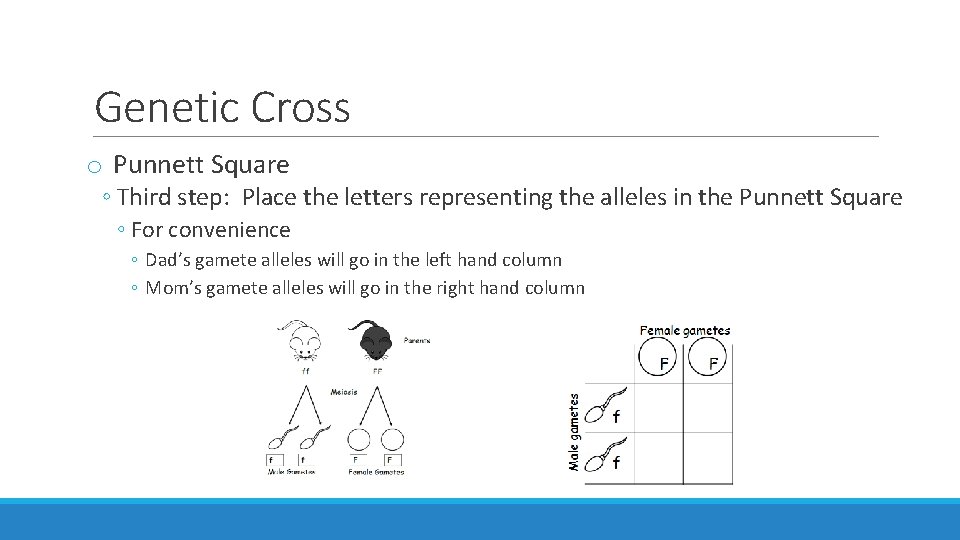
Genetic Cross o Punnett Square ◦ Third step: Place the letters representing the alleles in the Punnett Square ◦ For convenience ◦ Dad’s gamete alleles will go in the left hand column ◦ Mom’s gamete alleles will go in the right hand column
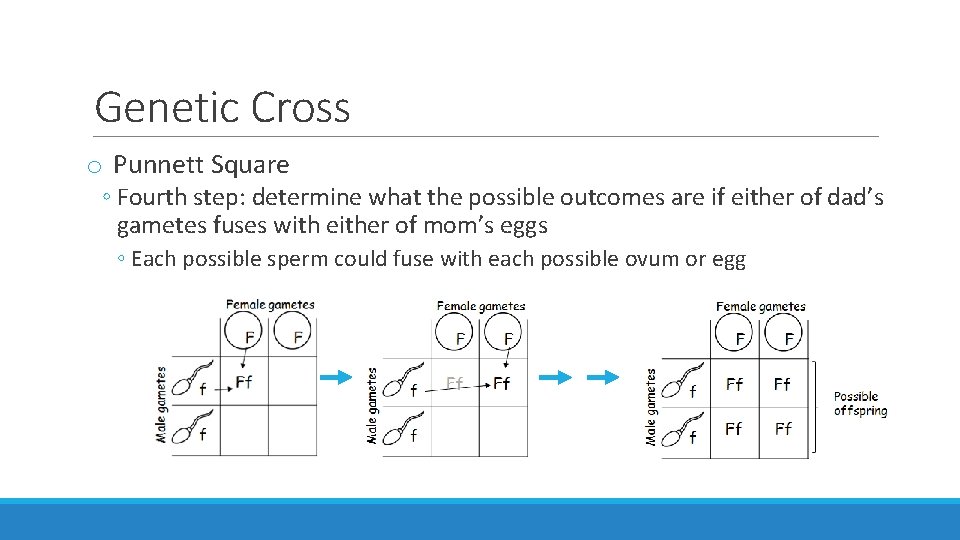
Genetic Cross o Punnett Square ◦ Fourth step: determine what the possible outcomes are if either of dad’s gametes fuses with either of mom’s eggs ◦ Each possible sperm could fuse with each possible ovum or egg
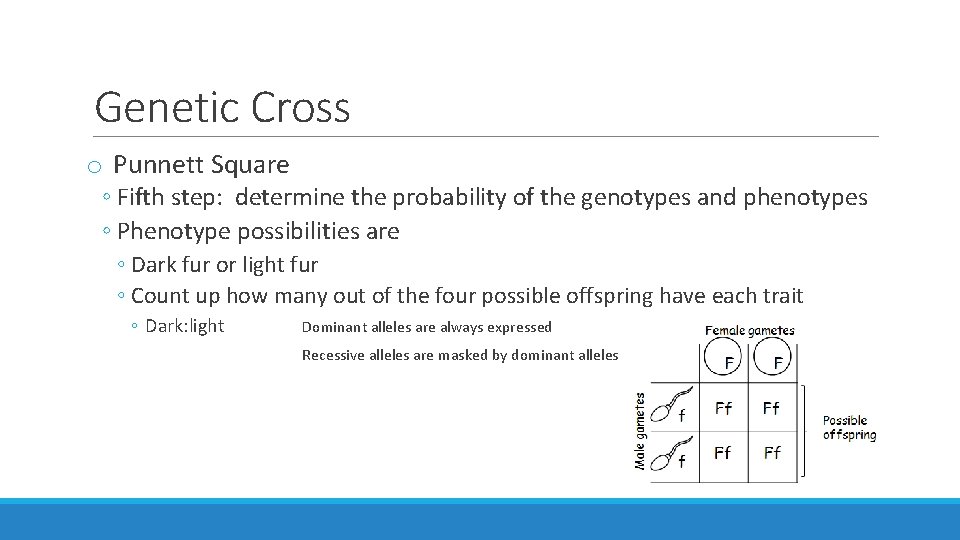
Genetic Cross o Punnett Square ◦ Fifth step: determine the probability of the genotypes and phenotypes ◦ Genotype possibilities are ◦ FF, Ff, or ff ◦ Count up how many out of the four possible offspring have each combination ◦ FF: Ff: ff
Genetic Cross o Punnett Square ◦ Fifth step: determine the probability of the genotypes and phenotypes ◦ Genotype possibilities are ◦ FF, Ff, or ff ◦ Count up how many out of the four possible offspring have each combination ◦ FF: Ff: ff ◦ 0: 4: 0
Genetic Cross o Punnett Square ◦ Fifth step: determine the probability of the genotypes and phenotypes ◦ Phenotype possibilities are ◦ Dark fur or light fur ◦ Count up how many out of the four possible offspring have each trait ◦ Dark: light Dominant alleles are always expressed Recessive alleles are masked by dominant alleles
Genetic Cross o Punnett Square ◦ Fifth step: determine the probability of the genotypes and phenotypes ◦ Phenotype possibilities are ◦ Dark fur or light fur ◦ Count up how many out of the four possible offspring have each trait ◦ Dark: light ◦ 4: 0
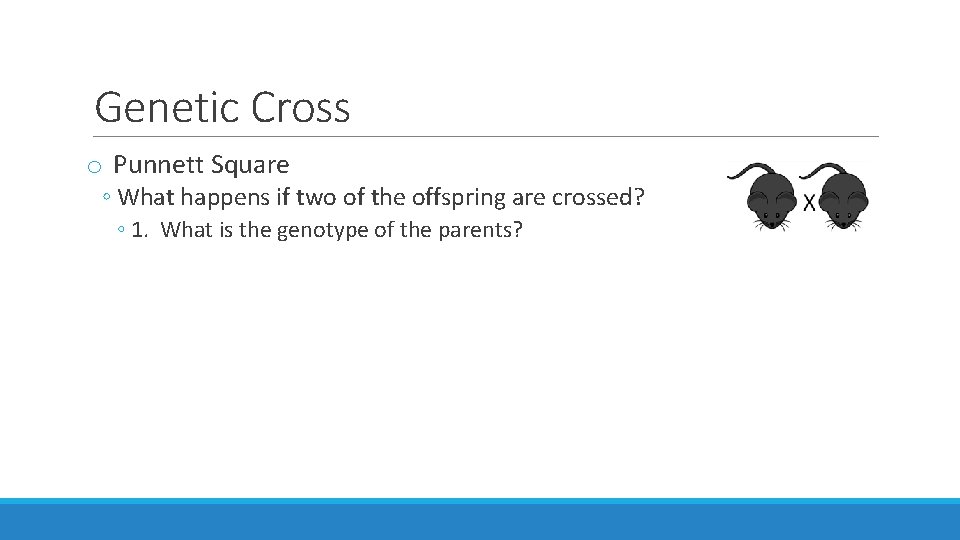
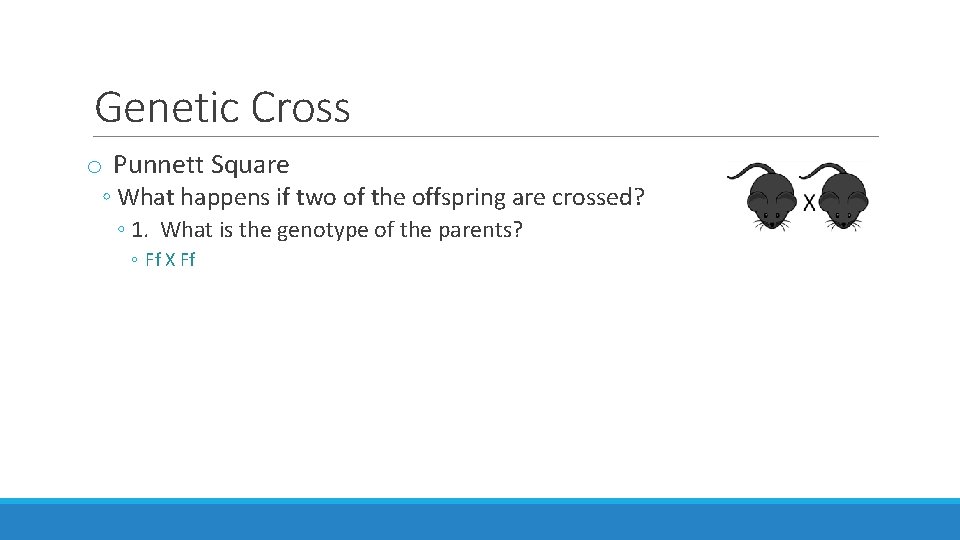
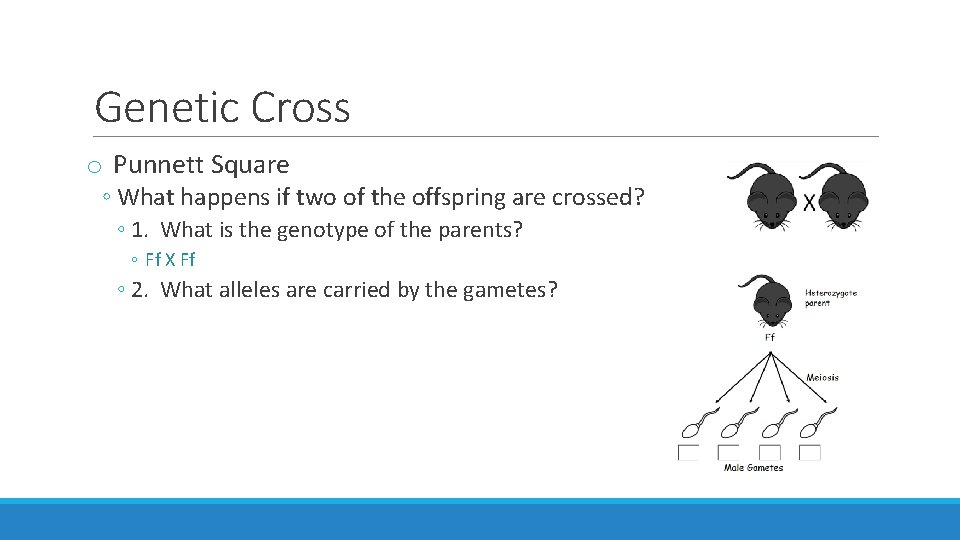
Genetic Cross o Punnett Square ◦ What happens if two of the offspring are crossed? ◦ 1. What is the genotype of the parents?
Genetic Cross o Punnett Square ◦ What happens if two of the offspring are crossed? ◦ 1. What is the genotype of the parents? ◦ Ff X Ff
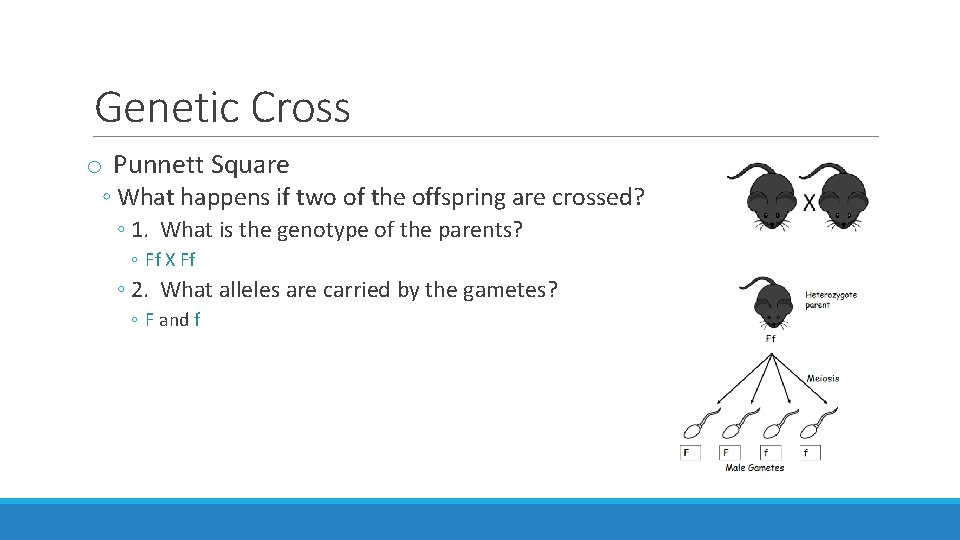
Genetic Cross o Punnett Square ◦ What happens if two of the offspring are crossed? ◦ 1. What is the genotype of the parents? ◦ Ff X Ff ◦ 2. What alleles are carried by the gametes?
Genetic Cross o Punnett Square ◦ What happens if two of the offspring are crossed? ◦ 1. What is the genotype of the parents? ◦ Ff X Ff ◦ 2. What alleles are carried by the gametes? ◦ F and f
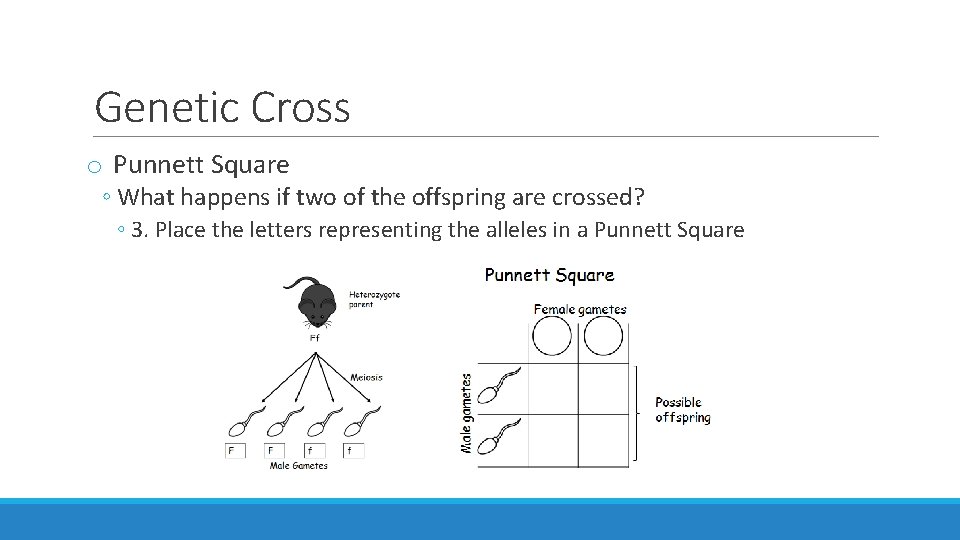
Genetic Cross o Punnett Square ◦ What happens if two of the offspring are crossed? ◦ 3. Place the letters representing the alleles in a Punnett Square
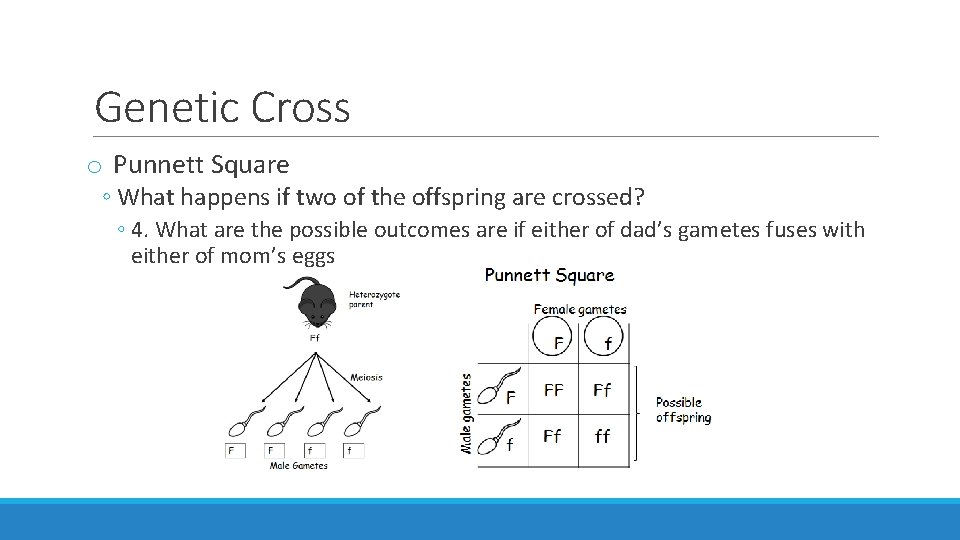
Genetic Cross o Punnett Square ◦ What happens if two of the offspring are crossed? ◦ 4. What are the possible outcomes are if either of dad’s gametes fuses with either of mom’s eggs
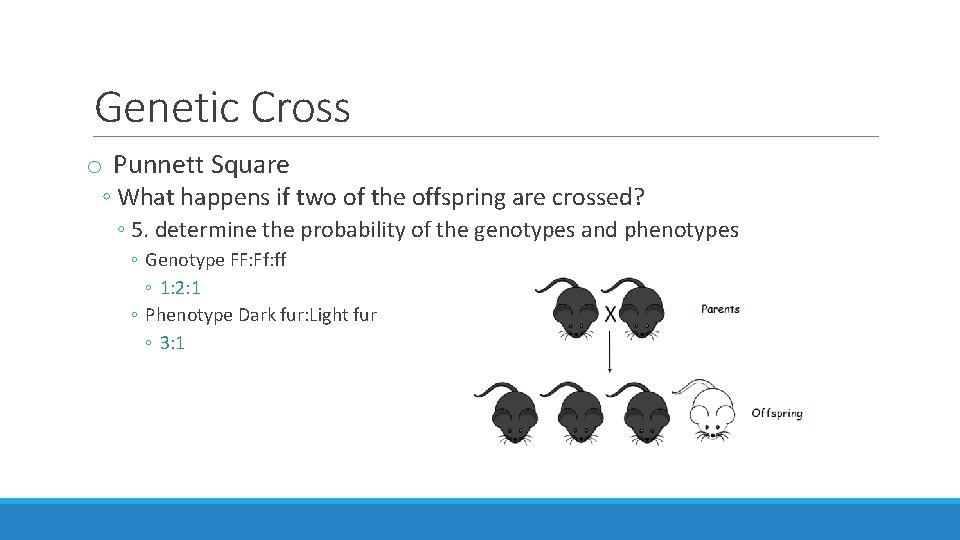
Genetic Cross o Punnett Square ◦ What happens if two of the offspring are crossed? ◦ 5. determine the probability of the genotypes and phenotypes ◦ Genotype FF: Ff: ff ◦ Phenotype Dark fur: Light fur
Genetic Cross o Punnett Square ◦ What happens if two of the offspring are crossed? ◦ 5. determine the probability of the genotypes and phenotypes ◦ Genotype FF: Ff: ff ◦ 1: 2: 1 ◦ Phenotype Dark fur: Light fur ◦ 3: 1
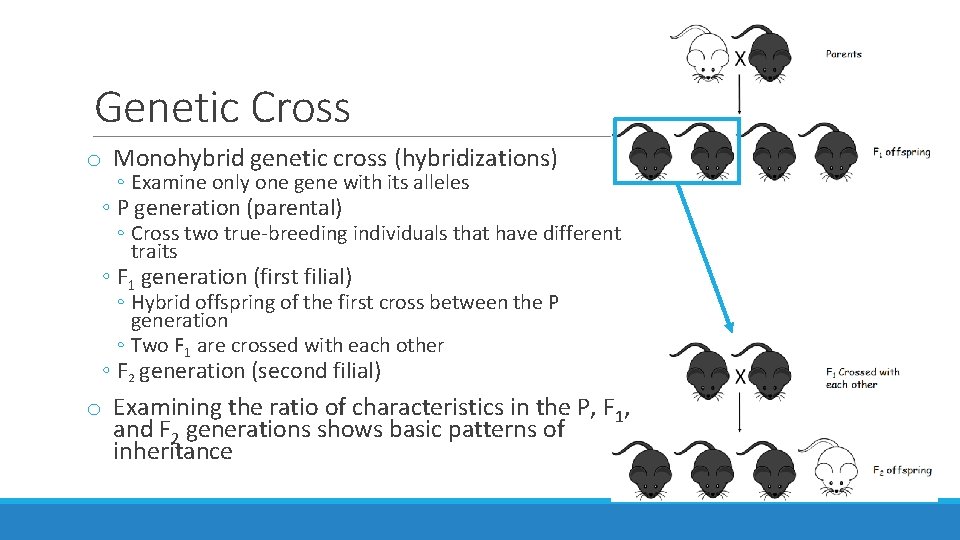
Genetic Cross o Monohybrid genetic cross (hybridizations) ◦ Examine only one gene with its alleles ◦ P generation (parental) ◦ Cross two true-breeding individuals that have different traits ◦ F 1 generation (first filial) ◦ Hybrid offspring of the first cross between the P generation ◦ Two F 1 are crossed with each other ◦ F 2 generation (second filial) o Examining the ratio of characteristics in the P, F 1, and F 2 generations shows basic patterns of inheritance
Genetic Cross o Punnett Square practice of monohybrid crosses
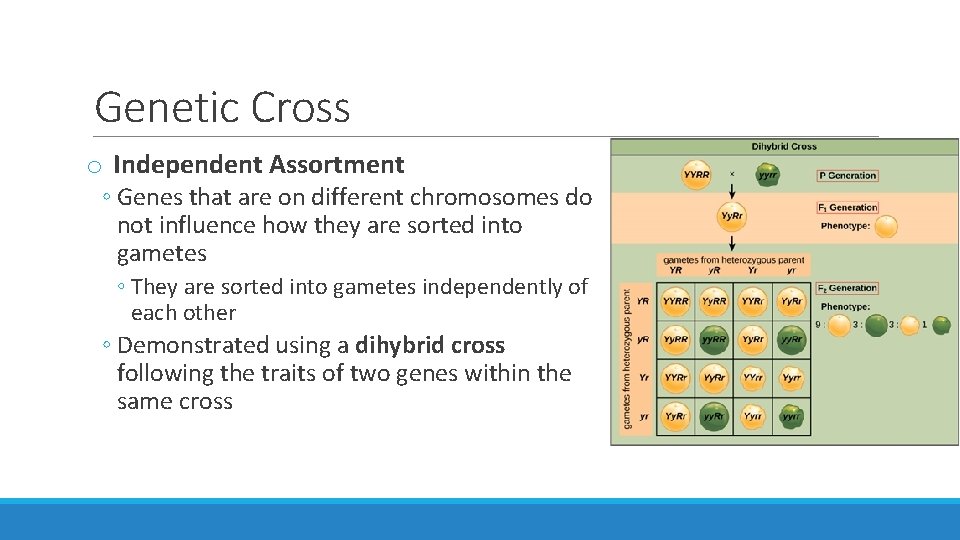
Genetic Cross o Independent Assortment ◦ Genes that are on different chromosomes do not influence how they are sorted into gametes ◦ They are sorted into gametes independently of each other ◦ Demonstrated using a dihybrid cross following the traits of two genes within the same cross
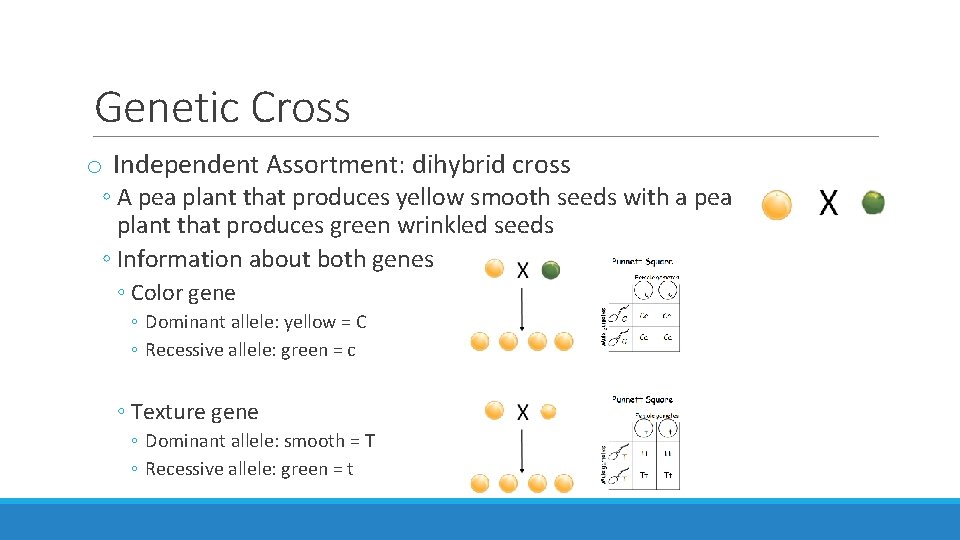
Genetic Cross o Independent Assortment: dihybrid cross ◦ A pea plant that produces yellow smooth seeds with a pea plant that produces green wrinkled seeds ◦ Information about both genes ◦ Color gene ◦ Dominant allele: yellow = C ◦ Recessive allele: green = c ◦ Texture gene ◦ Dominant allele: smooth = T ◦ Recessive allele: green = t
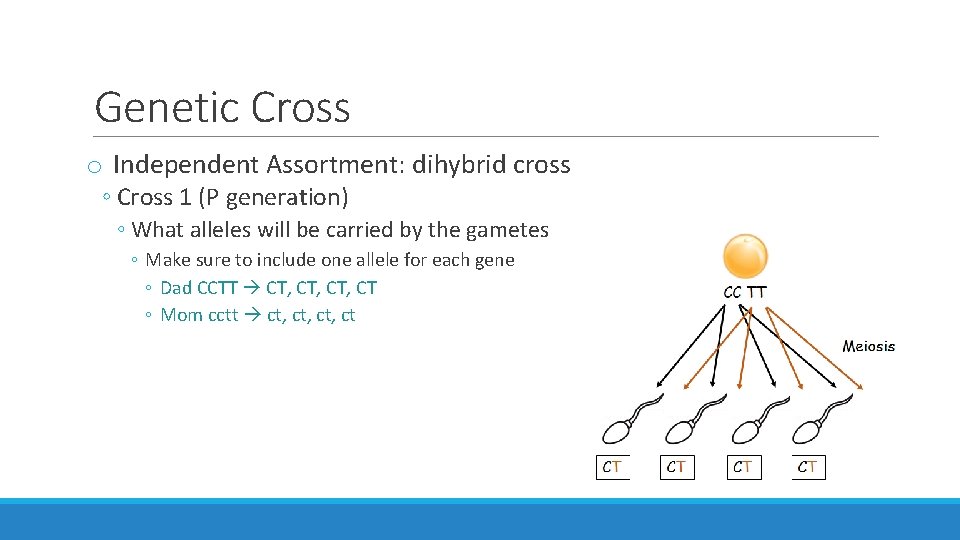
Genetic Cross o Independent Assortment: dihybrid cross ◦ Cross 1 (P generation) ◦ What is the genotype of the parents? ◦ Make sure to include two alleles for both genes ◦ Dad is yellow and smooth = CCTT ◦ Mom is green and wrinkled = cc tt
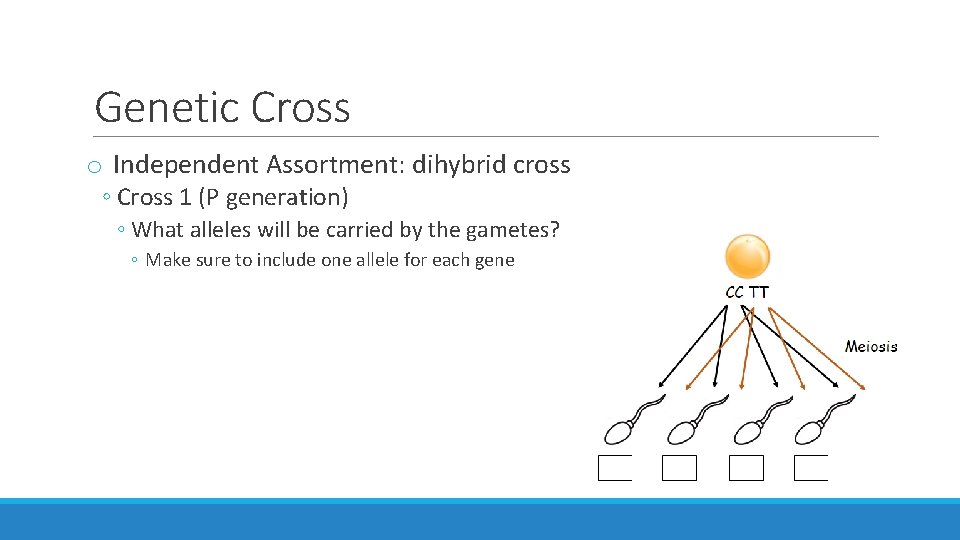
Genetic Cross o Independent Assortment: dihybrid cross ◦ Cross 1 (P generation) ◦ What alleles will be carried by the gametes? ◦ Make sure to include one allele for each gene
Genetic Cross o Independent Assortment: dihybrid cross ◦ Cross 1 (P generation) ◦ What alleles will be carried by the gametes ◦ Make sure to include one allele for each gene ◦ Dad CCTT CT, CT, CT ◦ Mom cctt ct, ct, ct
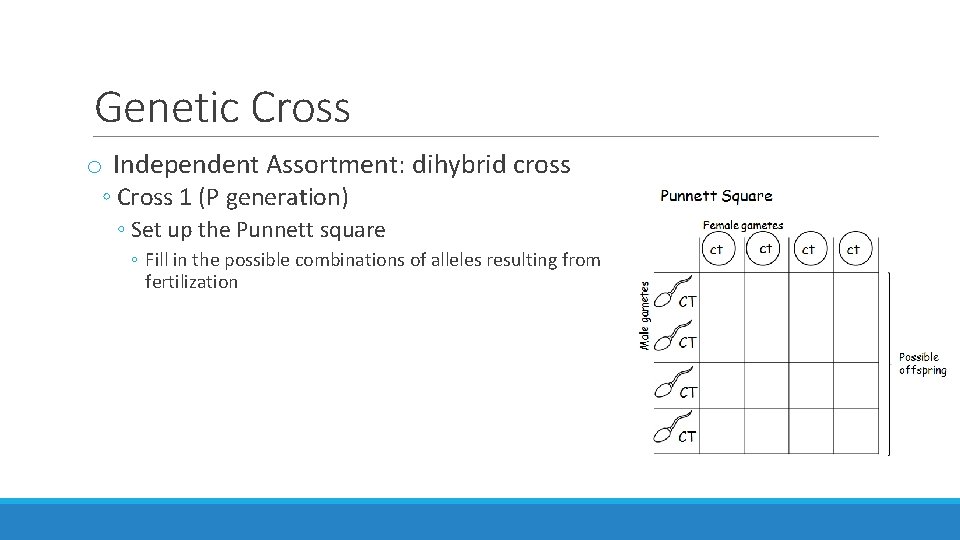
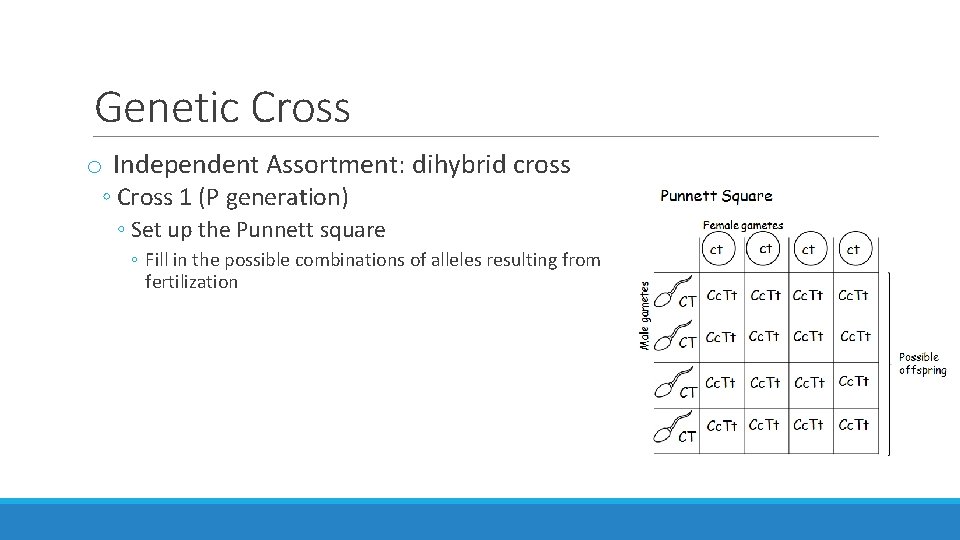
Genetic Cross o Independent Assortment: dihybrid cross ◦ Cross 1 (P generation) ◦ Set up the Punnett square ◦ Fill in the possible combinations of alleles resulting from fertilization
Genetic Cross o Independent Assortment: dihybrid cross ◦ Cross 1 (P generation) ◦ Set up the Punnett square ◦ Fill in the possible combinations of alleles resulting from fertilization
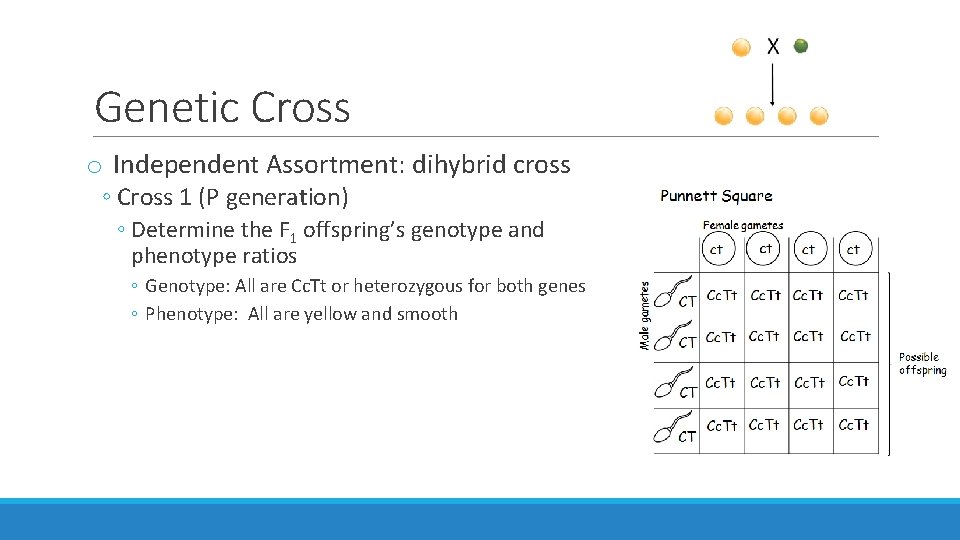
Genetic Cross o Independent Assortment: dihybrid cross ◦ Cross 1 (P generation) ◦ Determine the F 1 offspring’s genotype and phenotype ratios ◦ Genotype: All are Cc. Tt or heterozygous for both genes ◦ Phenotype: All are yellow and smooth
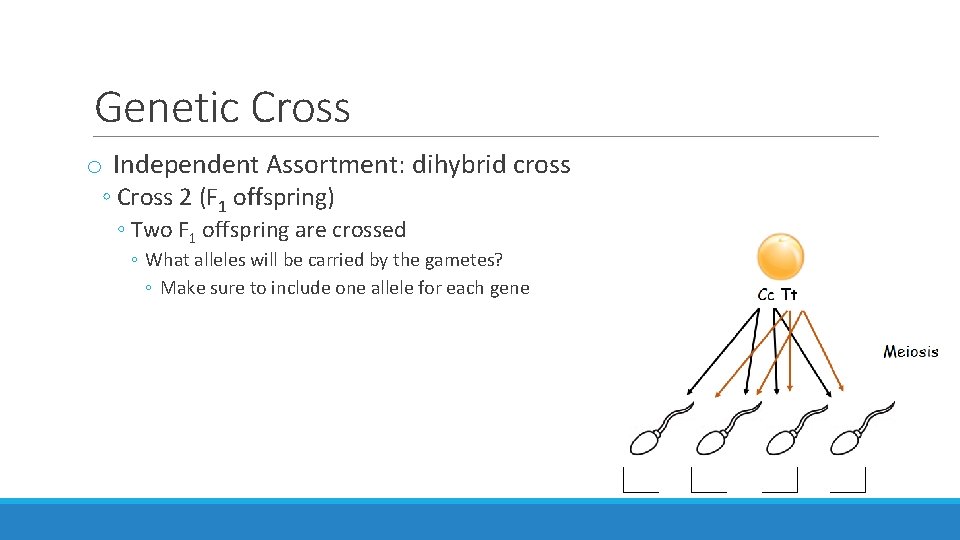
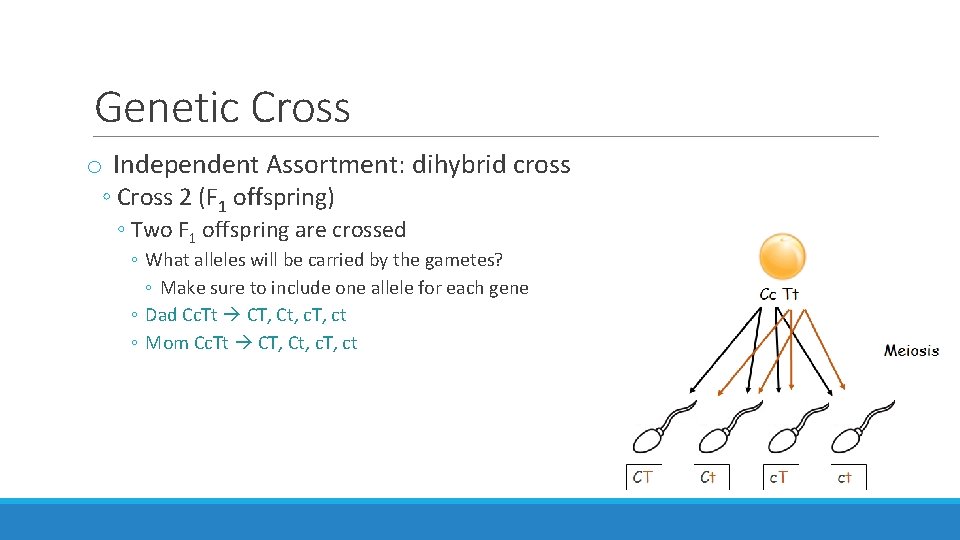
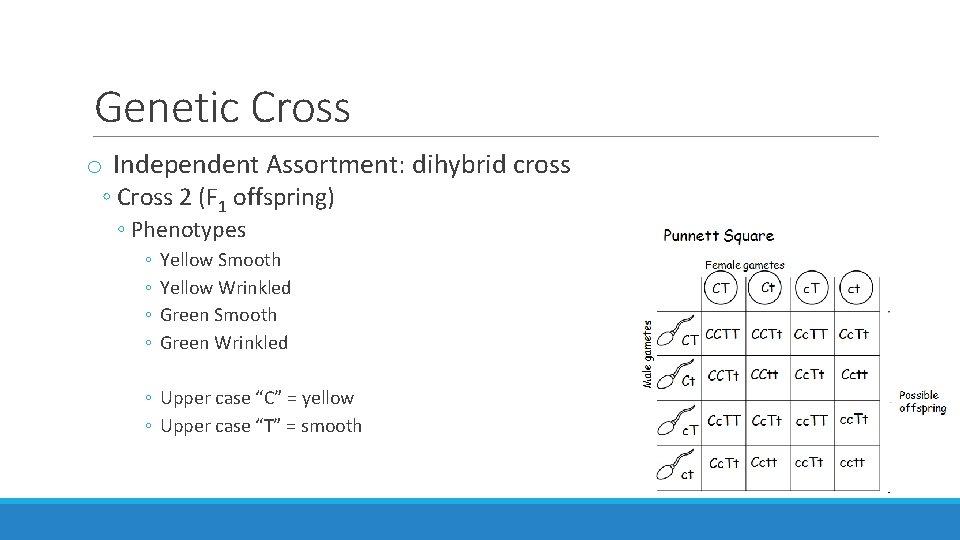
Genetic Cross o Independent Assortment: dihybrid cross ◦ Cross 2 (F 1 offspring) ◦ Two F 1 offspring are crossed ◦ What alleles will be carried by the gametes? ◦ Make sure to include one allele for each gene
Genetic Cross o Independent Assortment: dihybrid cross ◦ Cross 2 (F 1 offspring) ◦ Two F 1 offspring are crossed ◦ What alleles will be carried by the gametes? ◦ Make sure to include one allele for each gene ◦ Dad Cc. Tt CT, Ct, c. T, ct ◦ Mom Cc. Tt CT, Ct, c. T, ct
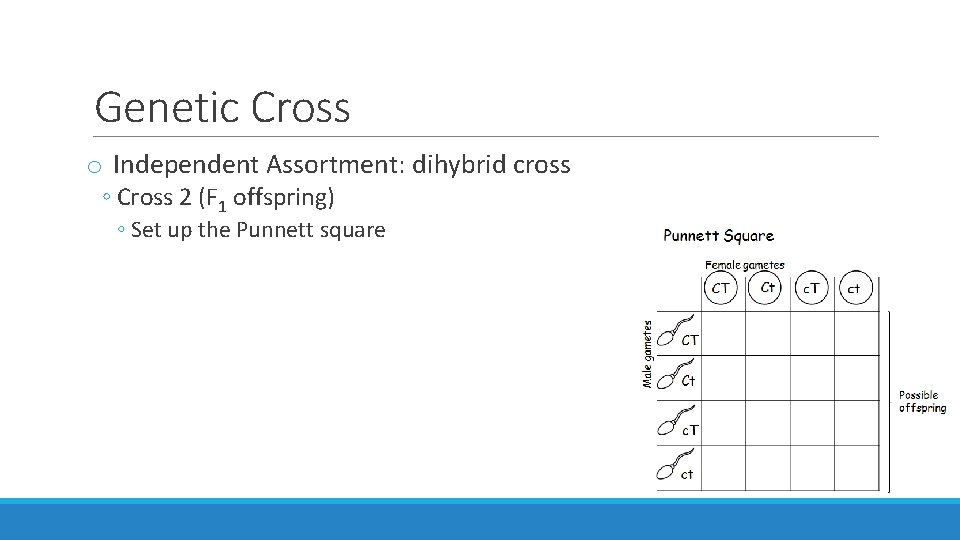
Genetic Cross o Independent Assortment: dihybrid cross ◦ Cross 2 (F 1 offspring) ◦ Set up the Punnett square
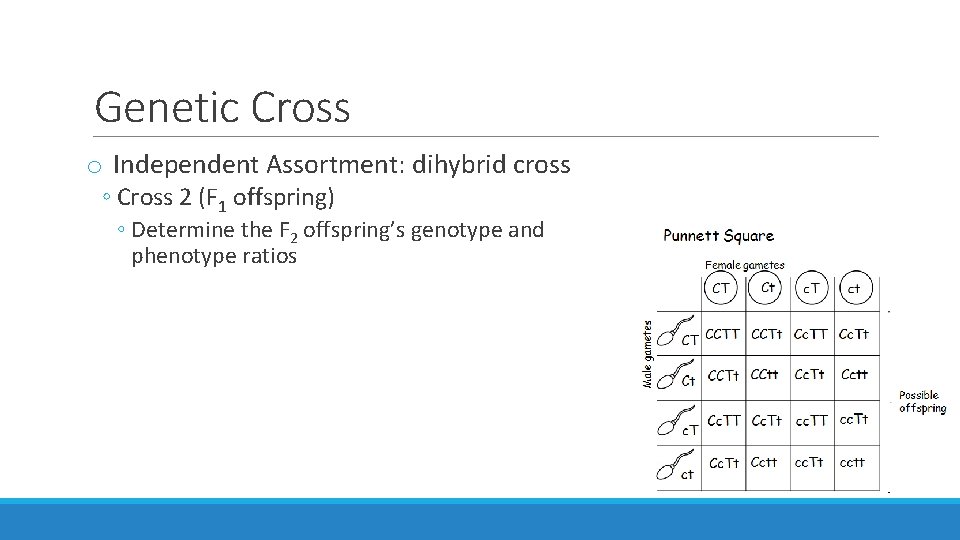
Genetic Cross o Independent Assortment: dihybrid cross ◦ Cross 2 (F 1 offspring) ◦ Determine the F 2 offspring’s genotype and phenotype ratios
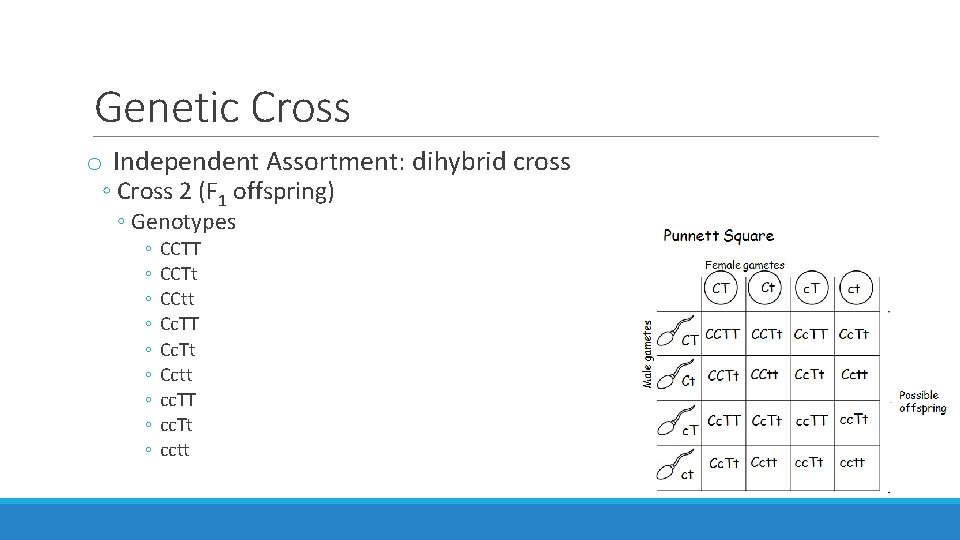
Genetic Cross o Independent Assortment: dihybrid cross ◦ Cross 2 (F 1 offspring) ◦ Genotypes ◦ ◦ ◦ ◦ ◦ CCTT CCTt CCtt Cc. TT Cc. Tt Cctt cc. TT cc. Tt cctt
Genetic Cross o Independent Assortment: dihybrid cross ◦ Cross 2 (F 1 offspring) ◦ Phenotypes ◦ ◦ Yellow Smooth Yellow Wrinkled Green Smooth Green Wrinkled ◦ Upper case “C” = yellow ◦ Upper case “T” = smooth
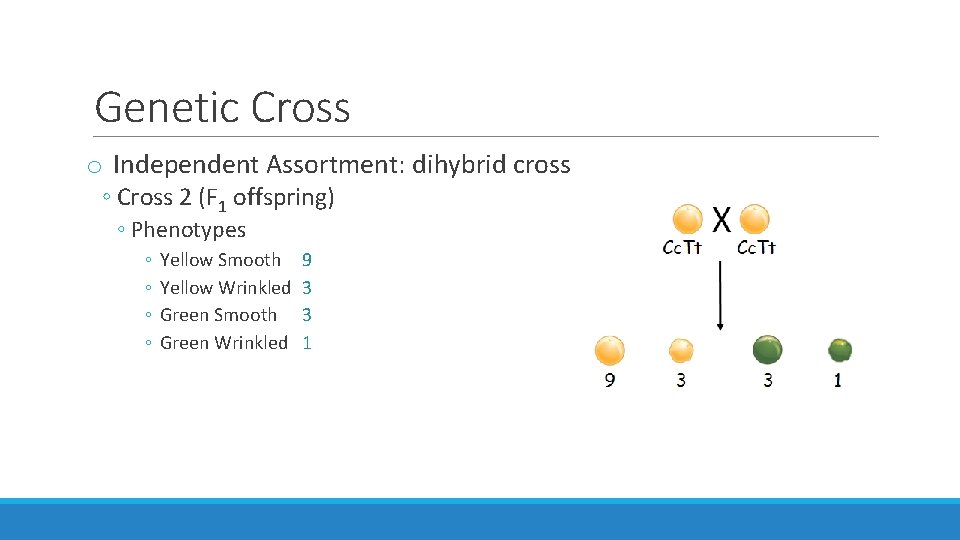
Genetic Cross o Independent Assortment: dihybrid cross ◦ Cross 2 (F 1 offspring) ◦ Phenotypes ◦ ◦ Yellow Smooth Yellow Wrinkled Green Smooth Green Wrinkled 9 3 3 1
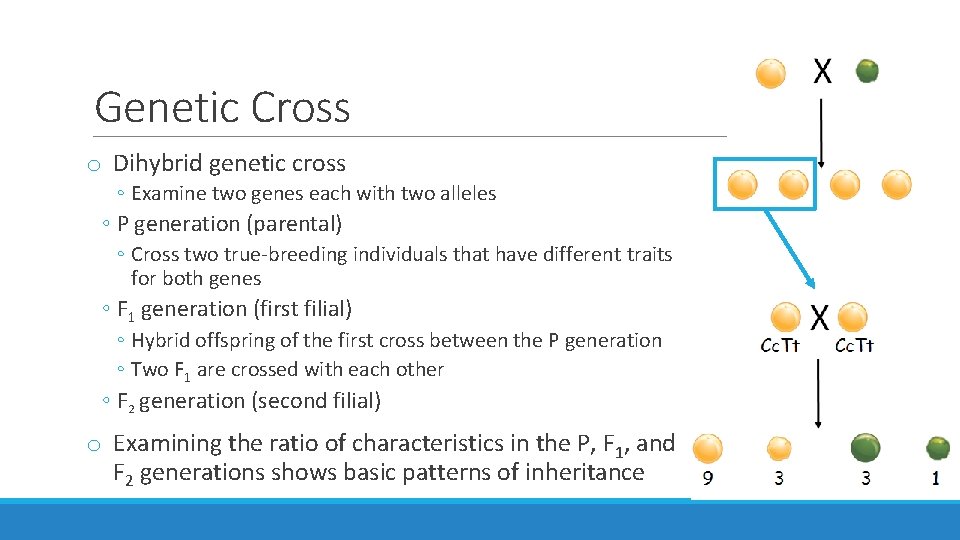
Genetic Cross o Dihybrid genetic cross ◦ Examine two genes each with two alleles ◦ P generation (parental) ◦ Cross two true-breeding individuals that have different traits for both genes ◦ F 1 generation (first filial) ◦ Hybrid offspring of the first cross between the P generation ◦ Two F 1 are crossed with each other ◦ F 2 generation (second filial) o Examining the ratio of characteristics in the P, F 1, and F 2 generations shows basic patterns of inheritance
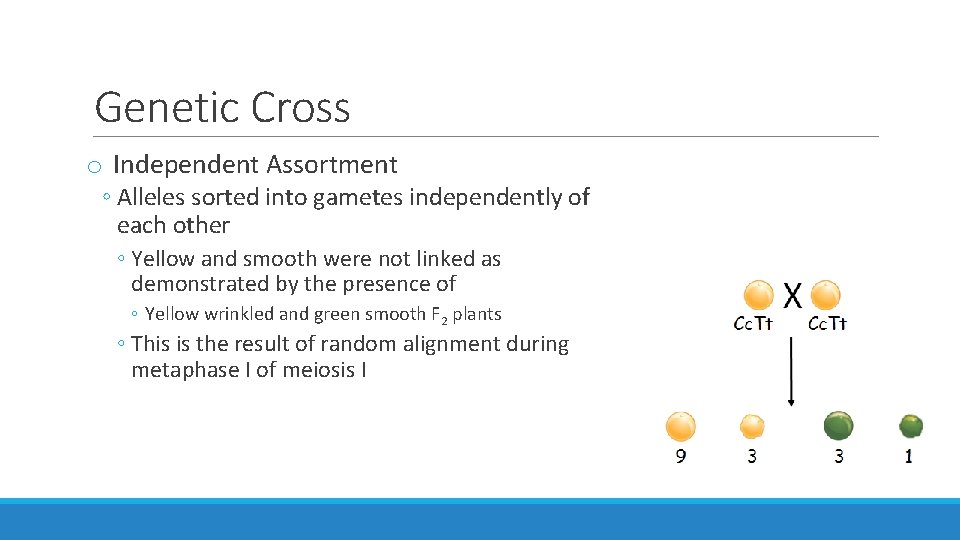
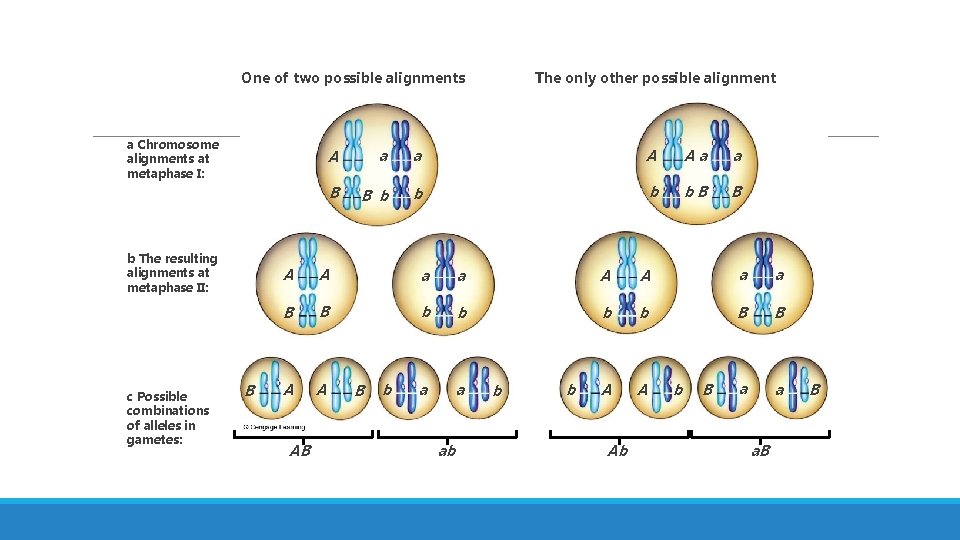
Genetic Cross o Independent Assortment ◦ Alleles sorted into gametes independently of each other ◦ Yellow and smooth were not linked as demonstrated by the presence of ◦ Yellow wrinkled and green smooth F 2 plants ◦ This is the result of random alignment during metaphase I of meiosis I
One of two possible alignments a Chromosome alignments at metaphase I: b The resulting alignments at metaphase II: c Possible combinations of alleles in gametes: B The only other possible alignment A a a A Aa a B B b b. B B A A a a B B b b B B A A a a AB B b ab b b Ab b B a. B B
Genetic Cross o Independent Assortment: ◦ Dihybrid practice problems
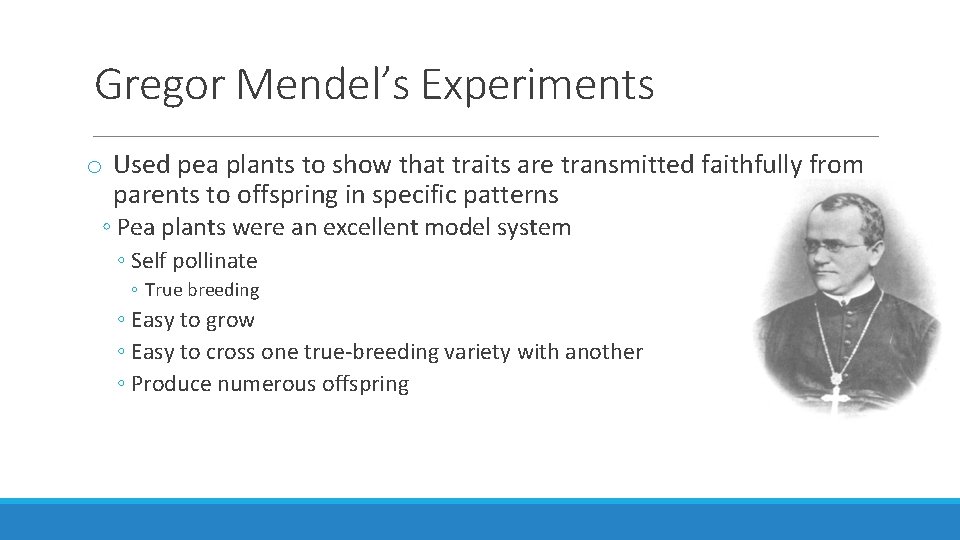
Gregor Mendel’s Experiments o Used pea plants to show that traits are transmitted faithfully from parents to offspring in specific patterns ◦ Pea plants were an excellent model system ◦ Self pollinate ◦ True breeding ◦ Easy to grow ◦ Easy to cross one true-breeding variety with another ◦ Produce numerous offspring
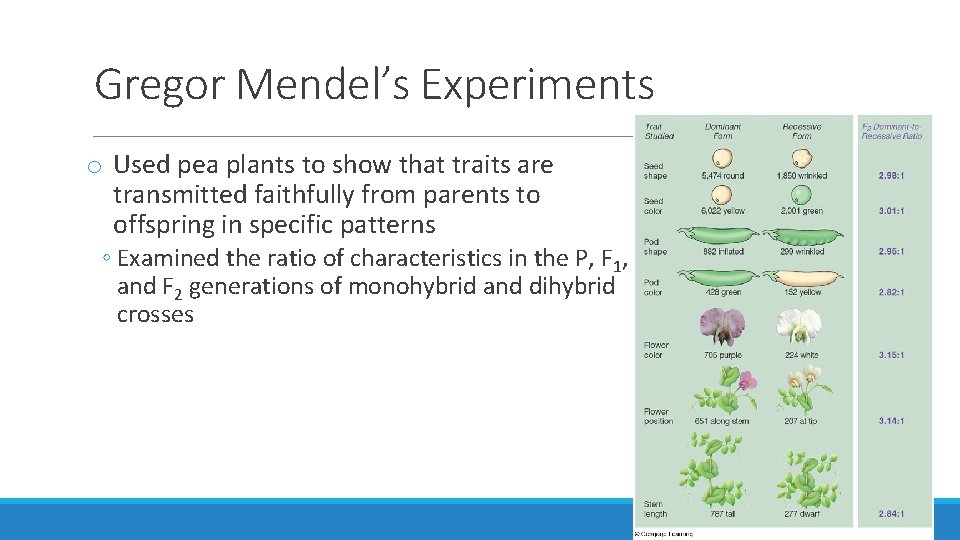
Gregor Mendel’s Experiments o Used pea plants to show that traits are transmitted faithfully from parents to offspring in specific patterns ◦ Examined the ratio of characteristics in the P, F 1, and F 2 generations of monohybrid and dihybrid crosses
Gregor Mendel’s Experiments o Used pea plants to show that traits are transmitted faithfully from parents to offspring in specific patterns ◦ Law of dominance ◦ Some alleles are always expressed ◦ Cross true-breeding with different traits all of the offspring express the dominant phenotype ◦ Law of segregation ◦ Monohybrid cross ◦ Anaphase I of meiosis I ◦ Law of independent assortment ◦ Dihybrid cross ◦ Metaphase I of meiosis I
Vocabulary o Genes o Haploid o Dominant o Alleles o Diploid o Recessive o Chromosomes ◦ Homologous Pair ◦ Sister Chromatids ◦ Centromere ◦ DNA o Gamete o Genotype o Zygote o Phenotype o Germ cells o Homozygous o Somatic cells o Heterozygous o o Punnett square Monohybrid cross Dihybrid cross Generations ◦ P, F 1 , F 2 o Gregor Mendel ◦ Dominance ◦ Segregation ◦ Independent assortment