
Patterns of disappearance of the middle ear ossicular
- Slides: 1
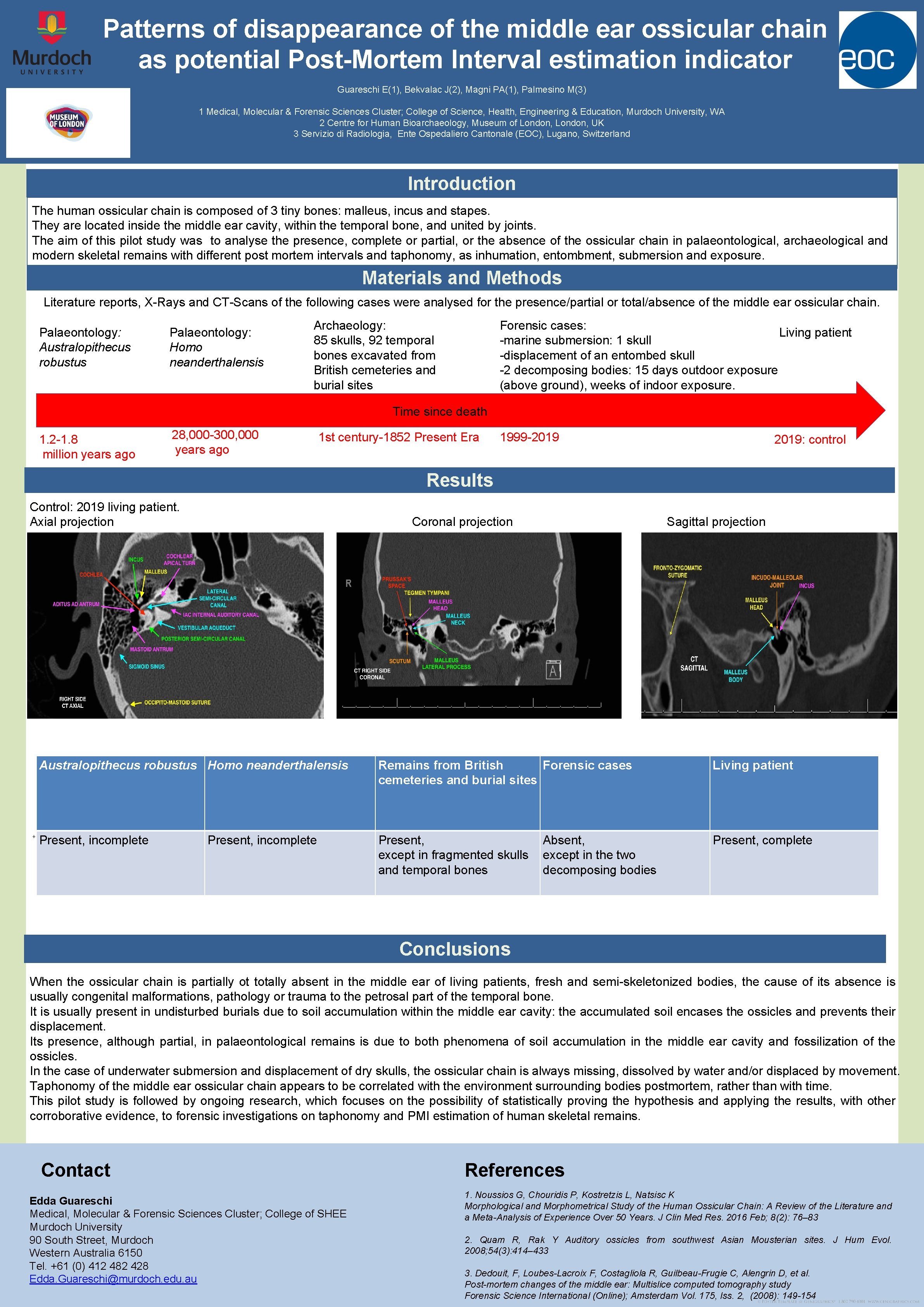
Patterns of disappearance of the middle ear ossicular chain as potential Post-Mortem Interval estimation indicator Guareschi E(1), Bekvalac J(2), Magni PA(1), Palmesino M(3) 1 Medical, Molecular & Forensic Sciences Cluster; College of Science, Health, Engineering & Education, Murdoch University, WA 2 Centre for Human Bioarchaeology, Museum of London, UK 3 Servizio di Radiologia, Ente Ospedaliero Cantonale (EOC), Lugano, Switzerland Introduction The human ossicular chain is composed of 3 tiny bones: malleus, incus and stapes. They are located inside the middle ear cavity, within the temporal bone, and united by joints. The aim of this pilot study was to analyse the presence, complete or partial, or the absence of the ossicular chain in palaeontological, archaeological and modern skeletal remains with different post mortem intervals and taphonomy, as inhumation, entombment, submersion and exposure. Materials and Methods Literature reports, X-Rays and CT-Scans of the following cases were analysed for the presence/partial or total/absence of the middle ear ossicular chain. Palaeontology: Australopithecus robustus Palaeontology: Homo neanderthalensis Archaeology: 85 skulls, 92 temporal bones excavated from British cemeteries and burial sites Forensic cases: Living patient -marine submersion: 1 skull -displacement of an entombed skull -2 decomposing bodies: 15 days outdoor exposure (above ground), weeks of indoor exposure. Time since death 1. 2 -1. 8 million years ago 28, 000 -300, 000 years ago 1 st century-1852 Present Era 1999 -2019: control Results Control: 2019 living patient. Axial projection Coronal projection Australopithecus robustus Homo neanderthalensis + coronali e sagittali Present, incomplete Sagittal projection Remains from British Forensic cases cemeteries and burial sites Living patient Present, except in fragmented skulls and temporal bones Present, complete Absent, except in the two decomposing bodies Conclusions When the ossicular chain is partially ot totally absent in the middle ear of living patients, fresh and semi-skeletonized bodies, the cause of its absence is usually congenital malformations, pathology or trauma to the petrosal part of the temporal bone. It is usually present in undisturbed burials due to soil accumulation within the middle ear cavity: the accumulated soil encases the ossicles and prevents their displacement. Its presence, although partial, in palaeontological remains is due to both phenomena of soil accumulation in the middle ear cavity and fossilization of the ossicles. In the case of underwater submersion and displacement of dry skulls, the ossicular chain is always missing, dissolved by water and/or displaced by movement. Taphonomy of the middle ear ossicular chain appears to be correlated with the environment surrounding bodies postmortem, rather than with time. This pilot study is followed by ongoing research, which focuses on the possibility of statistically proving the hypothesis and applying the results, with other corroborative evidence, to forensic investigations on taphonomy and PMI estimation of human skeletal remains. Contact Edda Guareschi Medical, Molecular & Forensic Sciences Cluster; College of SHEE Murdoch University 90 South Street, Murdoch Western Australia 6150 Tel. +61 (0) 412 482 428 Edda. Guareschi@murdoch. edu. au References 1. Noussios G, Chouridis P, Kostretzis L, Natsisc K Morphological and Morphometrical Study of the Human Ossicular Chain: A Review of the Literature and a Meta-Analysis of Experience Over 50 Years. J Clin Med Res. 2016 Feb; 8(2): 76– 83 2. Quam R, Rak Y Auditory ossicles from southwest Asian Mousterian sites. J Hum Evol. 2008; 54(3): 414– 433 3. Dedouit, F, Loubes-Lacroix F, Costagliola R, Guilbeau-Frugie C, Alengrin D, et al. Post-mortem changes of the middle ear: Multislice computed tomography study Forensic Science International (Online); Amsterdam Vol. 175, Iss. 2, (2008): 149 -154