
Patterns of Communication Between Objects CS 5010 Program
Patterns of Communication Between Objects CS 5010 Program Design Paradigms "Bootcamp" Lesson 10. 1 © Mitchell Wand, 2012 -2015 This work is licensed under a Creative Commons Attribution-Non. Commercial 4. 0 International License. 1
Key Points for this Module • Objects can communicate in two basic ways: pull and push. • Objects must have stable identity in order to communicate reliably • We use stateful objects to implement objects with stable identity. • Publish-subscribe is a common pattern for implementing push-style communication • Delegates are a refinement of publish-subscribe. 2
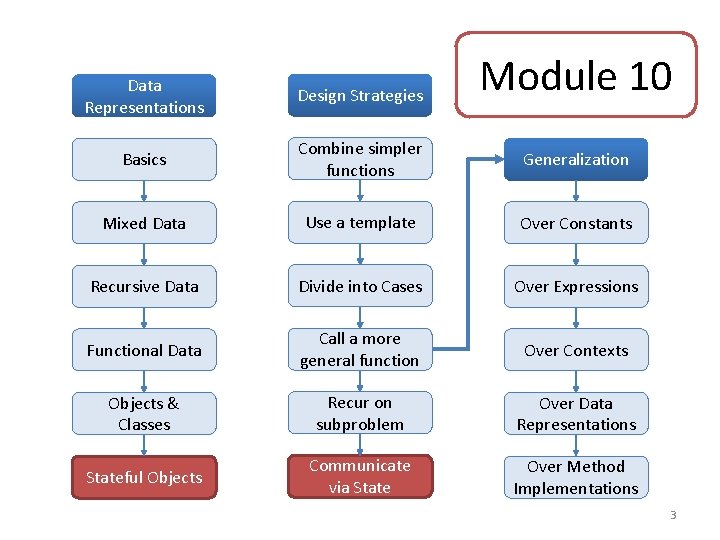
Module 10 Data Representations Design Strategies Basics Combine simpler functions Generalization Mixed Data Use a template Over Constants Recursive Data Divide into Cases Over Expressions Functional Data Call a more general function Over Contexts Objects & Classes Recur on subproblem Over Data Representations Stateful Objects Communicate via State Over Method Implementations 3
Key Points for Lesson 10. 1 • Sometimes you need to combine data from two objects. • The data could be combined in 3 possible places: – some external function (typical in functional organization, but generally considered bad OO design) – asking the other object to give you its data ("pull" model) – sending your information to the other object, and asking it to do the computation ("push" model) 4
Most methods have an obvious home • Most of the time, we want to do calculations in the object where the data is. • If you need to compute the area of a circle, make that a method of the Circle% class. 5
Sometimes you need to combine information from two objects • How do you determine if two balls intersect? • Let’s look at three designs. 6
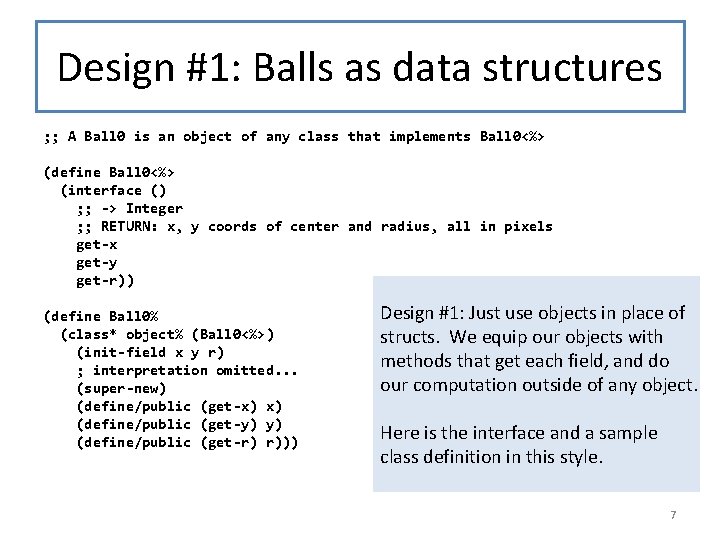
Design #1: Balls as data structures ; ; A Ball 0 is an object of any class that implements Ball 0<%> (define Ball 0<%> (interface () ; ; -> Integer ; ; RETURN: x, y coords of center and radius, all in pixels get-x get-y get-r)) (define Ball 0% (class* object% (Ball 0<%>) (init-field x y r) ; interpretation omitted. . . (super-new) (define/public (get-x) x) (define/public (get-y) y) (define/public (get-r) r))) Design #1: Just use objects in place of structs. We equip our objects with methods that get each field, and do our computation outside of any object. Here is the interface and a sample class definition in this style. 7
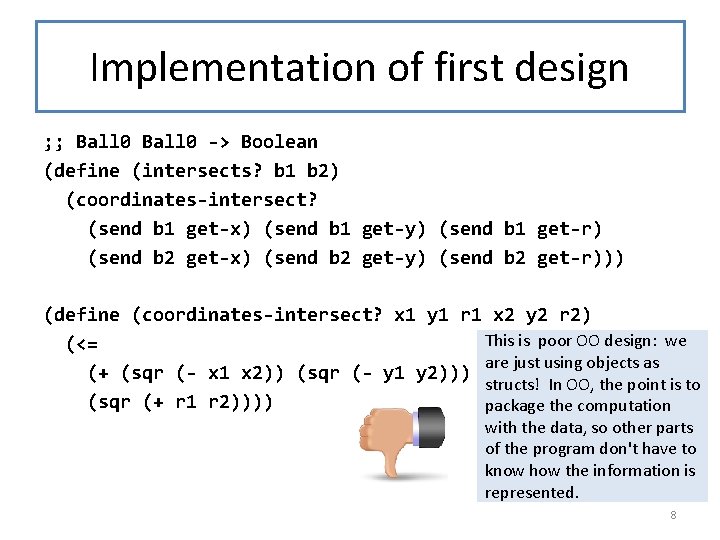
Implementation of first design ; ; Ball 0 -> Boolean (define (intersects? b 1 b 2) (coordinates-intersect? (send b 1 get-x) (send b 1 get-y) (send b 1 get-r) (send b 2 get-x) (send b 2 get-y) (send b 2 get-r))) (define (coordinates-intersect? x 1 y 1 r 1 x 2 y 2 r 2) This is poor OO design: we (<= are just using objects as (+ (sqr (- x 1 x 2)) (sqr (- y 1 y 2))) structs! In OO, the point is to (sqr (+ r 1 r 2)))) package the computation with the data, so other parts of the program don't have to know how the information is represented. 8
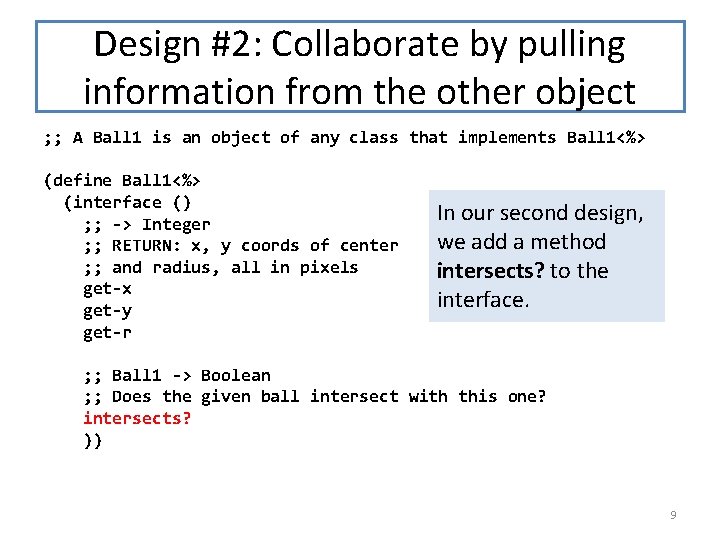
Design #2: Collaborate by pulling information from the other object ; ; A Ball 1 is an object of any class that implements Ball 1<%> (define Ball 1<%> (interface () ; ; -> Integer ; ; RETURN: x, y coords of center ; ; and radius, all in pixels get-x get-y get-r In our second design, we add a method intersects? to the interface. ; ; Ball 1 -> Boolean ; ; Does the given ball intersect with this one? intersects? )) 9
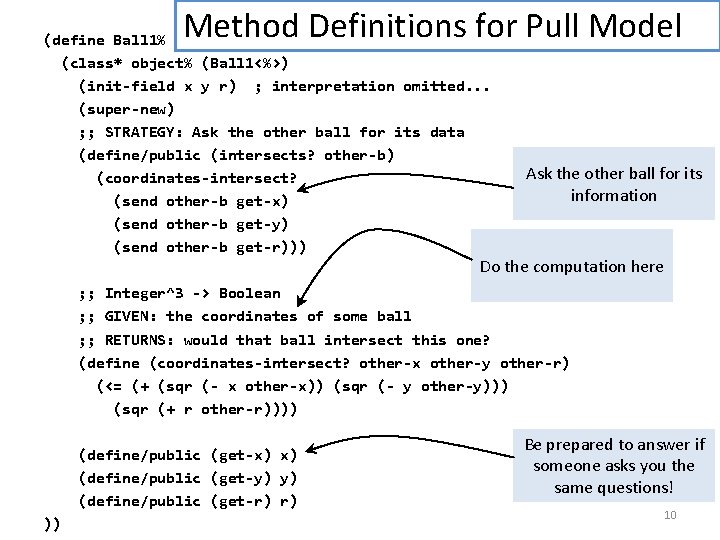
Method Definitions for Pull Model (define Ball 1% (class* object% (Ball 1<%>) (init-field x y r) ; interpretation omitted. . . (super-new) ; ; STRATEGY: Ask the other ball for its data (define/public (intersects? other-b) (coordinates-intersect? (send other-b get-x) (send other-b get-y) (send other-b get-r))) Ask the other ball for its information Do the computation here ; ; Integer^3 -> Boolean ; ; GIVEN: the coordinates of some ball ; ; RETURNS: would that ball intersect this one? (define (coordinates-intersect? other-x other-y other-r) (<= (+ (sqr (- x other-x)) (sqr (- y other-y))) (sqr (+ r other-r)))) (define/public (get-x) x) (define/public (get-y) y) (define/public (get-r) r) )) Be prepared to answer if someone asks you the same questions! 10
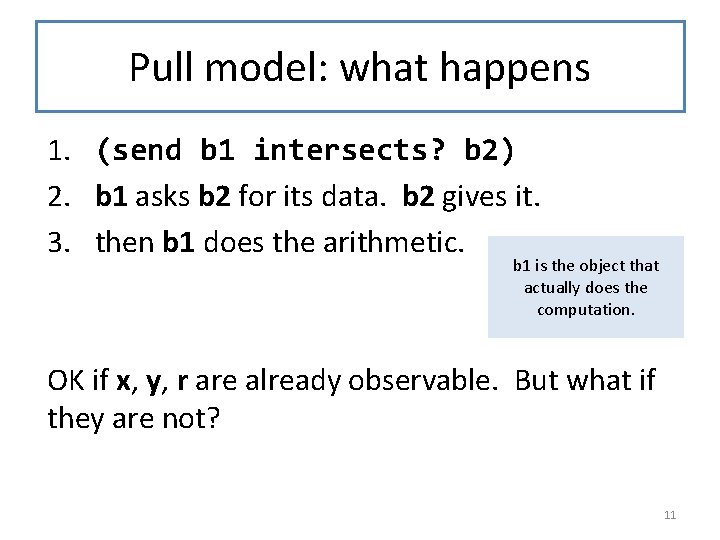
Pull model: what happens 1. (send b 1 intersects? b 2) 2. b 1 asks b 2 for its data. b 2 gives it. 3. then b 1 does the arithmetic. b 1 is the object that actually does the computation. OK if x, y, r are already observable. But what if they are not? 11
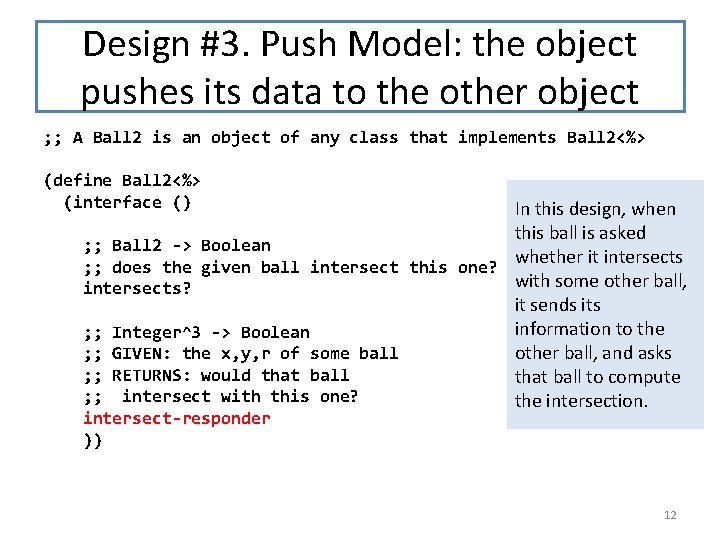
Design #3. Push Model: the object pushes its data to the other object ; ; A Ball 2 is an object of any class that implements Ball 2<%> (define Ball 2<%> (interface () In this design, when this ball is asked ; ; Ball 2 -> Boolean whether it intersects ; ; does the given ball intersect this one? with some other ball, intersects? it sends its information to the ; ; Integer^3 -> Boolean other ball, and asks ; ; GIVEN: the x, y, r of some ball ; ; RETURNS: would that ball to compute ; ; intersect with this one? the intersection. intersect-responder )) 12
So now we have two methods • intersects? sends this ball’s data to the other ball. • intersect-responder responds to the request, computing whether or not there is an intersection between the two balls. 13
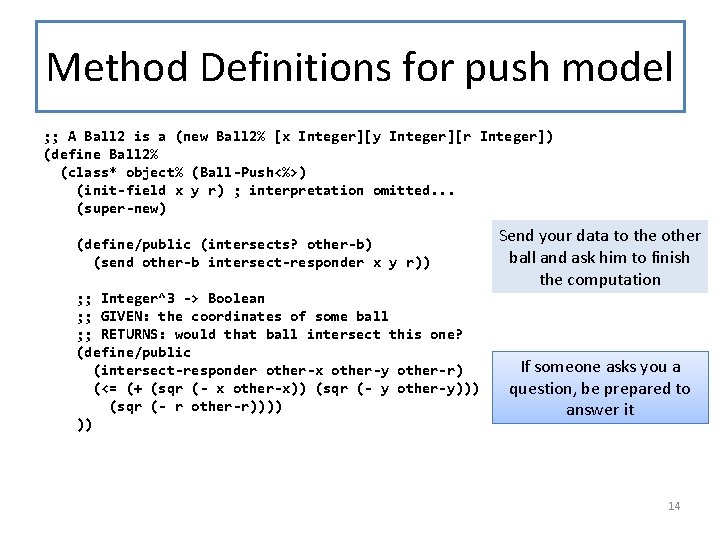
Method Definitions for push model ; ; A Ball 2 is a (new Ball 2% [x Integer][y Integer][r Integer]) (define Ball 2% (class* object% (Ball-Push<%>) (init-field x y r) ; interpretation omitted. . . (super-new) (define/public (intersects? other-b) (send other-b intersect-responder x y r)) ; ; Integer^3 -> Boolean ; ; GIVEN: the coordinates of some ball ; ; RETURNS: would that ball intersect this one? (define/public (intersect-responder other-x other-y other-r) (<= (+ (sqr (- x other-x)) (sqr (- y other-y))) (sqr (- r other-r)))) )) Send your data to the other ball and ask him to finish the computation If someone asks you a question, be prepared to answer it 14
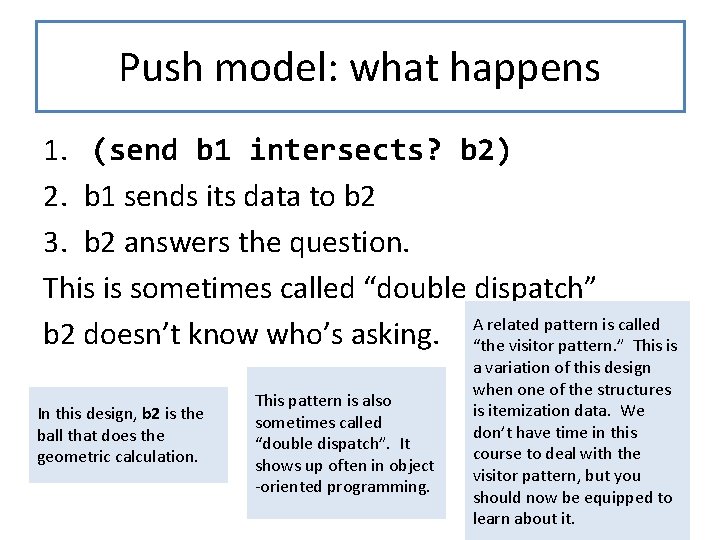
Push model: what happens 1. (send b 1 intersects? b 2) 2. b 1 sends its data to b 2 3. b 2 answers the question. This is sometimes called “double dispatch” related pattern is called b 2 doesn’t know who’s asking. A“the visitor pattern. ” This is In this design, b 2 is the ball that does the geometric calculation. This pattern is also sometimes called “double dispatch”. It shows up often in object -oriented programming. a variation of this design when one of the structures is itemization data. We don’t have time in this course to deal with the visitor pattern, but you should now be equipped to 15 learn about it.
Push or pull: how to choose? • Most of the time the answer is clear: most operations naturally act on a particular object. • Operations should happen in the object where the data resides – our first attempt was not good design • Binary operations like intersect? are relatively rare in practice – either design 2 or design 3 would be ok for our purposes 16
Lesson Summary • Sometimes you need to combine data from two objects. • The data could be combined in 3 possible places: – some external function (typical in functional organization, but generally considered bad OO design) – asking the other object to give you its data ("pull" model) – sending your information to the other object, and asking it to do the computation ("push" model) 17
Next Steps • Study 10 -1 -communicating-objects. rkt in the Examples folder • If you have questions about this lesson, ask them on the Discussion Board • Think about the following question: – How would b 1 know about b 2? • Go on to the next lesson 18
- Slides: 18