
PATTERNS OF CHANGE CRIME AND PUNISHMENT PATTERNS OF

- Slides: 22
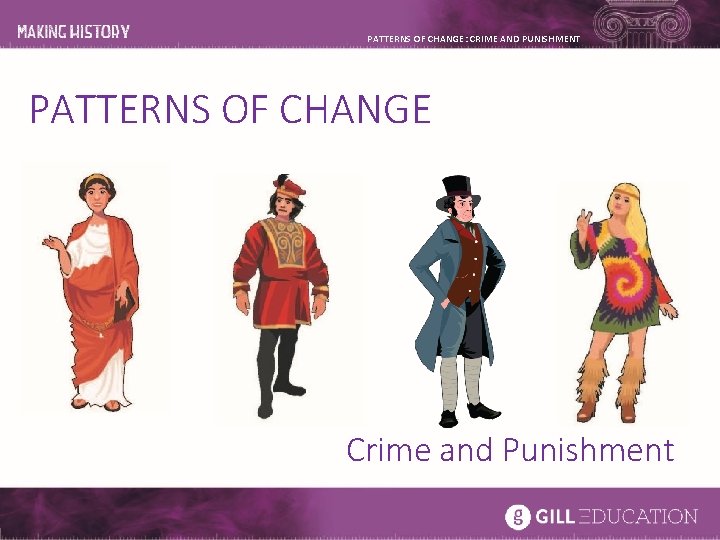
PATTERNS OF CHANGE: CRIME AND PUNISHMENT PATTERNS OF CHANGE Crime and Punishment
PATTERNS OF CHANGE: CRIME AND PUNISHMENT PATTERNS OF CHANGE Ø Crime and Punishment in Ancient Rome Ø Crime and Punishment in Medieval Times Ø Crime and Punishment in 19 th Century Industrial Society Ø Crime and Punishment in Modern Times Crime and Punishment
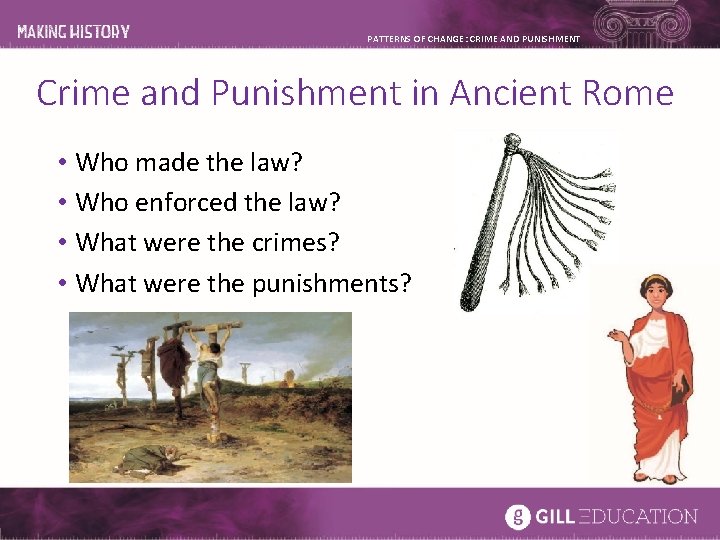
PATTERNS OF CHANGE: CRIME AND PUNISHMENT Crime and Punishment in Ancient Rome • Who made the law? • Who enforced the law? • What were the crimes? • What were the punishments?
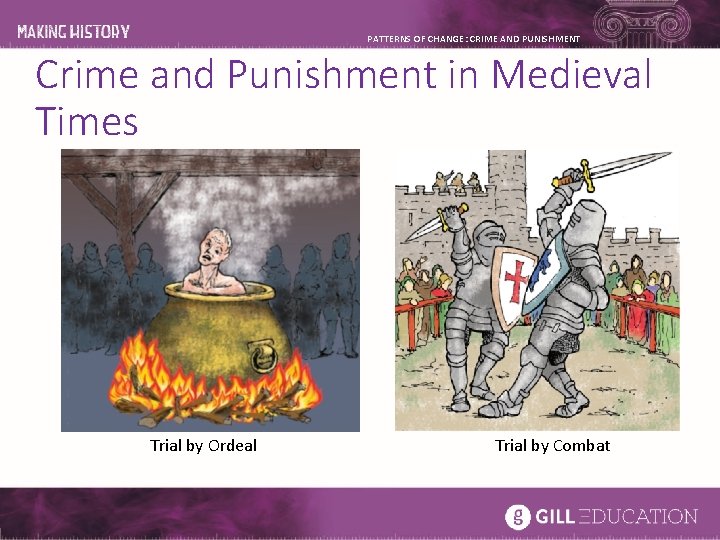
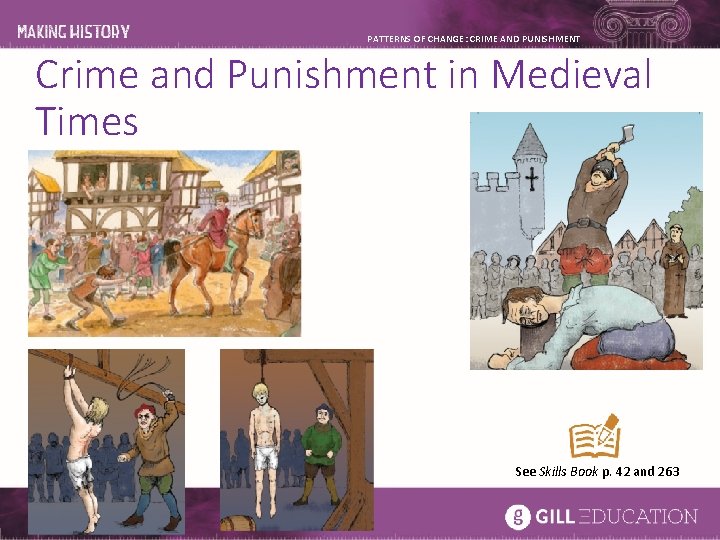
PATTERNS OF CHANGE: CRIME AND PUNISHMENT Crime and Punishment in Medieval Times Trial by Ordeal Trial by Combat
PATTERNS OF CHANGE: CRIME AND PUNISHMENT Crime and Punishment in Medieval Times See Skills Book p. 42 and 263
PATTERNS OF CHANGE: CRIME AND PUNISHMENT Is Justice Served? Source 1 Source 2 Emma wife of Walter of Elsfield says that Roger Mock on the Thursday after Epiphany [8 January] 1238 came to her in her house and hit her with a pair of tongs in the eye so that she lost her right eye. And that he did this wickedly against the king’s peace she offers to prove. Roger comes and denies everything, and since it is demonstrated (shown) that she made no appeal against him until now and this happened 3 years ago, it is adjudged that the appeal is null (invalid), and let an enquiry be made by jury. The jurors say that Roger is not guilty, so he is acquitted (found not guilty), but they say that Walter of Elsfield, Emma’s husband, hit her so that she lost her eye, so he is committed to gaol. John Scot lodged at the house of John Wenge in Ekynton, rose by night wishing to do away with John Wenge, who seeing this, raised the hue (shout, noise). John Scot fled at once. Richard, former groom of Hugh de Cantilupo, hearing the hue, joined in and together they pursued John Scot whom they beheaded as a thief in flight. (1281 Derbyshire Eyre, Case 454, www. nationalarchives. gov. uk/) (Oxfordshire Records Society vol. LVI, 1047, www. nationalarchives. gov. uk/) See Skills Book p. 41
PATTERNS OF CHANGE: CRIME AND PUNISHMENT How Violent Were the Middle Ages? • To decide whether the amount of violent crimes is great or small, the number of murders is measured against the number of people. Thus the number of murders per 100, 000 people in 1995– 7 was: • For London – 2. 1 • For Washington D. C – 69. 3 • For Moscow – 18. 1 • And, by one historian’s estimate, for 14 th century England – 12. 0 (www. nationalarchives. gov. uk/)
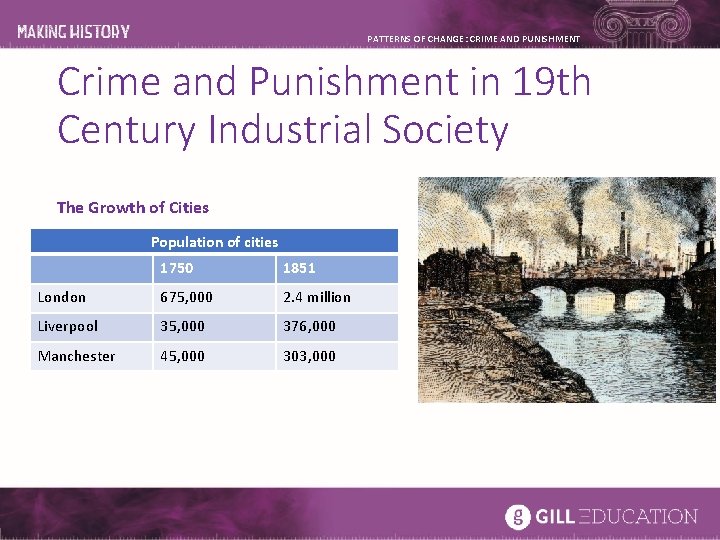
PATTERNS OF CHANGE: CRIME AND PUNISHMENT Crime and Punishment in 19 th Century Industrial Society The Growth of Cities Population of cities 1750 1851 London 675, 000 2. 4 million Liverpool 35, 000 376, 000 Manchester 45, 000 303, 000
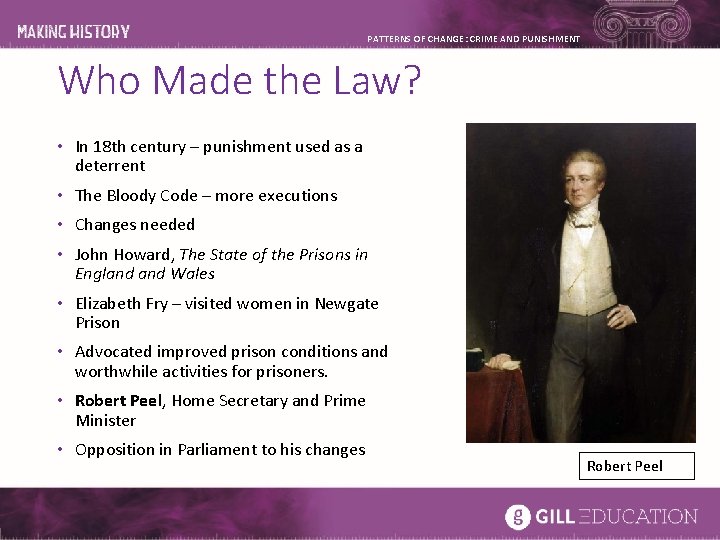
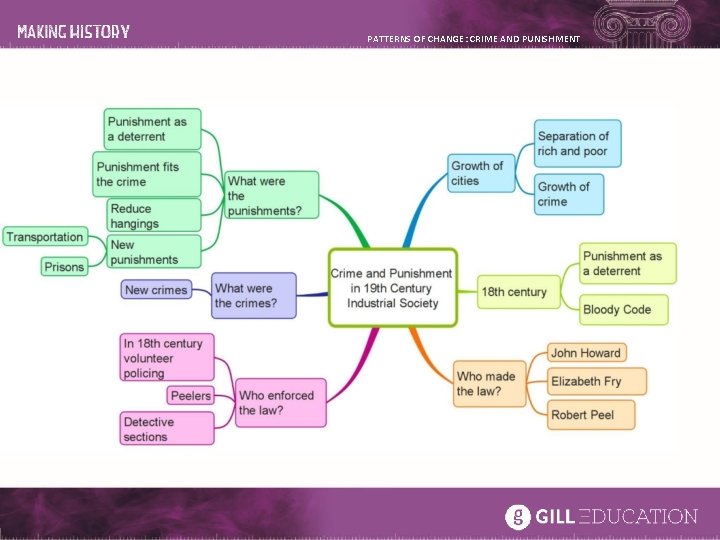
PATTERNS OF CHANGE: CRIME AND PUNISHMENT Who Made the Law? • In 18 th century – punishment used as a deterrent • The Bloody Code – more executions • Changes needed • John Howard, The State of the Prisons in England Wales • Elizabeth Fry – visited women in Newgate Prison • Advocated improved prison conditions and worthwhile activities for prisoners. • Robert Peel, Home Secretary and Prime Minister • Opposition in Parliament to his changes Robert Peel
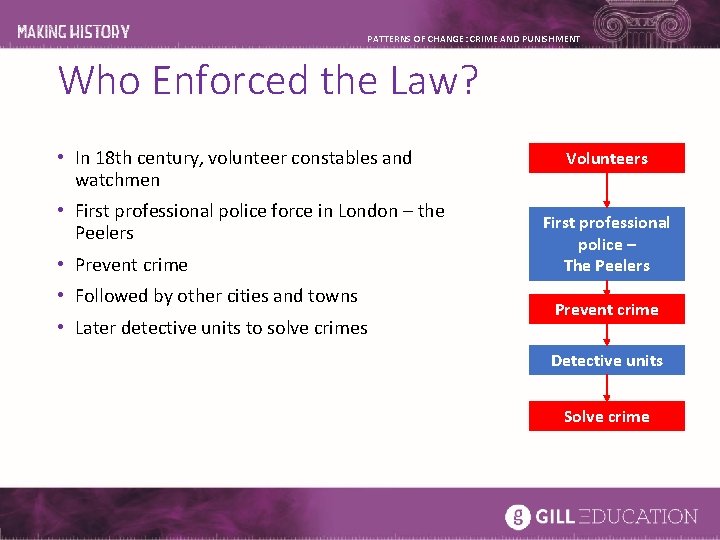
PATTERNS OF CHANGE: CRIME AND PUNISHMENT Who Enforced the Law? • In 18 th century, volunteer constables and watchmen • First professional police force in London – the Peelers • Prevent crime • Followed by other cities and towns • Later detective units to solve crimes Volunteers First professional police – The Peelers Prevent crime Detective units Solve crime
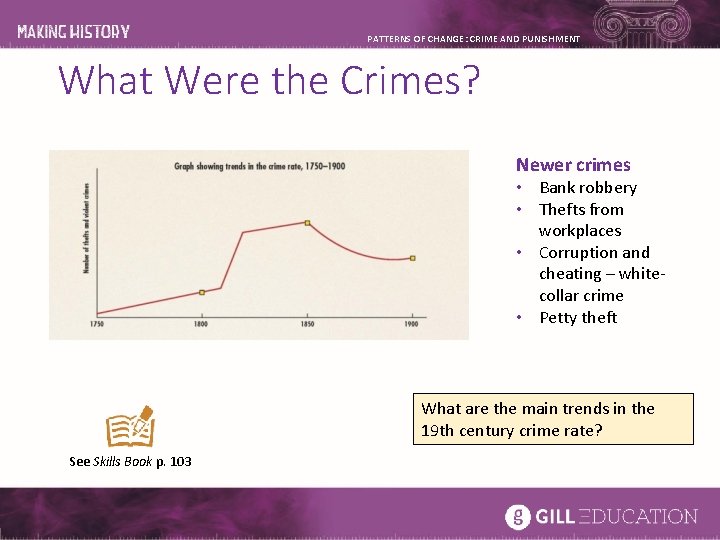
PATTERNS OF CHANGE: CRIME AND PUNISHMENT What Were the Crimes? Newer crimes • Bank robbery • Thefts from workplaces • Corruption and cheating – whitecollar crime • Petty theft What are the main trends in the 19 th century crime rate? See Skills Book p. 103
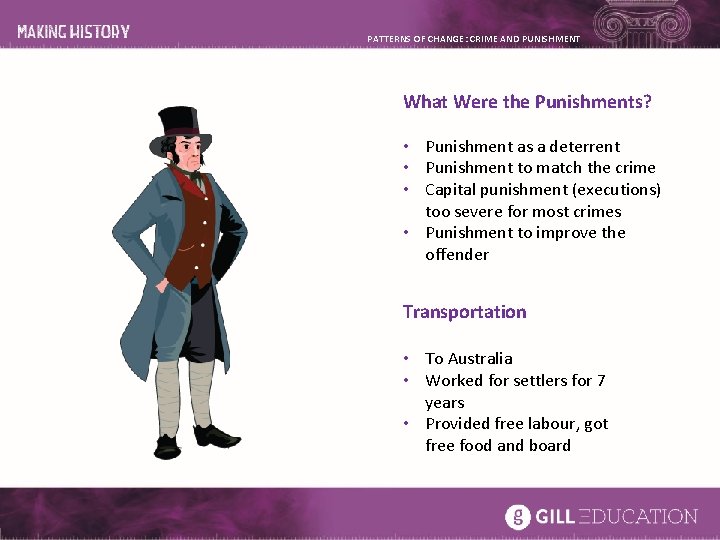
PATTERNS OF CHANGE: CRIME AND PUNISHMENT What Were the Punishments? • Punishment as a deterrent • Punishment to match the crime • Capital punishment (executions) too severe for most crimes • Punishment to improve the offender Transportation • To Australia • Worked for settlers for 7 years • Provided free labour, got free food and board
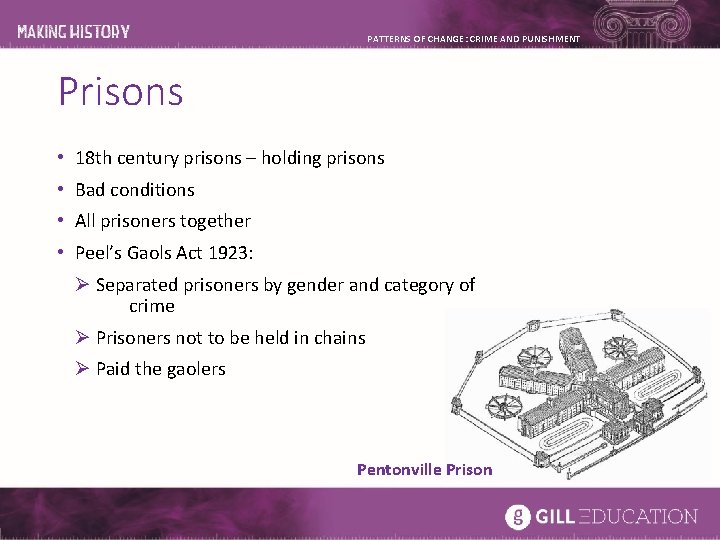
PATTERNS OF CHANGE: CRIME AND PUNISHMENT Prisons • 18 th century prisons – holding prisons • Bad conditions • All prisoners together • Peel’s Gaols Act 1923: Ø Separated prisoners by gender and category of crime Ø Prisoners not to be held in chains Ø Paid the gaolers Pentonville Prison
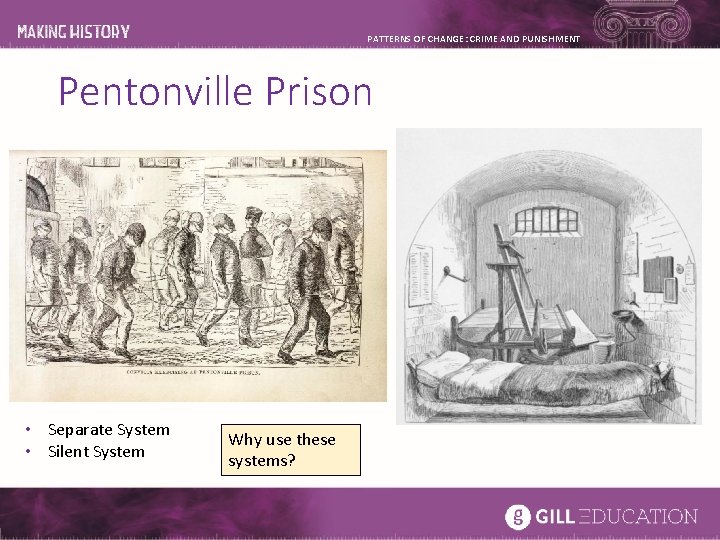
PATTERNS OF CHANGE: CRIME AND PUNISHMENT Pentonville Prison • Separate System • Silent System Why use these systems?
PATTERNS OF CHANGE: CRIME AND PUNISHMENT The Ballad of Reading Gaol We tore the tarry rope to shreds With blunt and bleeding nails; We rubbed the doors, and scrubbed the floors, And cleaned the shining rails And, rank by rank, we soaped the plank, And clattered with the pails. We sewed the sacks, we broke the stones, We turned the dusty drill We banged the tins, and bawled the hymns And sweated on the mill But in the heart of every man Terror was lying still
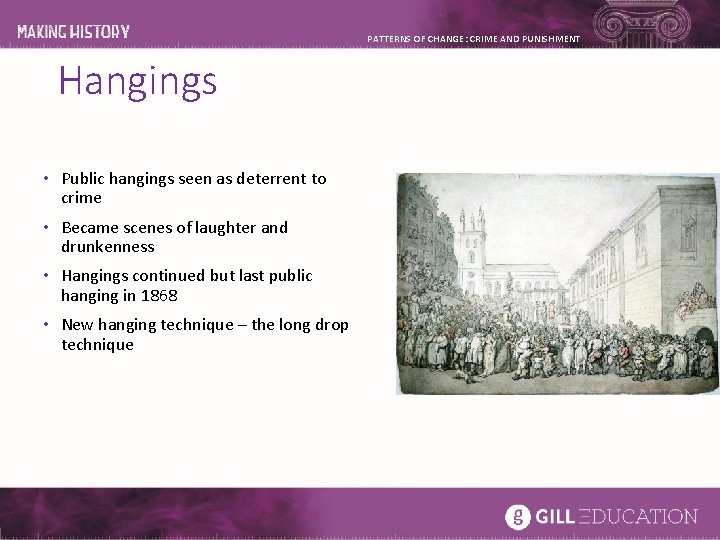
PATTERNS OF CHANGE: CRIME AND PUNISHMENT Hangings • Public hangings seen as deterrent to crime • Became scenes of laughter and drunkenness • Hangings continued but last public hanging in 1868 • New hanging technique – the long drop technique
PATTERNS OF CHANGE: CRIME AND PUNISHMENT
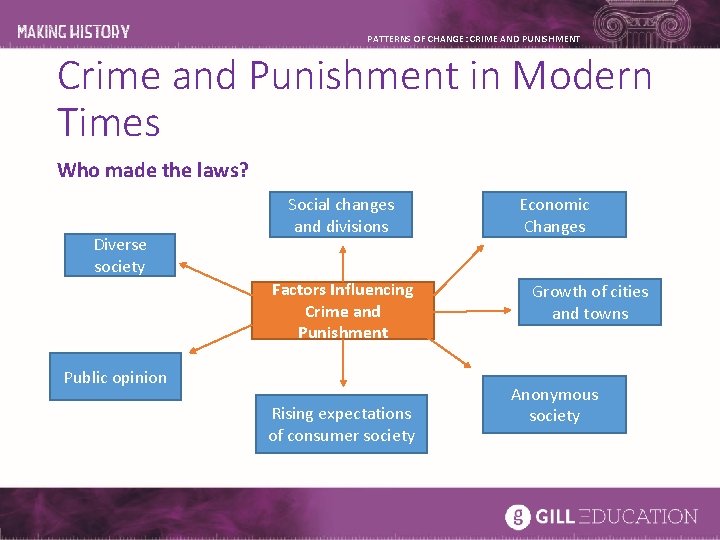
PATTERNS OF CHANGE: CRIME AND PUNISHMENT Crime and Punishment in Modern Times Who made the laws? Diverse society Social changes and divisions Factors Influencing Crime and Punishment Public opinion Rising expectations of consumer society Economic Changes Growth of cities and towns Anonymous society
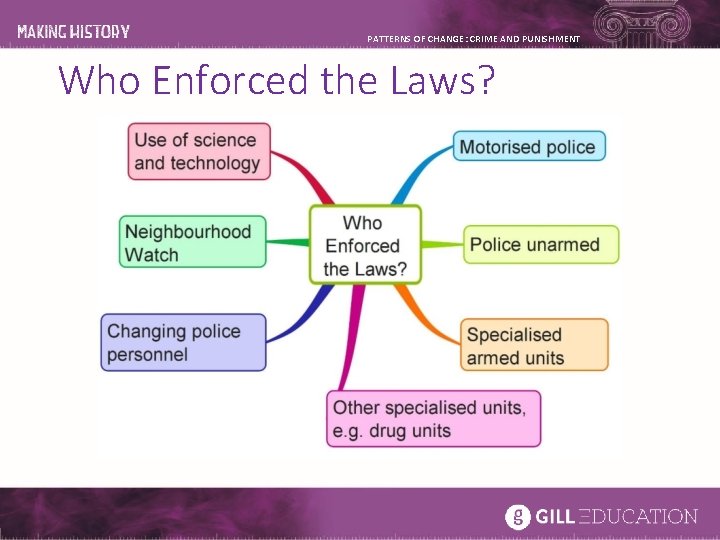
PATTERNS OF CHANGE: CRIME AND PUNISHMENT Who Enforced the Laws?
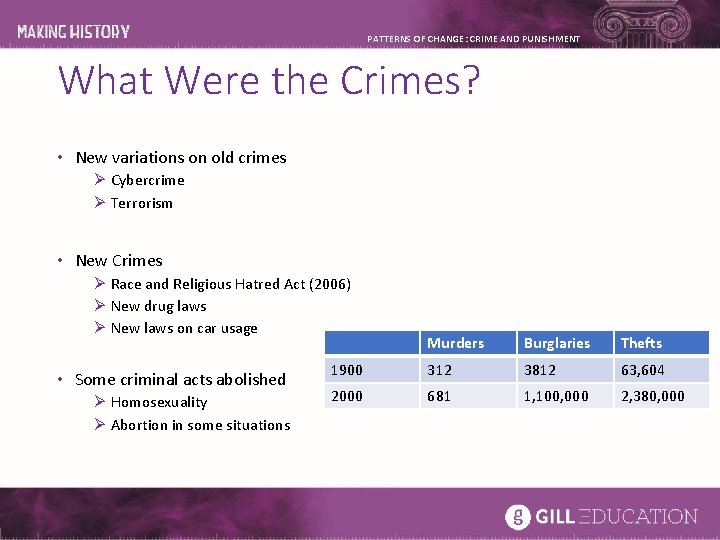
PATTERNS OF CHANGE: CRIME AND PUNISHMENT What Were the Crimes? • New variations on old crimes Ø Cybercrime Ø Terrorism • New Crimes Ø Race and Religious Hatred Act (2006) Ø New drug laws Ø New laws on car usage • Some criminal acts abolished Ø Homosexuality Ø Abortion in some situations Murders Burglaries Thefts 1900 312 3812 63, 604 2000 681 1, 100, 000 2, 380, 000
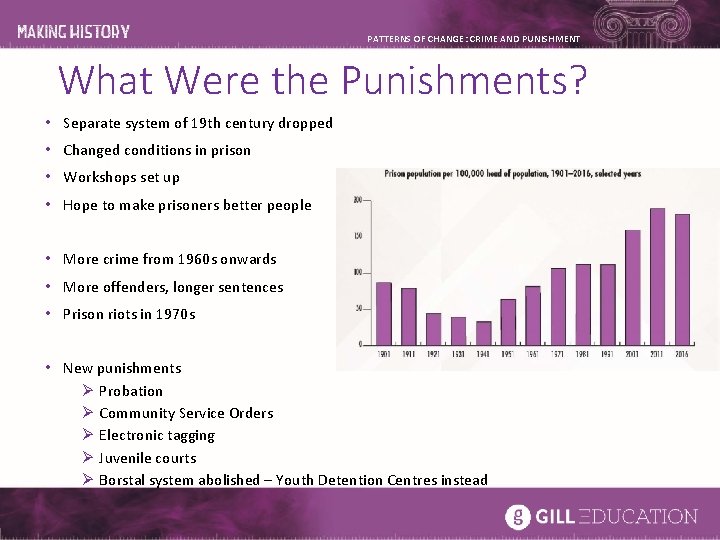
PATTERNS OF CHANGE: CRIME AND PUNISHMENT What Were the Punishments? • Separate system of 19 th century dropped • Changed conditions in prison • Workshops set up • Hope to make prisoners better people • More crime from 1960 s onwards • More offenders, longer sentences • Prison riots in 1970 s • New punishments Ø Probation Ø Community Service Orders Ø Electronic tagging Ø Juvenile courts Ø Borstal system abolished – Youth Detention Centres instead
PATTERNS OF CHANGE: CRIME AND PUNISHMENT Death Penalty Death penalty abolished Capital punishment is still carried out in some states in the USA. There is a heated debate there over whether or not capital punishment should be abolished Arguments for capital punishment Arguments against capital punishment Hanging deterred criminals from committing murder Most murders are done on the spur of the moment, so deterrents won’t work Murderers deserved to die since they had killed a person/people The governments are only acting revengefully Murderers get a fair trial and justice is done Many people who have been found guilty of murder have since proved their innocence