
Patterns Groups and Fractions Counting and calculating by
Patterns: Groups and Fractions Counting and calculating by grouping Objectives Day 1 Use counting in 2 s, 5 s or 10 s to solve a practical problem. Day 2 Use counting in 2 s, 5 s or 10 s to solve a practical problem (money). Day 3 Multiplication using a penny number line. Day 4 Solve division problems by finding how many sets. Day 5 Solve division problems by finding how many sets. © hamilton-trust. org. uk 1 Year R/1
Patterns: Groups and Fractions Counting and calculating by grouping Objectives Day 1 Use counting in 2 s, 5 s or 10 s to solve a practical problem. © hamilton-trust. org. uk 2 Year R/1
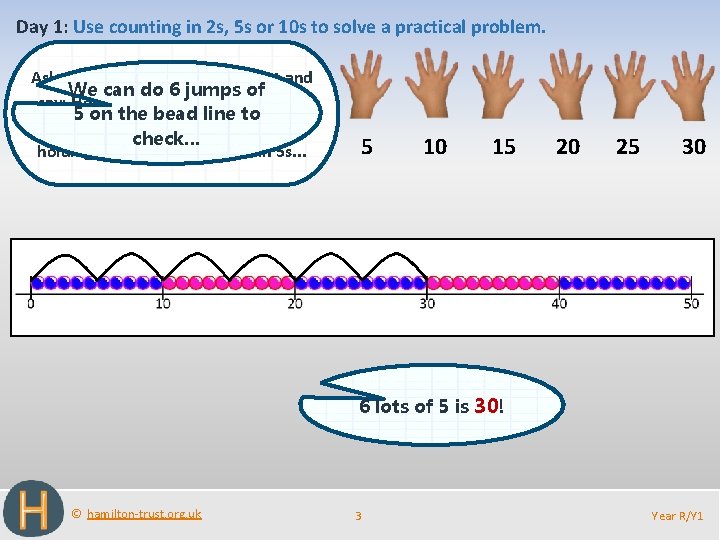
Day 1: Use counting in 2 s, 5 s or 10 s to solve a practical problem. Ask three children up to the front and We can do 6 jumps of say: Hold up your hands. How many 5 on the bead line to fingers (including thumbs) are they check… holding up? Let’s count them in 5 s. . . 5 10 15 20 25 30 6 lots of 5 is 30! © hamilton-trust. org. uk 3 Year R/Y 1
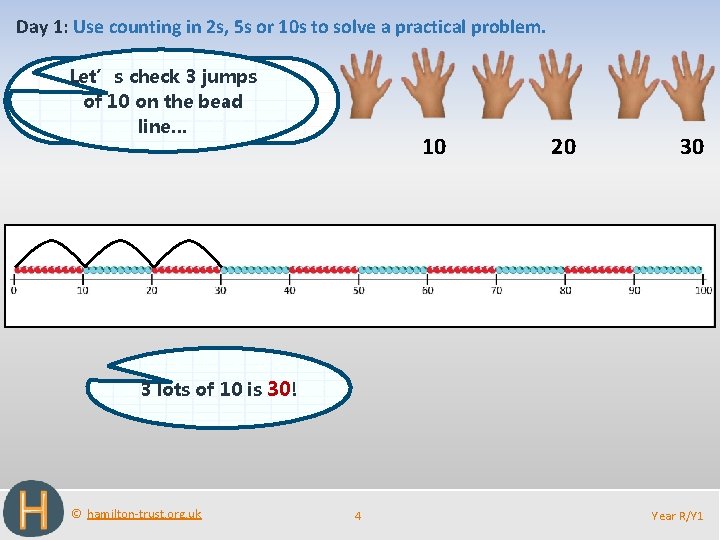
Day 1: Use counting in 2 s, 5 s or 10 s to solve a practical problem. Let’s check 3 jumps We canof also our bead fingers in 10 s. . . 10 count on the line… 10 20 30 3 lots of 10 is 30! © hamilton-trust. org. uk 4 Year R/Y 1
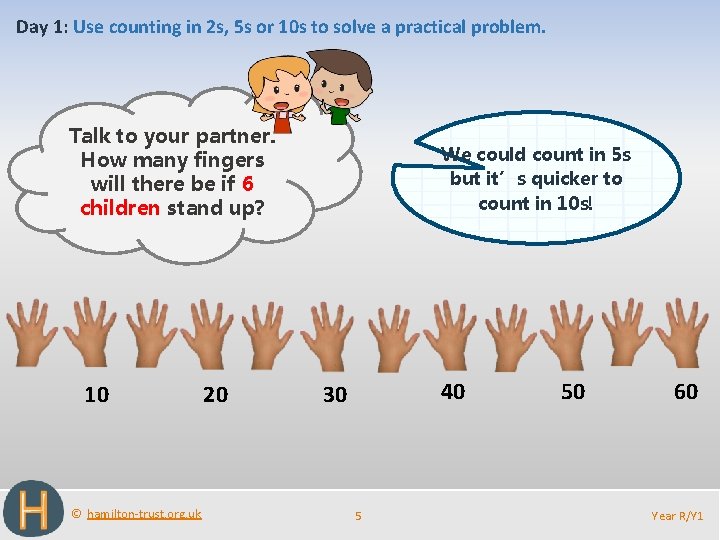
Day 1: Use counting in 2 s, 5 s or 10 s to solve a practical problem. Talk to your partner. How many fingers will there be if 6 children stand up? 10 © hamilton-trust. org. uk 20 We could count in 5 s but it’s quicker to count in 10 s! 40 30 5 50 60 Year R/Y 1
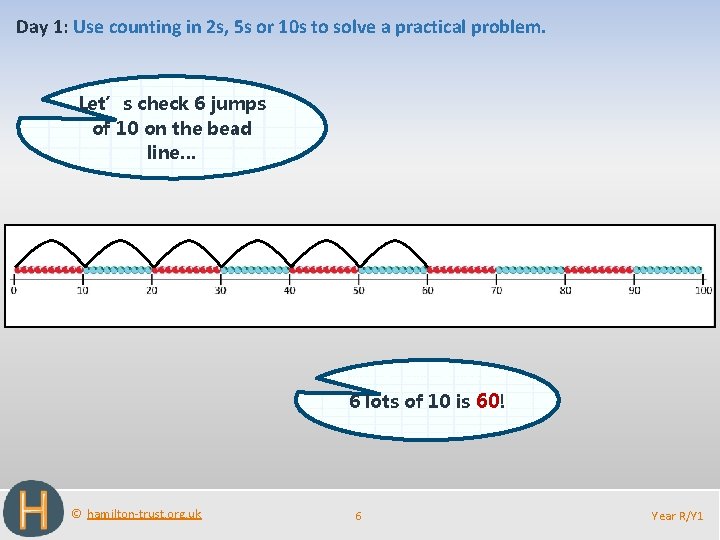
Day 1: Use counting in 2 s, 5 s or 10 s to solve a practical problem. Let’s check 6 jumps of 10 on the bead line… 6 lots of 10 is 60! © hamilton-trust. org. uk 6 Year R/Y 1
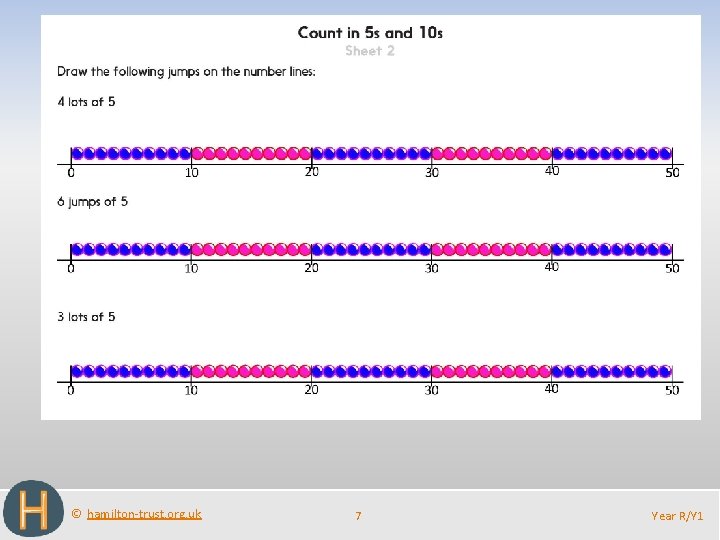
© hamilton-trust. org. uk 7 Year R/Y 1
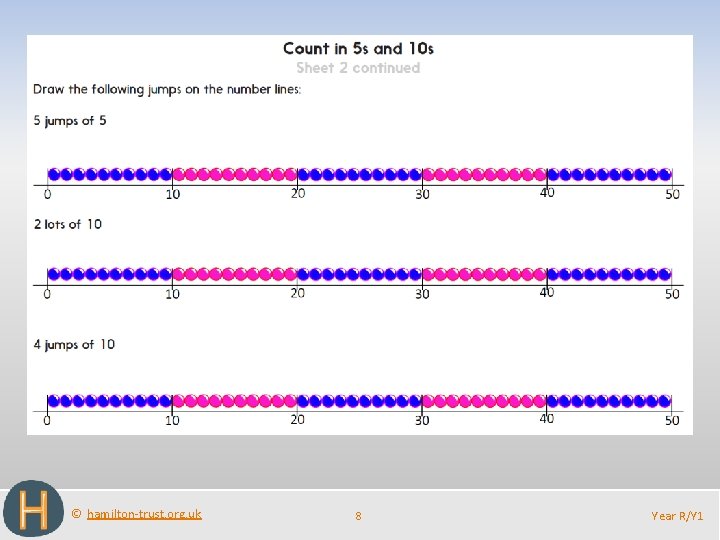
© hamilton-trust. org. uk 8 Year R/Y 1
Patterns: Groups and Fractions Counting and calculating by grouping Objectives Day 2 Use counting in 2 s, 5 s or 10 s to solve a practical problem (money). © hamilton-trust. org. uk 9 Year R/1
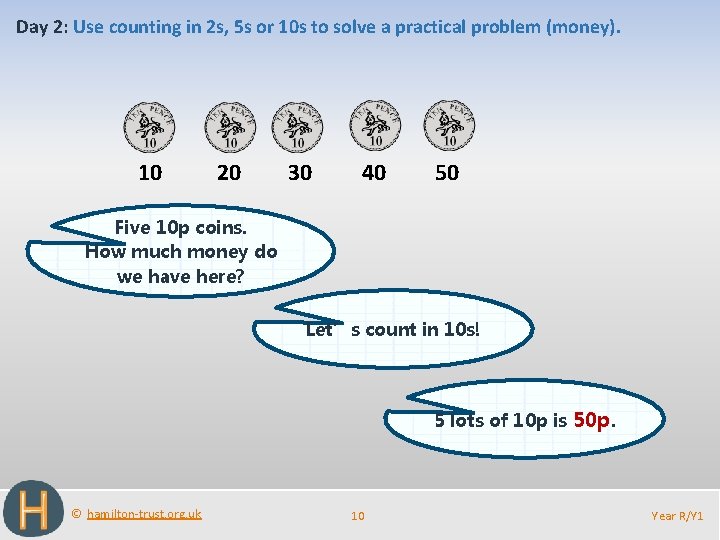
Day 2: Use counting in 2 s, 5 s or 10 s to solve a practical problem (money). 10 20 30 40 50 Five 10 p coins. How much money do we have here? Let’s count in 10 s! 5 lots of 10 p is 50 p. © hamilton-trust. org. uk 10 Year R/Y 1
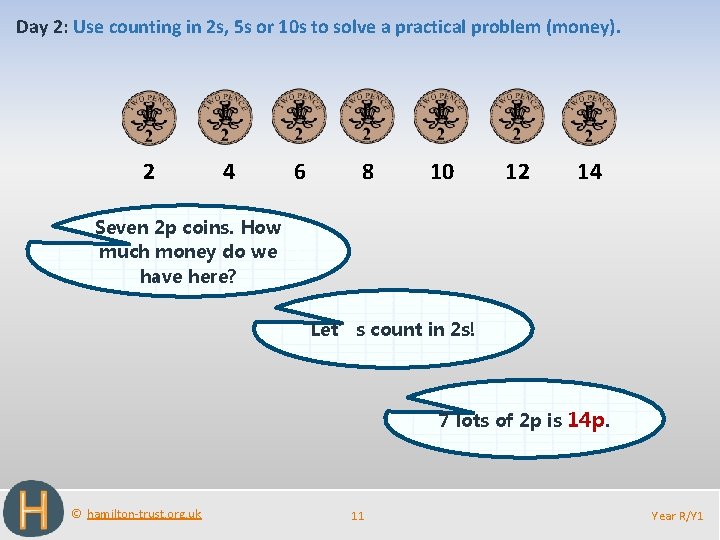
Day 2: Use counting in 2 s, 5 s or 10 s to solve a practical problem (money). 2 4 6 8 10 12 14 Seven 2 p coins. How much money do we have here? Let’s count in 2 s! 7 lots of 2 p is 14 p. © hamilton-trust. org. uk 11 Year R/Y 1
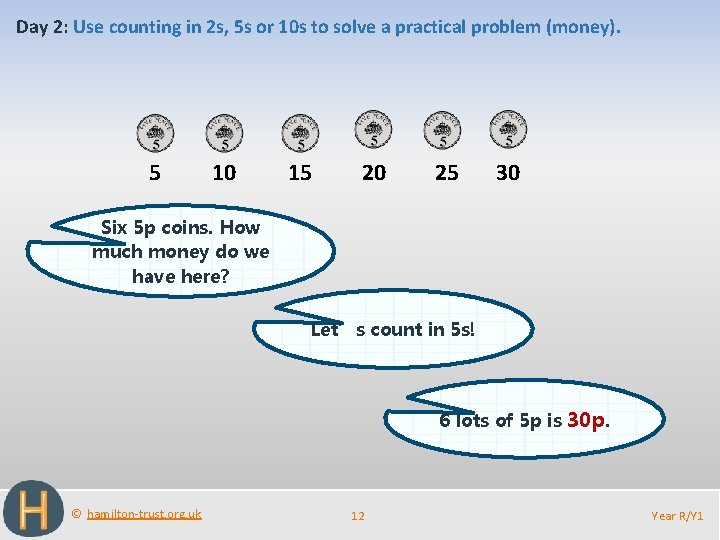
Day 2: Use counting in 2 s, 5 s or 10 s to solve a practical problem (money). 5 10 15 20 25 30 Six 5 p coins. How much money do we have here? Let’s count in 5 s! 6 lots of 5 p is 30 p. © hamilton-trust. org. uk 12 Year R/Y 1
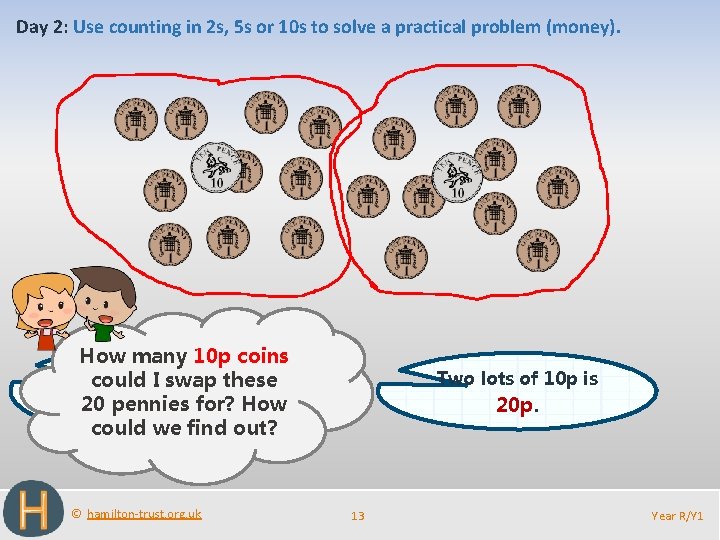
Day 2: Use counting in 2 s, 5 s or 10 s to solve a practical problem (money). How many 10 p coins 10 to Do. We wecould have count enough could I swap these pennies and swap for another 10 p 20 pennies for? How themcoin? for a 10 p! Two lots of 10 p is 20 p. could we find out? © hamilton-trust. org. uk 13 Year R/Y 1
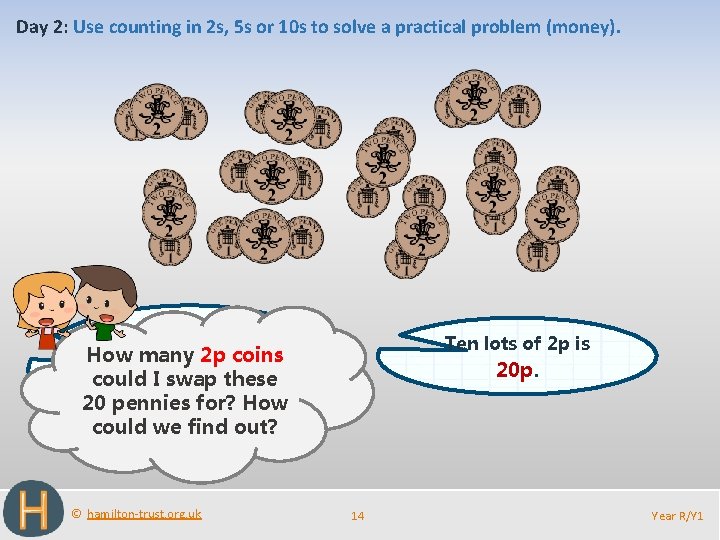
Day 2: Use counting in 2 s, 5 s or 10 s to solve a practical problem (money). We could swap two 1 ps How 2 p coins for amany 2 p! Let’s see could I swap these how many times we 20 pennies can do for? that!How Ten lots of 2 p is 20 p. could we find out? © hamilton-trust. org. uk 14 Year R/Y 1
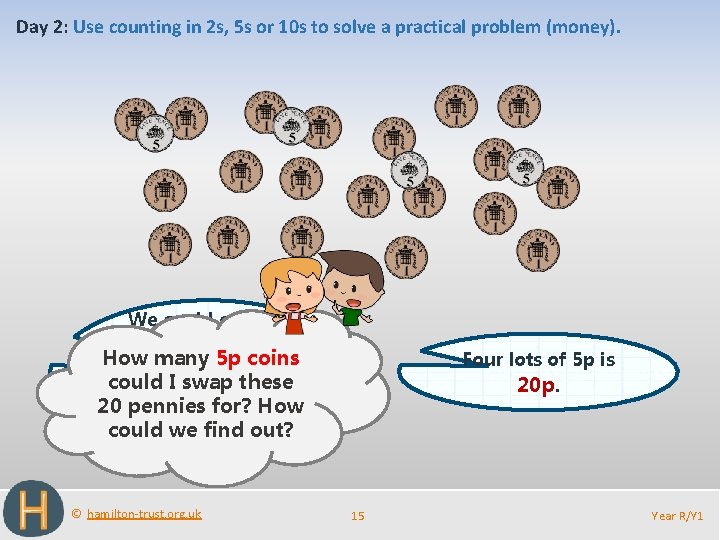
Day 2: Use counting in 2 s, 5 s or 10 s to solve a practical problem (money). We could count 5 pennies and swap How many 5 p coins them for a 5 p! could I swap these How many times do 20 pennies for? How you think we can do could we find out? that? © hamilton-trust. org. uk Four lots of 5 p is 20 p. 15 Year R/Y 1
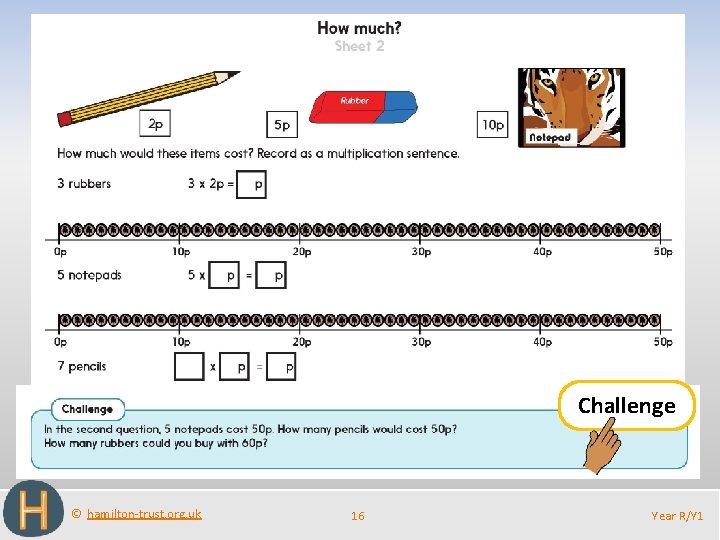
Challenge © hamilton-trust. org. uk 16 Year R/Y 1

20
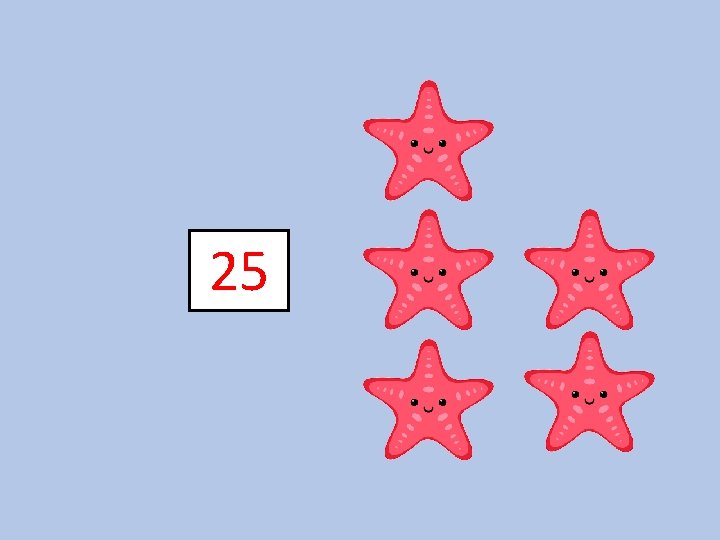
25

35

30

50
Patterns: Groups and Fractions Counting and calculating by grouping Objectives Day 3 Multiplication using a penny number line. © hamilton-trust. org. uk 22 Year R/1
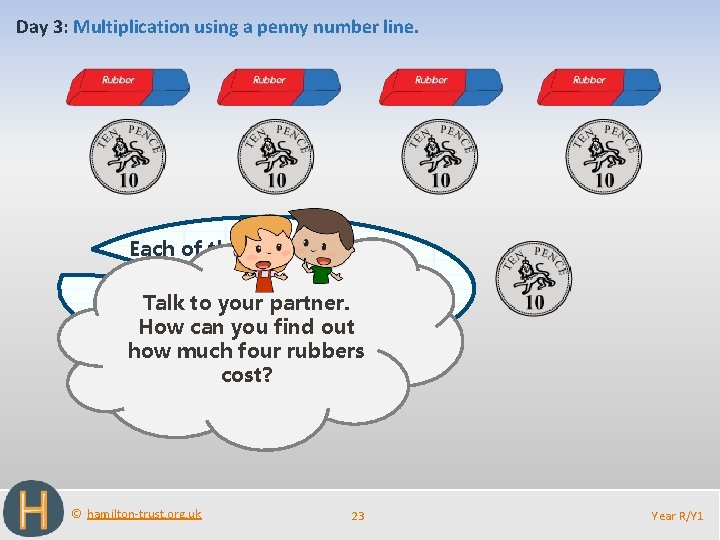
Day 3: Multiplication using a penny number line. Each of these rubbers costs 10 p. How many 10 ps would Talk yourtopartner. weto need buy four How canrubbers? you find out how much four rubbers cost? © hamilton-trust. org. uk 23 Year R/Y 1
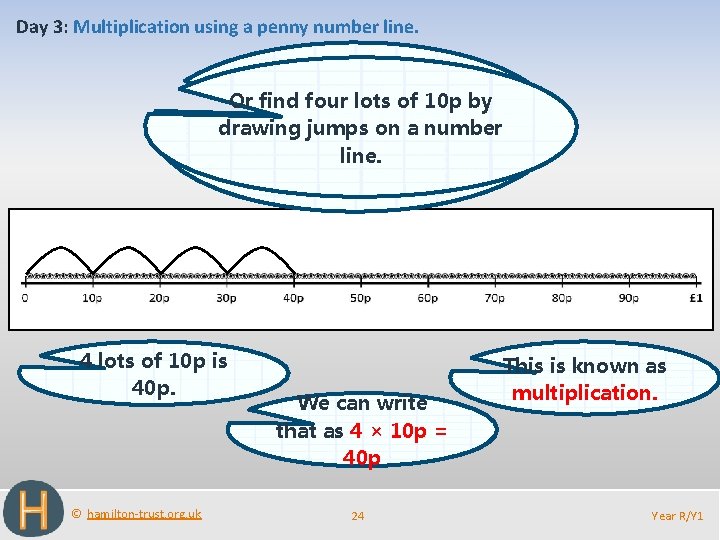
Day 3: Multiplication using a penny number line. We can count in 10 s or add Or find four lots of 10 p by four 10 ps: 10 p + 10 pjumps + 10 p on + 10 p = 40 p. drawing a number This is called line. repeated addition. 4 lots of 10 p is 40 p. © hamilton-trust. org. uk We can write that as 4 × 10 p = 40 p 24 This is known as multiplication. Year R/Y 1
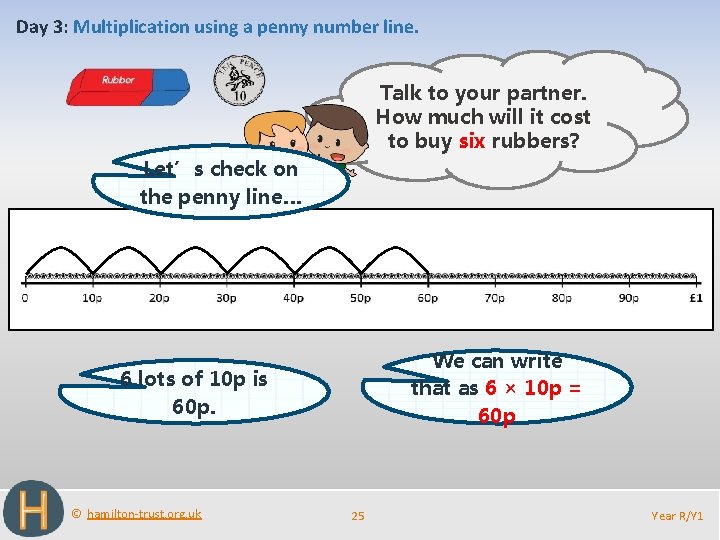
Day 3: Multiplication using a penny number line. Talk to your partner. How much will it cost to buy six rubbers? Let’s check on the penny line… We can write that as 6 × 10 p = 60 p 6 lots of 10 p is 60 p. © hamilton-trust. org. uk 25 Year R/Y 1
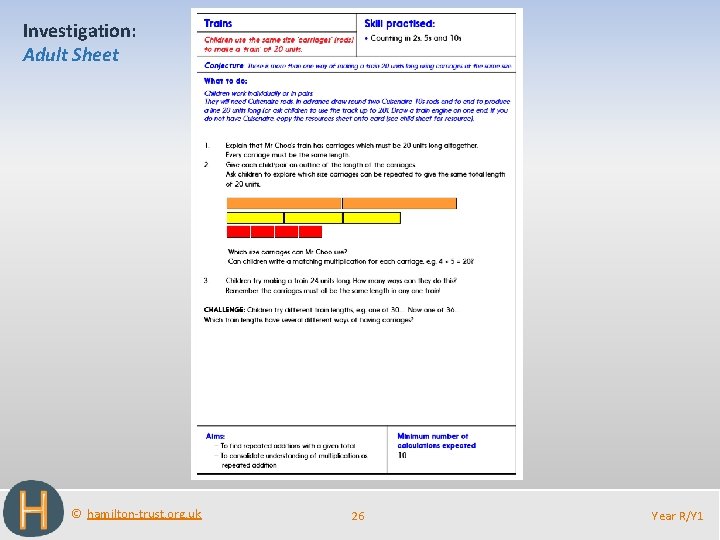
Investigation: Adult Sheet © hamilton-trust. org. uk 26 Year R/Y 1
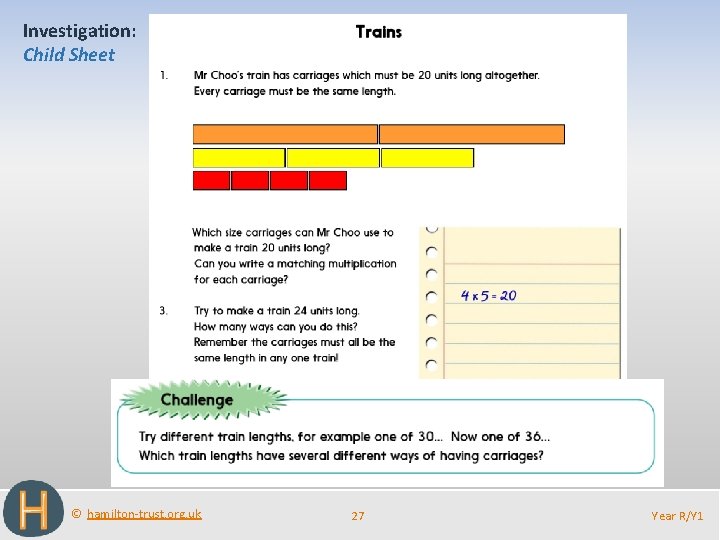
Investigation: Child Sheet © hamilton-trust. org. uk 27 Year R/Y 1
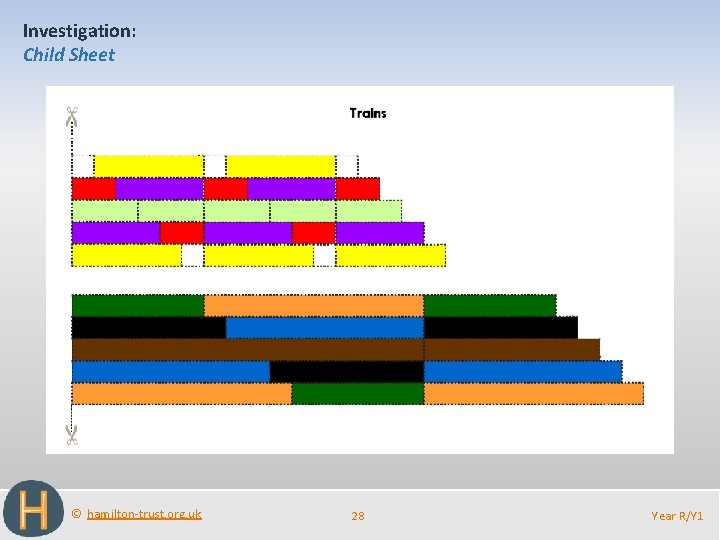
Investigation: Child Sheet © hamilton-trust. org. uk 28 Year R/Y 1
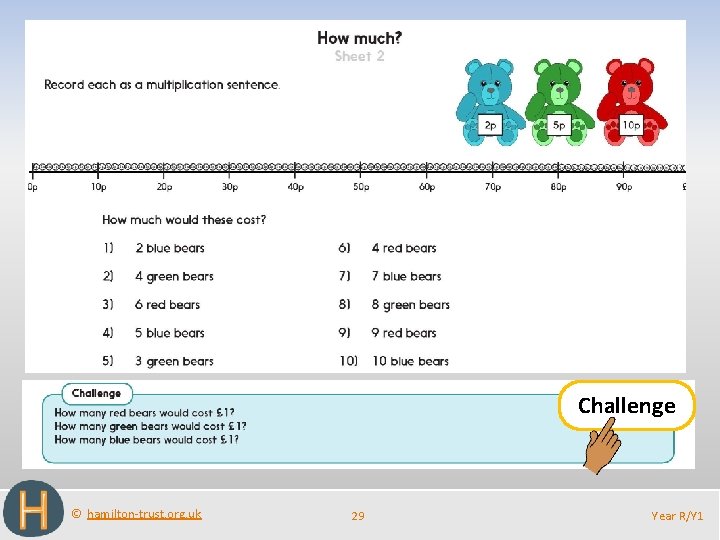
Challenge © hamilton-trust. org. uk 29 Year R/Y 1
Patterns: Groups and Fractions Counting and calculating by grouping Objectives Day 4 Solve division problems by finding how many sets. © hamilton-trust. org. uk 30 Year R/1
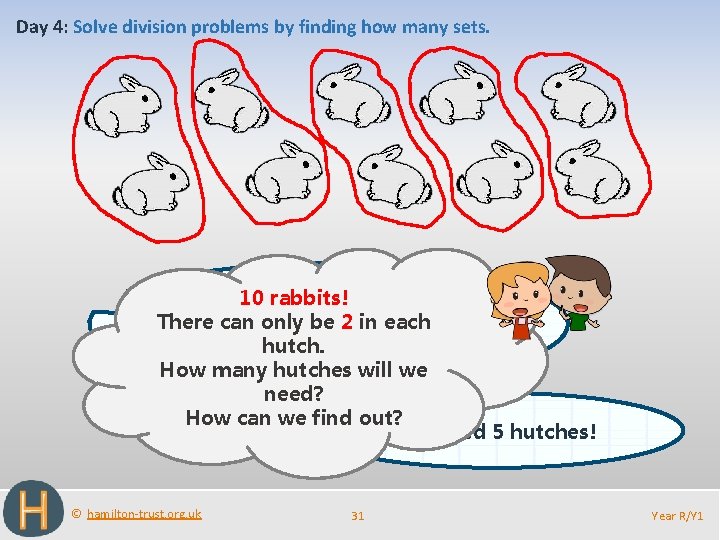
Day 4: Solve division problems by finding how many sets. We can around pairs of 10 draw rabbits! How many of 2 There cantoonly begroups 2 inthe each rabbits represent groups rabbits did we make? hutch. of two that go in each hutch. . . How many hutches will we need? How can we find out? We need 5 hutches! © hamilton-trust. org. uk 31 Year R/Y 1
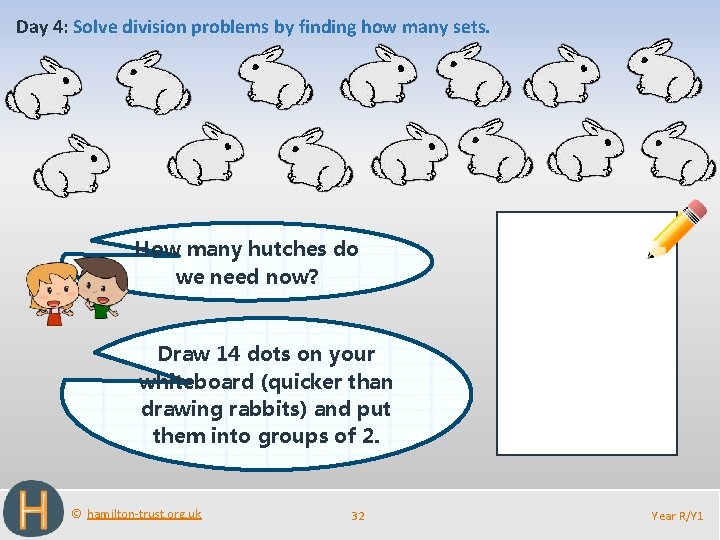
Day 4: Solve division problems by finding how many sets. How many hutches do we need now? Draw 14 dots on your whiteboard (quicker than drawing rabbits) and put them into groups of 2. © hamilton-trust. org. uk 32 Year R/Y 1
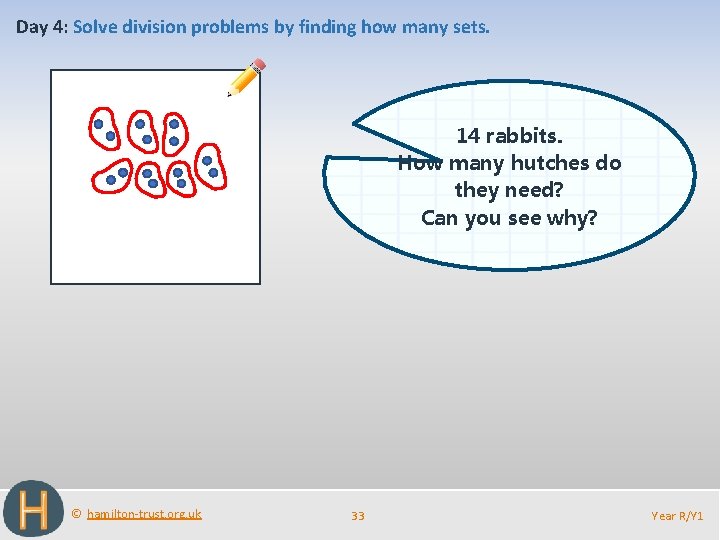
Day 4: Solve division problems by finding how many sets. 14 rabbits. How many hutches do they need? Can you see why? © hamilton-trust. org. uk 33 Year R/Y 1
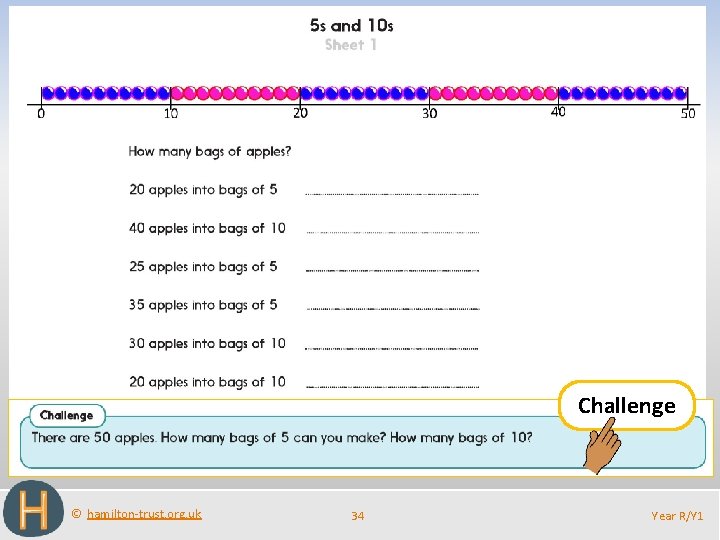
Challenge © hamilton-trust. org. uk 34 Year R/Y 1
Patterns: Groups and Fractions Counting and calculating by grouping Objectives Day 5 Know what each digit means in a 2 -digit number (money). © hamilton-trust. org. uk 35 Year R/1
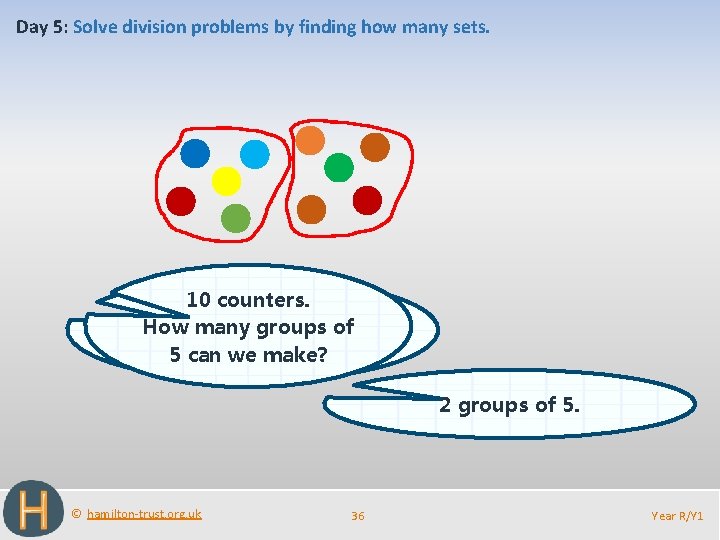
Day 5: Solve division problems by finding how many sets. 10 there counters. Are enough How manyfor groups of counters another 5 can we of make? group 5? 2 groups of 5. © hamilton-trust. org. uk 36 Year R/Y 1
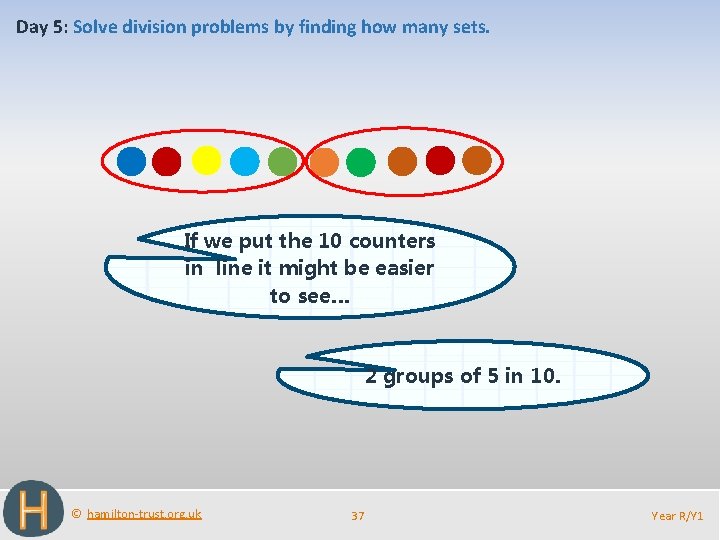
Day 5: Solve division problems by finding how many sets. If we put the 10 counters in line it might be easier to see… 2 groups of 5 in 10. © hamilton-trust. org. uk 37 Year R/Y 1
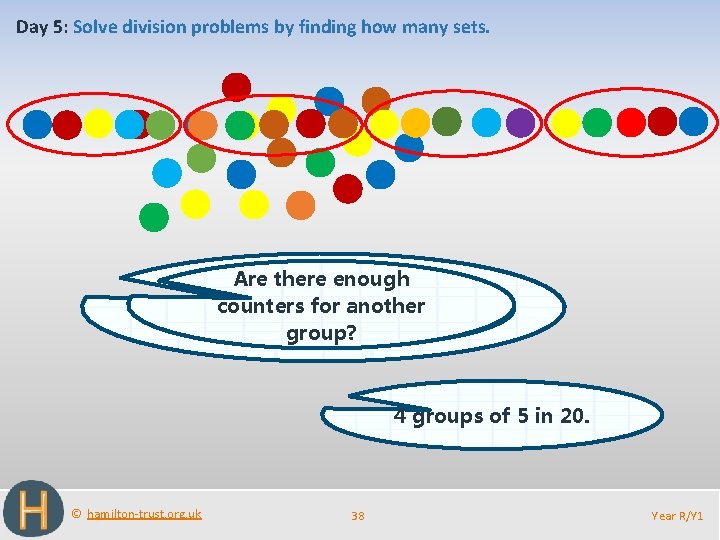
Day 5: Solve division problems by finding how many sets. Are 20 there enough counters. Let’s put them in a for another Howcounters many groups of 5 can we line… group? make? 4 groups of 5 in 20. © hamilton-trust. org. uk 38 Year R/Y 1
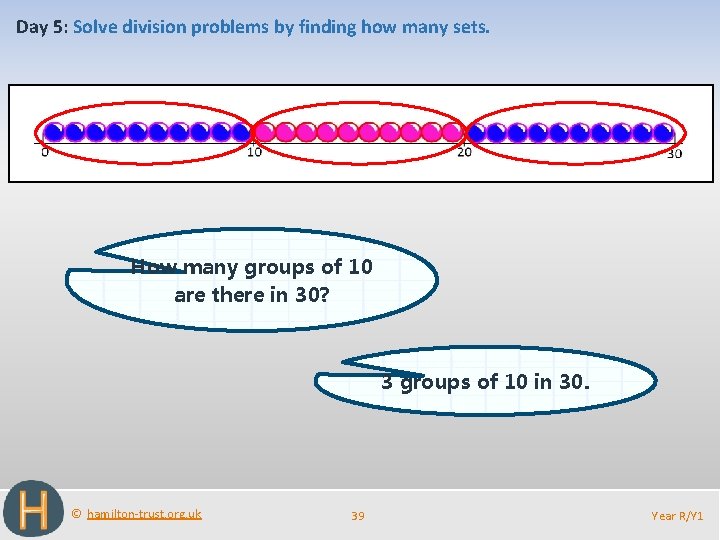
Day 5: Solve division problems by finding how many sets. How many groups of 10 are there in 30? 3 groups of 10 in 30. © hamilton-trust. org. uk 39 Year R/Y 1
© hamilton-trust. org. uk 40 Year R/Y 1
Patterns: Groups and Fractions Counting and calculating by grouping Well Done! You’ve completed this unit. Objectives Day 1 Use counting in 2 s, 5 s or 10 s to solve a practical problem. Day 2 Use counting in 2 s, 5 s or 10 s to solve a practical problem (money). Day 3 Multiplication using a penny number line. Day 4 Solve division problems by finding how many sets. Day 5 Solve division problems by finding how many sets. © hamilton-trust. org. uk 41 Year R/1
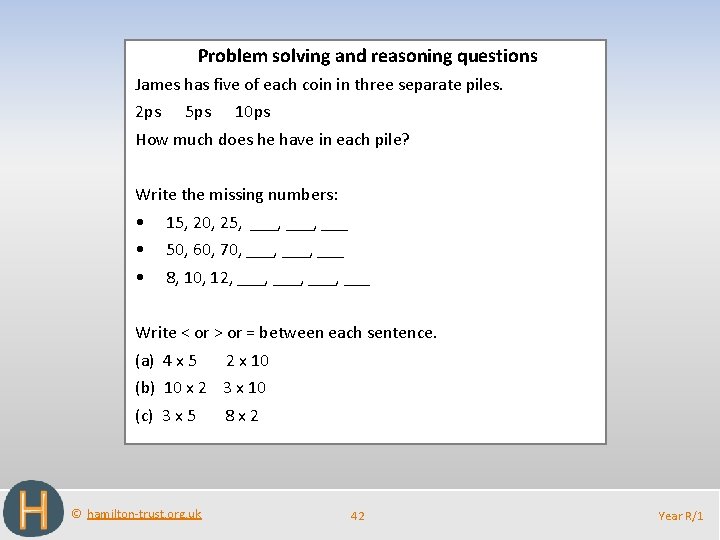
Problem solving and reasoning questions James has five of each coin in three separate piles. 2 ps 5 ps 10 ps How much does he have in each pile? Write the missing numbers: • 15, 20, 25, ___, ___ • 50, 60, 70, ___, ___ • 8, 10, 12, ___, ___ Write < or > or = between each sentence. (a) 4 x 5 2 x 10 (b) 10 x 2 3 x 10 (c) 3 x 5 © hamilton-trust. org. uk 8 x 2 42 Year R/1
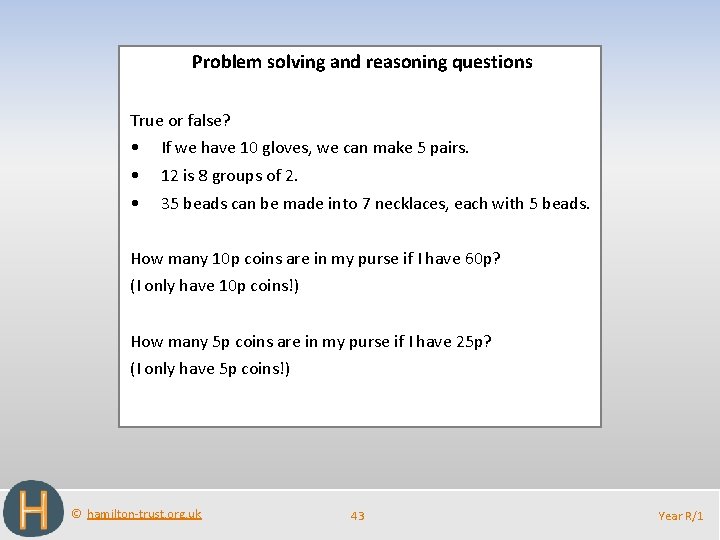
Problem solving and reasoning questions True or false? • If we have 10 gloves, we can make 5 pairs. • 12 is 8 groups of 2. • 35 beads can be made into 7 necklaces, each with 5 beads. How many 10 p coins are in my purse if I have 60 p? (I only have 10 p coins!) How many 5 p coins are in my purse if I have 25 p? (I only have 5 p coins!) © hamilton-trust. org. uk 43 Year R/1
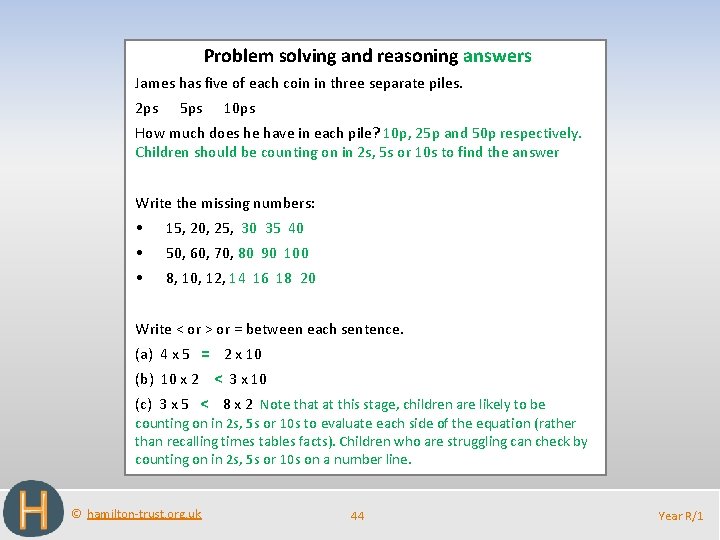
Problem solving and reasoning answers James has five of each coin in three separate piles. 2 ps 5 ps 10 ps How much does he have in each pile? 10 p, 25 p and 50 p respectively. Children should be counting on in 2 s, 5 s or 10 s to find the answer Write the missing numbers: • 15, 20, 25, 30 35 40 • 50, 60, 70, 80 90 100 • 8, 10, 12, 14 16 18 20 Write < or > or = between each sentence. (a) 4 x 5 = 2 x 10 (b) 10 x 2 < 3 x 10 (c) 3 x 5 < 8 x 2 Note that at this stage, children are likely to be counting on in 2 s, 5 s or 10 s to evaluate each side of the equation (rather than recalling times tables facts). Children who are struggling can check by counting on in 2 s, 5 s or 10 s on a number line. © hamilton-trust. org. uk 44 Year R/1
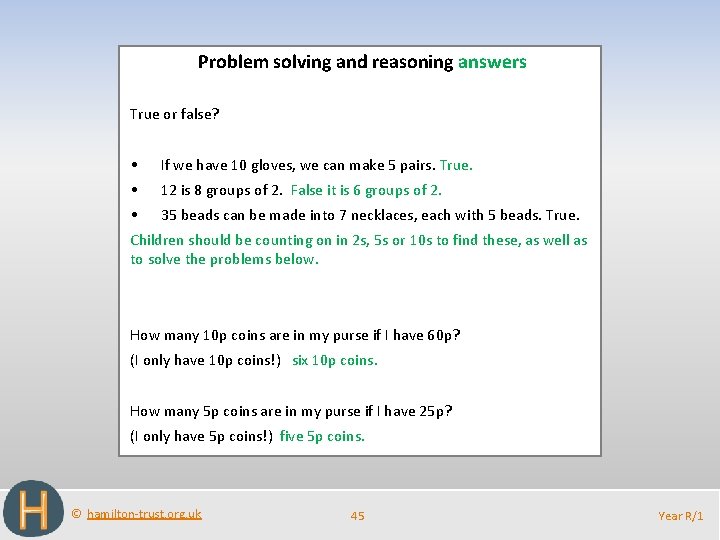
Problem solving and reasoning answers True or false? • If we have 10 gloves, we can make 5 pairs. True. • 12 is 8 groups of 2. False it is 6 groups of 2. • 35 beads can be made into 7 necklaces, each with 5 beads. True. Children should be counting on in 2 s, 5 s or 10 s to find these, as well as to solve the problems below. How many 10 p coins are in my purse if I have 60 p? (I only have 10 p coins!) six 10 p coins. How many 5 p coins are in my purse if I have 25 p? (I only have 5 p coins!) five 5 p coins. © hamilton-trust. org. uk 45 Year R/1
- Slides: 45