
Patterns for IT Systems Management An IT architect
- Slides: 33
Patterns for IT Systems Management • An IT architect evaluates a business problem to build a solution for it. • Solution design begins with gathering inputs about the problem, an outline of the desired solution and any special considerations that need to be taken care in the solution. • To improve the design over time, the experience of the IT architects are captured and reused to carry out future developments in simpler and efficient way. • Knowledge gained from each past development are recorded and used it to build a repository of assets to build future solutions based on these proven assets. Ajith G. S: poposir. orgfree. com
Patterns for IT Systems Management • This reuse saves time, money, effort, ensure delivery of a solid and properly architected solution. • A pattern helps to facilitate this reuse of assets that have been used, tested and proven to be successful. • Patterns are used in software engineering and object-oriented designing to provide efficient software solutions. • "Each pattern describes a problem that occurs over and over again in our environment, and then describes the core of the solution to that problem in such a way that one can use this solution a million times over without ever doing it the same way twice. " • -Dr C Alexander, A Pattern Language Ajith G. S: poposir. orgfree. com
Patterns for IT Systems Management • • • Patterns for e-Business approach helps to implement successful e-Business solutions through the re-use of components and solutions from proven successful assets. Patterns approach is based on a set of layered assets that can be used by any existing development methodology to build a solution. These layered assets are organised in such a way that each level is built on the previous level. An e-Business solution spans multiple business domains and requires a constant and clear exchange of ideas and information between the business owners and the IT personnel. Though design patterns are useful in solution development, its impact is minimal in the early phases of the solution design as key decisions are made on the overall structure of solution and end-to-end architecture. Ajith G. S: poposir. orgfree. com
Patterns for IT Systems Management • • Patterns for e-Business Introduced by IBM The concept of patterns helps in understanding and analyzing the complex business problems, and breaks them down into smaller, more manageable functions that can then be implemented using lower-level design patterns. There are five major types of patterns for e-Business: 1. Business Pattern It helps in identifying the interaction between users, businesses and data. 2. Integration Pattern It groups multiple business patterns together when a solution cannot be provided based on a single business pattern. Ajith G. S: poposir. orgfree. com
Patterns for IT Systems Management Patterns for e-Business • • 3. Application Pattern Provides a conceptual layout describing how the application components and data within a business pattern or integration pattern interact. • • • 4. Runtime Pattern Defines the logical middleware structure supporting an application pattern. A runtime pattern describes the major middleware nodes, their roles and the interfaces between these nodes. • • • 5. Composite Pattern Represents a set of proven architectural solutions. Represents commonly occurring combinations of business pattern and integration pattern. Ajith G. S: poposir. orgfree. com
Design Process of Information System Design Process • Objective is to create a customised instance of the IT system architecture from a basic model. • Commonly accepted design process is business-process centric design process. • It uses a model of the business processes as the starting point and then subsequently refine it using a step-by-step process (by following selected computing paradigms such as custom client-server, internet computing and so on). • This design process has two types of requirements; Functional and Non. Functional requirements. Ajith G. S: poposir. orgfree. com
Design Process of Information System Design Process • Functional requirements: • Describe the behaviours (functions and services) of the system that support user goals, tasks or activities. • Non-functional requirements: • Specify criterion that can be employed to judge the operation of a system. • These requirements contains those for systems management to include performance, availability and security. • They are treated as secondary considerations while designing. • They influence, but do not overly constrain the design or deployment of the IT solution. Ajith G. S: poposir. orgfree. com
Design Models and Context Diagrams Design Models Three popular and relevant system models are: 1. Business processes based model: It is a business system model that represents the business processes. These models deal with the representation of processes involved in a business. • The main goal behind business process modelling is to analyse the current processes and suggest future improvements. • It is usually performed by business analysts and managers who are looking for improvements in process quality and efficiency. • • Ajith G. S: poposir. orgfree. com
Design Models and Context Diagrams Design Models • 2. Management activities based model: • It is a business system model that represents the management activities which support the business processes. • 3. Hybrid model: • Also called Managed system business model. • It is a business system model that combines both business processes and IT Management processes. Ajith G. S: poposir. orgfree. com
System Context Diagram • Provides the highest level view of a system and is used to specify details of a system design. • Used in systems design to represent all external entities that may interact with a system. • It gives a convenient representation for a system model. • Like a block diagram, it normally shows a software-based system as a whole, and its inputs and outputs from/to external factors. • Help in understanding the context in which the system is part of. Ajith G. S: poposir. orgfree. com
System Context Diagram • Drawn using labelled boxes to represent each of the external entities and the system being developed. • The relationship between entities and the developed system is shown using lines. • The main system in diagram is kept at its centre and all its interacting systems, environment and activities surrounding it. • The relationships are labelled with a subject-verb-object format, for example, "customer places order". • System context diagrams use different drawing types such as ovals, stick figures, pictures, clip art etc to convey meaning and represent external entities. Ajith G. S: poposir. orgfree. com
System Context Diagram Unified Modelling Language (UML) • A standardised formal visual specification language for object modelling. • Frequently used for drawing system context diagrams. • It is a general-purpose modelling language which includes a graphical notation used to create an abstract model of a system, referred to as a UML model. • UML defines several standard representations for architecture elaboration. Eg: use-case diagrams, collaboration diagrams, class diagrams, sequence diagrams, component and deployment diagrams. • A system context diagram follows the structure of use-case diagram. Ajith G. S: poposir. orgfree. com
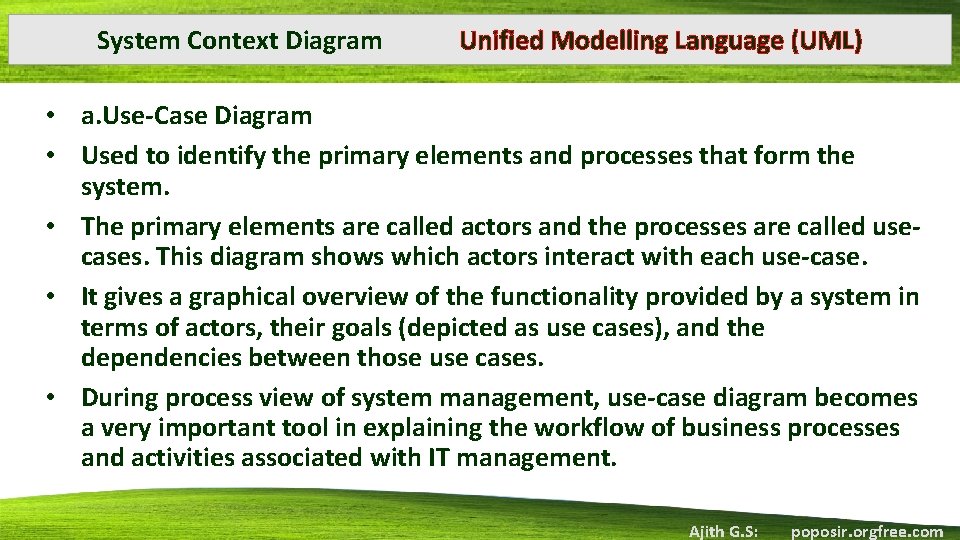
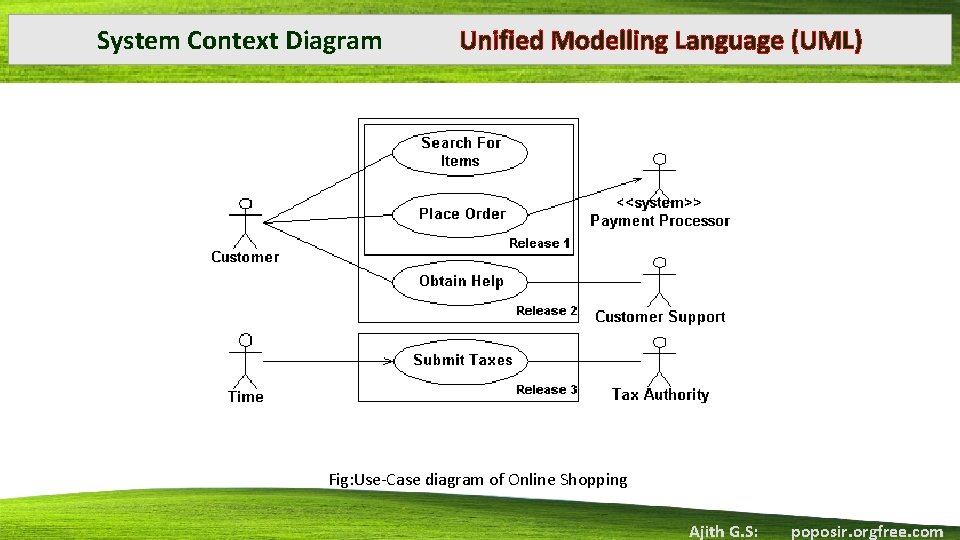
System Context Diagram Unified Modelling Language (UML) • a. Use-Case Diagram • Used to identify the primary elements and processes that form the system. • The primary elements are called actors and the processes are called usecases. This diagram shows which actors interact with each use-case. • It gives a graphical overview of the functionality provided by a system in terms of actors, their goals (depicted as use cases), and the dependencies between those use cases. • During process view of system management, use-case diagram becomes a very important tool in explaining the workflow of business processes and activities associated with IT management. Ajith G. S: poposir. orgfree. com
System Context Diagram Unified Modelling Language (UML) Fig: Use-Case diagram of Online Shopping Ajith G. S: poposir. orgfree. com
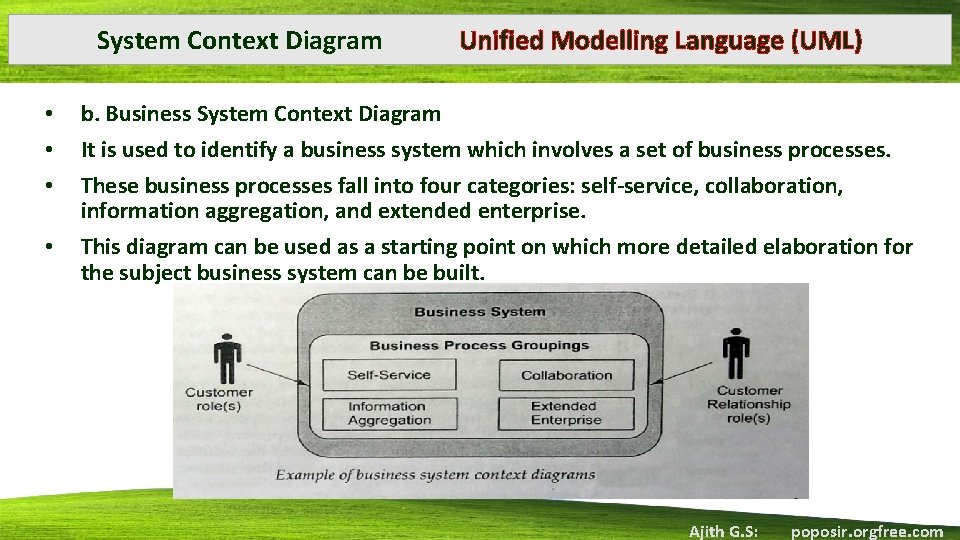
System Context Diagram • • Unified Modelling Language (UML) b. Business System Context Diagram It is used to identify a business system which involves a set of business processes. These business processes fall into four categories: self-service, collaboration, information aggregation, and extended enterprise. This diagram can be used as a starting point on which more detailed elaboration for the subject business system can be built. Ajith G. S: poposir. orgfree. com
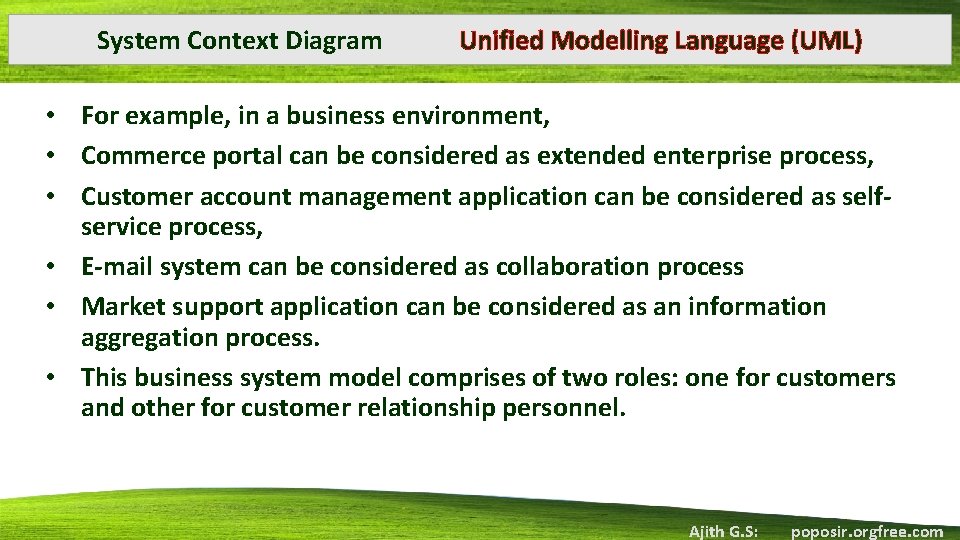
System Context Diagram Unified Modelling Language (UML) • For example, in a business environment, • Commerce portal can be considered as extended enterprise process, • Customer account management application can be considered as selfservice process, • E-mail system can be considered as collaboration process • Market support application can be considered as an information aggregation process. • This business system model comprises of two roles: one for customers and other for customer relationship personnel. Ajith G. S: poposir. orgfree. com
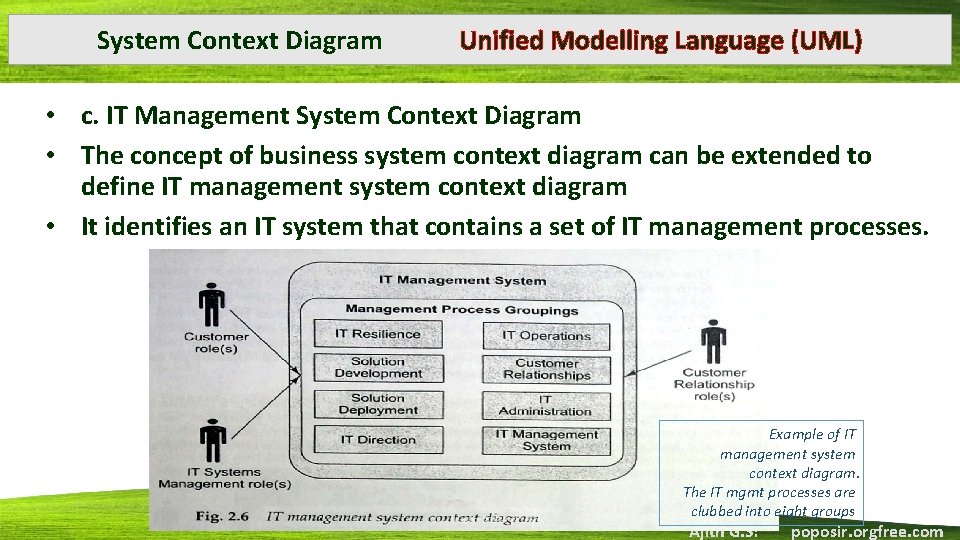
System Context Diagram Unified Modelling Language (UML) • c. IT Management System Context Diagram • The concept of business system context diagram can be extended to define IT management system context diagram • It identifies an IT system that contains a set of IT management processes. Example of IT management system context diagram. The IT mgmt processes are clubbed into eight groups Ajith G. S: poposir. orgfree. com
System Context Diagram Unified Modelling Language (UML) • IT management system context diagram can be used as a starting point based on which an elaboration can be developed. • For example, IT management system context diagram can be used to identify: • how systems' designs are developed, deployed, and operated • how administration of an IT system is done • how customer relationships are set up and sustained • how the availability is maintained Ajith G. S: poposir. orgfree. com
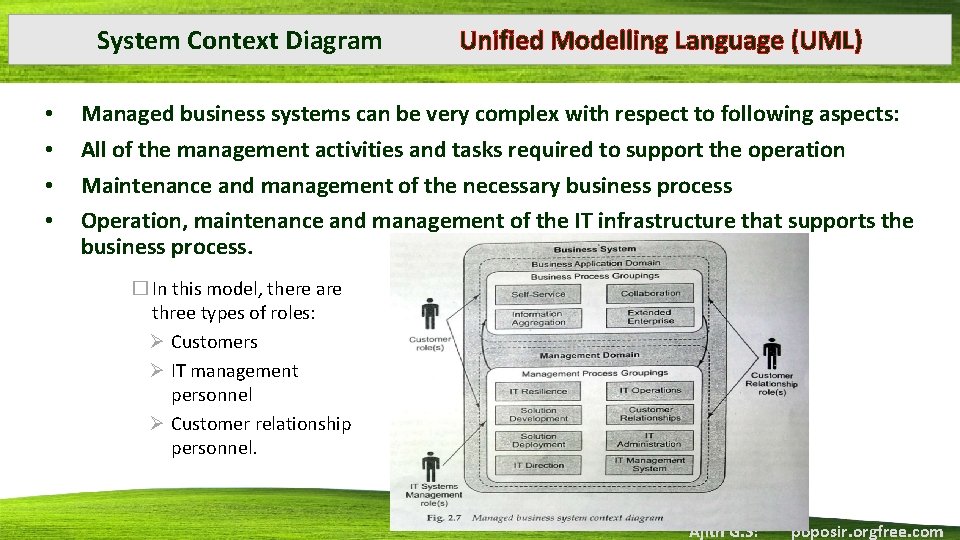
System Context Diagram Unified Modelling Language (UML) • d. Managed Business System Context Diagram • The managed business system model integrates business and management aspects of the system; a composite view of business and IT management process models. • Managed business system context diagram is used to represent such integrated business models. • Business aspect is described as the functional view of the solution whereas management aspect is described as the non-functional view of the solution. • It can be observed that the managed business system is divided into a business application domain and a management domain. Ajith G. S: poposir. orgfree. com
System Context Diagram • • Unified Modelling Language (UML) Managed business systems can be very complex with respect to following aspects: All of the management activities and tasks required to support the operation Maintenance and management of the necessary business process Operation, maintenance and management of the IT infrastructure that supports the business process. � In this model, there are three types of roles: Ø Customers Ø IT management personnel Ø Customer relationship personnel. Ajith G. S: poposir. orgfree. com
Information Technology Infrastructure Library ITIL • ITIL is a management framework developed to provide guidelines to deliver better IT services at lower cost. • Developed in the late 1980’s by the Central Computer and Telecommunications Agency (CCTA). • It is a public domain framework with scalable property. • The most widely accepted approach to IT service management worldwide. • A customizable framework. • Helps to overcome problems associated with the growth of IT systems. • Provides a systematic approach to manage IT services, through design, implementation, operation and continual improvement. Ajith G. S: poposir. orgfree. com
Information Technology Infrastructure Library • • • ITIL consists of set of concepts, policies and practices used for managing IT infrastructure, development and operations. It provides a comprehensive description of a number of important IT practices with detailed catalogue, procedures and tasks that an IT organisation can adapt for its need. Collection of concepts and strategies for controlling IT infrastructure, their developments and operations. ITIL is a series of training manuals that summarize and explain the practices that are most profitable to IT services. The aim of ITPL is for managers to have outstanding high standards in IT value, with high financial quality in day-to-day IT operations. ITIL practices are vendor-independent and comprises of instructional resources on IT infrastructure, operations and development issues. Ajith G. S: poposir. orgfree. com
Information Technology Infrastructure Library ITIL • ITIL is published in a series of books, each of which give details of an IT management topic. • • ITIL version 1 Initial version. Expanded over 30 volumes. Published as a collection of series of books, each covered a particular practice of IT service management. Initially, it was projected as a set of formal methods. Later it was changed and published as set of guidelines. ITIL version 2 Make ITIL more approachable and financially manageable. Consolidates the volumes of ITIL version 1 into logical sets, by grouping the related process guidelines of IT management, applications, and services. • • Ajith G. S: poposir. orgfree. com
Information Technology Infrastructure Library • The eight book volumes of ITIL version 2 are grouped into three parts as follows: • • • 1. IT service management set • • 2. Operational guidance set • • 3. Implementation guidelines set • • 4. Supplementary set –An additional set ITIL Service delivery Service support ICT infrastructure management Security management The business perspective Application management Software asset management Planning to implement service management ITIL small-scale implementation Ajith G. S: poposir. orgfree. com
Information Technology Infrastructure Library • • • ITIL version 3 It updates the version-2 by expanding the scope of ITIL in the domain of service management. ITIL version 3 comprises of five key volumes : a. Service Strategy Focuses on helping IT organisations to improve and develop over the long term. Introduces service lifecycle and encourages the development of a business perspective. Guides both service provider and the business customer, through choices that they need to achieve service excellence. Key topics include, business case development, service assets, service value definition, market analysis and service provider types. Processes included are, IT financial management, service portfolio management and demand management. Ajith G. S: poposir. orgfree. com
Information Technology Infrastructure Library • • ITIL b. Service Design Provides good practice guidance on design of IT services and processes within limited frames of time and money. Gives a framework for service design which considers the customer's present and future requirements, while firmly maintaining the business view. Processes included are, service level mgmt, capacity mgmt, availability mgmt, IT service continuity mgmt, supplier mgmt, information security mgmt and service catalogue mgmt. c. Service Transition Provides guidance on managing the many aspects of service changes, preventing undesired consequences while allowing for innovation. It is essential reading for anyone seeking to deliver IT change with the best possible benefit to the business. Ajith G. S: poposir. orgfree. com
Information Technology Infrastructure Library • • • ITIL Topics covered are transition planning and support, service asset and configuration mgmt and change mgmt, release and deployment mgmt and knowledge mgmt. It states the key roles and responsibilities of staff involved in service transition. d. Service Operation Introduces delivery and control activities used to support high quality service operations. It covers best practices for balancing conflicting goals (such as reliability vs. cost); problem mgmt, event mgmt, incident mgmt, service desk, asset mgmt, technical and application mgmt. It also defines the key roles and responsibilities for staff involved in service operation. Ajith G. S: poposir. orgfree. com
Information Technology Infrastructure Library ITIL • e. Continual Service Improvement • Contains guidelines for improvements in service quality to survive in a competitive environment and helps in achieving the best possible outcomes. • Introduces the processes involved in identifying and introducing a cycle of service management improvements. • The goal is to align and realign IT services to changes in business needs by identifying and implementing improvements to the IT services such as service quality, process effectiveness, efficiency and cost effectiveness. Ajith G. S: poposir. orgfree. com
Alternatives to ITIL • • • 1. Microsoft Operations Framework Goal of every business process is to provide better services at lower cost. MOF helps to achieve the same. Help customers in achieving operational excellence across entire IT service lifecycle. Originally it was developed to provide knowledge and processes required to align their work in managing Microsoft platforms cost-effectively and with high reliability. Newer version-MOF 4. 0 offers its customers new ways to cope up with the new challenges in providing better IT services. It provides practical guidelines for each and every day-to-day activity and helps in maintaining the regulatory requirements for enhancing organisational capabilities. Ajith G. S: poposir. orgfree. com
Alternatives to ITIL • • IT Service Lifecycle of MOF Comprised of three phases and one manage layer. Manage layer operates throughout the cycle of other three phases and works as the foundation of IT service lifecycle and covers the components that apply to all lifecycle phases. These three phases and foundation layer are: Plan Phase: The task of this phase is to plan and optimise an IT service strategy so that the set business objectives can be achieved. Deliver phase: It ensures that IT services are developed and deployed successfully and are ready for operations. Ajith G. S: poposir. orgfree. com
Alternatives to ITIL • • Operate phase: This phase is responsible to ensure that IT services are operated, maintained and supported effectively to meet business objectives and expectations. Manage layer: This layer is the foundation of the IT service lifecycle, and processes in this layer apply to all phases of the lifecycle. It is responsible for IT governance, risk management, change management, configuration management, etc. To align IT services to the business requirement, each phase of the IT service lifecycle contains Service Management Functions (SMFs). These SMFs define and structure the processes, people, and activities required. Each SMF has three to six key processes, and each process has one to six key activities. Ajith G. S: poposir. orgfree. com
Alternatives to ITIL • 2. ISO/IEC 20000 • It is the first international standard for IT service management. • Referred to as combination of service support and service delivery volumes of ITIL version 2. • ISO/IEC 20000 was originally developed to reflect best practices of ITIL. • It equally supports other IT service management frameworks such as Microsoft Operations Framework, components of ISACA's Cob. IT framework, etc. • Consists of two parts: the first part contains a specification for IT service management whereas second one defines the code of practice for service management. Ajith G. S: poposir. orgfree. com
Alternatives to ITIL • IT Service Ajith G. S: poposir. orgfree. com