
Patterns as solutions to problems l A design
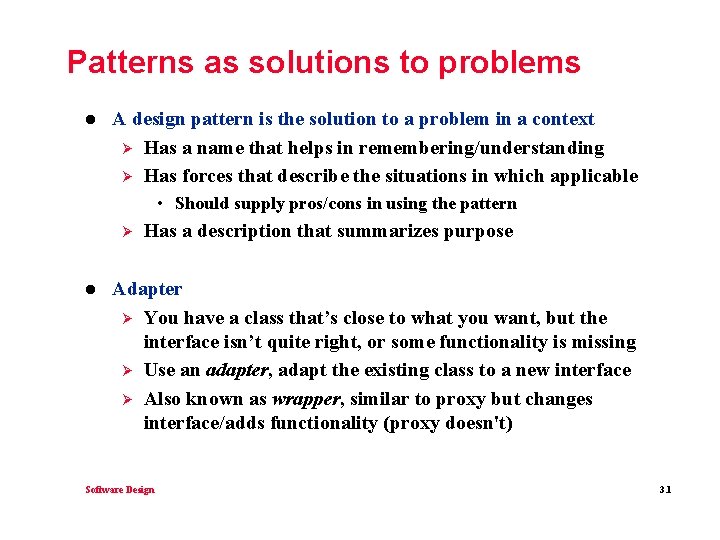
Patterns as solutions to problems l A design pattern is the solution to a problem in a context Ø Has a name that helps in remembering/understanding Ø Has forces that describe the situations in which applicable • Should supply pros/cons in using the pattern Ø l Has a description that summarizes purpose Adapter Ø You have a class that’s close to what you want, but the interface isn’t quite right, or some functionality is missing Ø Use an adapter, adapt the existing class to a new interface Ø Also known as wrapper, similar to proxy but changes interface/adds functionality (proxy doesn't) Software Design 3. 1
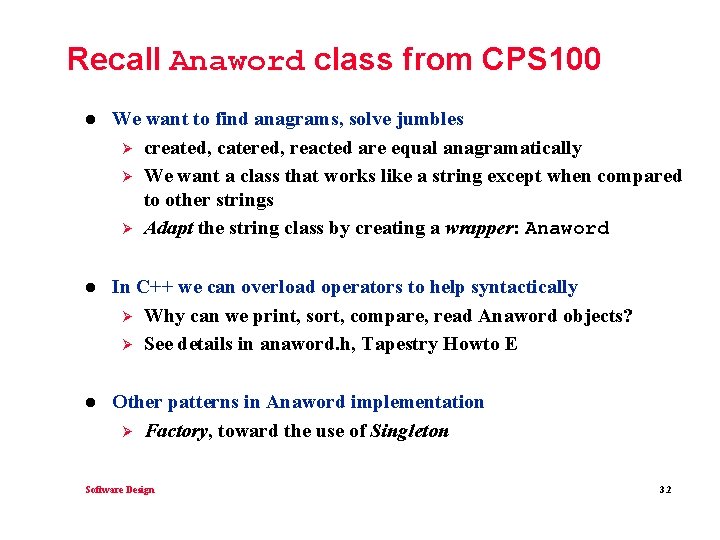
Recall Anaword class from CPS 100 l We want to find anagrams, solve jumbles Ø created, catered, reacted are equal anagramatically Ø We want a class that works like a string except when compared to other strings Ø Adapt the string class by creating a wrapper: Anaword l In C++ we can overload operators to help syntactically Ø Why can we print, sort, compare, read Anaword objects? Ø See details in anaword. h, Tapestry Howto E l Other patterns in Anaword implementation Ø Factory, toward the use of Singleton Software Design 3. 2
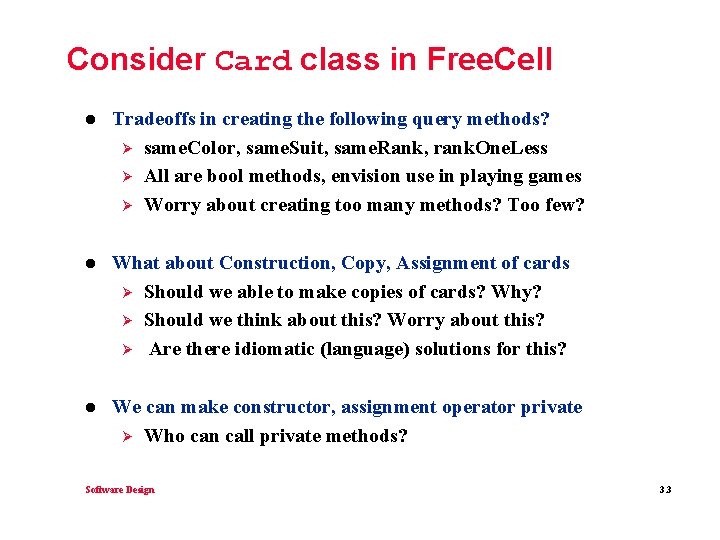
Consider Card class in Free. Cell l Tradeoffs in creating the following query methods? Ø same. Color, same. Suit, same. Rank, rank. One. Less Ø All are bool methods, envision use in playing games Ø Worry about creating too many methods? Too few? l What about Construction, Copy, Assignment of cards Ø Should we able to make copies of cards? Why? Ø Should we think about this? Worry about this? Ø Are there idiomatic (language) solutions for this? l We can make constructor, assignment operator private Ø Who can call private methods? Software Design 3. 3
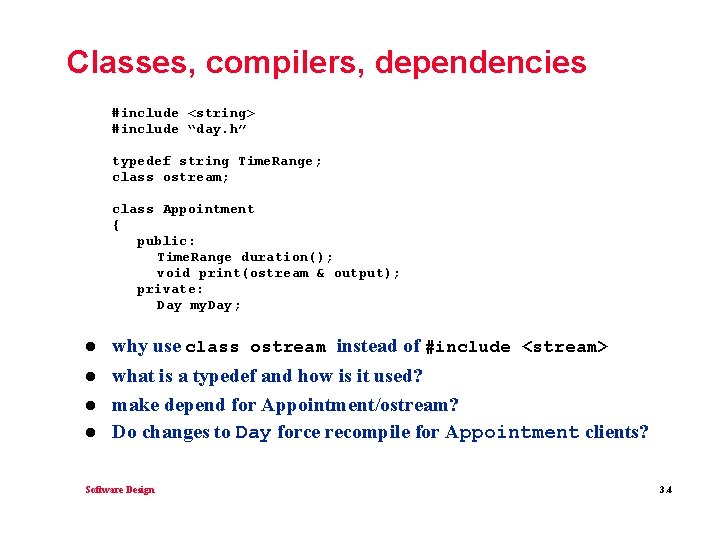
Classes, compilers, dependencies #include <string> #include “day. h” typedef string Time. Range; class ostream; class Appointment { public: Time. Range duration(); void print(ostream & output); private: Day my. Day; l l why use class ostream instead of #include <stream> what is a typedef and how is it used? make depend for Appointment/ostream? Do changes to Day force recompile for Appointment clients? Software Design 3. 4
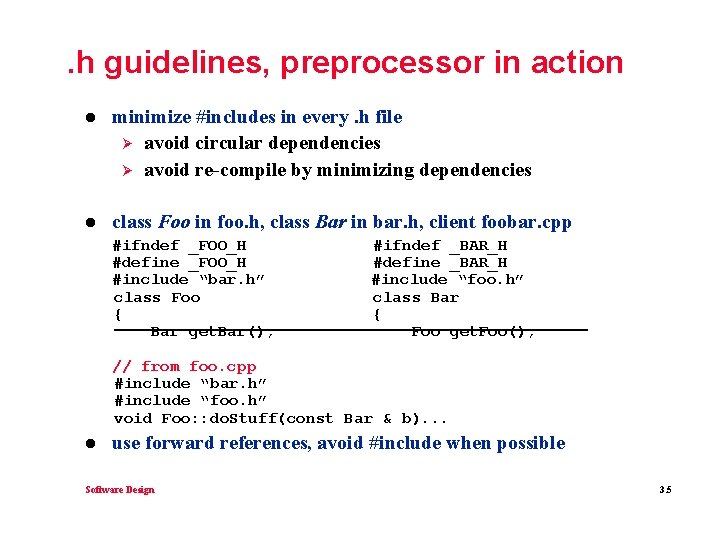
. h guidelines, preprocessor in action l minimize #includes in every. h file Ø avoid circular dependencies Ø avoid re-compile by minimizing dependencies l class Foo in foo. h, class Bar in bar. h, client foobar. cpp #ifndef _FOO_H #define _FOO_H #include “bar. h” class Foo { Bar get. Bar(); #ifndef _BAR_H #define _BAR_H #include “foo. h” class Bar { Foo get. Foo(); // from foo. cpp #include “bar. h” #include “foo. h” void Foo: : do. Stuff(const Bar & b). . . l use forward references, avoid #include when possible Software Design 3. 5

#include “foo. h” l l l will be needed in. cpp file, e. g. , foo. cpp and bar. cpp using pointers and references in. h files minimizes dependencies Ø minimize recompiles when. h changes Ø loose coupling: avoid implementation dependencies when possible avoid letting implementation leek into public view Ø what about private section? Ø opaque pointer: Foo. Impl * my. Impl; • implementation of Foo. Impl is hidden, class can be implemented in foo. cpp (handle-body idiom) Software Design 3. 6
C++ idioms l What happens with the statement my. Day = d; ? assignment is memberwise unless operator = overloaded Ø copy constructor used in passing parameters by value If you need one of: destructor, assignment operator, copy constructor, you need all of them Ø heuristic only: managing resources other than memory Ø preventing objects from being copied Ø what about non-copyable state, e. g. , stream Ø l l l In assignment operator, watch for self-assignment Study implementation of string/vector Software Design 3. 7
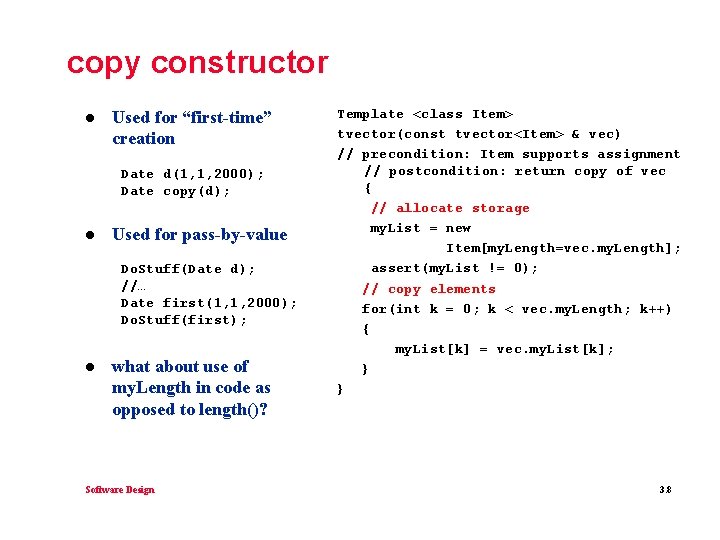
copy constructor l Used for “first-time” creation Date d(1, 1, 2000); Date copy(d); l Used for pass-by-value Do. Stuff(Date d); //… Date first(1, 1, 2000); Do. Stuff(first); l what about use of my. Length in code as opposed to length()? Software Design Template <class Item> tvector(const tvector<Item> & vec) // precondition: Item supports assignment // postcondition: return copy of vec { // allocate storage my. List = new Item[my. Length=vec. my. Length]; assert(my. List != 0); // copy elements for(int k = 0; k < vec. my. Length; k++) { my. List[k] = vec. my. List[k]; } } 3. 8
- Slides: 8