
Patterns and trends in child physical activity A
- Slides: 18
Patterns and trends in child physical activity A presentation of the latest data on child physical activity Updated February 2018
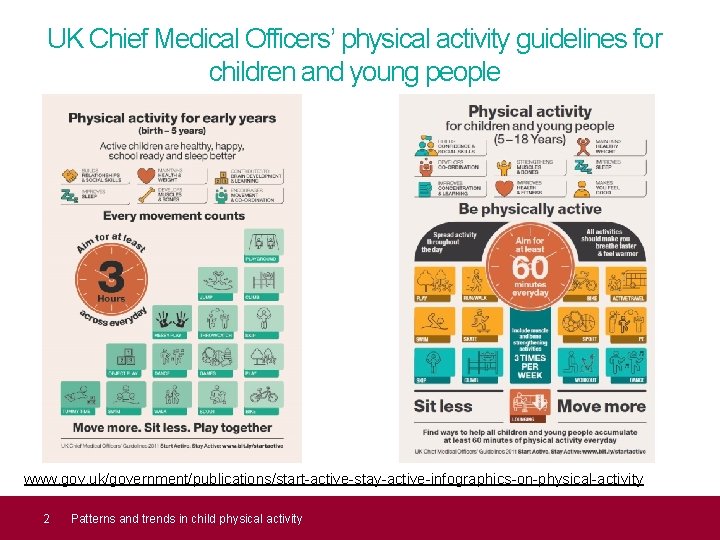
UK Chief Medical Officers’ physical activity guidelines for children and young people www. gov. uk/government/publications/start-active-stay-active-infographics-on-physical-activity 2 Patterns and trends in child physical activity
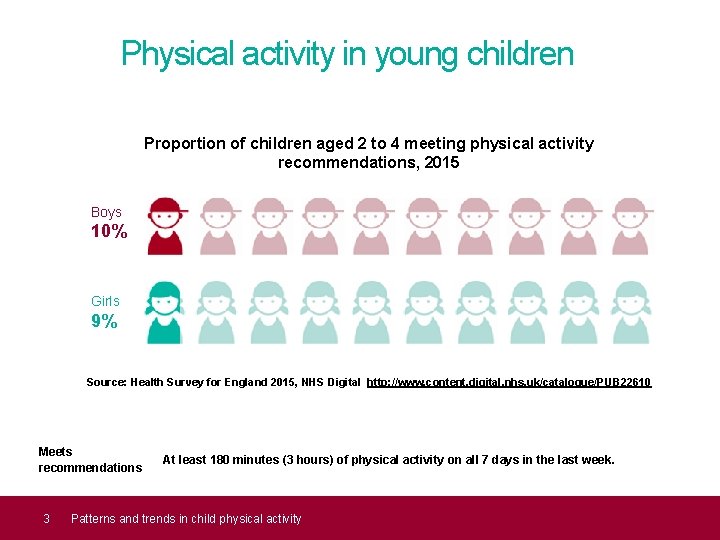
Physical activity in young children Proportion of children aged 2 to 4 meeting physical activity recommendations, 2015 Boys 10% Girls 9% Source: Health Survey for England 2015, NHS Digital http: //www. content. digital. nhs. uk/catalogue/PUB 22610 Meets recommendations 3 At least 180 minutes (3 hours) of physical activity on all 7 days in the last week. Patterns and trends in child physical activity
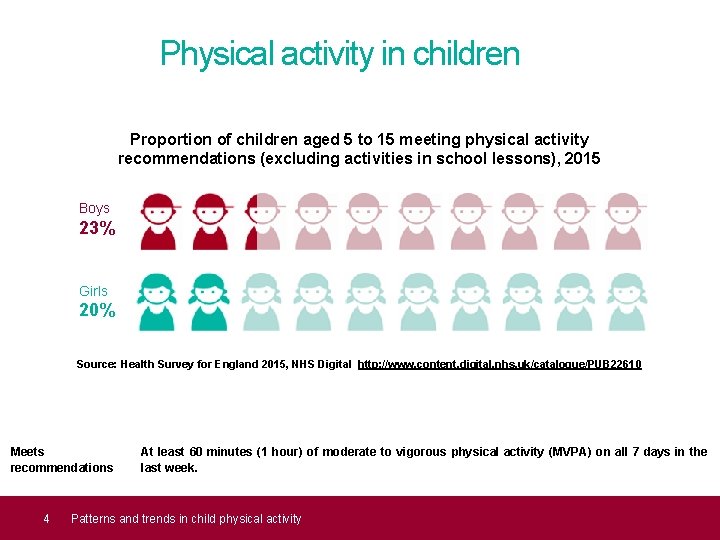
Physical activity in children Proportion of children aged 5 to 15 meeting physical activity recommendations (excluding activities in school lessons), 2015 Boys 23% Girls 20% Source: Health Survey for England 2015, NHS Digital http: //www. content. digital. nhs. uk/catalogue/PUB 22610 Meets recommendations 4 At least 60 minutes (1 hour) of moderate to vigorous physical activity (MVPA) on all 7 days in the last week. Patterns and trends in child physical activity
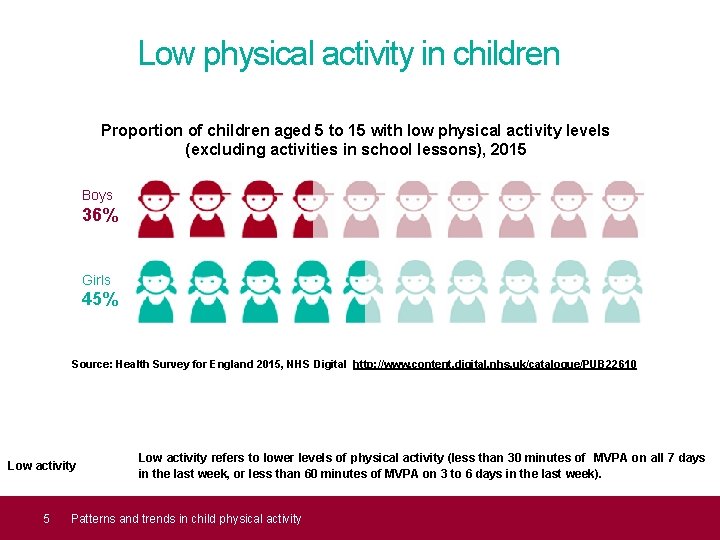
Low physical activity in children Proportion of children aged 5 to 15 with low physical activity levels (excluding activities in school lessons), 2015 Boys 36% Girls 45% Source: Health Survey for England 2015, NHS Digital http: //www. content. digital. nhs. uk/catalogue/PUB 22610 Low activity 5 Low activity refers to lower levels of physical activity (less than 30 minutes of MVPA on all 7 days in the last week, or less than 60 minutes of MVPA on 3 to 6 days in the last week). Patterns and trends in child physical activity
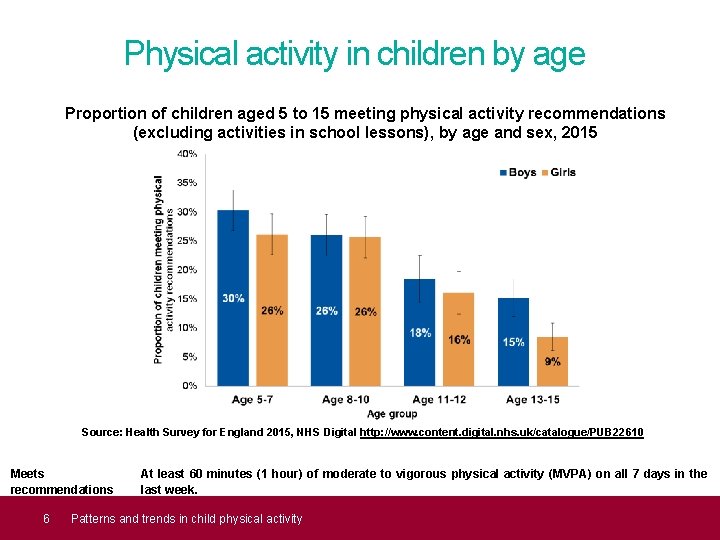
Physical activity in children by age Proportion of children aged 5 to 15 meeting physical activity recommendations (excluding activities in school lessons), by age and sex, 2015 Source: Health Survey for England 2015, NHS Digital http: //www. content. digital. nhs. uk/catalogue/PUB 22610 Meets recommendations 6 At least 60 minutes (1 hour) of moderate to vigorous physical activity (MVPA) on all 7 days in the last week. Patterns and trends in child physical activity
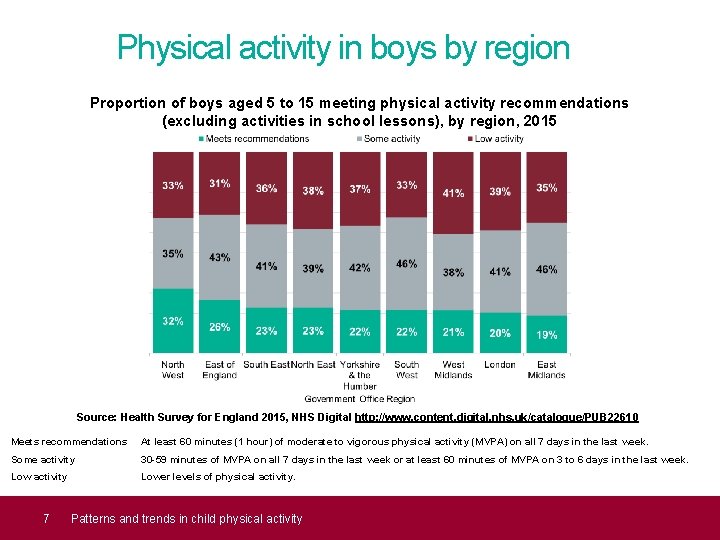
Physical activity in boys by region Proportion of boys aged 5 to 15 meeting physical activity recommendations (excluding activities in school lessons), by region, 2015 Source: Health Survey for England 2015, NHS Digital http: //www. content. digital. nhs. uk/catalogue/PUB 22610 Meets recommendations At least 60 minutes (1 hour) of moderate to vigorous physical activity (MVPA) on all 7 days in the last week. Some activity 30 -59 minutes of MVPA on all 7 days in the last week or at least 60 minutes of MVPA on 3 to 6 days in the last week. Low activity Lower levels of physical activity. 7 Patterns and trends in child physical activity
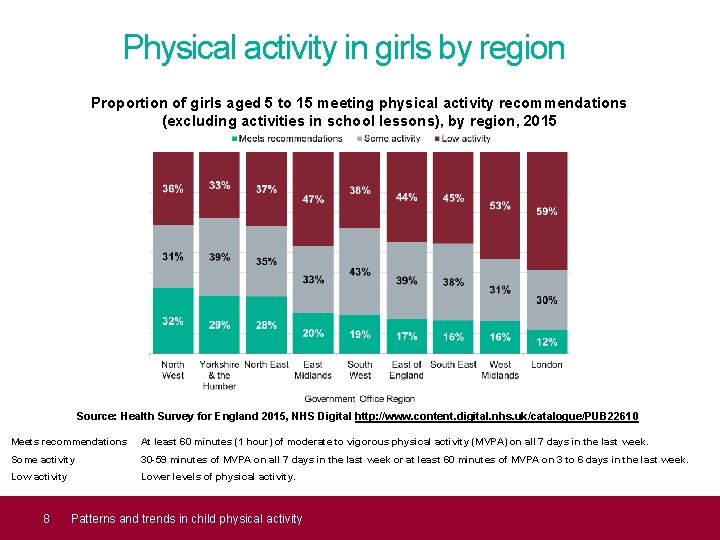
Physical activity in girls by region Proportion of girls aged 5 to 15 meeting physical activity recommendations (excluding activities in school lessons), by region, 2015 Source: Health Survey for England 2015, NHS Digital http: //www. content. digital. nhs. uk/catalogue/PUB 22610 Meets recommendations At least 60 minutes (1 hour) of moderate to vigorous physical activity (MVPA) on all 7 days in the last week. Some activity 30 -59 minutes of MVPA on all 7 days in the last week or at least 60 minutes of MVPA on 3 to 6 days in the last week. Low activity Lower levels of physical activity. 8 Patterns and trends in child physical activity
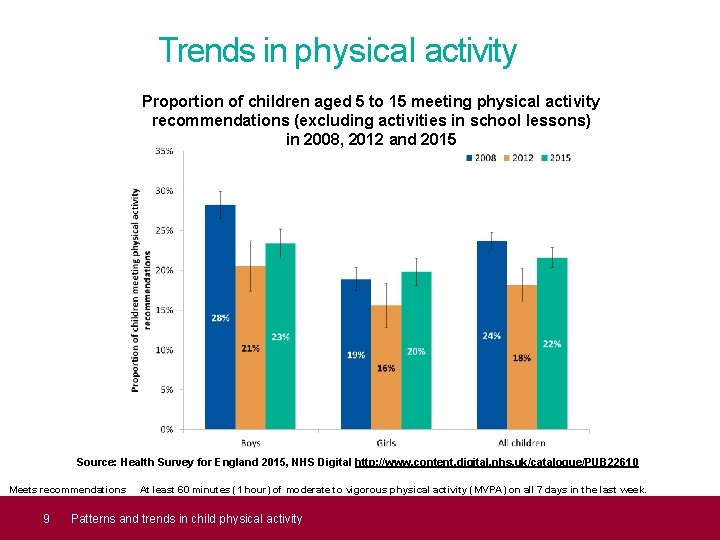
Trends in physical activity Proportion of children aged 5 to 15 meeting physical activity recommendations (excluding activities in school lessons) in 2008, 2012 and 2015 Source: Health Survey for England 2015, NHS Digital http: //www. content. digital. nhs. uk/catalogue/PUB 22610 Meets recommendations 9 At least 60 minutes (1 hour) of moderate to vigorous physical activity (MVPA) on all 7 days in the last week. Patterns and trends in child physical activity
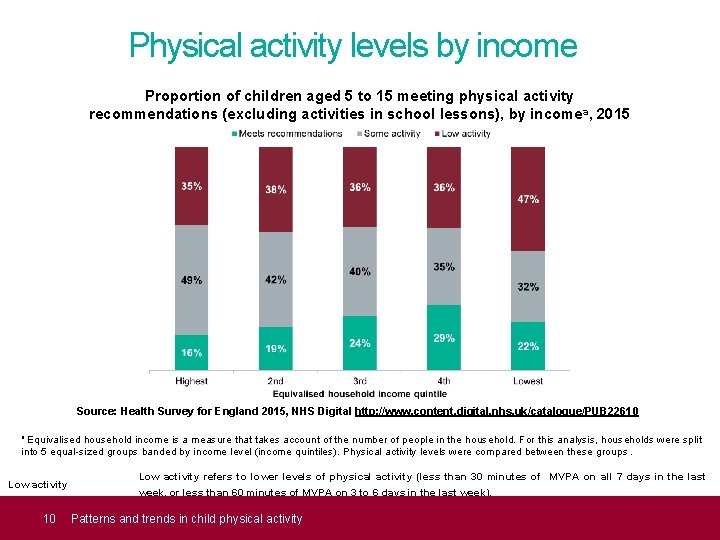
Physical activity levels by income Proportion of children aged 5 to 15 meeting physical activity recommendations (excluding activities in school lessons), by income a, 2015 95% CI: 39%-48% 95% CI: 26%-37% Source: Health Survey for England 2015, NHS Digital http: //www. content. digital. nhs. uk/catalogue/PUB 22610 a Equivalised household income is a measure that takes account of the number of people in the household. For this analysis, households were split into 5 equal-sized groups banded by income level (income quintiles). Physical activity levels were compared between these groups. Low activity 10 Low activity refers to lower levels of physical activity (less than 30 minutes of MVPA on all 7 days in the last week, or less than 60 minutes of MVPA on 3 to 6 days in the last week). Patterns and trends in child physical activity
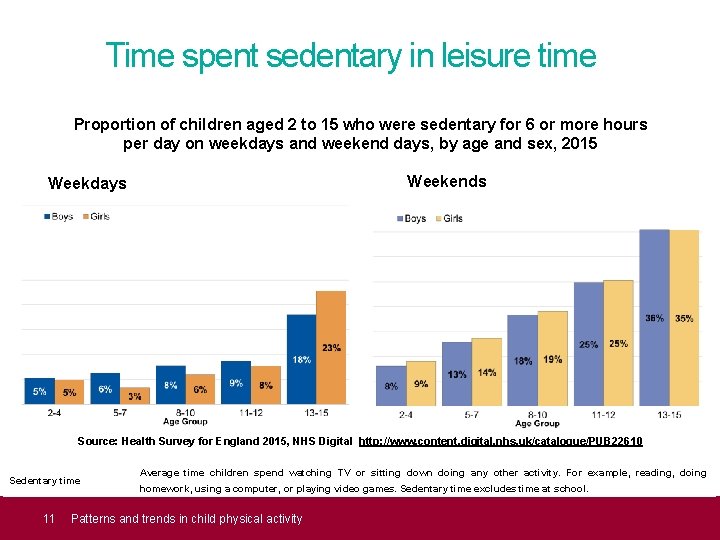
Time spent sedentary in leisure time Proportion of children aged 2 to 15 who were sedentary for 6 or more hours per day on weekdays and weekend days, by age and sex, 2015 Weekends Weekdays Source: Health Survey for England 2015, NHS Digital http: //www. content. digital. nhs. uk/catalogue/PUB 22610 Sedentary time 11 Average time children spend watching TV or sitting down doing any other activity. For example, reading, doing homework, using a computer, or playing video games. Sedentary time excludes time at school. Patterns and trends in child physical activity
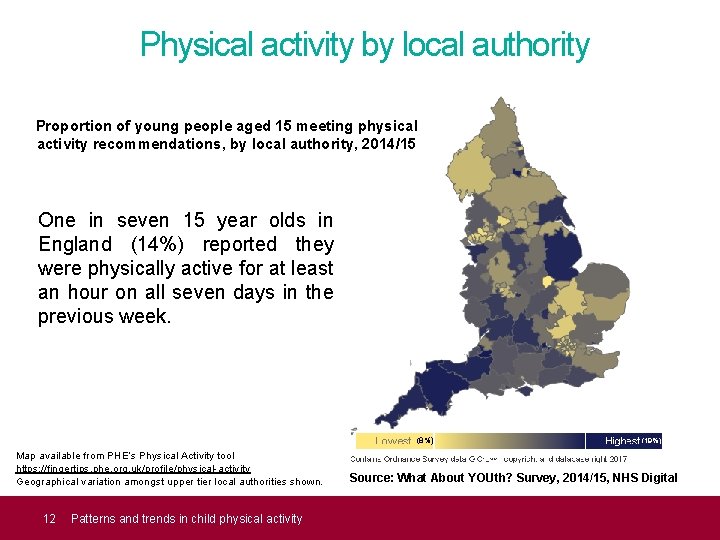
Physical activity by local authority Proportion of young people aged 15 meeting physical activity recommendations, by local authority, 2014/15 One in seven 15 year olds in England (14%) reported they were physically active for at least an hour on all seven days in the previous week. (8%) Map available from PHE’s Physical Activity tool https: //fingertips. phe. org. uk/profile/physical-activity Geographical variation amongst upper tier local authorities shown. 12 Patterns and trends in child physical activity (19%) Source: What About YOUth? Survey, 2014/15, NHS Digital
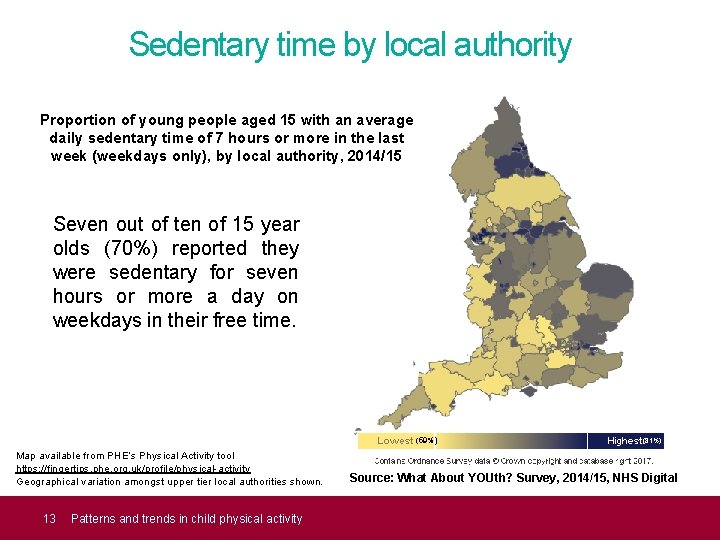
Sedentary time by local authority Proportion of young people aged 15 with an average daily sedentary time of 7 hours or more in the last week (weekdays only), by local authority, 2014/15 Seven out of ten of 15 year olds (70%) reported they were sedentary for seven hours or more a day on weekdays in their free time. (59%) Map available from PHE’s Physical Activity tool https: //fingertips. phe. org. uk/profile/physical-activity Geographical variation amongst upper tier local authorities shown. 13 Patterns and trends in child physical activity (81%) Source: What About YOUth? Survey, 2014/15, NHS Digital
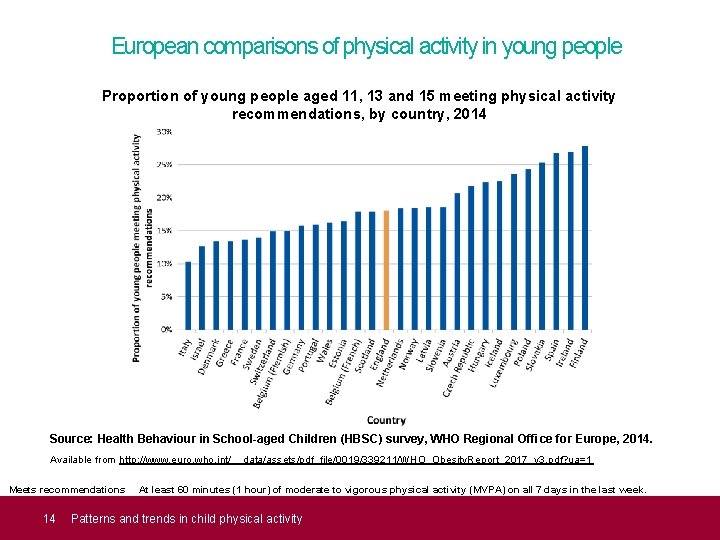
European comparisons of physical activity in young people Proportion of young people aged 11, 13 and 15 meeting physical activity recommendations, by country, 2014 Source: Health Behaviour in School-aged Children (HBSC) survey, WHO Regional Office for Europe, 2014. Available from http: //www. euro. who. int/__data/assets/pdf_file/0019/339211/WHO_Obesity. Report_2017_v 3. pdf? ua=1 Meets recommendations 14 At least 60 minutes (1 hour) of moderate to vigorous physical activity (MVPA) on all 7 days in the last week. Patterns and trends in child physical activity
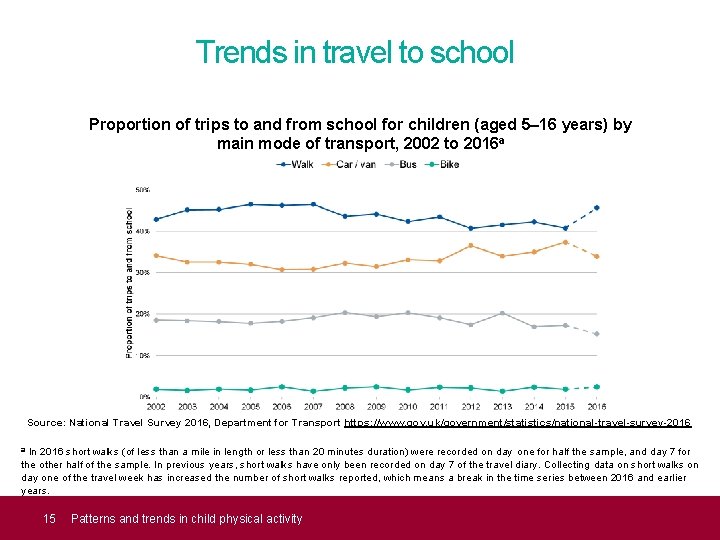
Trends in travel to school Proportion of trips to and from school for children (aged 5– 16 years) by main mode of transport, 2002 to 2016 a Source: National Travel Survey 2016, Department for Transport https: //www. gov. uk/government/statistics/national-travel-survey-2016 ª In 2016 short walks (of less than a mile in length or less than 20 minutes duration) were recorded on day one for half the sample, and day 7 for the other half of the sample. In previous years, short walks have only been recorded on day 7 of the travel diary. Collecting data on short walks on day one of the travel week has increased the number of short walks reported, which means a break in the time series between 2016 and earlier years. 15 Patterns and trends in child physical activity
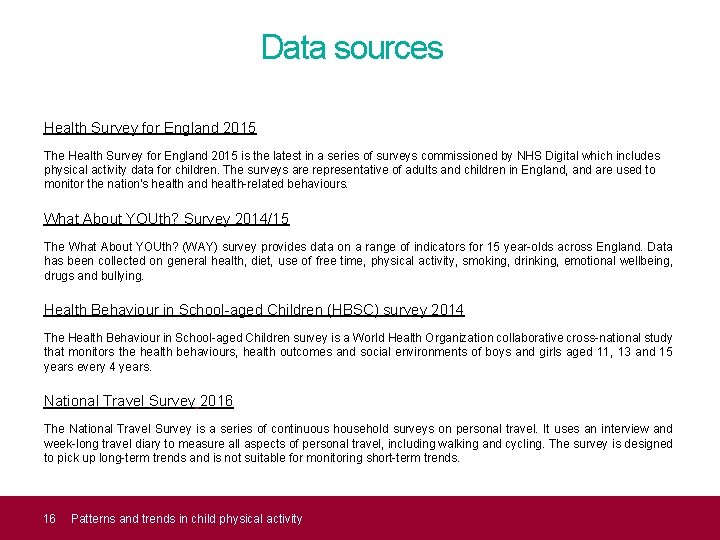
Data sources Health Survey for England 2015 The Health Survey for England 2015 is the latest in a series of surveys commissioned by NHS Digital which includes physical activity data for children. The surveys are representative of adults and children in England, and are used to monitor the nation's health and health-related behaviours. What About YOUth? Survey 2014/15 The What About YOUth? (WAY) survey provides data on a range of indicators for 15 year-olds across England. Data has been collected on general health, diet, use of free time, physical activity, smoking, drinking, emotional wellbeing, drugs and bullying. Health Behaviour in School-aged Children (HBSC) survey 2014 The Health Behaviour in School-aged Children survey is a World Health Organization collaborative cross-national study that monitors the health behaviours, health outcomes and social environments of boys and girls aged 11, 13 and 15 years every 4 years. National Travel Survey 2016 The National Travel Survey is a series of continuous household surveys on personal travel. It uses an interview and week-long travel diary to measure all aspects of personal travel, including walking and cycling. The survey is designed to pick up long-term trends and is not suitable for monitoring short-term trends. 16 Patterns and trends in child physical activity
Other PHE physical activity resources • Physical activity tool • Everybody active, every day: an evidence-based approach to physical activity • What works in schools and colleges to increase physical activity • Obesity and the environment: increasing physical activity and active travel • Active travel briefings for local authorities • Standard evaluation framework for physical activity interventions • Guide to physical activity data sources • Guide to online tools for valuing physical activity, sport and obesity programmes • E-learning modules on physical activity and health • Change 4 Life campaign resources • Start active, stay active: infographics on physical activity 17 Patterns and trends in child physical activity
About Public Health England exists to protect and improve the nation’s health and wellbeing, and reduce health inequalities. We do this through world-leading science, knowledge and intelligence, advocacy, partnerships and the delivery of specialist public health services. We are an executive agency of the Department of Health and Social Care, and are a distinct delivery organisation with operational autonomy to advise and support government, local authorities and the NHS in a professionally independent manner. Public Health England Wellington House 133 -155 Waterloo Road London SE 1 8 UG Tel: 020 7654 8000 www. gov. uk/phe Twitter: @PHE_uk @PHE_Obesity Facebook: www. facebook. com/Public. Health. England © Crown copyright 2018 You may re-use this information (excluding logos) free of charge in any format or medium, under the terms of the Open Government Licence v 3. 0. To view this licence, visit https: //www. nationalarchives. gov. uk/doc/open-governmentlicence/version/3/ or email psi@nationalarchives. gsi. gov. uk. Where we have identified any third party copyright information you will need to obtain permission from the copyright holders concerned. Published: February 2018 PHE publications gateway number: 2017742 18 Patterns and trends in child physical activity