
Patterns and principles of RNA structure can be

Patterns and principles of RNA structure can be specific, stable and complex. (As a result, RNA mediates specific recognition and catalytic reactions. ) Principles/ideas--RNAs contain characteristic 2° and 3° motifs Secondary structure--stems, bulges & loops Coaxial stacking Metal ion binding Tertiary motifs (Pseudoknots, A-A platform, tetraloop/tetraloop receptor, A-minor motif, ribose zipper)
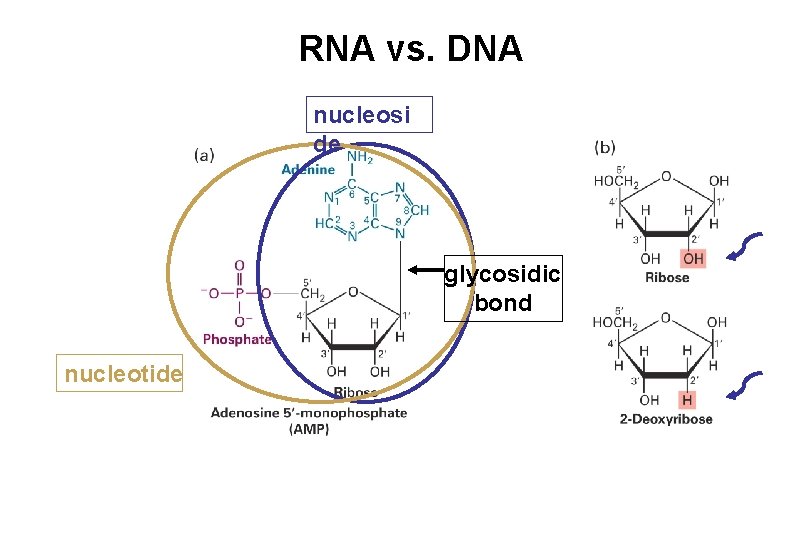
RNA vs. DNA nucleosi de glycosidic bond nucleotide
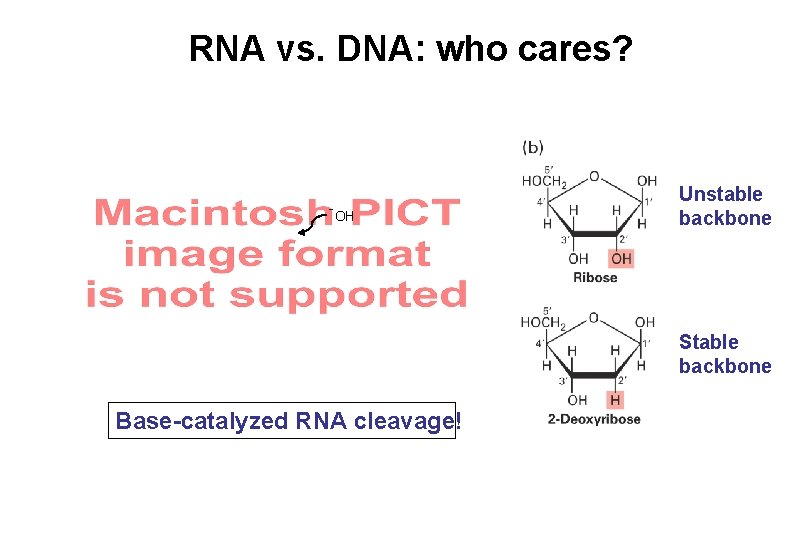
RNA vs. DNA: who cares? -OH Unstable backbone Stable backbone Base-catalyzed RNA cleavage!
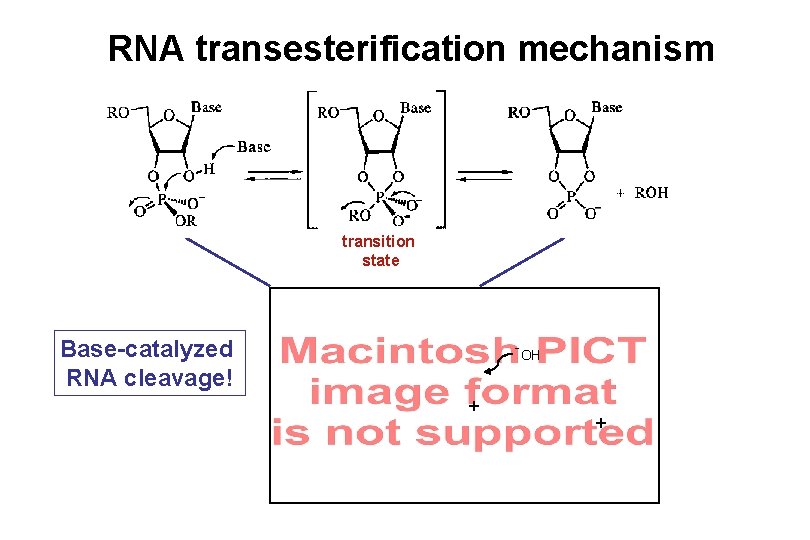
RNA transesterification mechanism transition state Base-catalyzed RNA cleavage! -OH + +
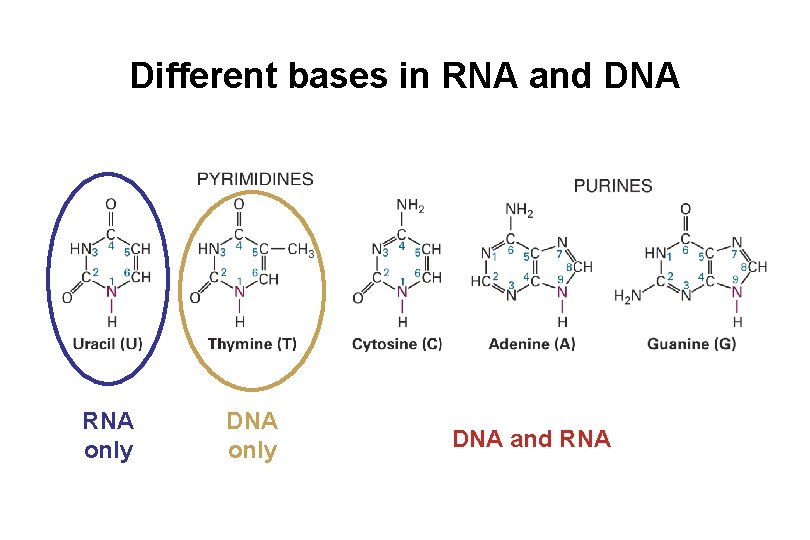
Different bases in RNA and DNA RNA only DNA and RNA

RNA chain is made single stranded! Chemical schematic One-letter code ds. RNA can block protein synthesis and signal viral infections Chain is directional. Convention: 5’ ss. DNA can signal DNA damage and promote cell death 3’.

Six backbone dihedral angles ( ) per nucleotide in RNA and DNA Is ss. DNA floppy or rigid? Is RNA more or less flexible than ss. DNA?
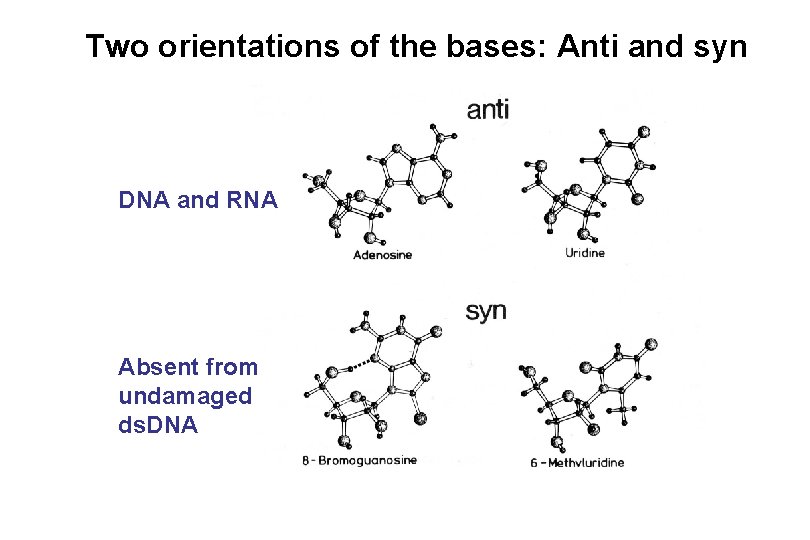
Two orientations of the bases: Anti and syn DNA and RNA Absent from undamaged ds. DNA
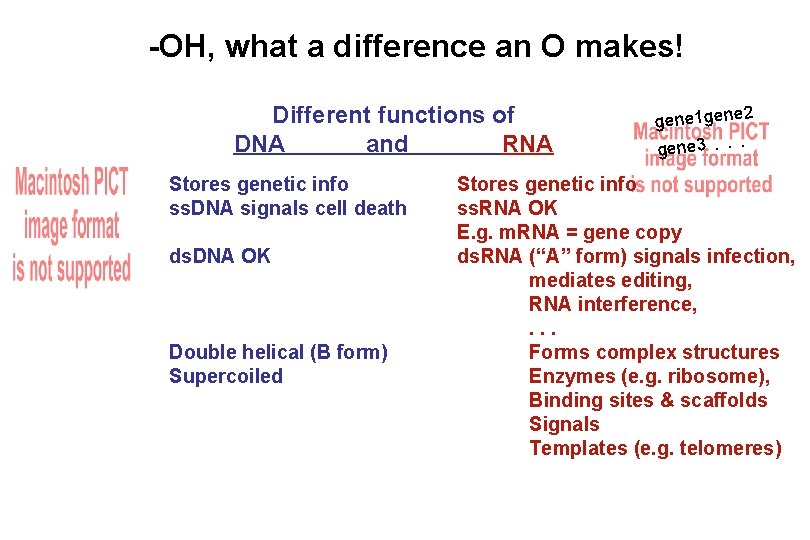
-OH, what a difference an O makes! Different functions of DNA and RNA Stores genetic info ss. DNA signals cell death ds. DNA OK Double helical (B form) Supercoiled 2 gene 1 gene 3. . . Stores genetic info ss. RNA OK E. g. m. RNA = gene copy ds. RNA (“A” form) signals infection, mediates editing, RNA interference, . . . Forms complex structures Enzymes (e. g. ribosome), Binding sites & scaffolds Signals Templates (e. g. telomeres)

Examples of RNA structural motifs Secondary structures Stem, bulge, loop 4 -helix junction Tetraloop Pseudoknot Sheared AA pairs Purine stacks Metal binding sites A-A platform Tetraloop receptor A-minor motif Ribose zipper. . . Tertiary structures

Cloverleaf representation of yeast Phe t. RNA “Cloverleaf” conserved in all t. RNAs Coaxial stacking of adjacent stems forms an L-shaped fold
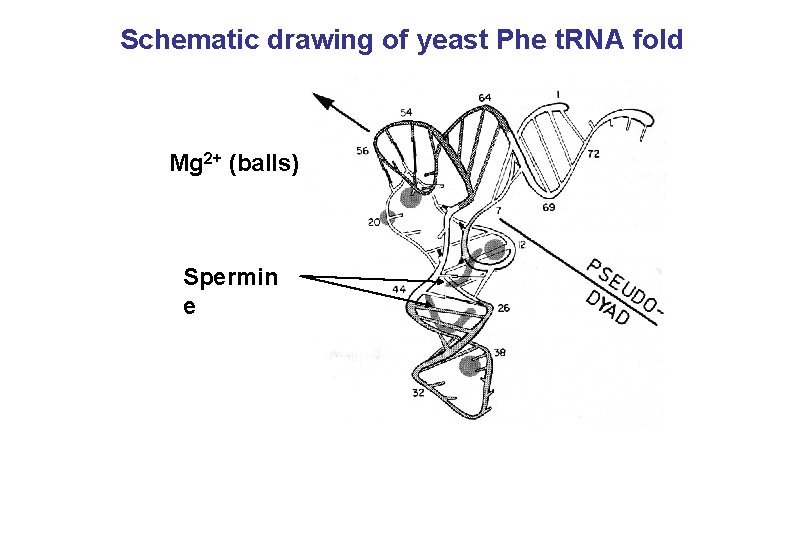
Schematic drawing of yeast Phe t. RNA fold Mg 2+ (balls) Spermin e
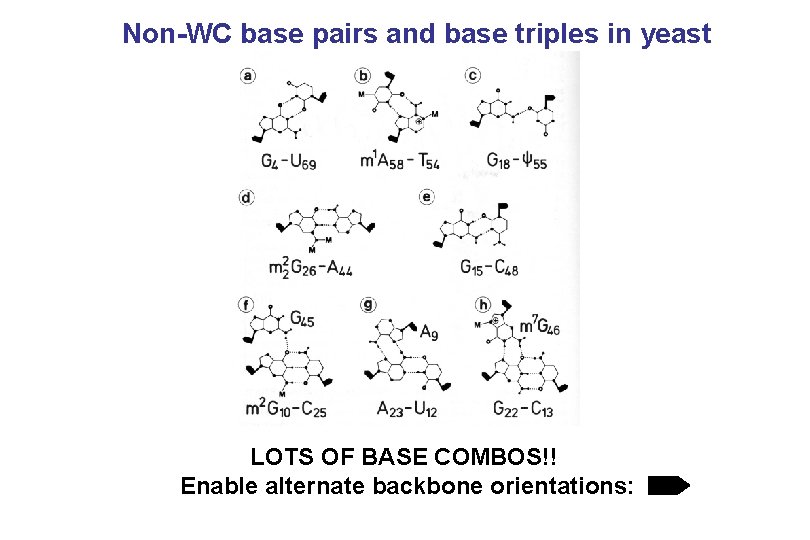
Non-WC base pairs and base triples in yeast t. RNA Phe LOTS OF BASE COMBOS!! Enable alternate backbone orientations:
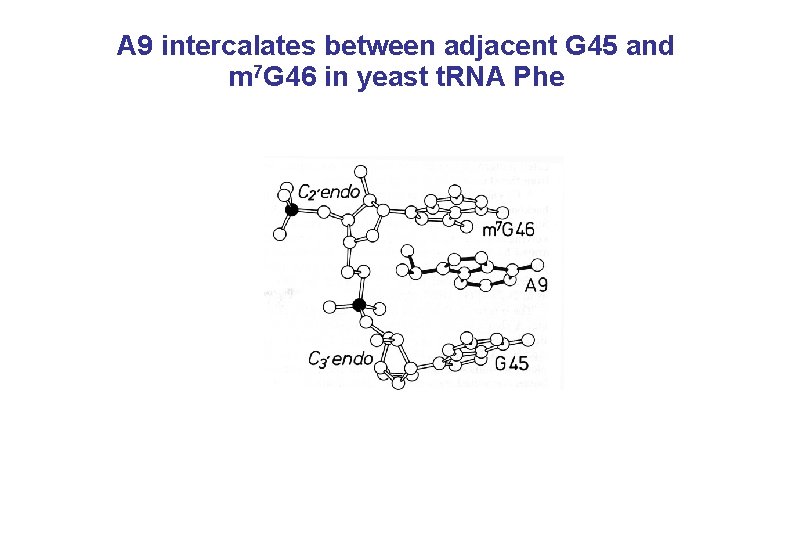
A 9 intercalates between adjacent G 45 and m 7 G 46 in yeast t. RNA Phe

Examples of RNA structural motifs Tetraloop Pseudoknot 4 -helix junction Sheared AA pairs Purine stacks Metal binding sites A-A platform Tetraloop receptor A-minor motif. . .
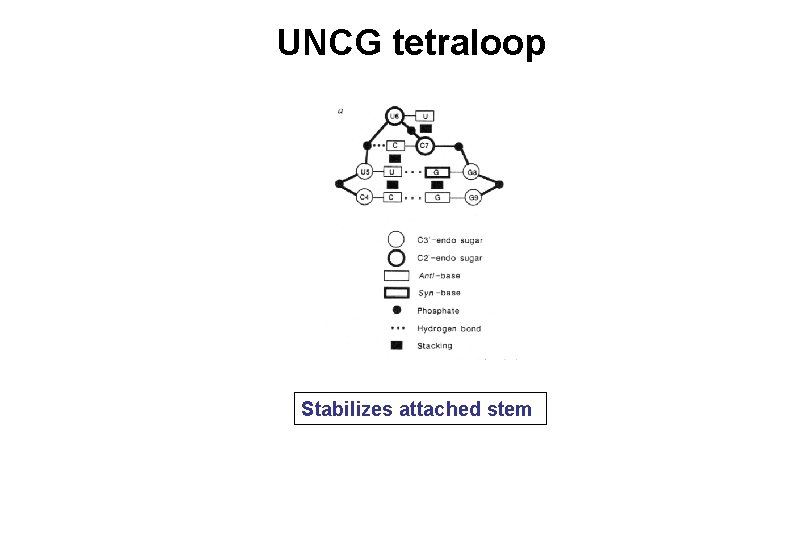
UNCG tetraloop Stabilizes attached stem
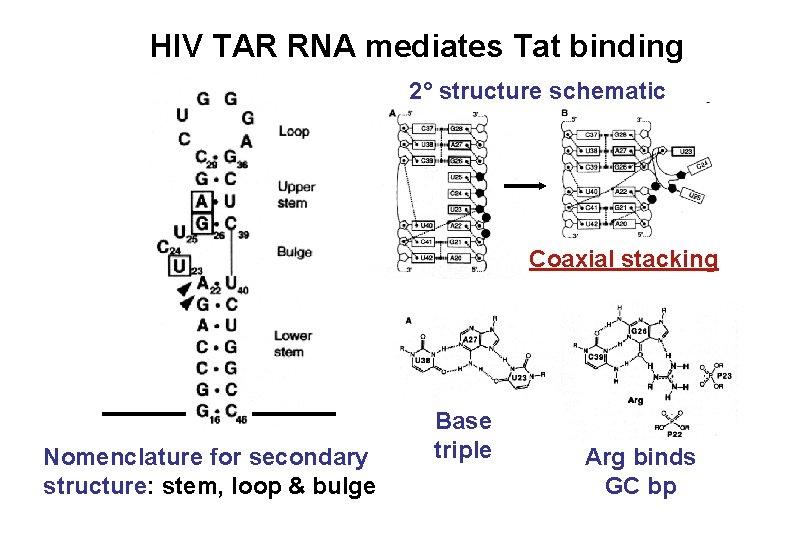
HIV TAR RNA mediates Tat binding 2° structure schematic Coaxial stacking Nomenclature for secondary structure: stem, loop & bulge Base triple Arg binds GC bp
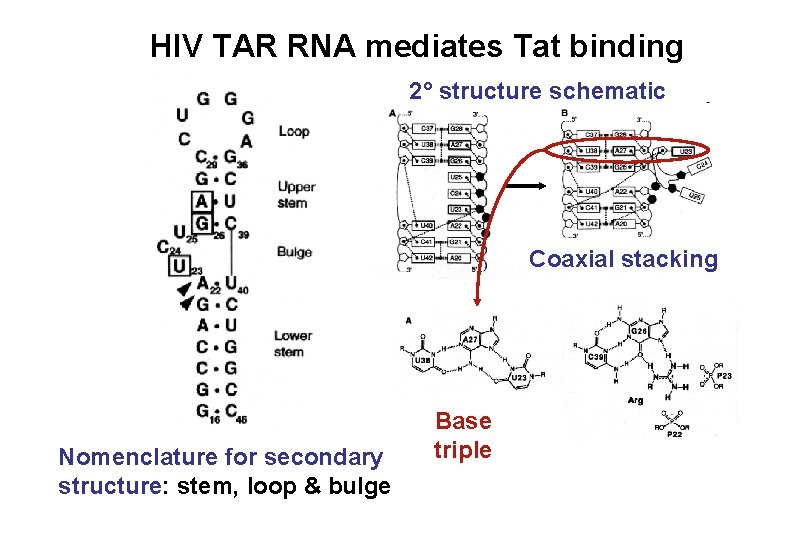
HIV TAR RNA mediates Tat binding 2° structure schematic Coaxial stacking Nomenclature for secondary structure: stem, loop & bulge Base triple
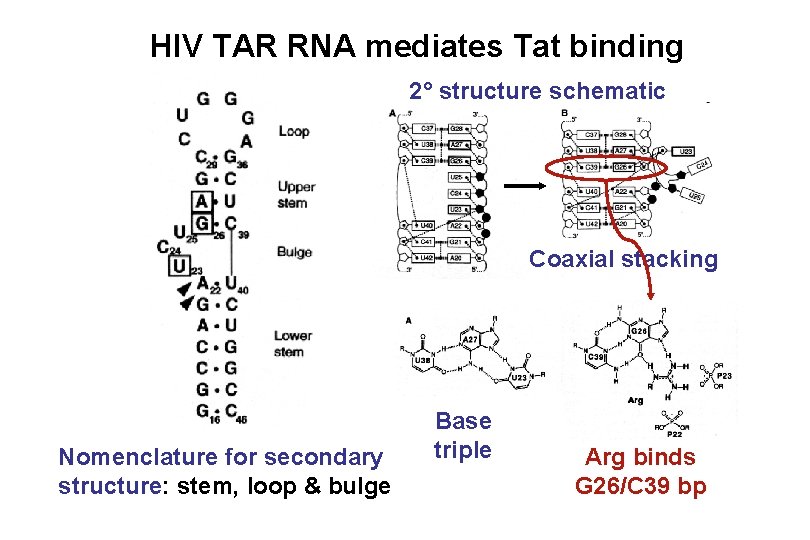
HIV TAR RNA mediates Tat binding 2° structure schematic Coaxial stacking Nomenclature for secondary structure: stem, loop & bulge Base triple Arg binds G 26/C 39 bp
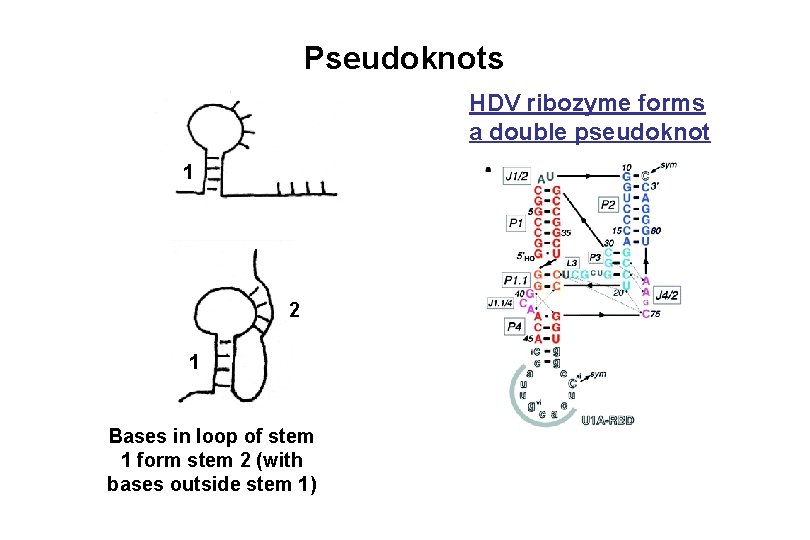
Pseudoknots HDV ribozyme forms a double pseudoknot 1 2 1 Bases in loop of stem 1 form stem 2 (with bases outside stem 1)
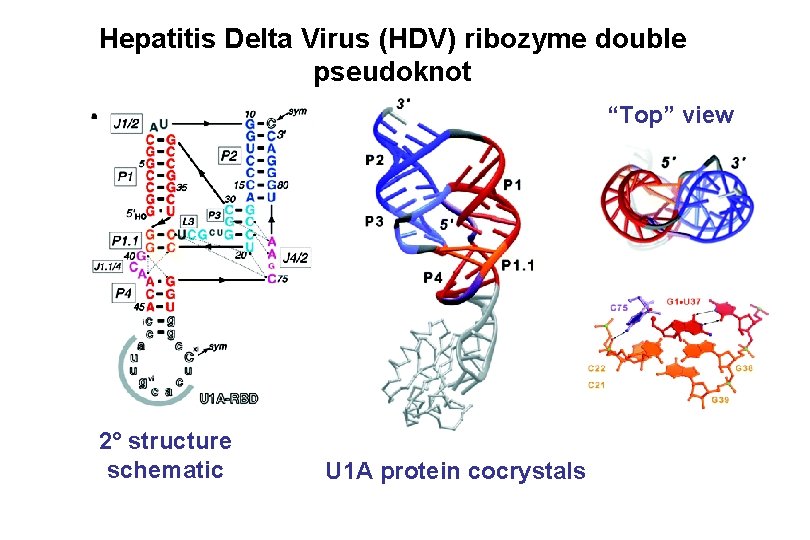
Hepatitis Delta Virus (HDV) ribozyme double pseudoknot “Top” view 2° structure schematic U 1 A protein cocrystals
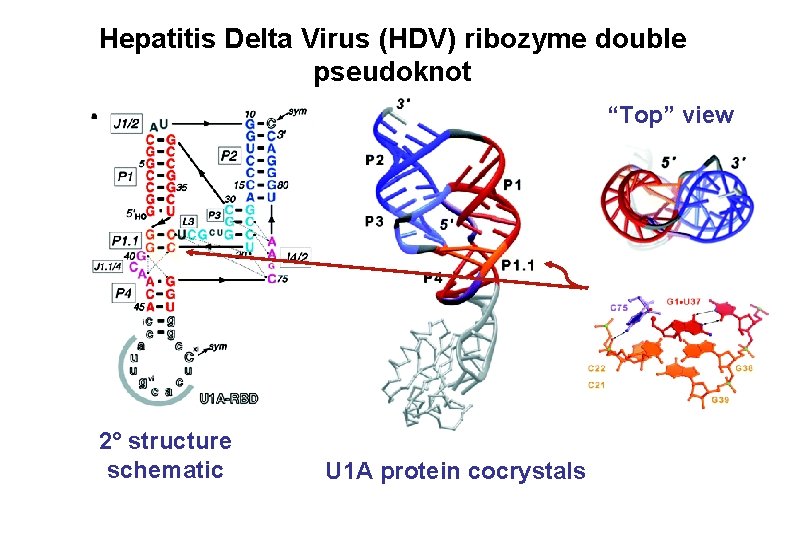
Hepatitis Delta Virus (HDV) ribozyme double pseudoknot “Top” view 2° structure schematic U 1 A protein cocrystals
Four-helix junction: L 11 protein binding site in 23 S RNA
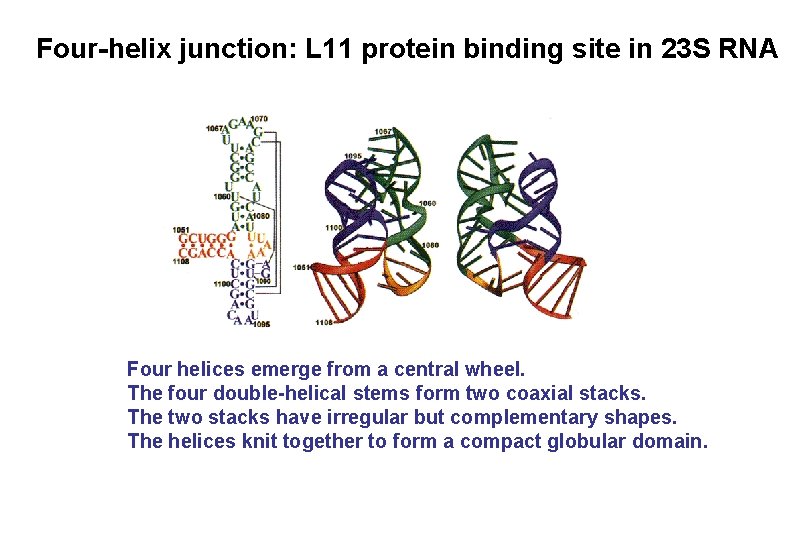
Four-helix junction: L 11 protein binding site in 23 S RNA Four helices emerge from a central wheel. The four double-helical stems form two coaxial stacks. The two stacks have irregular but complementary shapes. The helices knit together to form a compact globular domain.
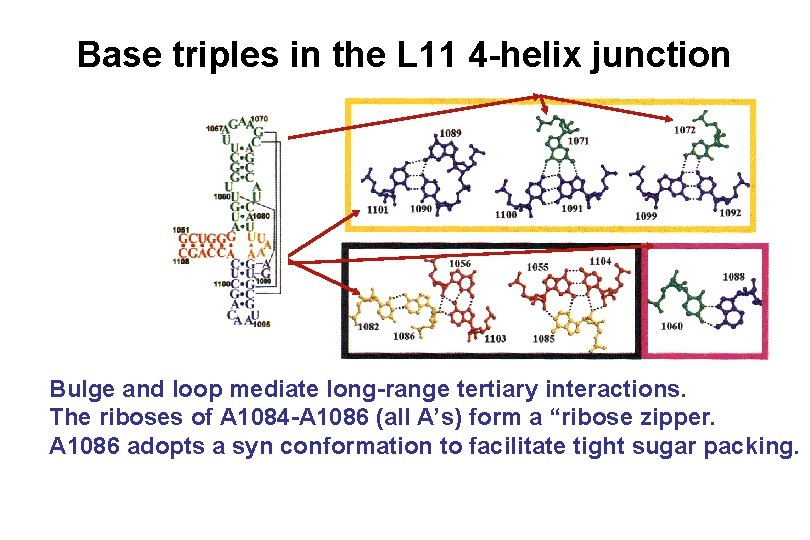
Base triples in the L 11 4 -helix junction Bulge and loop mediate long-range tertiary interactions. The riboses of A 1084 -A 1086 (all A’s) form a “ribose zipper. A 1086 adopts a syn conformation to facilitate tight sugar packing.
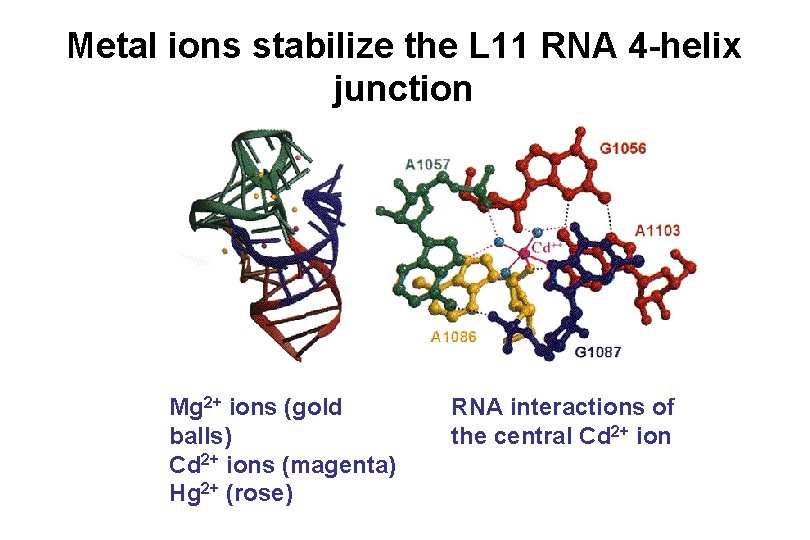
Metal ions stabilize the L 11 RNA 4 -helix junction Mg 2+ ions (gold balls) Cd 2+ ions (magenta) Hg 2+ (rose) RNA interactions of the central Cd 2+ ion

P 4 -P 6 Domain of the Group I ribozyme
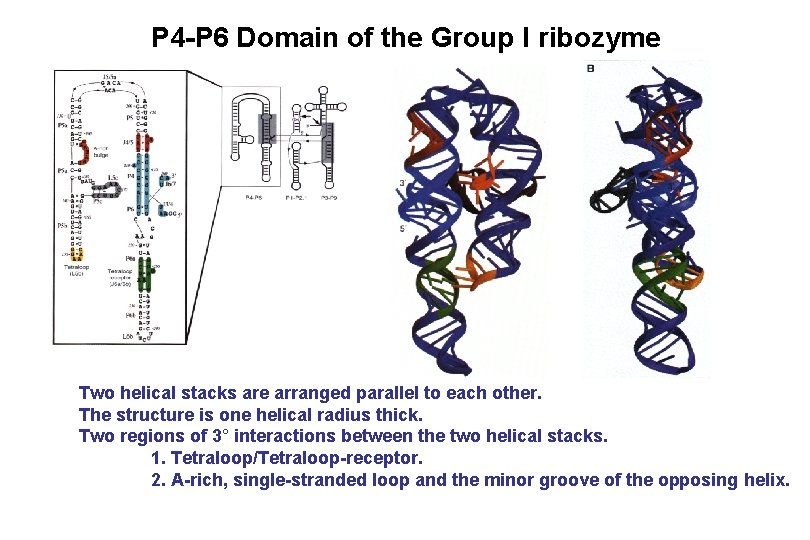
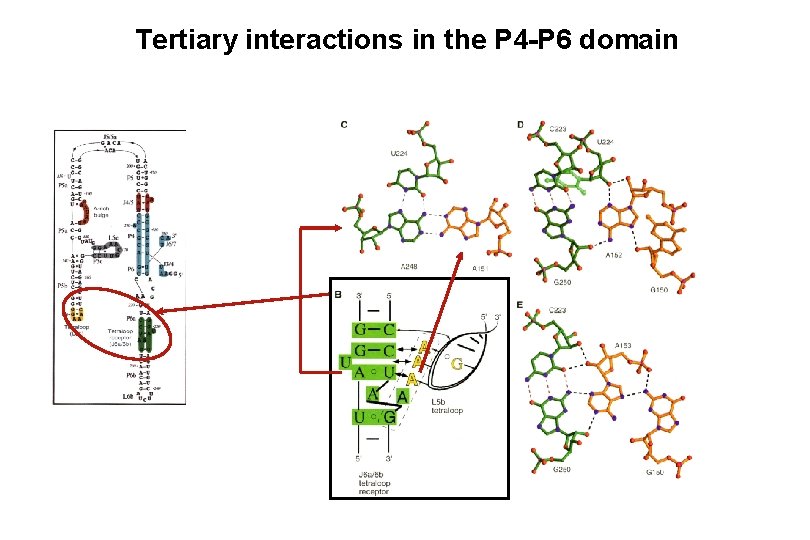
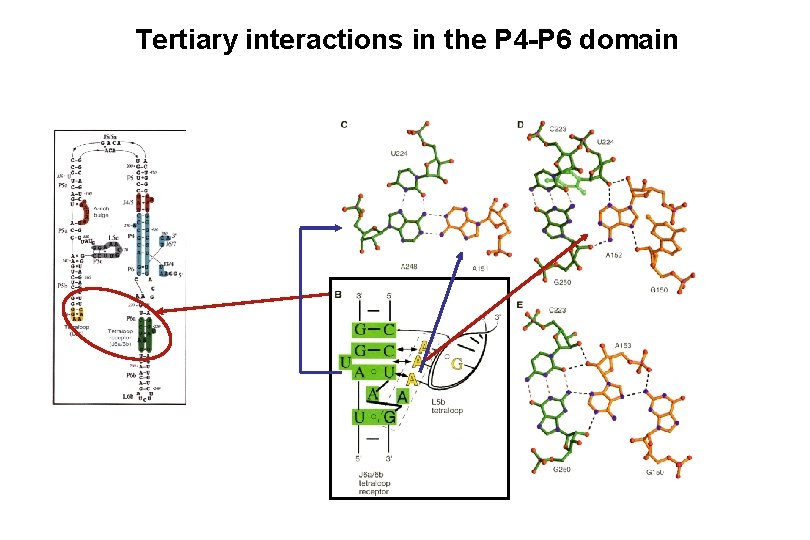
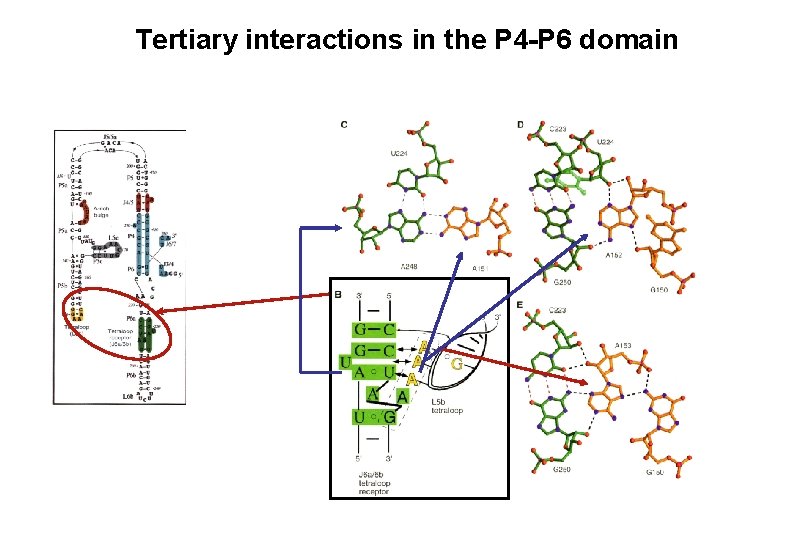
P 4 -P 6 Domain of the Group I ribozyme Two helical stacks are arranged parallel to each other. The structure is one helical radius thick. Two regions of 3° interactions between the two helical stacks. 1. Tetraloop/Tetraloop-receptor. 2. A-rich, single-stranded loop and the minor groove of the opposing helix.
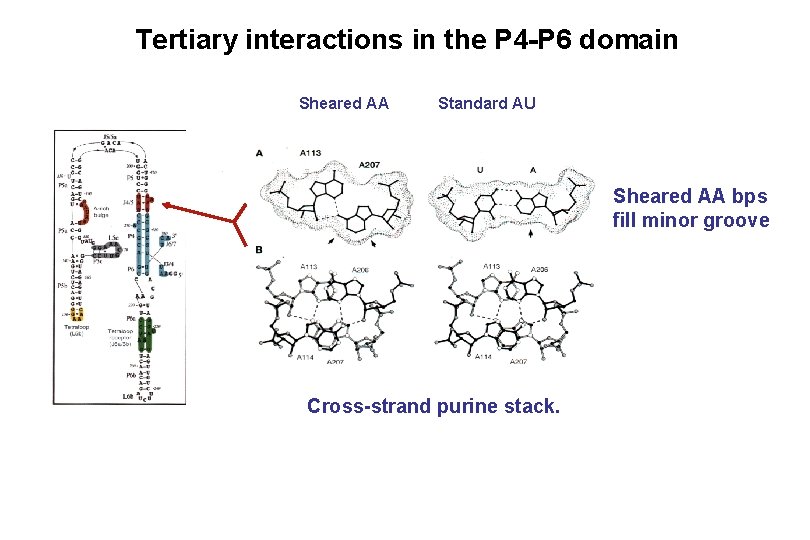
Tertiary interactions in the P 4 -P 6 domain Sheared AA Standard AU Sheared AA bps fill minor groove Cross-strand purine stack.
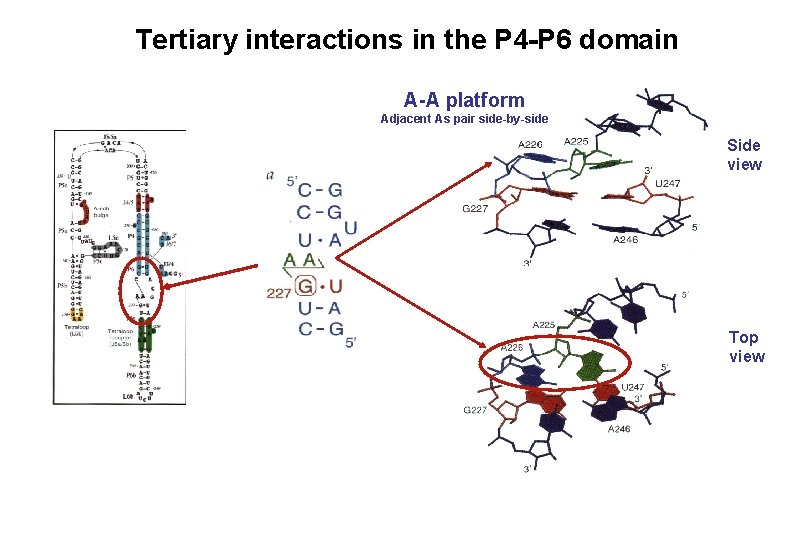
Tertiary interactions in the P 4 -P 6 domain A-A platform Adjacent As pair side-by-side Side view Top view

Tertiary interactions in the P 4 -P 6 domain A-A platform Adjacent As pair side-by-side Side view Top view
Tertiary interactions in the P 4 -P 6 domain
Tertiary interactions in the P 4 -P 6 domain
Tertiary interactions in the P 4 -P 6 domain
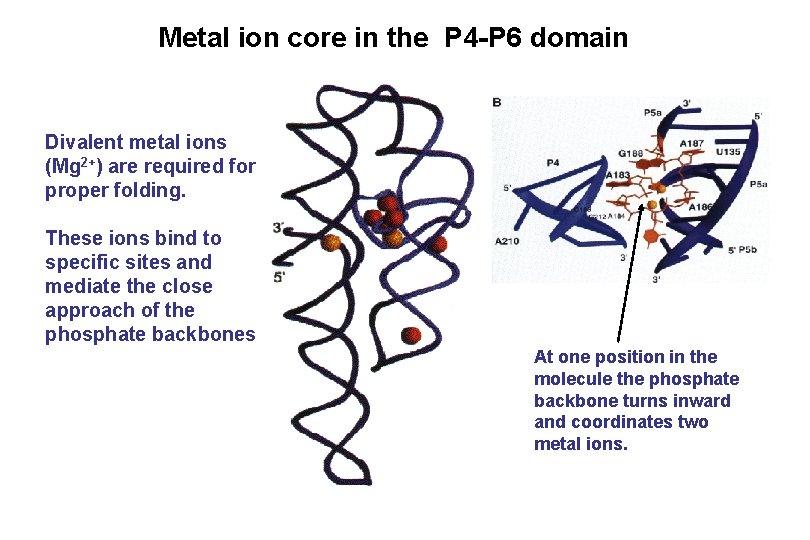
Metal ion core in the P 4 -P 6 domain Divalent metal ions (Mg 2+) are required for proper folding. These ions bind to specific sites and mediate the close approach of the phosphate backbones At one position in the molecule the phosphate backbone turns inward and coordinates two metal ions.
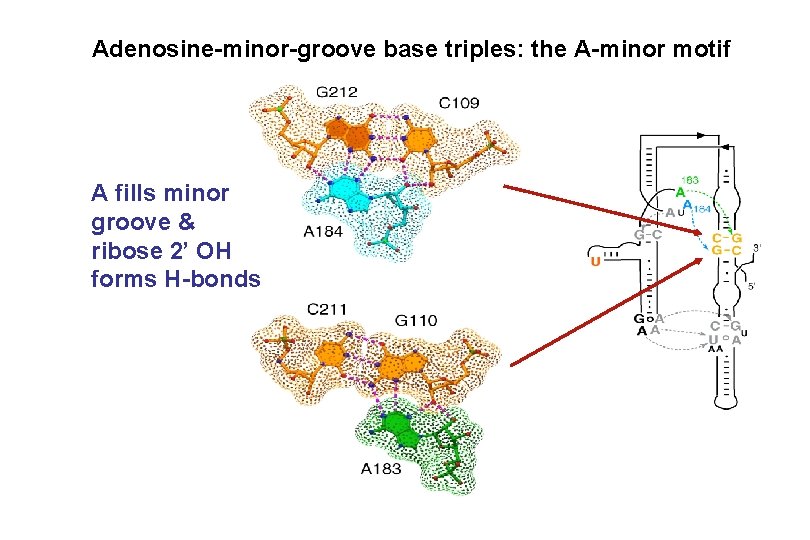
Adenosine-minor-groove base triples: the A-minor motif A fills minor groove & ribose 2’ OH forms H-bonds
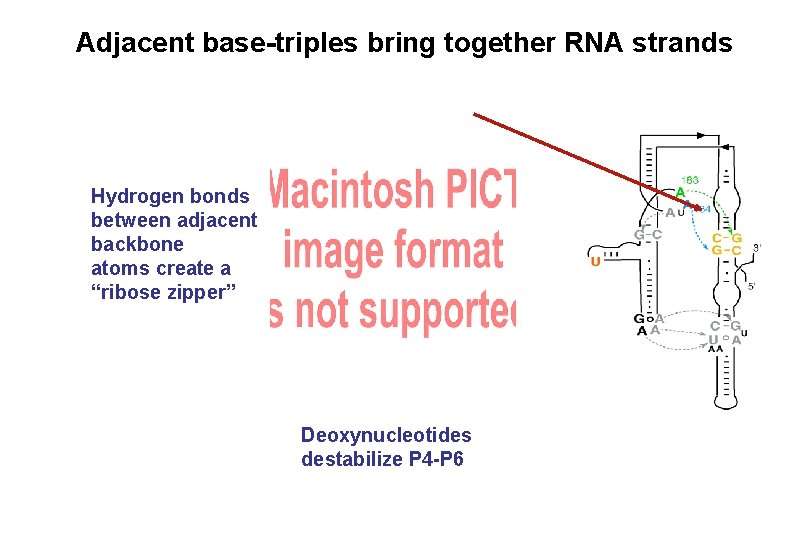
Adjacent base-triples bring together RNA strands Hydrogen bonds between adjacent backbone atoms create a “ribose zipper” Deoxynucleotides destabilize P 4 -P 6
The A-minor motif is widespread Conserved As are abundant in unpaired regions of structured RNAs. Group I intron P 4 -P 6 % of As in “single-stranded regions
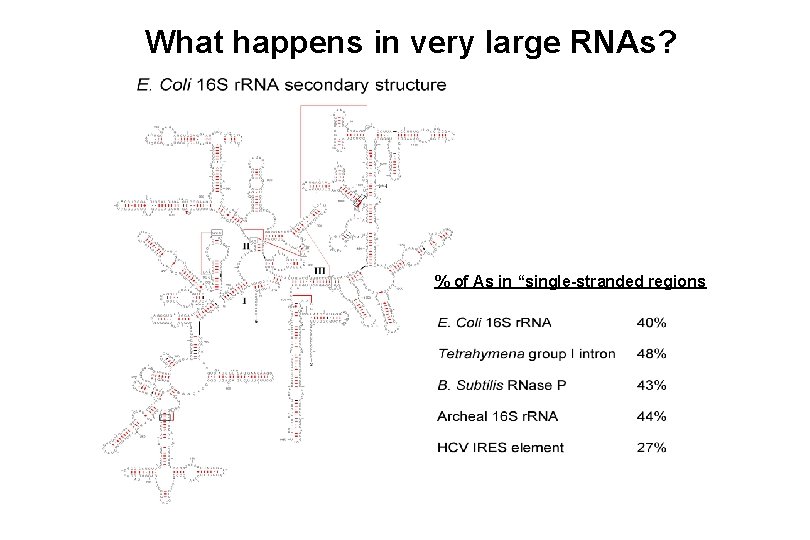
What happens in very large RNAs? % of As in “single-stranded regions

A-minor motifs are the predominant tertiary interaction in the 50 S ribosomal subunit
Summary 1. 2. 3. 4. RNA structure can be specific, globular, stable and complex. (As a result, RNA mediates specific recognition and catalytic reactions. ) Secondary structures include stems, bulges, and loops. Tertiary motifs include base triples, pseudoknots, A-A platforms, the tetraloop/tetraloop receptor, A-minor motifs, ribose zippers Principles: stems and loops conserved, many non-WC base contacts, coaxial stacking, metal ion binding, H-bonding of ribose 2’ OH, and repeated “motifs”.
- Slides: 42