
Patterns and PreAlgebra KindergartenGrade 3 1 Agenda Why
Patterns and Pre-Algebra Kindergarten–Grade 3 1
Agenda Why Teach Patterns and Pre-Algebra? Simple Patterns Are Everywhere There Are Different Types of Patterns—Numerical/Non-numerical The Same Pattern Can Be Expressed in Different Ways Your Questions Break There Are Different Types of Patterns—Repeating and Increasing/Decreasing Your Questions Lunch Pattern Rules Generalize Relationships Your Questions Break Equations Express Relationships Between Numbers Your Questions and Feedback 2
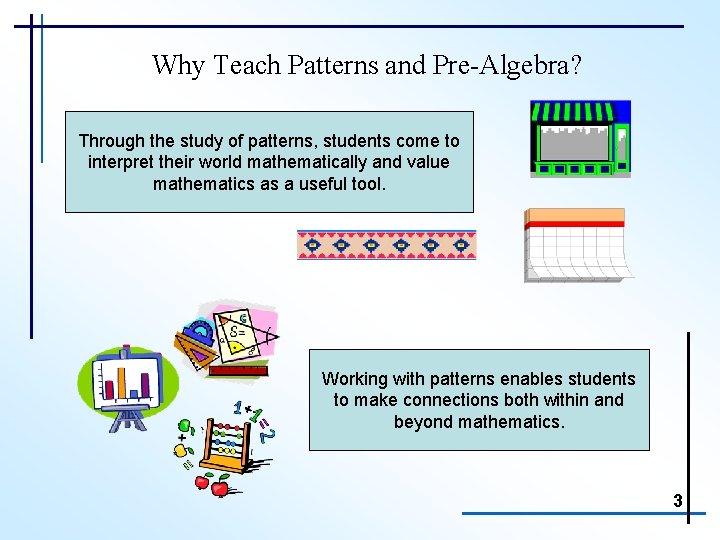
Why Teach Patterns and Pre-Algebra? Through the study of patterns, students come to interpret their world mathematically and value mathematics as a useful tool. Working with patterns enables students to make connections both within and beyond mathematics. 3
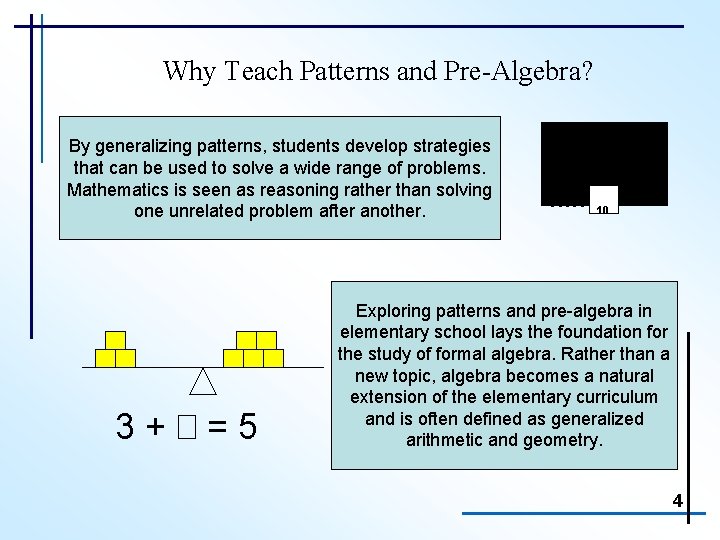
Why Teach Patterns and Pre-Algebra? By generalizing patterns, students develop strategies that can be used to solve a wide range of problems. Mathematics is seen as reasoning rather than solving one unrelated problem after another. 3+�=5 10 Exploring patterns and pre-algebra in elementary school lays the foundation for the study of formal algebra. Rather than a new topic, algebra becomes a natural extension of the elementary curriculum and is often defined as generalized arithmetic and geometry. 4
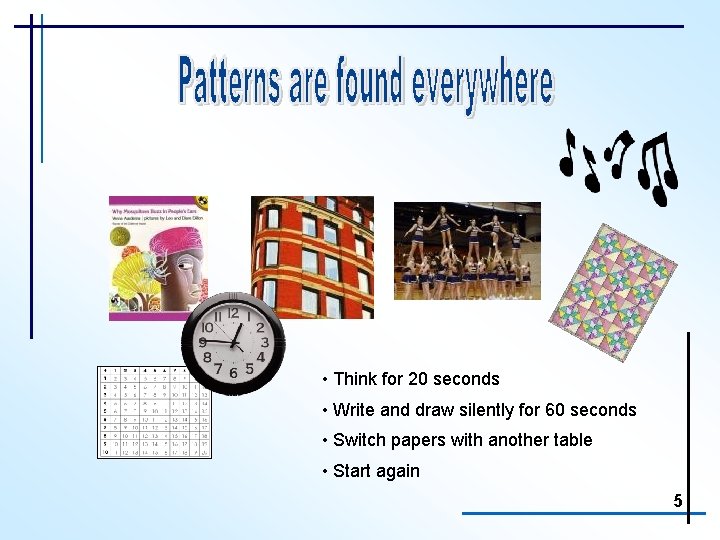
• Think for 20 seconds • Write and draw silently for 60 seconds • Switch papers with another table • Start again 5
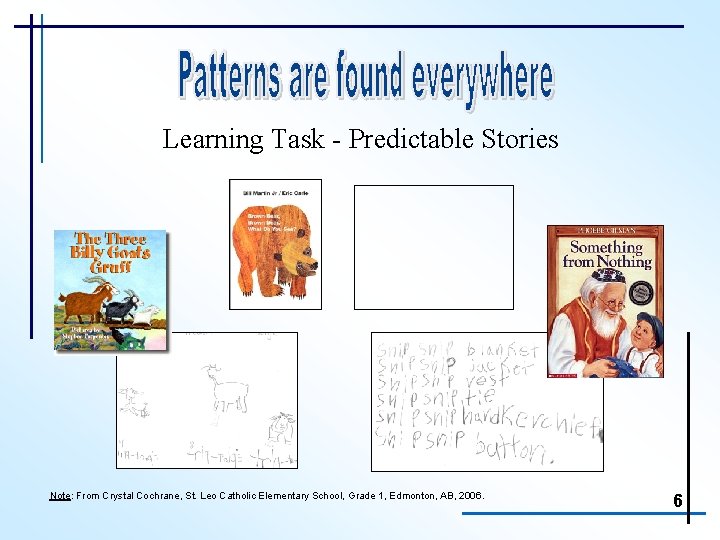
Learning Task - Predictable Stories Note: From Crystal Cochrane, St. Leo Catholic Elementary School, Grade 1, Edmonton, AB, 2006. 6
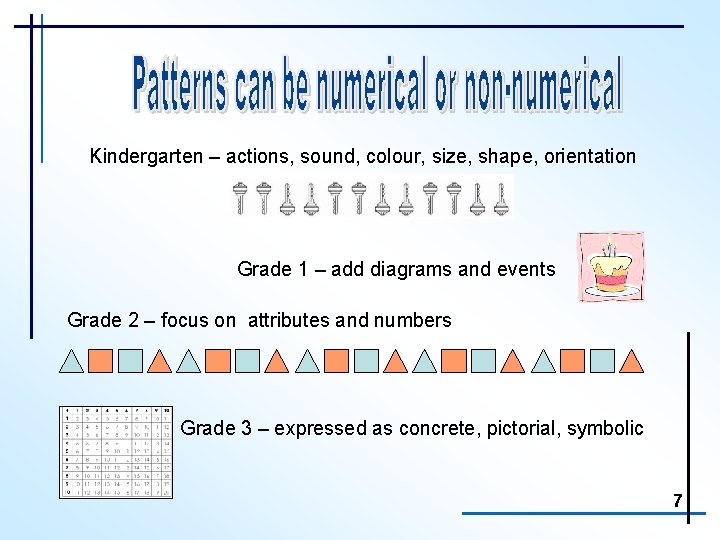
Kindergarten – actions, sound, colour, size, shape, orientation Grade 1 – add diagrams and events Grade 2 – focus on attributes and numbers Grade 3 – expressed as concrete, pictorial, symbolic 7
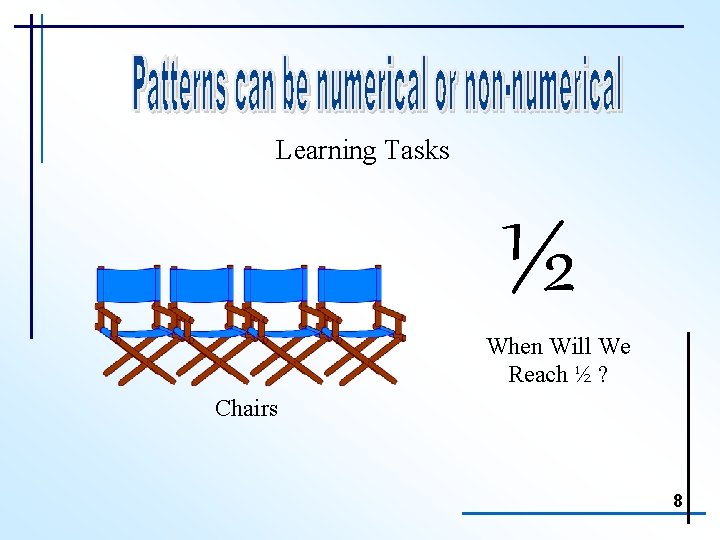
Learning Tasks ½ When Will We Reach ½ ? Chairs 8
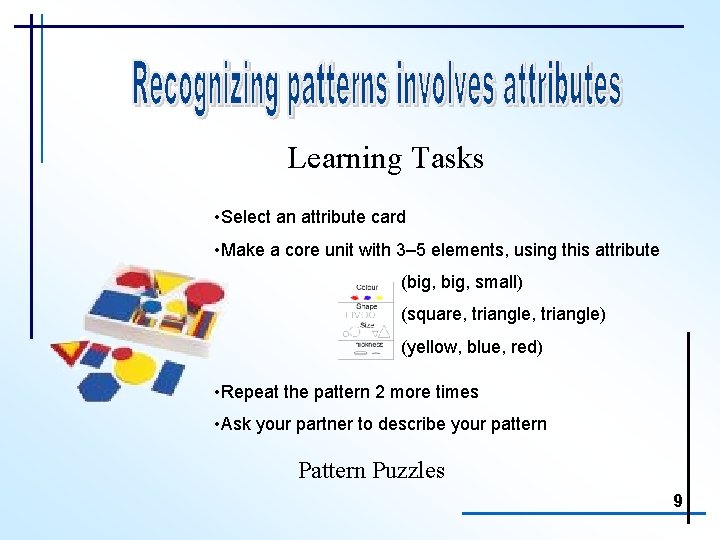
Learning Tasks • Select an attribute card • Make a core unit with 3– 5 elements, using this attribute (big, small) (square, triangle) (yellow, blue, red) • Repeat the pattern 2 more times • Ask your partner to describe your pattern Puzzles 9
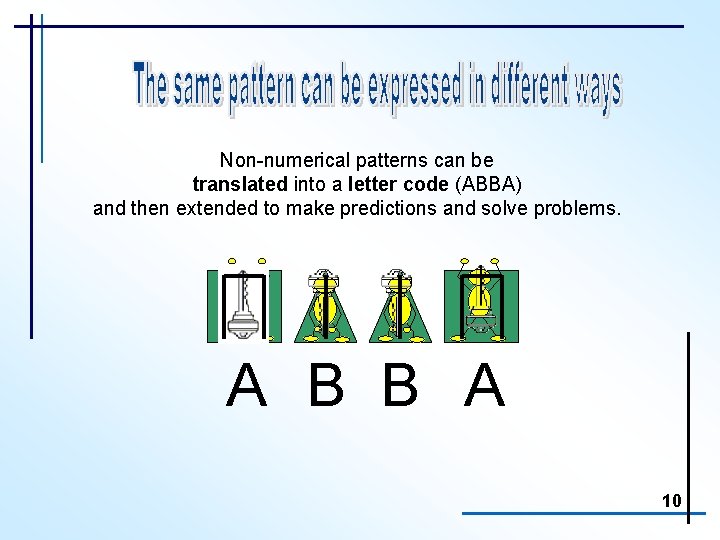
Non-numerical patterns can be translated into a letter code (ABBA) and then extended to make predictions and solve problems. A B B A 10

Learning Tasks – Translating Patterns These are both AABB patterns. Mix and Match • Create a 2 - to 4 -element core, using your choice of materials; e. g. , colour, orientation, size. • Extend your pattern 2 more times. • Find someone else in the room with the same pattern code. 11
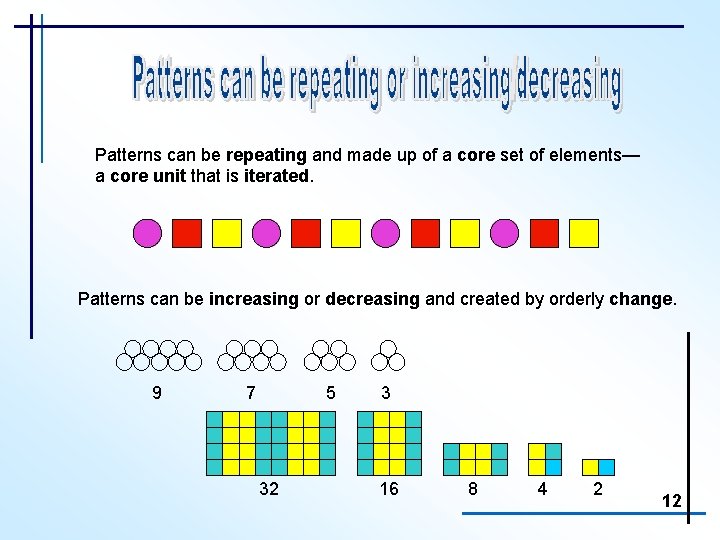
Patterns can be repeating and made up of a core set of elements— a core unit that is iterated. Patterns can be increasing or decreasing and created by orderly change. 9 7 5 32 3 16 8 4 2 12
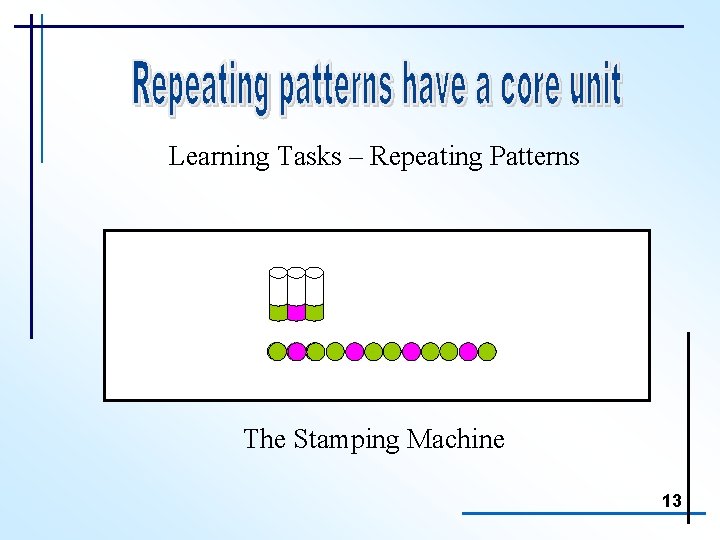
Learning Tasks – Repeating Patterns The Stamping Machine 13
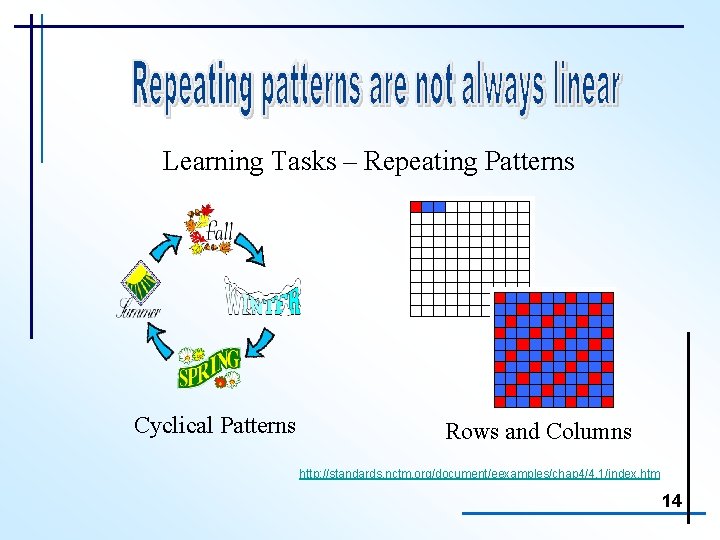
Learning Tasks – Repeating Patterns Cyclical Patterns Rows and Columns http: //standards. nctm. org/document/eexamples/chap 4/4. 1/index. htm 14
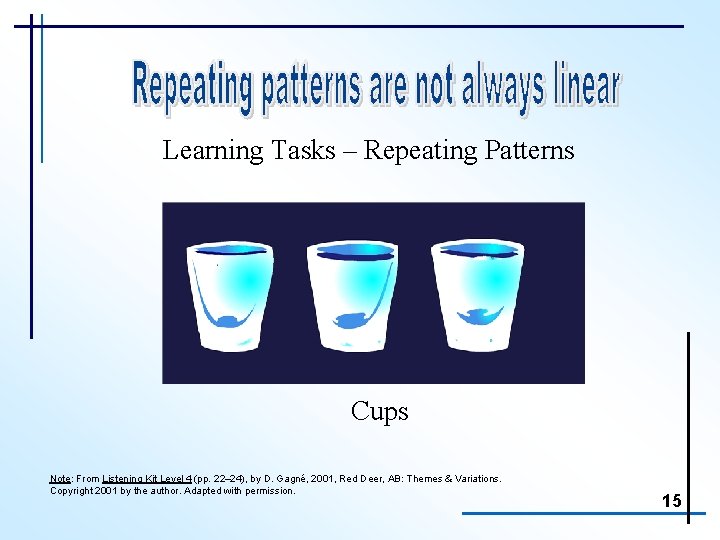
Learning Tasks – Repeating Patterns Cups Note: From Listening Kit Level 4 (pp. 22– 24), by D. Gagné, 2001, Red Deer, AB: Themes & Variations. Copyright 2001 by the author. Adapted with permission. 15
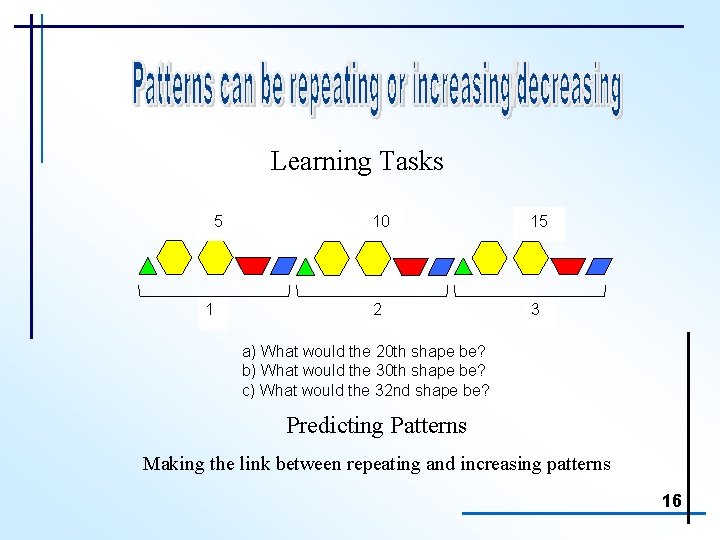
Learning Tasks 5 1 10 15 2 3 a) What would the 20 th shape be? b) What would the 30 th shape be? c) What would the 32 nd shape be? Predicting Patterns Making the link between repeating and increasing patterns 16
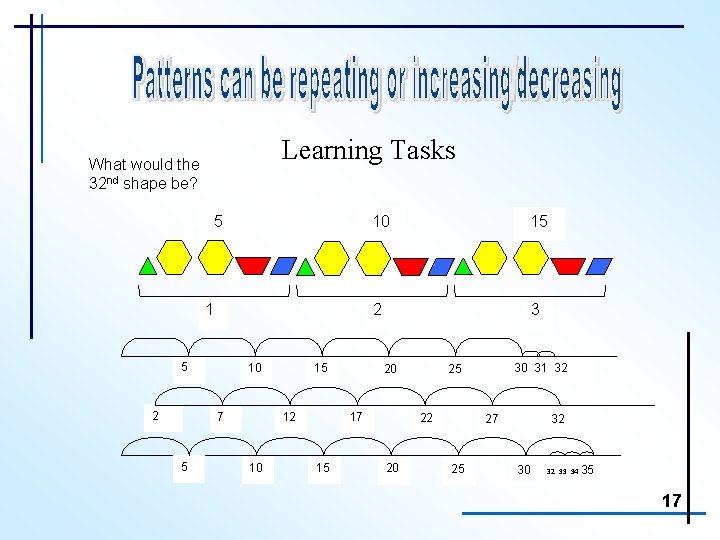
Learning Tasks What would the 32 nd shape be? 5 1 5 2 10 7 5 15 12 10 10 15 2 3 20 17 15 22 20 30 31 32 25 27 25 32 30 32 33 34 35 17
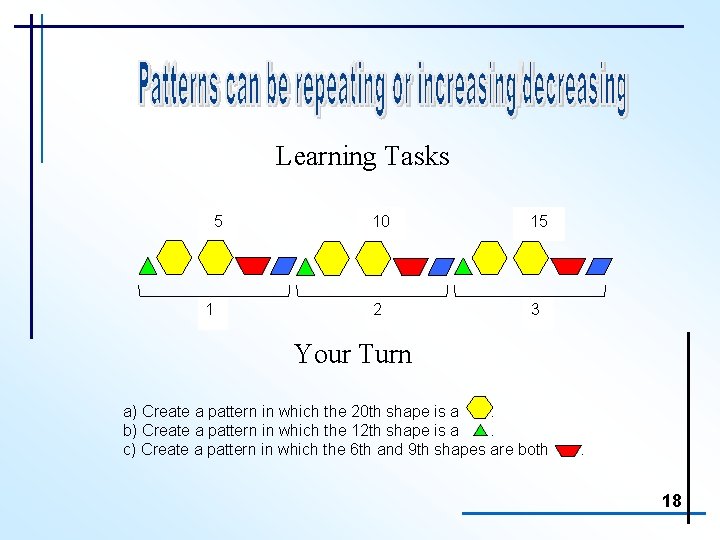
Learning Tasks 5 1 10 15 2 3 Your Turn a) Create a pattern in which the 20 th shape is a. b) Create a pattern in which the 12 th shape is a. c) Create a pattern in which the 6 th and 9 th shapes are both . 18
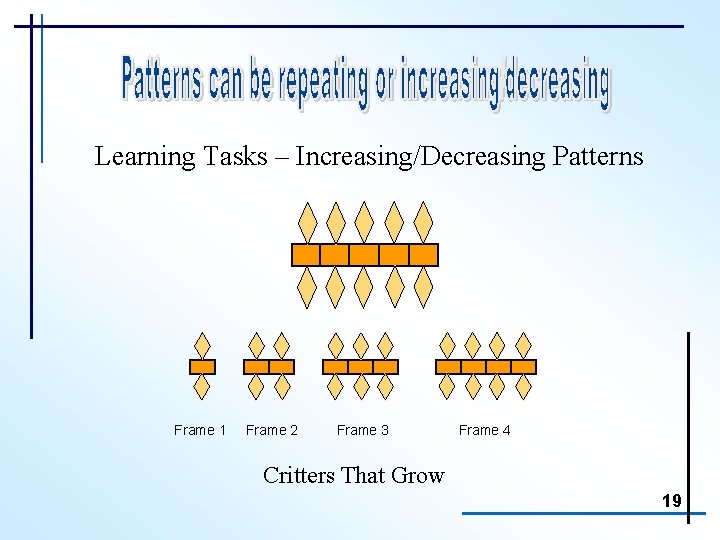
Learning Tasks – Increasing/Decreasing Patterns Frame 1 Frame 2 Frame 3 Frame 4 Critters That Grow 19
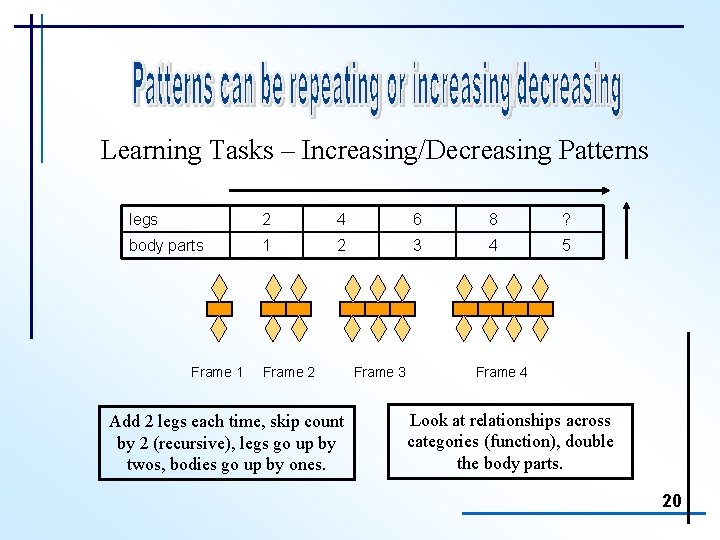
Learning Tasks – Increasing/Decreasing Patterns legs 2 4 6 8 ? body parts 1 2 3 4 5 Frame 1 Frame 2 Add 2 legs each time, skip count by 2 (recursive), legs go up by twos, bodies go up by ones. Frame 3 Frame 4 Look at relationships across categories (function), double the body parts. 20
Developing relational thinking 1. Build and extend to the next frame: How many legs would the critter have the next year? 2. Keep extending the pattern, frame by frame: The next year after that? 3. Identify a pattern (often a skip-counting pattern): What do you notice? 4. Push students to generalize: How many legs will the critter have in 10 years? In 100 years? How can you find the number of legs at any age? 21
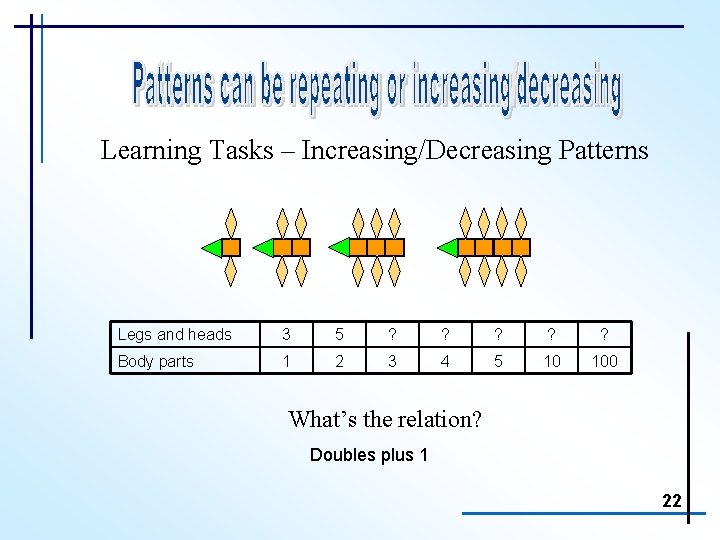
Learning Tasks – Increasing/Decreasing Patterns Legs and heads 3 5 ? ? ? Body parts 1 2 3 4 5 10 100 What’s the relation? Doubles plus 1 22
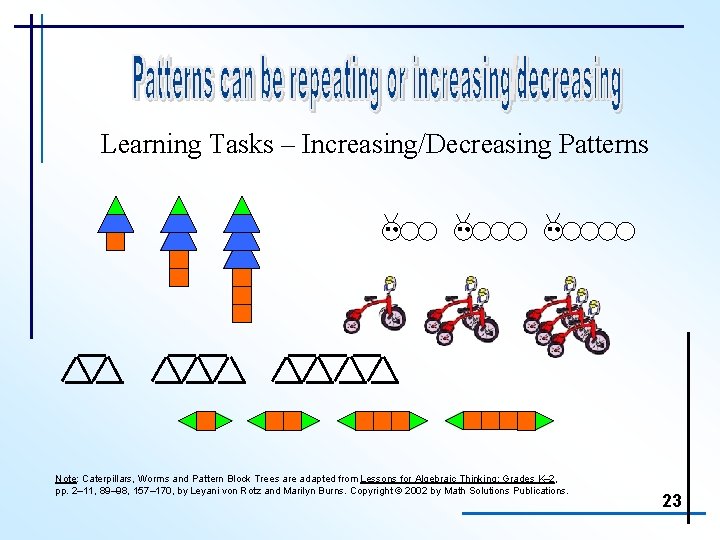
Learning Tasks – Increasing/Decreasing Patterns Note: Caterpillars, Worms and Pattern Block Trees are adapted from Lessons for Algebraic Thinking: Grades K– 2, pp. 2– 11, 89– 98, 157– 170, by Leyani von Rotz and Marilyn Burns. Copyright © 2002 by Math Solutions Publications. 23
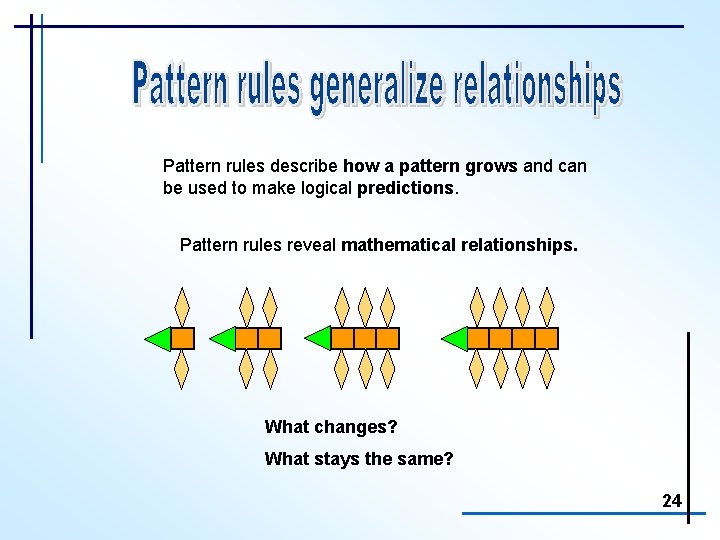
Pattern rules describe how a pattern grows and can be used to make logical predictions. Pattern rules reveal mathematical relationships. What changes? What stays the same? 24
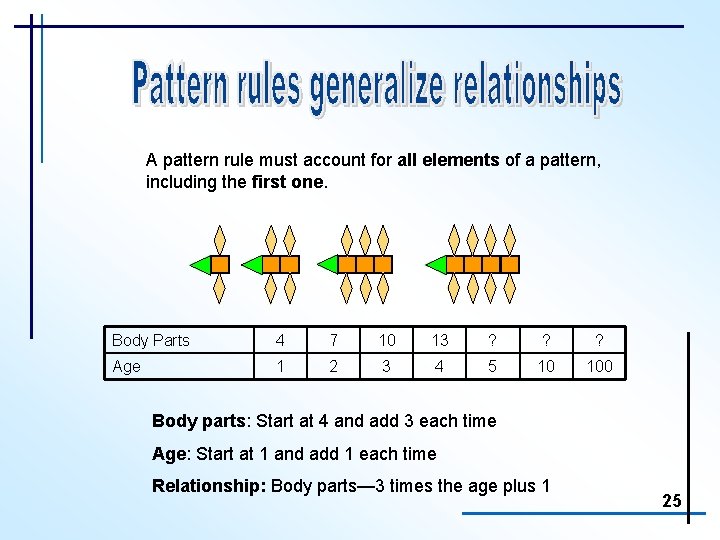
A pattern rule must account for all elements of a pattern, including the first one. Body Parts 4 7 10 13 ? ? ? Age 1 2 3 4 5 10 100 Body parts: Start at 4 and add 3 each time Age: Start at 1 and add 1 each time Relationship: Body parts— 3 times the age plus 1 25
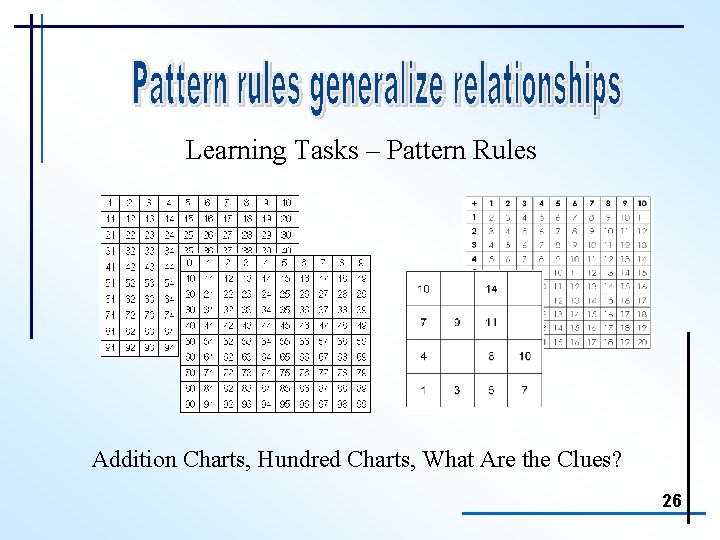
Learning Tasks – Pattern Rules Addition Charts, Hundred Charts, What Are the Clues? 26
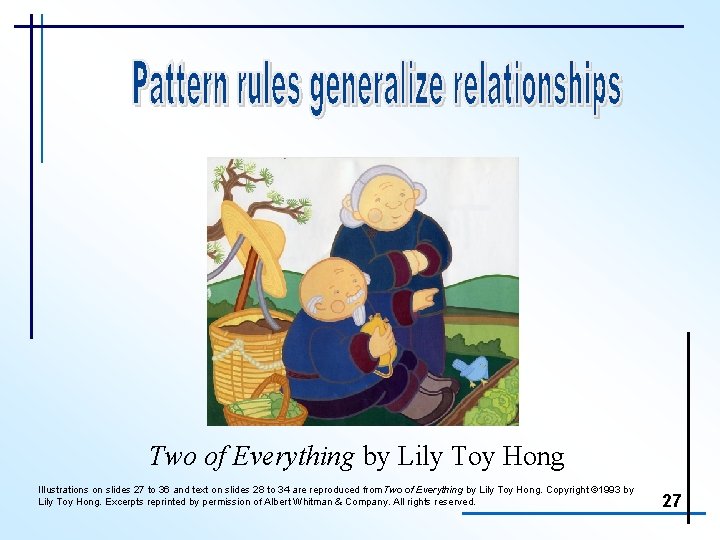
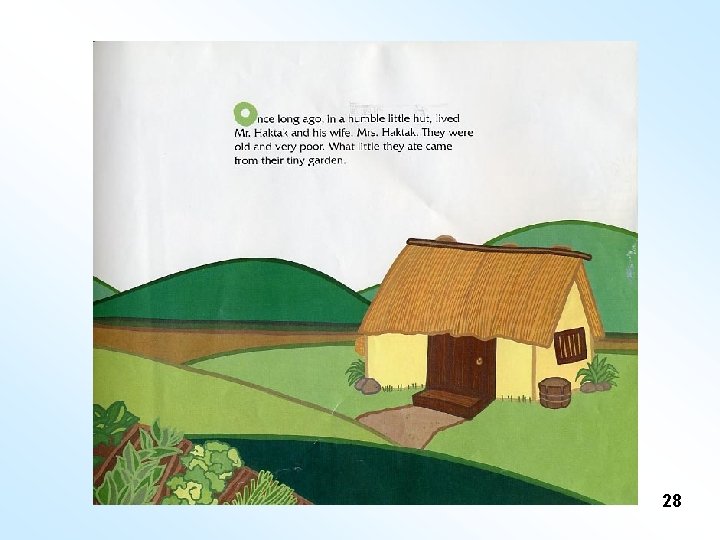
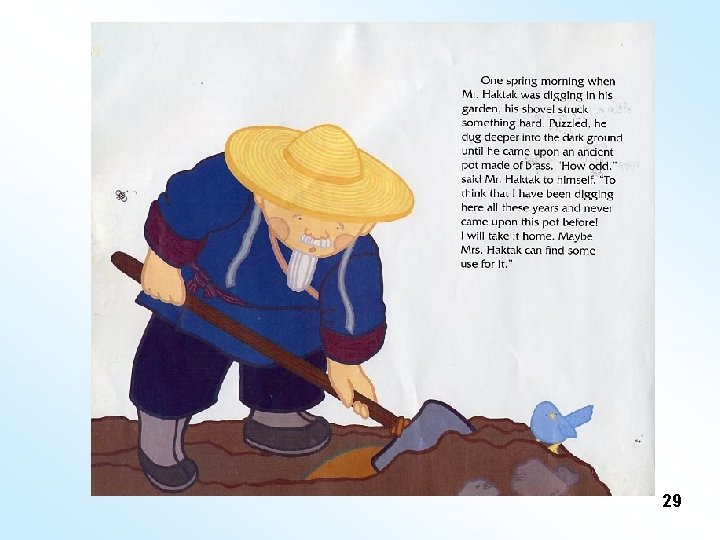
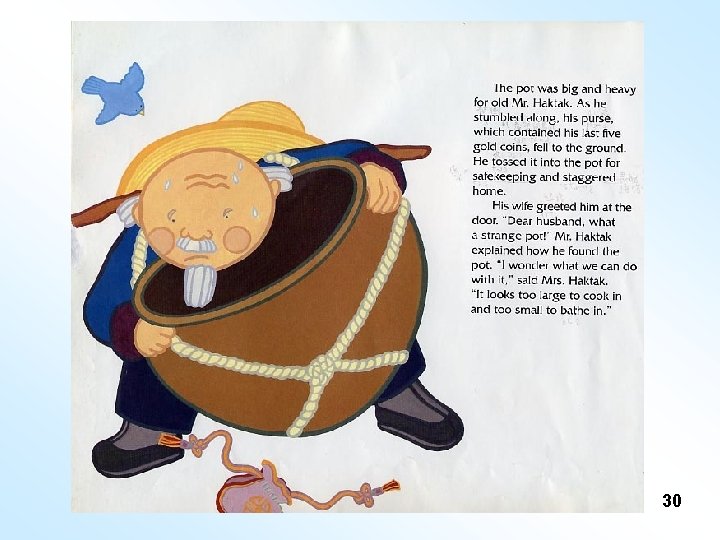
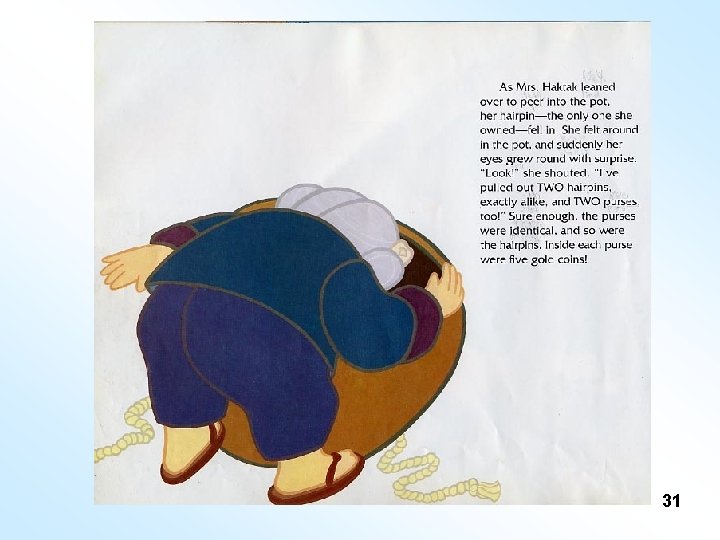
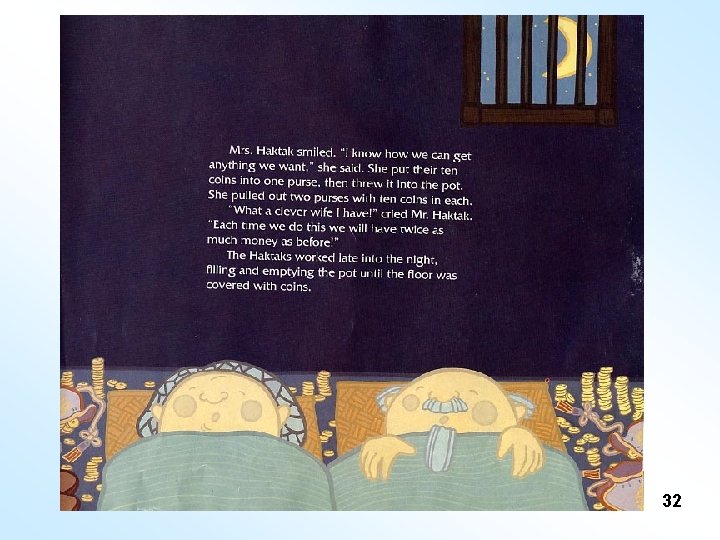
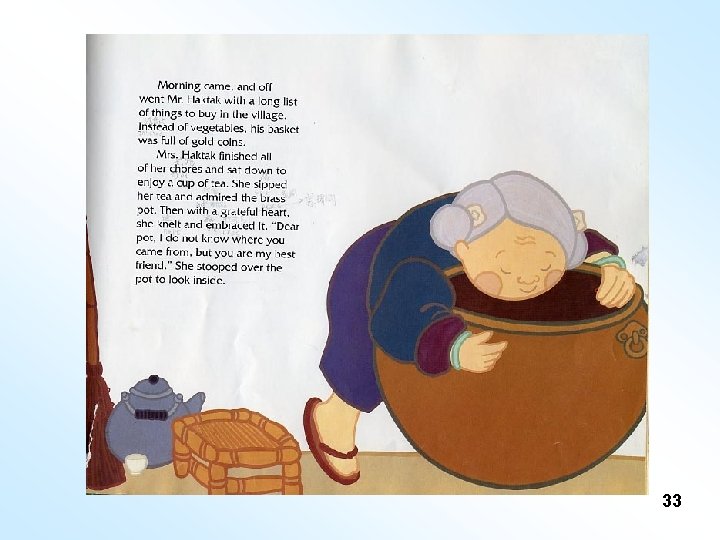
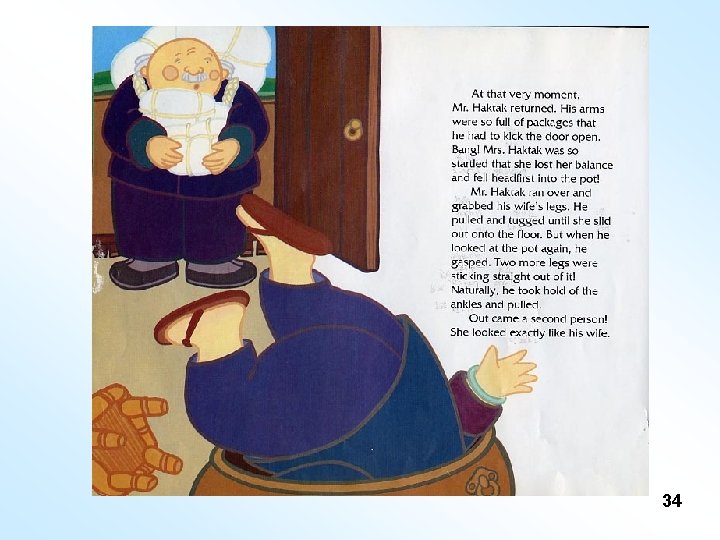
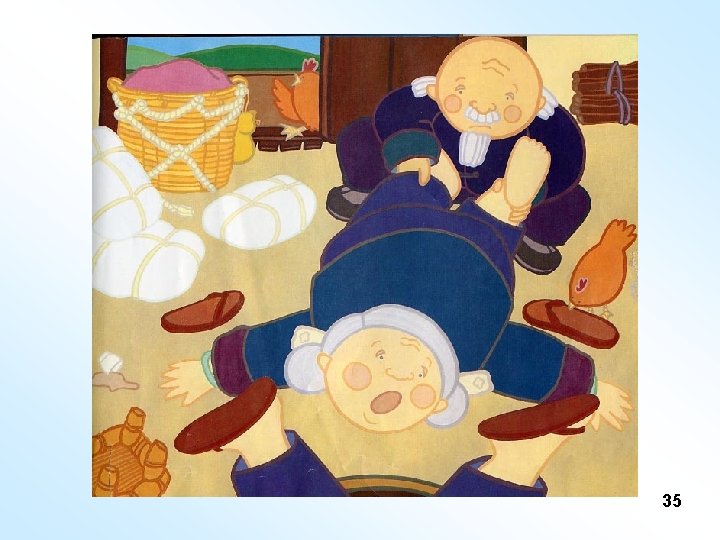
Two of Everything by Lily Toy Hong Illustrations on slides 27 to 36 and text on slides 28 to 34 are reproduced from Two of Everything by Lily Toy Hong. Copyright © 1993 by Lily Toy Hong. Excerpts reprinted by permission of Albert Whitman & Company. All rights reserved. 27
28
29
30
31
32
33
34
35
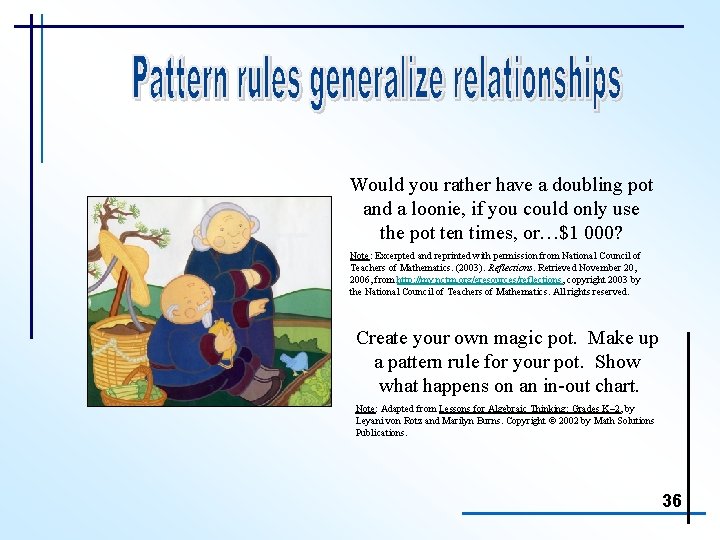
Would you rather have a doubling pot and a loonie, if you could only use the pot ten times, or…$1 000? Note: Excerpted and reprinted with permission from National Council of Teachers of Mathematics. (2003). Reflections. Retrieved November 20, 2006, from http: //my. nctm. org/eresources/reflections, copyright 2003 by the National Council of Teachers of Mathematics. All rights reserved. Create your own magic pot. Make up a pattern rule for your pot. Show what happens on an in-out chart. Note: Adapted from Lessons for Algebraic Thinking: Grades K– 2, by Leyani von Rotz and Marilyn Burns. Copyright © 2002 by Math Solutions Publications. 36
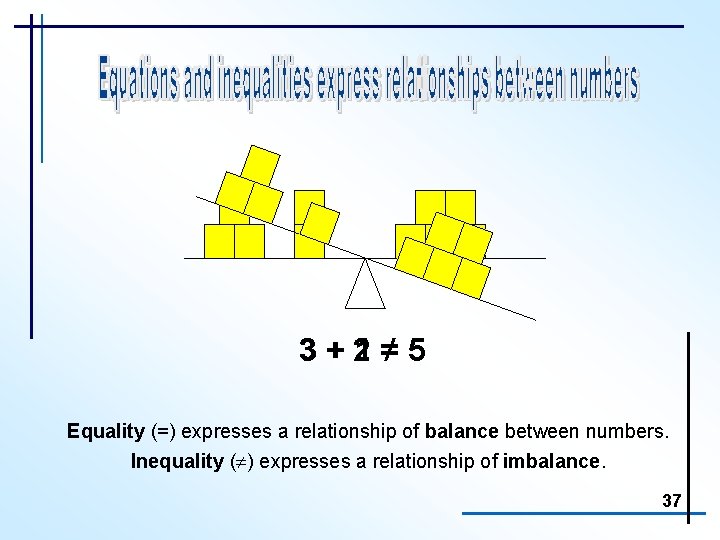
3+2 1= ≠ 5 Equality (=) expresses a relationship of balance between numbers. Inequality ( ) expresses a relationship of imbalance. 37
What do elementary students think the equal sign means? 38
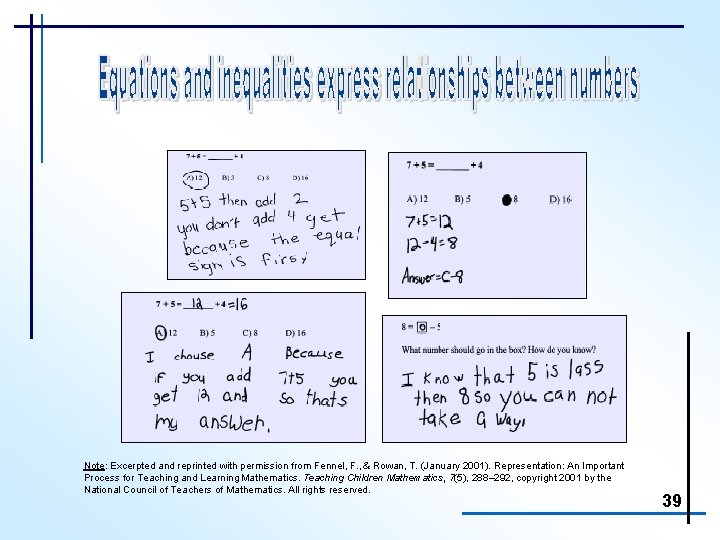
Note: Excerpted and reprinted with permission from Fennel, F. , & Rowan, T. (January 2001). Representation: An Important Process for Teaching and Learning Mathematics. Teaching Children Mathematics, 7(5), 288– 292, copyright 2001 by the National Council of Teachers of Mathematics. All rights reserved. 39
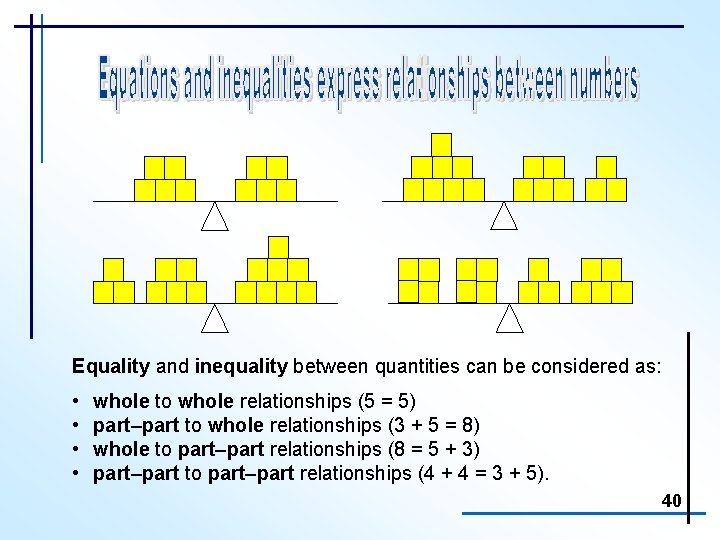
Equality and inequality between quantities can be considered as: • • whole to whole relationships (5 = 5) part–part to whole relationships (3 + 5 = 8) whole to part–part relationships (8 = 5 + 3) part–part to part–part relationships (4 + 4 = 3 + 5). 40
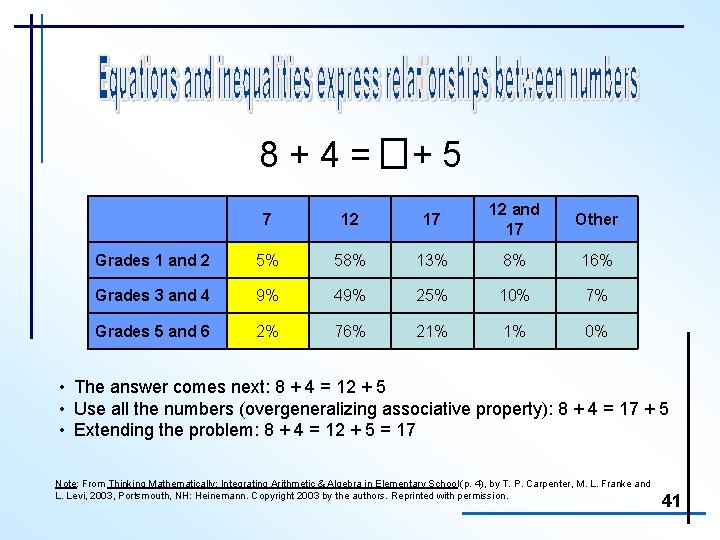
8+4= +5 7 12 17 12 and 17 Other Grades 1 and 2 5% 58% 13% 8% 16% Grades 3 and 4 9% 49% 25% 10% 7% Grades 5 and 6 2% 76% 21% 1% 0% • The answer comes next: 8 + 4 = 12 + 5 • Use all the numbers (overgeneralizing associative property): 8 + 4 = 17 + 5 • Extending the problem: 8 + 4 = 12 + 5 = 17 Note: From Thinking Mathematically: Integrating Arithmetic & Algebra in Elementary School (p. 4), by T. P. Carpenter, M. L. Franke and L. Levi, 2003, Portsmouth, NH: Heinemann. Copyright 2003 by the authors. Reprinted with permission. 41
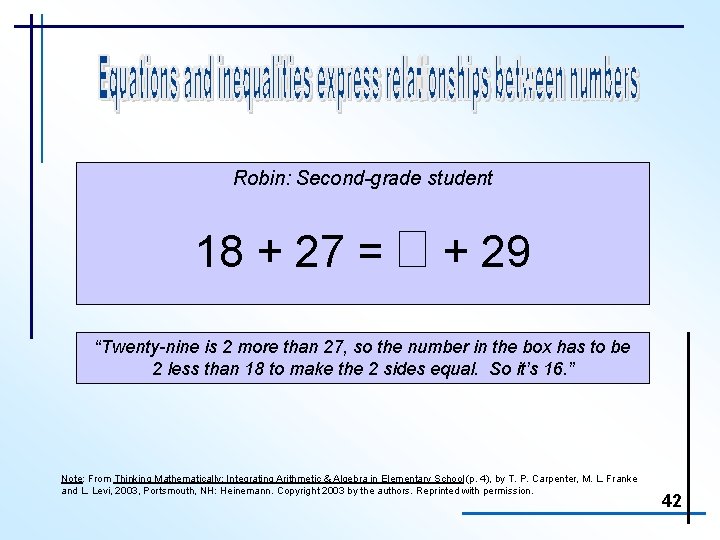
Robin: Second-grade student 18 + 27 = � + 29 “Twenty-nine is 2 more than 27, so the number in the box has to be 2 less than 18 to make the 2 sides equal. So it’s 16. ” Note: From Thinking Mathematically: Integrating Arithmetic & Algebra in Elementary School (p. 4), by T. P. Carpenter, M. L. Franke and L. Levi, 2003, Portsmouth, NH: Heinemann. Copyright 2003 by the authors. Reprinted with permission. 42
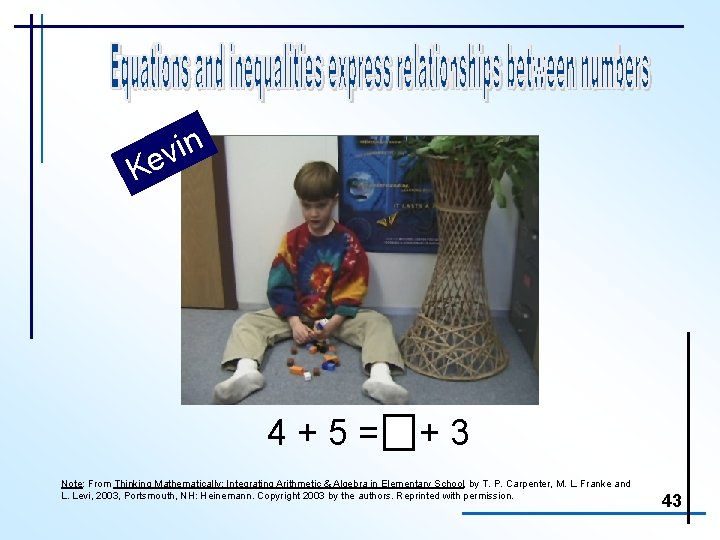
n i v e K 4+5= +3 Note: From Thinking Mathematically: Integrating Arithmetic & Algebra in Elementary School, by T. P. Carpenter, M. L. Franke and L. Levi, 2003, Portsmouth, NH: Heinemann. Copyright 2003 by the authors. Reprinted with permission. 43
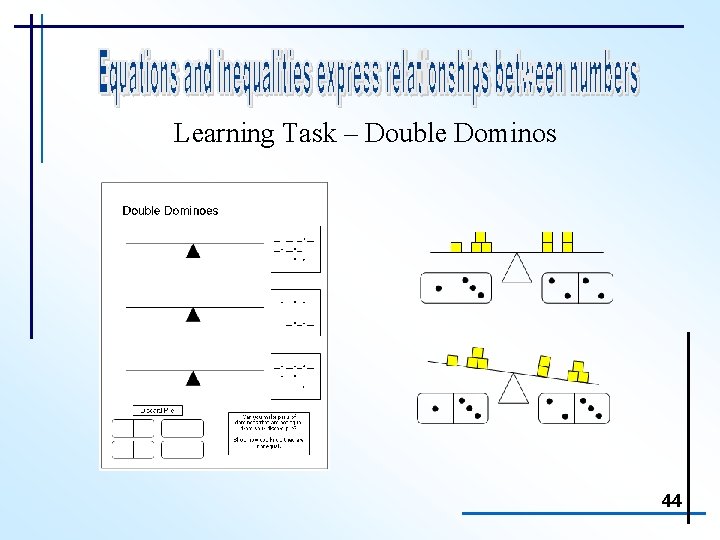
Learning Task – Double Dominos 44
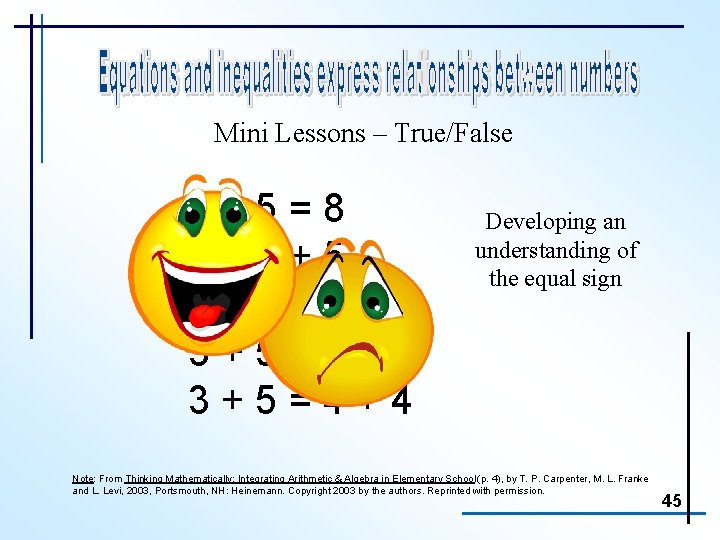
Mini Lessons – True/False 3+5=8 8=3+5 8=8 3+5=5+3 3+5=4+4 Developing an understanding of the equal sign Note: From Thinking Mathematically: Integrating Arithmetic & Algebra in Elementary School (p. 4), by T. P. Carpenter, M. L. Franke and L. Levi, 2003, Portsmouth, NH: Heinemann. Copyright 2003 by the authors. Reprinted with permission. 45
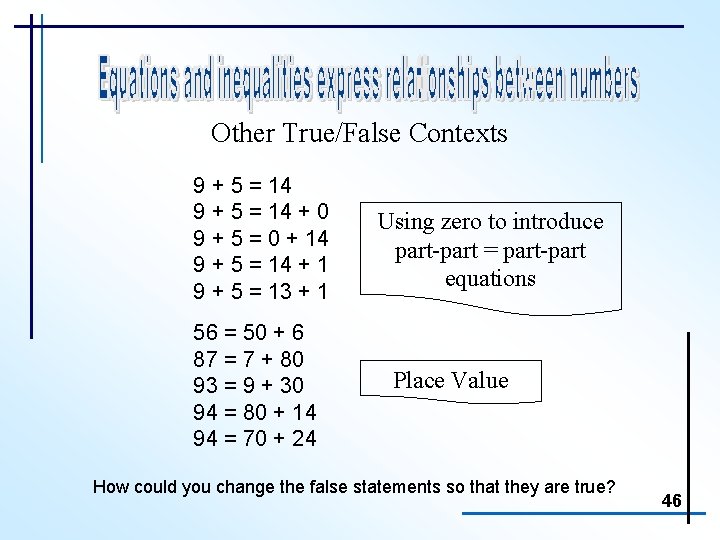
Other True/False Contexts 9 + 5 = 14 + 0 9 + 5 = 0 + 14 9 + 5 = 14 + 1 9 + 5 = 13 + 1 56 = 50 + 6 87 = 7 + 80 93 = 9 + 30 94 = 80 + 14 94 = 70 + 24 Using zero to introduce part-part = part-part equations Place Value How could you change the false statements so that they are true? 46
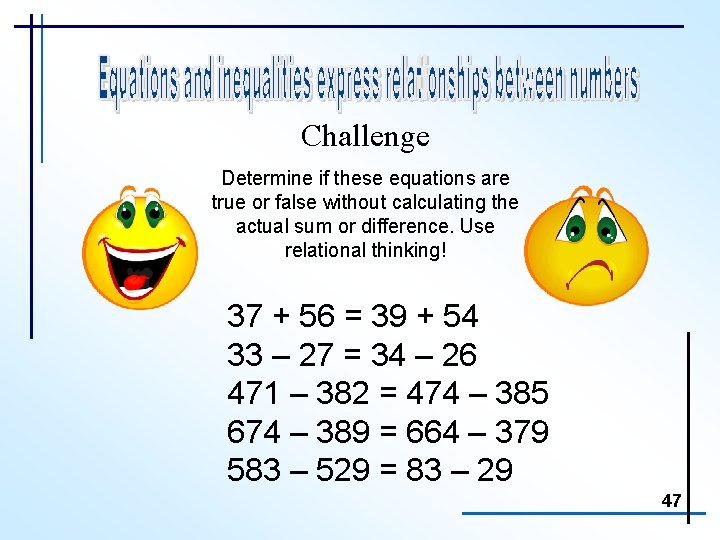
Challenge Determine if these equations are true or false without calculating the actual sum or difference. Use relational thinking! 37 + 56 = 39 + 54 33 – 27 = 34 – 26 471 – 382 = 474 – 385 674 – 389 = 664 – 379 583 – 529 = 83 – 29 47
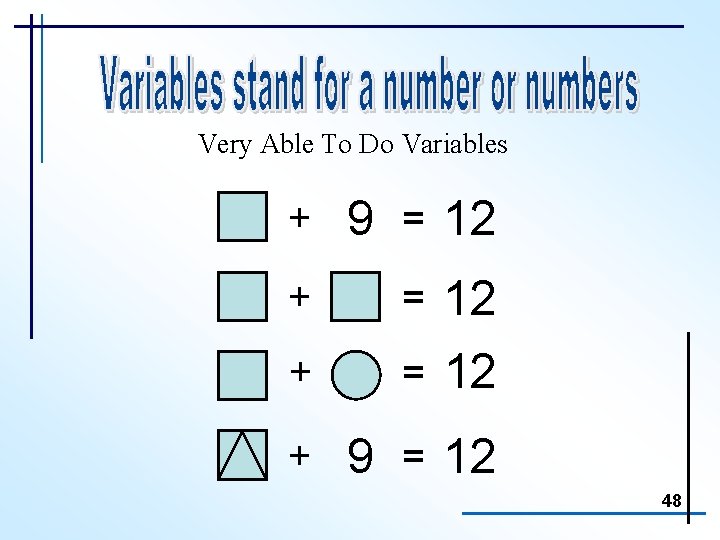
Very Able To Do Variables + 9 = 12 + 9 = 12 48
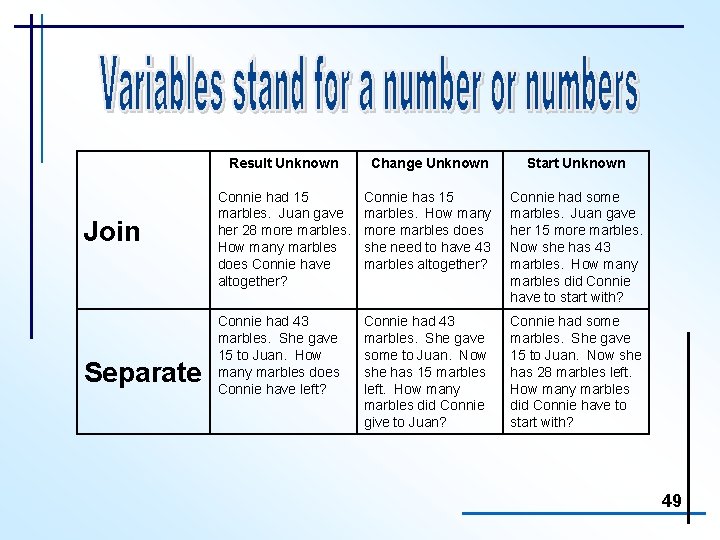
Join Separate Result Unknown Change Unknown Start Unknown Connie had 15 marbles. Juan gave her 28 more marbles. How many marbles does Connie have altogether? Connie has 15 marbles. How many more marbles does she need to have 43 marbles altogether? Connie had some marbles. Juan gave her 15 more marbles. Now she has 43 marbles. How many marbles did Connie have to start with? Connie had 43 marbles. She gave 15 to Juan. How many marbles does Connie have left? Connie had 43 marbles. She gave some to Juan. Now she has 15 marbles left. How many marbles did Connie give to Juan? Connie had some marbles. She gave 15 to Juan. Now she has 28 marbles left. How many marbles did Connie have to start with? 49
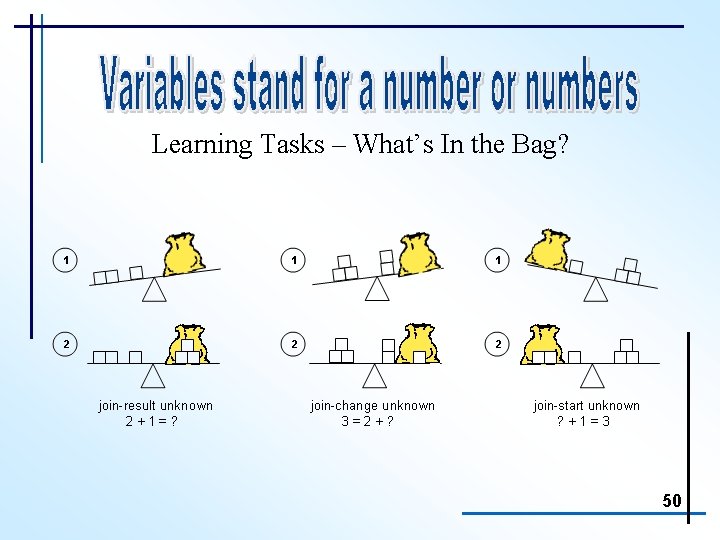
Learning Tasks – What’s In the Bag? 50
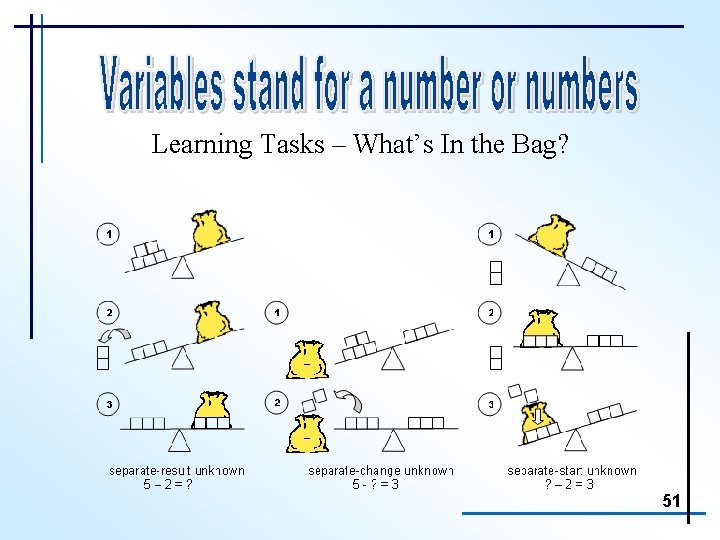
Learning Tasks – What’s In the Bag? 51
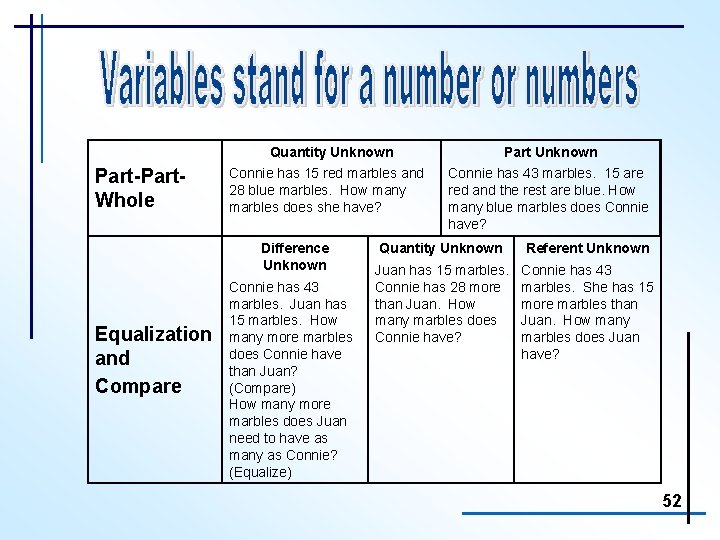
Quantity Unknown Part-Part. Whole Connie has 15 red marbles and 28 blue marbles. How many marbles does she have? Difference Unknown Equalization and Compare Connie has 43 marbles. Juan has 15 marbles. How many more marbles does Connie have than Juan? (Compare) How many more marbles does Juan need to have as many as Connie? (Equalize) Part Unknown Connie has 43 marbles. 15 are red and the rest are blue. How many blue marbles does Connie have? Quantity Unknown Referent Unknown Juan has 15 marbles. Connie has 28 more than Juan. How many marbles does Connie have? Connie has 43 marbles. She has 15 more marbles than Juan. How many marbles does Juan have? 52
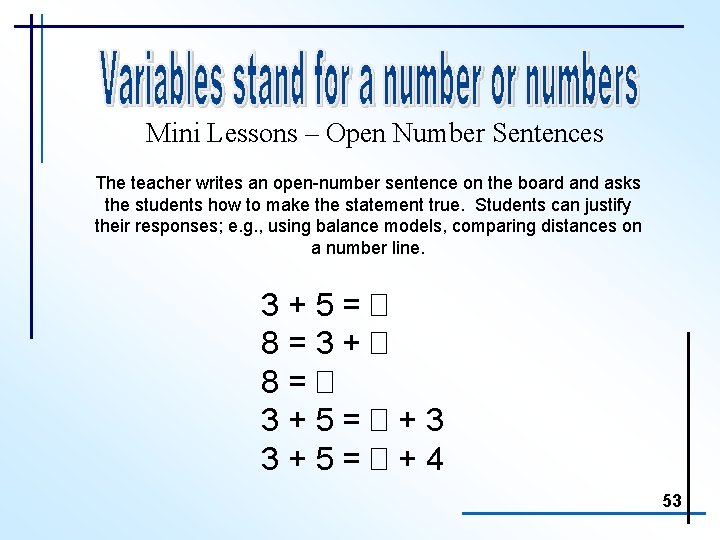
Mini Lessons – Open Number Sentences The teacher writes an open-number sentence on the board and asks the students how to make the statement true. Students can justify their responses; e. g. , using balance models, comparing distances on a number line. 3+5=� 8=3+� 8=� 3+5=�+3 3+5=�+4 53
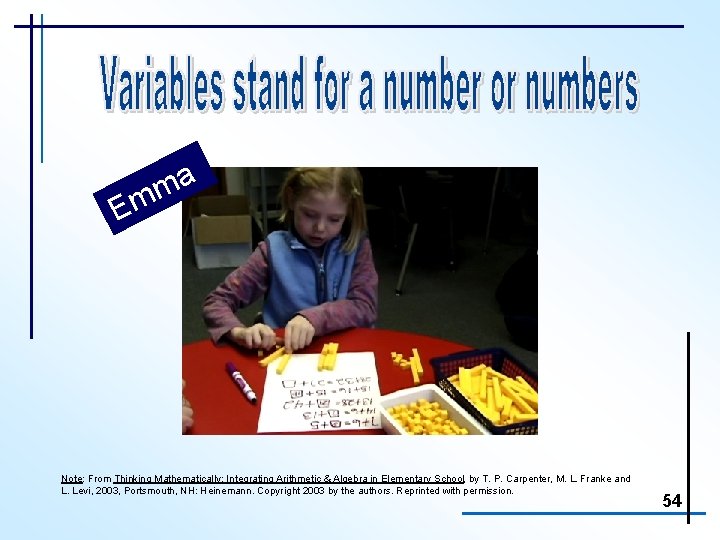
a m m E Note: From Thinking Mathematically: Integrating Arithmetic & Algebra in Elementary School, by T. P. Carpenter, M. L. Franke and L. Levi, 2003, Portsmouth, NH: Heinemann. Copyright 2003 by the authors. Reprinted with permission. 54
Each problem that I solved became a rule which served afterwards to solve other problems. René Descartes 55
- Slides: 55