
Pattern Recognition Why To provide machines with perception
- Slides: 16
Pattern Recognition Why? • To provide machines with perception & cognition capabilities so that they could interact independently with their environments. Pattern Recognition • a natural ability of human • based on some description of an object, such description is termed Pattern. Lecture #1 COMP 527 Pattern Recognition 1
Patterns and Pattern Classes • Almost anything within the reach of our five senses can be chosen as a pattern: – Sensory patterns: speech, odors, tastes – Spatial patterns: characters, fingerprints, pictures – Temporal patterns: waveforms, electrocardiograms, movies – Conceptual recognition for abstract items (We will limit ourselves to deal with only physical objects/ events, but NOT abstract entities, say, concepts. ) • A pattern class is a group of patterns with certain common characteristics. Lecture #1 COMP 527 Pattern Recognition 2
Pattern Recognition • Pattern Recognition is the science to assign an object/event of interest to one of several pre specified categories/classes based on certain measurements or observations. • Measurements are usually problem dependent. E. g. weight or height for basketball players/jockeys color for apples/oranges • Feature vectors represent measurements as coordinates of points in a vector space (feature space). Lecture #1 COMP 527 Pattern Recognition 3
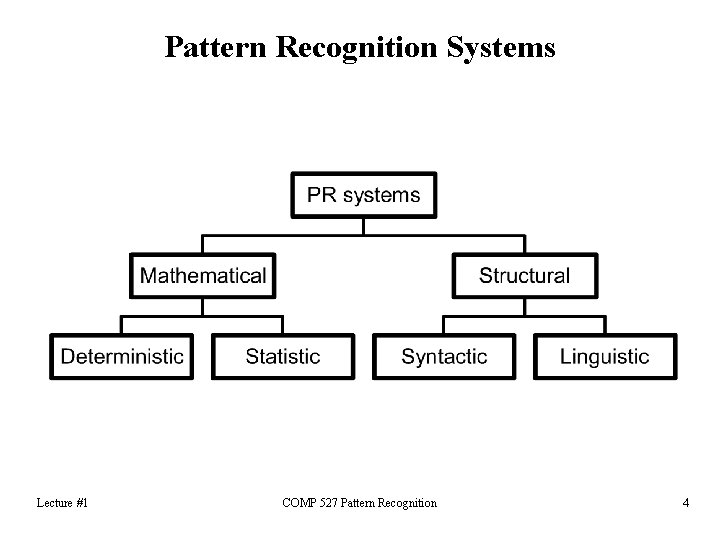
Pattern Recognition Systems Lecture #1 COMP 527 Pattern Recognition 4
Statistical Pattern Recognition • Taps into the vast and thorough knowledge of statistics to provide a formal treatment of PR. • Observations are assumed to be generated by a state of nature – data can be described by a statistical model – model by a set of probability functions • Strength: many powerful mathematical “tools” from theory of probability and statistics. • Shortcoming: it is usually impossible to design (statistically) error free systems. Lecture #1 COMP 527 Pattern Recognition 5
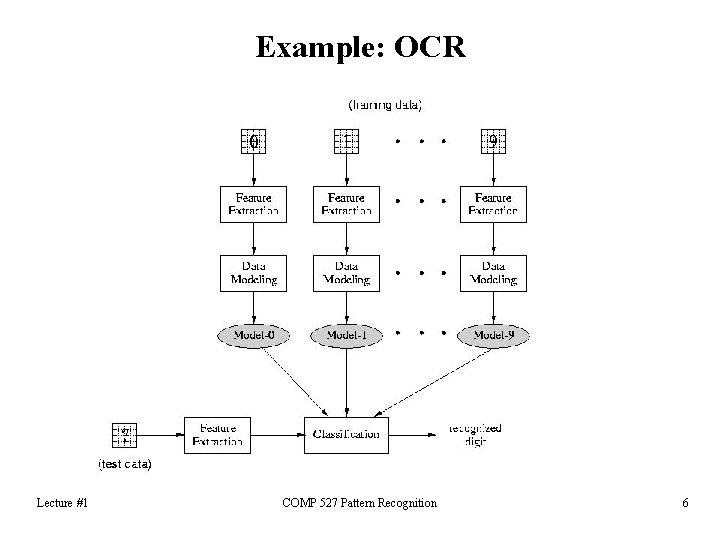
Example: OCR Lecture #1 COMP 527 Pattern Recognition 6
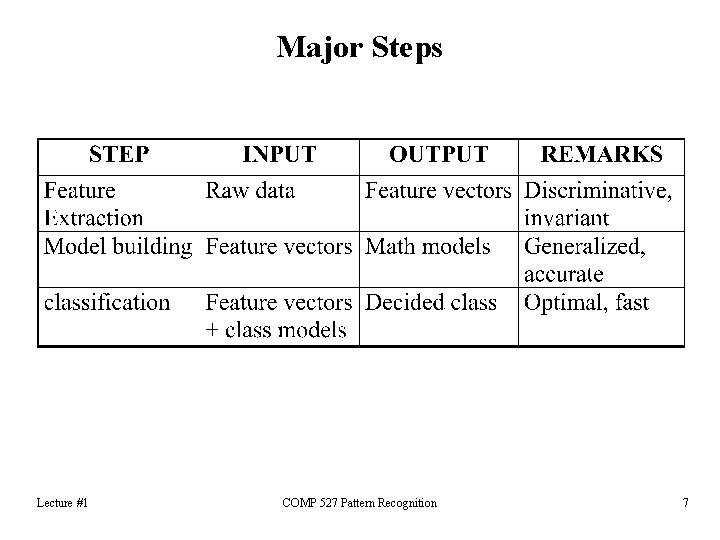
Major Steps Lecture #1 COMP 527 Pattern Recognition 7
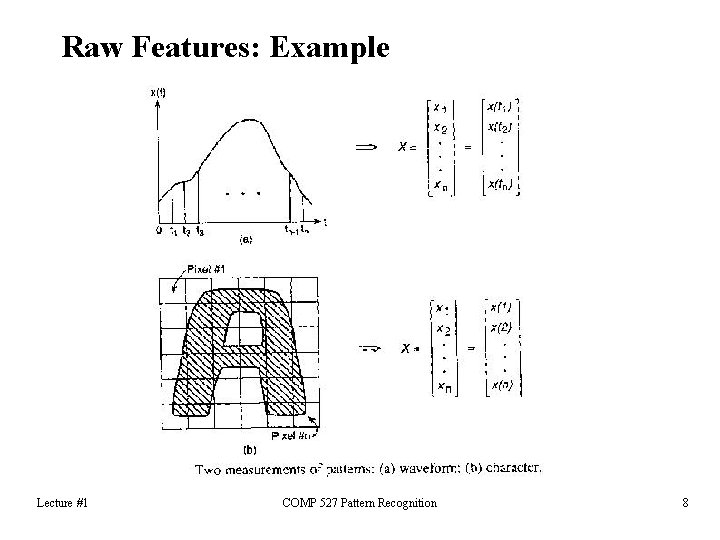
Raw Features: Example Lecture #1 COMP 527 Pattern Recognition 8
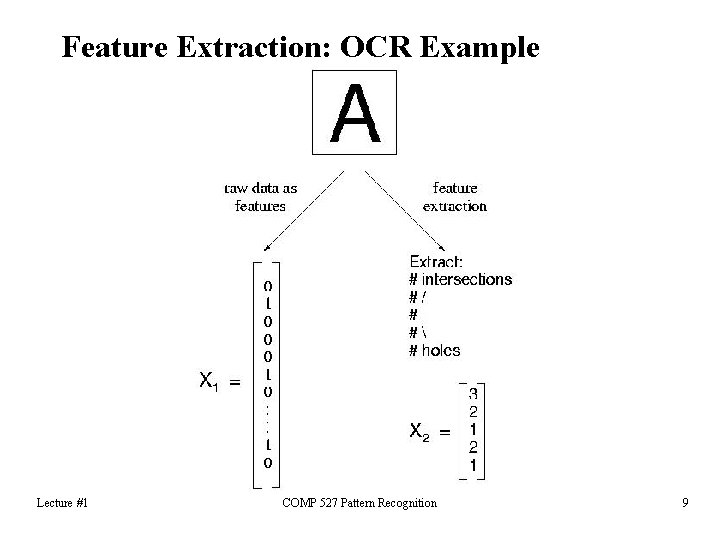
Feature Extraction: OCR Example Lecture #1 COMP 527 Pattern Recognition 9
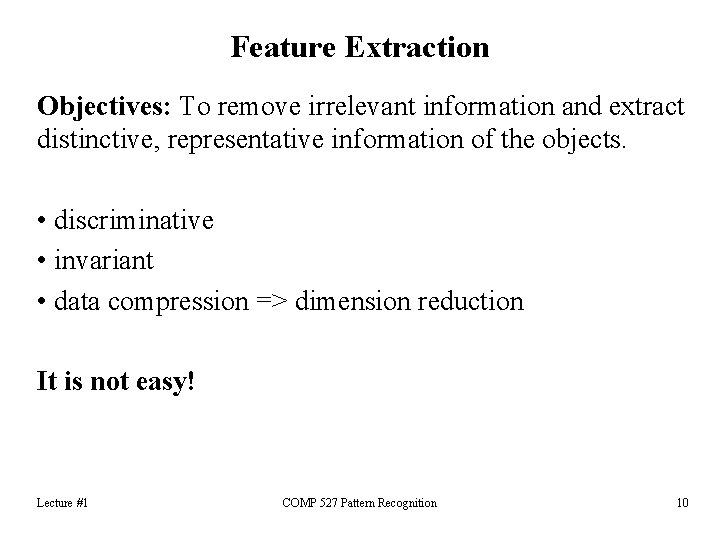
Feature Extraction Objectives: To remove irrelevant information and extract distinctive, representative information of the objects. • discriminative • invariant • data compression => dimension reduction It is not easy! Lecture #1 COMP 527 Pattern Recognition 10
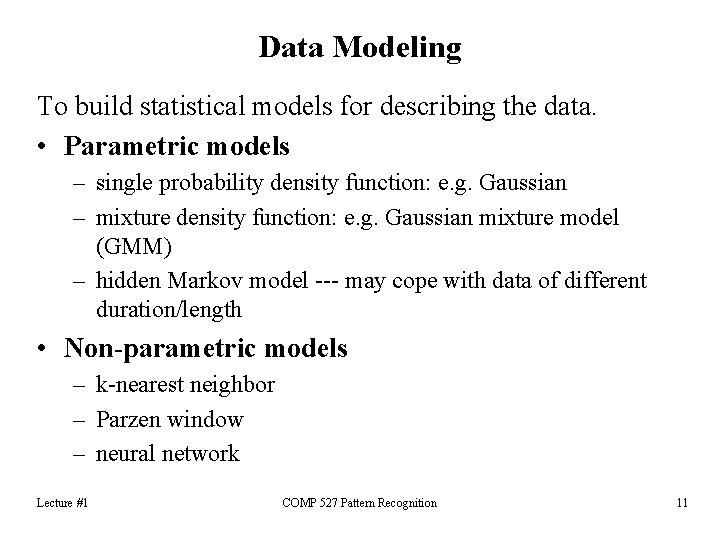
Data Modeling To build statistical models for describing the data. • Parametric models – single probability density function: e. g. Gaussian – mixture density function: e. g. Gaussian mixture model (GMM) – hidden Markov model may cope with data of different duration/length • Non parametric models – k nearest neighbor – Parzen window – neural network Lecture #1 COMP 527 Pattern Recognition 11
Training Data : • Model is “learned” from a set of training data • Data collection should contain data from various regions of the pattern space. • Do you know the whole pattern space? Training Algorithm : can be iterative. • When to stop training? Generalization : Models trained on a finite set of data should also generalize well to unseen data. • How to ensure that? Lecture #1 COMP 527 Pattern Recognition 12
Supervised vs. Unsupervised Supervised PR • Representative patterns from each pattern class under consideration are available. • Supervised learning. Unsupervised PR • A set of training patterns of unknown classification is given. • Unsupervised learning. Lecture #1 COMP 527 Pattern Recognition 13
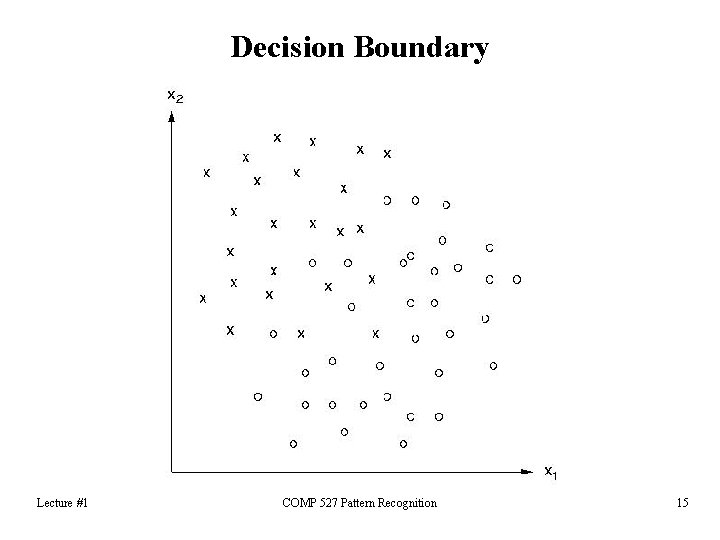
Classification of N Classes: can be thought as partitioning the feature space into N regions, as non overlapping as possible, so that each region represents one of the N classes. Often called Decision Theoretic Approach Decision Boundaries: the boundaries between the class regions in the feature space. Discriminant Functions: mathematical functions to describe the decision boundaries. Types of Classifiers: depending on the functional form of the decision boundary, classifiers may be categorized into: – Linear classifier – Quadratic classifier – Piecewise classifier Lecture #1 COMP 527 Pattern Recognition 14
Decision Boundary Lecture #1 COMP 527 Pattern Recognition 15
Summary • Three main components: features, data model, and recognition algorithm. • Make sure you find out a good set of features to work with before you build data models. • Data modeling requires knowledge of statistics and optimization. • Recognition requires classifier design (i. e. the discriminant functions), search, and algorithm design. • Evaluation involves testing on unseen test data which must be large enough in order to claim statistical significance. Lecture #1 COMP 527 Pattern Recognition 16