
Pattern Recognition Topic 1 Principle Component Analysis Shapiro

- Slides: 22
Pattern Recognition Topic 1: Principle Component Analysis Shapiro chap Duda & Hart chap • Features • Principle Components Analysis (PCA) • Bayes Decision Theory • Gaussian Normal Density Dr. Ng Teck Khim CS 4243 Computer Vision and Pattern Recognition Basics 1
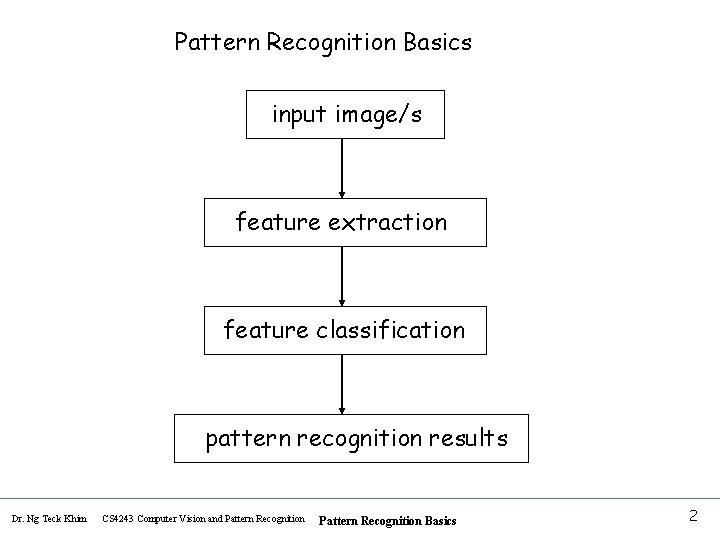
Pattern Recognition Basics input image/s feature extraction feature classification pattern recognition results Dr. Ng Teck Khim CS 4243 Computer Vision and Pattern Recognition Basics 2
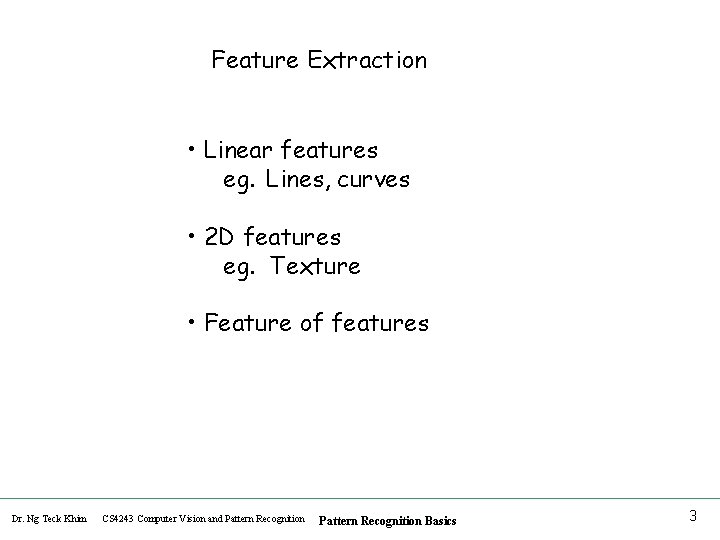
Feature Extraction • Linear features eg. Lines, curves • 2 D features eg. Texture • Feature of features Dr. Ng Teck Khim CS 4243 Computer Vision and Pattern Recognition Basics 3
Feature Extraction • A good feature should be invariant to changes in • • Dr. Ng Teck Khim scale rotation translation illumination CS 4243 Computer Vision and Pattern Recognition Basics 4
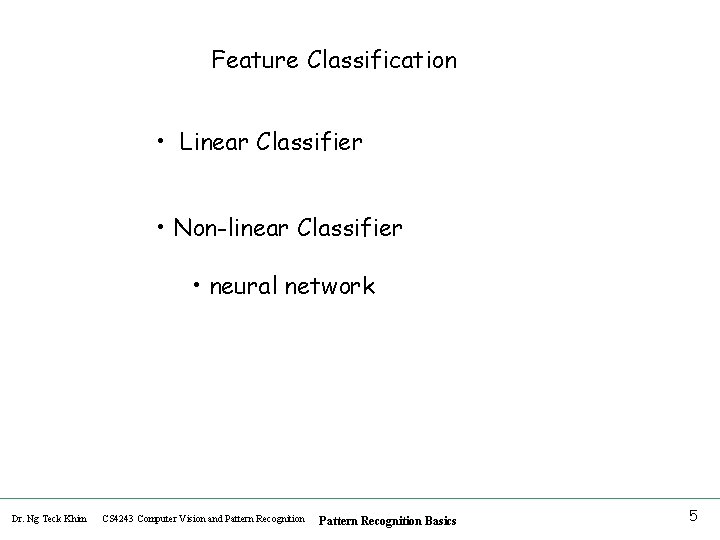
Feature Classification • Linear Classifier • Non-linear Classifier • neural network Dr. Ng Teck Khim CS 4243 Computer Vision and Pattern Recognition Basics 5
Pattern Recognition Principle Components Analysis (Karhunen-Loeve Transformation) • Principle components analysis and its interpretation • Applications Dr. Ng Teck Khim CS 4243 Computer Vision and Pattern Recognition Basics 6
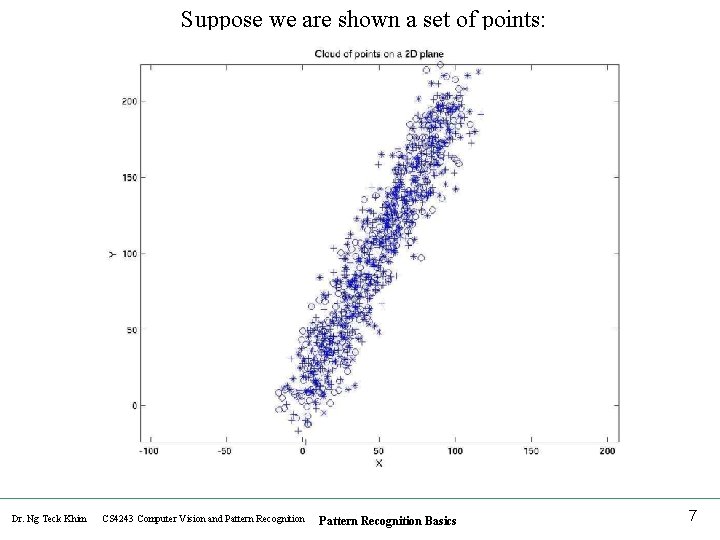
Suppose we are shown a set of points: Dr. Ng Teck Khim CS 4243 Computer Vision and Pattern Recognition Basics 7
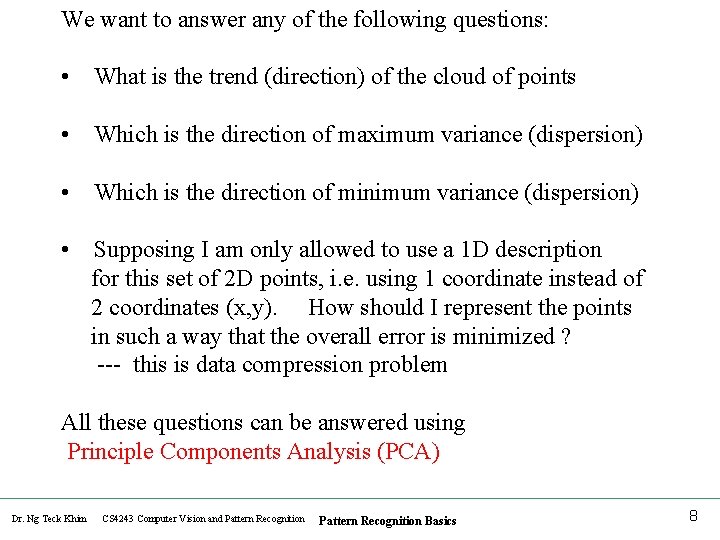
We want to answer any of the following questions: • What is the trend (direction) of the cloud of points • Which is the direction of maximum variance (dispersion) • Which is the direction of minimum variance (dispersion) • Supposing I am only allowed to use a 1 D description for this set of 2 D points, i. e. using 1 coordinate instead of 2 coordinates (x, y). How should I represent the points in such a way that the overall error is minimized ? --- this is data compression problem All these questions can be answered using Principle Components Analysis (PCA) Dr. Ng Teck Khim CS 4243 Computer Vision and Pattern Recognition Basics 8
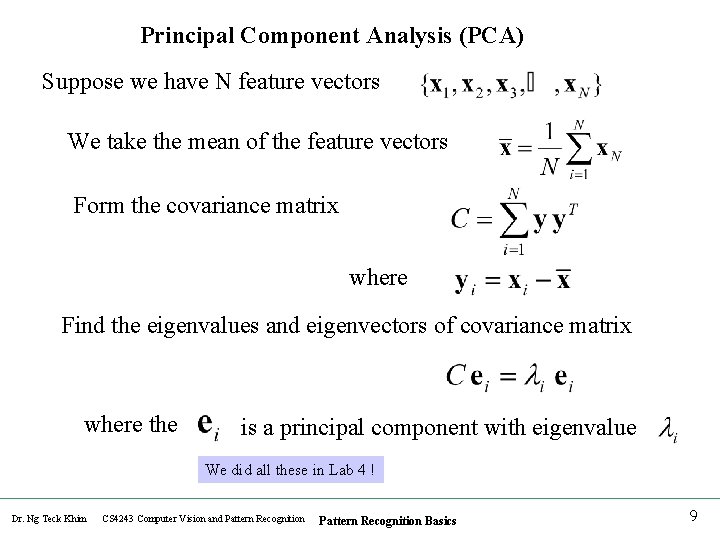
Principal Component Analysis (PCA) Suppose we have N feature vectors We take the mean of the feature vectors Form the covariance matrix where Find the eigenvalues and eigenvectors of covariance matrix where the is a principal component with eigenvalue We did all these in Lab 4 ! Dr. Ng Teck Khim CS 4243 Computer Vision and Pattern Recognition Basics 9
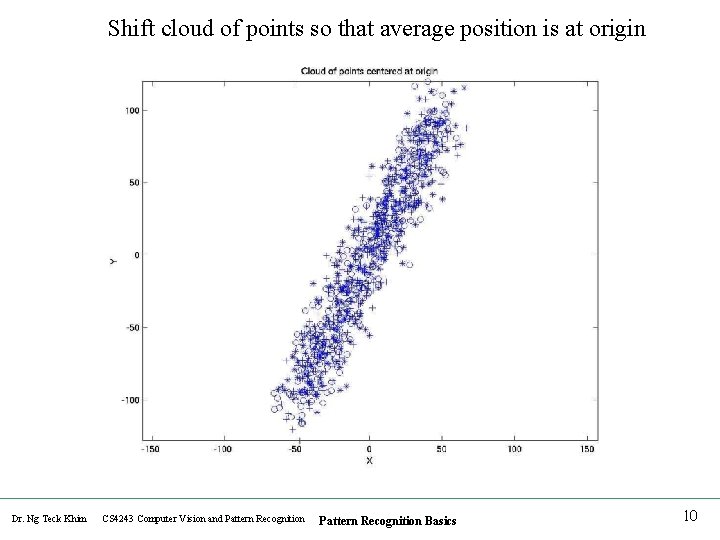
Shift cloud of points so that average position is at origin Dr. Ng Teck Khim CS 4243 Computer Vision and Pattern Recognition Basics 10
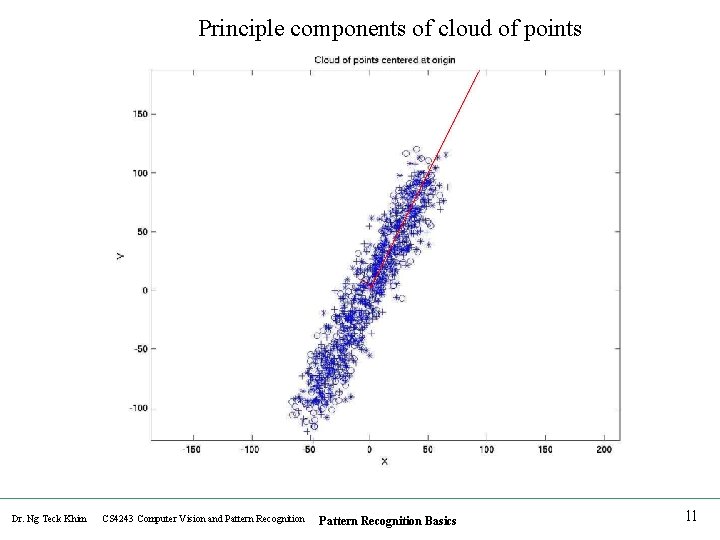
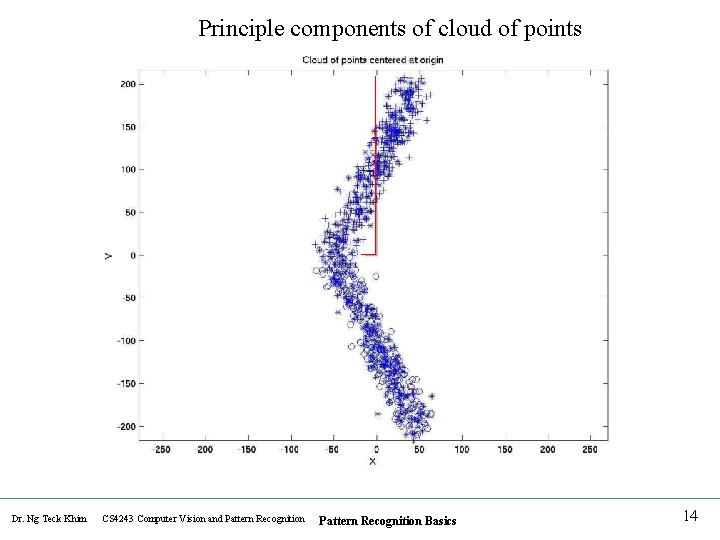
Principle components of cloud of points Dr. Ng Teck Khim CS 4243 Computer Vision and Pattern Recognition Basics 11
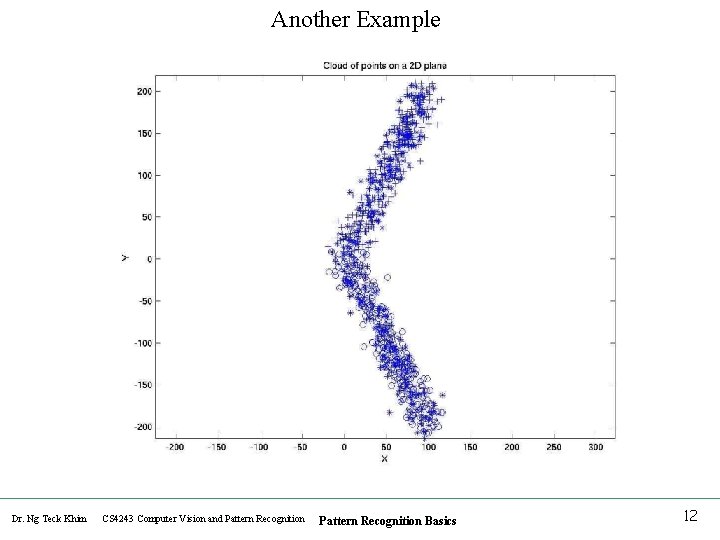
Another Example Dr. Ng Teck Khim CS 4243 Computer Vision and Pattern Recognition Basics 12
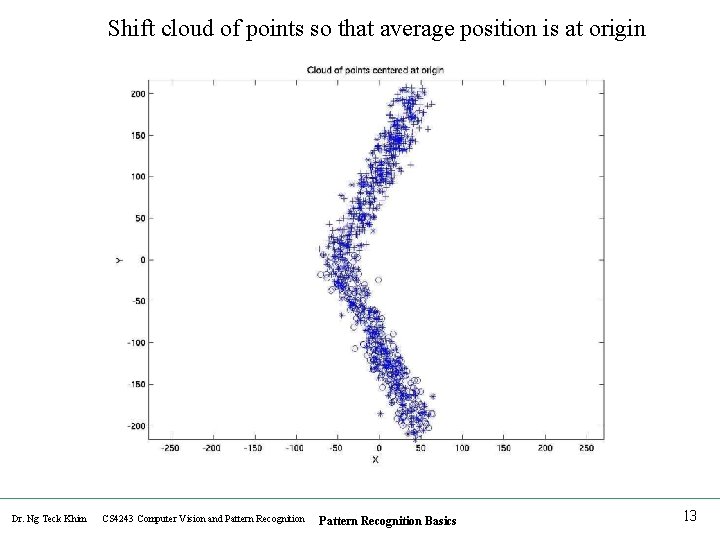
Shift cloud of points so that average position is at origin Dr. Ng Teck Khim CS 4243 Computer Vision and Pattern Recognition Basics 13
Principle components of cloud of points Dr. Ng Teck Khim CS 4243 Computer Vision and Pattern Recognition Basics 14
One problem with PCA when applied directly to the covariance matrix of the images is that the dimension of covariance matrix is huge! For example, for a 256 x 256 image, X will be of dimension 65536 x 1. So the covariance matrix of X will be of size 65536 x 65536 !!! To compute the eigenvector of such a huge matrix is clearly inconceivable. To solve this problem, Murakami and Kumar proposed a technique in the following paper: Murakami, H. and Vijaya Kumar, B. V. K. , “Efficient Calculation of Primary Images from a Set of Images”, IEEE Trans. Pattern Analysis and Machine Intelligence, vol. PAMI-4, No. 5, Sep 1982. We shall now look at this method. In the lab, you will practice implementing this algorithm for getting principle components from huge feature vectors. We will use a face recognition example in the lab. Dr. Ng Teck Khim CS 4243 Computer Vision and Pattern Recognition Basics 15
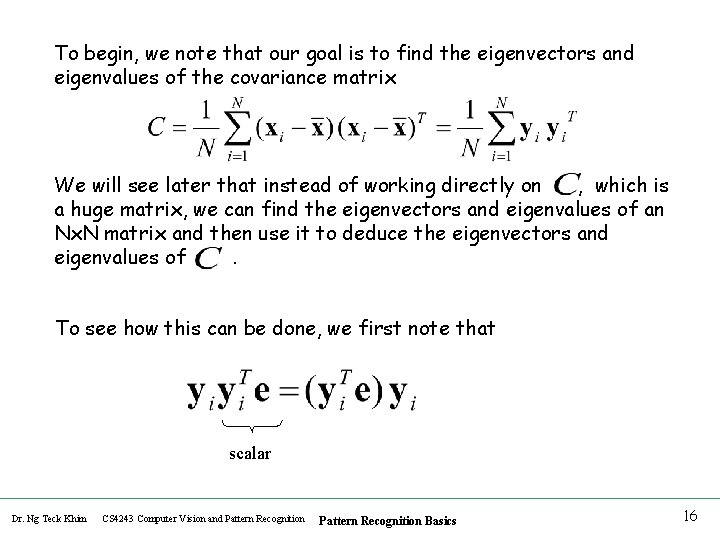
To begin, we note that our goal is to find the eigenvectors and eigenvalues of the covariance matrix We will see later that instead of working directly on , which is a huge matrix, we can find the eigenvectors and eigenvalues of an Nx. N matrix and then use it to deduce the eigenvectors and eigenvalues of. To see how this can be done, we first note that scalar Dr. Ng Teck Khim CS 4243 Computer Vision and Pattern Recognition Basics 16
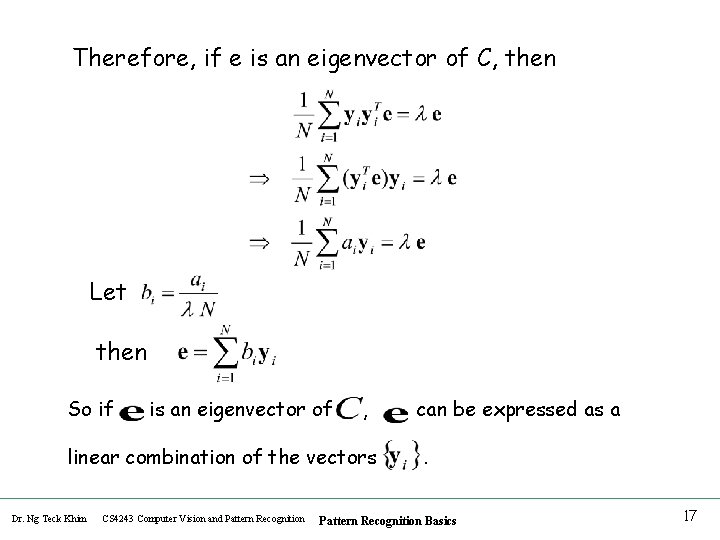
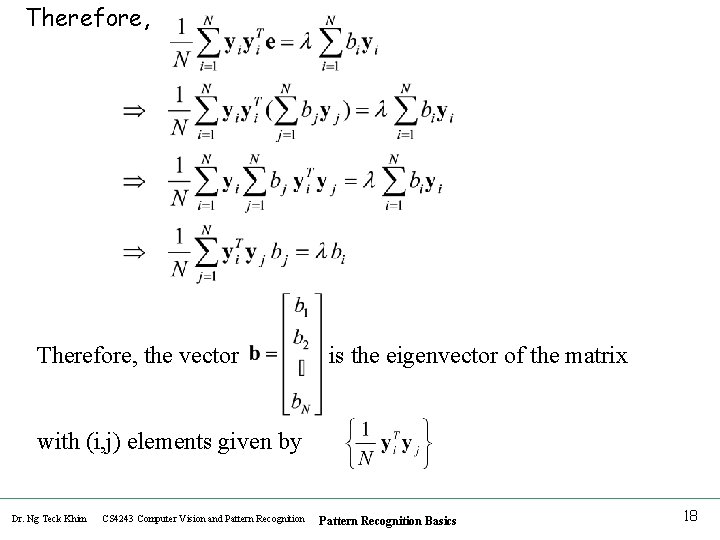
Therefore, if e is an eigenvector of C, then Let then So if is an eigenvector of , linear combination of the vectors Dr. Ng Teck Khim CS 4243 Computer Vision and Pattern Recognition can be expressed as a. Pattern Recognition Basics 17
Therefore, the vector is the eigenvector of the matrix with (i, j) elements given by Dr. Ng Teck Khim CS 4243 Computer Vision and Pattern Recognition Basics 18
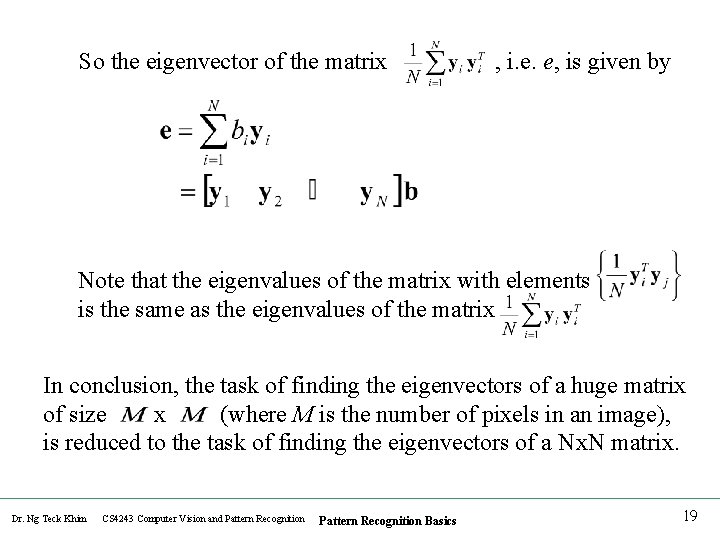
So the eigenvector of the matrix , i. e. e, is given by Note that the eigenvalues of the matrix with elements is the same as the eigenvalues of the matrix In conclusion, the task of finding the eigenvectors of a huge matrix of size x (where M is the number of pixels in an image), is reduced to the task of finding the eigenvectors of a Nx. N matrix. Dr. Ng Teck Khim CS 4243 Computer Vision and Pattern Recognition Basics 19
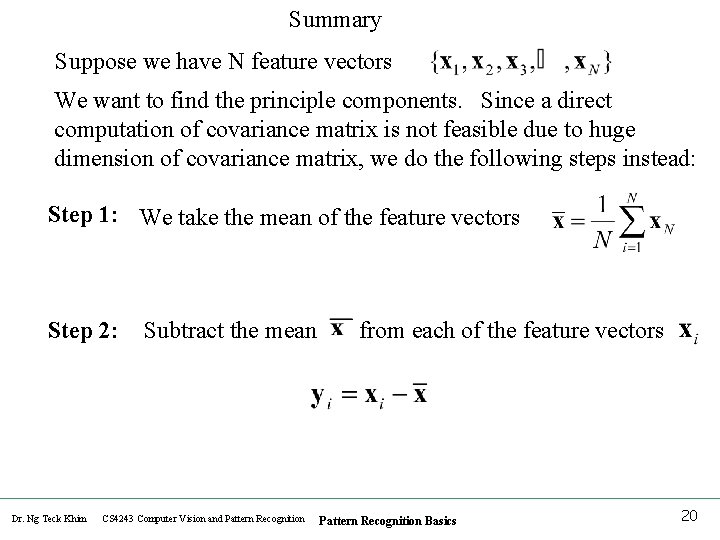
Summary Suppose we have N feature vectors We want to find the principle components. Since a direct computation of covariance matrix is not feasible due to huge dimension of covariance matrix, we do the following steps instead: Step 1: We take the mean of the feature vectors Step 2: Dr. Ng Teck Khim Subtract the mean CS 4243 Computer Vision and Pattern Recognition from each of the feature vectors Pattern Recognition Basics 20
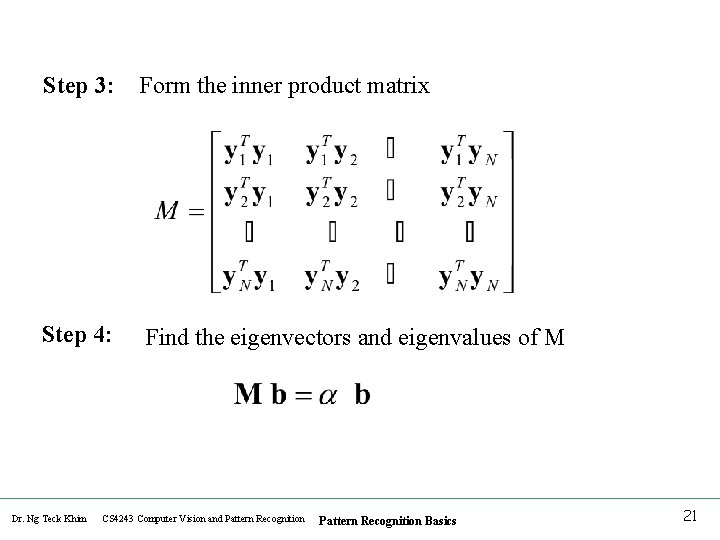
Step 3: Form the inner product matrix Step 4: Find the eigenvectors and eigenvalues of M Dr. Ng Teck Khim CS 4243 Computer Vision and Pattern Recognition Basics 21
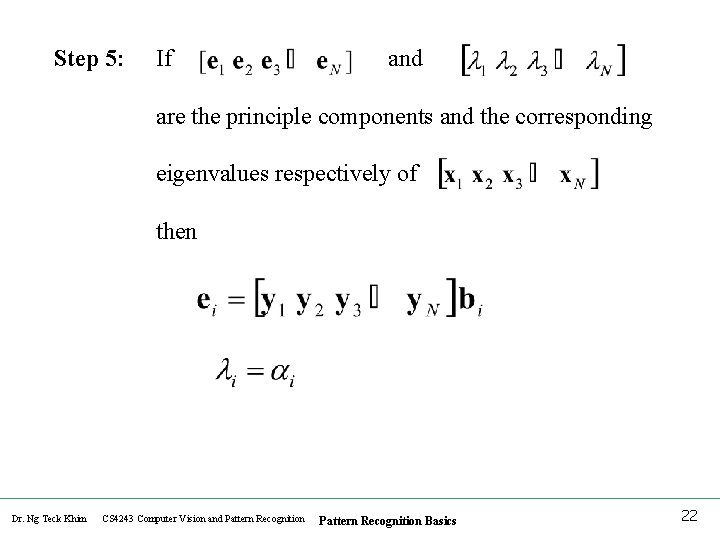
Step 5: If and are the principle components and the corresponding eigenvalues respectively of then Dr. Ng Teck Khim CS 4243 Computer Vision and Pattern Recognition Basics 22