
PATTERN RECOGNITION STRATEGIES DETECTION OF FAST TRANSIENTS AS
- Slides: 6
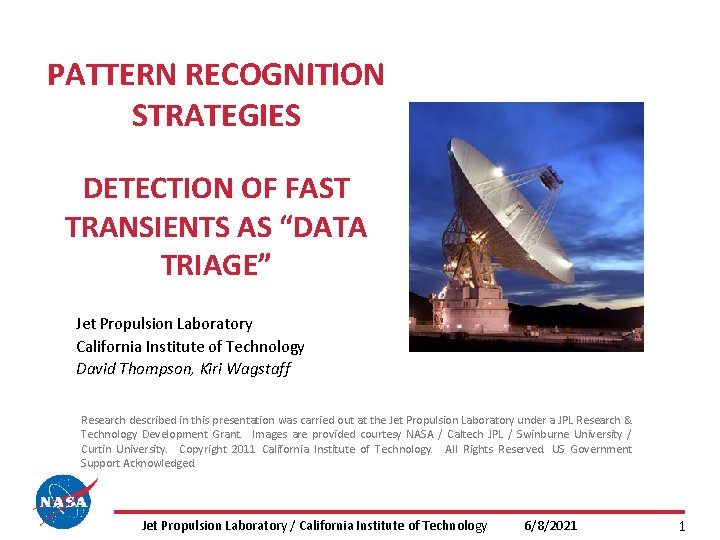
PATTERN RECOGNITION STRATEGIES DETECTION OF FAST TRANSIENTS AS “DATA TRIAGE” Jet Propulsion Laboratory California Institute of Technology David Thompson, Kiri Wagstaff Research described in this presentation was carried out at the Jet Propulsion Laboratory under a JPL Research & Technology Development Grant. Images are provided courtesy NASA / Caltech JPL / Swinburne University / Curtin University. Copyright 2011 California Institute of Technology. All Rights Reserved. US Government Support Acknowledged. Jet Propulsion Laboratory / California Institute of Technology 6/8/2021 1
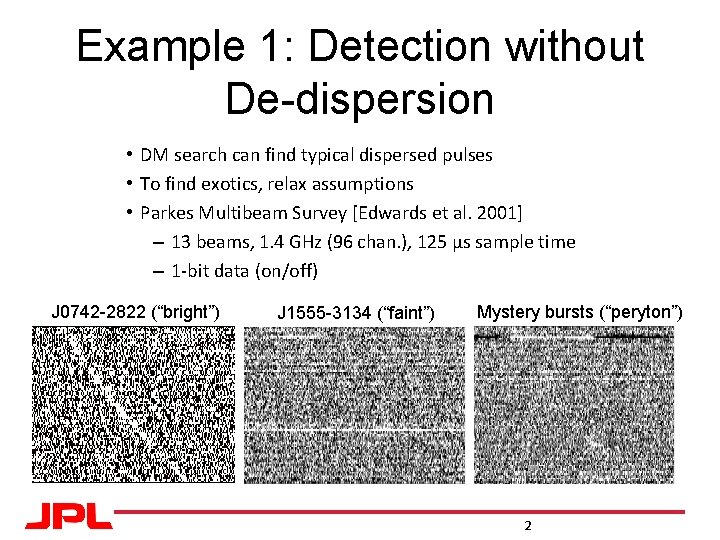
Example 1: Detection without De-dispersion • DM search can find typical dispersed pulses • To find exotics, relax assumptions • Parkes Multibeam Survey [Edwards et al. 2001] – 13 beams, 1. 4 GHz (96 chan. ), 125 μs sample time – 1 -bit data (on/off) J 0742 -2822 (“bright”) J 1555 -3134 (“faint”) Mystery bursts (“peryton”) 2
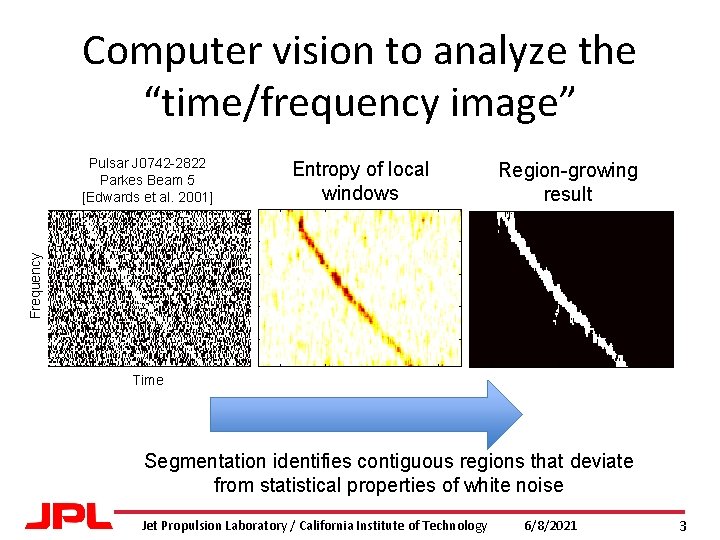
Computer vision to analyze the “time/frequency image” Entropy of local windows Region-growing result Frequency Pulsar J 0742 -2822 Parkes Beam 5 [Edwards et al. 2001] Time Segmentation identifies contiguous regions that deviate from statistical properties of white noise Jet Propulsion Laboratory / California Institute of Technology 6/8/2021 3
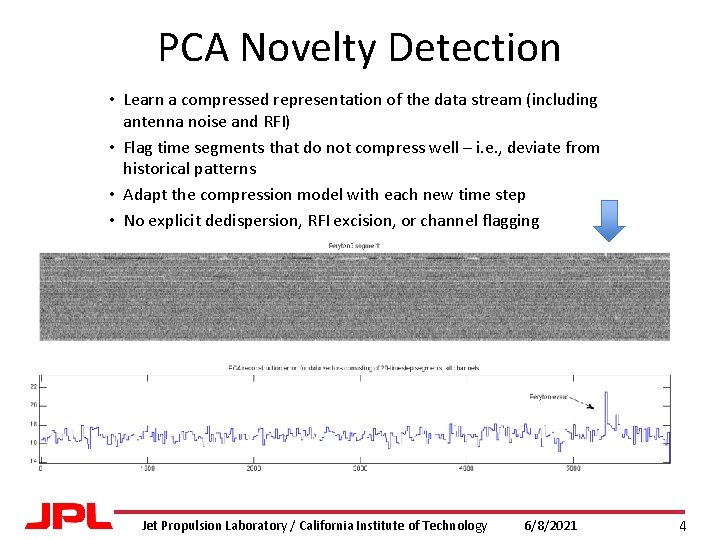
PCA Novelty Detection • Learn a compressed representation of the data stream (including antenna noise and RFI) • Flag time segments that do not compress well – i. e. , deviate from historical patterns • Adapt the compression model with each new time step • No explicit dedispersion, RFI excision, or channel flagging Jet Propulsion Laboratory / California Institute of Technology 6/8/2021 4
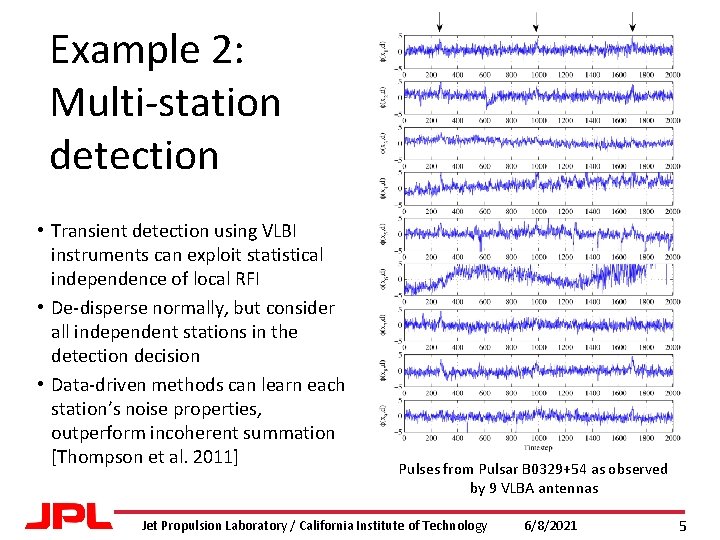
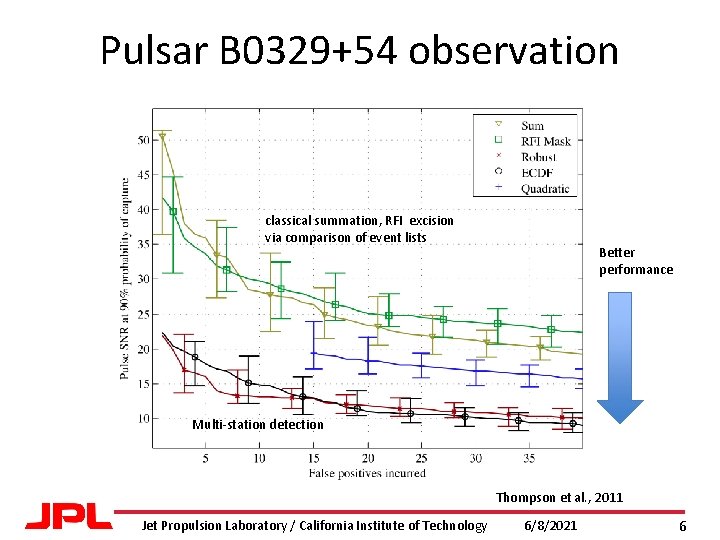
Example 2: Multi-station detection • Transient detection using VLBI instruments can exploit statistical independence of local RFI • De-disperse normally, but consider all independent stations in the detection decision • Data-driven methods can learn each station’s noise properties, outperform incoherent summation [Thompson et al. 2011] Pulses from Pulsar B 0329+54 as observed by 9 VLBA antennas Jet Propulsion Laboratory / California Institute of Technology 6/8/2021 5
Pulsar B 0329+54 observation classical summation, RFI excision via comparison of event lists Better performance Multi-station detection Thompson et al. , 2011 Jet Propulsion Laboratory / California Institute of Technology 6/8/2021 6