
Pattern Recognition Problems in Computational Linguistics Information Retrieval
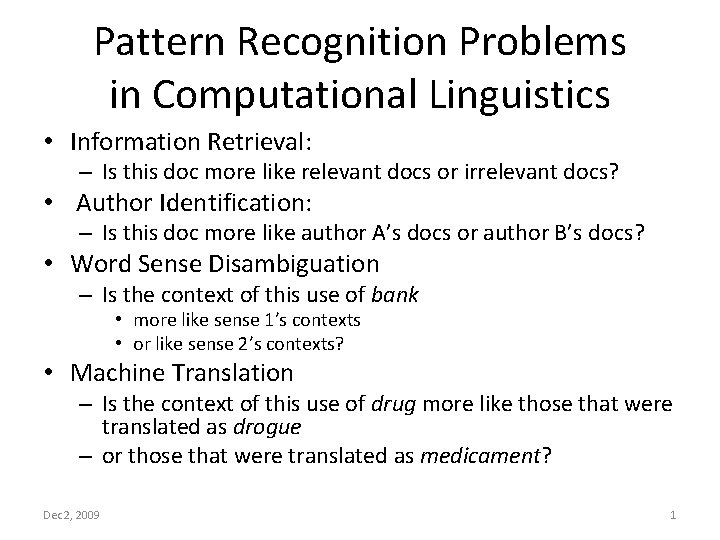
Pattern Recognition Problems in Computational Linguistics • Information Retrieval: – Is this doc more like relevant docs or irrelevant docs? • Author Identification: – Is this doc more like author A’s docs or author B’s docs? • Word Sense Disambiguation – Is the context of this use of bank • more like sense 1’s contexts • or like sense 2’s contexts? • Machine Translation – Is the context of this use of drug more like those that were translated as drogue – or those that were translated as medicament? Dec 2, 2009 1
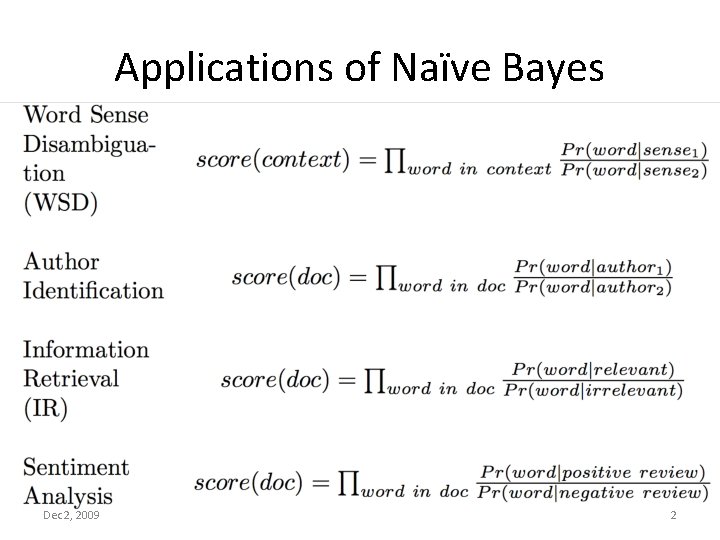
Applications of Naïve Bayes Dec 2, 2009 2
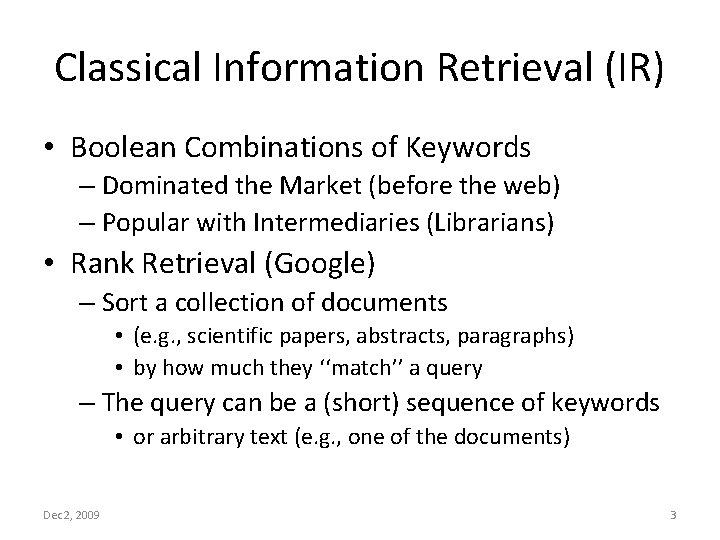
Classical Information Retrieval (IR) • Boolean Combinations of Keywords – Dominated the Market (before the web) – Popular with Intermediaries (Librarians) • Rank Retrieval (Google) – Sort a collection of documents • (e. g. , scientific papers, abstracts, paragraphs) • by how much they ‘‘match’’ a query – The query can be a (short) sequence of keywords • or arbitrary text (e. g. , one of the documents) Dec 2, 2009 3
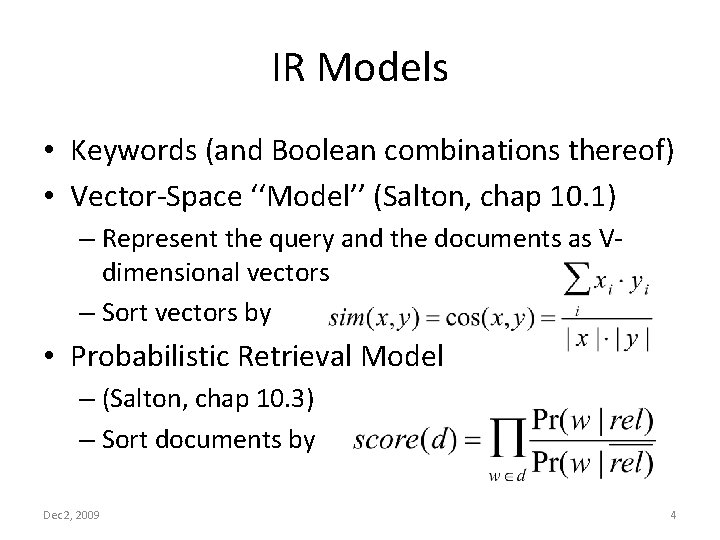
IR Models • Keywords (and Boolean combinations thereof) • Vector-Space ‘‘Model’’ (Salton, chap 10. 1) – Represent the query and the documents as Vdimensional vectors – Sort vectors by • Probabilistic Retrieval Model – (Salton, chap 10. 3) – Sort documents by Dec 2, 2009 4
Motivation for Information Retrieval (circa 1990, about 5 years before web) • Text is available like never before • Currently, N≈100 million words – and projections run as high as 1015 bytes by 2000! • What can we do with it all? – It is better to do something simple, – than nothing at all. • IR vs. Natural Language Understanding – Revival of 1950 -style empiricism Dec 2, 2009 5
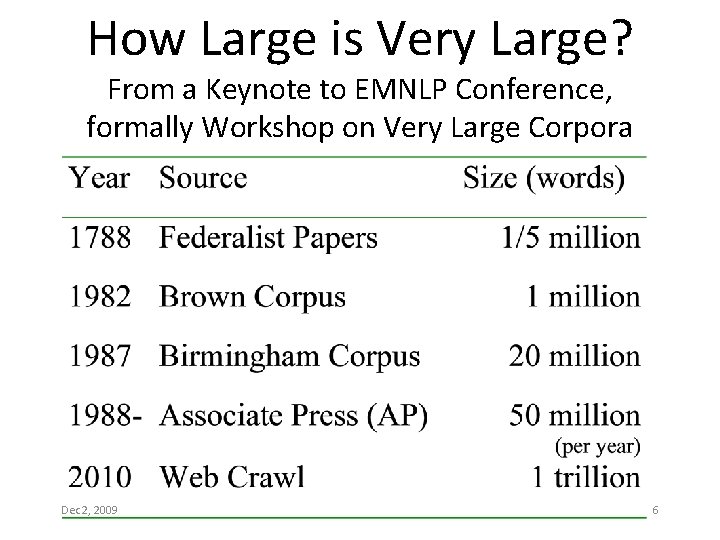
How Large is Very Large? From a Keynote to EMNLP Conference, formally Workshop on Very Large Corpora Dec 2, 2009 6
Rising Tide of Data Lifts All Boats If you have a lot of data, then you don’t need a lot of methodology • 1985: “There is no data like more data” – Fighting words uttered by radical fringe elements (Mercer at Arden House) • 1993 Workshop on Very Large Corpora – Perfect timing: Just before the web – Couldn’t help but succeed – Fate • 1995: The Web changes everything • All you need is data (magic sauce) – – – Dec 2, 2009 No linguistics No artificial intelligence (representation) No machine learning No statistics No error analysis 7
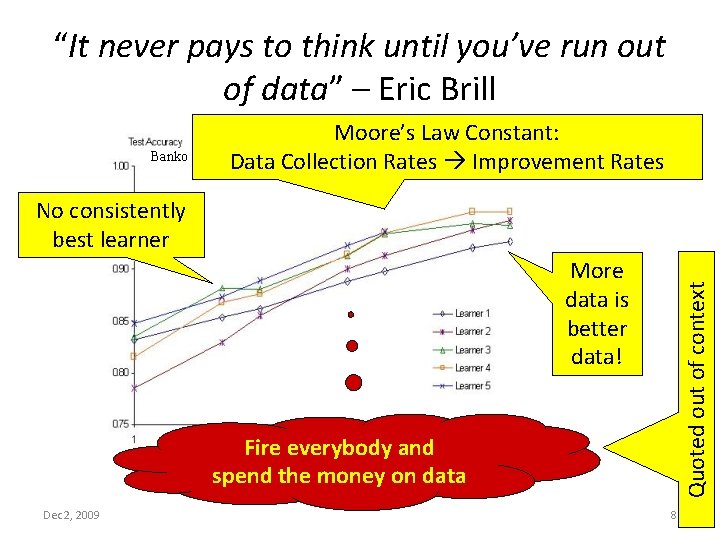
“It never pays to think until you’ve run out of data” – Eric Brill Moore’s Law Constant: Banko & Brill: Mitigating the Paucity-of-Data Problem (HLT 2001) Data Collection Rates Improvement Rates No consistently best learner Quoted out of context More data is better data! Fire everybody and spend the money on data Dec 2, 2009 8
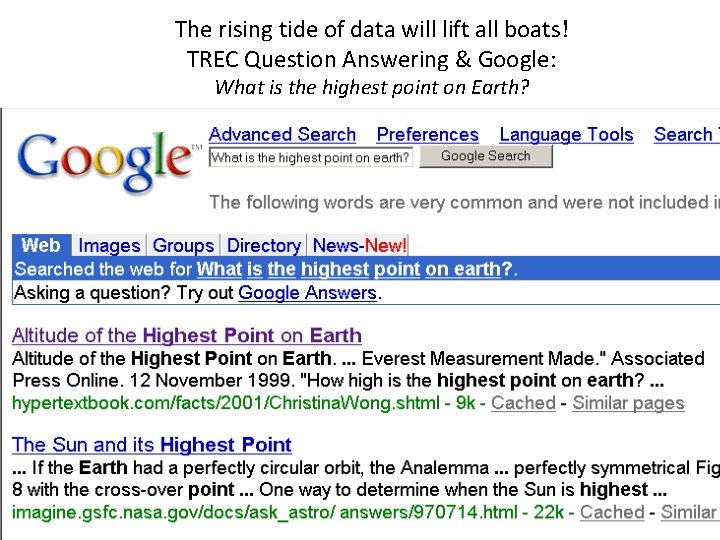
The rising tide of data will lift all boats! TREC Question Answering & Google: What is the highest point on Earth? Dec 2, 2009 9
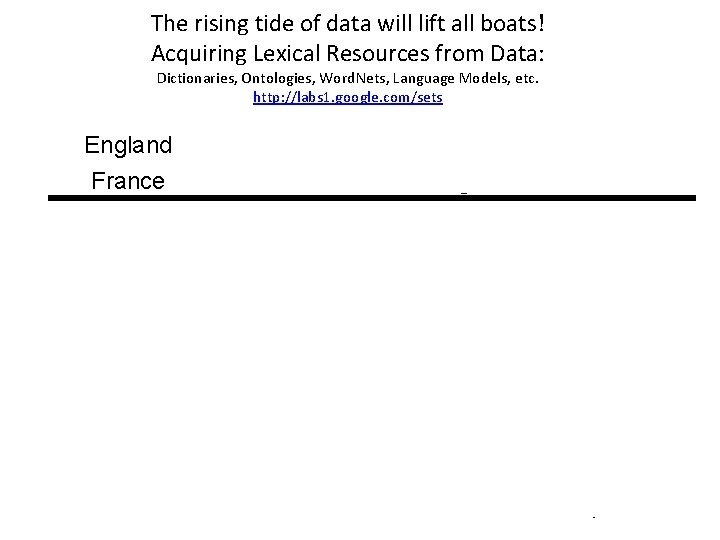
The rising tide of data will lift all boats! Acquiring Lexical Resources from Data: Dictionaries, Ontologies, Word. Nets, Language Models, etc. http: //labs 1. google. com/sets England France Germany Italy Ireland Spain Scotland Belgium Canada Austria Dec Australia 2, 2009 Japan China India Indonesia Cat Dog Horse Fish Malaysia Korea Taiwan Thailand Singapore Australia Bangladesh Bird Rabbit Cattle Rat Livestock Mouse Human cat more ls rm mv cd cp mkdir man tail pwd 10
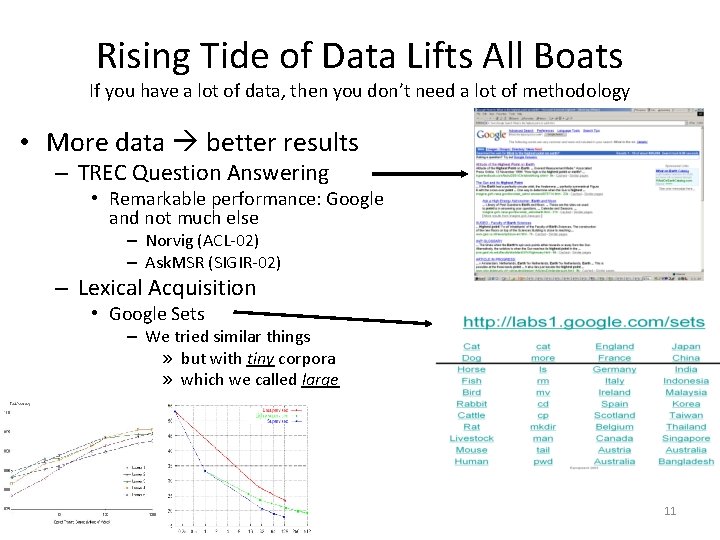
Rising Tide of Data Lifts All Boats If you have a lot of data, then you don’t need a lot of methodology • More data better results – TREC Question Answering • Remarkable performance: Google and not much else – Norvig (ACL-02) – Ask. MSR (SIGIR-02) – Lexical Acquisition • Google Sets – We tried similar things » but with tiny corpora » which we called large Dec 2, 2009 11
Entropy of Search Logs - How Big is the Web? - How Hard is Search? - With Personalization? With Backoff? Qiaozhu Mei†, Kenneth Church‡ † University of Illinois at Urbana-Champaign ‡ Microsoft Research Dec 2, 2009 12
How Big is the Web? Small 5 B? 20 B? More? Less? • What if a small cache of millions of pages – Could capture much of the value of billions? • Could a Big bet on a cluster in the clouds – Turn into a big liability? • Examples of Big Bets – Computer Centers & Clusters • Capital (Hardware) • Expense (Power) • Dev (Mapreduce, GFS, Big Table, etc. ) – Sales & Marketing >> Production & Distribution Dec 2, 2009 13
Millions (Not Billions) Dec 2, 2009 14
Population Bound • With all the talk about the Long Tail – You’d think that the Web was astronomical – Carl Sagan: Billions and Billions… • Lower Distribution $$ Sell Less of More • But there are limits to this process – Net. Flix: 55 k movies (not even millions) – Amazon: 8 M products – Vanity Searches: Infinite? ? ? • Personal Home Pages << Phone Book < Population • Business Home Pages << Yellow Pages < Population • Millions, not Billions (until market saturates) Dec 2, 2009 15
It Will Take Decades to Reach Population Bound • Most people (and products) – don’t have a web page (yet) • Currently, I can find famous people • (and academics) • but not my neighbors – There aren’t that many famous people • (and academics)… – Millions, not billions • (for the foreseeable future) Dec 2, 2009 16
Equilibrium: Supply = Demand • If there is a page on the web, – And no one sees it, – Did it make a sound? • How big is the web? – Should we count “silent” pages – That don’t make a sound? • How many products are there? – Do we count “silent” flops – That no one buys? Dec 2, 2009 17
Demand Side Accounting • Consumers have limited time – Telephone Usage: 1 hour per line per day – TV: 4 hours per day – Web: ? ? ? hours per day • Suppliers will post as many pages as consumers can consume (and no more) • Size of Web: O(Consumers) Dec 2, 2009 18
How Big is the Web? • Related questions come up in language • How big is English? How many words – Dictionary Marketing do people know? – Education (Testing of Vocabulary Size) – Psychology – Statistics – Linguistics What is a word? • Two Very Different Answers Person? Know? – Chomsky: language is infinite – Shannon: 1. 25 bits per character Dec 2, 2009 19
Chomskian Argument: Web is Infinite • One could write a malicious spider trap – http: //successor. aspx? x=0 http: //successor. aspx? x=1 http: //successor. aspx? x=2 • Not just academic exercise • Web is full of benign examples like – http: //calendar. duke. edu/ – Infinitely many months – Each month has a link to the next Dec 2, 2009 20
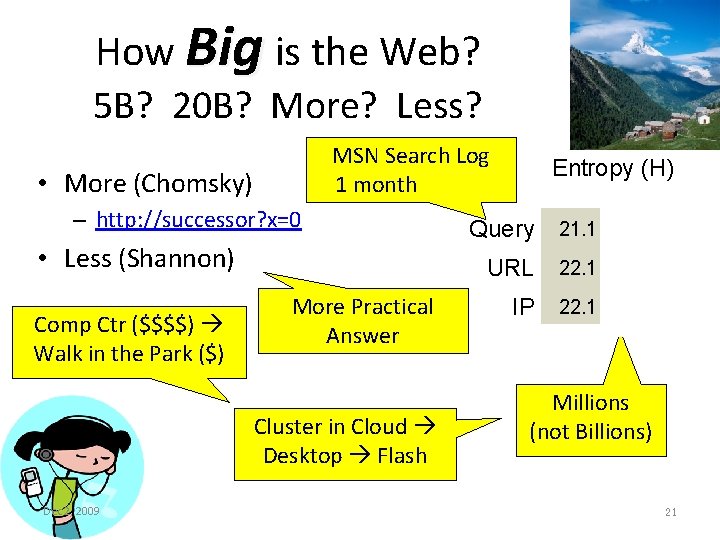
How Big is the Web? 5 B? 20 B? More? Less? MSN Search Log 1 month x 18 • More (Chomsky) – http: //successor? x=0 • Less (Shannon) Comp Ctr ($$$$) Walk in the Park ($) Entropy (H) Query 21. 1 22. 9 URL 22. 1 22. 4 More Practical IP Answer All But IP 22. 1 22. 6 23. 9 All But URL 26. 0 Millions All But Query(not Billions) 27. 1 Cluster in Cloud Desktop Flash All Three 27. 2 Dec 2, 2009 21
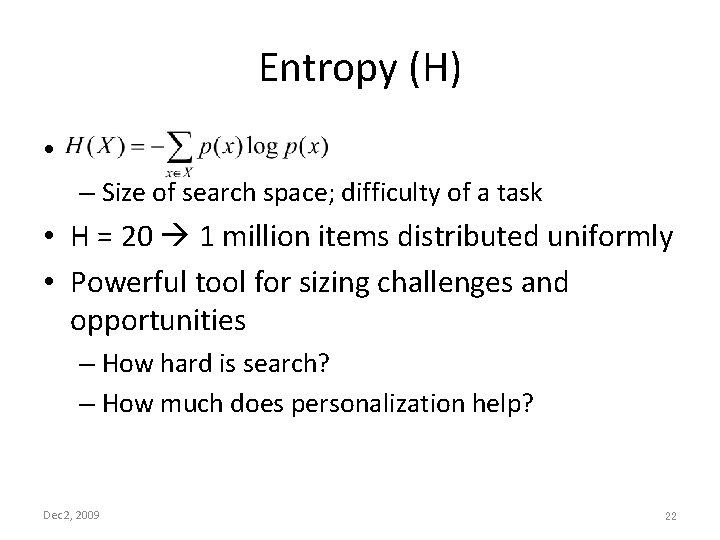
Entropy (H) • – Size of search space; difficulty of a task • H = 20 1 million items distributed uniformly • Powerful tool for sizing challenges and opportunities – How hard is search? – How much does personalization help? Dec 2, 2009 22
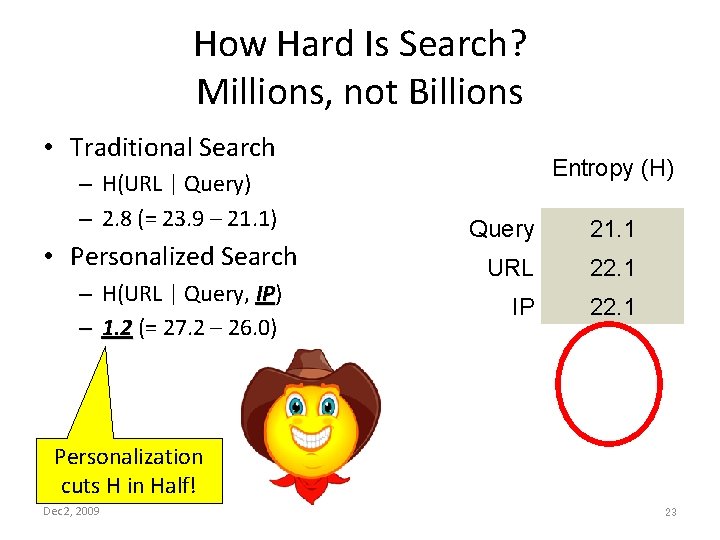
How Hard Is Search? Millions, not Billions • Traditional Search – H(URL | Query) – 2. 8 (= 23. 9 – 21. 1) • Personalized Search – H(URL | Query, IP) IP – 1. 2 (= 27. 2 – 26. 0) Personalization cuts H in Half! Dec 2, 2009 Entropy (H) Query 21. 1 URL 22. 1 IP 22. 1 All But IP 23. 9 All But URL 26. 0 All But Query 27. 1 All Three 27. 2 23
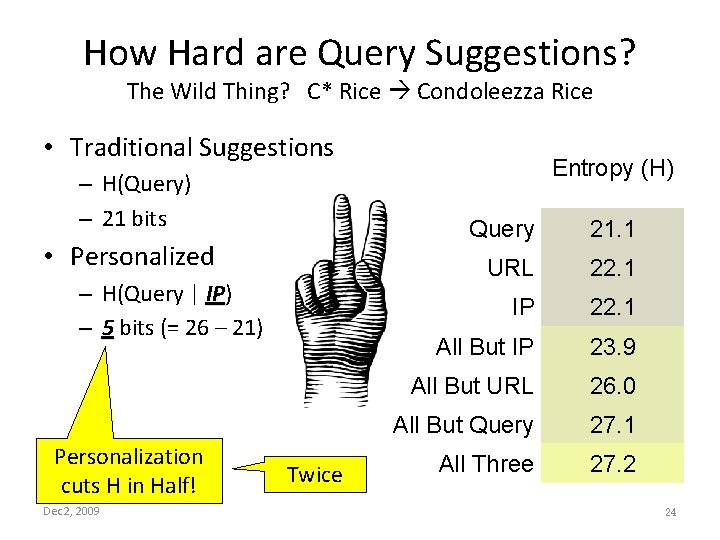
How Hard are Query Suggestions? The Wild Thing? C* Rice Condoleezza Rice • Traditional Suggestions – H(Query) – 21 bits • Personalized – H(Query | IP) IP – 5 bits (= 26 – 21) Personalization cuts H in Half! Dec 2, 2009 Twice Entropy (H) Query 21. 1 URL 22. 1 IP 22. 1 All But IP 23. 9 All But URL 26. 0 All But Query 27. 1 All Three 27. 2 24
Personalization with Backoff • Ambiguous query: MSG – Madison Square Garden – Monosodium Glutamate • Disambiguate based on user’s prior clicks • When we don’t have data – Backoff to classes of users • Proof of Concept: – Classes defined by IP addresses • Better: – Market Segmentation (Demographics) – Collaborative Filtering (Other users who click like me) Dec 2, 2009 25
Conclusions: Millions (not Billions) • How Big is the Web? – Upper bound: O(Population) • Not Billions • Not Infinite • Shannon >> Chomsky – How hard is search? – Query Suggestions? – Personalization? Entropy is a great hammer • Cluster in Cloud ($$$$) Walk-in-the-Park ($) Dec 2, 2009 26
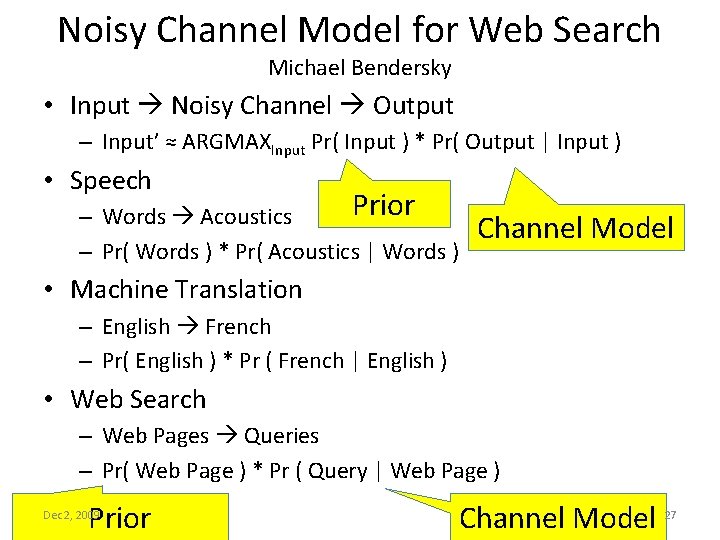
Noisy Channel Model for Web Search Michael Bendersky • Input Noisy Channel Output – Input’ ≈ ARGMAXInput Pr( Input ) * Pr( Output | Input ) • Speech Prior – Words Acoustics – Pr( Words ) * Pr( Acoustics | Words ) Channel Model • Machine Translation – English French – Pr( English ) * Pr ( French | English ) • Web Search – Web Pages Queries – Pr( Web Page ) * Pr ( Query | Web Page ) Prior Dec 2, 2009 Channel Model 27
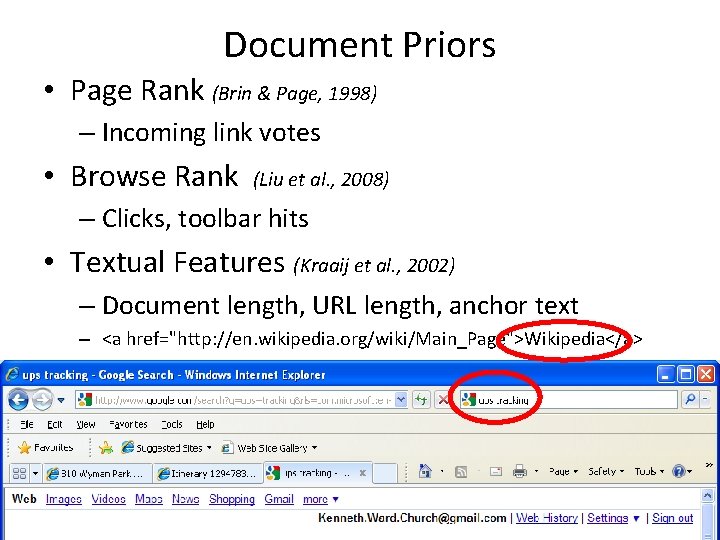
Document Priors • Page Rank (Brin & Page, 1998) – Incoming link votes • Browse Rank (Liu et al. , 2008) – Clicks, toolbar hits • Textual Features (Kraaij et al. , 2002) – Document length, URL length, anchor text – <a href="http: //en. wikipedia. org/wiki/Main_Page">Wikipedia</a> Dec 2, 2009 28
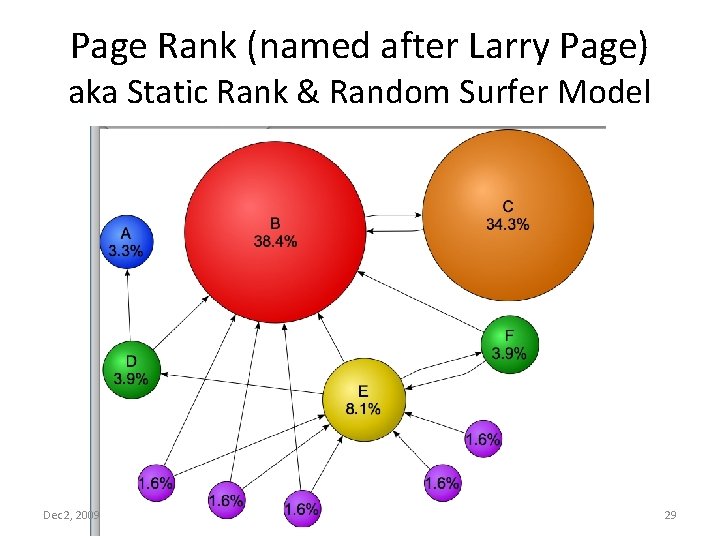
Page Rank (named after Larry Page) aka Static Rank & Random Surfer Model Dec 2, 2009 29
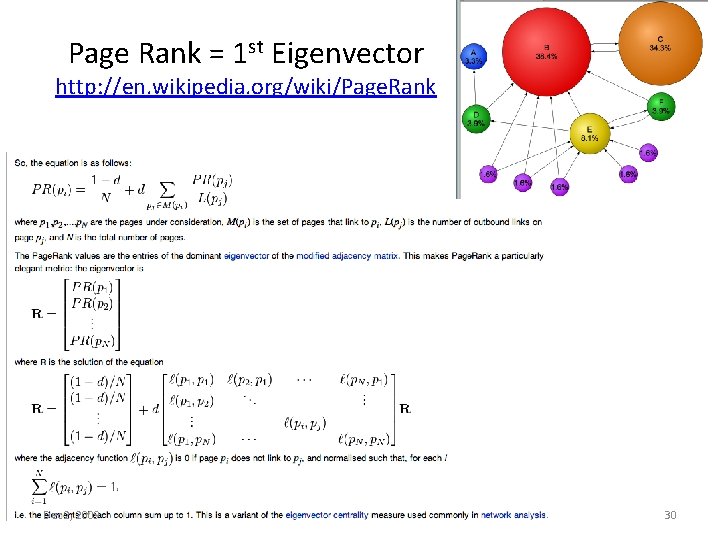
Page Rank = 1 st Eigenvector http: //en. wikipedia. org/wiki/Page. Rank Dec 2, 2009 30
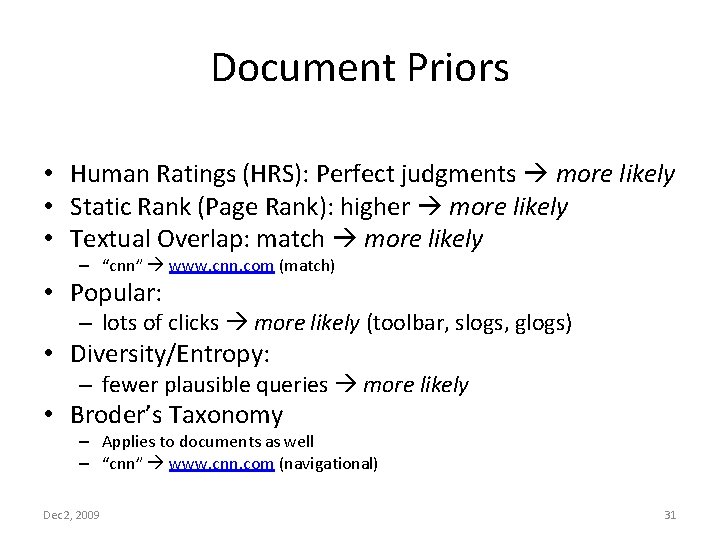
Document Priors • Human Ratings (HRS): Perfect judgments more likely • Static Rank (Page Rank): higher more likely • Textual Overlap: match more likely – “cnn” www. cnn. com (match) • Popular: – lots of clicks more likely (toolbar, slogs, glogs) • Diversity/Entropy: – fewer plausible queries more likely • Broder’s Taxonomy – Applies to documents as well – “cnn” www. cnn. com (navigational) Dec 2, 2009 31
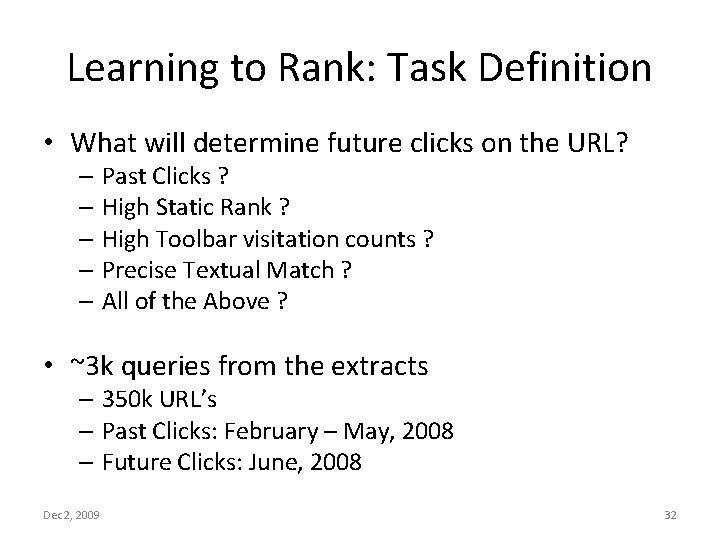
Learning to Rank: Task Definition • What will determine future clicks on the URL? – Past Clicks ? – High Static Rank ? – High Toolbar visitation counts ? – Precise Textual Match ? – All of the Above ? • ~3 k queries from the extracts – 350 k URL’s – Past Clicks: February – May, 2008 – Future Clicks: June, 2008 Dec 2, 2009 32
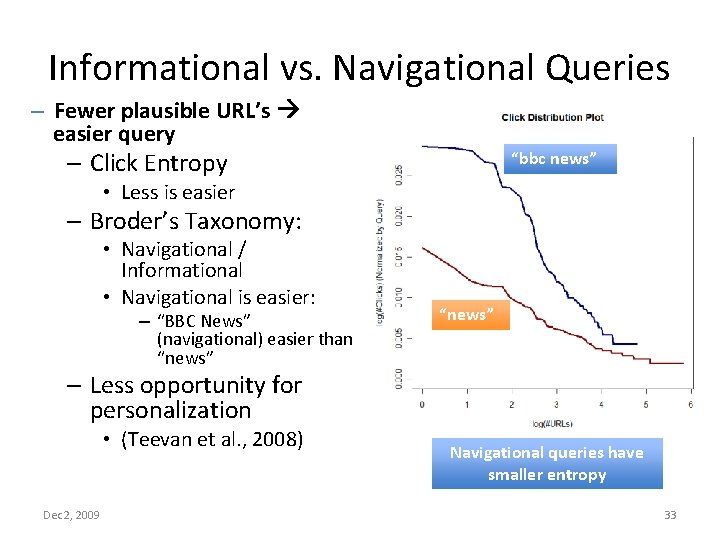
Informational vs. Navigational Queries – Fewer plausible URL’s easier query – Click Entropy “bbc news” • Less is easier – Broder’s Taxonomy: • Navigational / Informational • Navigational is easier: – “BBC News” (navigational) easier than “news” – Less opportunity for personalization • (Teevan et al. , 2008) Dec 2, 2009 Navigational queries have smaller entropy 33
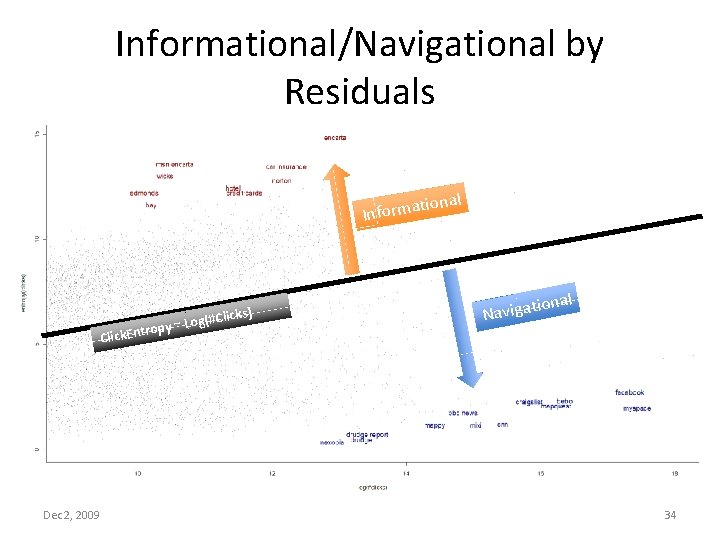
Informational/Navigational by Residuals tional a m r o f n I op ) (#Clicks y ~ Log tr Click. En Dec 2, 2009 al tion Naviga 34
Alternative Taxonomy: Click Types • Classify queries by type – Problem: query logs have no “informational/navigational” labels • Instead, we can use logs to categorize queries – Commercial Intent more ad clicks – Malleability more query suggestion clicks – Popularity more future clicks (anywhere) • Predict future clicks ( anywhere ) – Past Clicks: February – May, 2008 – Future Clicks: June, 2008 Dec 2, 2009 35
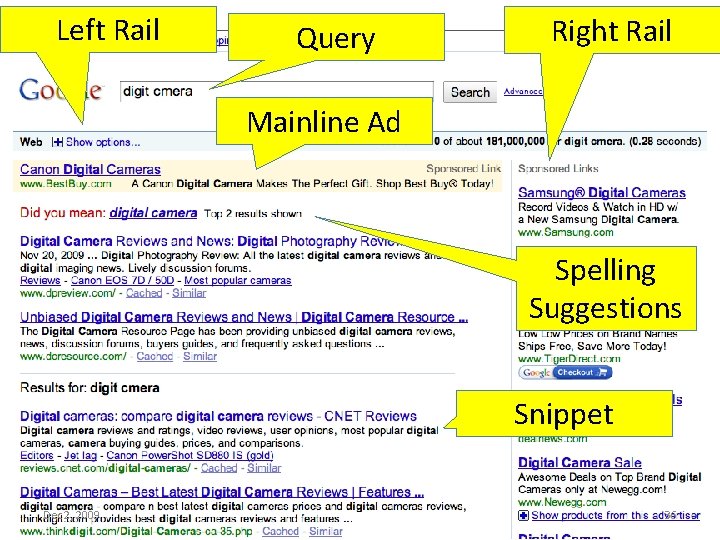
Left Rail Query Right Rail Mainline Ad Spelling Suggestions Snippet Dec 2, 2009 36
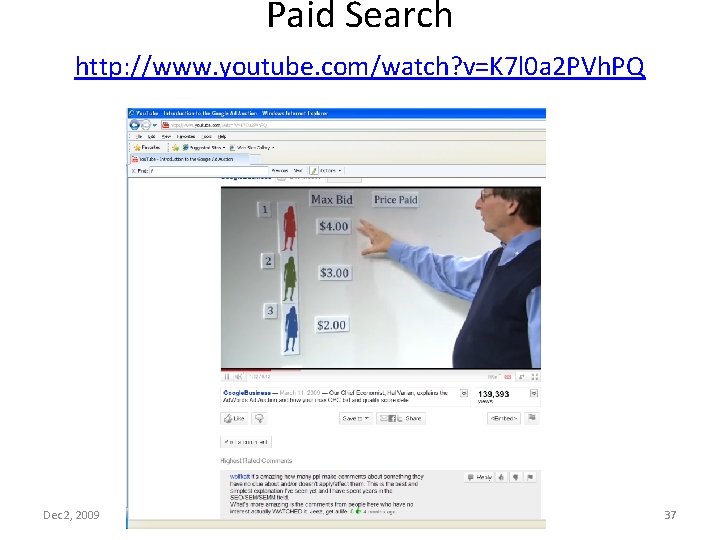
Paid Search http: //www. youtube. com/watch? v=K 7 l 0 a 2 PVh. PQ Dec 2, 2009 37
Summary: Information Retrieval (IR) • Boolean Combinations of Keywords – Popular with Intermediaries (Librarians) • Rank Retrieval – Sort a collection of documents • (e. g. , scientific papers, abstracts, paragraphs) • by how much they ‘‘match’’ a query – The query can be a (short) sequence of keywords • or arbitrary text (e. g. , one of the documents) • Logs of User Behavior (Clicks, Toolbar) – Solitaire Multi-Player Game: • Authors, Users, Advertisers, Spammers – More Users than Authors More Information in Logs than Docs – Learning to Rank: • Use Machine Learning to combine doc features & log features Dec 2, 2009 38
- Slides: 38