
Pattern Recognition and Machine Learning Fuzzy Sets in


![T- Norm For all x, y, z, u, v [0, 1] Identity : T(x,](https://slidetodoc.com/presentation_image/5a04e4b0039838705c097c9e06ce1019/image-6.jpg "T- Norm For all x, y, z, u, v [0, 1] Identity : T(x,")


- Slides: 38
Pattern Recognition and Machine Learning (Fuzzy Sets in Pattern Recognition) Debrup Chakraborty CINVESTAV
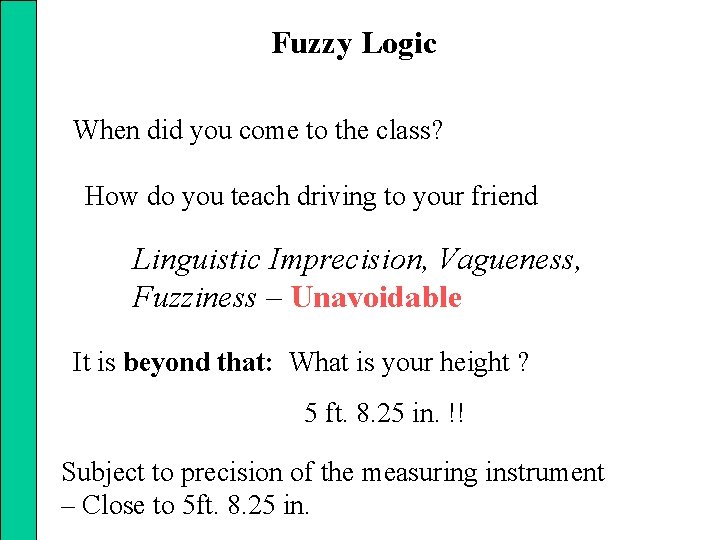
Fuzzy Logic When did you come to the class? How do you teach driving to your friend Linguistic Imprecision, Vagueness, Fuzziness – Unavoidable It is beyond that: What is your height ? 5 ft. 8. 25 in. !! Subject to precision of the measuring instrument – Close to 5 ft. 8. 25 in.
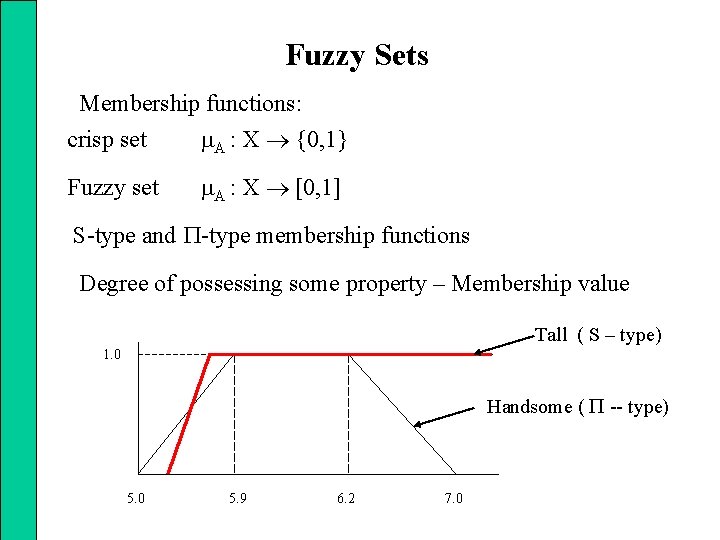
Fuzzy Sets Membership functions: crisp set A : X {0, 1} Fuzzy set A : X [0, 1] S-type and -type membership functions Degree of possessing some property – Membership value Tall ( S – type) 1. 0 Handsome ( -- type) 5. 0 5. 9 6. 2 7. 0
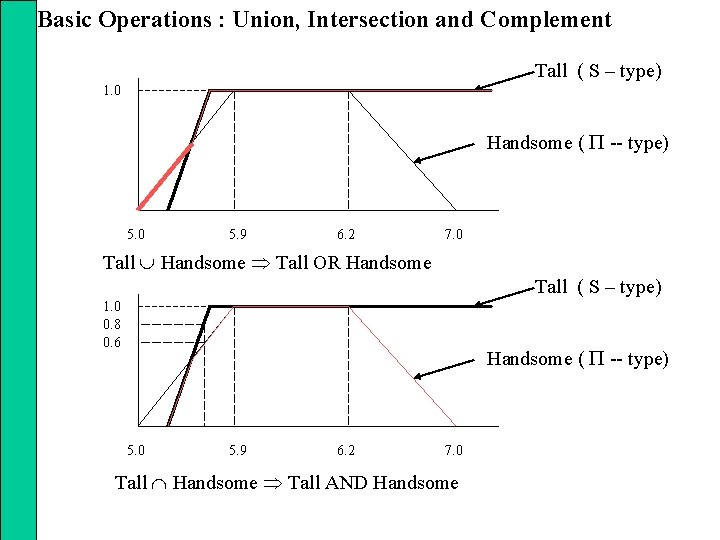
Basic Operations : Union, Intersection and Complement Tall ( S – type) 1. 0 Handsome ( -- type) 5. 0 5. 9 6. 2 7. 0 Tall Handsome Tall OR Handsome Tall ( S – type) 1. 0 0. 8 0. 6 Handsome ( -- type) 5. 0 5. 9 6. 2 7. 0 Tall Handsome Tall AND Handsome
Not Tall ( S – type) 1. 0 5. 9 6. 2 7. 0 Not Tall (Not = SHORT) There a family of operators which can be used for union and intersection for fuzzy sets, they are called S- Norms and T- Norms respectively
T- Norm For all x, y, z, u, v [0, 1] Identity : T(x, 1) = x Commutativity: T(x, y) = T(y, x) Associativity : T(x, T(y, z)) = T(T(x, y), x) Monotonicity: x y, y v, T(x, y) T(u, v) S- Norm Identity : S(x, 0) = x Commutativity: S(x, y) = S(y, x) Associativity : S(x, S(y, z)) = S(S(x, y), x) Monotonicity: x y, y v, S(x, y) S(u, v)
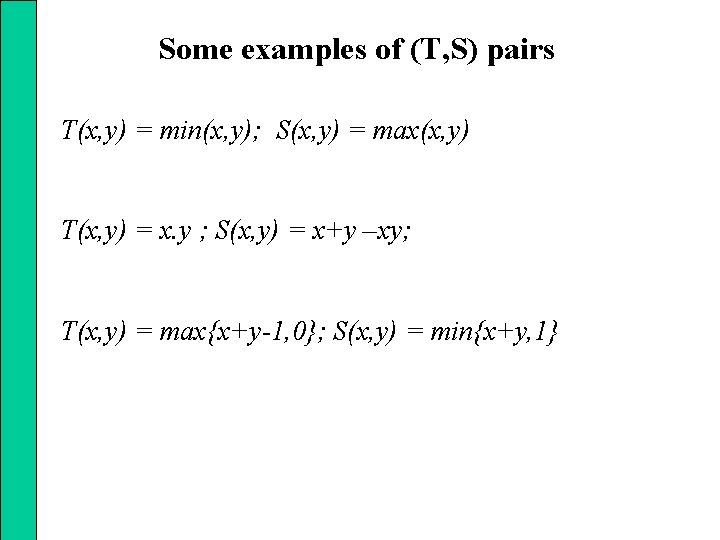
Some examples of (T, S) pairs T(x, y) = min(x, y); S(x, y) = max(x, y) T(x, y) = x. y ; S(x, y) = x+y –xy; T(x, y) = max{x+y-1, 0}; S(x, y) = min{x+y, 1}
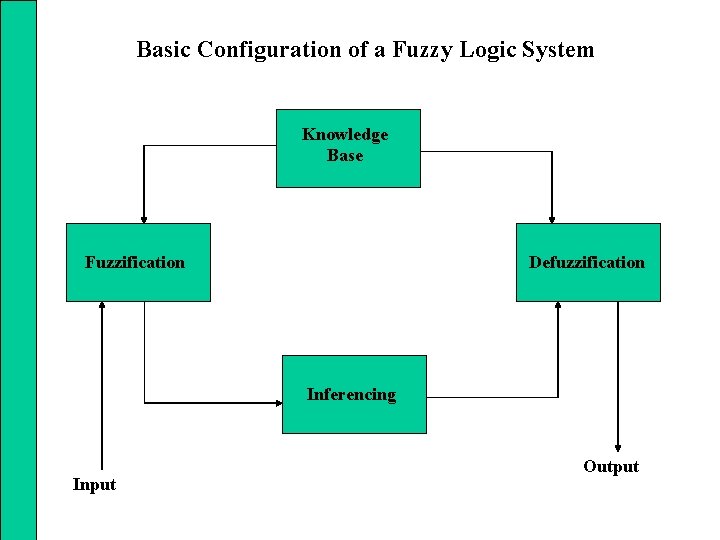
Basic Configuration of a Fuzzy Logic System Knowledge Base Fuzzification Defuzzification Inferencing Input Output
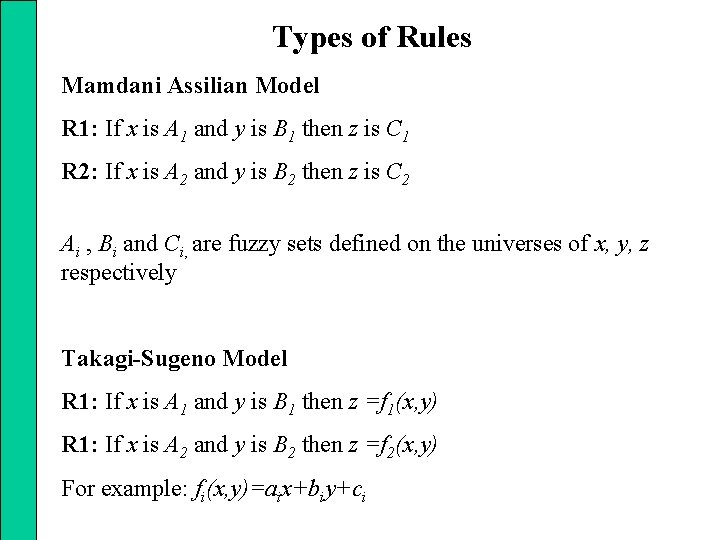
Types of Rules Mamdani Assilian Model R 1: If x is A 1 and y is B 1 then z is C 1 R 2: If x is A 2 and y is B 2 then z is C 2 Ai , Bi and Ci, are fuzzy sets defined on the universes of x, y, z respectively Takagi-Sugeno Model R 1: If x is A 1 and y is B 1 then z =f 1(x, y) R 1: If x is A 2 and y is B 2 then z =f 2(x, y) For example: fi(x, y)=aix+biy+ci
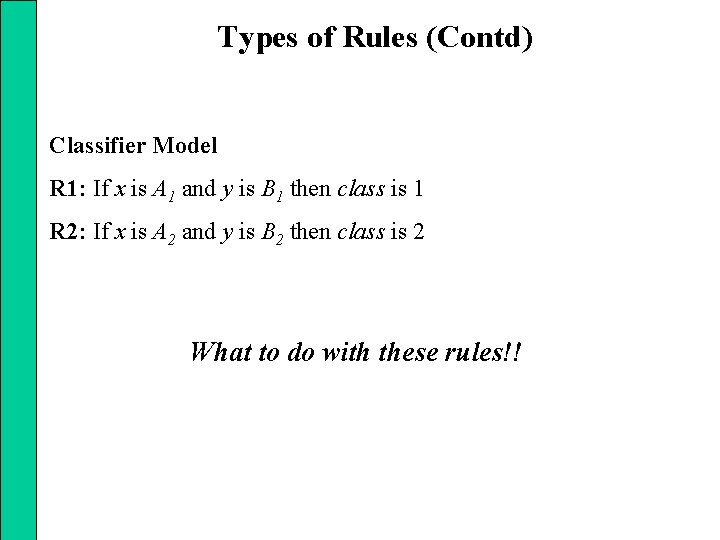
Types of Rules (Contd) Classifier Model R 1: If x is A 1 and y is B 1 then class is 1 R 2: If x is A 2 and y is B 2 then class is 2 What to do with these rules!!
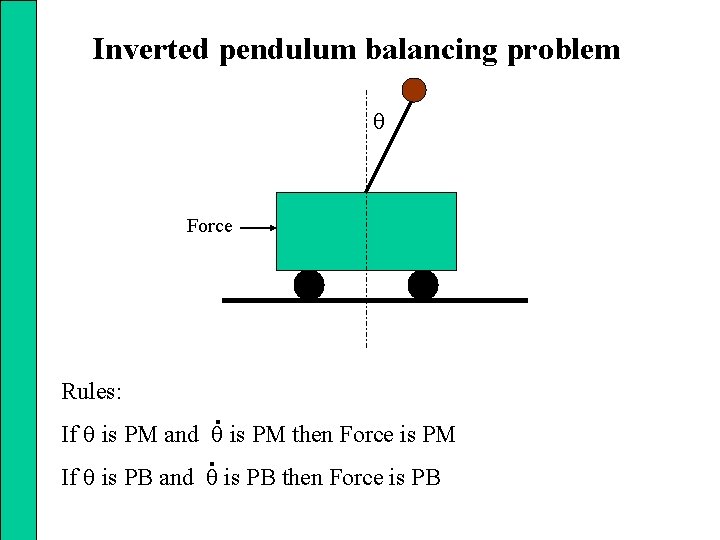
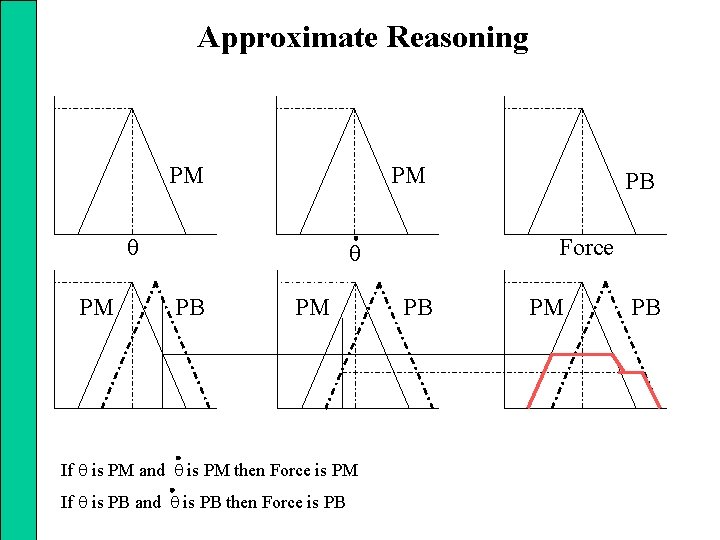
Inverted pendulum balancing problem Force Rules: If is PM and is PM then Force is PM If is PB and is PB then Force is PB
Approximate Reasoning PM PM Force PB PM If is PM and is PM then Force is PM If is PB and is PB then Force is PB PB PB PM PB
Pattern Recognition (Recapitulation) Data Object Data Relational Data Pattern Recognition Tasks 1) Clustering: Finding groups in data 2) Classification: Partitioning the feature space 3) Feature Analysis: Feature selection, Feature ranking, Dimentionality Reduction
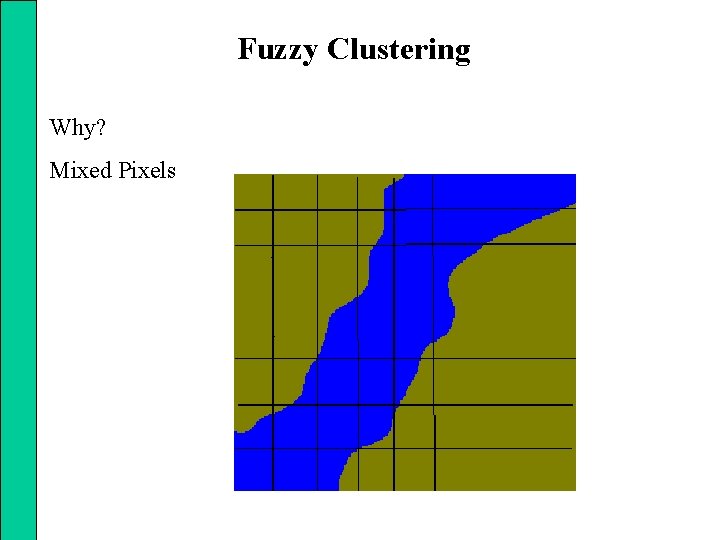
Fuzzy Clustering Why? Mixed Pixels
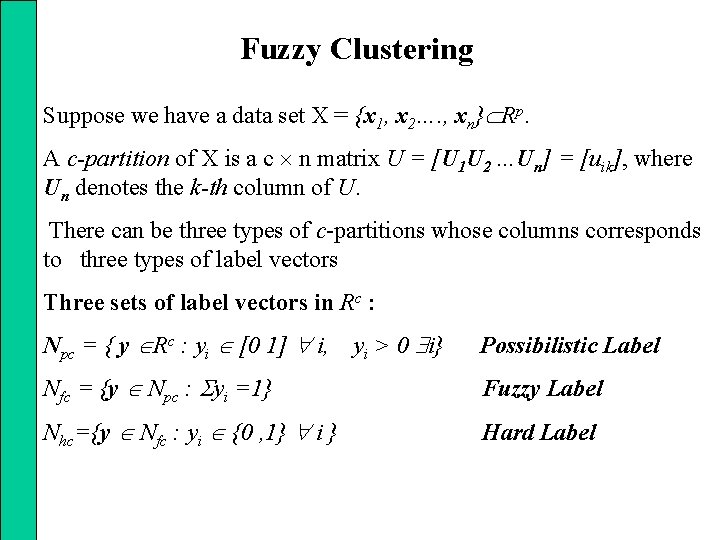
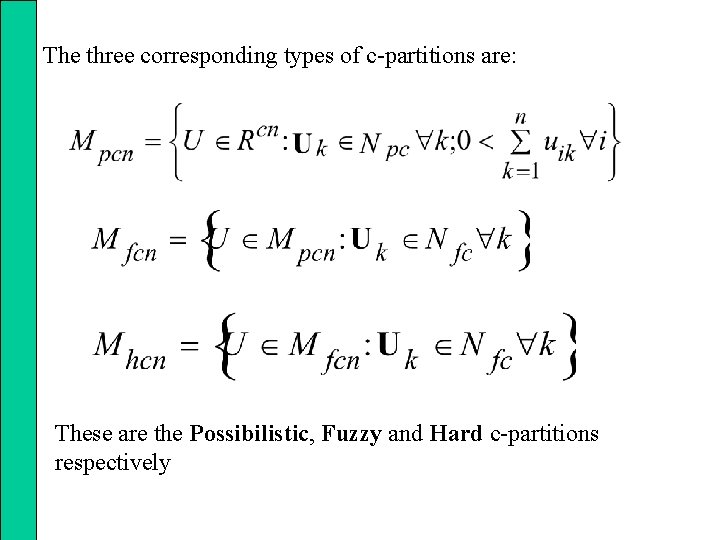
Fuzzy Clustering Suppose we have a data set X = {x 1, x 2…. , xn} Rp. A c-partition of X is a c n matrix U = [U 1 U 2 …Un] = [uik], where Un denotes the k-th column of U. There can be three types of c-partitions whose columns corresponds to three types of label vectors Three sets of label vectors in Rc : Npc = { y Rc : yi [0 1] i, yi > 0 i} Possibilistic Label Nfc = {y Npc : yi =1} Fuzzy Label Nhc={y Nfc : yi {0 , 1} i } Hard Label
The three corresponding types of c-partitions are: These are the Possibilistic, Fuzzy and Hard c-partitions respectively
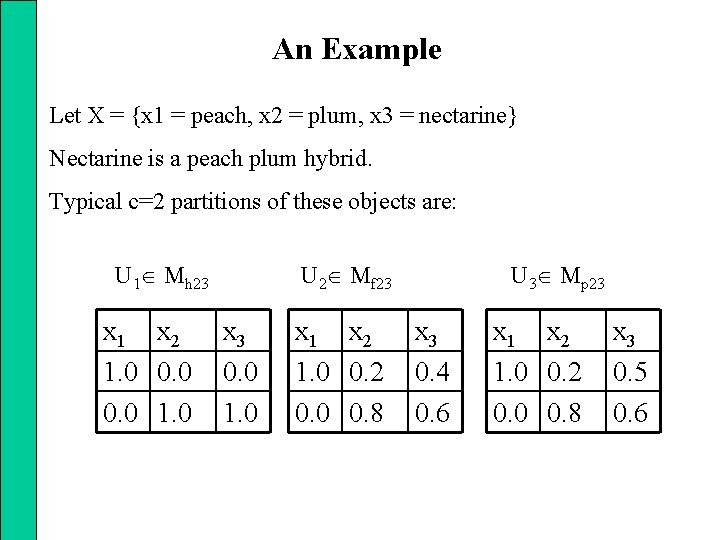
An Example Let X = {x 1 = peach, x 2 = plum, x 3 = nectarine} Nectarine is a peach plum hybrid. Typical c=2 partitions of these objects are: U 1 Mh 23 x 1 x 2 1. 0 0. 0 1. 0 U 2 Mf 23 x 3 0. 0 1. 0 x 1 x 2 1. 0 0. 2 0. 0 0. 8 U 3 Mp 23 x 3 0. 4 0. 6 x 1 x 2 1. 0 0. 2 0. 0 0. 8 x 3 0. 5 0. 6
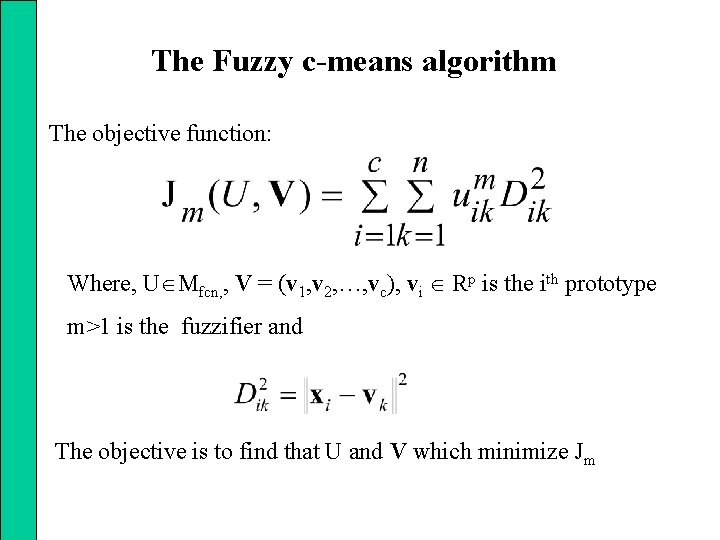
The Fuzzy c-means algorithm The objective function: Where, U Mfcn, , V = (v 1, v 2, …, vc), vi Rp is the ith prototype m>1 is the fuzzifier and The objective is to find that U and V which minimize Jm
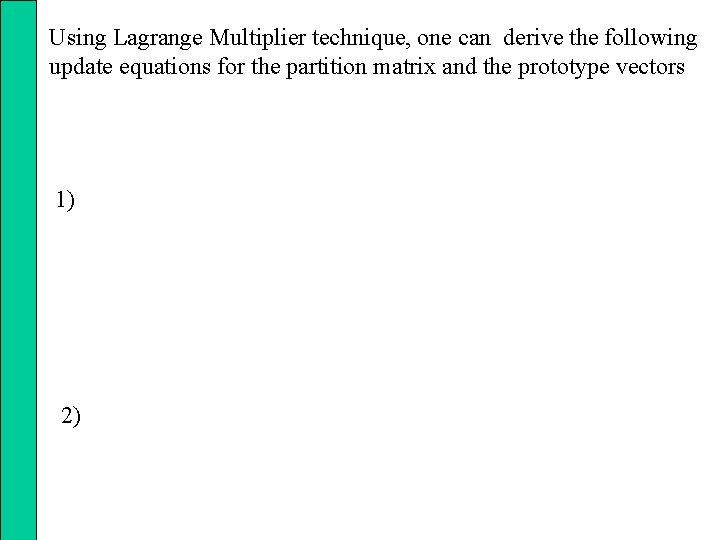
Using Lagrange Multiplier technique, one can derive the following update equations for the partition matrix and the prototype vectors 1) 2)
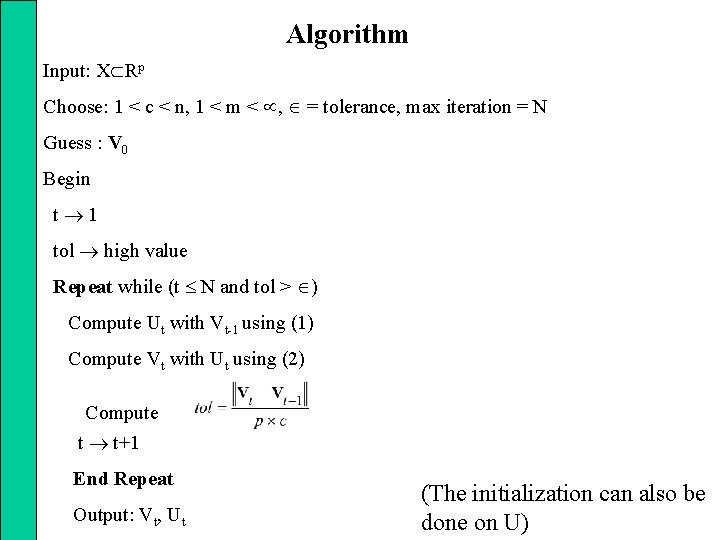
Algorithm Input: X Rp Choose: 1 < c < n, 1 < m < , = tolerance, max iteration = N Guess : V 0 Begin t 1 tol high value Repeat while (t N and tol > ) Compute Ut with Vt-1 using (1) Compute Vt with Ut using (2) Compute t t+1 End Repeat Output: Vt, Ut (The initialization can also be done on U)
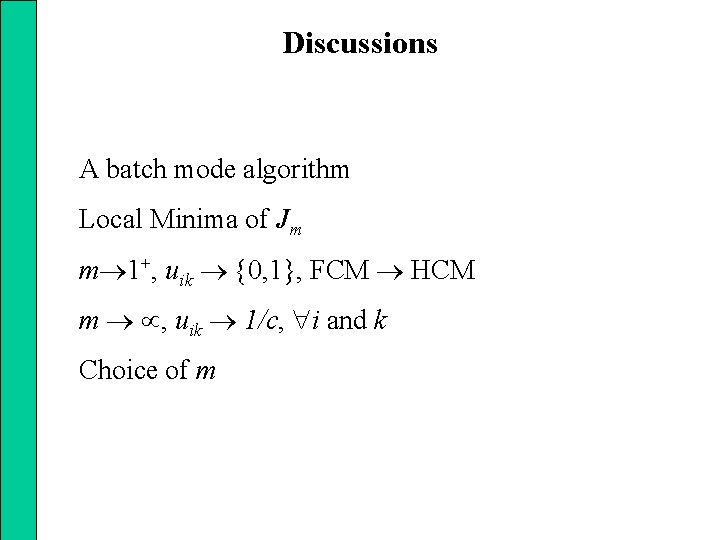
Discussions A batch mode algorithm Local Minima of Jm m 1+, uik {0, 1}, FCM HCM m , uik 1/c, i and k Choice of m
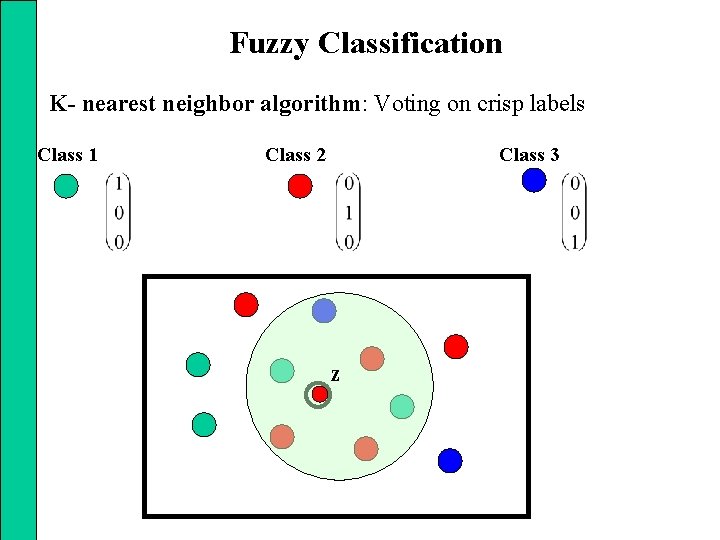
Fuzzy Classification K- nearest neighbor algorithm: Voting on crisp labels Class 1 Class 2 Class 3 z
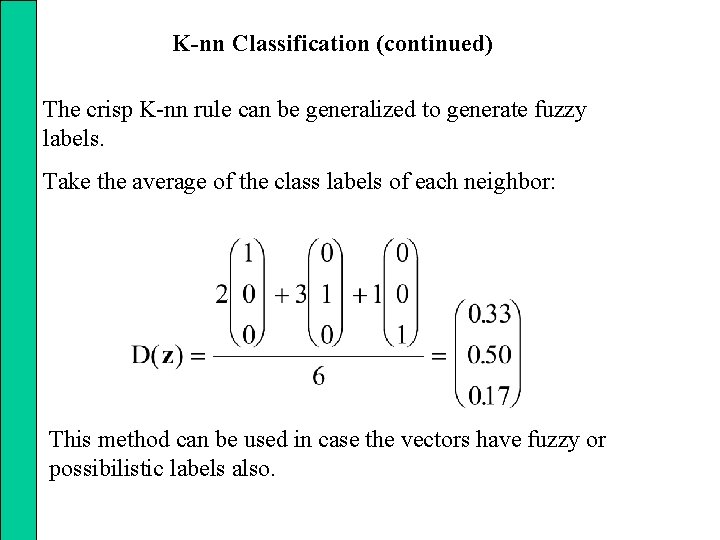
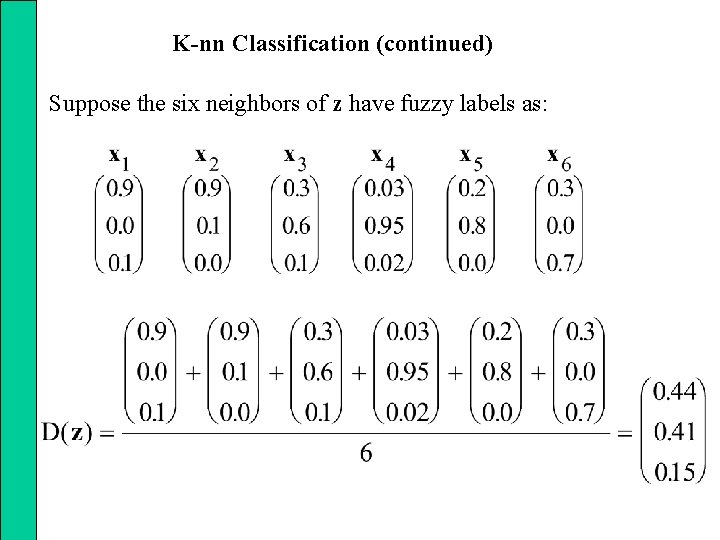
K-nn Classification (continued) The crisp K-nn rule can be generalized to generate fuzzy labels. Take the average of the class labels of each neighbor: This method can be used in case the vectors have fuzzy or possibilistic labels also.
K-nn Classification (continued) Suppose the six neighbors of z have fuzzy labels as:
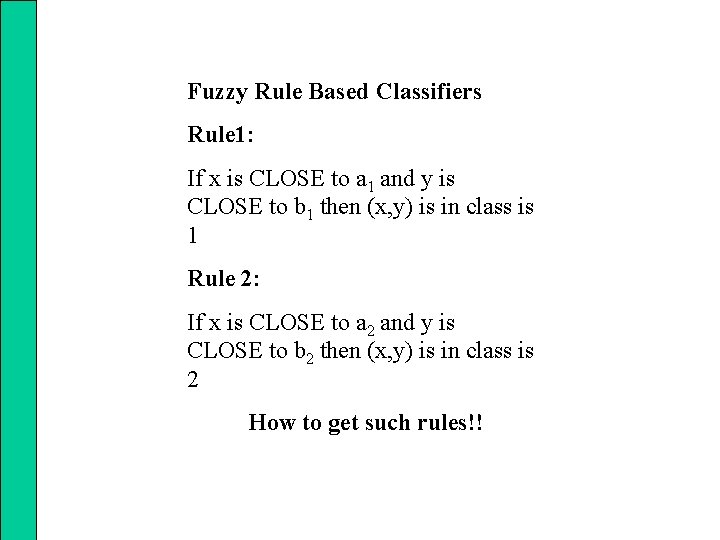
Fuzzy Rule Based Classifiers Rule 1: If x is CLOSE to a 1 and y is CLOSE to b 1 then (x, y) is in class is 1 Rule 2: If x is CLOSE to a 2 and y is CLOSE to b 2 then (x, y) is in class is 2 How to get such rules!!
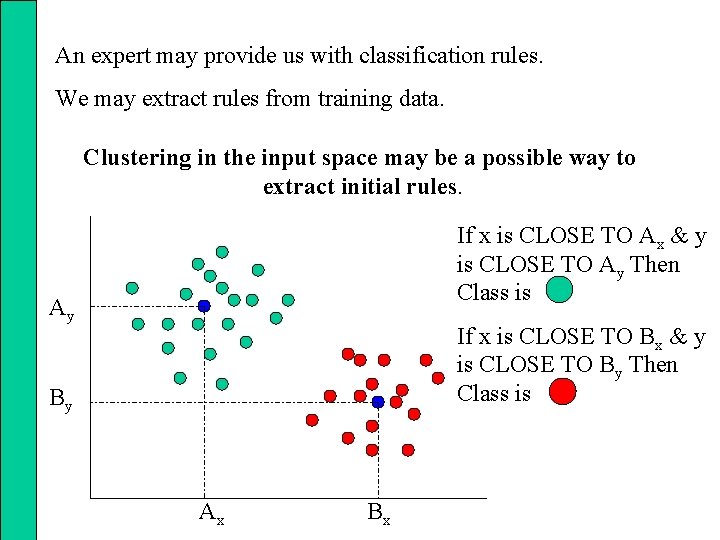
An expert may provide us with classification rules. We may extract rules from training data. Clustering in the input space may be a possible way to extract initial rules. If x is CLOSE TO Ax & y is CLOSE TO Ay Then Class is Ay If x is CLOSE TO Bx & y is CLOSE TO By Then Class is By Ax Bx
Why not make a system which learns linguistic rules from input output data. A neural network can learn from data. But we cannot extract linguistic (or other easily interpretable) rules from a trained network. Can we combine these to paradigms? YES!!
Neuro-Fuzzy Systems
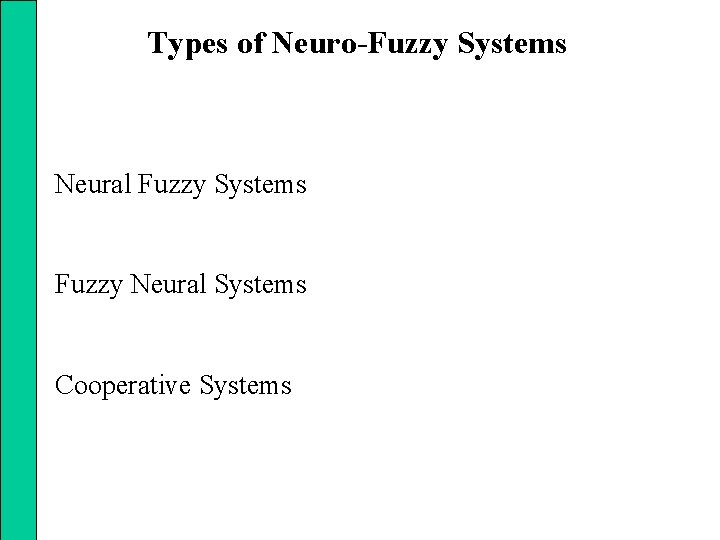
Types of Neuro-Fuzzy Systems Neural Fuzzy Systems Fuzzy Neural Systems Cooperative Systems
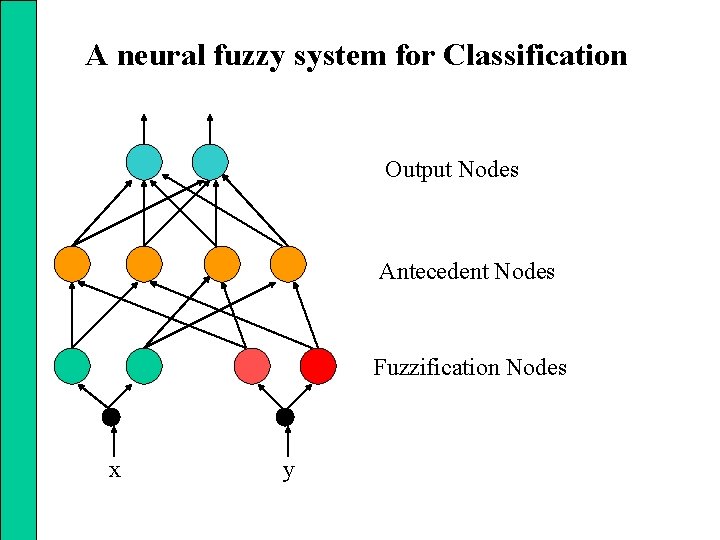
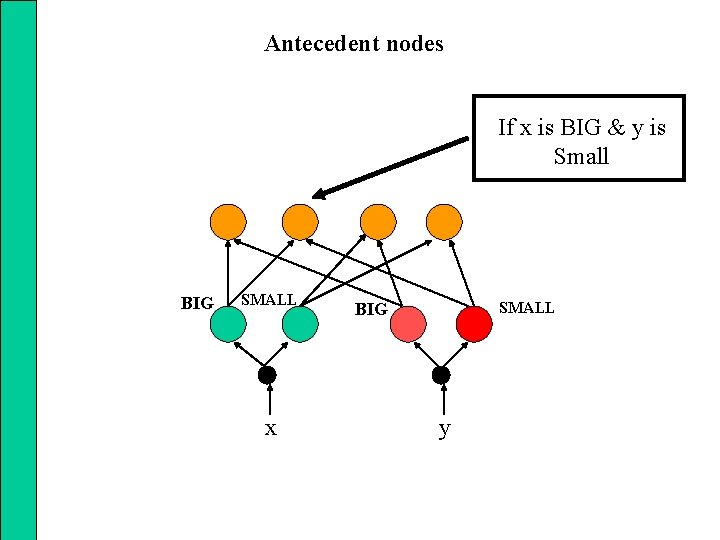
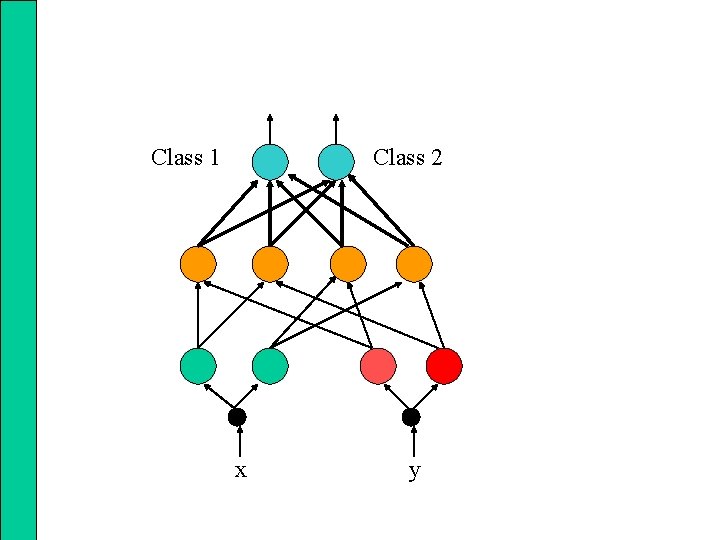
A neural fuzzy system for Classification Output Nodes Antecedent Nodes Fuzzification Nodes x y
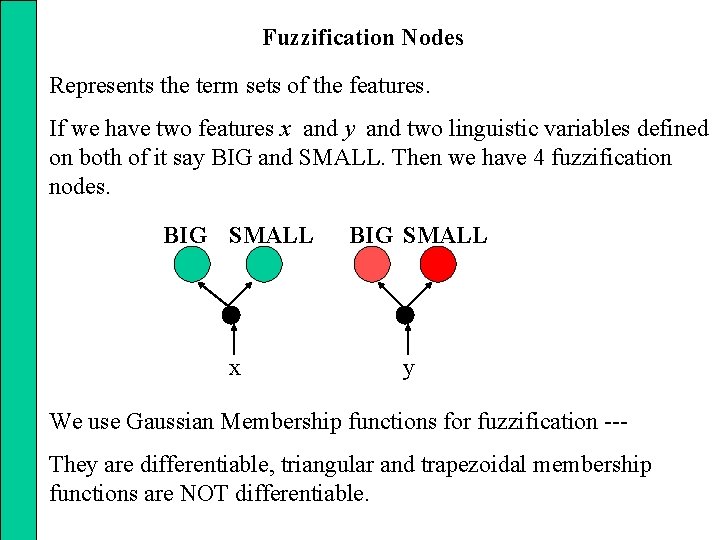
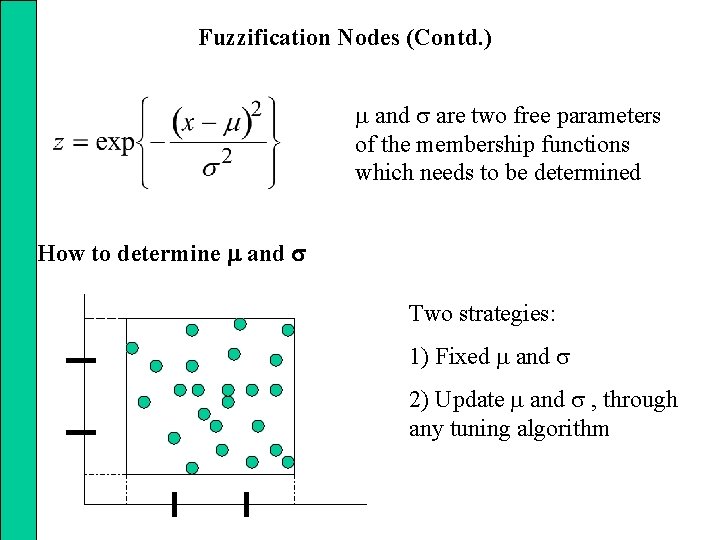
Fuzzification Nodes Represents the term sets of the features. If we have two features x and y and two linguistic variables defined on both of it say BIG and SMALL. Then we have 4 fuzzification nodes. BIG SMALL x BIG SMALL y We use Gaussian Membership functions for fuzzification --They are differentiable, triangular and trapezoidal membership functions are NOT differentiable.
Fuzzification Nodes (Contd. ) and are two free parameters of the membership functions which needs to be determined How to determine and Two strategies: 1) Fixed and 2) Update and , through any tuning algorithm
Antecedent nodes If x is BIG & y is Small BIG SMALL x SMALL BIG y
Class 1 Class 2 x y
Further Readings 1) Neural Networks, a comprehensive foundation, Simon Haykin, 2 nd ed. Prentice Hall 2) Introduction to theory of neural computation, Hertz, Krog and Palmer, Addision Wesley 3) Introduction to Artificial Neural Systems, J. M. Zurada, West Publishing Company 4) Fuzzy Models and Algorithms for Pattern Recognition and Image Processing, Bezdek, Keller, Krishnapuram, Pal, Kluwer Academic Publishers 5) Fuzzy Sets and Fuzzy Systems, Klir and Yuan 6) Pattern Classification, Duda, Hart and Stork
Thank You