
PATTERN OF POISONING CASES REPORTED TO THE NATIONAL

- Slides: 23
PATTERN OF POISONING CASES REPORTED TO THE NATIONAL POISON CENTRE OF MALAYSIA: THE SECOND FIVE-YEAR REPORT Haslina H. ¹, A. I. Fathelrahman¹, A. F. Ab Rahman 2, A. Shalihin M. S. ¹, Razak L. ¹ , Rahmat A. ¹, Asdariah M. ¹ 1 National Poison Centre ; 2 School of Pharmaceutical Sciences, Universiti Sains Malaysia, 11800 Minden, Penang, Malaysia MPS-CPA Conference 2007, Kuala Lumpur
Introduction Ø Acute poisoning is a significant health problem worldwide. Ø In the United States, more than 2 million poisoning exposures were reported to the poison centre each year Ø In Malaysia, poisoning surveillance is undertaken by the Ministry of Health & Ministry of Human Resource – national data on poisoning pattern is scarce and incomplete Ø 84. 2% of medically treated poisonings in Malaysia result in hospital admissions. (Sirajuddin H et al, Med J Malaysia 2001)
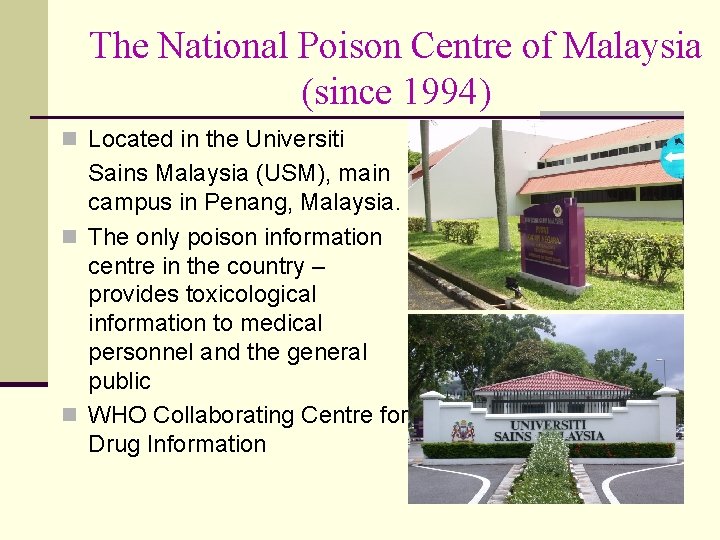
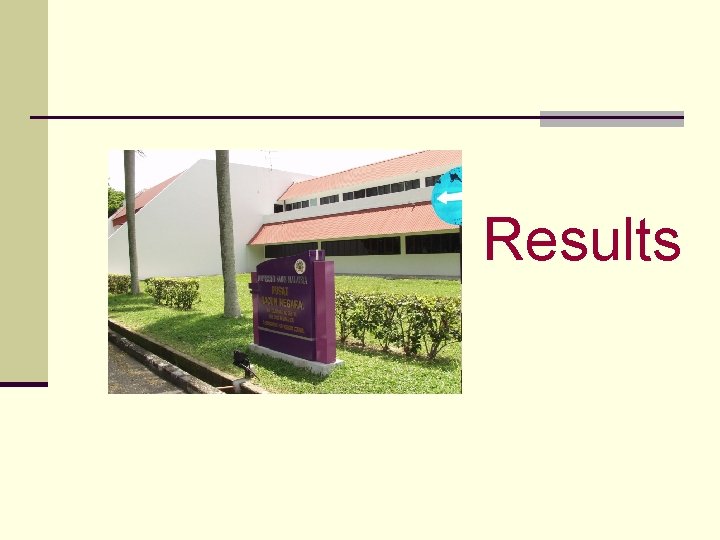
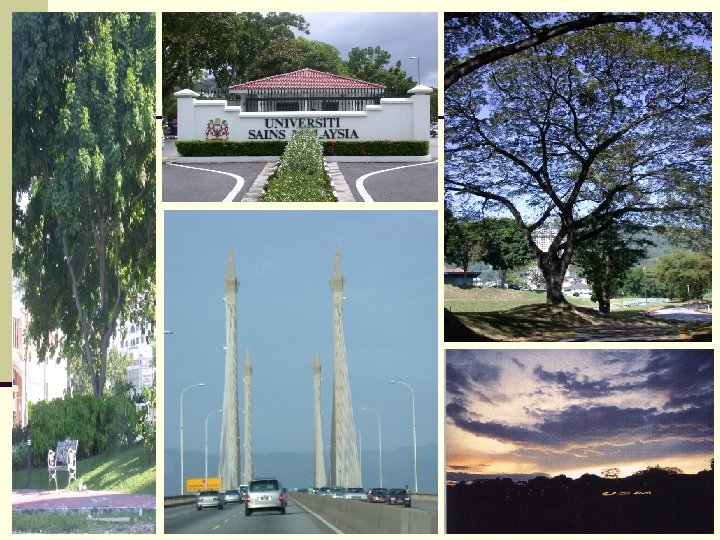
The National Poison Centre of Malaysia (since 1994) n Located in the Universiti Sains Malaysia (USM), main campus in Penang, Malaysia. n The only poison information centre in the country – provides toxicological information to medical personnel and the general public n WHO Collaborating Centre for Drug Information
The National Poison Centre of Malaysia (since 1994) n Serves a population of approximately 25 million n Established in 1994 based on a research by a group of scientists from the School of Pharmaceutical Sciences, USM. n Official mandate from the Malaysian government. n Staff members comprises lecturers, pharmacists, science officers, ICT and multimedia personnel and other supporting staffs (Total : 39)
24 hrs Service 24 After Office Hours Hrs Including Weekends & Public Holidays
Objectives n To describe the pattern of poisoning inquiries for the second 5 -year period (2001 -2005) n To compare demographic characteristics of poisoned cases in relation to substances implicated and circumstances of poisoning.
Methodology n All enquiries on poisoning received by the National Poison Centre (NPC) n Data were extracted from the NPC report forms and analyzed using SPSS n Descriptive analyses like frequencies and percentages were used n Chi-square statistic was used to test differences between groups where ever applicable.
Results
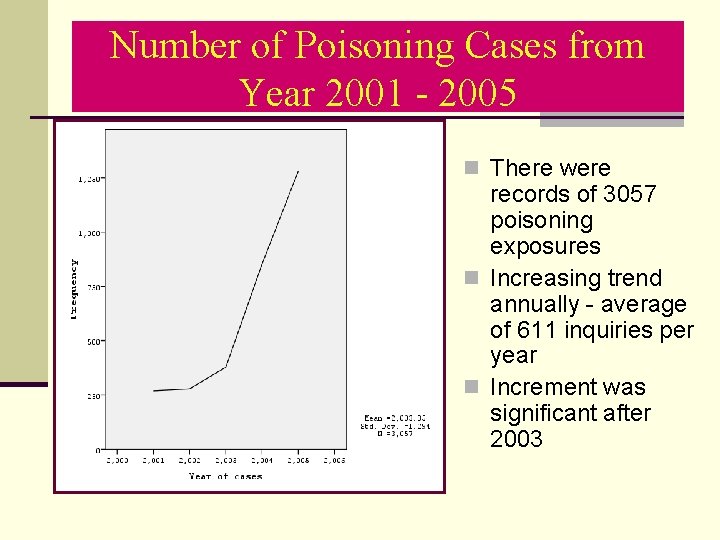
Number of Poisoning Cases from Year 2001 - 2005 n There were records of 3057 poisoning exposures n Increasing trend annually - average of 611 inquiries per year n Increment was significant after 2003
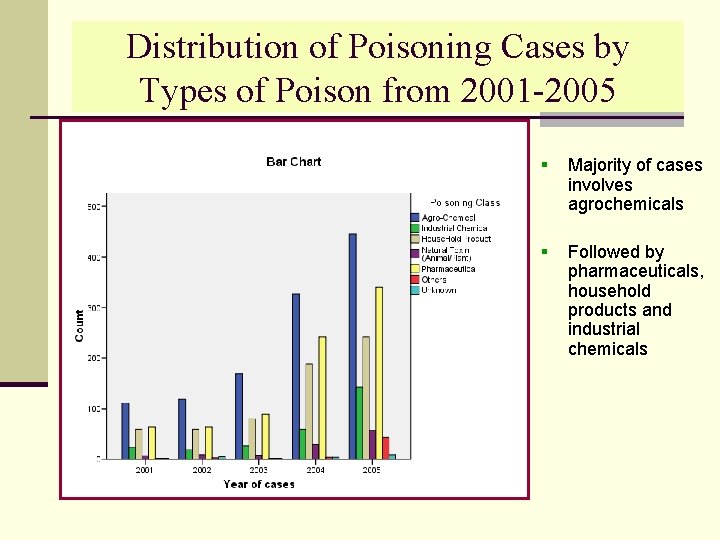
Distribution of Poisoning Cases by Types of Poison from 2001 -2005 § Majority of cases involves agrochemicals § Followed by pharmaceuticals, household products and industrial chemicals
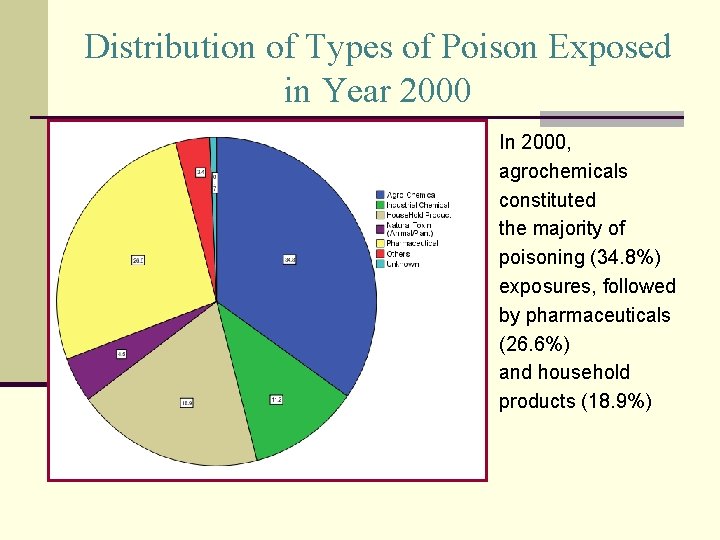
Distribution of Types of Poison Exposed in Year 2000 In 2000, agrochemicals constituted the majority of poisoning (34. 8%) exposures, followed by pharmaceuticals (26. 6%) and household products (18. 9%)
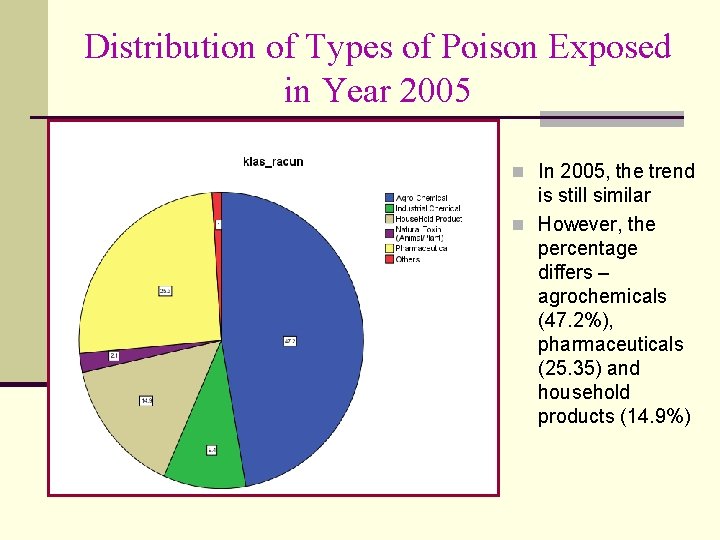
Distribution of Types of Poison Exposed in Year 2005 n In 2005, the trend is still similar n However, the percentage differs – agrochemicals (47. 2%), pharmaceuticals (25. 35) and household products (14. 9%)
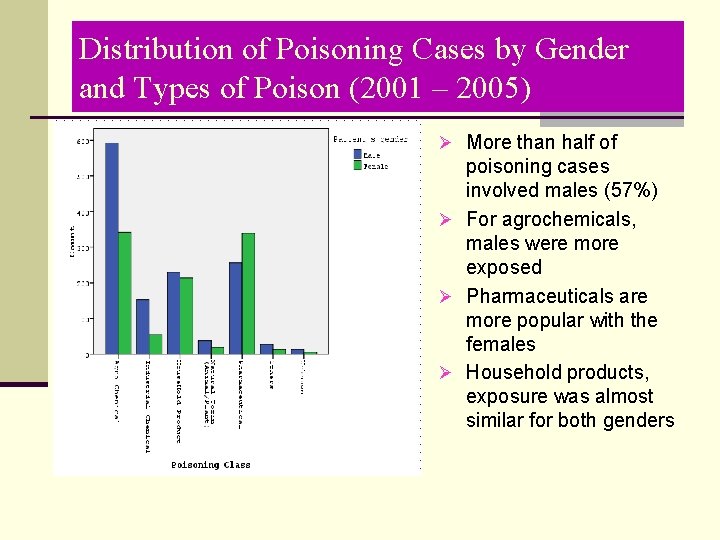
Distribution of Poisoning Cases by Gender and Types of Poison (2001 – 2005) Ø More than half of poisoning cases involved males (57%) Ø For agrochemicals, males were more exposed Ø Pharmaceuticals are more popular with the females Ø Household products, exposure was almost similar for both genders
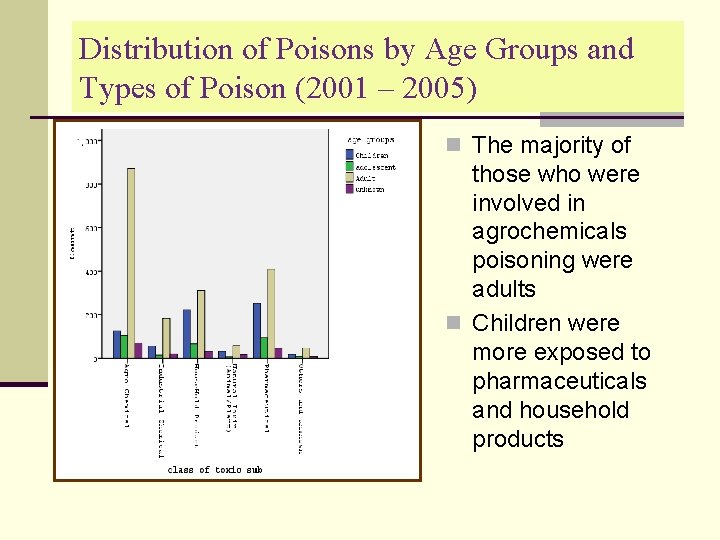
Distribution of Poisons by Age Groups and Types of Poison (2001 – 2005) n The majority of those who were involved in agrochemicals poisoning were adults n Children were more exposed to pharmaceuticals and household products
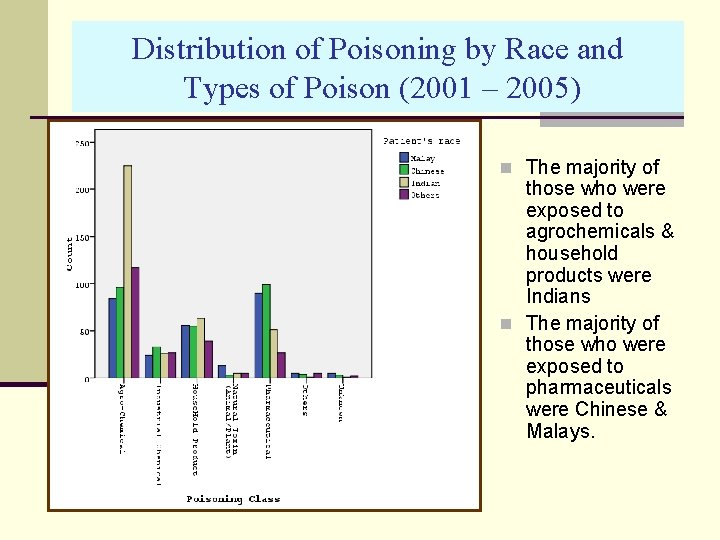
Distribution of Poisoning by Race and Types of Poison (2001 – 2005) n The majority of those who were exposed to agrochemicals & household products were Indians n The majority of those who were exposed to pharmaceuticals were Chinese & Malays.
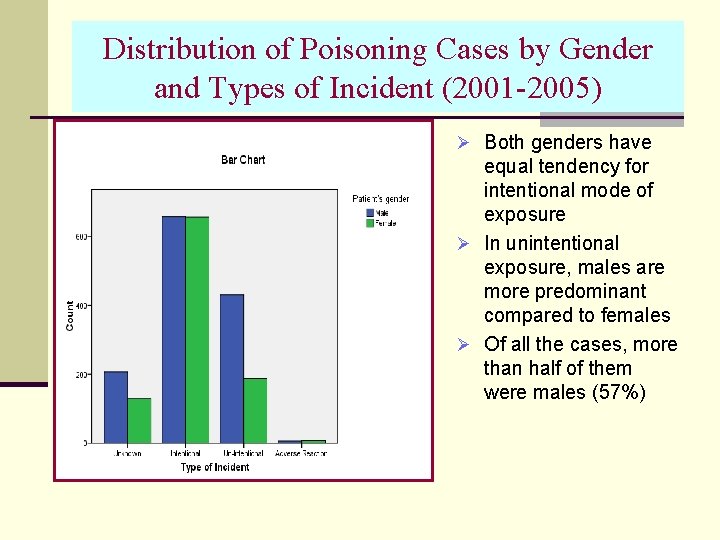
Distribution of Poisoning Cases by Gender and Types of Incident (2001 -2005) Ø Both genders have equal tendency for intentional mode of exposure Ø In unintentional exposure, males are more predominant compared to females Ø Of all the cases, more than half of them were males (57%)
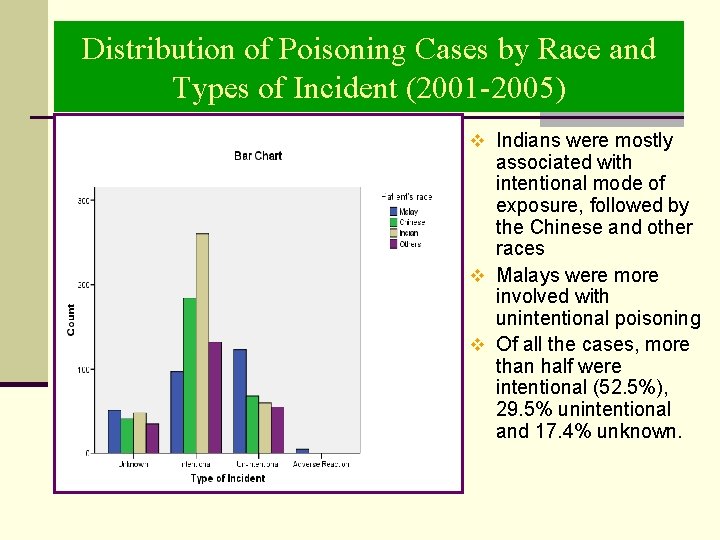
Distribution of Poisoning Cases by Race and Types of Incident (2001 -2005) v Indians were mostly associated with intentional mode of exposure, followed by the Chinese and other races v Malays were more involved with unintentional poisoning v Of all the cases, more than half were intentional (52. 5%), 29. 5% unintentional and 17. 4% unknown.
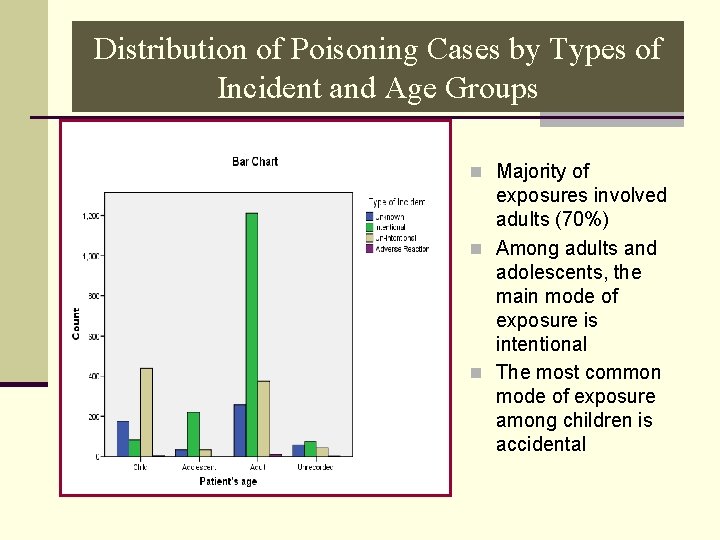
Distribution of Poisoning Cases by Types of Incident and Age Groups n Majority of exposures involved adults (70%) n Among adults and adolescents, the main mode of exposure is intentional n The most common mode of exposure among children is accidental
Conclusion n Increasing trend of reported exposures from year 2001 to 2005 n Significant increase from 2003 onwards after the 24 -hour service was introduced n Predominant cases of adults, males, chemical toxicities and intentional mode. n Among ethnic groups, there were variations in the implicated agents and circumstances of exposures.
References n n n n R Awang, AF Abd Rahman, WZA Wan Abdullah, R Lajis, MI Abd Majid, Trends in Inquiries on Poisoning: A Five-Year Report from the National Poison Centre, Malaysia. Med J Malaysia, Vol 58, No 3, August 2003 AI Fathelrahman, AF Ab Rahman, Z Mohd Zain, MA Tengku, Factors associated with adult poisoning in Northern Malaysia: a case-control study. Human & Experimental Tox (2006), 25: 1 -7 AI Fathelrahman, AF Ab Rahman, Z Mohd Zain, Demographic Features of Drug and Chemical Poisoning in Northern Malaysia. Clin Tox 43: 89 -94, 2005 Mohd Zain Z, Fathelrahman AI, Ab Rahman AF, Characteristics and outcomes of paracetamol poisoning cases at a general hospital in Northern Malaysia, Singapore Med J 2006; 47(2): 134 Ministry of Health Annual Report 1999 Tenaganita and Pesticide Action Network Asia and the Pacific. Poisoned and Silenced. A study of pesticide poisoning in the plantations, Malaysia; Ganesh Printers, 2002. Sirajuddin H, Roslinah A, Rampal KG, Kuppusamy I, Rohna R, Aziz M, Aw TC, Beach JR. Notification of occupational and work-related diseases and poisonings in Malaysia, 1997 -1998. Med J Malaysia 2001; 56: 25 -31 Rahman AFA. Drug and chemical poisoning admissions at a teaching hospital in Malaysia. Human & Experimental Toxicology 2002; 21: 377 -381.