
Pattern of Childrens Development Physical Development Factors That


- Slides: 25
Pattern of Children’s Development Physical Development
Factors That Affect Children’s Growth • Heredity • Hormones • Nutrition • Sleep • Illness • Emotional influences
Areas of Development • Physical development is to do with gross motor and fine motor movement; or large movement of limbs, developing locomotion, balance and coordination, and fine manipulative movement of fingers developing hand–eye coordination. gross • Cognitive development is the way children develop thought processes, perception, memory, imagination and problem solving, and are able to increase their knowledge and understanding of their environment. • Communication and language development is the way children communicate and develop speech, including reading and writing. • Emotional and behavioural development is how children develop feelings and express their emotions through behaviour, and includes the development of self concept and self-esteem. • Social development includes how children develop friendships with peers, cooperate with others and become aware of role models.
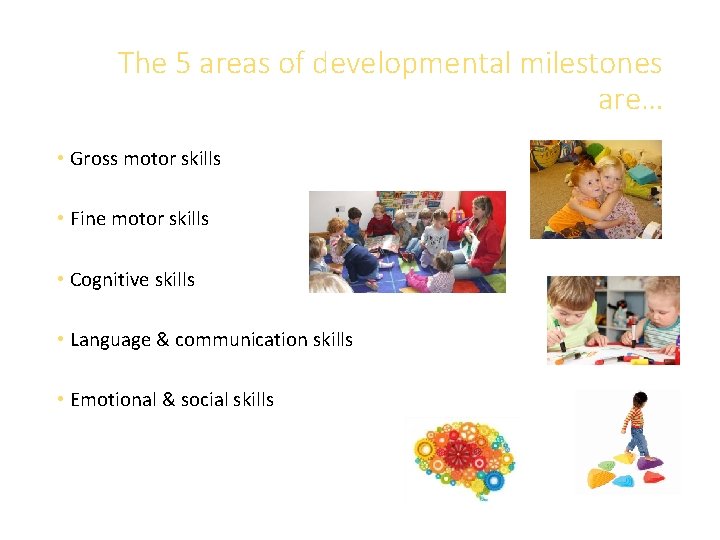
The 5 areas of developmental milestones are… • Gross motor skills • Fine motor skills • Cognitive skills • Language & communication skills • Emotional & social skills
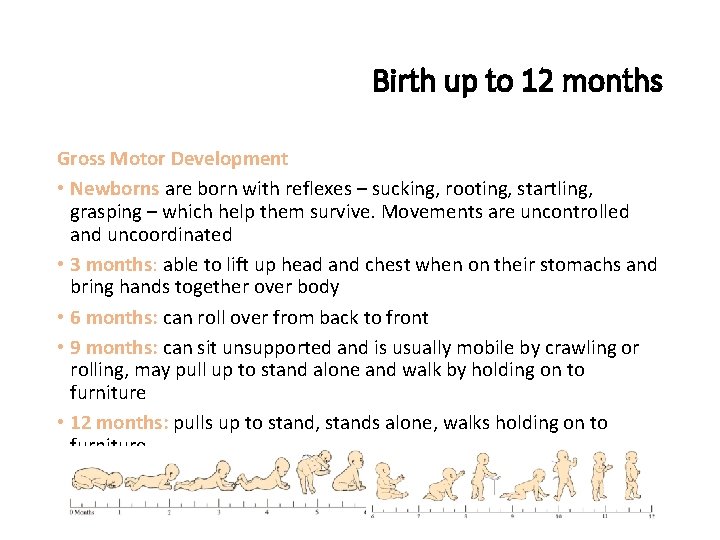
Birth up to 12 months Gross Motor Development • Newborns are born with reflexes – sucking, rooting, startling, grasping – which help them survive. Movements are uncontrolled and uncoordinated • 3 months: able to lift up head and chest when on their stomachs and bring hands together over body • 6 months: can roll over from back to front • 9 months: can sit unsupported and is usually mobile by crawling or rolling, may pull up to stand alone and walk by holding on to furniture • 12 months: pulls up to stand, stands alone, walks holding on to furniture.
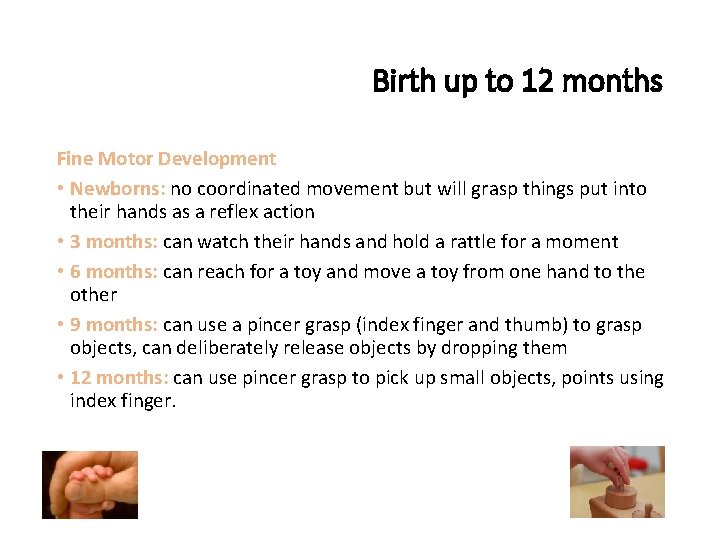
Birth up to 12 months Fine Motor Development • Newborns: no coordinated movement but will grasp things put into their hands as a reflex action • 3 months: can watch their hands and hold a rattle for a moment • 6 months: can reach for a toy and move a toy from one hand to the other • 9 months: can use a pincer grasp (index finger and thumb) to grasp objects, can deliberately release objects by dropping them • 12 months: can use pincer grasp to pick up small objects, points using index finger.
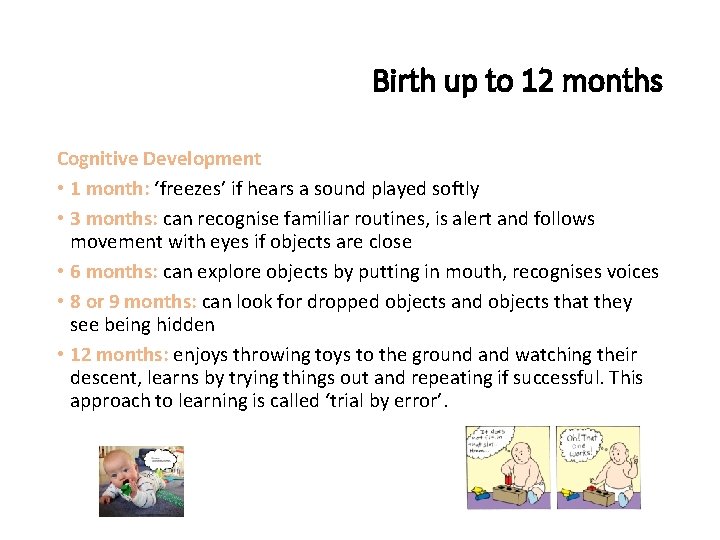
Birth up to 12 months Cognitive Development • 1 month: ‘freezes’ if hears a sound played softly • 3 months: can recognise familiar routines, is alert and follows movement with eyes if objects are close • 6 months: can explore objects by putting in mouth, recognises voices • 8 or 9 months: can look for dropped objects and objects that they see being hidden • 12 months: enjoys throwing toys to the ground and watching their descent, learns by trying things out and repeating if successful. This approach to learning is called ‘trial by error’.
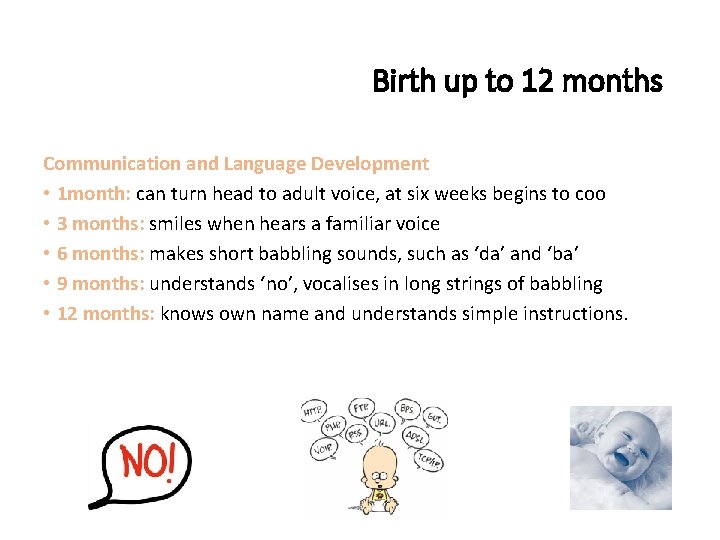
Birth up to 12 months Communication and Language Development • 1 month: can turn head to adult voice, at six weeks begins to coo • 3 months: smiles when hears a familiar voice • 6 months: makes short babbling sounds, such as ‘da’ and ‘ba’ • 9 months: understands ‘no’, vocalises in long strings of babbling • 12 months: knows own name and understands simple instructions.
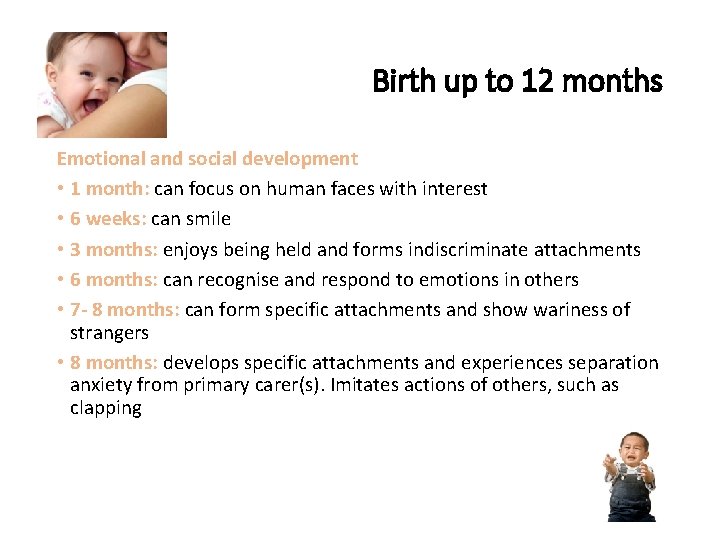
Birth up to 12 months Emotional and social development • 1 month: can focus on human faces with interest • 6 weeks: can smile • 3 months: enjoys being held and forms indiscriminate attachments • 6 months: can recognise and respond to emotions in others • 7 - 8 months: can form specific attachments and show wariness of strangers • 8 months: develops specific attachments and experiences separation anxiety from primary carer(s). Imitates actions of others, such as clapping
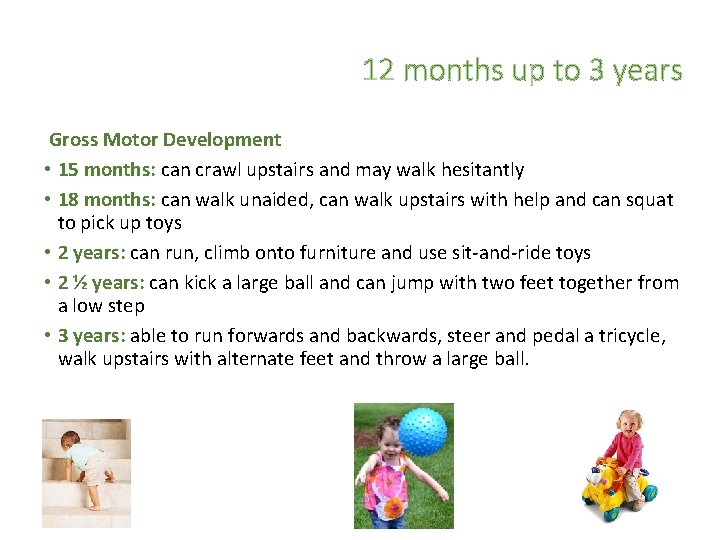
12 months up to 3 years Gross Motor Development • 15 months: can crawl upstairs and may walk hesitantly • 18 months: can walk unaided, can walk upstairs with help and can squat to pick up toys • 2 years: can run, climb onto furniture and use sit-and-ride toys • 2 ½ years: can kick a large ball and can jump with two feet together from a low step • 3 years: able to run forwards and backwards, steer and pedal a tricycle, walk upstairs with alternate feet and throw a large ball.
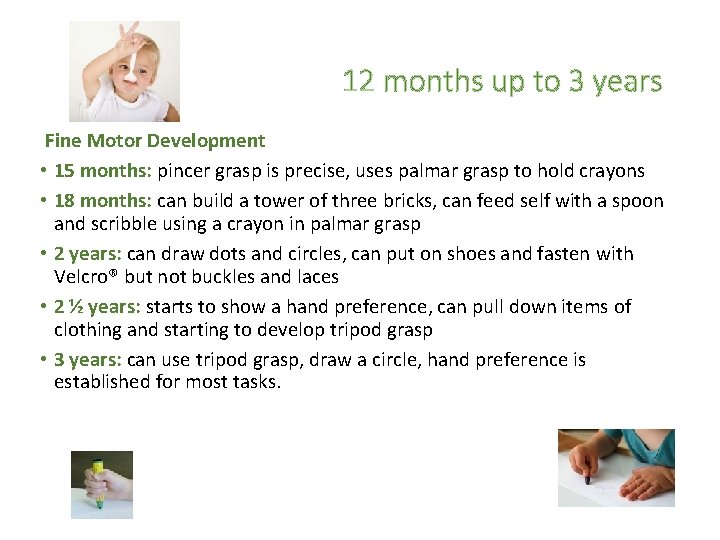
12 months up to 3 years Fine Motor Development • 15 months: pincer grasp is precise, uses palmar grasp to hold crayons • 18 months: can build a tower of three bricks, can feed self with a spoon and scribble using a crayon in palmar grasp • 2 years: can draw dots and circles, can put on shoes and fasten with Velcro® but not buckles and laces • 2 ½ years: starts to show a hand preference, can pull down items of clothing and starting to develop tripod grasp • 3 years: can use tripod grasp, draw a circle, hand preference is established for most tasks.
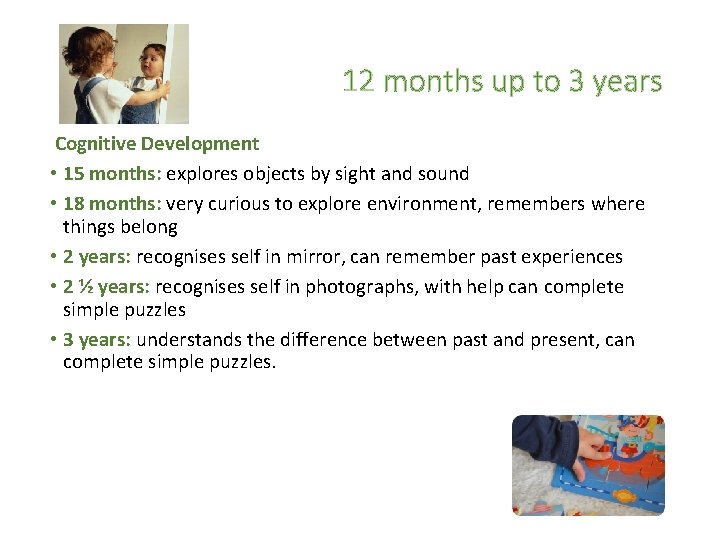
12 months up to 3 years Cognitive Development • 15 months: explores objects by sight and sound • 18 months: very curious to explore environment, remembers where things belong • 2 years: recognises self in mirror, can remember past experiences • 2 ½ years: recognises self in photographs, with help can complete simple puzzles • 3 years: understands the difference between past and present, can complete simple puzzles.
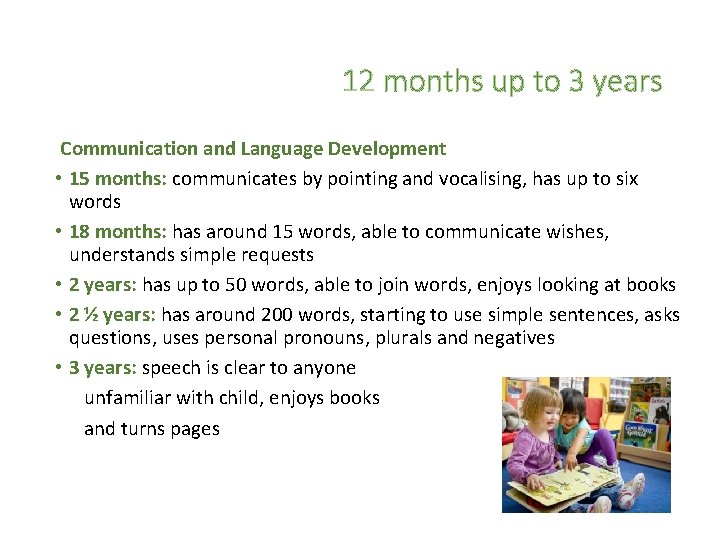
12 months up to 3 years Communication and Language Development • 15 months: communicates by pointing and vocalising, has up to six words • 18 months: has around 15 words, able to communicate wishes, understands simple requests • 2 years: has up to 50 words, able to join words, enjoys looking at books • 2 ½ years: has around 200 words, starting to use simple sentences, asks questions, uses personal pronouns, plurals and negatives • 3 years: speech is clear to anyone unfamiliar with child, enjoys books and turns pages
12 months up to 3 years Emotional and Social Development • 18 months: emotionally dependent on parents and key persons, plays alone but enjoys being near adults and siblings, insistent on immediate attention to needs and can copy adult actions • 2 years: unable to wait for needs to be met, may be distracted from tantrums, plays in parallel with other children but unable to share toys • 2 ½ years: plays alongside other children and engages in onlooker play, very dependent on adults and jealous of other children gaining attention, responds well to adult attention and praise, and has tantrums when frustrated • 3 years: finds it easier to wait, starting to take turns and share, enjoys being with other children and will comfort another child.
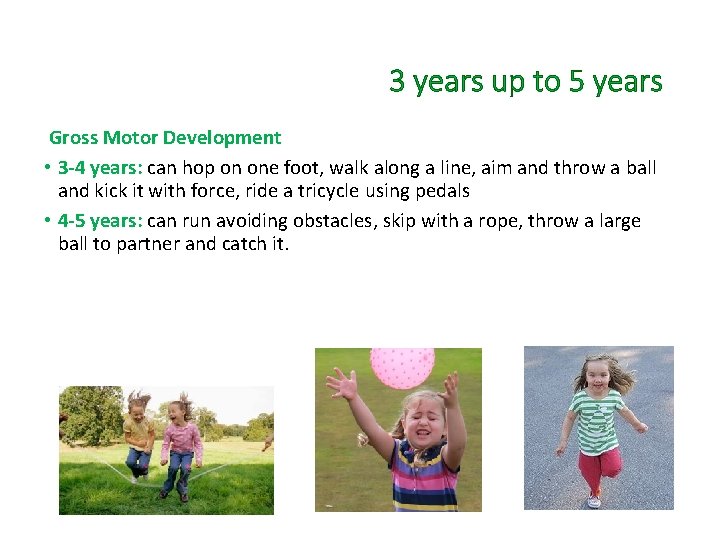
3 years up to 5 years Gross Motor Development • 3 -4 years: can hop on one foot, walk along a line, aim and throw a ball and kick it with force, ride a tricycle using pedals • 4 -5 years: can run avoiding obstacles, skip with a rope, throw a large ball to partner and catch it.
3 years up to 5 years Fine Motor Development • 3 -4 years: can button and unbutton clothes, use scissors to cut out simple shapes, draw a person with head, trunk and legs, eat with a knife and fork, thread beads to make a necklace • 4 -5 years: can form letters, write own name and colour in pictures.
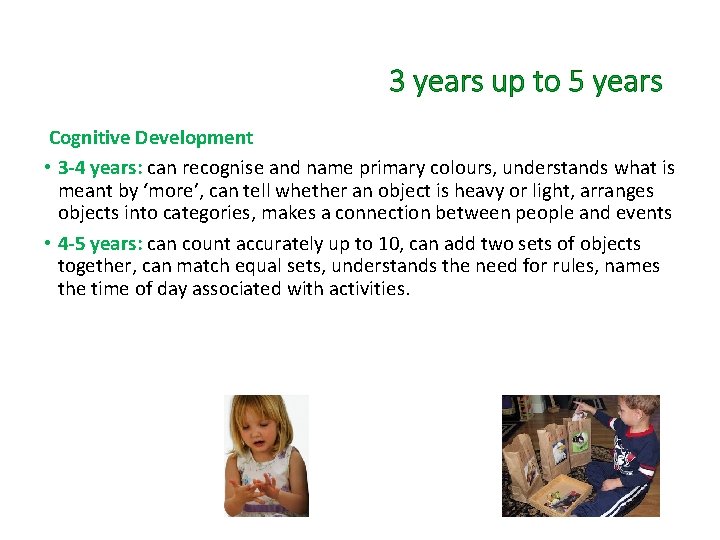
3 years up to 5 years Cognitive Development • 3 -4 years: can recognise and name primary colours, understands what is meant by ‘more’, can tell whether an object is heavy or light, arranges objects into categories, makes a connection between people and events • 4 -5 years: can count accurately up to 10, can add two sets of objects together, can match equal sets, understands the need for rules, names the time of day associated with activities.
3 years up to 5 years Communication and Language Development • 3 -4 years: speech can be easily understood, although some words may be incorrect, uses questions and by four years language is fluent, with some speech immaturities • 4 -5 years: can count accurately up to 10, uses complex sentences with words such as ‘because’, can talk about what has happened and what might happen, uses language to argue and answer back.
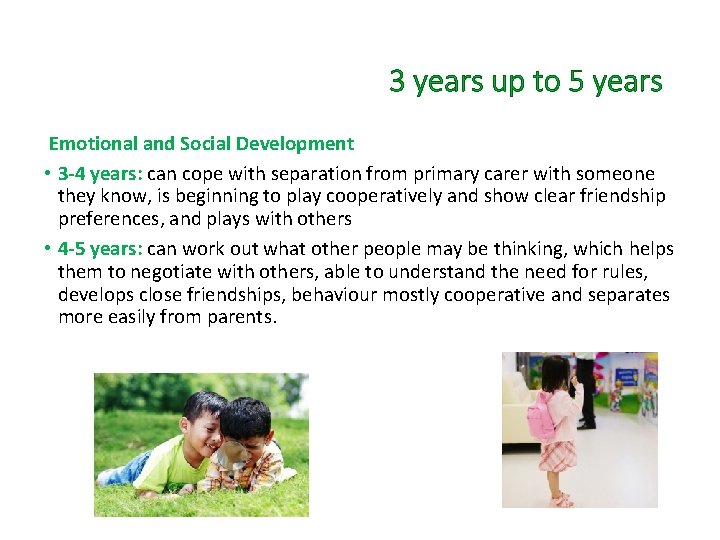
3 years up to 5 years Emotional and Social Development • 3 -4 years: can cope with separation from primary carer with someone they know, is beginning to play cooperatively and show clear friendship preferences, and plays with others • 4 -5 years: can work out what other people may be thinking, which helps them to negotiate with others, able to understand the need for rules, develops close friendships, behaviour mostly cooperative and separates more easily from parents.
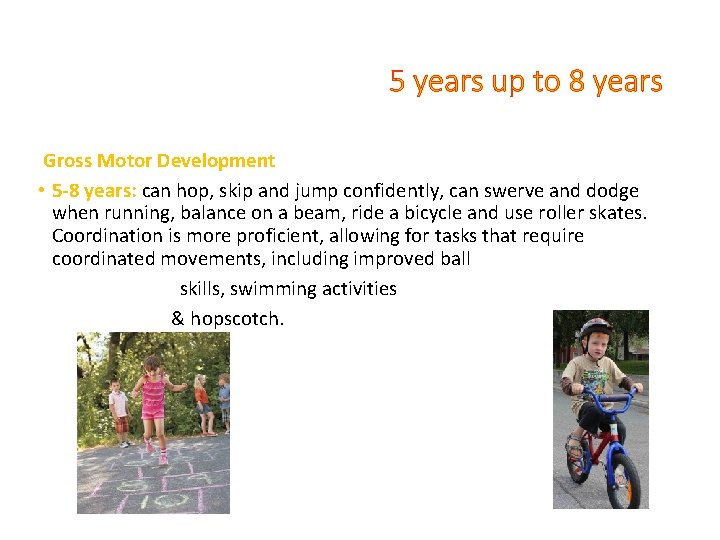
5 years up to 8 years Gross Motor Development • 5 -8 years: can hop, skip and jump confidently, can swerve and dodge when running, balance on a beam, ride a bicycle and use roller skates. Coordination is more proficient, allowing for tasks that require coordinated movements, including improved ball skills, swimming activities & hopscotch.
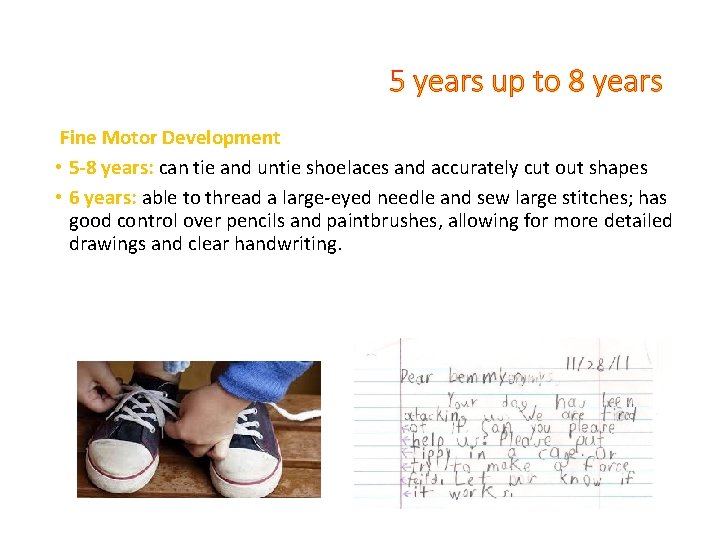
5 years up to 8 years Fine Motor Development • 5 -8 years: can tie and untie shoelaces and accurately cut out shapes • 6 years: able to thread a large-eyed needle and sew large stitches; has good control over pencils and paintbrushes, allowing for more detailed drawings and clear handwriting.
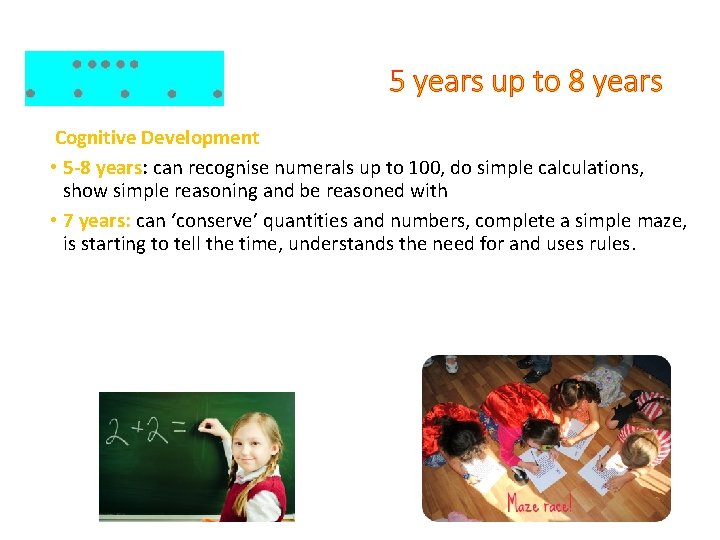
5 years up to 8 years Cognitive Development • 5 -8 years: can recognise numerals up to 100, do simple calculations, show simple reasoning and be reasoned with • 7 years: can ‘conserve’ quantities and numbers, complete a simple maze, is starting to tell the time, understands the need for and uses rules.
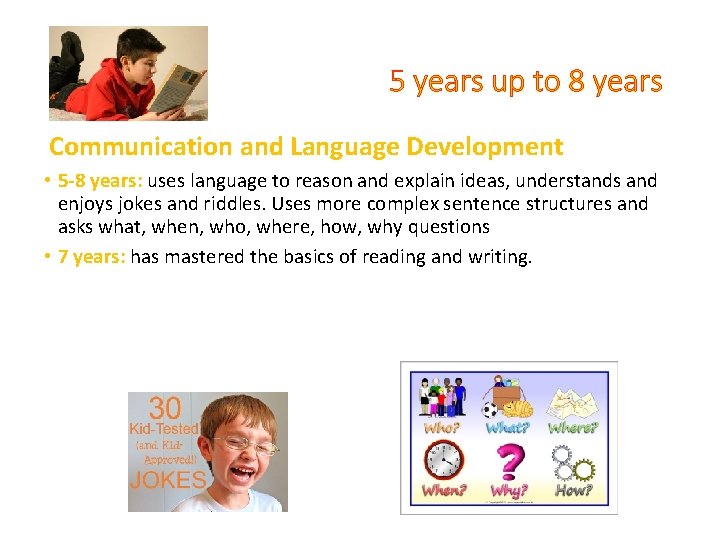
5 years up to 8 years Communication and Language Development • 5 -8 years: uses language to reason and explain ideas, understands and enjoys jokes and riddles. Uses more complex sentence structures and asks what, when, who, where, how, why questions • 7 years: has mastered the basics of reading and writing.
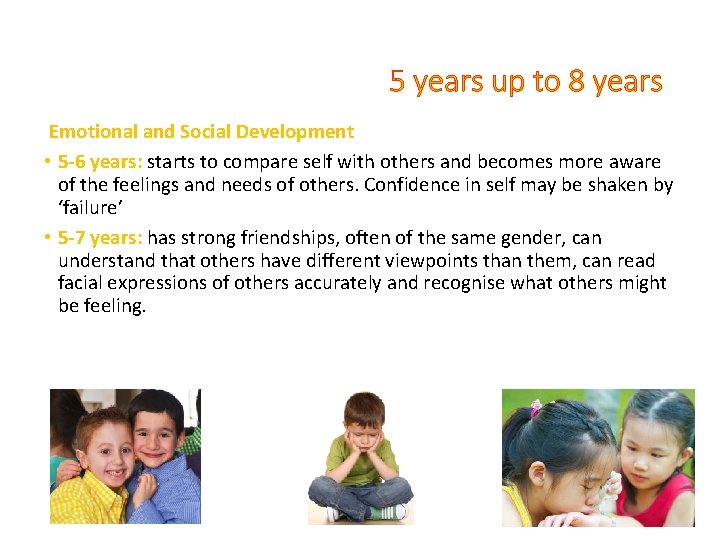
5 years up to 8 years Emotional and Social Development • 5 -6 years: starts to compare self with others and becomes more aware of the feelings and needs of others. Confidence in self may be shaken by ‘failure’ • 5 -7 years: has strong friendships, often of the same gender, can understand that others have different viewpoints than them, can read facial expressions of others accurately and recognise what others might be feeling.
Characteristics of Children’s Development Any Questions? The End