
Pattern Classification All materials in these slides were

![7 Where: = [ , A, B] = P( (1) = ) (initial state](https://slidetodoc.com/presentation_image_h2/544757dfaba1d4bb4291b08572bf74a2/image-8.jpg "7 Where: = [ , A, B] = P( (1) = ) (initial state")
- Slides: 9
Pattern Classification All materials in these slides were taken from Pattern Classification (2 nd ed) by R. O. Duda, P. E. Hart and D. G. Stork, John Wiley & Sons, 2000 with the permission of the authors and the publisher
Chapter 3 (Part 3): Maximum-Likelihood and Bayesian Parameter Estimation (Section 3. 10) • Hidden Markov Model: Extension of Markov Chains
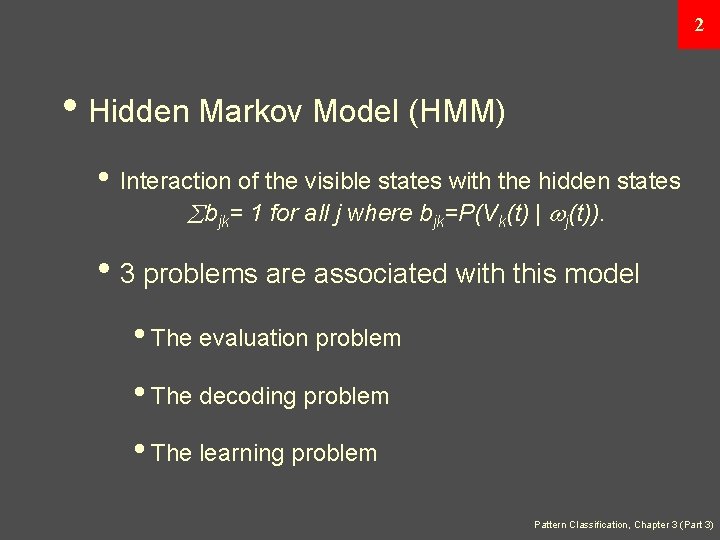
2 • Hidden Markov Model (HMM) • Interaction of the visible states with the hidden states bjk= 1 for all j where bjk=P(Vk(t) | j(t)). • 3 problems are associated with this model • The evaluation problem • The decoding problem • The learning problem Pattern Classification, Chapter 3 (Part 3)
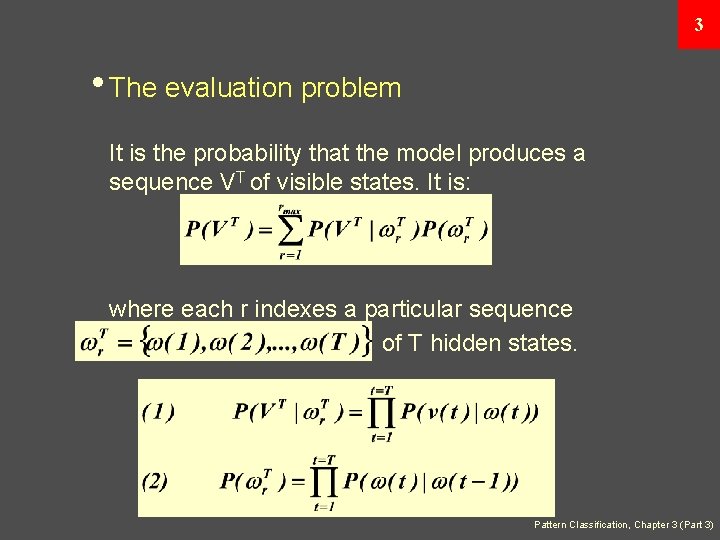
3 • The evaluation problem It is the probability that the model produces a sequence VT of visible states. It is: where each r indexes a particular sequence of T hidden states. Pattern Classification, Chapter 3 (Part 3)
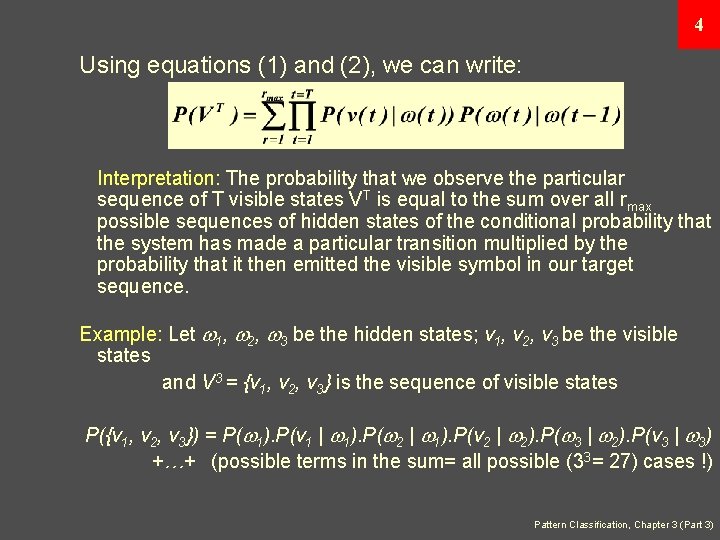
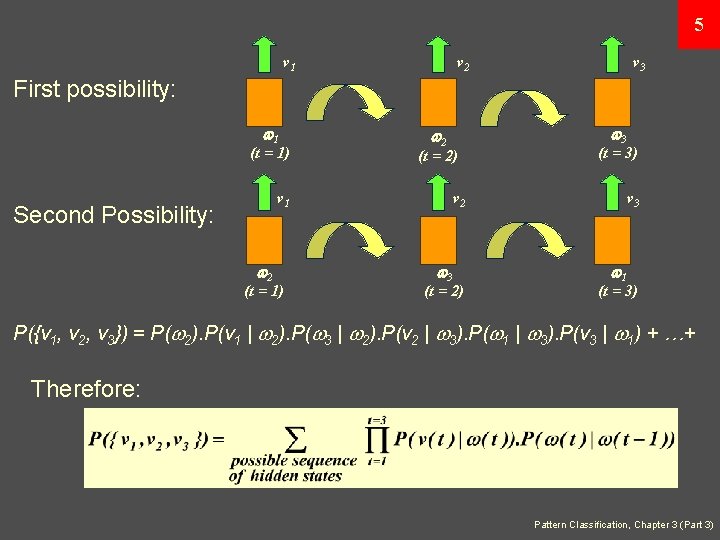
4 Using equations (1) and (2), we can write: Interpretation: The probability that we observe the particular sequence of T visible states VT is equal to the sum over all rmax possible sequences of hidden states of the conditional probability that the system has made a particular transition multiplied by the probability that it then emitted the visible symbol in our target sequence. Example: Let 1, 2, 3 be the hidden states; v 1, v 2, v 3 be the visible states and V 3 = {v 1, v 2, v 3} is the sequence of visible states P({v 1, v 2, v 3}) = P( 1). P(v 1 | 1). P( 2 | 1). P(v 2 | 2). P( 3 | 2). P(v 3 | 3) +…+ (possible terms in the sum= all possible (33= 27) cases !) Pattern Classification, Chapter 3 (Part 3)
5 v 1 v 2 v 3 First possibility: 1 (t = 1) (t = 2) v 1 Second Possibility: 2 (t = 1) 3 2 (t = 3) v 2 3 (t = 2) v 3 1 (t = 3) P({v 1, v 2, v 3}) = P( 2). P(v 1 | 2). P( 3 | 2). P(v 2 | 3). P( 1 | 3). P(v 3 | 1) + …+ Therefore: Pattern Classification, Chapter 3 (Part 3)
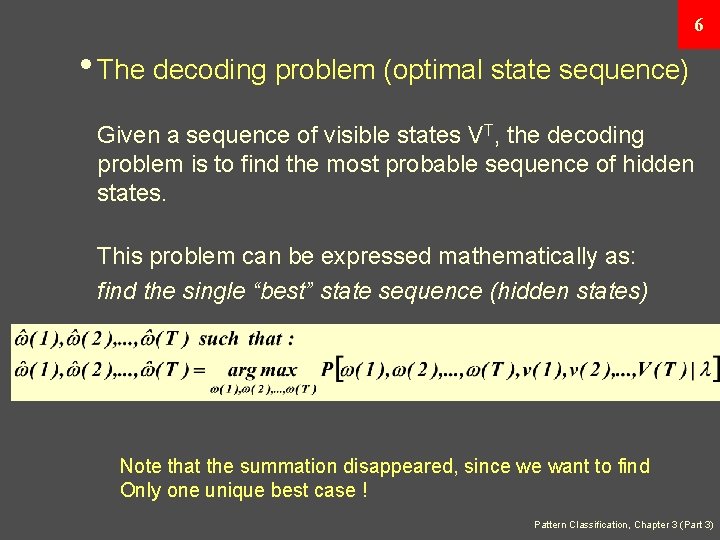
6 • The decoding problem (optimal state sequence) Given a sequence of visible states VT, the decoding problem is to find the most probable sequence of hidden states. This problem can be expressed mathematically as: find the single “best” state sequence (hidden states) Note that the summation disappeared, since we want to find Only one unique best case ! Pattern Classification, Chapter 3 (Part 3)
7 Where: = [ , A, B] = P( (1) = ) (initial state probability) A = aij = P( (t+1) = j | (t) = i) B = bjk = P(v(t) = k | (t) = j) In the preceding example, this computation corresponds to the selection of the best path amongst: { 1(t = 1), 2(t = 2), 3(t = 3)}, { 2(t = 1), 3(t = 2), 1(t = 3)} { 3(t = 1), 1(t = 2), 2(t = 3)}, { 3(t = 1), 2(t = 2), 1(t = 3)} { 2(t = 1), 1(t = 2), 3(t = 3)} Pattern Classification, Chapter 3 (Part 3)
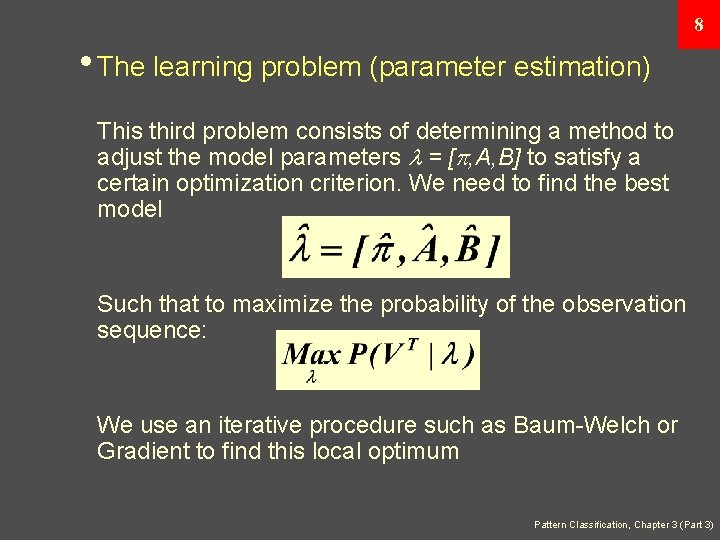
8 • The learning problem (parameter estimation) This third problem consists of determining a method to adjust the model parameters = [ , A, B] to satisfy a certain optimization criterion. We need to find the best model Such that to maximize the probability of the observation sequence: We use an iterative procedure such as Baum-Welch or Gradient to find this local optimum Pattern Classification, Chapter 3 (Part 3)