
PATMOSx Reflectance Calibration and Reflectance TimeSeries Andrew Heidinger
PATMOS-x Reflectance Calibration and Reflectance Time-Series Andrew Heidinger NOAA/NESDIS/STAR Madison, Wisconsin, USA Christine Molling UW/CIMSS Madison, Wisconsin, USA February 10, 2010 Joint GRWG and GDWG Meeting 9 -10 & 11 February 2010 at CNES, Toulouse (France) 1
Outline • PATMOS-x Introduction • Calibration Methodology • Validation using PATMOS-x Time Series • Future Work 2
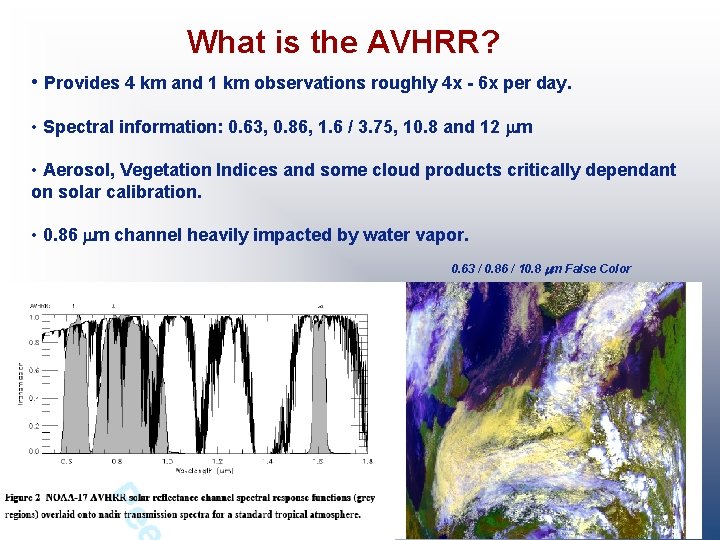
What is the AVHRR? • Provides 4 km and 1 km observations roughly 4 x - 6 x per day. • Spectral information: 0. 63, 0. 86, 1. 6 / 3. 75, 10. 8 and 12 m • Aerosol, Vegetation Indices and some cloud products critically dependant on solar calibration. • 0. 86 m channel heavily impacted by water vapor. 0. 63 / 0. 86 / 10. 8 mm False Color
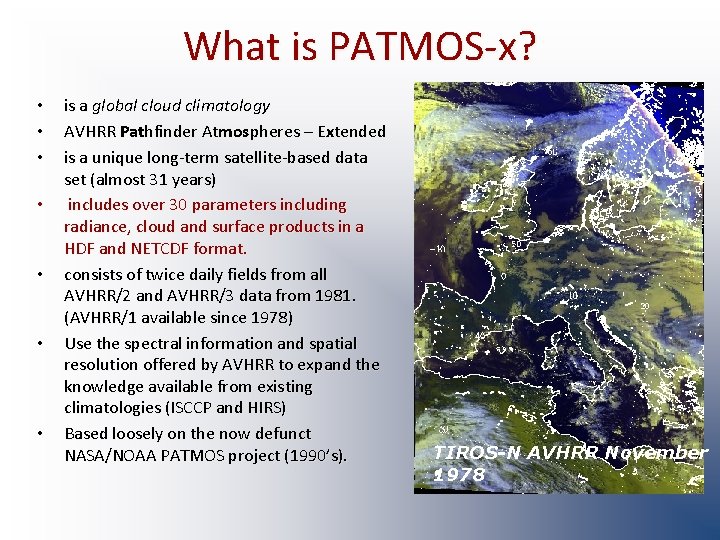
What is PATMOS-x? • • is a global cloud climatology AVHRR Pathfinder Atmospheres – Extended is a unique long-term satellite-based data set (almost 31 years) includes over 30 parameters including radiance, cloud and surface products in a HDF and NETCDF format. consists of twice daily fields from all AVHRR/2 and AVHRR/3 data from 1981. (AVHRR/1 available since 1978) Use the spectral information and spatial resolution offered by AVHRR to expand the knowledge available from existing climatologies (ISCCP and HIRS) Based loosely on the now defunct NASA/NOAA PATMOS project (1990’s). TIROS-N AVHRR November 1978
Collaborations • Done in collaboration with the AVHRR reprocessing effort in CM-SAF within the WMO SCOPE-CM • Solar calibration, navigation and entire LEVEL-1 b data provided to CM-SAF in DWD in Offenbach • Solar calibration data being tested by ISCCP now. • NCDC runs PATMOS-x for several CDR generation projects. • PATMOS-x products contribute to the GEWEX Cloud Climatology Assessment Effort.
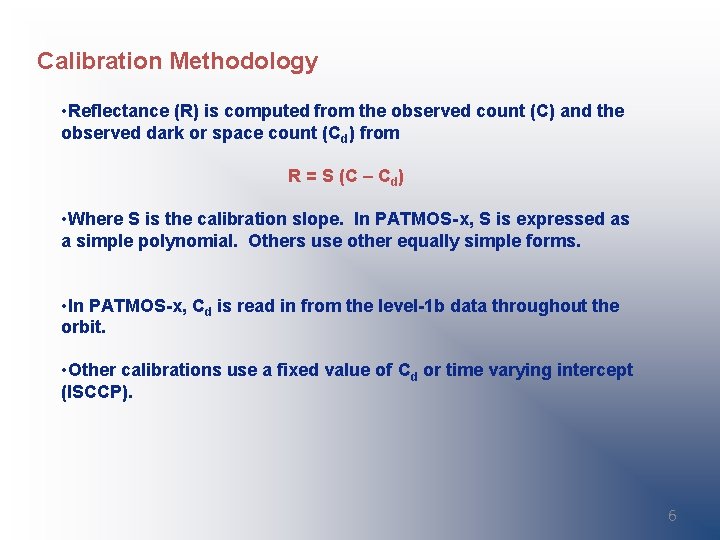
Calibration Methodology • Reflectance (R) is computed from the observed count (C) and the observed dark or space count (Cd) from R = S (C – Cd) • Where S is the calibration slope. In PATMOS-x, S is expressed as a simple polynomial. Others use other equally simple forms. • In PATMOS-x, Cd is read in from the level-1 b data throughout the orbit. • Other calibrations use a fixed value of Cd or time varying intercept (ISCCP). 6
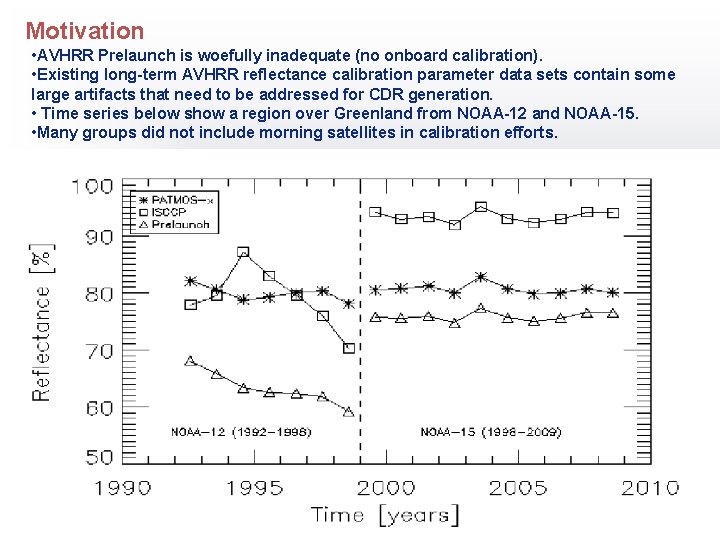
Motivation • AVHRR Prelaunch is woefully inadequate (no onboard calibration). • Existing long-term AVHRR reflectance calibration parameter data sets contain some large artifacts that need to be addressed for CDR generation. • Time series below show a region over Greenland from NOAA-12 and NOAA-15. • Many groups did not include morning satellites in calibration efforts. 7
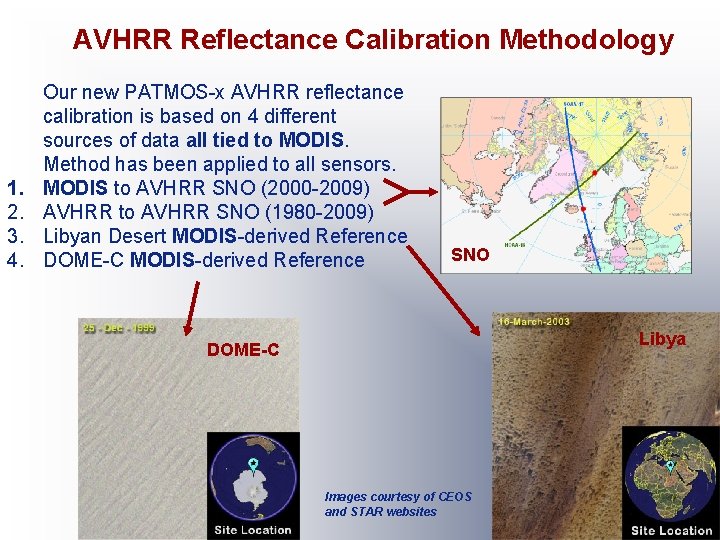
AVHRR Reflectance Calibration Methodology 1. 2. 3. 4. Our new PATMOS-x AVHRR reflectance calibration is based on 4 different sources of data all tied to MODIS. Method has been applied to all sensors. MODIS to AVHRR SNO (2000 -2009) AVHRR to AVHRR SNO (1980 -2009) Libyan Desert MODIS-derived Reference DOME-C MODIS-derived Reference SNO Libya DOME-C Images courtesy of CEOS and STAR websites
Methodology Contd. • Method to convert MODIS to AVHRR observations for Clear-Skt Targets • Ozone and Water Vapor Source (NCEP Reanalysis) • Spectral Surface Reflectance of Targets (HYPERION and ASTER Library) • Radiative Transfer Models (MODTRAN) • Aerosol Climatological • Method to convert MODIS to AVHRR observations for SNO. These are generally not clear-sky observations. (Heidinger et al. 2001) • MODTRAN parameterization based on MODIS TPW channels (Chs 17, 18 and 19) • Ozone absorption added in. • Aerosol ignored. 9
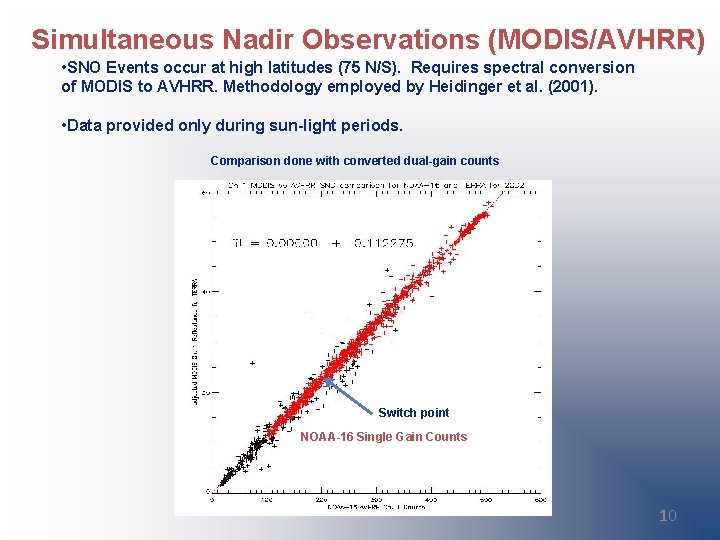
Simultaneous Nadir Observations (MODIS/AVHRR) • SNO Events occur at high latitudes (75 N/S). Requires spectral conversion of MODIS to AVHRR. Methodology employed by Heidinger et al. (2001). • Data provided only during sun-light periods. Comparison done with converted dual-gain counts Switch point NOAA-16 Single Gain Counts 10
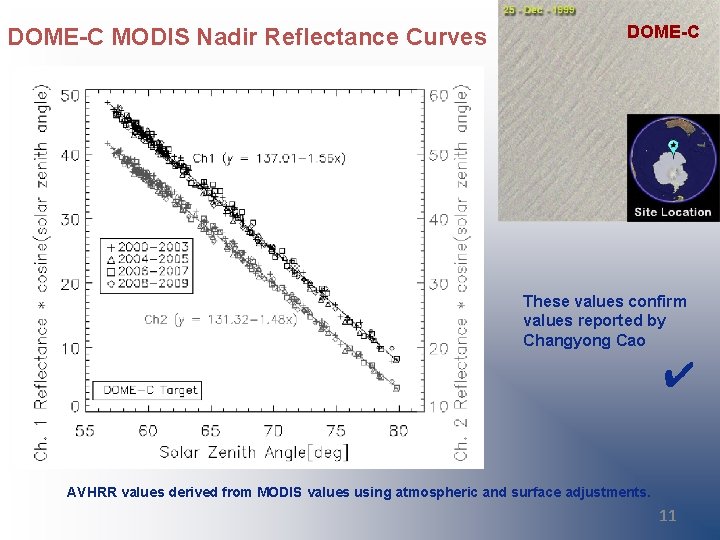
DOME-C MODIS Nadir Reflectance Curves DOME-C These values confirm values reported by Changyong Cao ✔ AVHRR values derived from MODIS values using atmospheric and surface adjustments. 11
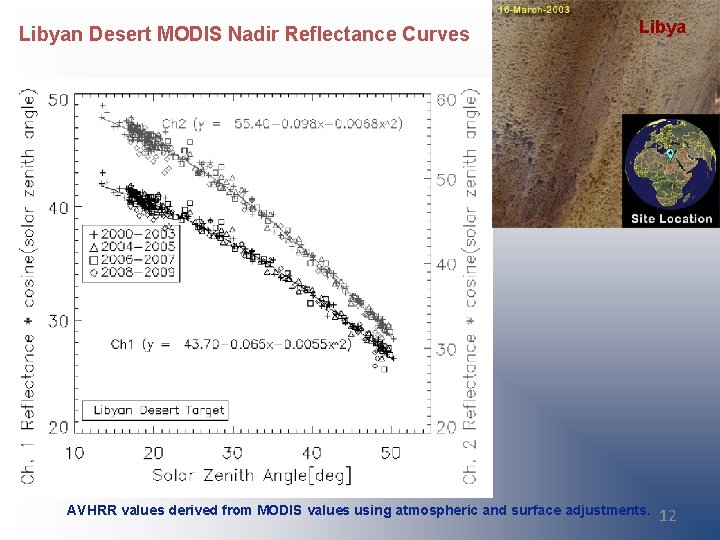
Libyan Desert MODIS Nadir Reflectance Curves Libya AVHRR values derived from MODIS values using atmospheric and surface adjustments. 12
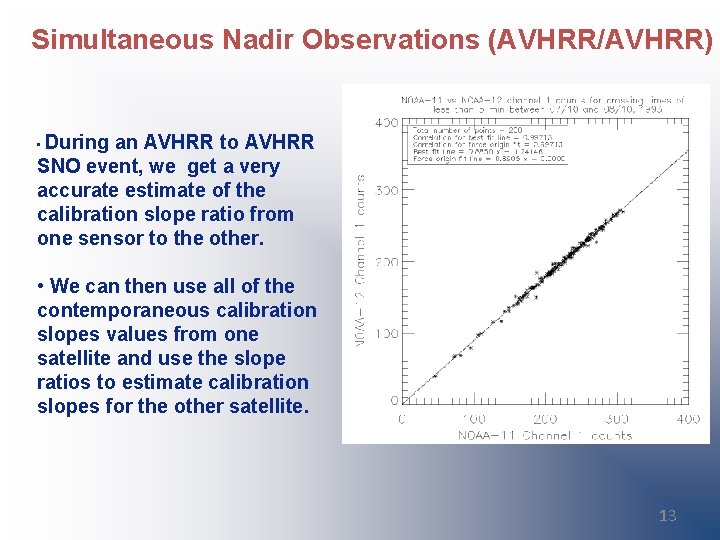
Simultaneous Nadir Observations (AVHRR/AVHRR) During an AVHRR to AVHRR SNO event, we get a very accurate estimate of the calibration slope ratio from one sensor to the other. • • We can then use all of the contemporaneous calibration slopes values from one satellite and use the slope ratios to estimate calibration slopes for the other satellite. 13
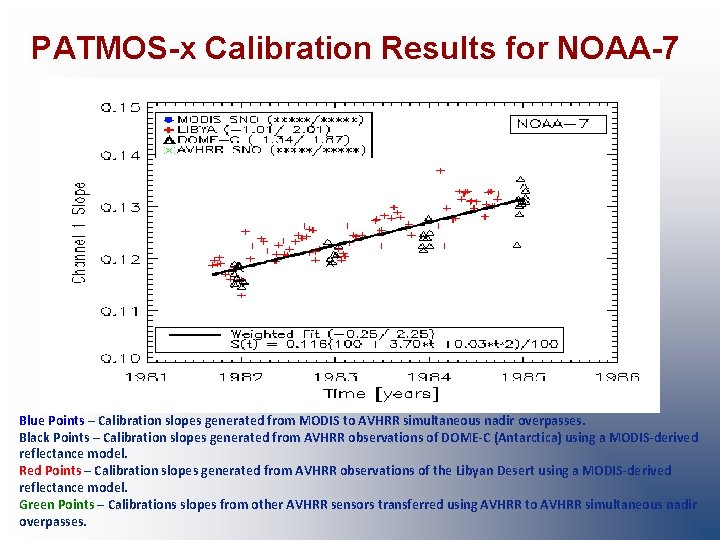
PATMOS-x Calibration Results for NOAA-7 Blue Points – Calibration slopes generated from MODIS to AVHRR simultaneous nadir overpasses. Black Points – Calibration slopes generated from AVHRR observations of DOME-C (Antarctica) using a MODIS-derived reflectance model. Red Points – Calibration slopes generated from AVHRR observations of the Libyan Desert using a MODIS-derived reflectance model. Green Points – Calibrations slopes from other AVHRR sensors transferred using AVHRR to AVHRR simultaneous nadir overpasses.
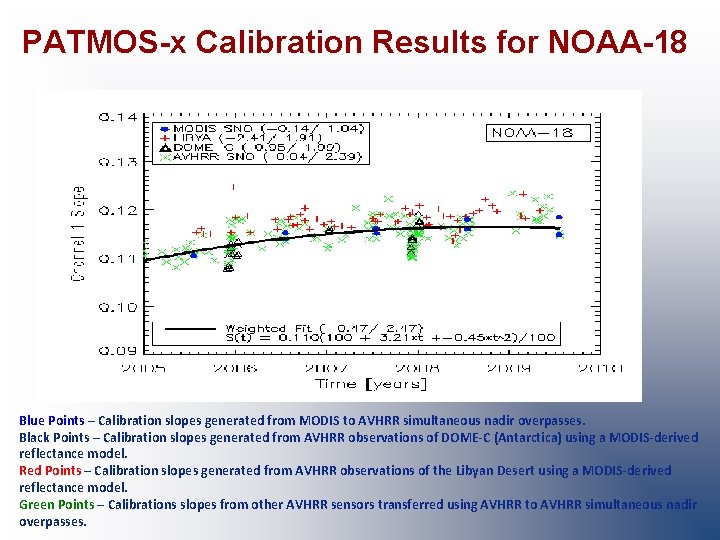
PATMOS-x Calibration Results for NOAA-18 Blue Points – Calibration slopes generated from MODIS to AVHRR simultaneous nadir overpasses. Black Points – Calibration slopes generated from AVHRR observations of DOME-C (Antarctica) using a MODIS-derived reflectance model. Red Points – Calibration slopes generated from AVHRR observations of the Libyan Desert using a MODIS-derived reflectance model. Green Points – Calibrations slopes from other AVHRR sensors transferred using AVHRR to AVHRR simultaneous nadir overpasses.
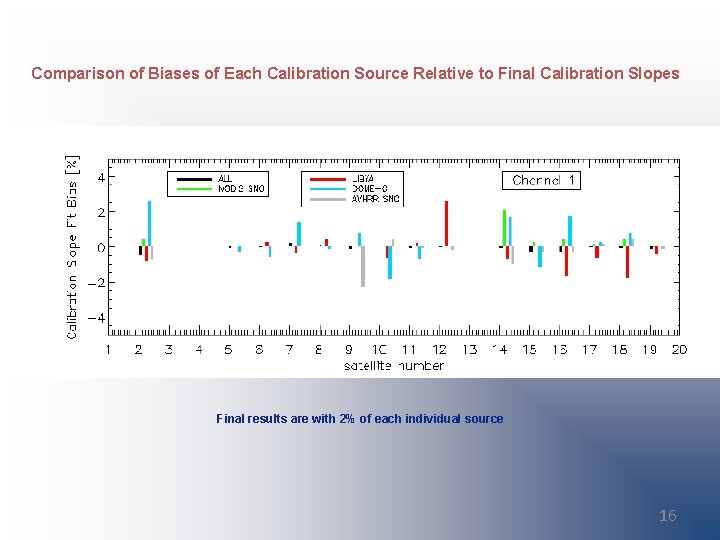
Comparison of Biases of Each Calibration Source Relative to Final Calibration Slopes Final results are with 2% of each individual source 16
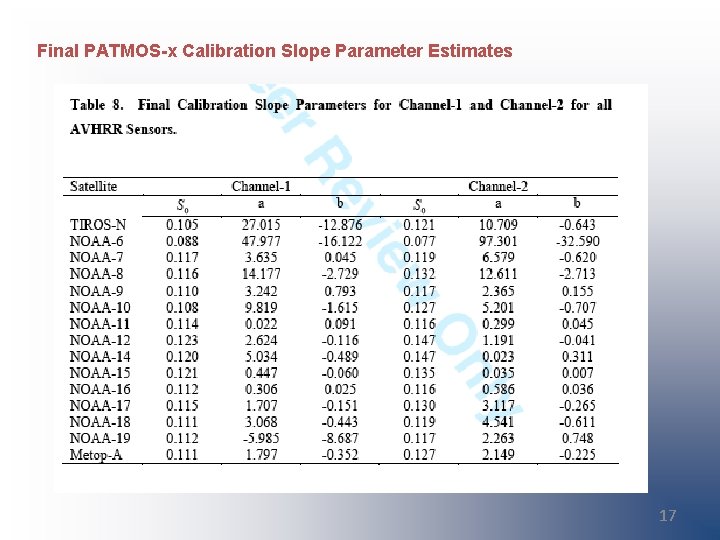
Final PATMOS-x Calibration Slope Parameter Estimates 17
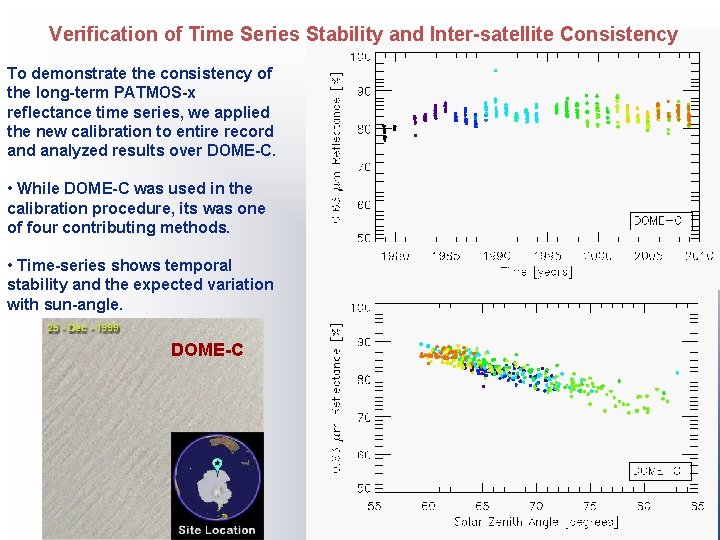
Verification of Time Series Stability and Inter-satellite Consistency To demonstrate the consistency of the long-term PATMOS-x reflectance time series, we applied the new calibration to entire record analyzed results over DOME-C. • While DOME-C was used in the calibration procedure, its was one of four contributing methods. • Time-series shows temporal stability and the expected variation with sun-angle. DOME-C 18
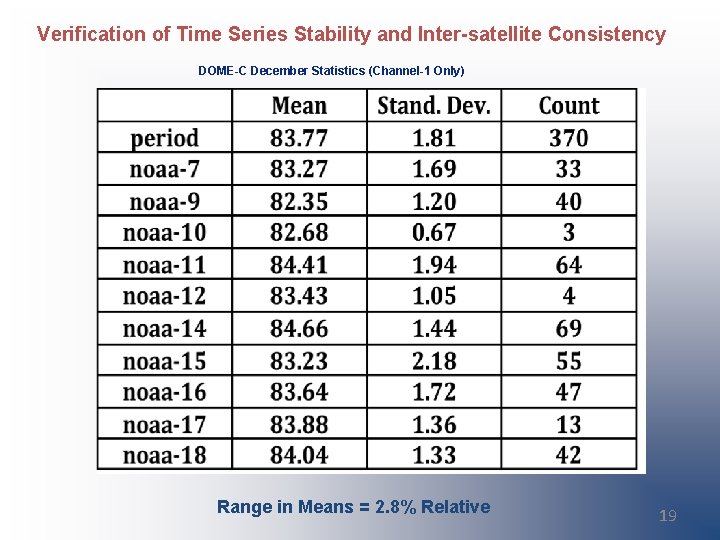
Verification of Time Series Stability and Inter-satellite Consistency DOME-C December Statistics (Channel-1 Only) Range in Means = 2. 8% Relative 19
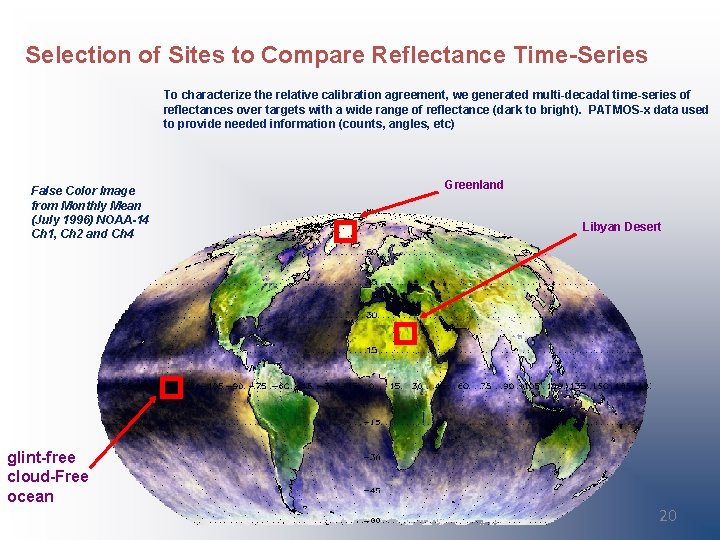
Selection of Sites to Compare Reflectance Time-Series To characterize the relative calibration agreement, we generated multi-decadal time-series of reflectances over targets with a wide range of reflectance (dark to bright). PATMOS-x data used to provide needed information (counts, angles, etc) False Color Image from Monthly Mean (July 1996) NOAA-14 Ch 1, Ch 2 and Ch 4 glint-free cloud-Free ocean Greenland Libyan Desert 20
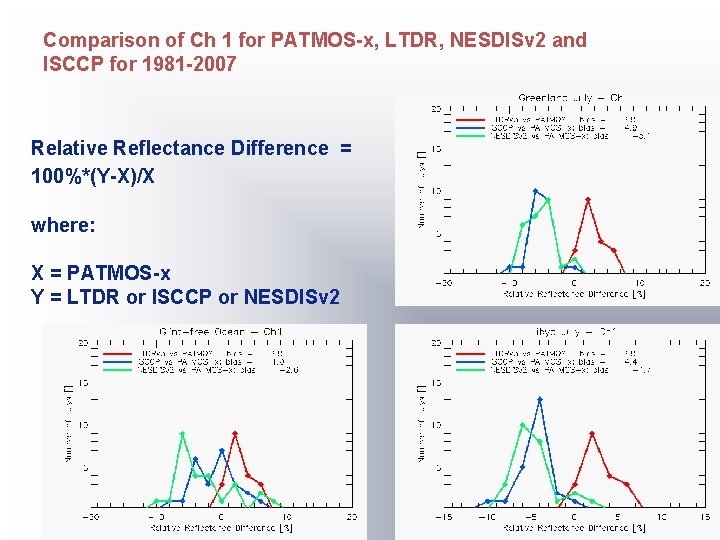
Comparison of Ch 1 for PATMOS-x, LTDR, NESDISv 2 and ISCCP for 1981 -2007 Relative Reflectance Difference = 100%*(Y-X)/X where: X = PATMOS-x Y = LTDR or ISCCP or NESDISv 2 21
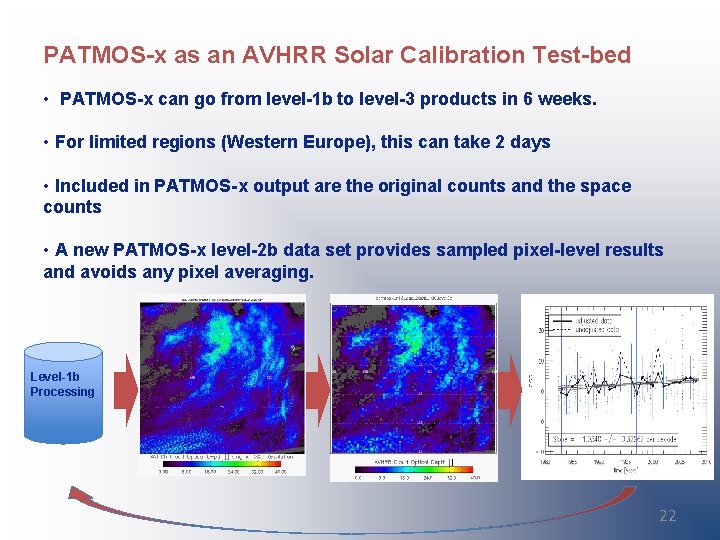
PATMOS-x as an AVHRR Solar Calibration Test-bed • PATMOS-x can go from level-1 b to level-3 products in 6 weeks. • For limited regions (Western Europe), this can take 2 days • Included in PATMOS-x output are the original counts and the space counts • A new PATMOS-x level-2 b data set provides sampled pixel-level results and avoids any pixel averaging. Level-1 b Processing 22
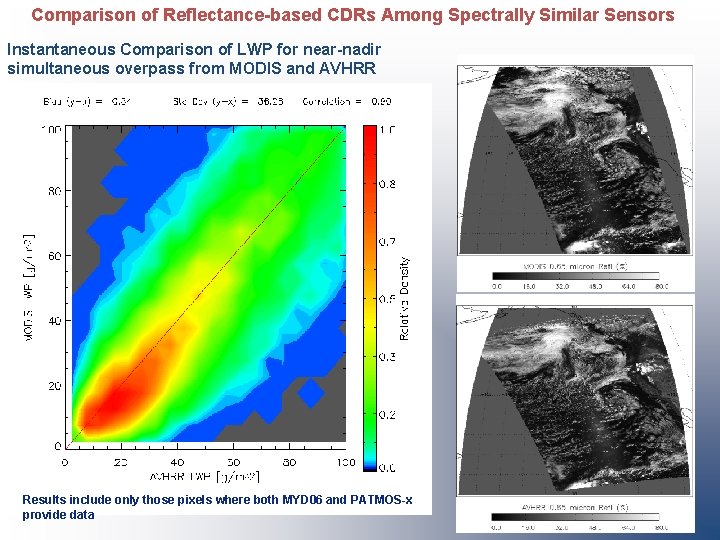
Comparison of Reflectance-based CDRs Among Spectrally Similar Sensors Instantaneous Comparison of LWP for near-nadir simultaneous overpass from MODIS and AVHRR Results include only those pixels where both MYD 06 and PATMOS-x provide data
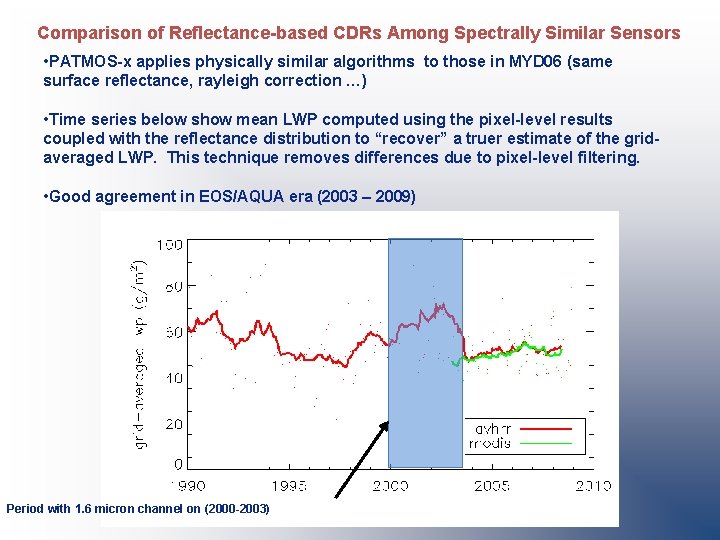
Comparison of Reflectance-based CDRs Among Spectrally Similar Sensors • PATMOS-x applies physically similar algorithms to those in MYD 06 (same surface reflectance, rayleigh correction …) • Time series below show mean LWP computed using the pixel-level results coupled with the reflectance distribution to “recover” a truer estimate of the gridaveraged LWP. This technique removes differences due to pixel-level filtering. • Good agreement in EOS/AQUA era (2003 – 2009) Period with 1. 6 micron channel on (2000 -2003)
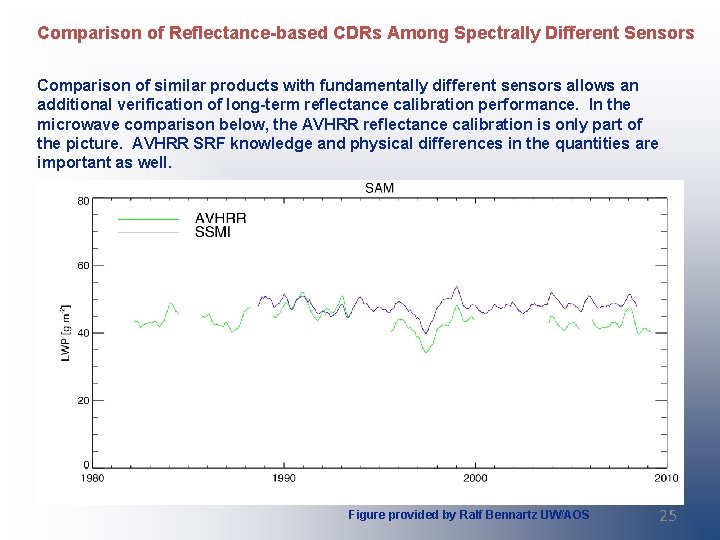
Comparison of Reflectance-based CDRs Among Spectrally Different Sensors Comparison of similar products with fundamentally different sensors allows an additional verification of long-term reflectance calibration performance. In the microwave comparison below, the AVHRR reflectance calibration is only part of the picture. AVHRR SRF knowledge and physical differences in the quantities are important as well. Figure provided by Ralf Bennartz UW/AOS 25
Recommendations for Future Work We would be very close to a consensus AVHRR solar calibration if we could come to consensus on the following. (All of the PATMOS-x values are on-line). • MODIS nadir reflectance curves for DOME-c and Saharan Desert Sites. • AVHRR to AVHRR relative calibration slope archive derived from SNO. • AVHRR calibration slopes from MODIS / AVHRR SNO events • Method to convert MODIS to AVHRR observations for MODIS/AVHRR SNO • Water Vapor Source (NCEP Reanalysis) • Spectral Surface Reflectance of Targets (HYPERION and ASTER Library) • Radiative Transfer Models (MODTRAN) 26
AVHRR Solar Reflectance Conclusions • The PATMOS-x reflectance calibration has achieved agreement with MODIS to within 3%. (MODIS itself has an error of approximately 2%). • Largest remaining source of uncertainty is the spectral surface reflectance of the DOME-C and Libyan Targets. • Use of Simultaneous Nadir Overpass between AVHRR + MODIS and AVHRR + AVHRR offer key constraints. • Inclusion of the CEOS-sanctioned DOME-C site offers substantial improvements because it allows for afternoon and morning orbiters to view the same calibration target. Deserts are only viewed by afternoon sensors. • Analysis of PATMOS-x time-series is a critical component in verifying the impact of the reflectance calibration. • Future work will include including the 1. 6 micron channel using MODIS/AVHRR SNO • Future work will also include incorporation of CEOS and GSICS advancements (more sites, more sensor SNOs) in collaboration with the larger NESDIS team. 27
Thank You 28
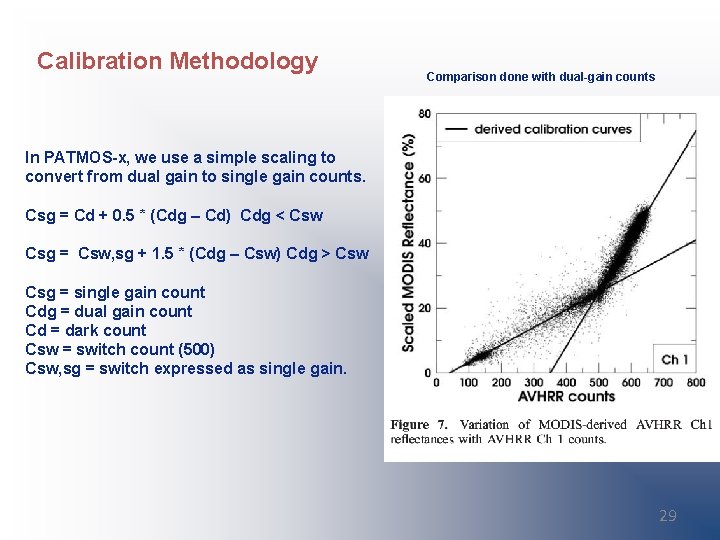
Calibration Methodology Comparison done with dual-gain counts In PATMOS-x, we use a simple scaling to convert from dual gain to single gain counts. Csg = Cd + 0. 5 * (Cdg – Cd) Cdg < Csw Csg = Csw, sg + 1. 5 * (Cdg – Csw) Cdg > Csw Csg = single gain count Cdg = dual gain count Cd = dark count Csw = switch count (500) Csw, sg = switch expressed as single gain. 29
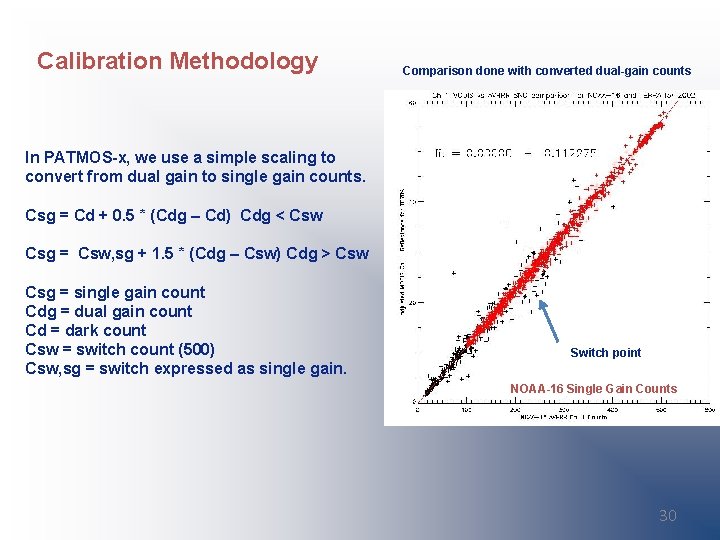
Calibration Methodology Comparison done with converted dual-gain counts In PATMOS-x, we use a simple scaling to convert from dual gain to single gain counts. Csg = Cd + 0. 5 * (Cdg – Cd) Cdg < Csw Csg = Csw, sg + 1. 5 * (Cdg – Csw) Cdg > Csw Csg = single gain count Cdg = dual gain count Cd = dark count Csw = switch count (500) Csw, sg = switch expressed as single gain. Switch point NOAA-16 Single Gain Counts 30
- Slides: 30