
Patients with Chronic Cardiorenal Syndrome and Fluid Overload
- Slides: 1
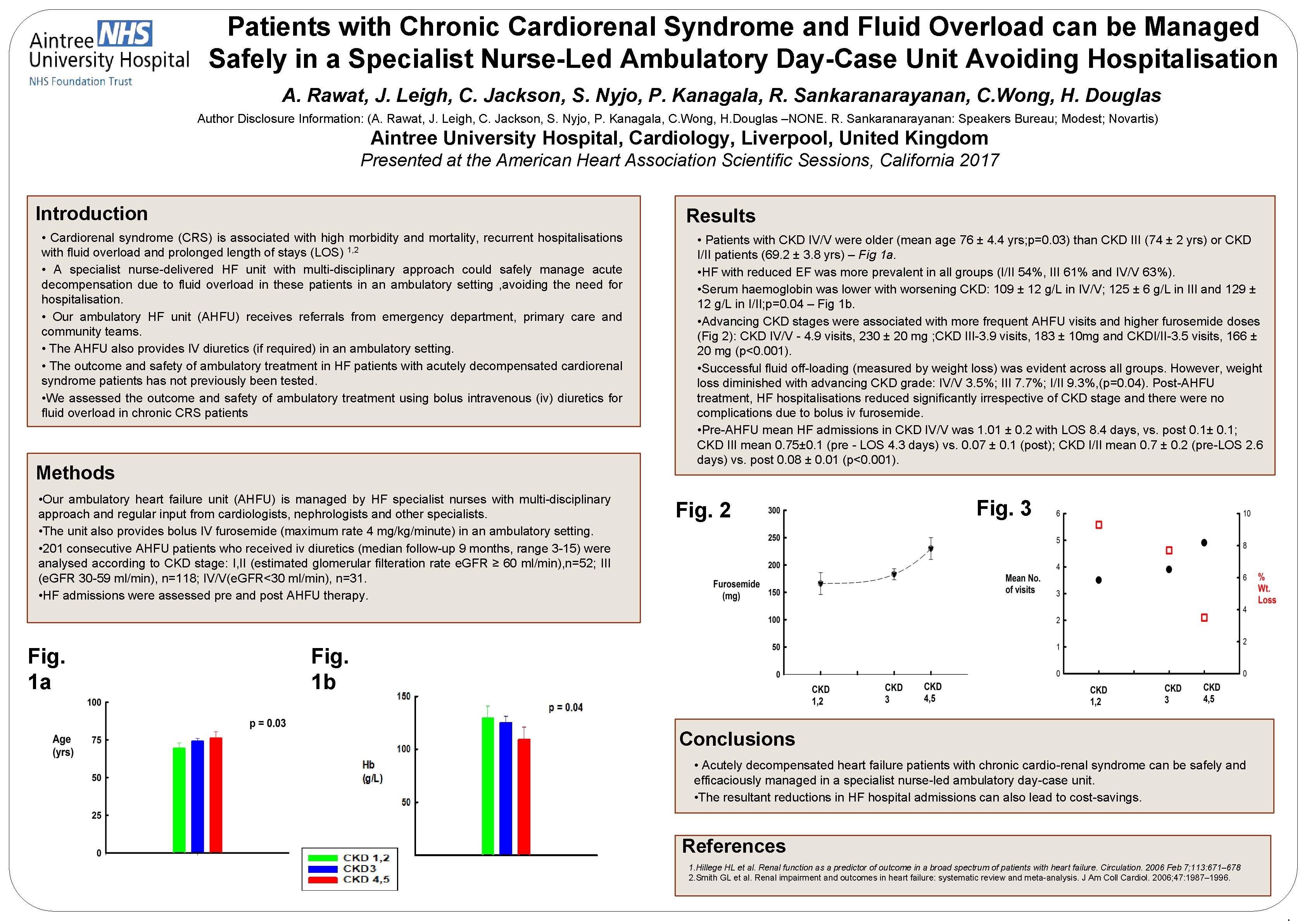
Patients with Chronic Cardiorenal Syndrome and Fluid Overload can be Managed Safely in a Specialist Nurse-Led Ambulatory Day-Case Unit Avoiding Hospitalisation A. Rawat, J. Leigh, C. Jackson, S. Nyjo, P. Kanagala, R. Sankaranarayanan, C. Wong, H. Douglas Author Disclosure Information: (A. Rawat, J. Leigh, C. Jackson, S. Nyjo, P. Kanagala, C. Wong, H. Douglas –NONE. R. Sankaranarayanan: Speakers Bureau; Modest; Novartis) Aintree University Hospital, Cardiology, Liverpool, United Kingdom Presented at the American Heart Association Scientific Sessions, California 2017 Introduction Results • Cardiorenal syndrome (CRS) is associated with high morbidity and mortality, recurrent hospitalisations with fluid overload and prolonged length of stays (LOS) 1, 2 • A specialist nurse-delivered HF unit with multi-disciplinary approach could safely manage acute decompensation due to fluid overload in these patients in an ambulatory setting , avoiding the need for hospitalisation. • Our ambulatory HF unit (AHFU) receives referrals from emergency department, primary care and community teams. • The AHFU also provides IV diuretics (if required) in an ambulatory setting. • The outcome and safety of ambulatory treatment in HF patients with acutely decompensated cardiorenal syndrome patients has not previously been tested. • We assessed the outcome and safety of ambulatory treatment using bolus intravenous (iv) diuretics for fluid overload in chronic CRS patients Methods • Our ambulatory heart failure unit (AHFU) is managed by HF specialist nurses with multi-disciplinary approach and regular input from cardiologists, nephrologists and other specialists. • The unit also provides bolus IV furosemide (maximum rate 4 mg/kg/minute) in an ambulatory setting. • 201 consecutive AHFU patients who received iv diuretics (median follow-up 9 months, range 3 -15) were analysed according to CKD stage: I, II (estimated glomerular filteration rate e. GFR ≥ 60 ml/min), n=52; III (e. GFR 30 -59 ml/min), n=118; IV/V(e. GFR<30 ml/min), n=31. • HF admissions were assessed pre and post AHFU therapy. Fig. 1 a • Patients with CKD IV/V were older (mean age 76 ± 4. 4 yrs; p=0. 03) than CKD III (74 ± 2 yrs) or CKD I/II patients (69. 2 ± 3. 8 yrs) – Fig 1 a. • HF with reduced EF was more prevalent in all groups (I/II 54%, III 61% and IV/V 63%). • Serum haemoglobin was lower with worsening CKD: 109 ± 12 g/L in IV/V; 125 ± 6 g/L in III and 129 ± 12 g/L in I/II; p=0. 04 – Fig 1 b. • Advancing CKD stages were associated with more frequent AHFU visits and higher furosemide doses (Fig 2): CKD IV/V - 4. 9 visits, 230 ± 20 mg ; CKD III-3. 9 visits, 183 ± 10 mg and CKDI/II-3. 5 visits, 166 ± 20 mg (p<0. 001). • Successful fluid off-loading (measured by weight loss) was evident across all groups. However, weight loss diminished with advancing CKD grade: IV/V 3. 5%; III 7. 7%; I/II 9. 3%, (p=0. 04). Post-AHFU treatment, HF hospitalisations reduced significantly irrespective of CKD stage and there were no complications due to bolus iv furosemide. • Pre-AHFU mean HF admissions in CKD IV/V was 1. 01 ± 0. 2 with LOS 8. 4 days, vs. post 0. 1± 0. 1; CKD III mean 0. 75± 0. 1 (pre - LOS 4. 3 days) vs. 0. 07 ± 0. 1 (post); CKD I/II mean 0. 7 ± 0. 2 (pre-LOS 2. 6 days) vs. post 0. 08 ± 0. 01 (p<0. 001). Fig. 2 Fig. 3 Fig. 1 b Conclusions • Acutely decompensated heart failure patients with chronic cardio-renal syndrome can be safely and efficaciously managed in a specialist nurse-led ambulatory day-case unit. • The resultant reductions in HF hospital admissions can also lead to cost-savings. References 1. Hillege HL et al. Renal function as a predictor of outcome in a broad spectrum of patients with heart failure. Circulation. 2006 Feb 7; 113: 671– 678 2. Smith GL et al. Renal impairment and outcomes in heart failure: systematic review and meta-analysis. J Am Coll Cardiol. 2006; 47: 1987– 1996. .