
PatientDelivered Partner Treatment for Chlamydia in California Legislation
- Slides: 20
Patient-Delivered Partner Treatment for Chlamydia in California: Legislation, Implementation, and Evaluation Heidi M Bauer, MD MS MPH STD Control Branch California Department of Health Services 2006 National STD Prevention Conference
Presentation Overview § Legislative process § Guidelines development and statewide implementation § Provider survey findings § Preliminary evaluation findings § Next steps
Background § More than 110, 000 CT infections were reported in California in 2002 § High rate of re-infection after treatment, which increases risk for adverse health outcomes § Untreated partner is a major risk for repeat infection § Allowing patients to deliver antibiotics to sexual partners facilitates partner treatment and reduces re-infection
Legislative Background § PDPT for CT common among STD and ob/gyn providers § Legal impediment: California Medical Practice Act § Interest in legislation originated from MCOs in late 1990 s § Strong rationale in CT morbidity as well as safety and effectiveness of PDPT § Broad support among professional organizations
Legislative Process: SB 643 ØIntroduced by Senator Ortiz in February 1999 ØAmended May 2000 ØEnacted in the fall of 2000 ØSigned into law January 2001
Health & Safety Code “Notwithstanding any other provision of law, a physician and surgeon who diagnoses a sexually transmitted chlamydia infection in an individual patient may prescribe, dispense, furnish, or otherwise provide prescription antibiotic drugs to that patient's sexual partner or partners without examination of that patient's partner or partners. The department may adopt regulations to implement this section. ” Similar language allowed nurse practitioners, certified nurse-midwifes, and physician assistants to dispense, furnish, or provide prescriptions for PDPT CA Health & Safety Code Section 120582
Clinical Guidelines § First-choice strategy: Attempt to bring partners in for evaluation and treatment § Most appropriate patients: Females with male partners § Diagnosis: Laboratory-confirmed genital chlamydia infection without co-infection with gonorrhea or other complications § Most appropriate partners: Males who are uninsured or unlikely to seek medical services § Medication: The law does not specify, but recommended medication is Azithromycin (Zithromax) 1 gram (250 mg tablets x 4) orally once www. ucsf. edu/castd
Clinical Guidelines (cont) § Number of doses are limited to the number of known sex partners in past 60 days § Educational materials must accompany medication § Patient counseling: Abstinence until 7 days after treatment and until 7 days after partners have been treated § Evaluation: Recommend re-test patients for chlamydia three to four months after treatment § Adverse reactions: Does not protect provider from liability, as is the case for any medical treatment. Report to 1 -866 -556 -3730 (toll-free) www. ucsf. edu/castd
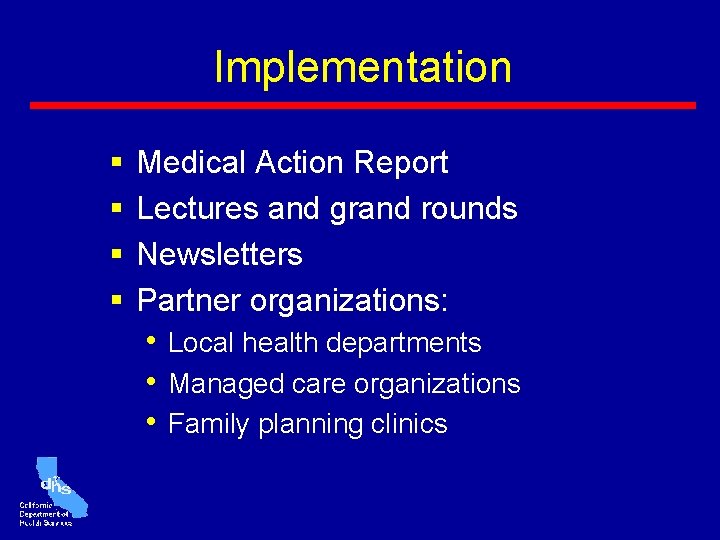
Implementation § § Medical Action Report Lectures and grand rounds Newsletters Partner organizations: • Local health departments • Managed care organizations • Family planning clinics
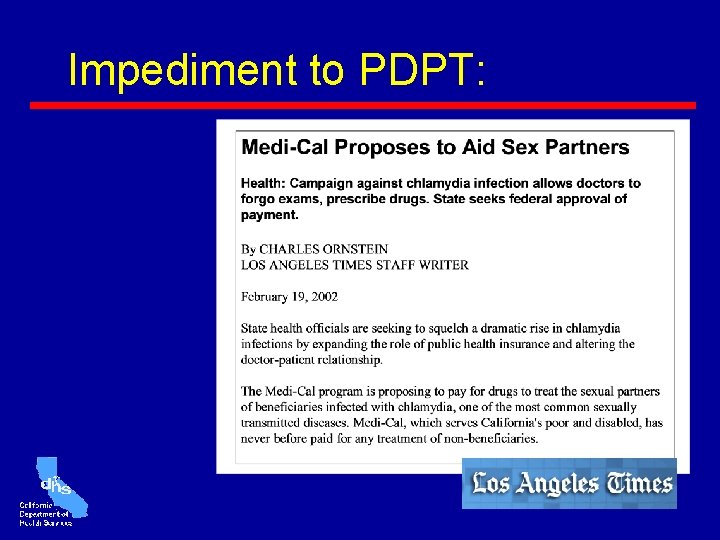
Impediment to PDPT:
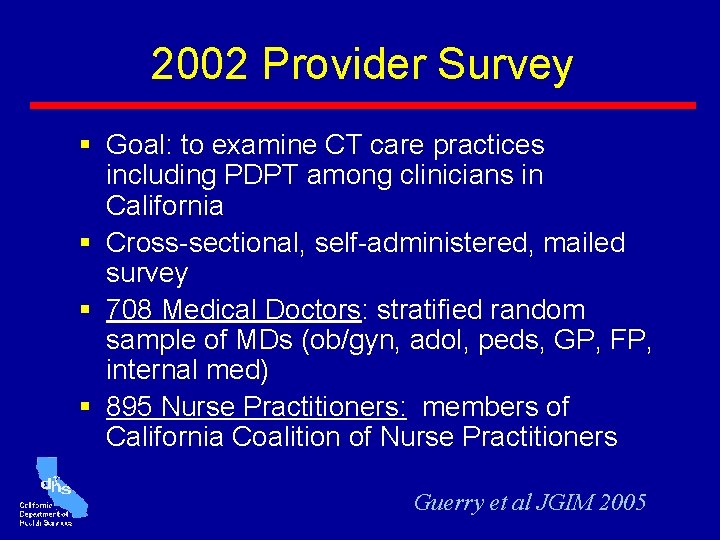
2002 Provider Survey § Goal: to examine CT care practices including PDPT among clinicians in California § Cross-sectional, self-administered, mailed survey § 708 Medical Doctors: stratified random sample of MDs (ob/gyn, adol, peds, GP, FP, internal med) § 895 Nurse Practitioners: members of California Coalition of Nurse Practitioners Guerry et al JGIM 2005
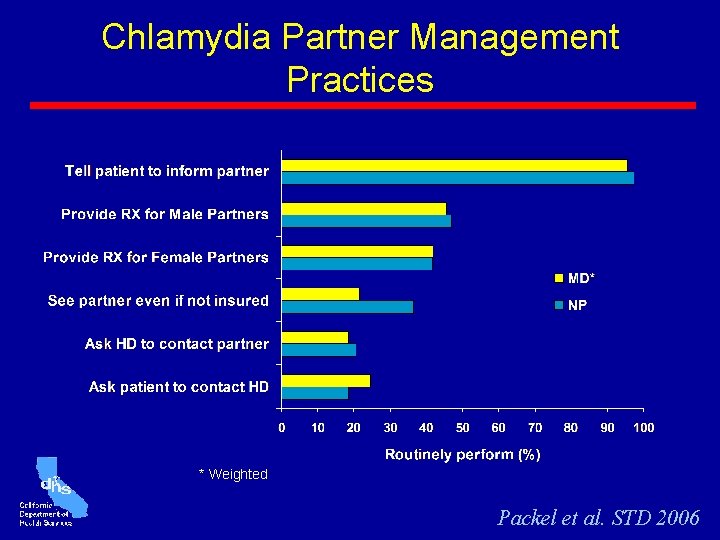
Chlamydia Partner Management Practices * Weighted Packel et al. STD 2006
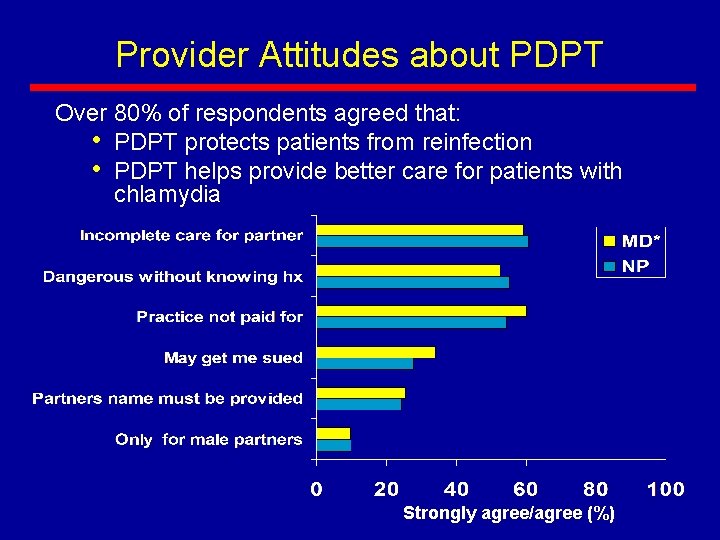
Provider Attitudes about PDPT Over 80% of respondents agreed that: • PDPT protects patients from reinfection • PDPT helps provide better care for patients with chlamydia Strongly agree/agree (%)
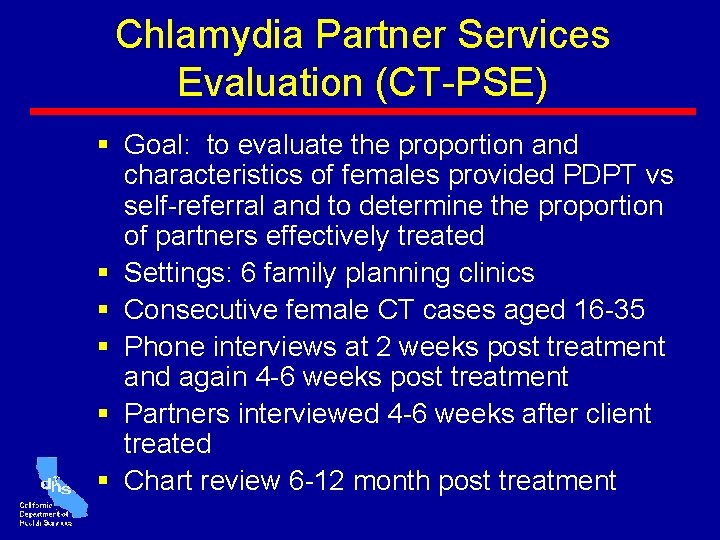
Chlamydia Partner Services Evaluation (CT-PSE) § Goal: to evaluate the proportion and characteristics of females provided PDPT vs self-referral and to determine the proportion of partners effectively treated § Settings: 6 family planning clinics § Consecutive female CT cases aged 16 -35 § Phone interviews at 2 weeks post treatment and again 4 -6 weeks post treatment § Partners interviewed 4 -6 weeks after client treated § Chart review 6 -12 month post treatment
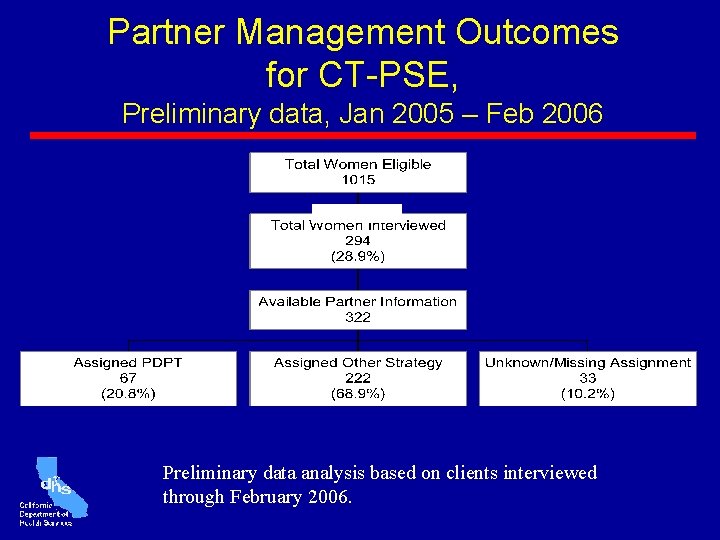
Partner Management Outcomes for CT-PSE, Preliminary data, Jan 2005 – Feb 2006 Preliminary data analysis based on clients interviewed through February 2006.
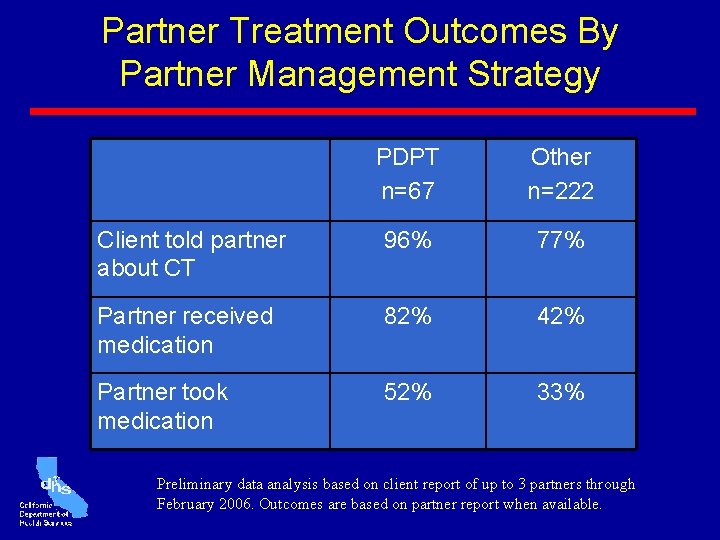
Partner Treatment Outcomes By Partner Management Strategy PDPT n=67 Other n=222 Client told partner about CT 96% 77% Partner received medication 82% 42% Partner took medication 52% 33% Preliminary data analysis based on client report of up to 3 partners through February 2006. Outcomes are based on partner report when available.
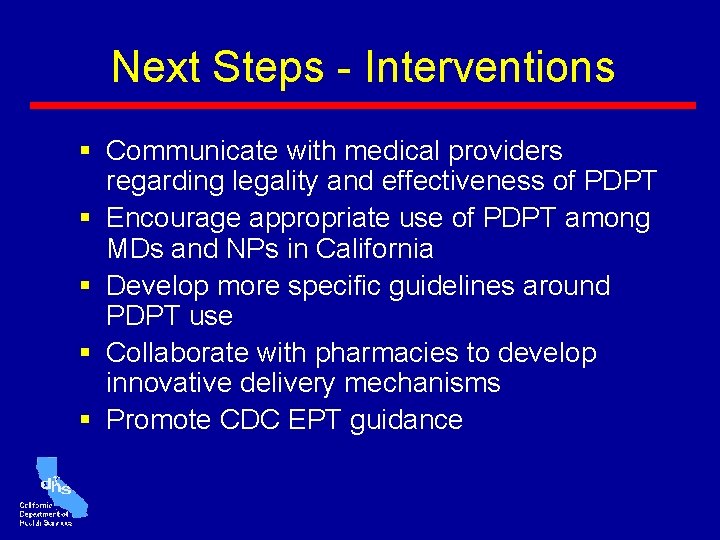
Next Steps - Interventions § Communicate with medical providers regarding legality and effectiveness of PDPT § Encourage appropriate use of PDPT among MDs and NPs in California § Develop more specific guidelines around PDPT use § Collaborate with pharmacies to develop innovative delivery mechanisms § Promote CDC EPT guidance
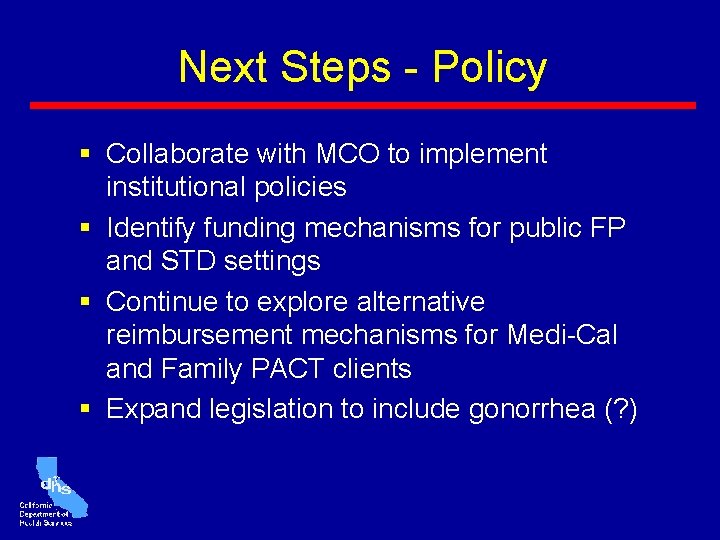
Next Steps - Policy § Collaborate with MCO to implement institutional policies § Identify funding mechanisms for public FP and STD settings § Continue to explore alternative reimbursement mechanisms for Medi-Cal and Family PACT clients § Expand legislation to include gonorrhea (? )
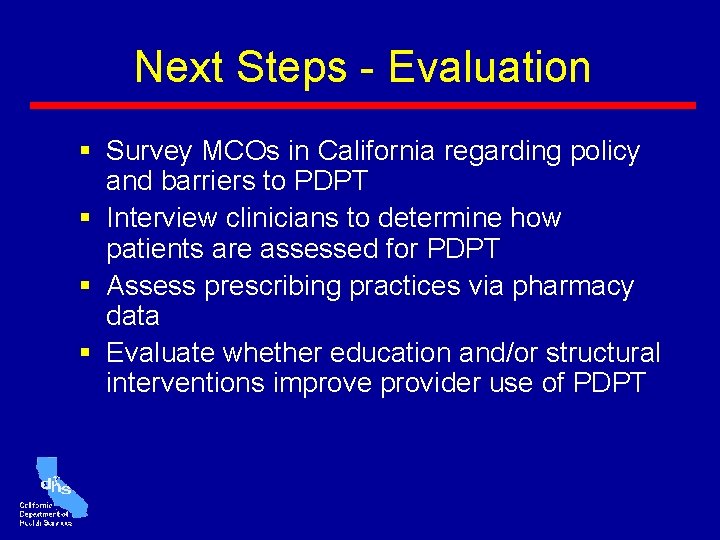
Next Steps - Evaluation § Survey MCOs in California regarding policy and barriers to PDPT § Interview clinicians to determine how patients are assessed for PDPT § Assess prescribing practices via pharmacy data § Evaluate whether education and/or structural interventions improve provider use of PDPT
Acknowledgments § Jessica Frasure, CT-PSE Coordinator § Dan Wohlfeiler, Policy & Communications § Jas Nihalani, California Chlamydia Action Coalition § CA STD/HIV Prevention Training Center § Sarah Guerry, Laura Packel, Joan Chow, Miriam Rhew, Michael Samuel § Gail Bolan, Chief STD Control Branch Contact: HBauer@dhs. ca. gov