
Patient Safety Monitoring in International Laboratories SMILE Urine

Patient Safety Monitoring in International Laboratories (SMILE) Urine Sediment Case Studies By Heidi Hanes 1
Patient Safety Monitoring in International Laboratories (SMILE) How to use macroscopic results for possible urine sediment • • • p. H – help decide what type of crystal Hemoglobin- detect RBC intact and lysed Leukocyte Esterase – detect WBC Nitrite – bacteria Protein – cast, epithelium cells 2

Patient Safety Monitoring in International Laboratories (SMILE) Case Study 3
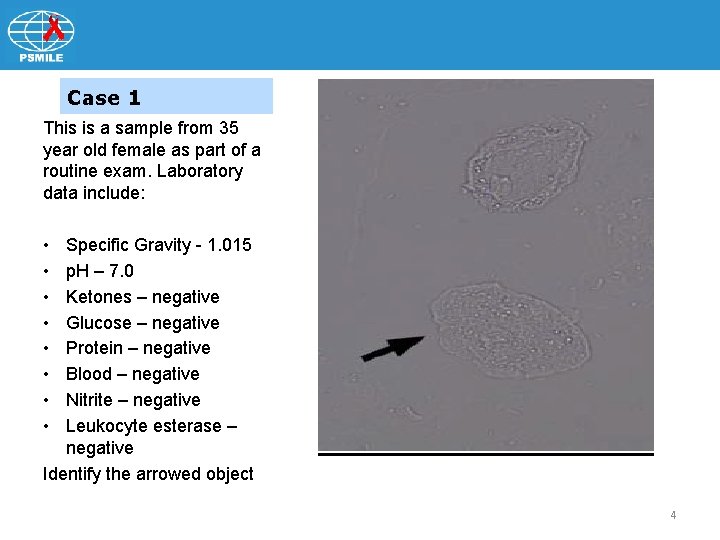
Case 1 This is a sample from 35 year old female as part of a routine exam. Laboratory data include: • • Specific Gravity - 1. 015 p. H – 7. 0 Ketones – negative Glucose – negative Protein – negative Blood – negative Nitrite – negative Leukocyte esterase – negative Identify the arrowed object 4
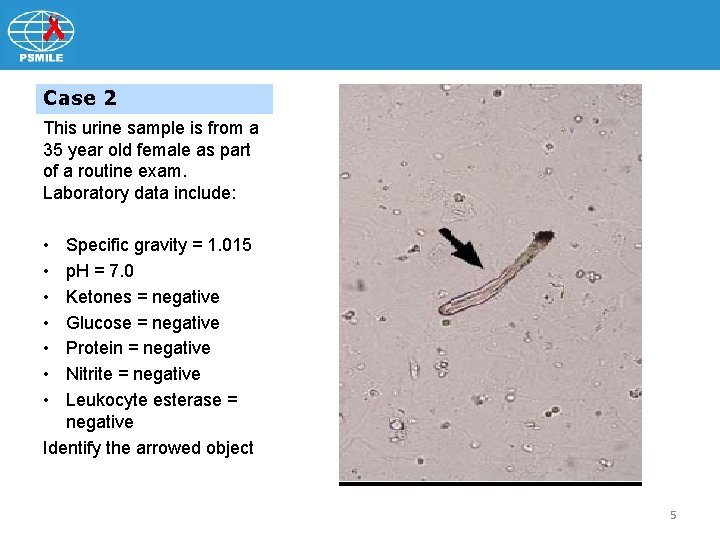
Case 2 This urine sample is from a 35 year old female as part of a routine exam. Laboratory data include: • • Specific gravity = 1. 015 p. H = 7. 0 Ketones = negative Glucose = negative Protein = negative Nitrite = negative Leukocyte esterase = negative Identify the arrowed object 5
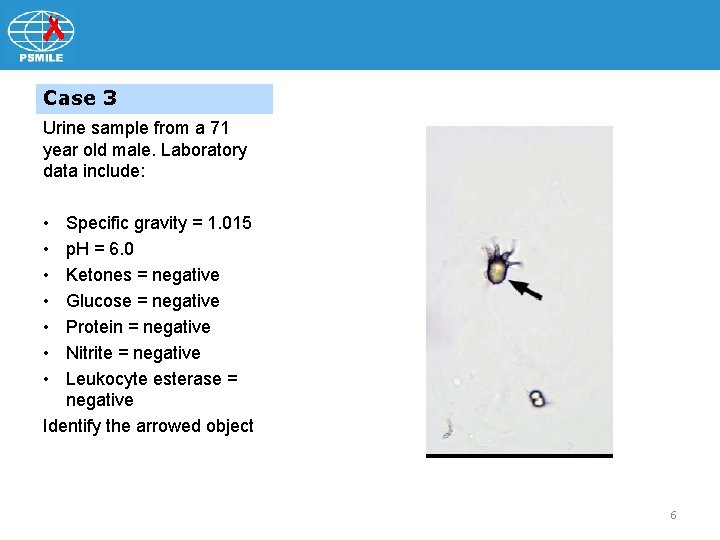
Case 3 Urine sample from a 71 year old male. Laboratory data include: • • Specific gravity = 1. 015 p. H = 6. 0 Ketones = negative Glucose = negative Protein = negative Nitrite = negative Leukocyte esterase = negative Identify the arrowed object 6
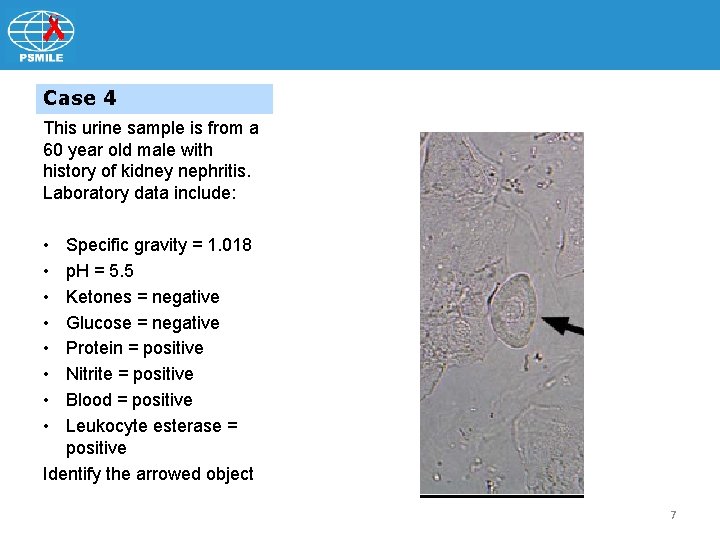
Case 4 This urine sample is from a 60 year old male with history of kidney nephritis. Laboratory data include: • • Specific gravity = 1. 018 p. H = 5. 5 Ketones = negative Glucose = negative Protein = positive Nitrite = positive Blood = positive Leukocyte esterase = positive Identify the arrowed object 7
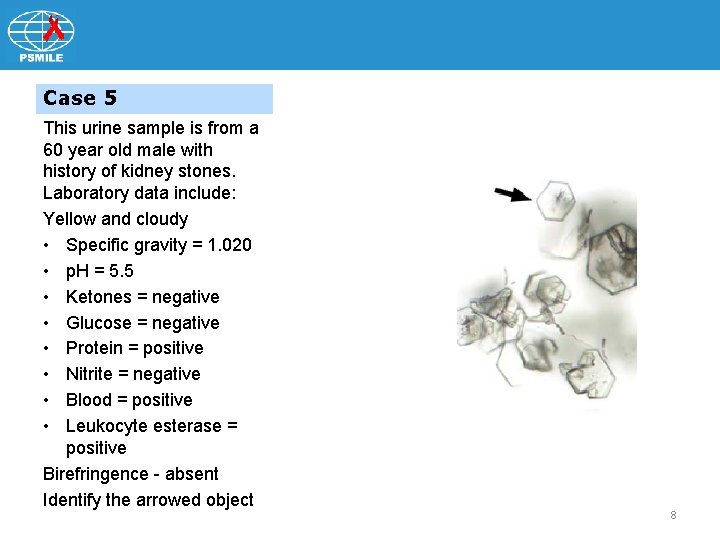
Case 5 This urine sample is from a 60 year old male with history of kidney stones. Laboratory data include: Yellow and cloudy • Specific gravity = 1. 020 • p. H = 5. 5 • Ketones = negative • Glucose = negative • Protein = positive • Nitrite = negative • Blood = positive • Leukocyte esterase = positive Birefringence - absent Identify the arrowed object 8
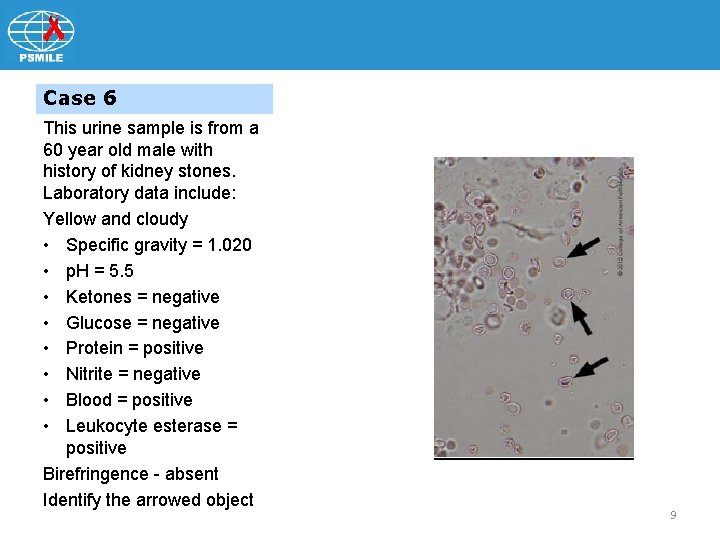
Case 6 This urine sample is from a 60 year old male with history of kidney stones. Laboratory data include: Yellow and cloudy • Specific gravity = 1. 020 • p. H = 5. 5 • Ketones = negative • Glucose = negative • Protein = positive • Nitrite = negative • Blood = positive • Leukocyte esterase = positive Birefringence - absent Identify the arrowed object 9
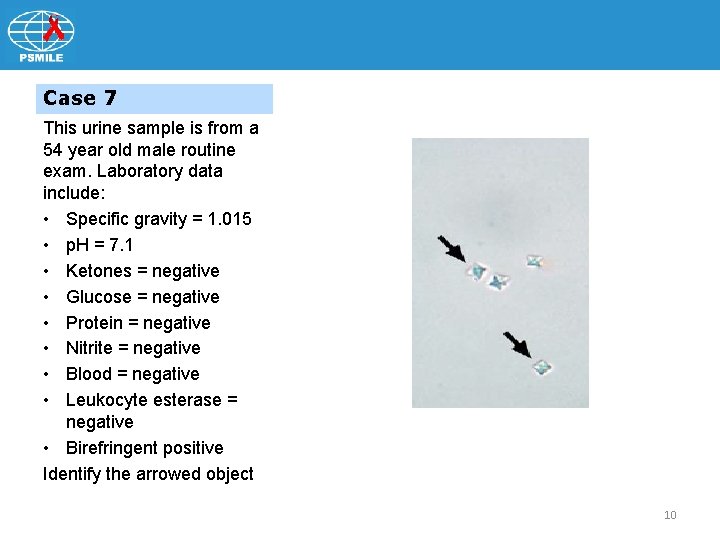
Case 7 This urine sample is from a 54 year old male routine exam. Laboratory data include: • Specific gravity = 1. 015 • p. H = 7. 1 • Ketones = negative • Glucose = negative • Protein = negative • Nitrite = negative • Blood = negative • Leukocyte esterase = negative • Birefringent positive Identify the arrowed object 10
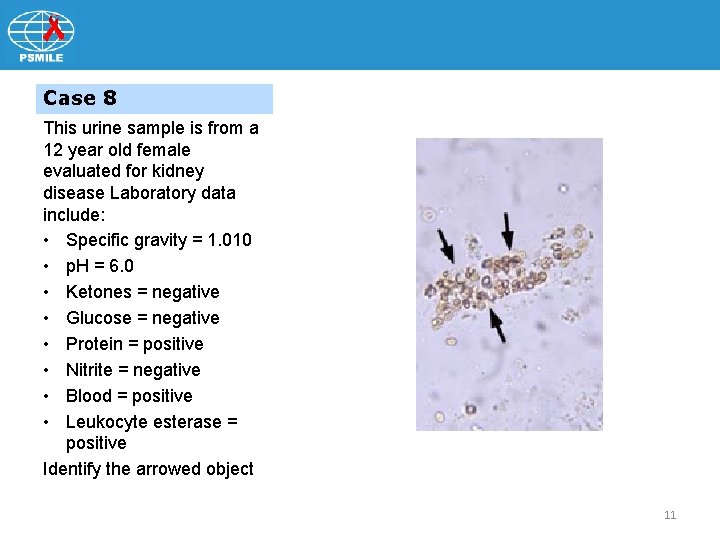
Case 8 This urine sample is from a 12 year old female evaluated for kidney disease Laboratory data include: • Specific gravity = 1. 010 • p. H = 6. 0 • Ketones = negative • Glucose = negative • Protein = positive • Nitrite = negative • Blood = positive • Leukocyte esterase = positive Identify the arrowed object 11
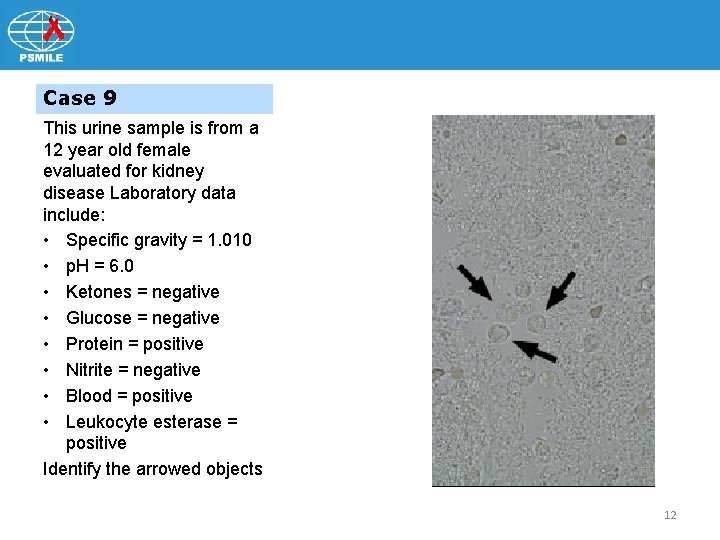
Case 9 This urine sample is from a 12 year old female evaluated for kidney disease Laboratory data include: • Specific gravity = 1. 010 • p. H = 6. 0 • Ketones = negative • Glucose = negative • Protein = positive • Nitrite = negative • Blood = positive • Leukocyte esterase = positive Identify the arrowed objects 12
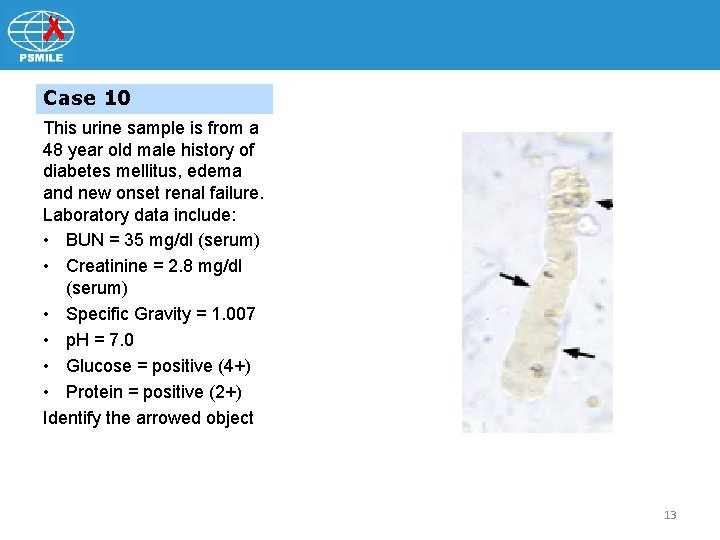
Case 10 This urine sample is from a 48 year old male history of diabetes mellitus, edema and new onset renal failure. Laboratory data include: • BUN = 35 mg/dl (serum) • Creatinine = 2. 8 mg/dl (serum) • Specific Gravity = 1. 007 • p. H = 7. 0 • Glucose = positive (4+) • Protein = positive (2+) Identify the arrowed object 13
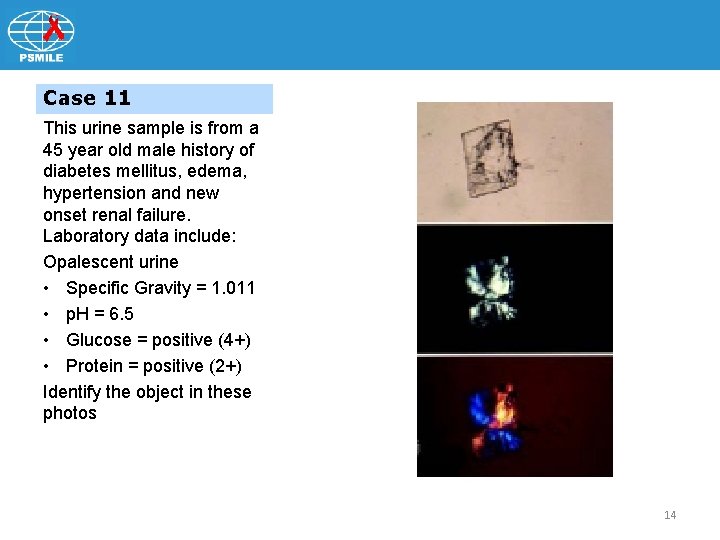
Case 11 This urine sample is from a 45 year old male history of diabetes mellitus, edema, hypertension and new onset renal failure. Laboratory data include: Opalescent urine • Specific Gravity = 1. 011 • p. H = 6. 5 • Glucose = positive (4+) • Protein = positive (2+) Identify the object in these photos 14
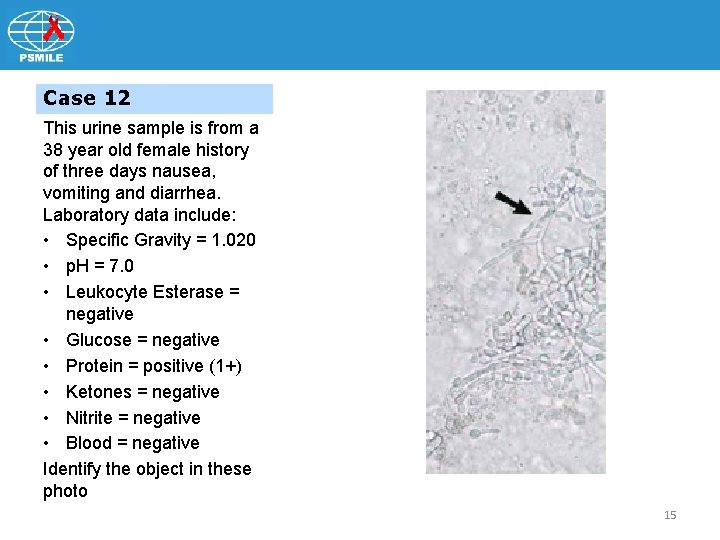
Case 12 This urine sample is from a 38 year old female history of three days nausea, vomiting and diarrhea. Laboratory data include: • Specific Gravity = 1. 020 • p. H = 7. 0 • Leukocyte Esterase = negative • Glucose = negative • Protein = positive (1+) • Ketones = negative • Nitrite = negative • Blood = negative Identify the object in these photo 15

Case 13 This urine sample is from a 14 year old female asymptomatic Laboratory data include: • Specific Gravity = 1. 012 • p. H = 6. 0 • Leukocyte Esterase = negative • Glucose = negative • Protein = positive (1+) • Ketones = negative • Nitrite = negative • Blood = negative Identify the object 16
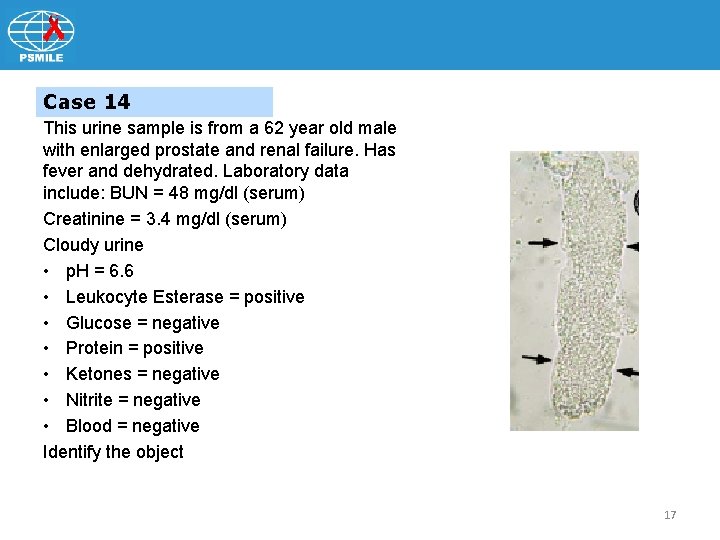
Case 14 This urine sample is from a 62 year old male with enlarged prostate and renal failure. Has fever and dehydrated. Laboratory data include: BUN = 48 mg/dl (serum) Creatinine = 3. 4 mg/dl (serum) Cloudy urine • p. H = 6. 6 • Leukocyte Esterase = positive • Glucose = negative • Protein = positive • Ketones = negative • Nitrite = negative • Blood = negative Identify the object 17
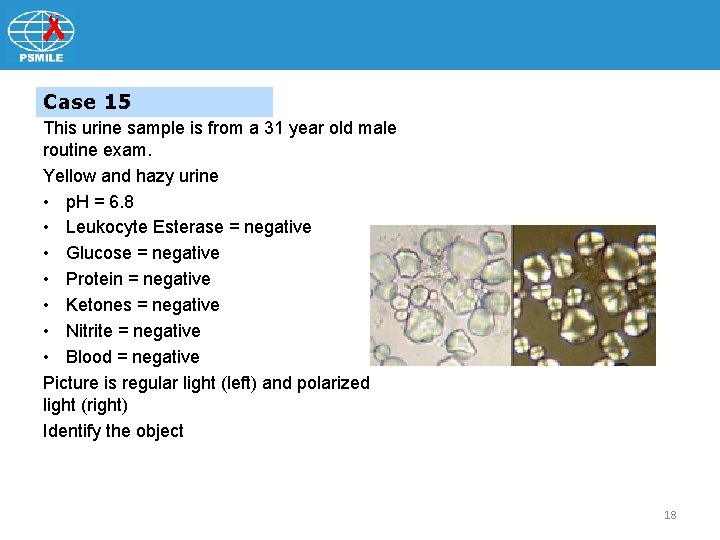
Case 15 This urine sample is from a 31 year old male routine exam. Yellow and hazy urine • p. H = 6. 8 • Leukocyte Esterase = negative • Glucose = negative • Protein = negative • Ketones = negative • Nitrite = negative • Blood = negative Picture is regular light (left) and polarized light (right) Identify the object 18
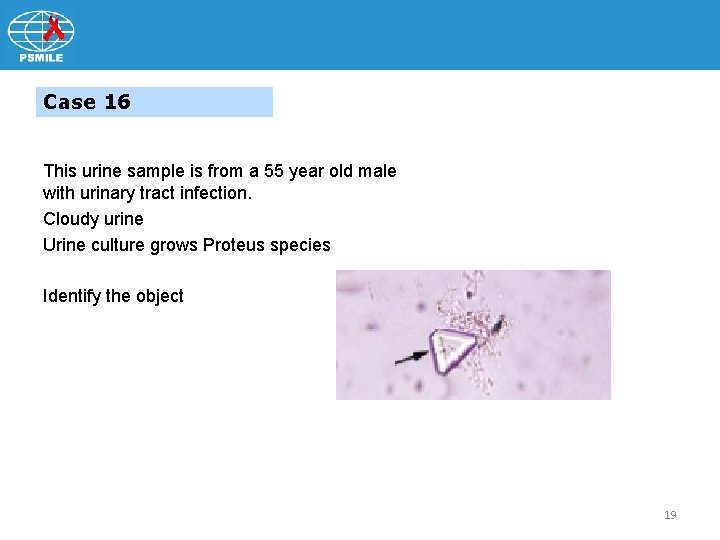
Case 16 This urine sample is from a 55 year old male with urinary tract infection. Cloudy urine Urine culture grows Proteus species Identify the object 19
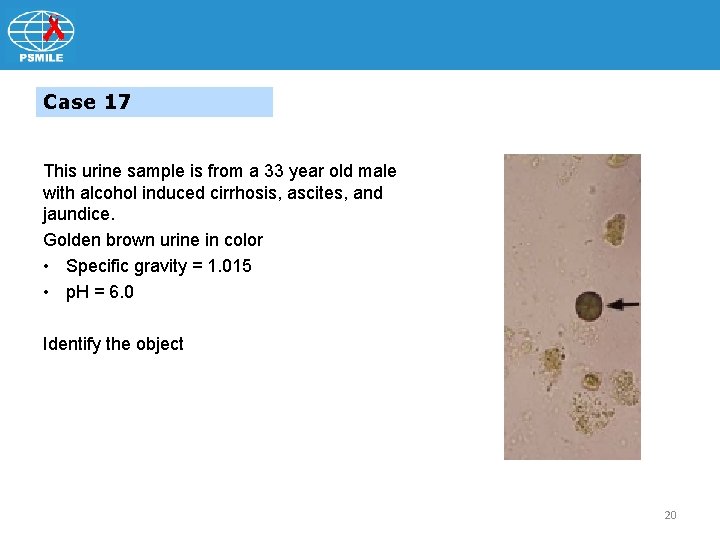
Case 17 This urine sample is from a 33 year old male with alcohol induced cirrhosis, ascites, and jaundice. Golden brown urine in color • Specific gravity = 1. 015 • p. H = 6. 0 Identify the object 20
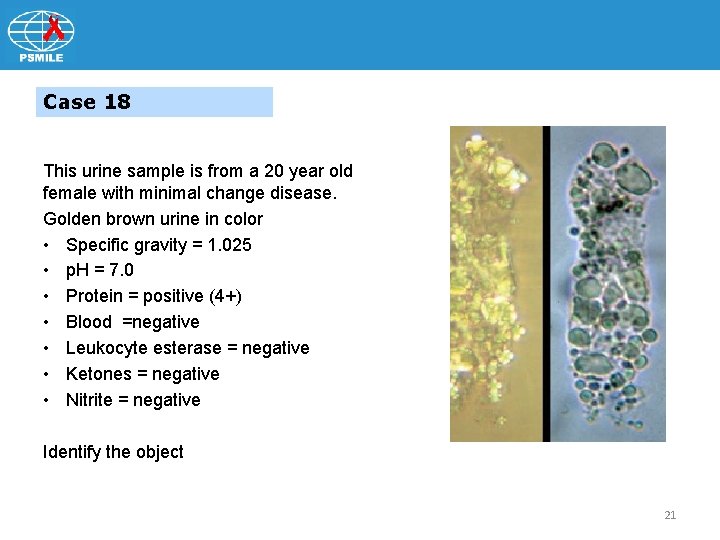
Case 18 This urine sample is from a 20 year old female with minimal change disease. Golden brown urine in color • Specific gravity = 1. 025 • p. H = 7. 0 • Protein = positive (4+) • Blood =negative • Leukocyte esterase = negative • Ketones = negative • Nitrite = negative Identify the object 21
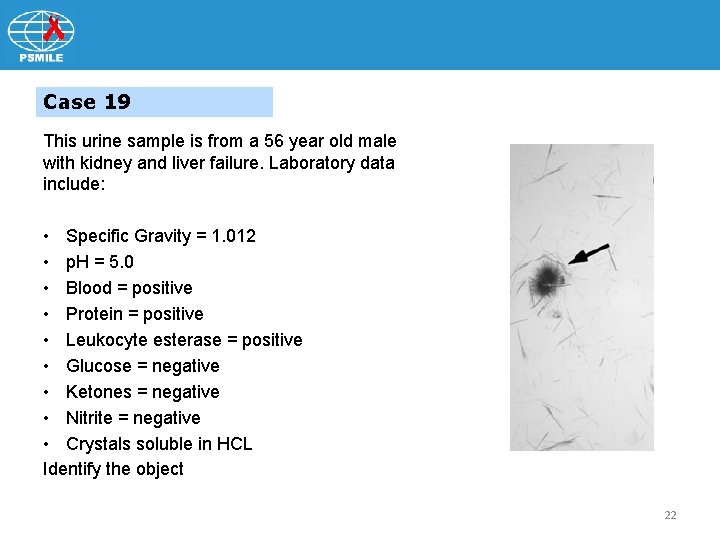
Case 19 This urine sample is from a 56 year old male with kidney and liver failure. Laboratory data include: • Specific Gravity = 1. 012 • p. H = 5. 0 • Blood = positive • Protein = positive • Leukocyte esterase = positive • Glucose = negative • Ketones = negative • Nitrite = negative • Crystals soluble in HCL Identify the object 22
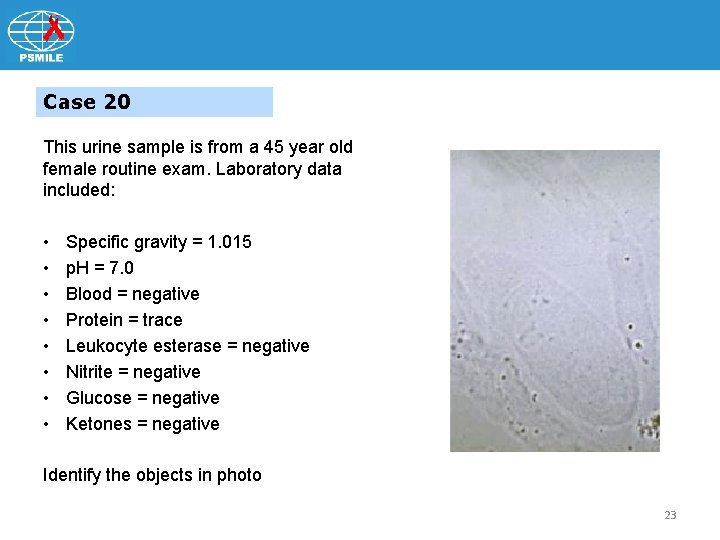
Case 20 This urine sample is from a 45 year old female routine exam. Laboratory data included: • • Specific gravity = 1. 015 p. H = 7. 0 Blood = negative Protein = trace Leukocyte esterase = negative Nitrite = negative Glucose = negative Ketones = negative Identify the objects in photo 23

Patient Safety Monitoring in International Laboratories (SMILE) Case Study Results 24
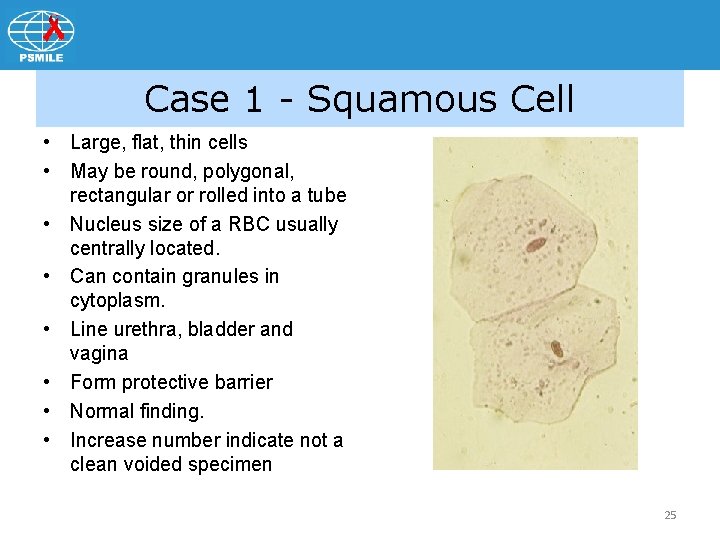
Case 1 - Squamous Cell • Large, flat, thin cells • May be round, polygonal, rectangular or rolled into a tube • Nucleus size of a RBC usually centrally located. • Can contain granules in cytoplasm. • Line urethra, bladder and vagina • Form protective barrier • Normal finding. • Increase number indicate not a clean voided specimen 25
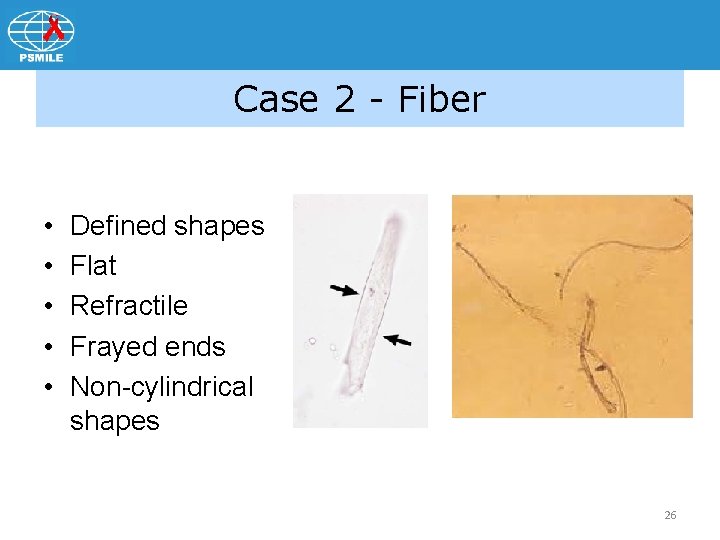
Case 2 - Fiber • • • Defined shapes Flat Refractile Frayed ends Non-cylindrical shapes 26
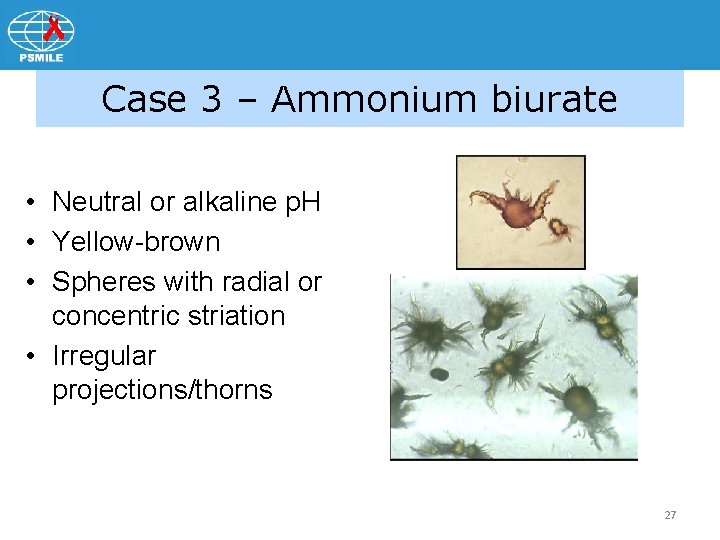
Case 3 – Ammonium biurate • Neutral or alkaline p. H • Yellow-brown • Spheres with radial or concentric striation • Irregular projections/thorns 27
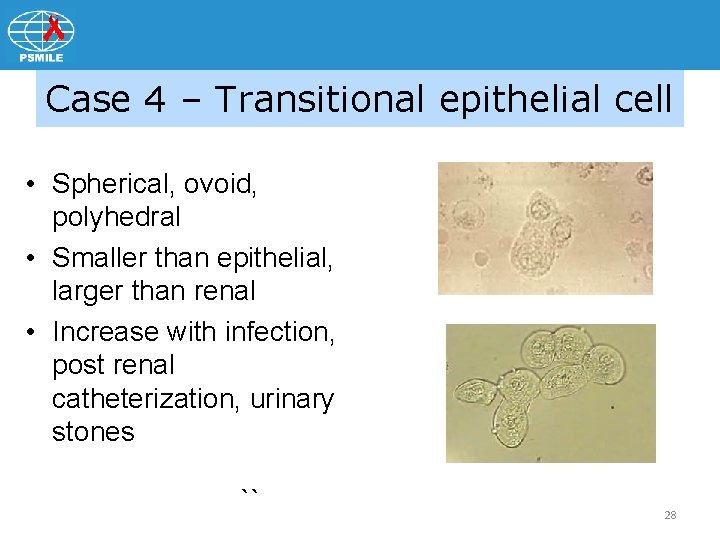
Case 4 – Transitional epithelial cell • Spherical, ovoid, polyhedral • Smaller than epithelial, larger than renal • Increase with infection, post renal catheterization, urinary stones `` 28
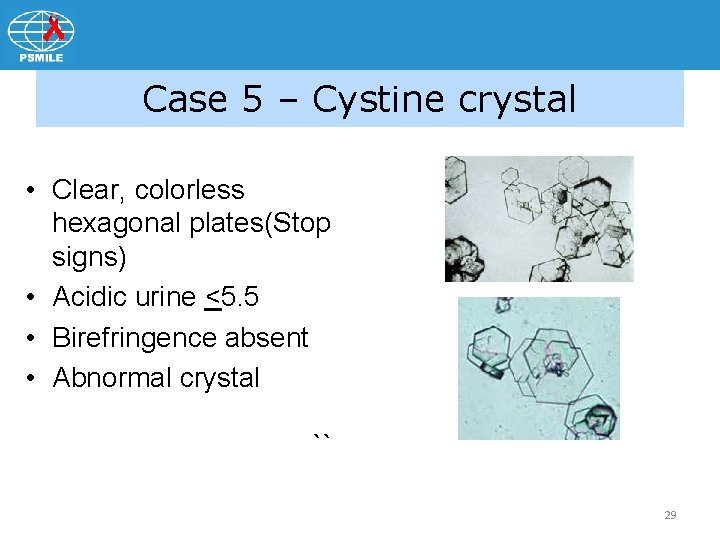
Case 5 – Cystine crystal • Clear, colorless hexagonal plates(Stop signs) • Acidic urine <5. 5 • Birefringence absent • Abnormal crystal `` 29
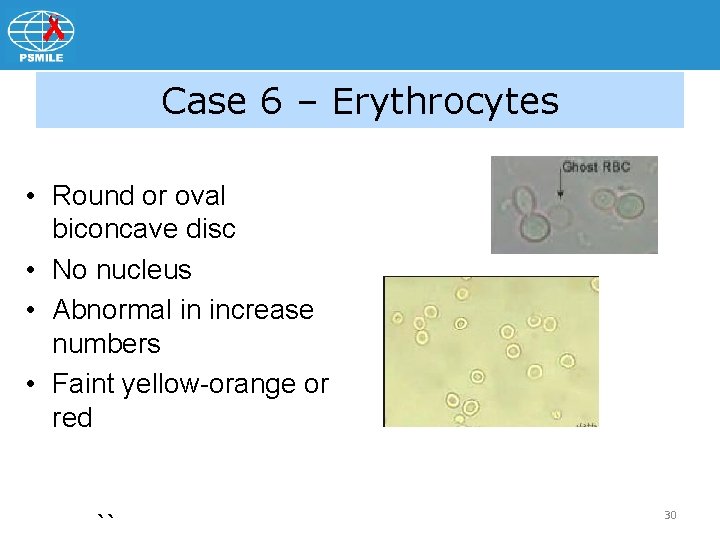
Case 6 – Erythrocytes • Round or oval biconcave disc • No nucleus • Abnormal in increase numbers • Faint yellow-orange or red `` 30
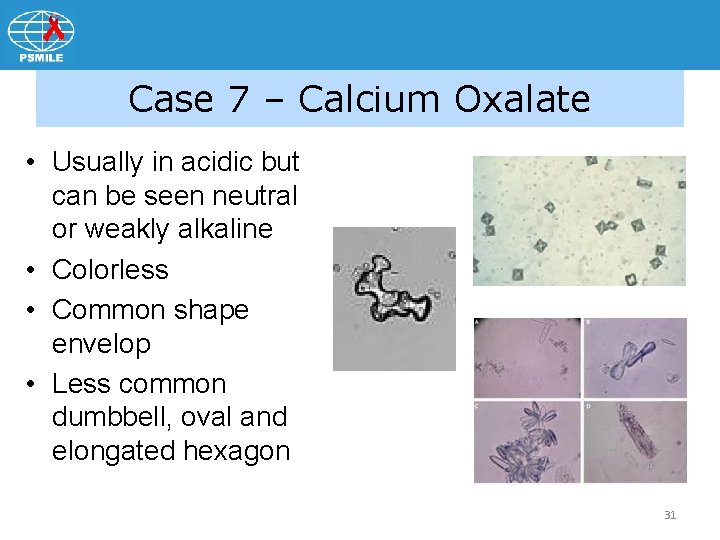
Case 7 – Calcium Oxalate • Usually in acidic but can be seen neutral or weakly alkaline • Colorless • Common shape envelop • Less common dumbbell, oval and elongated hexagon 31

Case 8 – RBC Cast • • Least common cast Most significant Tinged red or brown Seen in freshly voided specimens • Differentiated by presence intact RBC 32
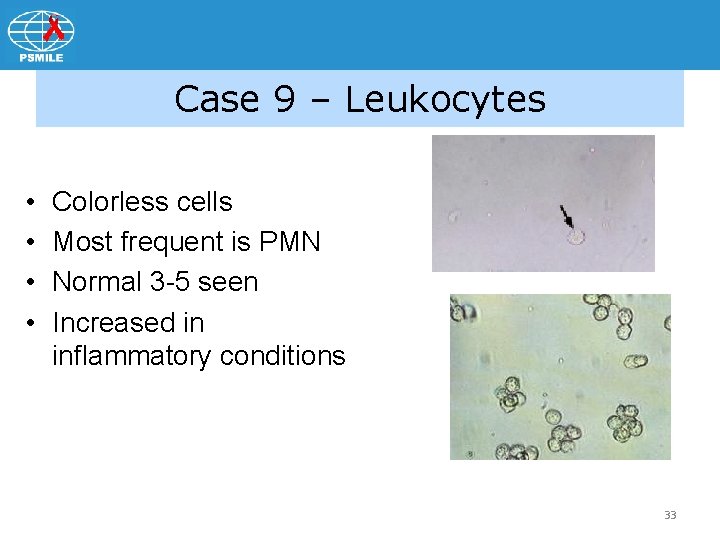
Case 9 – Leukocytes • • Colorless cells Most frequent is PMN Normal 3 -5 seen Increased in inflammatory conditions 33

Case 10 – Waxy Cast • High refractive index • Blunt or broken off ends • Parallel margins may show notching • Colorless, pale yellow, waxy appearance • Abnormal finding 34
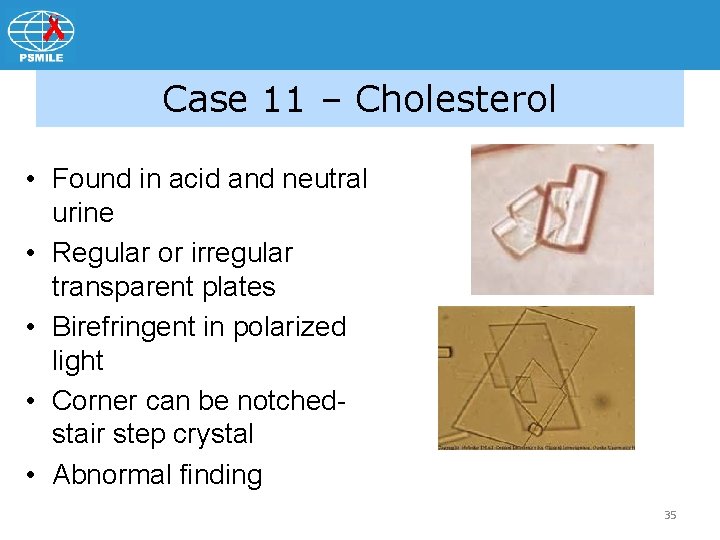
Case 11 – Cholesterol • Found in acid and neutral urine • Regular or irregular transparent plates • Birefringent in polarized light • Corner can be notchedstair step crystal • Abnormal finding 35
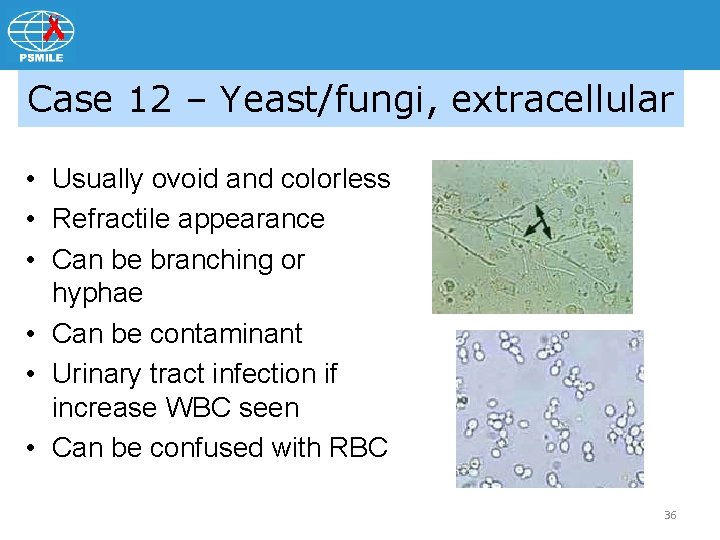
Case 12 – Yeast/fungi, extracellular • Usually ovoid and colorless • Refractile appearance • Can be branching or hyphae • Can be contaminant • Urinary tract infection if increase WBC seen • Can be confused with RBC 36
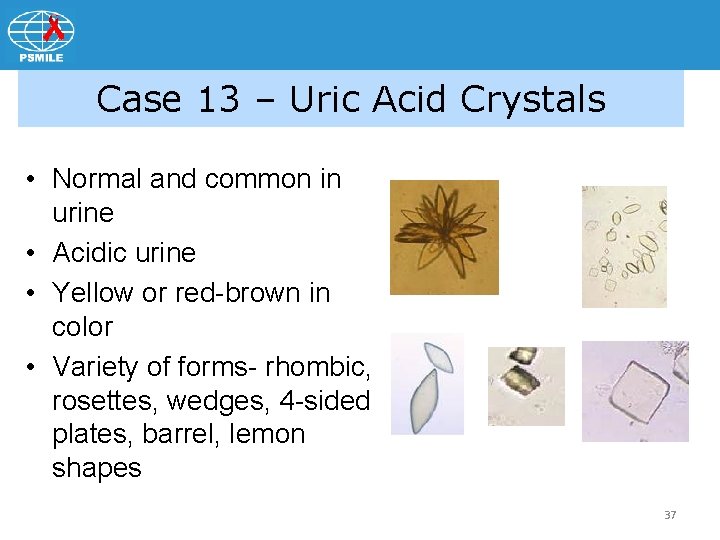
Case 13 – Uric Acid Crystals • Normal and common in urine • Acidic urine • Yellow or red-brown in color • Variety of forms- rhombic, rosettes, wedges, 4 -sided plates, barrel, lemon shapes 37
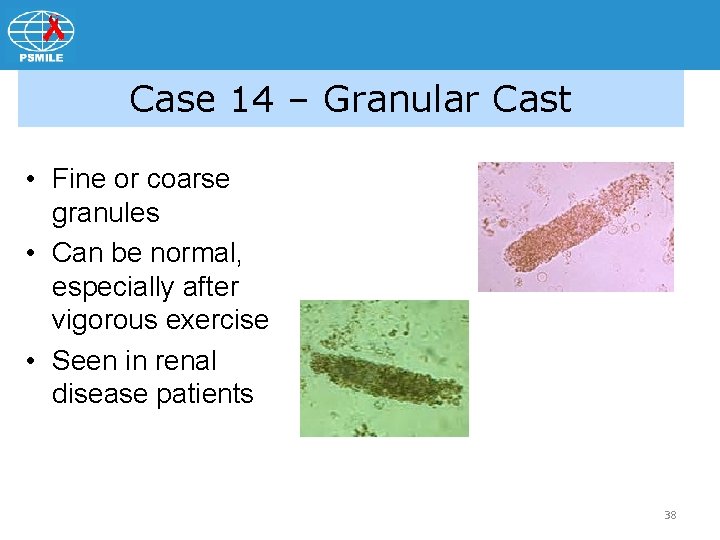
Case 14 – Granular Cast • Fine or coarse granules • Can be normal, especially after vigorous exercise • Seen in renal disease patients 38

Case 15 – Starch granule • Colorless • Irregularly round with dark striation to the center • Asymmetric “Maltese cross” in polarized light. Can be confused with fat bodies. • Frequent contaminant Starch polarized Fat droplet polarized 39
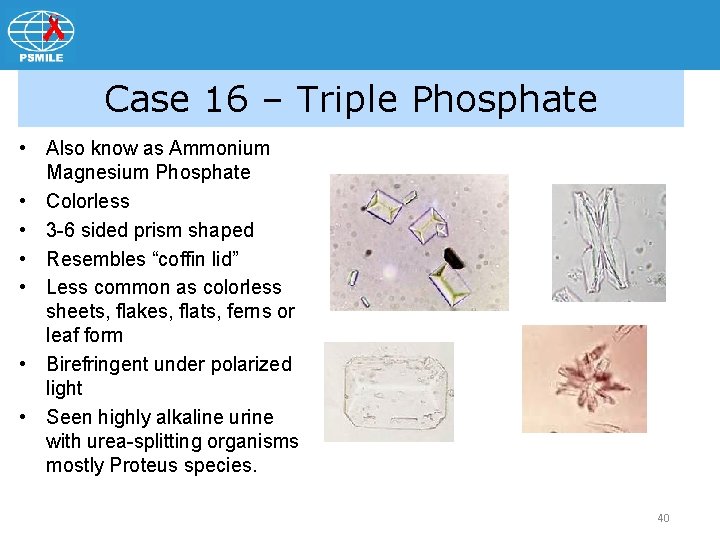
Case 16 – Triple Phosphate • Also know as Ammonium Magnesium Phosphate • Colorless • 3 -6 sided prism shaped • Resembles “coffin lid” • Less common as colorless sheets, flakes, flats, ferns or leaf form • Birefringent under polarized light • Seen highly alkaline urine with urea-splitting organisms mostly Proteus species. 40

Case 17 – Leucine Crystal • Acidic urine • Spheroids with concentric striations • Dense • Highly refractile • Yellowish brown • “pseudo” Maltese cross • Seen severe liver disease • Hereditary amino acid metabolic disorders • Can be seen with tyrosine crystals 41
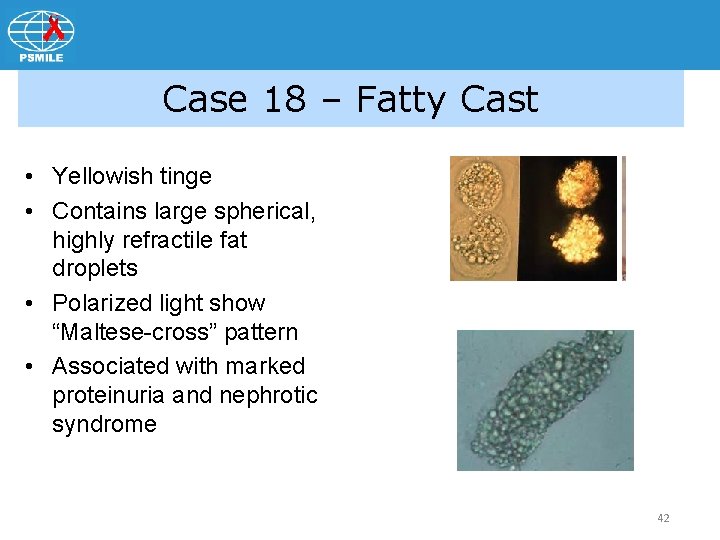
Case 18 – Fatty Cast • Yellowish tinge • Contains large spherical, highly refractile fat droplets • Polarized light show “Maltese-cross” pattern • Associated with marked proteinuria and nephrotic syndrome 42

Case 19 – Tyrosine Crystals • Rare, always abnormal • Form clusters of silky needlelike structures • Colorless or black on focusing • Acid urine • Increase after refrigeration • Insoluble in alcohol or ether • Soluble in dilute HCL • Orange color with nitrosonaphthol confirmatory • Tyrosiuria occurs with liver disease 43
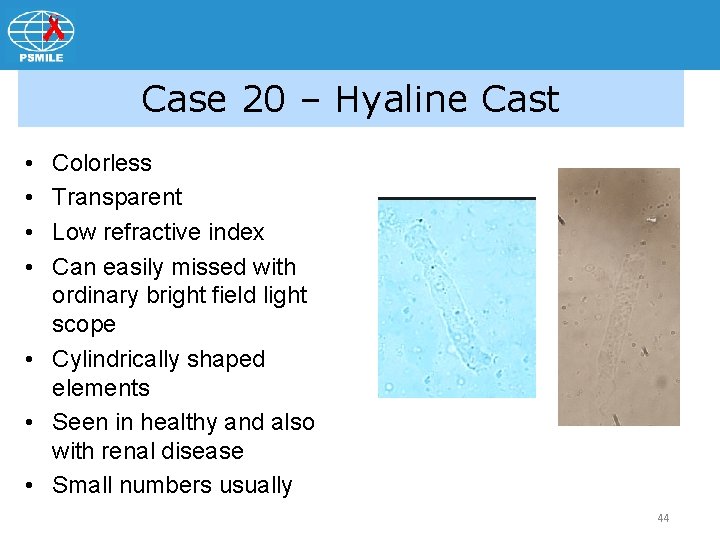
Case 20 – Hyaline Cast • • Colorless Transparent Low refractive index Can easily missed with ordinary bright field light scope • Cylindrically shaped elements • Seen in healthy and also with renal disease • Small numbers usually 44
References • Urinary Sediment: A Textbook Atlas, by Meryl H Haber • Images from http: //www. bing. com/images/search? q=urine+sediment+images&qp vt=urine+sediment+images&FORM=IGREes • CAP Participant Summary for Clinical Microscopy 45
- Slides: 45