
Patient Safety in Emergency Medical Services Ontario Base
Patient Safety in Emergency Medical Services Ontario Base Hospital Group Annual Symposium May 15, 2013
Canadian Patient Safety Institute Our Vision: Safe healthcare for all Canadians Our Mission: To inspire extraordinary improvement in patient safety and quality Our Main Roles: • • We champion the cause of patient safety. We help create the capacity to improve. We are integrators; brokers; catalysts; and promoters. We create resources for the healthcare system, work with partners, and celebrate successes. • We listen, engage, customize, and spread knowledge.
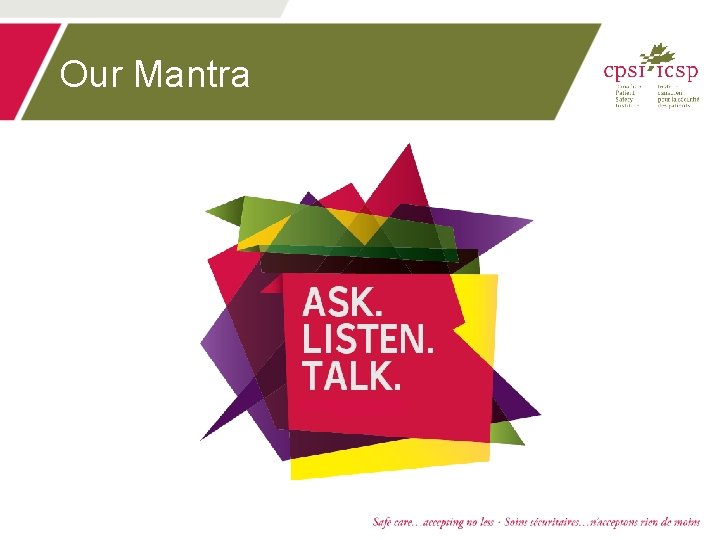
Our Mantra
Definitions Patient safety – the avoidance, prevention, and amelioration of adverse outcomes or injuries stemming from the processes of health care • Patient safety incident – an event or circumstance that could have resulted, or did result, in unnecessary harm to a patient • Harmful incident (preventable adverse event) – an incident which resulted in harm to a patient • No harm incident – an incident that did reach the patient but did not result in harm • Near miss – an incident that did not reach the patient • Reportable circumstance – a situation in which there was significant potential for harm, but no incident occurred
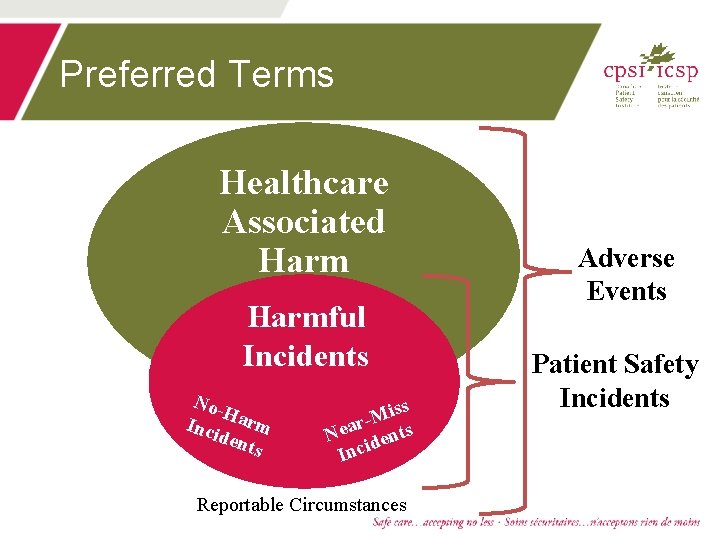
Preferred Terms Healthcare Associated Harmful Incidents No. H Inci arm den ts iss M r Nea dents Inci Reportable Circumstances Adverse Events Patient Safety Incidents
Definitions Adverse event defined as: “an unintended injury or complication that results in disability at the time of discharge, death or prolonged hospital stay and that is caused by health care management rather than by the patient’s underlying disease process. ” Baker GR, Norton PG, Flintoft V, Blais R, Brown A, Cox J et al. (2004). The Canadian Adverse Events Study: The incidence of adverse events among hospital patients in Canada. CMAJ, 170(11), 1678 -1686. 6
Canadian Adverse Events Study (Baker et al. , 2004) Findings: • 3, 745 charts reviewed • ~7. 5% of hospital admissions involve harmful incidents (adverse events); 37% of these were deemed to be preventable Extrapolation: • Of ~2. 5 million hospital admissions in Canada in 2000…. . – 185, 000 experienced 1 or more adverse events – 70, 000 of the 185, 000 were determined to be preventable – Between 9, 000 and 24, 000 deaths due to adverse events could have been prevented
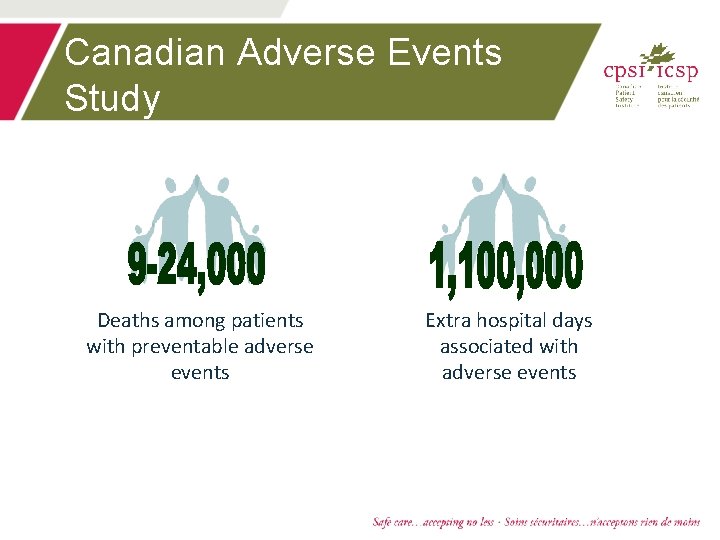
Canadian Adverse Events Study Deaths among patients with preventable adverse events Extra hospital days associated with adverse events
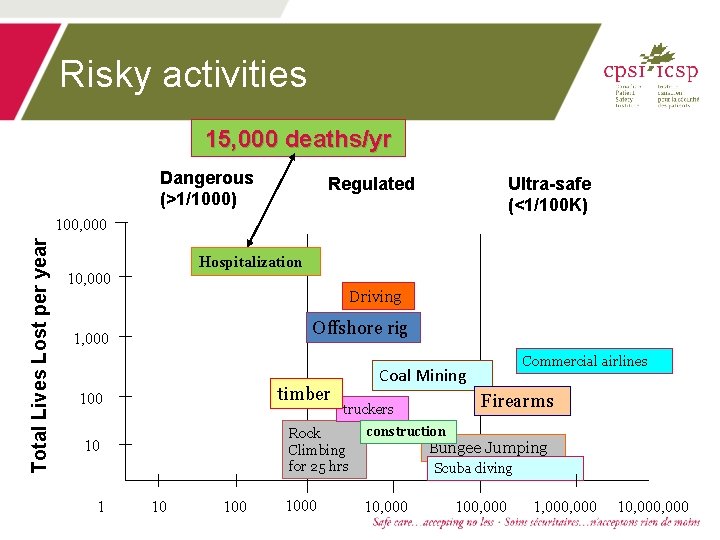
Risky activities 15, 000 deaths/yr Dangerous (>1/1000) Regulated Ultra-safe (<1/100 K) Total Lives Lost per year 100, 000 Hospitalization 10, 000 Driving Offshore rig 1, 000 timber 100 1 Coal Mining 10 1000 Firearms truckers Rock Climbing for 25 hrs 10 Commercial airlines construction Bungee Jumping Scuba diving 10, 000 100, 000 1, 000 10, 000
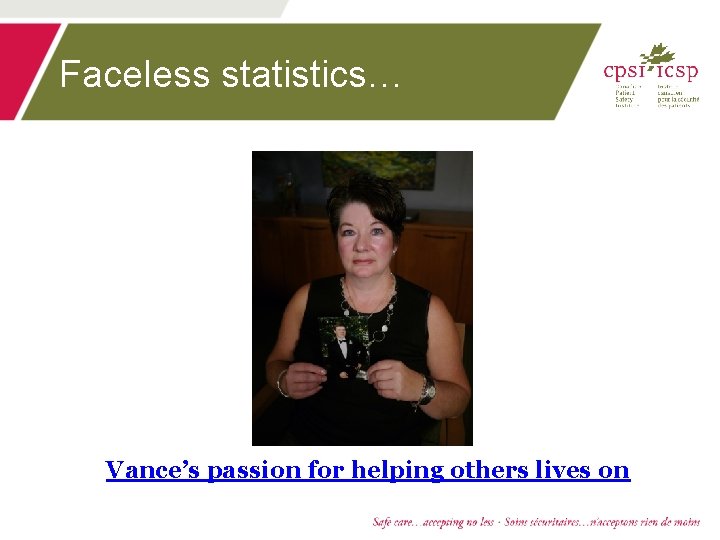
Faceless statistics… Vance’s passion for helping others lives on

Understanding the issues § Many issues related to patient safety are applicable throughout the care continuum § CPSI has made a concerted effort to understand these complex issues both within and external to hospitals § Community-based healthcare has additional unique patient safety issues that must be understood in context before they can be appropriately addressed
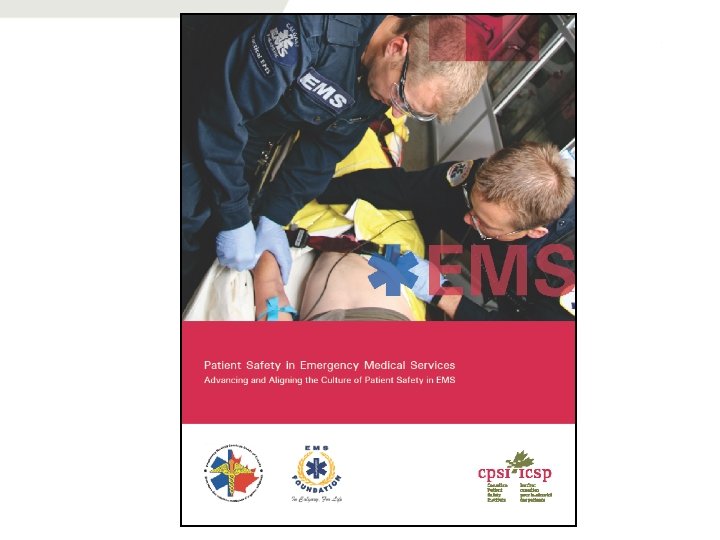
Background As well trained, compassionate caregivers EMS professionals often care for patients in unstable, challenging and dynamic environments. Providing care in this type of high stress atmosphere means that well intended caregivers are at risk of causing inadvertent harm to patients. Little research has addressed the types and frequency of patient safety problems during the delivery of pre-hospital care.
Patient Safety in EMS
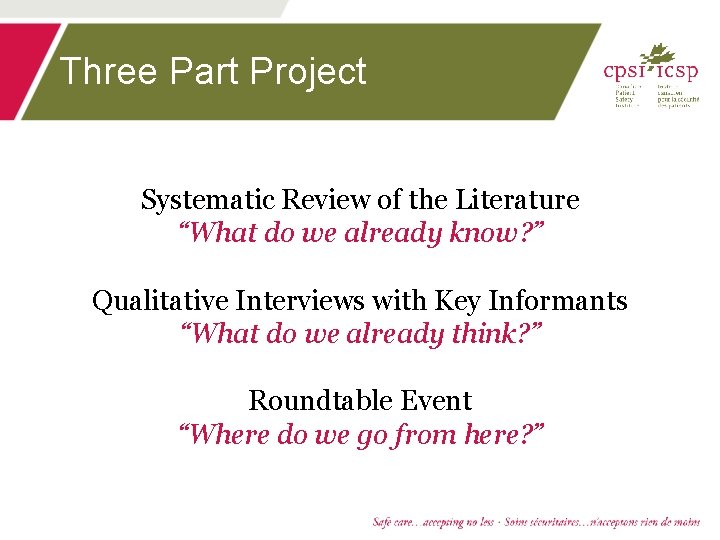
Three Part Project Systematic Review of the Literature “What do we already know? ” Qualitative Interviews with Key Informants “What do we already think? ” Roundtable Event “Where do we go from here? ”
Key Issues § Clinical judgement and training “Clinical judgment and the training required to make coherent decisions was profoundly identified as the greatest risk to patient safety” § Focus on EMS and relationship to healthcare “. . . EMS has shifted to the healthcare domain, however, true integration with that system is lacking. ” § Vehicle collisions § Medication incidents § Knowledge gaps “. . . there is a need to study best practices in educating paramedics and to clarify what constitutes adequate clinical experience, exposure and judgment. ”
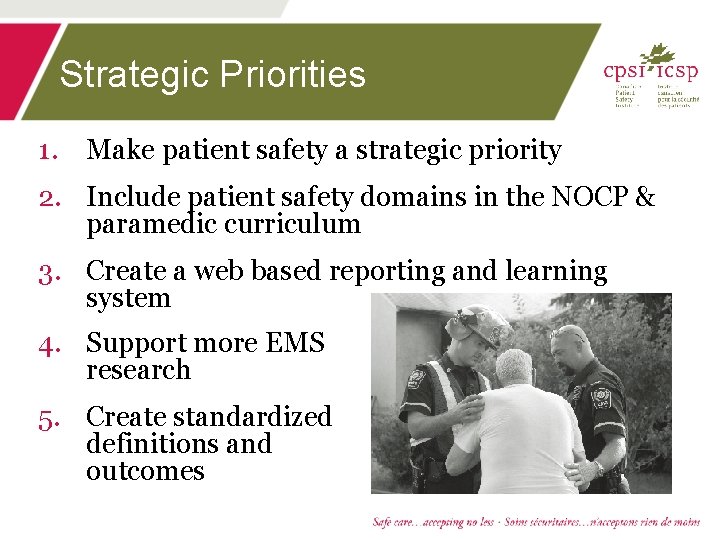
Strategic Priorities 1. Make patient safety a strategic priority 2. Include patient safety domains in the NOCP & paramedic curriculum 3. Create a web based reporting and learning system 4. Support more EMS research 5. Create standardized definitions and outcomes
Strategic Priorities 6. Support the concept that the paramedic is part of the healthcare team 7. Examine the literature from other disciplines 8. Build human resource capacity in EMS research, education and patient safety 9. Promote the identification and reporting of high-risk activities performed by paramedics
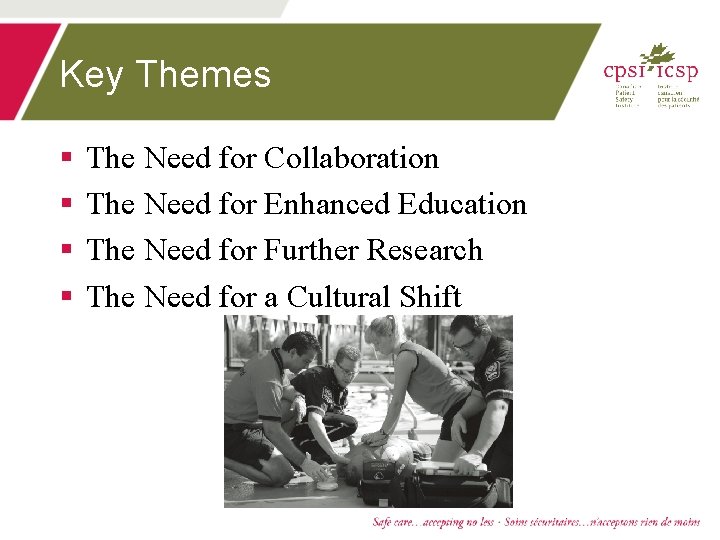
Key Themes § § The Need for Collaboration The Need for Enhanced Education The Need for Further Research The Need for a Cultural Shift
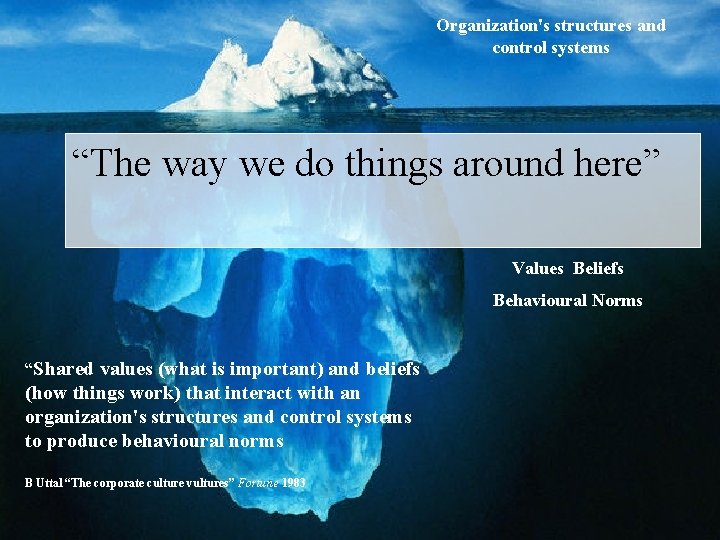
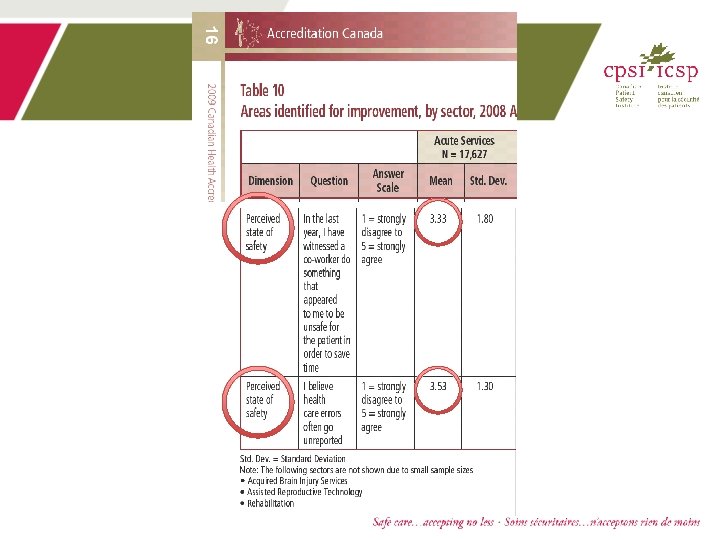
Organization's structures and control systems “The way we do things around here” Values Beliefs Behavioural Norms “Shared values (what is important) and beliefs (how things work) that interact with an organization's structures and control systems to produce behavioural norms B Uttal “The corporate culture vultures” Fortune 1983
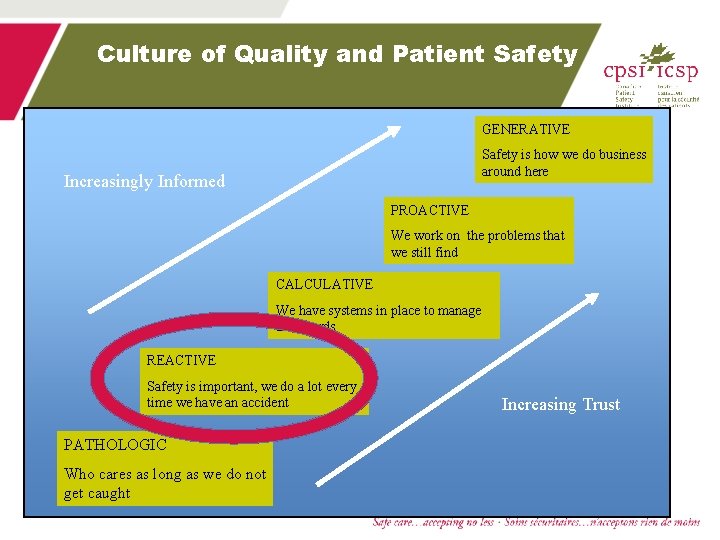
Culture of Quality and Patient Safety GENERATIVE Safety is how we do business around here Increasingly Informed PROACTIVE We work on the problems that we still find CALCULATIVE We have systems in place to manage all hazards REACTIVE Safety is important, we do a lot every time we have an accident PATHOLOGIC Who cares as long as we do not get caught Increasing Trust
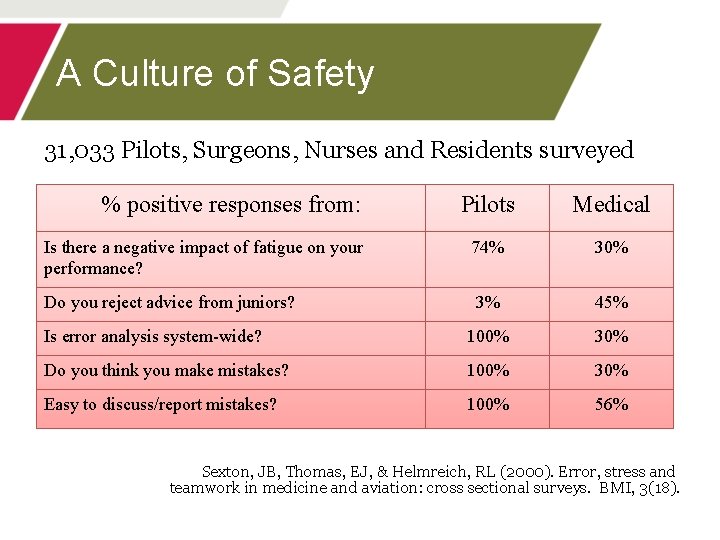
A Culture of Safety 31, 033 Pilots, Surgeons, Nurses and Residents surveyed % positive responses from: Pilots Medical Is there a negative impact of fatigue on your performance? 74% 30% Do you reject advice from juniors? 3% 45% Is error analysis system-wide? 100% 30% Do you think you make mistakes? 100% 30% Easy to discuss/report mistakes? 100% 56% Sexton, JB, Thomas, EJ, & Helmreich, RL (2000). Error, stress and teamwork in medicine and aviation: cross sectional surveys. BMI, 3(18).
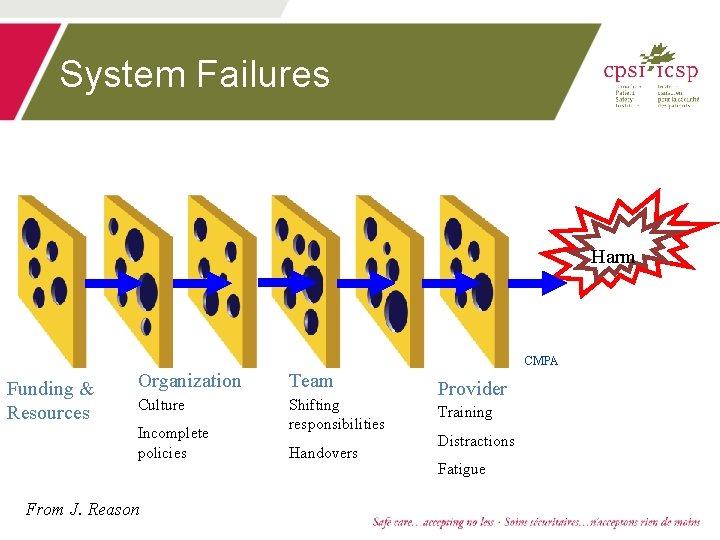
System Failures Harm CMPA Funding & Resources Organization Team Culture Shifting responsibilities Incomplete policies From J. Reason Handovers Provider Training Distractions Fatigue
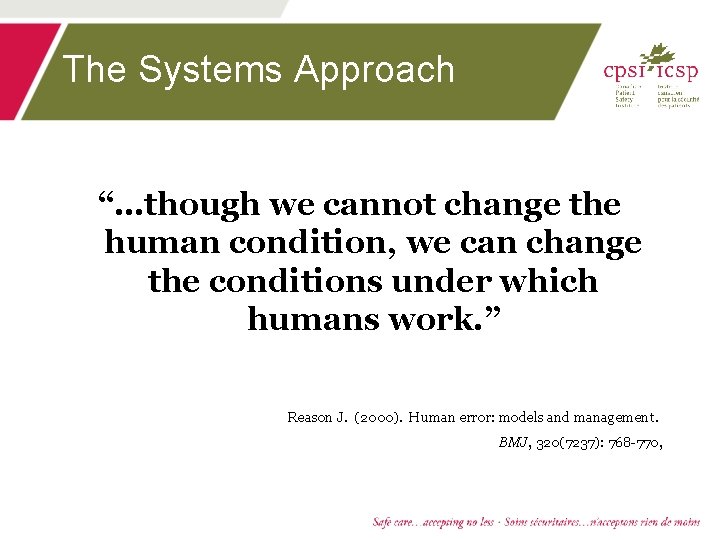
The Systems Approach “…though we cannot change the human condition, we can change the conditions under which humans work. ” Reason J. (2000). Human error: models and management. BMJ, 320(7237): 768 -770,
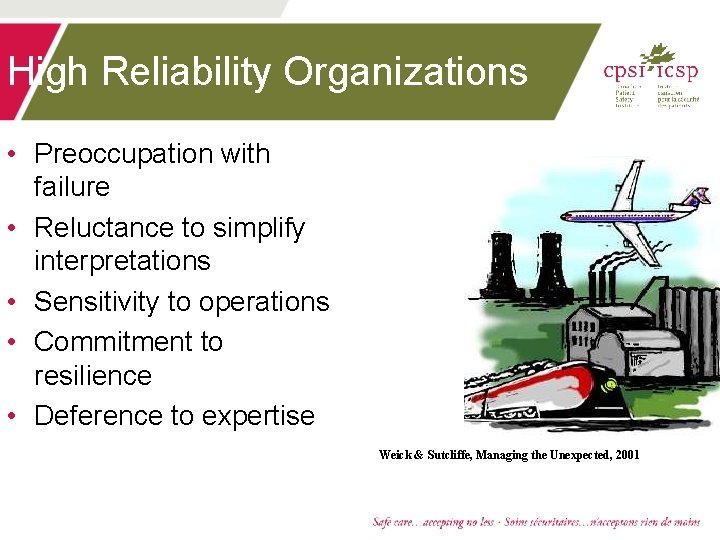
High Reliability Organizations • Preoccupation with failure • Reluctance to simplify interpretations • Sensitivity to operations • Commitment to resilience • Deference to expertise Weick & Sutcliffe, Managing the Unexpected, 2001
Systems thinking vs. “blame-free” culture § Systems thinking is not a “blame-free” culture § Emphasizes analysis of the entire system of care – instead of a rush to blame individuals § People are part of the system – disregard for professional responsibility is grounds to hold an individual accountable
Just culture of safety § There is focus on system, not on individual § The organization accepts appropriate responsibility and accountability § The organization does not tolerate wilful misconduct and misbehaviour § There is “a collective understanding of where the line should be drawn between blameless and blameworthy actions”
Patient Safety Culture “There is a culture in every health care facility. Often this culture has more of an impact on patient safety than the process problems that exist. ” “Changing the way people think about patient safety is not easy. Culture change is not a program. By definition, programs have beginnings and ends. They often are directed at manipulating people in some way to achieve an end result. They can even be punitive. Culture change is a process that, once embraced by the people, brings about lasting change. ” http: //www. brownspath. com/original_articles/culture. htm
Canadian Patient Safety Officer Course § Partnership with CPSI and CHA § 4 day intensive program designed to train patient safety officers § Geared to those with roles in developing quality and patient safety programs
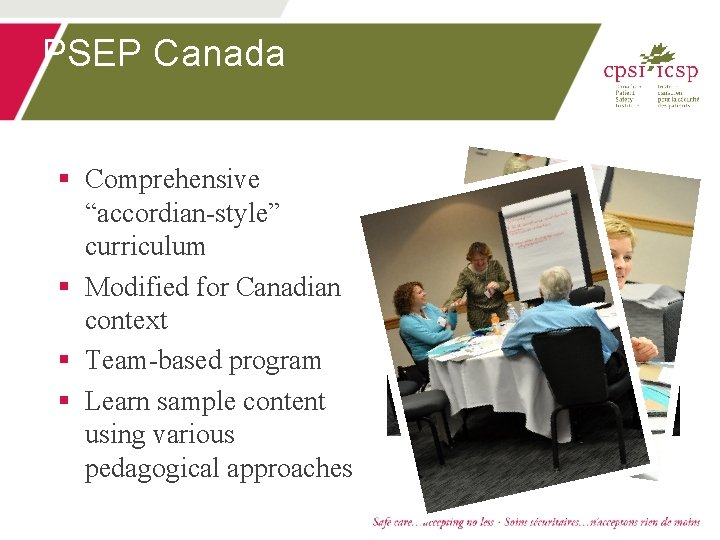
PSEP Canada § Comprehensive “accordian-style” curriculum § Modified for Canadian context § Team-based program § Learn sample content using various pedagogical approaches
Summary § To blame is human, but once you understand that, you can guard against it using systems thinking. § Healthcare is a complex system of interacting components. The interactions among the components produce safety or a lack thereof. § Empathy is a crucial part of our systems and culture change agenda.
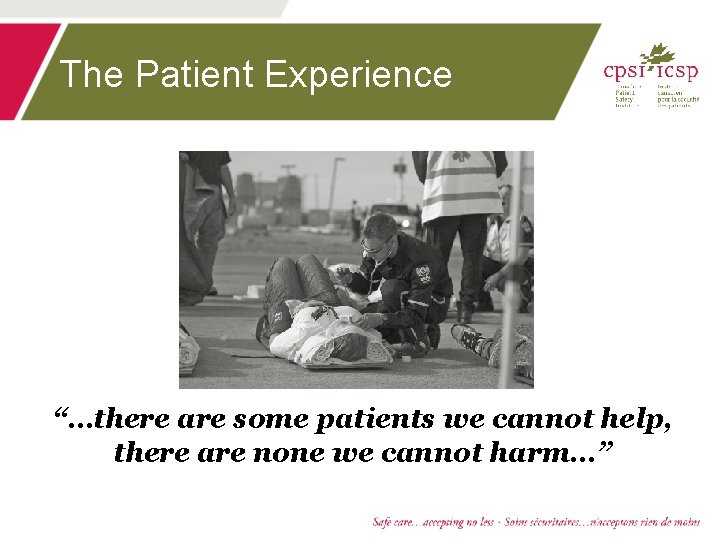
The Patient Experience “…there are some patients we cannot help, there are none we cannot harm. . . ” 34
Contact Information Sandi Kossey, Senior Director 780. 498. 7252 skossey@cpsi-icsp. ca Abigail Hain, Director of Education 613. 738. 4779 ahain@cpsi-icsp. ca www. patientsafetyinstitute. ca 35
- Slides: 35