
Patient Safety High Reliability and Risk Management Allan
Patient Safety, High Reliability, and Risk Management Allan Frankel MD Director of Patient Safety Partners Healthcare System Boston, Massachusetts Summer, 2003
The Goal of Patient Safety IS High Reliability

High Reliability Known to be highly risky but also highly safe and effective.
The most important goal of Risk Management IS High Reliability
High Reliability • Known to be highly risky but also highly safe and effective. • Highly reliable industries/organizations: – Aviation industry • Korean War – Nuclear power plants • 3 Mile Island – Chemical industries • Union Carbide in Bhopal – ? Catholic Church • Boston Sexual Abuse
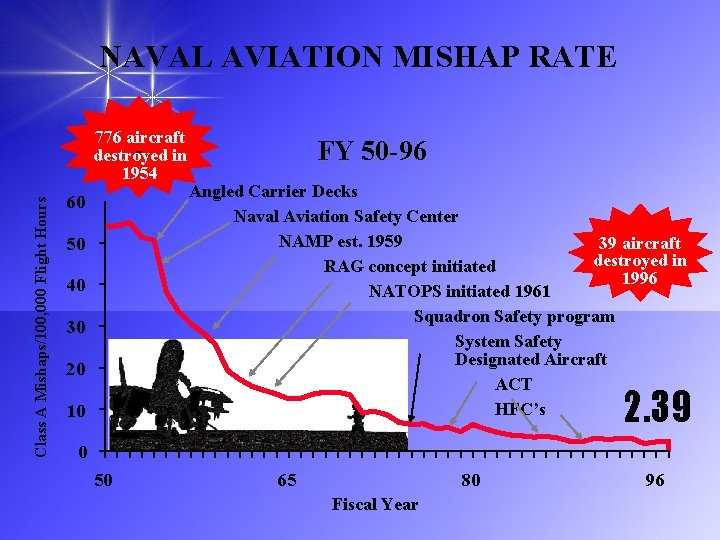
NAVAL AVIATION MISHAP RATE Class A Mishaps/100, 000 Flight Hours 776 aircraft destroyed in 1954 60 50 40 30 20 FY 50 -96 Angled Carrier Decks Naval Aviation Safety Center NAMP est. 1959 39 aircraft destroyed in RAG concept initiated 1996 NATOPS initiated 1961 Squadron Safety program System Safety Designated Aircraft ACT HFC’s 2. 39 10 0 50 65 80 Fiscal Year 96
Hypotheses • The conceptual frameworks for Patient Safety, High Reliability and Risk Management are one and the same. • The current legal processes impacting the healthcare industry undermine high reliability and subvert risk management. • Change for the better is possible, and will occur through cultural remodeling by leadership and risk management.
Components of this talk • The Nature of Systems (Healthcare) • The Nature of Human Beings – An Explanation of Individual Interest • • The Nature of Accountability The Nature of Risk Management Proof of Hypotheses Actions – Professionally – Personally
The Nature of Systems (Healthcare industry)
Health. Care is Complex • Define complexity Waldrop and Stacey


Complex systems • Probability of Performing Perfectly: Probability of success, each element: # of steps 0. 95 0. 9999 1 25 40 0. 95 0. 28 0. 12 0. 99 0. 78 0. 66 0. 999 0. 975 0. 96 0. 9999 0. 997 0. 995 100 0. 006 0. 37 0. 90 0. 99
High Reliability Organizations • Manage Complexity and the Unexpected with Five Characteristics: • 1. Preoccupation with failure (safety) • 2. Deference to expertise • 3. Sensitivity to operations • 4. Commitment to resilience • 5. Reluctance to simplify interpretation Weick and Sutcliffe
Is Health. Care Highly Reliable?
HRO characteristics • • • 1. Preoccupation with Failure (Safety) 2. Deference to expertise 3. Sensitivity to operations 3. Commitment to resilience 5. Reluctant to simplify interpretation Weick and Sutcliffe
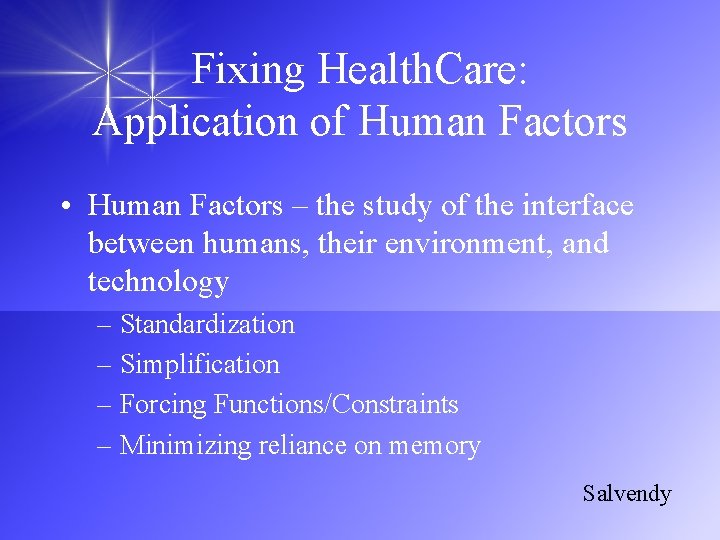
Fixing Health. Care: Application of Human Factors • Human Factors – the study of the interface between humans, their environment, and technology – Standardization – Simplification – Forcing Functions/Constraints – Minimizing reliance on memory Salvendy
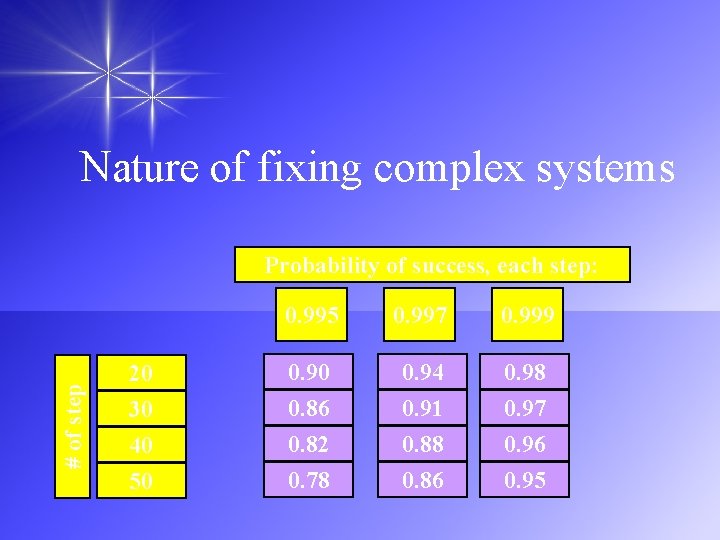
Nature of fixing complex systems # of step Probability of success, each step: 20 30 40 50 0. 995 0. 997 0. 999 0. 90 0. 86 0. 82 0. 78 0. 94 0. 91 0. 88 0. 86 0. 98 0. 97 0. 96 0. 95

The Nature of Human Beings
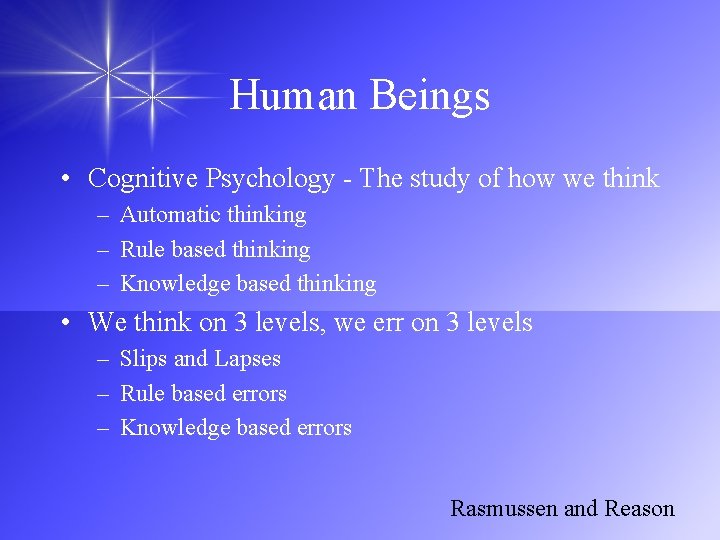
Human Beings • Cognitive Psychology - The study of how we think – Automatic thinking – Rule based thinking – Knowledge based thinking • We think on 3 levels, we err on 3 levels – Slips and Lapses – Rule based errors – Knowledge based errors Rasmussen and Reason

Human Beings • How frequently do we make errors? – Omission Errors • 1 in 100 times – Forgetting to turn on a pump – Commission Errors • 3 in 1000 times – Misreading a label – Risk of judgment errors under high stress • 90% Salvendy
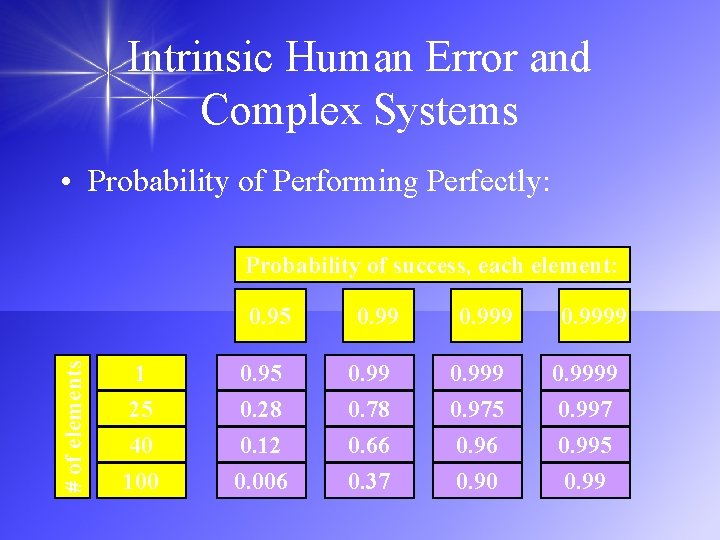
Intrinsic Human Error and Complex Systems • Probability of Performing Perfectly: Probability of success, each element: # of elements 0. 95 0. 9999 1 25 40 0. 95 0. 28 0. 12 0. 99 0. 78 0. 66 0. 999 0. 975 0. 96 0. 9999 0. 997 0. 995 100 0. 006 0. 37 0. 90 0. 99
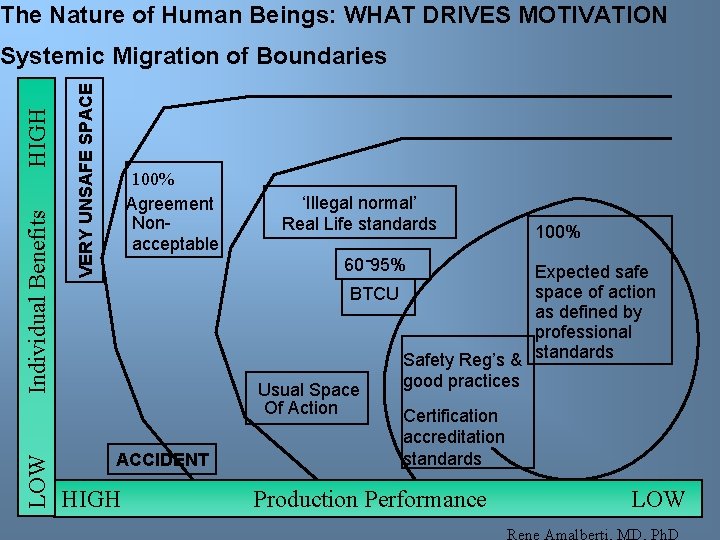
The Nature of Human Beings: WHAT DRIVES MOTIVATION LOW VERY UNSAFE SPACE Individual Benefits HIGH Systemic Migration of Boundaries 100% Agreement Nonacceptable ‘Illegal normal’ Real Life standards 100% 60 -95% Expected safe space of action BTCU as defined by professional Safety Reg’s & standards good practices Usual Space Of Action Certification ACCIDENT HIGH accreditation standards Production Performance LOW Rene Amalberti, MD, Ph. D
Individual Interest (A brief detour into philosophy)
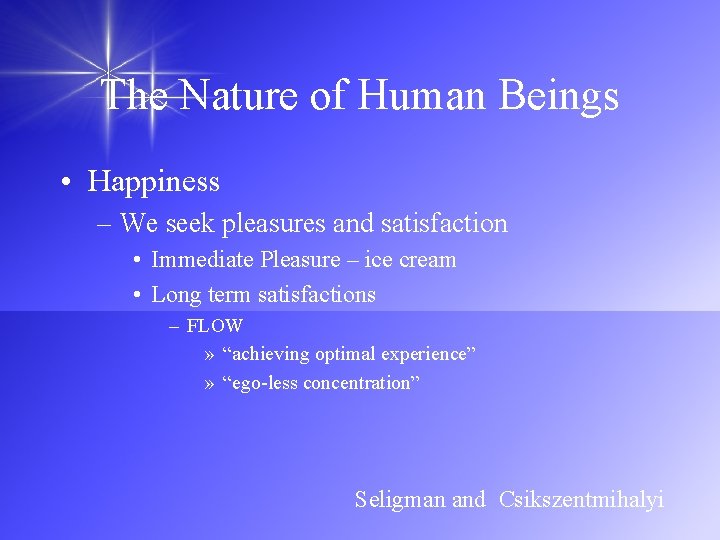
The Nature of Human Beings • Happiness – We seek pleasures and satisfaction • Immediate Pleasure – ice cream • Long term satisfactions – FLOW » “achieving optimal experience” » “ego-less concentration” Seligman and Csikszentmihalyi
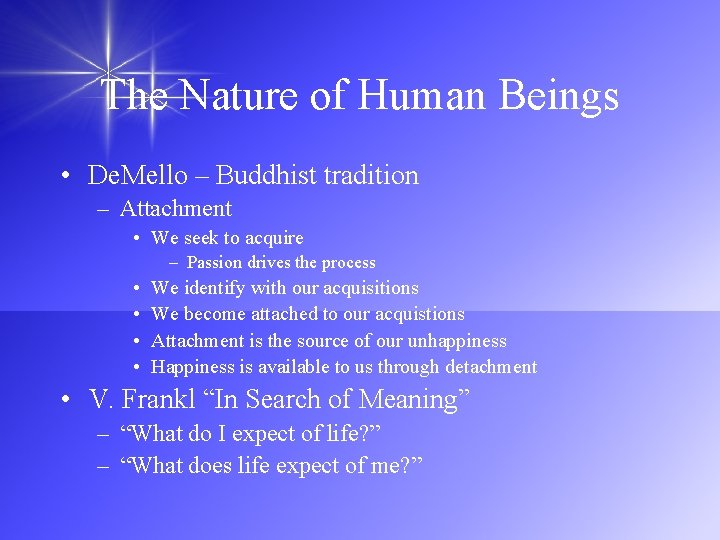
The Nature of Human Beings • De. Mello – Buddhist tradition – Attachment • We seek to acquire – Passion drives the process • • We identify with our acquisitions We become attached to our acquistions Attachment is the source of our unhappiness Happiness is available to us through detachment • V. Frankl “In Search of Meaning” – “What do I expect of life? ” – “What does life expect of me? ”
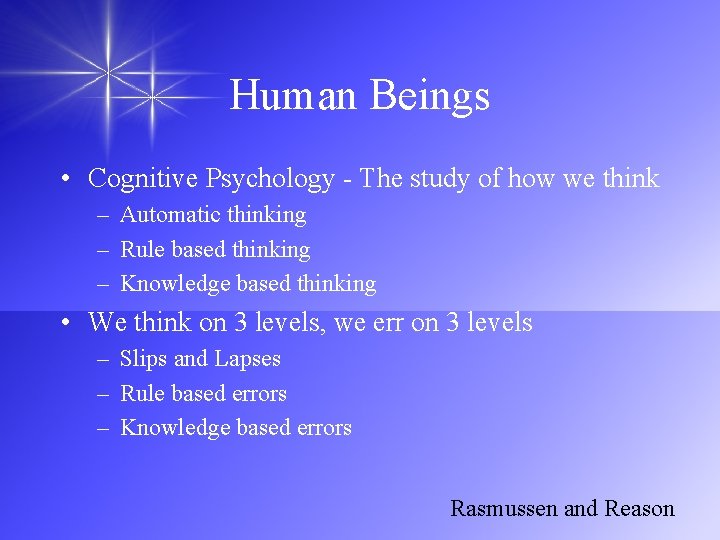
Human Beings • Cognitive Psychology - The study of how we think – Automatic thinking – Rule based thinking – Knowledge based thinking • We think on 3 levels, we err on 3 levels – Slips and Lapses – Rule based errors – Knowledge based errors Rasmussen and Reason
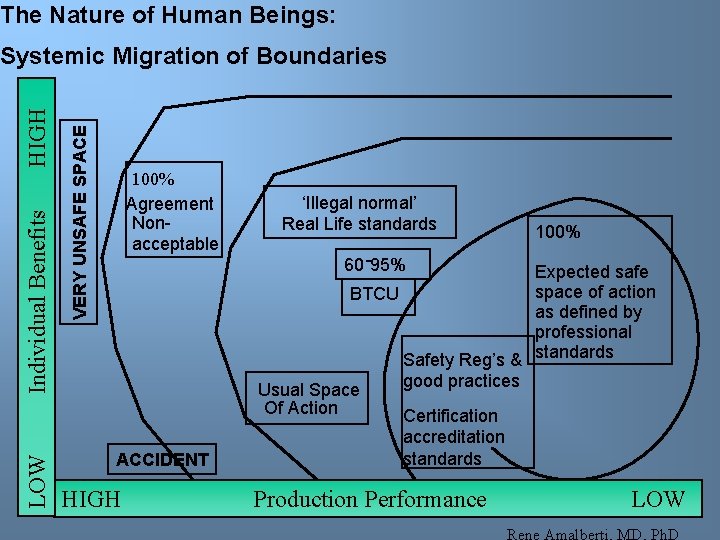
The Nature of Human Beings: LOW VERY UNSAFE SPACE Individual Benefits HIGH Systemic Migration of Boundaries 100% Agreement Nonacceptable ‘Illegal normal’ Real Life standards 100% 60 -95% Expected safe space of action BTCU as defined by professional Safety Reg’s & standards good practices Usual Space Of Action Certification ACCIDENT HIGH accreditation standards Production Performance LOW Rene Amalberti, MD, Ph. D

The Nature of Accountability
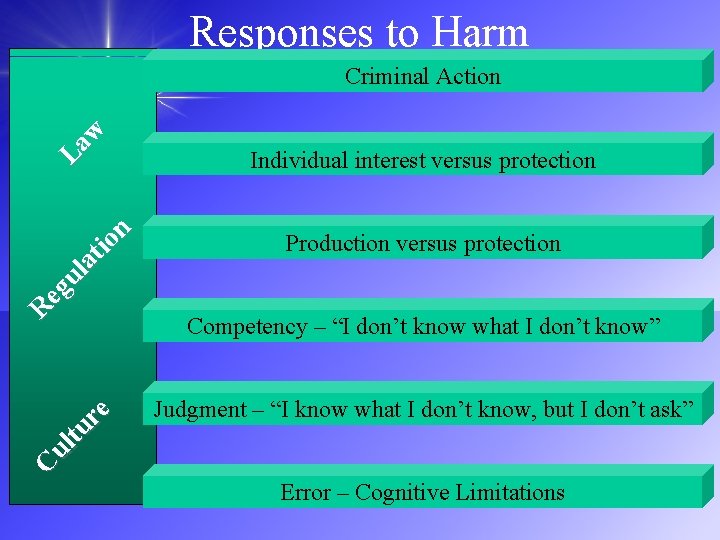
Responses to Harm C ul tu re R eg ul at io n La w Criminal Action Individual interest versus protection Production versus protection Competency – “I don’t know what I don’t know” Judgment – “I know what I don’t know, but I don’t ask” Error – Cognitive Limitations
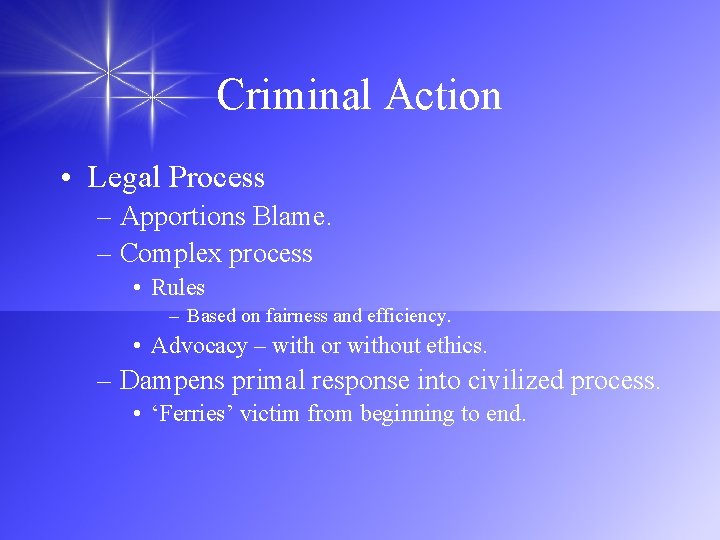
Criminal Action • Legal Process – Apportions Blame. – Complex process • Rules – Based on fairness and efficiency. • Advocacy – with or without ethics. – Dampens primal response into civilized process. • ‘Ferries’ victim from beginning to end.
Individual Interest versus Protection • Individual Responsibility • Ethical behavior – “What do I want to acquire? ” – “What am I attached to? ”

Production versus Protection • Organizational responsibility • Criteria based – Best evidence, then…. – Local consensus
Competency • Organizational expectation – Internal or external regulation • Criteria based – Best evidence seeking most effective education – Local consensus to promote simplicity

Judgment • Individual – Relationship with peers and organization – Environmental expectations • Culture – Sense of Accountability • Personal make-up (parenting) • Environmentally fostered
Error • Cognitive Psychology – Thinking about how we think • Rasmussen and Reason • The 3 ways we think and err: – Automatically – Ruled-based – Knowledge-based

Responses to Unsafe Acts J. Reason
The Nature of Risk Management
Risk Management • Reducing exposure – (through patient safety) • Fiduciary responsibility – Protect • Litigation and Malpractice insurance – Out of control
Actions • What do we want to accomplish? – “Identify areas of actual/potential risk. Prevent injuries to patients, visitors and employees…”
Actions • What changes do we need to make? – – Promote Feedback Promote Transparency Promote Open Communication Demand Ethical negotiation • For harmed individuals: “What would be ethically and morally sensible for us to do for this person who has been harmed. ” • Think Systems: “What can we do to make harm to the next patient less likely? ” – Innovative compensation • Iatrogenic overnight stay in ICU – negative pressure pulmonary edema – Leadership involvement in safety – • Leadership Patient Safety Walk. Rounds

Partners Health. Care Commitments to Patient Safety
Ethics DRAFT Patient Safety principles promoting transparency, accountability, and responsibility.
WE WILL SUPPORT THE EFFORTS OF EVERY INDIVIDUAL to deliver the best care possible and will view accountability for harm or potential harm in the context of individual and system influences. – Ø We commit to supporting simplification, standardization, effective teamwork and open communication in order to foster an environment that is least likely to cause or support error. – Ø We believe that individuals are accountable for their own performance but should not carry the burden for system flaws.
WE PROMOTE OPEN REPORTING of adverse events and potential harm by health care workers, patients, and patients’ families. – Ø We commit to developing and maintaining easily available and simple ways for healthcare workers and patients to report adverse events and to discuss concerns about the safety of care delivery. – Ø We commit to supporting and protecting individuals who report adverse events. Their information helps lead us to actions that will improve the healthcare environment.
WE WILL ACT TO IMPROVE SAFETY by implementing changes based on our analysis of adverse events and potential harms. – Ø We know that actions designed to address the causes of adverse events will improve the safety of care. We commit to identifying and assigning responsibility for implementing those actions to specific individuals or groups.
WE WILL INFORM PATIENTS AND FAMILY MEMBERS, HEALTHCARE PROVIDERS, LEADERSHIP AND TRUSTEES about actions that have been developed from open communication about adverse events and potential harms. – Ø We believe that patient input is indispensable to the delivery of safe care and we commit to promoting patient participation on our care delivery teams. – Ø We commit to fostering a culture that is concerned with safety through continuous education, reminders and safety-based leadership. – Ø We commit to ensuring that our leaders and all healthcare workers are cognizant of the risks in delivering care, the efforts generated to make care delivery safe, and the importance of supporting those efforts.
WE WILL ASSESS OUR SUCCESS IN PROMOTING A CULTURE OF SAFETY by evaluating willingness to communicate openly, and by improvements we achieve in patient safety. – Ø We commit to monitoring actions and attitudes for their effectiveness in supporting a culture of safety and modifying actions as needed.
WE PROMOTE INTERDISCIPLINARY DISCUSSION and analysis of adverse events and potential harms. – Ø We commit to eliciting different points-of-view to identify sources of harm and to use the information to improve safe delivery of care. – Ø We commit to analyzing episodes of harm or potential harm in an unbiased fashion to best determine the contribution of system and individual factors. – Ø We commit to fostering a teamwork approach to the analysis of adverse events and potential harms and the actions taken to address them.
Actions • How will we know a change is an improvement? – Outcome Data • Decreased harm – Process Data • Survey of Attitudes toward Safety and Teamwork • Understanding of human factors and systems/complexity/accountabiity theory • Lawsuits and Complaints
Hypotheses • The conceptual frameworks for high reliability and risk management are one and the same. – Ever safer and more effective care – Protection of system from miscreants • The current legal processes impacting the healthcare industry undermine the industry’s ability to develop high reliability and subvert risk management efforts. – Legal process diminishes feedback, transparency and communication – Promotes the qualities of acquisition and attachments • Culture trumps all. Appropriate attitudes will confer safety, enhanced by technology.
Personal Happiness • What does life expect of each of us? – “Follow ones bliss” • Joseph Campbell – Flow • Mihaly Csikszentmihalyi – Happiness • Martin Seligman

Questions/Comments Thank you
- Slides: 52