
Patient Safety Generating and Using Evidence to Make
- Slides: 29
Patient Safety: Generating and Using Evidence to Make Health Care Safer Jeff Brady, MD, MPH Director, Center for Quality Improvement and Patient Safety (CQu. IPS) Agency for Healthcare Research and Quality Massachusetts Patient Safety Forum Burlington, MA – April 7, 2014
Agenda • Producing and Using Evidence to Make Health Care Safer • Promoting Change in Health Care Delivery ► Focus on local capacity • Supporting Local Solutions and National Goals
AHRQ’s New Mission To produce evidence to make health care safer, higher quality, more accessible, equitable, and affordable, and to work with HHS and other partners to make sure that the evidence is understood and used.
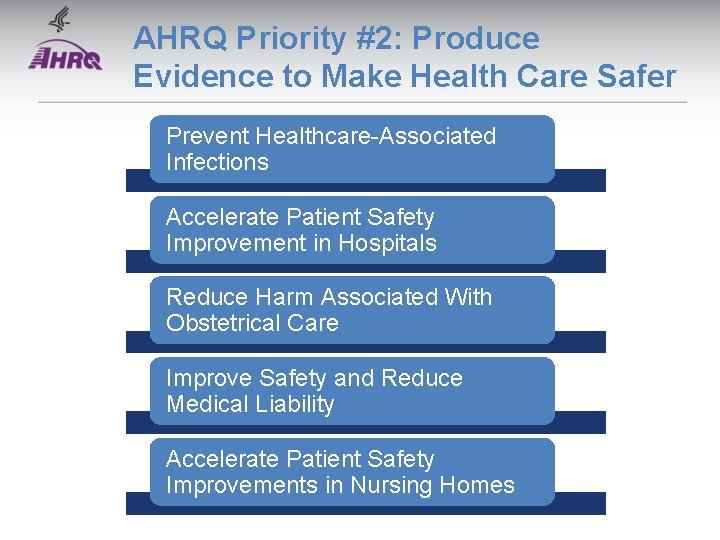
AHRQ Priority #2: Produce Evidence to Make Health Care Safer Prevent Healthcare-Associated Infections Accelerate Patient Safety Improvement in Hospitals Reduce Harm Associated With Obstetrical Care Improve Safety and Reduce Medical Liability Accelerate Patient Safety Improvements in Nursing Homes
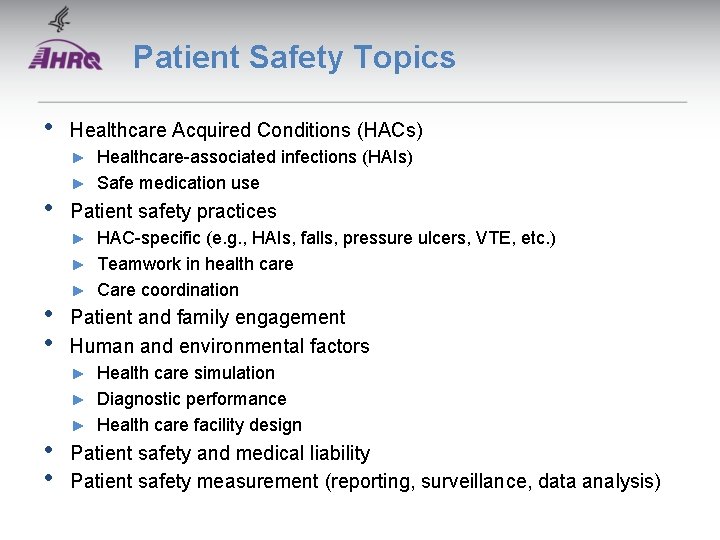
Patient Safety Topics • Healthcare Acquired Conditions (HACs) Healthcare-associated infections (HAIs) ► Safe medication use ► • Patient safety practices HAC-specific (e. g. , HAIs, falls, pressure ulcers, VTE, etc. ) ► Teamwork in health care ► Care coordination ► • • Patient and family engagement Human and environmental factors Health care simulation ► Diagnostic performance ► Health care facility design ► • • Patient safety and medical liability Patient safety measurement (reporting, surveillance, data analysis)
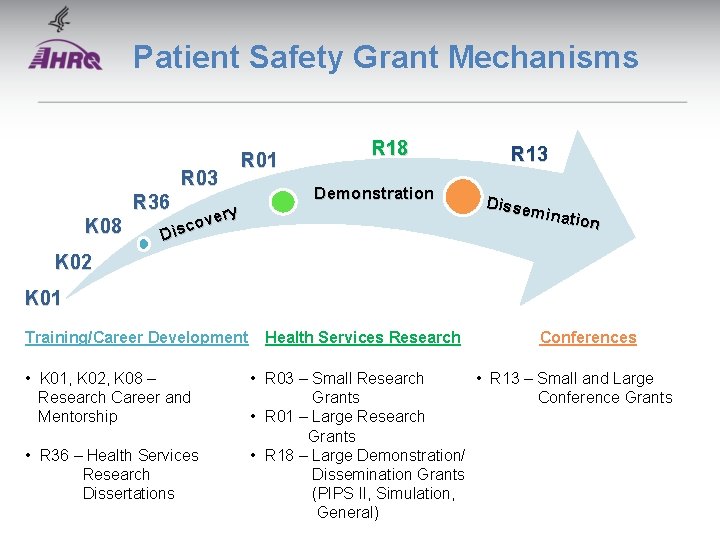
Patient Safety Grant Mechanisms R 03 R 01 R 36 K 08 ery v o Disc R 18 Demonstration R 13 Disse minat ion K 02 K 01 Training/Career Development • K 01, K 02, K 08 – Research Career and Mentorship • R 36 – Health Services Research Dissertations Health Services Research Conferences • R 03 – Small Research • R 13 – Small and Large Grants Conference Grants • R 01 – Large Research Grants • R 18 – Large Demonstration/ Dissemination Grants (PIPS II, Simulation, General)
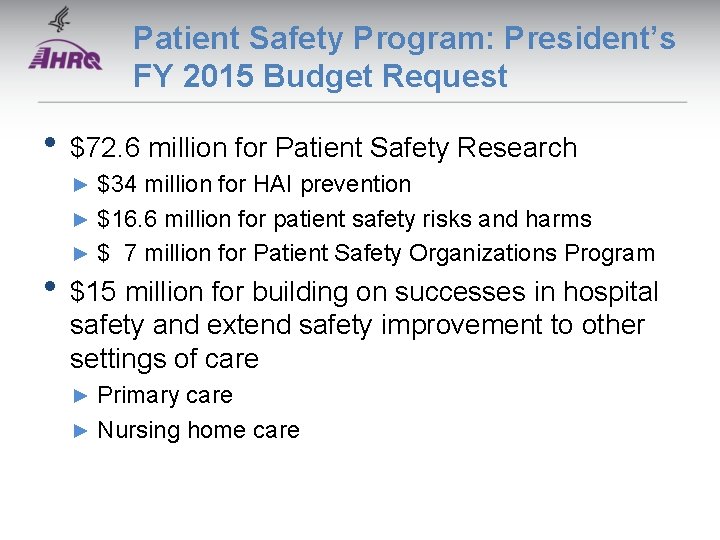
Patient Safety Program: President’s FY 2015 Budget Request • $72. 6 million for Patient Safety Research $34 million for HAI prevention ► $16. 6 million for patient safety risks and harms ► $ 7 million for Patient Safety Organizations Program ► • $15 million for building on successes in hospital safety and extend safety improvement to other settings of care Primary care ► Nursing home care ►
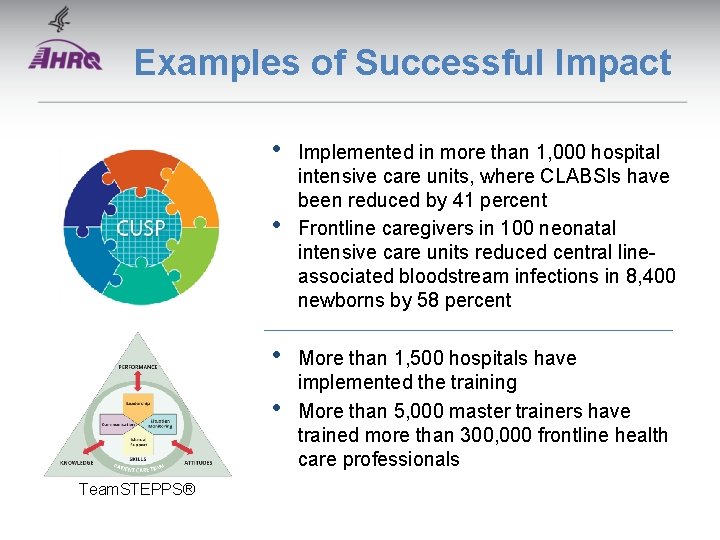
Examples of Successful Impact • • Team. STEPPS® Implemented in more than 1, 000 hospital intensive care units, where CLABSIs have been reduced by 41 percent Frontline caregivers in 100 neonatal intensive care units reduced central lineassociated bloodstream infections in 8, 400 newborns by 58 percent More than 1, 500 hospitals have implemented the training More than 5, 000 master trainers have trained more than 300, 000 frontline health care professionals
AHRQ Healthcare-Associated Infections (HAIs) Prevention Program AHRQ supports research and promotes wide-scale implementation of proven methods for preventing HAIs • Research projects focused on HAI prevention • Adaptation and Implementation of CUSP to reduce: ► CAUTI in hospitals ► SSI and other surgical complications in inpatient surgery ► SSI and other surgical complications in ambulatory surgery ► VAP ► CAUTI in long-term care/nursing homes
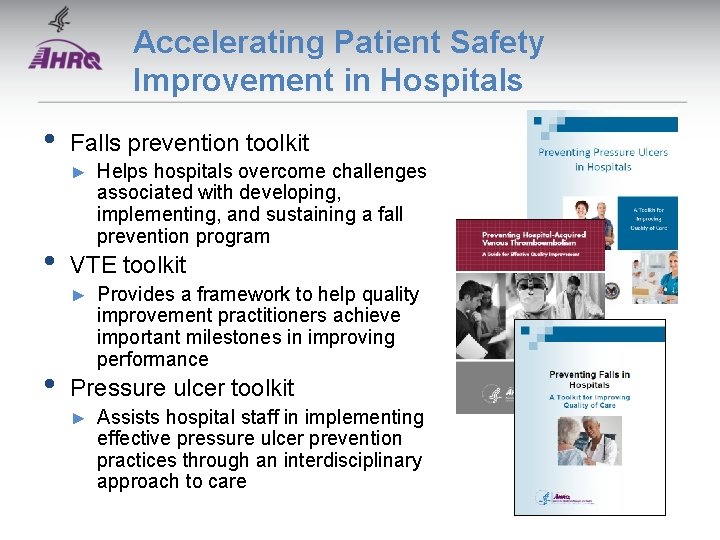
Accelerating Patient Safety Improvement in Hospitals • Falls prevention toolkit ► • VTE toolkit ► • Helps hospitals overcome challenges associated with developing, implementing, and sustaining a fall prevention program Provides a framework to help quality improvement practitioners achieve important milestones in improving performance Pressure ulcer toolkit ► Assists hospital staff in implementing effective pressure ulcer prevention practices through an interdisciplinary approach to care
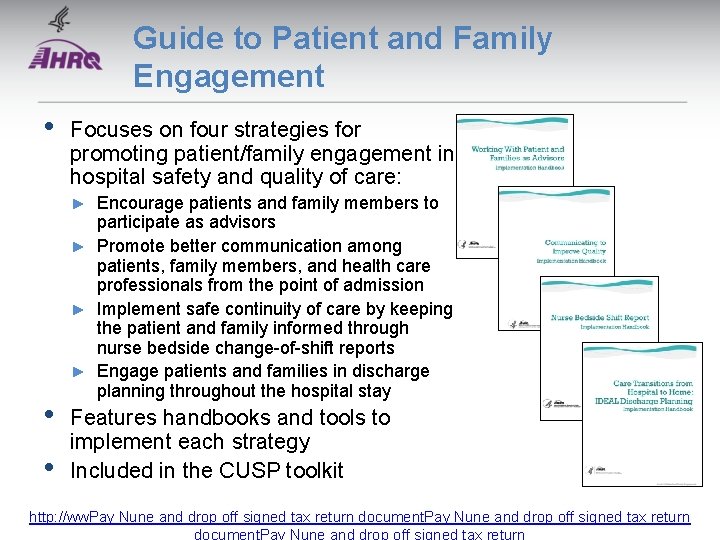
Guide to Patient and Family Engagement • Focuses on four strategies for promoting patient/family engagement in hospital safety and quality of care: Encourage patients and family members to participate as advisors ► Promote better communication among patients, family members, and health care professionals from the point of admission ► Implement safe continuity of care by keeping the patient and family informed through nurse bedside change-of-shift reports ► Engage patients and families in discharge planning throughout the hospital stay ► • • Features handbooks and tools to implement each strategy Included in the CUSP toolkit http: //ww. Pay Nune and drop off signed tax return document. Pay Nune and drop off signed tax return
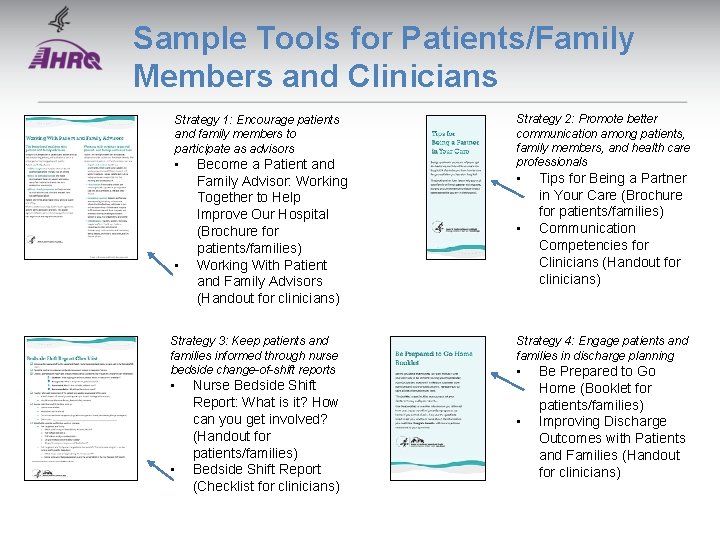
Sample Tools for Patients/Family Members and Clinicians Strategy 1: Encourage patients and family members to participate as advisors • • Become a Patient and Family Advisor: Working Together to Help Improve Our Hospital (Brochure for patients/families) Working With Patient and Family Advisors (Handout for clinicians) Strategy 3: Keep patients and families informed through nurse bedside change-of-shift reports • • Nurse Bedside Shift Report: What is it? How can you get involved? (Handout for patients/families) Bedside Shift Report (Checklist for clinicians) Strategy 2: Promote better communication among patients, family members, and health care professionals • • Tips for Being a Partner in Your Care (Brochure for patients/families) Communication Competencies for Clinicians (Handout for clinicians) Strategy 4: Engage patients and families in discharge planning • • Be Prepared to Go Home (Booklet for patients/families) Improving Discharge Outcomes with Patients and Families (Handout for clinicians)
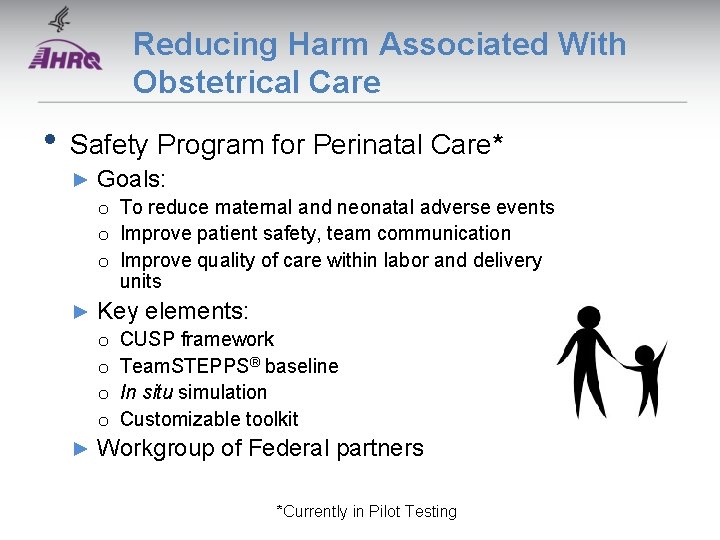
Reducing Harm Associated With Obstetrical Care • Safety Program for Perinatal Care* ► Goals: o To reduce maternal and neonatal adverse events o Improve patient safety, team communication o Improve quality of care within labor and delivery units ► Key elements: o o ► CUSP framework Team. STEPPS® baseline In situ simulation Customizable toolkit Workgroup of Federal partners *Currently in Pilot Testing
Patient Safety & Medical Liability Research Program • Part of the HHS patient safety and medical liability initiative. Seven demonstration grants across the Nation, four primary goals: 1) 2) 3) 4) Put patient safety first and work to reduce preventable injuries Foster better communication between doctors and their patients Ensure patients are compensated in a fair and timely manner while reducing frivolous lawsuits Reduce liability premiums “This new research is the largest government investment connecting medical liability to quality and aims to improve the overall quality of health care. ” http: //www. ahrq. gov/qual/liability HHS Secretary Kathleen Sebelius June 11, 2010
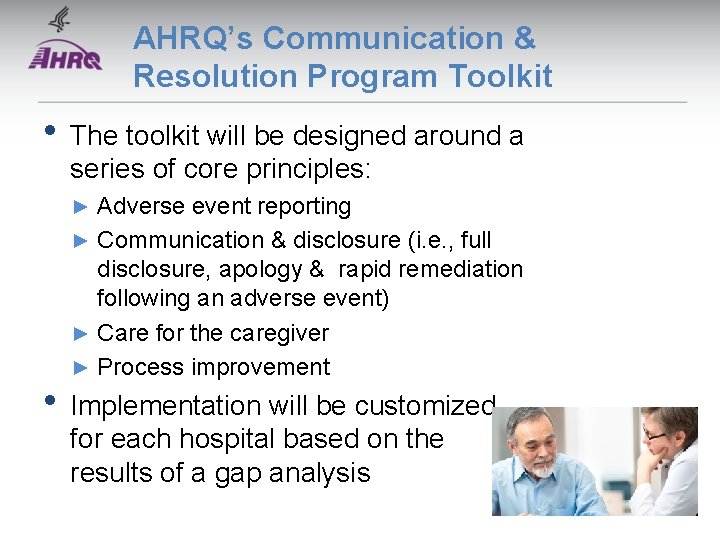
AHRQ’s Communication & Resolution Program Toolkit • The toolkit will be designed around a series of core principles: Adverse event reporting ► Communication & disclosure (i. e. , full disclosure, apology & rapid remediation following an adverse event) ► Care for the caregiver ► Process improvement ► • Implementation will be customized for each hospital based on the results of a gap analysis
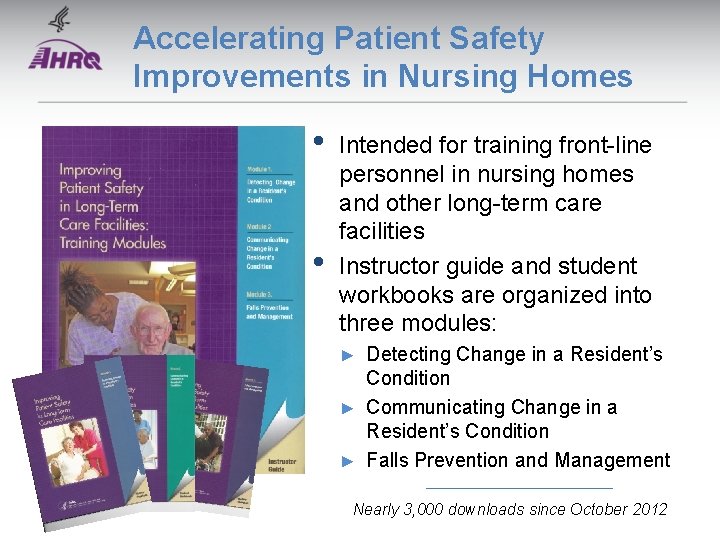
Accelerating Patient Safety Improvements in Nursing Homes • • Intended for training front-line personnel in nursing homes and other long-term care facilities Instructor guide and student workbooks are organized into three modules: Detecting Change in a Resident’s Condition ► Communicating Change in a Resident’s Condition ► Falls Prevention and Management ► Nearly 3, 000 downloads since October 2012
On-Time Pressure Ulcer Prevention Program • • • Uses health IT to improve care at the point of delivery through clinical decision support (CDS) CDS reports summarize real-time information from multiple sources, enabling early intervention to reduce pressure ulcer formation risk New research* found that implementation of the program led to a 59 percent reduction in the incidence of pressure ulcers per 100 nursing home residents per month Lauren EW, Spector, WD, et al. “Evaluation of AHRQ’s On-Time Pressure Ulcer Prevention Program. ” Medical Care March 2014
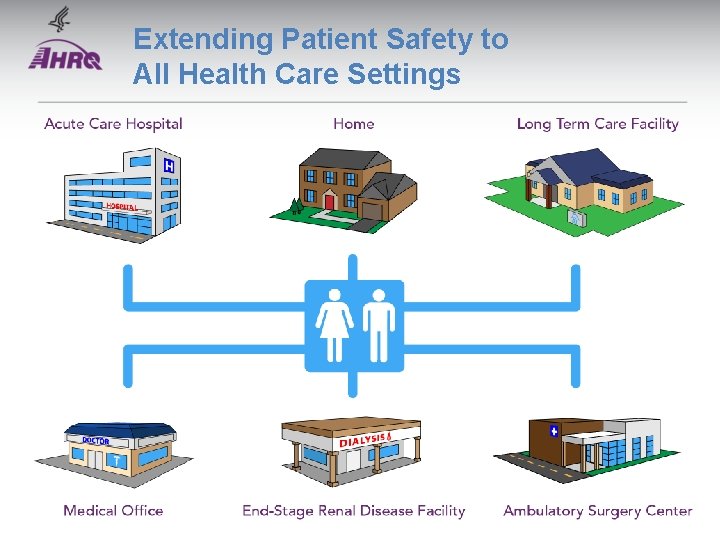
Extending Patient Safety to All Health Care Settings
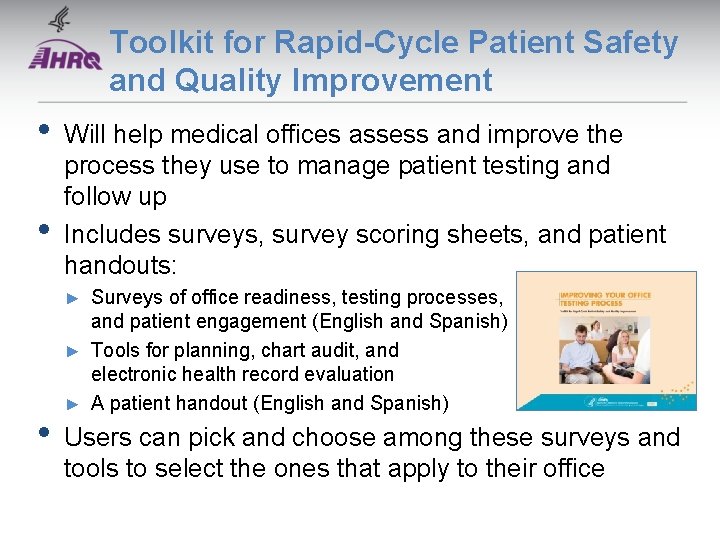
Toolkit for Rapid-Cycle Patient Safety and Quality Improvement • • Will help medical offices assess and improve the process they use to manage patient testing and follow up Includes surveys, survey scoring sheets, and patient handouts: Surveys of office readiness, testing processes, and patient engagement (English and Spanish) ► Tools for planning, chart audit, and electronic health record evaluation ► A patient handout (English and Spanish) ► • Users can pick and choose among these surveys and tools to select the ones that apply to their office
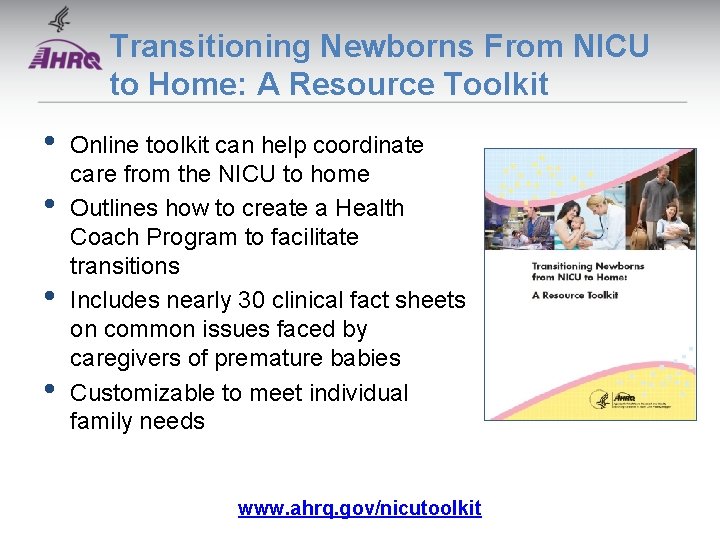
Transitioning Newborns From NICU to Home: A Resource Toolkit • • Online toolkit can help coordinate care from the NICU to home Outlines how to create a Health Coach Program to facilitate transitions Includes nearly 30 clinical fact sheets on common issues faced by caregivers of premature babies Customizable to meet individual family needs www. ahrq. gov/nicutoolkit
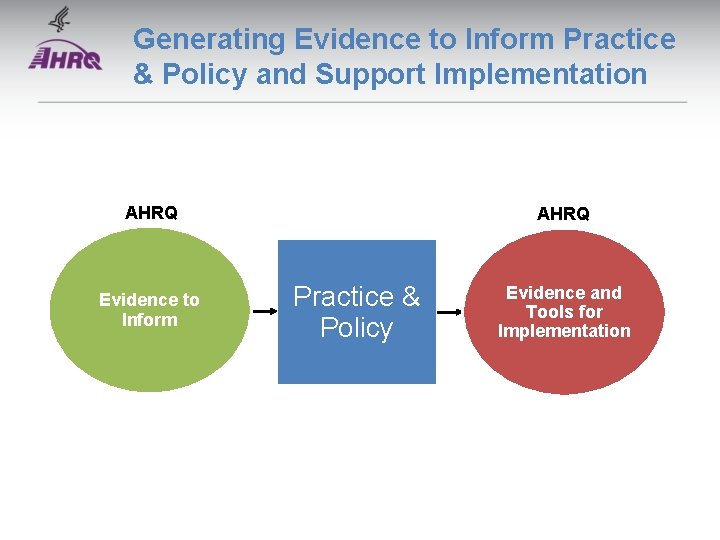
Generating Evidence to Inform Practice & Policy and Support Implementation AHRQ Evidence to Inform AHRQ Practice & Policy Evidence and Tools for Implementation
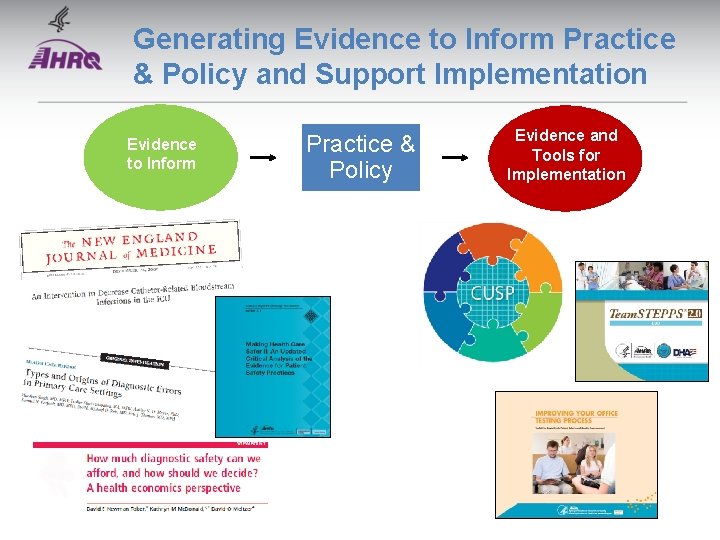
Generating Evidence to Inform Practice & Policy and Support Implementation Evidence to Inform Practice & Policy Evidence and Tools for Implementation
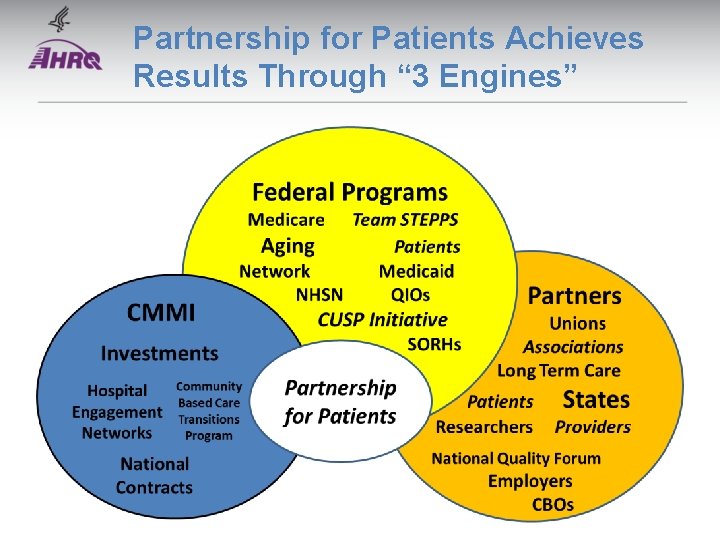
Partnership for Patients Achieves Results Through “ 3 Engines”
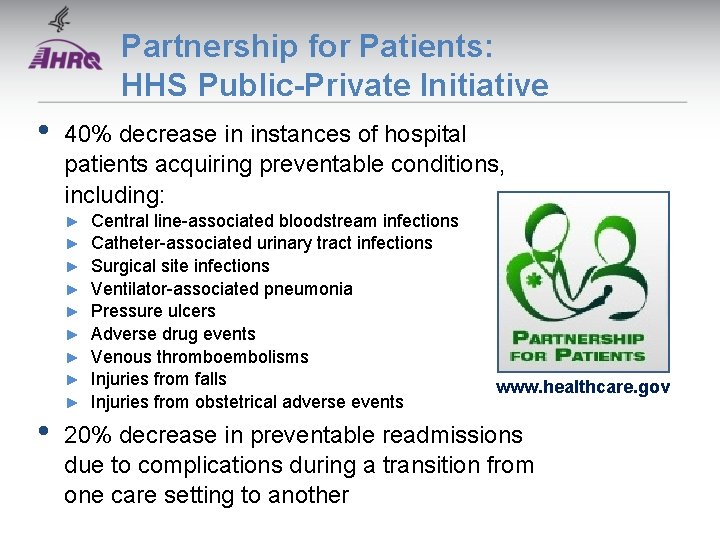
Partnership for Patients: HHS Public-Private Initiative • 40% decrease in instances of hospital patients acquiring preventable conditions, including: ► ► ► ► • ► Central line-associated bloodstream infections Catheter-associated urinary tract infections Surgical site infections Ventilator-associated pneumonia Pressure ulcers Adverse drug events Venous thromboembolisms Injuries from falls Injuries from obstetrical adverse events www. healthcare. gov 20% decrease in preventable readmissions due to complications during a transition from one care setting to another
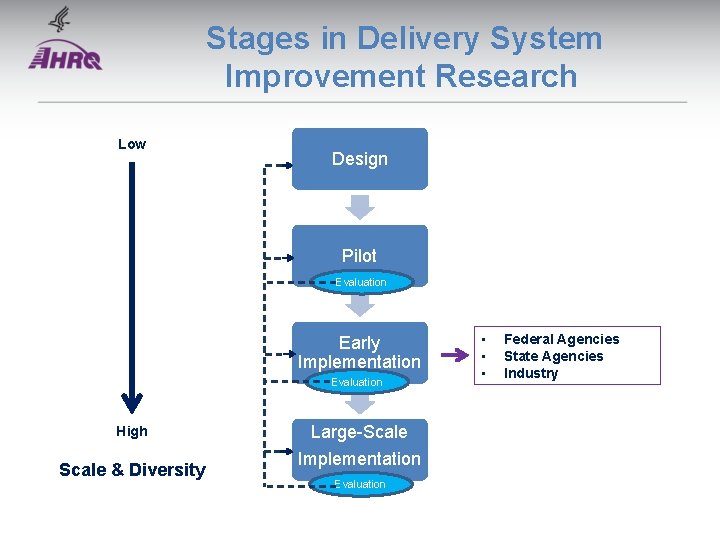
Stages in Delivery System Improvement Research Low Design Pilot Evaluation Early Implementation Evaluation High Scale & Diversity Large-Scale Implementation Evaluation • • • Federal Agencies State Agencies Industry
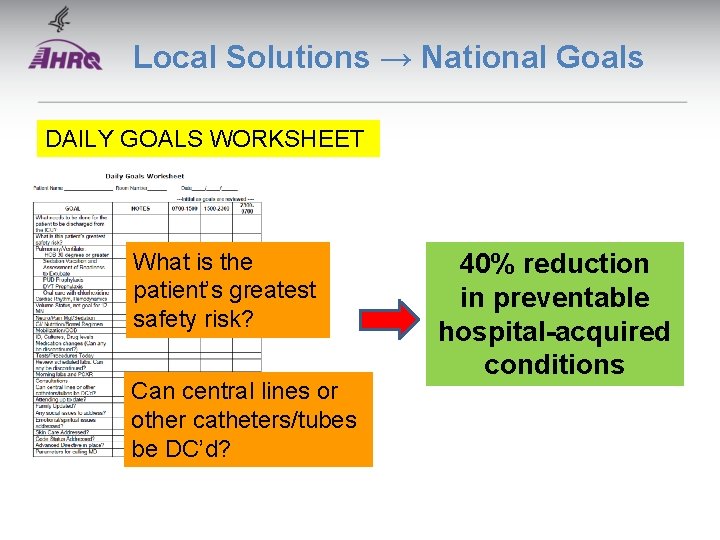
Local Solutions → National Goals DAILY GOALS WORKSHEET What is the patient’s greatest safety risk? Can central lines or other catheters/tubes be DC’d? 40% reduction in preventable hospital-acquired conditions
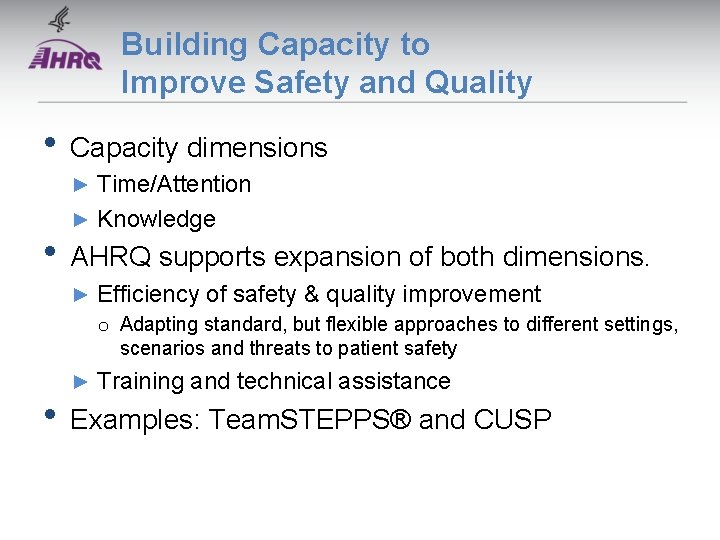
Building Capacity to Improve Safety and Quality • Capacity dimensions Time/Attention ► Knowledge ► • AHRQ supports expansion of both dimensions. ► Efficiency of safety & quality improvement o Adapting standard, but flexible approaches to different settings, scenarios and threats to patient safety ► Training and technical assistance • Examples: Team. STEPPS® and CUSP
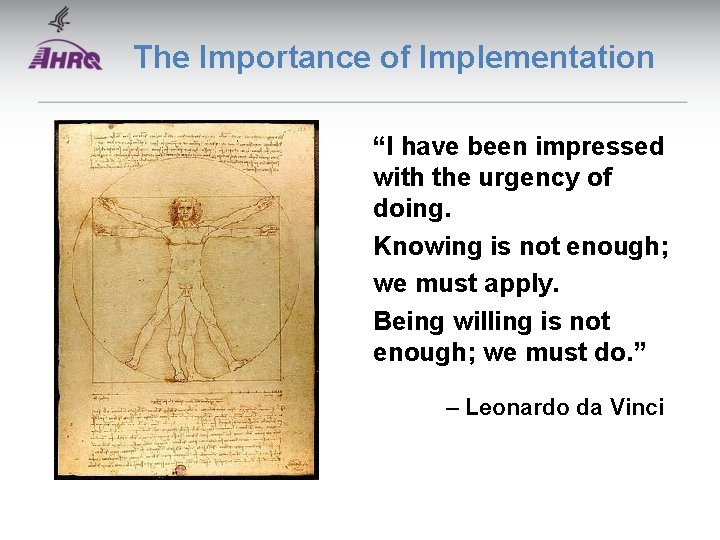
The Importance of Implementation “I have been impressed with the urgency of doing. Knowing is not enough; we must apply. Being willing is not enough; we must do. ” – Leonardo da Vinci
Thank You http: //www. ahrq. gov