
Patient Safety and Medication Management Nurse Compliance with
- Slides: 1
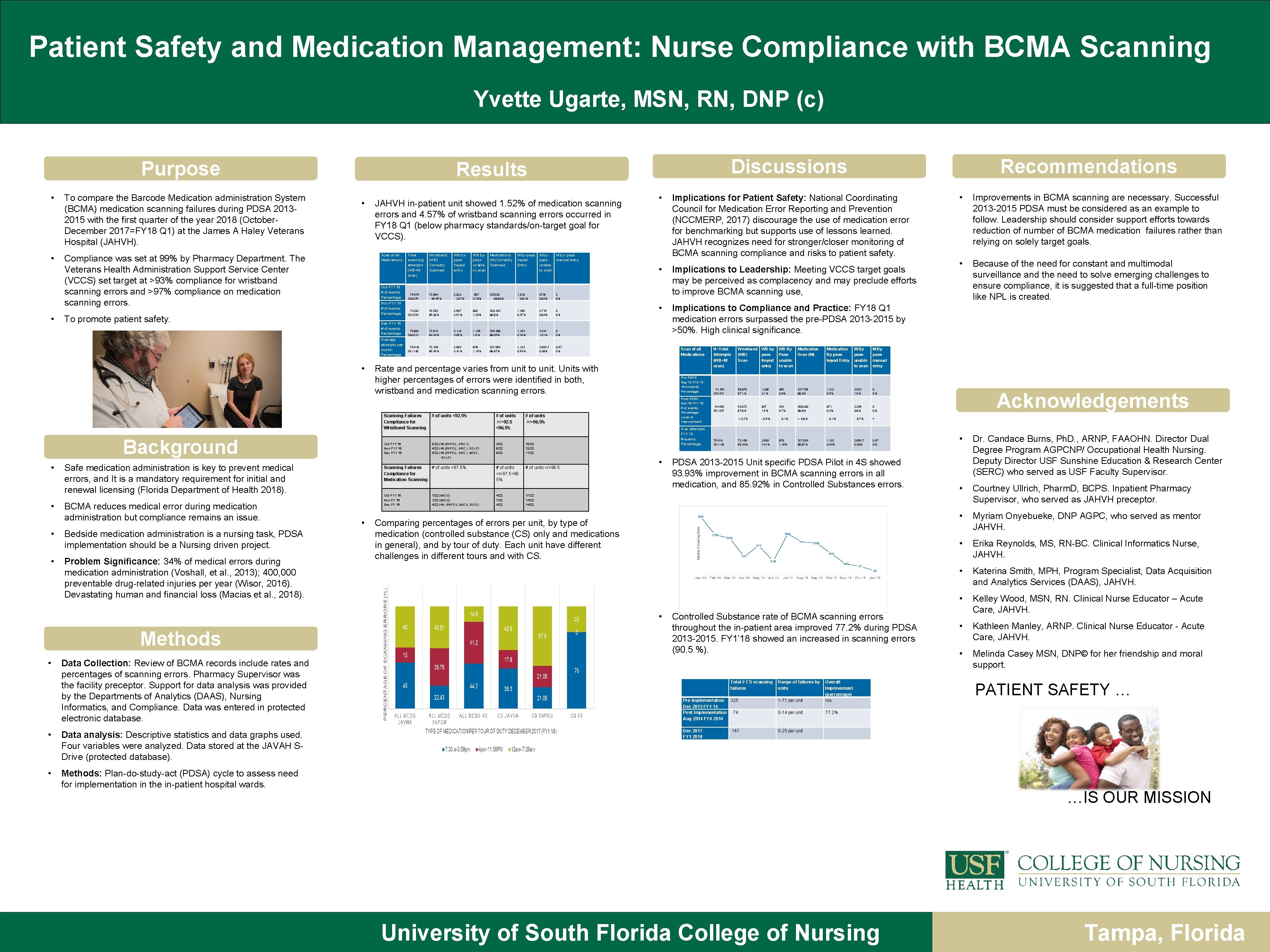
Patient Safety and Medication Management: Nurse Compliance with BCMA Scanning Yvette Ugarte, MSN, RN, DNP (c) Purpose • To compare the Barcode Medication administration System (BCMA) medication scanning failures during PDSA 20132015 with the first quarter of the year 2018 (October. December 2017=FY 18 Q 1) at the James A Haley Veterans Hospital (JAHVH). Purpose • • • JAHVH in-patient unit showed 1. 52% of medication scanning errors and 4. 57% of wristband scanning errors occurred in FY 18 Q 1 (below pharmacy standards/on-target goal for VCCS). Scan of all Medications Compliance was set at 99% by Pharmacy Department. The Veterans Health Administration Support Service Center (VCCS) set target at >93% compliance for wristband scanning errors and >97% compliance on medication scanning errors. To promote patient safety. Total scanning attempts (WB+M scan) Wristband (WB) Correctly Scanned WB bypass Keyed entry WB bypass unable to scan Medications (M) Correctly Scanned M by-pass keyed Entry M bypass unable to scan M by- pass manual entry Oct FY 1 18 # of events Percentage 75, 675 329, 075 73, 066 96. 55% 2, 022 2. 67% 587 0. 78% 325320 98. 86% 1, 018 0. 81% 2735 0. 83% 2 0% Nov FY 1 18 # of events Percentage 74, 291 324, 334 70, 792 95. 29% 2, 607 3. 51% 892 1. 20% 320, 434 98. 8% 1, 185 0. 37% 2, 715 0. 84% 0 0% Dec FY 1 18 # of events Percentage 76, 891 340, 012 72, 616 94. 44% 3, 119 4. 06% 1, 156 1. 5% 335, 408 98. 65% 1, 163 0. 34% 3, 441 1. 01% 0 0% 75, 619 331, 140 72, 158 95. 43% 2, 583 3. 41% 878 1. 16% 327, 054 98. 97% 1, 122 0. 54% 2, 963. 7 0. 49% 0. 67 0% Average attempts per month Percentage • Background • • Safe medication administration is key to prevent medical errors, and It is a mandatory requirement for initial and renewal licensing (Florida Department of Health 2018). BCMA reduces medical error during medication administration but compliance remains an issue. • Bedside medication administration is a nursing task, PDSA implementation should be a Nursing driven project. • Problem Significance: 34% of medical errors during medication administration (Voshall, et al. , 2013); 400, 000 preventable drug-related injuries per year (Wisor, 2016). Devastating human and financial loss (Macias et al. , 2018). Discussions Results Scanning Failures Compliance for Wristband Scanning # of units <92. 5% Oct FY 1 18 Nov FY 1 18 Dec FY 1 18 3/22 (4 N, 5 NPCU, ARC I) 4/22 (4 N, 5 NPCU, ARC I, SCI-F) 5/22 (4 N, 5 NPCU, ARC I, MICU, SCI-F) Oct FY 1 18 Nov FY 18 Dec FY 18 1/22 (MICU) 4/22 (4 N, 5 NPCU, MICU, SICU) # of units >/=92. 5 <96. 5% # of units >/=96. 5% 4/22 6/22 15/22 12/22 11/22 # of units >/=97. 5<98. 5% # of units >/=98. 5 4/22 7/22 4/22 • Implications to Leadership: Meeting VCCS target goals may be perceived as complacency and may preclude efforts to improve BCMA scanning use, • Implications to Compliance and Practice: FY 18 Q 1 medication errors surpassed the pre-PDSA 2013 -2015 by >50%. High clinical significance. Scan of all Medications Pre-PDAS Sep’ 13 FY 4 13 # of events Percentage Post-PDSA Dec’ 14 FY 1 15 # of events Percentage Level of Improvement Ave. attempts FY 1 18 # events Percentage • • Data Collection: Review of BCMA records include rates and percentages of scanning errors. Pharmacy Supervisor was the facility preceptor. Support for data analysis was provided by the Departments of Analytics (DAAS), Nursing Informatics, and Compliance. Data was entered in protected electronic database. • Data analysis: Descriptive statistics and data graphs used. Four variables were analyzed. Data stored at the JAVAH SDrive (protected database). • Methods: Plan-do-study-act (PDSA) cycle to assess need for implementation in the in-patient hospital wards. • N=Total Attempts (WB+M scan) Wristband WB by (WB) pass Scan Keyed entry WB By Pass unable to scan Medication Scan (M) Medication By pass keyed Entry M By pass unable to scan M By pass manual entry 61, 661 242, 441 59, 870 97. 1% 1, 296 2. 1% 495 0. 8% 237, 706 98. 0% 1, 212 0. 5% 3, 523 1. 5% 0 0% 64, 462 261, 437 63, 072 97. 8% 947 1. 5% 443 0. 7% 258, 200 98. 8% 971 0. 4% 2, 266 0. 8% 0 0% + 0. 7% - 0. 6% - 0. 1% + 0. 8% - 0. 1% - 0. 7% = 72, 158 95. 43% 2, 583 3. 41% 878 1. 16% 327, 054 98. 97% 1, 122 0. 54% 2, 963. 7 0. 49% 0. 67 0% 75, 619 331, 140 PDSA 2013 -2015 Unit specific PDSA Pilot in 4 S showed 93. 93% improvement in BCMA scanning errors in all medication, and 85. 92% in Controlled Substances errors. Comparing percentages of errors per unit, by type of medication (controlled substance (CS) only and medications in general), and by tour of duty. Each unit have different challenges in different tours and with CS. Controlled Substance rate of BCMA scanning errors throughout the in-patient area improved 77. 2% during PDSA 2013 -2015. FY 1’ 18 showed an increased in scanning errors (90. 5 %). Total # CS scanning failures Pre-Implementation 325 Dec 2013 FY 1 14 Post-Implementation 74 Aug 2014 FY 4 2014 1 -71 per unit Overall Improvement (percentage) n/a 0 -14 per unit 77. 2% Dec 2017 FY 1 2018 0 -25 per unit 141 Range of failures by units Improvements in BCMA scanning are necessary. Successful 2013 -2015 PDSA must be considered as an example to follow. Leadership should consider support efforts towards reduction of number of BCMA medication failures rather than relying on solely target goals. Discussion • Because of the need for constant and multimodal surveillance and the need to solve emerging challenges to ensure compliance, it is suggested that a full-time position like NPL is created. Acknowledgements • Dr. Candace Burns, Ph. D. , ARNP, FAAOHN. Director Dual Degree Program AGPCNP/ Occupational Health Nursing. Deputy Director USF Sunshine Education & Research Center (SERC) who served as USF Faculty Supervisor. • Courtney Ullrich, Pharm. D, BCPS. Inpatient Pharmacy Supervisor, who served as JAHVH preceptor. • Myriam Onyebueke, DNP AGPC, who served as mentor JAHVH. • Erika Reynolds, MS, RN-BC. Clinical Informatics Nurse, JAHVH. • Katerina Smith, MPH, Program Specialist, Data Acquisition and Analytics Services (DAAS), JAHVH. • Kelley Wood, MSN, RN. Clinical Nurse Educator – Acute Care, JAHVH. • Kathleen Manley, ARNP. Clinical Nurse Educator - Acute Care, JAHVH. • Melinda Casey MSN, DNP© for her friendship and moral support. 17/22 14/22 • Methods Implications for Patient Safety: National Coordinating Council for Medication Error Reporting and Prevention (NCCMERP, 2017) discourage the use of medication error for benchmarking but supports use of lessons learned. JAHVH recognizes need for stronger/closer monitoring of BCMA scanning compliance and risks to patient safety. Results Rate and percentage varies from unit to unit. Units with higher percentages of errors were identified in both, wristband medication scanning errors. Scanning Failures # of units <97. 5% Compliance for Medication Scanning • • Recommendations PATIENT SAFETY … …IS OUR MISSION University of South Florida College of Nursing Tampa, Florida